Split testing sends two versions to similar groups and judges them on one outcome chosen before launch; outbound teams should judge qualified replies or meetings rather than opens alone.
The popular advice, send both versions and pick whichever gets more responses, misses the hardest part: knowing whether the apparent winner deserves to be used again. A busy dashboard isn't evidence of a better campaign, and a faster decision can create more work if the team later has to reverse it.
What Split Testing Means on an Outbound Campaign
Split testing, also called A/B testing, is a controlled comparison. The existing version is the control, and the changed version is the challenger. Both run under comparable conditions so the team can investigate a particular campaign decision.
Think of posting different versions of the same letter to similar streets, not rebuilding the whole neighbourhood at once. If the message, recipients and delivery arrangements all change, the sender can't tell which change affected the response.
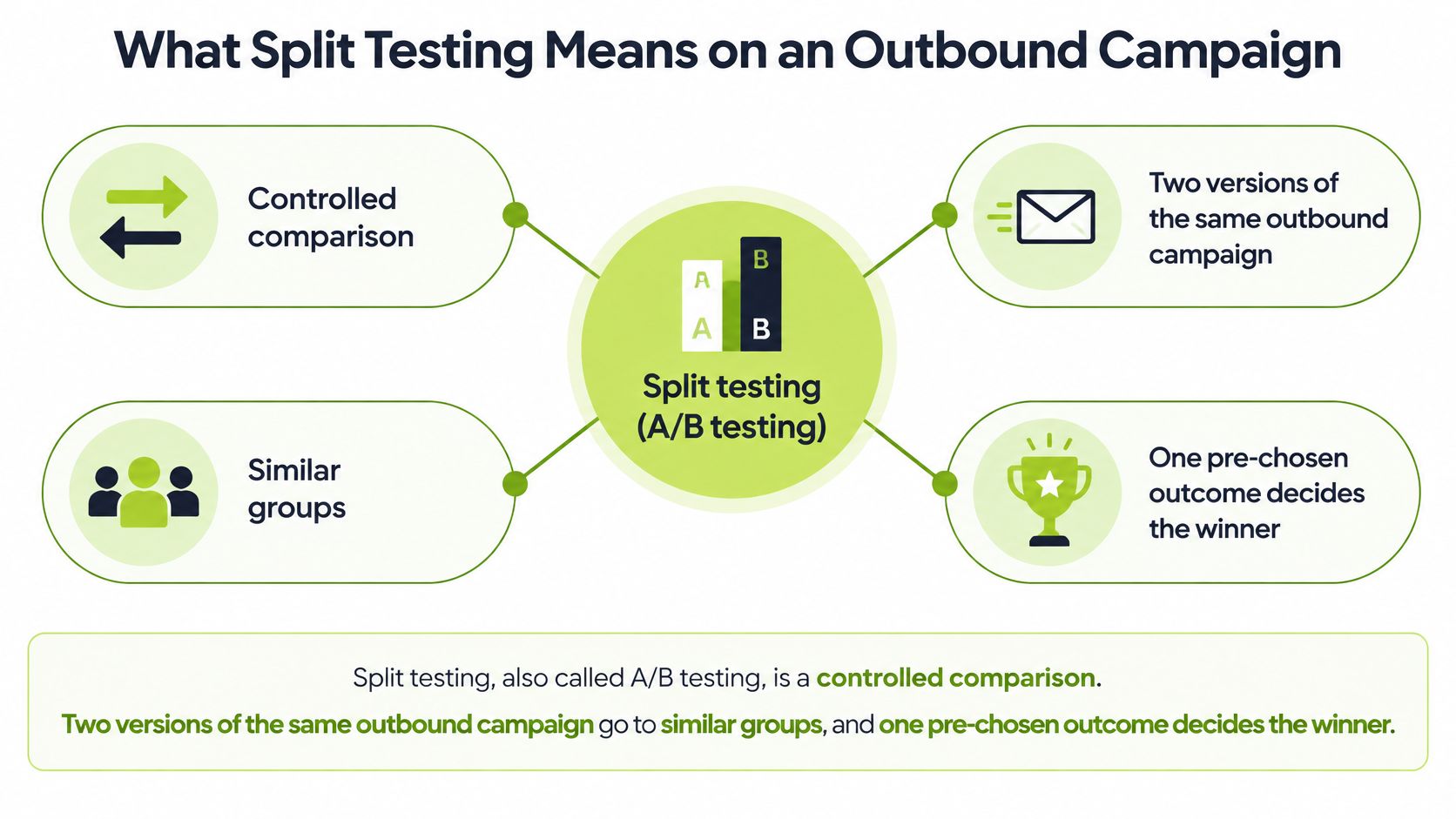
A campaign decision, not a dashboard race
Say a software studio wants conversations with services firms that depend on referrals. Its current email asks for a meeting, while the challenger asks whether the founder has a repeatable way to find work beyond referrals.
That comparison can answer a useful question about the next step being offered. It can't answer that question cleanly if the challenger also goes to a different market, uses a new subject line and arrives during a different trading period.
The same distinction matters outside email. For teams also evaluating advertising, AdManage.ai's resource on cross-channel ad performance analysis offers an adjacent perspective on creative testing, but outbound needs its own clearly defined sales outcome.
Define a response that matters
A positive reply expresses relevant interest rather than an unsubscribe, rejection or automated response. A qualified reply also meets agreed fit criteria, such as the right business, a relevant problem and a plausible reason to continue.
- Marketing owns the comparison: Record the campaign change and intended outcome.
- Sales owns qualification feedback: Explain which responses became worthwhile conversations.
- RevOps owns consistency: Keep assignment, tracking and CRM definitions aligned.
For anyone asking what is split testing in practical outbound terms, the answer is a way to make a specific decision with less guesswork. It isn't permission to crown whichever email leads after the morning's sends.
How to Write One Hypothesis
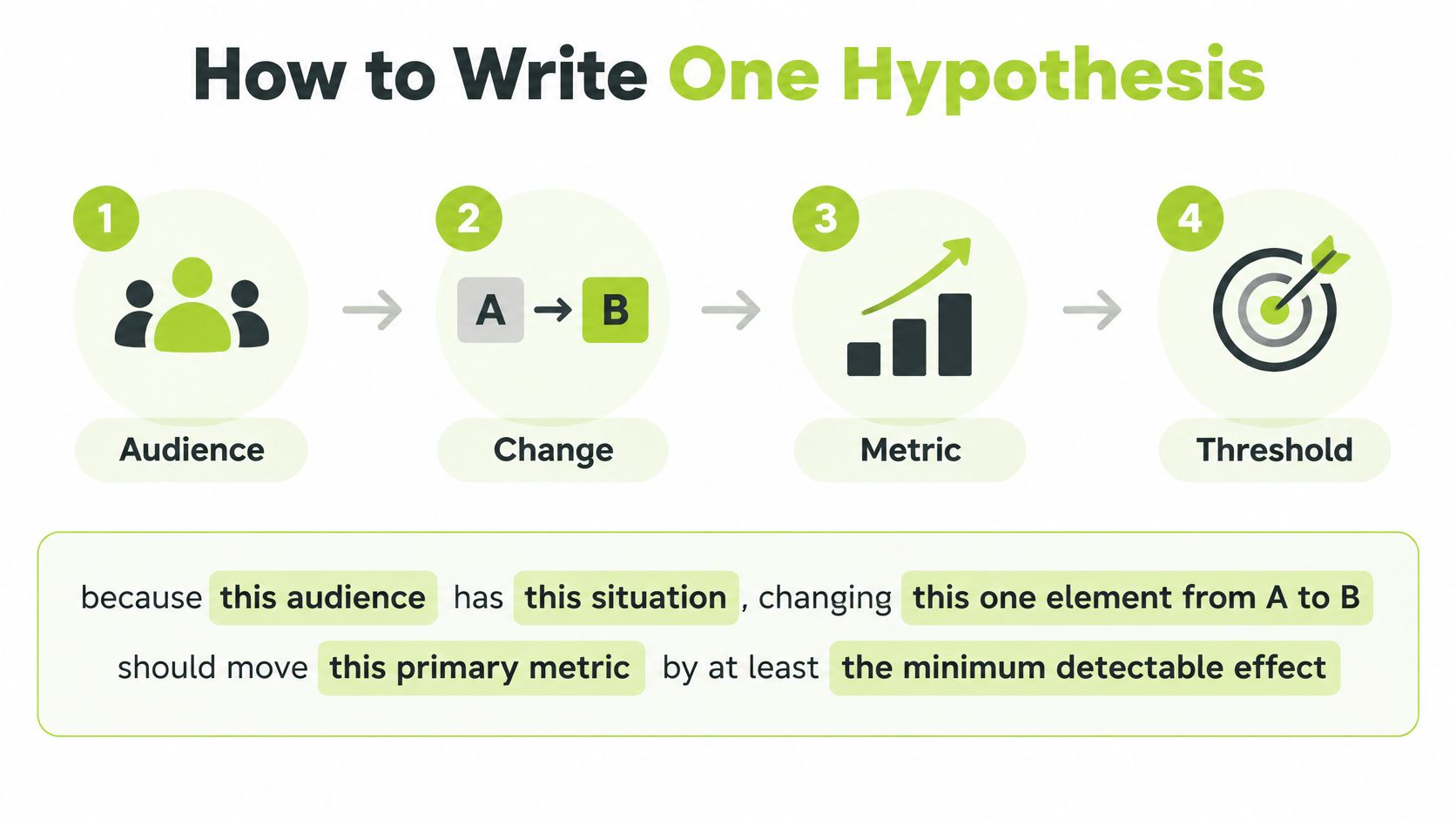
A hypothesis is a testable explanation of why a particular change should improve an outcome. It connects an audience's situation to a campaign decision, rather than starting with a preference for different wording.
A useful fill-in pattern is:
Because this audience has this situation, changing this element from A to B should improve this primary metric by at least the minimum detectable effect, without reducing qualified conversations.
The primary metric is the outcome allowed to determine success. The minimum detectable effect, or MDE, is the smallest relative change the test is designed to detect.
Set the decision rules before writing variations
-
Name the decision. Compare the call to action, meaning the requested next step, rather than changing the subject, opener and offer together. A decision about asking for a meeting needs a challenger that changes the ask.
-
Choose the primary metric. Positive reply rate can suit an early messaging test. Meetings booked may be more commercially direct, but the team needs enough outcomes to make that comparison useful.
-
Write down the commercial bar. State what additional sales activity would justify implementation, follow-up and operational effort. A detectable improvement isn't automatically worth pursuing.
-
Define an inconclusive result. If the evidence doesn't distinguish the versions, keep the control. Record that the test couldn't resolve the difference, not that the versions have been proved identical.
Adapt the hypothesis to low volume
Small B2B teams should favour a meaningful difference in the proposition or ask over a cosmetic wording adjustment. FluenceFlow's split-testing guide discusses adapting experiments to low-volume funnels and combining quantitative results with structured evidence from replies and sales conversations.
That qualitative evidence needs a consistent format. Tag replies for relevance, objection, timing and willingness to continue, rather than collecting only memorable comments that support the preferred version.
Sequential testing is a method designed to support interim analysis under specified statistical rules. Variance reduction uses relevant information to reduce measurement noise; both are methods to study with appropriate analytical support, not a licence to stop when a chart looks favourable.
A usable hypothesis for the studio is: because these founders already have a customer relationship management system, or CRM, but no outbound system, replacing an immediate meeting request with a question about winning work beyond referrals should improve qualified reply rate by the agreed MDE without reducing qualified meetings.
How to Size the Test Before You Send
Sample-size inputs for a fixed-horizon test
| Planning input | Meaning | Outbound use |
|---|---|---|
| Baseline rate | Control group's expected performance | Recent qualified reply or meeting rate, not a guessed benchmark |
| Minimum detectable effect | Smallest relative change the test is designed to detect | The commercial bar set in the hypothesis, such as a lift that adds real meetings |
| Significance level | How unusual the gap must be if there is no real difference | Often a 95% confidence threshold; raise it when a false winner is costly, as explained in Optimizely's statistical significance documentation |
| Variance | How widely the metric fluctuates | Uneven, low reply counts can make useful differences harder to distinguish |
A fixed-horizon test has a sample requirement agreed before launch. Optimizely's fixed-horizon documentation identifies baseline performance, MDE, significance level and variance as sample-size inputs, and says analysis should happen after the required sample has been reached.
The baseline should come from comparable recent activity. A reply rate from a broad prospect list won't necessarily describe a tightly qualified founder audience, even if both campaigns used the same sending tool.
Turn the commercial target into a sample
Use the MDE from the hypothesis, not a convenient effect selected to make the calculator produce a short run. A tiny relative increase may require more records than the addressable audience can supply.
The significance threshold controls how strong the evidence must be before rejecting a no-difference explanation. A stricter threshold generally needs more evidence, while sparse outcomes make precise estimates difficult; the team shouldn't compensate by choosing whichever setting produces a quick answer.
A sample-size calculator also needs its statistical power setting agreed. Power is the chance of detecting the specified effect when that effect really exists, so that setting belongs in the experiment record rather than being left as an unexplained default.
Convert sample into duration
Optimizely's sample-size guide gives the planning arithmetic: 1,000 visitors per variation, across control and challenger, means 2,000 visitors total; at 200 visitors per day, the estimated run time is 10 days.
For an outbound planning scenario, the same calculation can use delivered emails instead of visitors. That substitution estimates collection time, not whether the sample itself is statistically sufficient.
Hypothetical lower-volume check: a requirement of 1,000 records per variation means 2,000 records total; at 80 eligible records daily, collection takes about 25 days. Those are illustrative inputs and arithmetic, not a recommended sample.
- Keep the unit consistent: Don't compare delivered-email rates against account-level rates.
- Allow outcomes to mature: Meeting bookings may arrive after the last email is delivered.
- Account for clustered contacts: People at the same company aren't necessarily independent observations.
Teams applying the same discipline to a website can use Web Mage's guide to testing checkout changes as a separate practical reference. Website traffic and outbound accounts still require different measurement plans.
If the available audience can't support the planned test, the honest options are to wait, investigate a larger meaningful change or treat the activity as exploratory rather than conclusive.
Email Variables Worth a Split Test
Outbound email variables and the metric that fits
| Variable | What it changes | Keep fixed | Primary metric |
|---|---|---|---|
| Subject line | Whether the email is opened | Body, list and send window | Open rate, with reply rate as a check |
| First line | Whether the problem feels specific | Subject line and call to action | Positive reply rate |
| Call to action | Whether the ask is easy to accept | Problem statement and proof | Qualified reply or meeting rate |
| Proof or offer | Whether there is a credible reason to talk | Audience and call to action | Qualified conversation rate |
The table separates questions that teams often blend together. A subject-line test investigates attention, while an ask test investigates willingness to take the proposed next step.
Open rate can therefore be the primary read for a narrowly defined subject-line experiment, provided the measurement is suitable. It shouldn't, by itself, justify rolling out a campaign that produces weaker sales conversations.
Match the change to the bottleneck
A first-line test suits a campaign where recipients appear not to recognise the relevance of the problem. Compare a broad observation with a specific, verifiable business circumstance, while keeping the proposed solution and next step unchanged.
A call-to-action test suits a campaign where prospects recognise the problem but hesitate over the commitment. A short question and an immediate meeting request ask for different levels of effort, so qualification matters more than the raw reply count.
For a proof test, keep the underlying offer stable while changing the evidence supporting it. Alternatively, test an offer's framing while keeping the evidence fixed; changing both makes the conclusion less precise.
The guide to email copywriting can help distinguish the job of the opener, supporting argument and ask before selecting the element to change.
Keep the comparison fair
A personalisation-depth test needs particular care. A researched first line can alter specificity, length, tone and perceived familiarity together, so it's better treated as a defined research approach than as proof that a particular sentence caused the result.
- Randomise by account: Assign contacts from the same company to the same version so colleagues don't receive conflicting approaches.
- Use the same send window: Run versions alongside each other rather than comparing unrelated periods.
- Freeze list eligibility: Don't introduce a new audience segment halfway through.
- Hold follow-up rules steady: Keep response handling and subsequent qualification comparable unless those are the intended treatment.
An automation platform can execute these rules, but it can't choose the commercial question. The test record should explain why that variable deserves attention before the campaign builder creates the variations.
Pick the row that matches the business bottleneck, not the metric that's easiest to count. More curiosity, more interest and more qualified meetings are different outcomes.
When a Result Is Not Trustworthy
Stopping early feels efficient, but it can install a false winner. The cost isn't limited to disappointing results: sales staff may change their follow-up, operations may rebuild a workflow, and the team may spend another campaign discovering that the improvement wasn't durable.
Statistical significance asks how unusual the observed gap would be under an assumption of no real difference. It doesn't establish that the change is commercially useful, and it doesn't protect a test whose assignment or stopping rules are broken.
Separate the warning signals
Peeking means repeatedly examining results and using those checks to decide when to stop without an analysis method designed for that behaviour. A false positive, also called a Type-I error, means concluding that a difference exists when it doesn't.
A 2025 UCLA study found that peeking can produce up to three times as many false positives as a conventional t-test would suggest; its simulated novelty scenario produced a 55.7% Type-I error rate, illustrating a possible failure mode rather than an outbound campaign benchmark.
A novelty effect is a response to something being new rather than a lasting improvement. An unusual approach may attract attention initially without supporting better performance on later audiences.
Signals that should stop a winner call
| Signal | What it can mean | What to do |
|---|---|---|
| Confidence crosses the threshold early | Unplanned repeated checking can produce false positives | Wait for the planned sample or use a valid sequential method |
| Spike on first exposure | The response may reflect novelty | Retest whether the lift persists |
| Planned allocation is unexpectedly off | Sample ratio mismatch may indicate an implementation fault | Investigate allocation before comparing versions |
| Small but significant lift | Evidence of a difference without sufficient commercial value | Keep the control if meaningful sales outcomes barely move |
Check allocation before performance
Sample ratio mismatch, or SRM, is a statistically significant difference between configured allocation and actual variant entry. Microsoft's SRM guidance describes checking a planned 50/50 split with a chi-squared test, using a conservative alert threshold below a p-value of 0.0005, before analysing treatment effects.
A p-value measures how incompatible an observation is with the assumed no-difference model. A small allocation p-value is a reason to investigate randomisation, tracking loss, eligibility rules or routing, not evidence that the better-performing email has won.
Multiple comparisons create another trap: looking across many variants, metrics or segments gives chance more opportunities to produce an attractive result. Declare the variants and primary outcome before launch, and treat unexpected segment findings as hypotheses for another experiment.
Ask whether the lift is worth using
The guide to cold-email open rates helps place engagement measures in their diagnostic role. Purple Engage's venue email ROI guide provides a complementary, venue-specific perspective on looking beyond opens, without supplying a B2B outbound benchmark.
The decision note should record the metric, threshold, sample reached and movement in qualified conversations. If the measured gain wouldn't justify the copy, data or operational work, statistical significance alone isn't a reason to implement it.
A Worked Cold Email Split Test
The following example is hypothetical throughout, including its audience, numbers and outcomes. A B2B software studio contacts founders of similarly sized services firms, with an illustrative baseline positive reply rate of 4%.
The studio wants more qualified meetings, not a cosmetic wording win. It selects the call to action as the decision to test and keeps the subject line, opening observation, audience criteria and response-handling standards fixed.
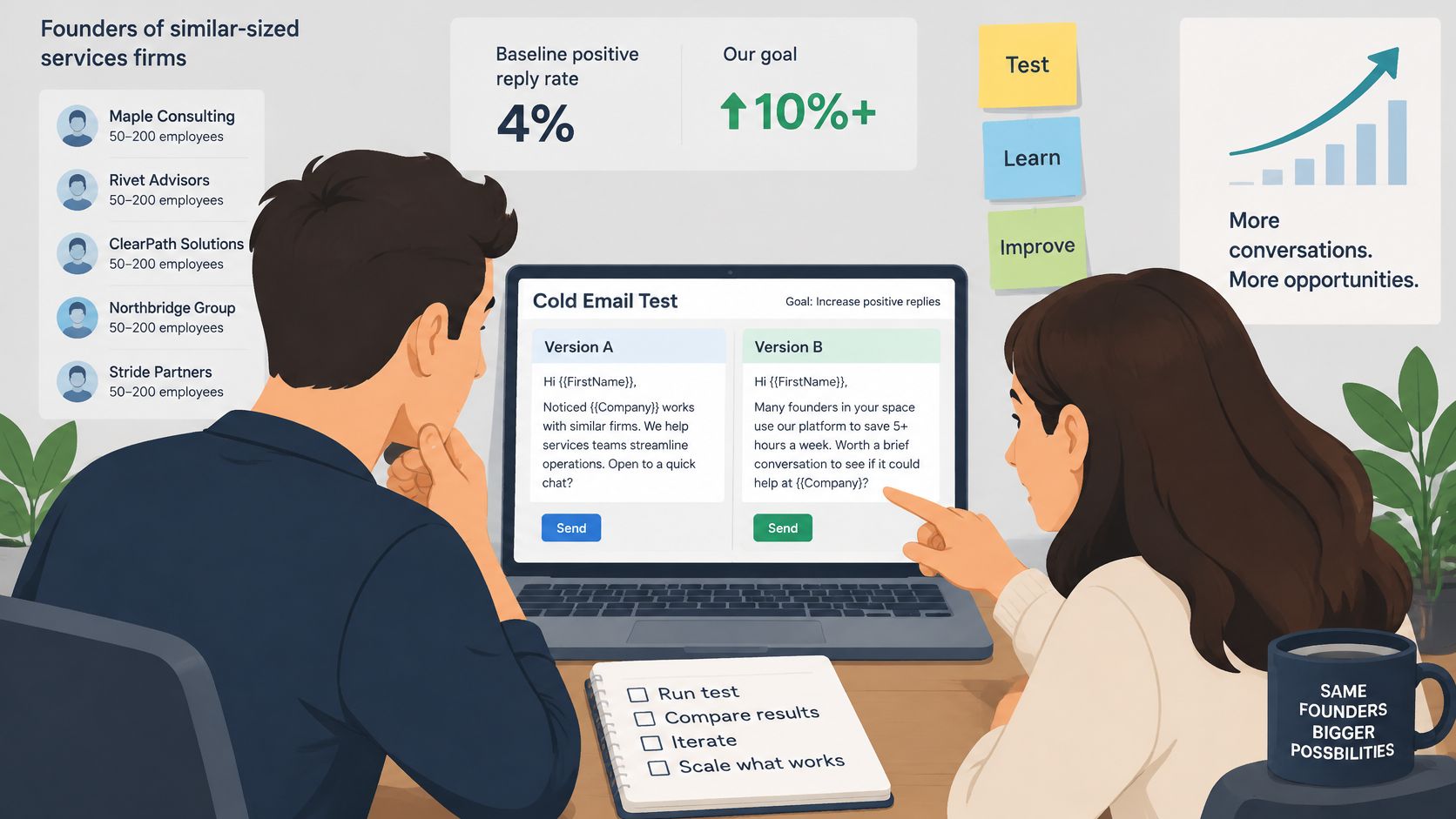
The control and challenger
Example control email, hypothetical
Subject: Beyond referrals
The firm's website describes a CRM-backed sales process but no outbound programme.
A repeatable prospecting workflow could help support growth beyond referrals.
Would a 15-minute call to discuss that be useful?
The call length in this example is hypothetical. The control asks for time before the recipient has engaged with the problem.
Example challenger email, hypothetical
Subject: Beyond referrals
The firm's website describes a CRM-backed sales process but no outbound programme.
A repeatable prospecting workflow could help support growth beyond referrals.
How does the firm currently win new work beyond referrals?
The challenger offers a call only after a relevant reply. That response path is part of the treatment, so the studio records it explicitly rather than presenting the experiment as a test of punctuation or phrasing alone.
Check feasibility before launch
The hypothetical plan starts with a two-week send window, but capacity planning shows that the required sample won't fit. The studio therefore extends the schedule before launch and runs both versions over the same revised window.
Hypothetical planned sample: 1,000 delivered emails per variation, at 100 delivered emails daily across both versions, requires a 20-day collection period. The illustrative arithmetic is 1,000 × 2 ÷ 100 = 20 days; the sample is an assumed calculator output, not a calculation derived from the baseline alone.
Accounts are randomly assigned, and contacts within each account stay together. The team doesn't add a fresh segment to accelerate collection, and it allows the agreed response window to close before interpreting outcomes.
Make a conditional decision
Suppose the challenger finishes with a higher positive reply rate and a similar meeting rate among those replies. The studio checks whether the reply lift meets the planned bar and whether qualified meetings per delivered email remain commercially acceptable.
- Roll forward cautiously: If both conditions hold, use the question-led ask on the next list and validate it on a later cohort.
- Keep the control: If extra replies produce fewer qualified meetings, reject the apparent engagement win.
- Make no winner call: If collection falls short or assignment is faulty, resolve the evidence gap first.
File the primary metric result, the sample reached and what sales heard on calls. Those records determine whether the studio keeps the control or rolls the challenger forward.
Decide the Next Campaign Change
A useful testing rhythm ends with a recorded decision, not a screenshot of the leading variation. The campaign owner should select an action and explain what evidence supports it.
Adopt, keep or retest
- Adopt the challenger as the new control when the experiment is valid, the planned evidence is complete and the improvement clears both the analytical and commercial requirements. Select a different decision for the next experiment.
- Keep the existing control when the challenger doesn't justify a change. An inconclusive comparison leaves uncertainty; it doesn't prove that the versions perform identically.
- Retest on a fresh cohort when the apparent advantage depends on initial exposure or an unplanned early stopping point. Preserve the comparison rather than rewriting the entire sequence.
Testing also needs a place within a broader B2B lead generation strategy. A team with an unclear offer or unsuitable account list shouldn't expect small email changes to solve the underlying commercial problem.
Choose who owns the operating work
Teams with a proven offer and sales capacity, but no appetite for day-to-day campaign operations, can consider a fully managed outbound service. Teams keeping execution in-house can use a private GTM workshop to work through messaging, qualification and campaign judgement.
The practical choice is whether to retain ownership, improve internal capability or hand off execution. Whichever route applies, a named person still needs to connect campaign findings with sales feedback and approve the next change.
H2 offers fully managed outbound, custom GTM systems and private workshops for teams that need a more consistent way to reach suitable buyers and assess campaign changes. Visit H2 to discuss the current audience, outbound bottleneck and whether managed execution or an in-house testing process is the right next step.
