Sending more cold emails isn't a B2B lead generation strategy. A usable strategy combines credibility before contact with account selection that a salesperson can explain. It decides which buyers deserve attention, what evidence makes contact relevant, and how a conversation could become a genuine sales opportunity.
By H2 Team
What a Working B2B Lead Generation Strategy Does
A B2B lead generation strategy is a set of commercial choices, not a sending schedule. It defines who is worth a conversation, why the problem might matter now, how prospects can investigate the offer independently, and what counts as progress.
Consider a hypothetical software services firm whose growth depends on founder relationships and occasional inbound enquiries. Its prospect list contains almost any company that could buy development support. Its emails describe capable engineers but give recipients no account-specific reason to respond.
The missing ingredient isn't another follow-up. The team hasn't decided which business circumstances make its offer useful.
Why relevance comes before reach
Gartner's 2025 buyer survey, based on 632 buyers surveyed in August and September 2024, found that 61% preferred an overall rep-free buying experience, 73% actively avoided suppliers sending irrelevant outreach, and 69% encountered inconsistencies between sellers and company websites.
Those findings don't mean salespeople have no role. They support a more selective approach: helpful independent research, consistent claims and conversations grounded in the buyer's circumstances.
For a SaaS business considering tactics alongside these foundations, FOMOchat's SaaS growth playbook provides a product-specific companion resource. The strategic question remains whether each tactic reaches suitable accounts with a credible reason to engage.
The minimum commercial brief
Before choosing channels, the team needs agreement on:
- The offer: The problem being addressed, the intended outcome and the limits of the service.
- The audience: An ideal customer profile, explicit exclusions and the relevant buyer roles.
- The timing hypothesis: Evidence that makes the problem plausible now, without assuming purchase intent.
- Sales capacity: Someone able to handle conversations and progress suitable opportunities.
- Success: Qualified meetings and opportunities, rather than activity alone.
Account fit and contact fit are different. A company may suit the offer while the selected employee has no responsibility for the problem.
Likewise, a reply isn't automatically a meeting, and a meeting isn't automatically pipeline. A useful strategy defines these distinctions before campaign results arrive, so marketing and sales don't interpret the same activity differently.
Define the Accounts Worth a Conversation
An ideal customer profile, or ICP, describes the organisations a business can serve well. A persona describes the people involved. The distinction matters when building audience rules, as explained in the guide to ICP versus persona.
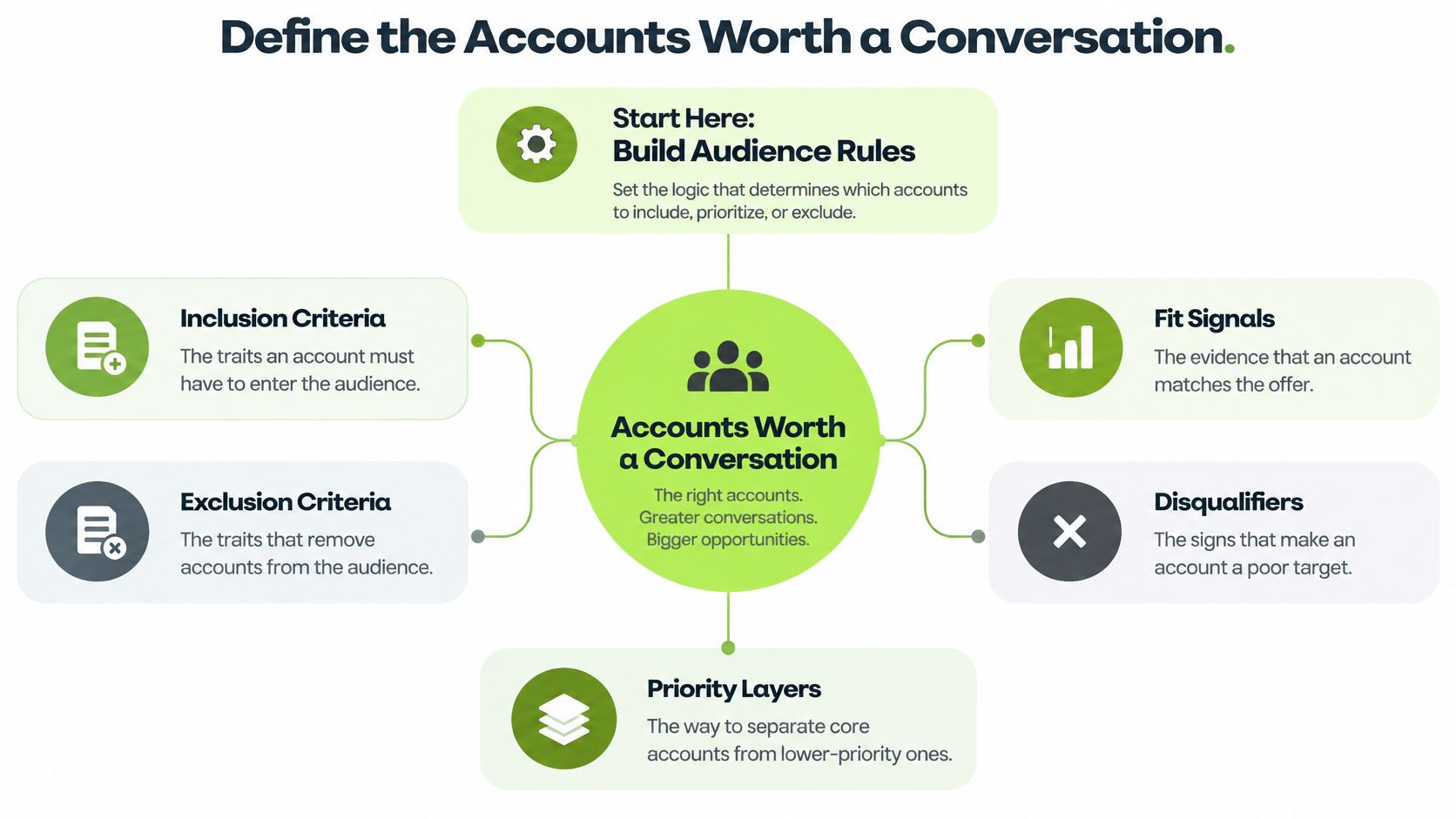
Start with inclusion and exclusion criteria. For a specialist integration services firm, inclusion might require a relevant software environment and an operational need the service can address. Exclusions might include unsupported technology, unsuitable delivery requirements or an existing relationship that makes prospecting inappropriate.
Separate suitability from problem evidence
Firmographics, such as sector and business model, establish broad suitability. Organisational changes, technology environments, hiring and public descriptions of operational problems help form a more specific hypothesis.
A vacancy can justify investigation. It doesn't prove a capacity shortage, budget or willingness to outsource.
Hypothetical account card
| Field | Research note |
|---|---|
| Why selected | A B2B services company is expanding an offer that requires customer-system integrations. |
| Supporting evidence | Its service announcement and a relevant engineering vacancy, each stored with a source and date. |
| Message hypothesis | Integration delivery may be competing with existing engineering commitments. |
| Initial contact | The technical leader responsible for delivery capacity. |
| Disqualifier | The company confirms that its internal team already covers the requirement. |
| Review decision | Human approval before contact because the capacity assumption remains unconfirmed. |
Maintain separate assessments for account fit and problem evidence. A strong match with weak evidence belongs in research, not automatically in a live campaign.
Map roles and buying context
A complex purchase can involve six to ten stakeholders, a planning range rather than a requirement for every deal, according to the buying-group figure reported by Bridge. Account planning should therefore consider champions, economic buyers, technical evaluators, users, security reviewers and potential blockers.
Gartner's buying-journey guidance identifies recurring jobs: problem identification, solution exploration, requirements building and supplier selection. Buyers revisit these jobs, so an account researching requirements shouldn't receive the same message as an account still defining its problem.
Qualification rule: Every selected account should have an explainable inclusion reason, a testable problem hypothesis and an explicit disqualifier.
Prioritisation can then distinguish well-supported accounts from plausible but uncertain ones. High-value or ambiguous records need human review, particularly when automated research has inferred a problem rather than located direct evidence.
Balance Outbound, Inbound and Self-Serve
Channel choice should reflect how buyers want to investigate, not which tactic the team happens to know.
McKinsey's 2024 B2B Pulse Survey, covering nearly 4,000 decision-makers across 34 sectors, eight major industries and 13 countries, found that buyers used an average of 10 interaction channels, up from five in 2016. Forty-two per cent used more than 11 touchpoints, while its “rule of thirds” described roughly equal preferences for in-person interaction, remote communication and digital self-service at each stage.
That isn't a recommendation for a small team to launch everywhere. It's a reason to make the available paths work together.
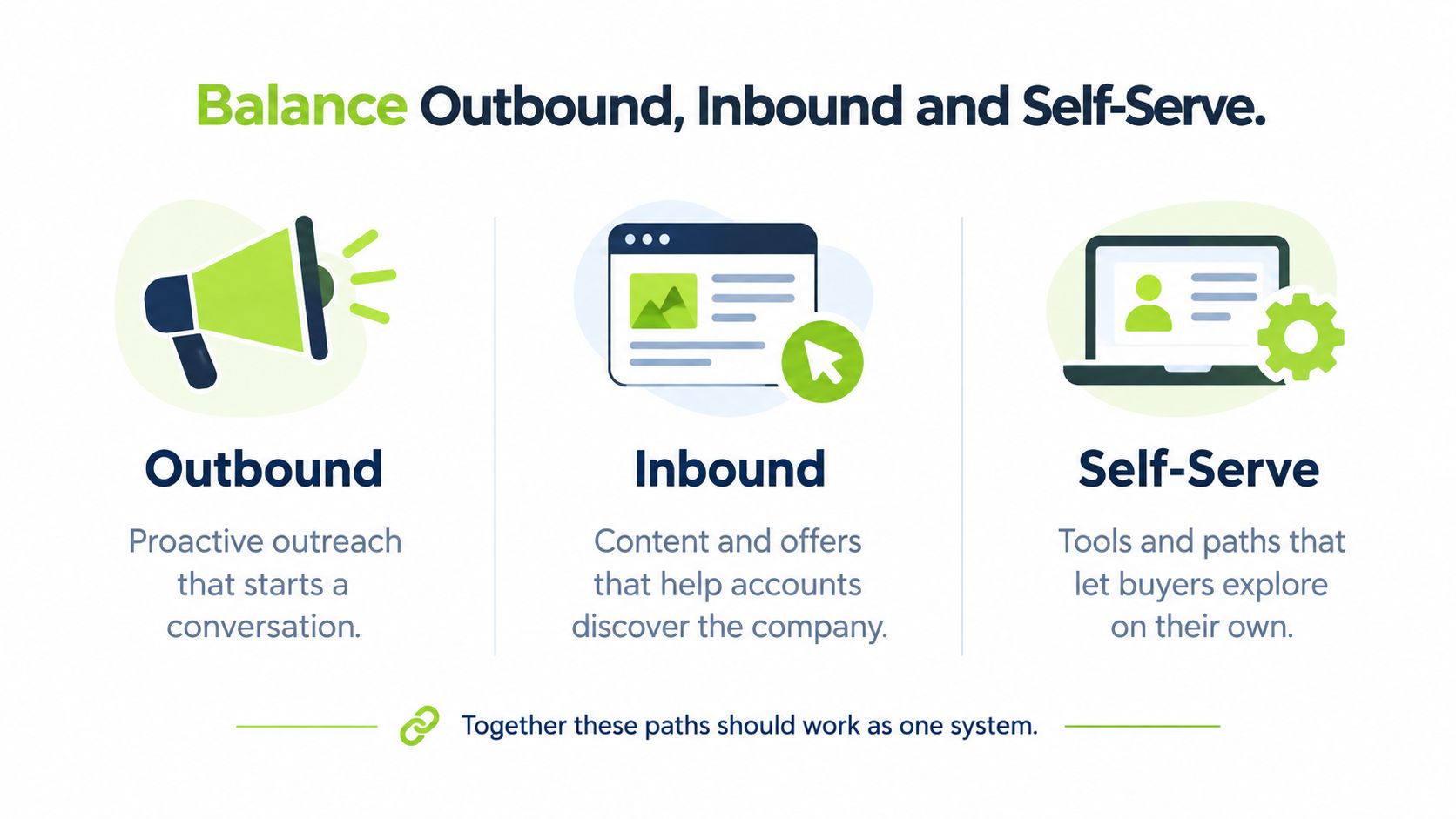
Give each path a distinct job
| Path | Main job | Trade-off |
|---|---|---|
| Outbound | Bring a relevant account hypothesis to a named contact. | Requires careful selection and active campaign management. |
| Inbound and referrals | Help interested accounts discover the business and approach it. | The team can't assume demand will arrive when sales needs it. |
| Digital self-serve | Let buyers examine scope, proof, limitations and implementation independently. | Requires clear, maintained information rather than a contact form alone. |
| Sales conversations | Resolve questions about fit, delivery and commercial risk. | Uses seller capacity, so routing and qualification matter. |
Inbound and self-serve overlap, but they aren't identical. A referral can introduce a company, while a technical page helps that company's evaluator investigate without booking a call.
The distinction between generating awareness and capturing active interest also matters. The guide to B2B demand generation provides supporting context for assigning those responsibilities.
A manageable weekly operating mix
A small GTM team could work with a controlled outbound cohort, maintain a useful asset tied to the offer's main problem, and review sales feedback together. That's a proposed working rhythm, not a universal channel allocation.
- Marketing maintains consistency: The landing page and supporting material describe the same offer as the outreach.
- Sales records context: Replies, objections and conversations retain the account's original hypothesis.
- RevOps connects records: Source, campaign, contact and opportunity information remain traceable.
For teams using that platform, the documentation explaining how to connect lead sources to CRAIM is relevant when planning intake. The broader requirement is continuity: buyers shouldn't need to repeat context because they changed channels.
Adding channels before resolving conflicting positioning creates more maintenance without necessarily creating a better buying experience.
Write Messages Buyers Can Verify
A first-touch email should distinguish observed evidence from commercial interpretation. It can state what the sender found, explain why that might matter, and ask a narrow question. It shouldn't pretend to know the recipient's internal priorities.
The same hypothesis needs different treatment for a technical evaluator and an economic buyer. The underlying evidence stays consistent, while the question changes.
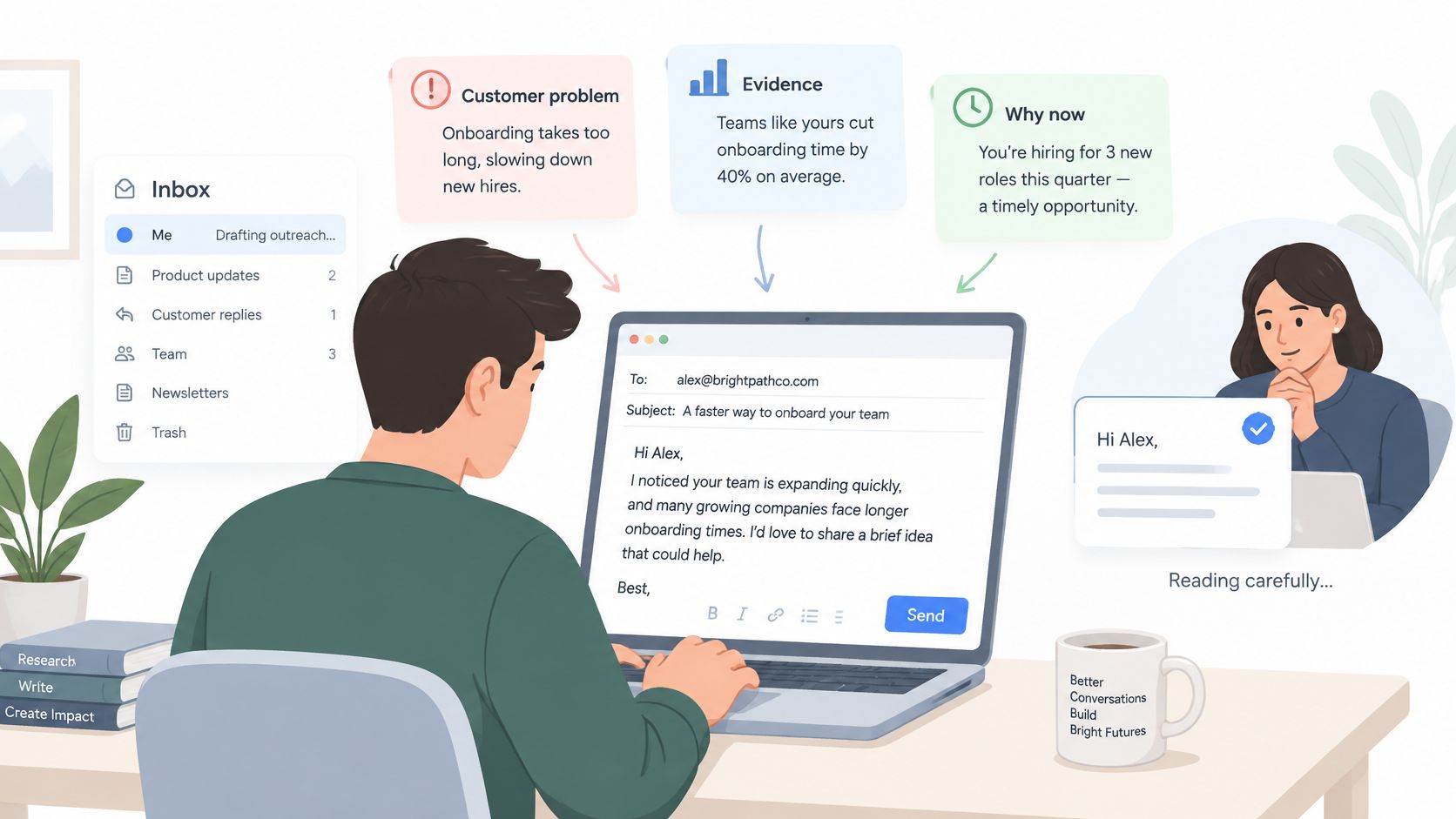
A hypothetical first-touch email
The following example assumes that the announcement and vacancy have been verified. The sender and company are fictional.
Hello Alex,
Northstar's service announcement mentions customer-system integrations, and its engineering vacancy includes integration delivery.
Meridian provides integration delivery support. Would an implementation outline covering access, testing and handover help assess whether external support could fit without adding review work?
Sam, Meridian
The message doesn't claim that Northstar is struggling. It asks whether a specific evaluation aid would be useful.
For an economic buyer, the central question could instead be:
Would a scope comparison help assess whether external integration support is commercially worthwhile alongside the current hiring plan?
Sam, Meridian
This version addresses the spending decision without inventing cost savings or urgency. Either example would still need the sender's required contact details and an appropriate opt-out route.
Make public proof support the message
Gartner's research published in May 2026 found that 45% of B2B buyers used generative AI during a purchase, mainly for vendor and product research, while buyers consulted an average of seven information sources. Fifty-one per cent believed generative AI made misleading information more likely, compared with 49% saying the same about sales representatives.
The practical response is verifiability, not more confident language.
- Category language: State what the company provides in terms a buyer can recognise.
- Relevant proof: Publish a genuine customer outcome with its context and limitations, where permission allows.
- Implementation detail: Explain responsibilities, prerequisites and delivery boundaries.
- Consistent claims: Keep the website, outreach and sales explanation aligned.
If a factual claim can't be checked, it shouldn't appear in the message.
Where customer evidence isn't available, a clearly labelled demonstration or technical explanation can show the approach. It mustn't be presented as a customer result.
Control Data Quality, Consent and Deliverability
Good copy can't compensate for an unsuitable list or an incorrectly applied consent rule. The operating record must explain both why contact is commercially relevant and whether the proposed contact method is appropriate.
Useful fields include subscriber type, source, selection reason, contact role, evidence date, confidence, suppression status and the person authorised to approve an exception.
Apply UK email rules to the subscriber
The ICO's business-to-business marketing guidance explains that PECR's consent requirement for electronic-mail marketing doesn't apply to corporate subscribers. These include limited companies, limited liability partnerships and Scottish partnerships with separate legal personality.
Unsolicited B2B marketing email can therefore be sent to those entities without consent or a soft opt-in. The sender must still identify itself, provide a valid contact address and honour opt-outs.
Sole traders and ordinary partnerships are individual subscribers, so consent rules can apply. A generic role address doesn't escape PECR, and personal-data obligations may apply when a named person's information is used.
Under the ICO's direct-marketing planning guidance, a valid soft opt-in requires qualifying circumstances, including directly collected details during a sale or active negotiation, similar products or services, and an opt-out opportunity at collection. Silence, inactivity and pre-ticked boxes don't establish valid consent.
Set technical and operational pause points
Google's Gmail sender requirements, effective from 1 February 2024, require senders delivering more than 5,000 messages daily to Gmail accounts to use SPF and DKIM, publish DMARC, and align the visible From domain with SPF or DKIM. Marketing messages also need one-click unsubscribe and a visible unsubscribe link; Google advises keeping user-reported spam below 0.1% and preventing it from reaching 0.3%, where bulk senders can lose delivery support or mitigation.
SPF and DKIM authenticate sending sources and messages. DMARC adds a domain-level policy, while alignment connects authentication to the domain recipients see.
- Pause for missing evidence: Uncertain subscriber status or unsupported account selection requires review before sending.
- Pause for authentication failure: Infrastructure needs verification before campaign expansion.
- Pause for negative feedback: Rising complaints or repeated poor-fit replies warrant cohort review.
- Suppress centrally: An opt-out must prevent re-entry through another list or workflow.
Clay, a CRM or another enrichment tool may form part of the workflow. Tool selection doesn't replace exclusion rules, human sampling or accountable ownership.
Measure Pipeline and Decide Who Runs It
Campaign reporting should separate delivery diagnostics from commercial progress. Sends and opens help investigate activity and attention. They don't establish that suitable buyers are entering the sales process.
Positive replies, qualified meetings, accepted opportunities and pipeline answer different questions. Combining them into a single lead count makes it harder to identify where the process needs work.
Agree what progress means
A qualified meeting should require more than attendance. Suggested criteria include account suitability, a relevant problem, an appropriate participant and a reason for a substantive conversation.
An opportunity needs sales acceptance under the company's agreed definition. Sales should record disqualification reasons so campaign operators can distinguish poor targeting from unsuitable timing or an unclear offer.
- Compare like with like: Review qualified-meeting and opportunity rates by audience cohort.
- Include workload: Track research effort, manual reviews and seller time spent on unsuitable conversations.
- Use objections: Repeated concerns should change targeting, proof or timing, rather than merely trigger more follow-ups.
- Control automation costs: Compare enrichment providers on verified usefulness and downstream outcomes, not records returned.
A review of AI tools for qualifying sales leads can support tool selection. Each candidate should be assessed for evidence traceability, exclusion handling, duplicates, review paths and cost controls, rather than plausible-looking scores alone.
Who should run the lead generation work
| Situation | Better fit | What the team still owns |
|---|---|---|
| An operator has capacity for research, copy, infrastructure and review | In-house outbound | Execution, commercial decisions and continuous learning |
| The offer is clear, but manual research and CRM handoffs slow delivery | Custom GTM system | Decision rules, data access and ongoing ownership |
| The team will operate campaigns but needs practical capability | Private workshop | Applying the learning and maintaining standards |
| The offer is proven and sales can take meetings, but operating capacity is missing | Fully managed outbound | Commercial context, feedback and progressing conversations |
A custom build should specify outcomes, inputs, decision rules, integrations, edge cases and ownership before implementation. Testing on real records, documented fallback paths and an operating runbook matter as much as the initial workflow.
A managed programme should have explicit responsibility for research, lists, enrichment, verification, infrastructure, deliverability, copy, testing, replies and booking. Launch readiness depends on data, domains and inboxes, not a generic deadline.
The guide to GTM strategy and operations helps frame the boundary between commercial decisions and the systems used to execute them.
Ownership test: Outsourcing execution doesn't outsource responsibility for the offer, sales feedback or the quality of the resulting customer conversations.
Put the Strategy into Motion
For a team starting a controlled programme, the next fortnight should produce a reviewable test, not a larger database. The useful output is a documented audience, a checkable message and a clear decision about whether to continue.
Assign a commercial owner before work starts. That person should resolve disagreements about account suitability and ensure that sales feedback reaches whoever controls targeting.
A practical launch checklist
- Freeze the audience rules: Record the ICP and exclusions for the initial test, so later changes remain visible.
- Choose a coherent cohort: Group accounts around a shared problem hypothesis rather than a broad industry label.
- Prepare supporting evidence: Confirm that the public offer and relevant proof support the message.
- Complete operating checks: Verify subscriber classification, suppression handling and authentication.
- Review risky accounts: Resolve uncertain selection reasons before messages leave the system.
- Assess conversations: Review meeting quality and objections before changing the audience or expanding activity.
A launch review should distinguish a missing input from a failed hypothesis. Incomplete contact data calls for repair; consistent feedback that the problem doesn't exist calls for a commercial rethink.
Recognise the failure signs
The programme needs intervention when operators can't explain why accounts were included, messages promise more than the website supports, complaints approach the documented stop point, or sales repeatedly rejects supposedly qualified meetings.
The correction shouldn't automatically be more channels, more enrichment or another sequence. The responsible owner should identify which decision failed and amend that decision before resuming.
For teams with a proven offer and meeting capacity but little operating time, fully managed outbound is the relevant service route. Teams needing the workflow inside their existing tools can consider custom GTM system builds, while private GTM workshops suit teams developing their own capability.
Current engagement questions belong on the pricing page, rather than being answered with assumed fees. A 15-minute introductory call can focus on the intended audience and current bottleneck; the free GTM strategy offers a lower-commitment starting point.
H2 offers fully managed outbound, custom GTM systems and private workshops for B2B teams that need more qualified conversations or a more dependable operating process. Teams can visit H2 to discuss their audience and current bottleneck, then choose whether execution, a system build or practical training fits the work ahead.
