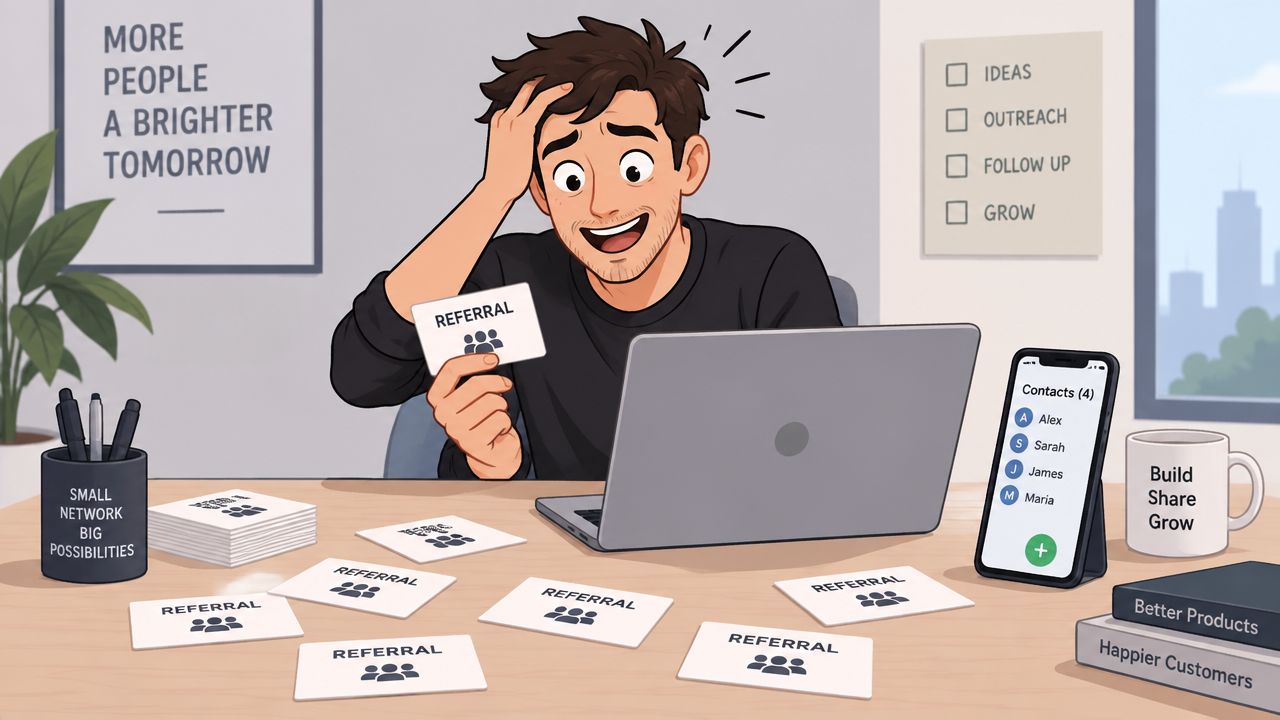
Your SaaS pipeline looks healthy until you remove referrals and the founder's personal network. Then the calendar empties, paid campaigns produce unqualified names, and sales asks marketing for “more leads” without agreeing on what a good opportunity looks like.
That's the operational gap in B2B demand generation. Creating attention is easy. Creating enough trust, context, and buyer intent for a sales conversation is harder, especially when prospects research privately and increasingly begin with AI chat rather than a search results page.
Demand generation gives that process structure. It connects audience selection, useful content, buyer signals, outbound outreach, sales handoff, and pipeline measurement into one operating system.
The Reality of B2B Demand Generation
A founder-led referral engine can feel like proof that growth is working. A former client introduces you to a peer, that peer books a call, and the deal moves quickly because trust already exists. The problem appears when referrals slow down. You're left with no reliable way to create similar conversations with companies that don't already know you.
B2B demand generation is the systematic process of creating awareness and interest in a solution among a defined group of businesses. It isn't lead capture. Lead capture records an action, such as a form submission. Demand generation creates the conditions that make a qualified action more likely, through repeated exposure, education, evidence, and timely relevance.
The market's investment reflects that shift. One 2026 industry snapshot projects global demand generation spending will reach nearly $70 billion, while another overview describes demand generation as a $7.4 billion industry growing at 14% annually. The same source reports that 87% of B2B marketers rank demand generation as a top priority. The figures differ because they describe the market in different ways, but the direction is clear. Demand generation has become an operating discipline rather than a campaign label.
Buyers now build opinions before sales gets involved
A prospect may encounter your company through a comparison page, a founder's LinkedIn post, an implementation guide, a customer comment, or an answer generated by an AI chatbot. They may never click through to your website during the earliest part of that process.
Recent industry coverage reports that 51% of B2B software buyers now begin research in an AI chatbot rather than Google, 69% changed vendor choice based on chatbot guidance, and one in three bought from a company they hadn't heard of before. These claims come from Omnibound's coverage of B2B demand generation statistics. For SaaS founders, the implication is practical: your expertise needs to be clear enough to be discovered, understood, and trusted inside an answer engine, not only ranked for a keyword.
Practical rule: Build demand for the problem, the buying decision, and the proof required to justify your solution. A landing page alone can't do all three jobs.
The replacement for referral dependence isn't more activity. It's a repeatable system that identifies the right accounts, gives them useful reasons to pay attention, detects evidence of evaluation, and lets sales enter the conversation with context.
How the Demand Funnel Actually Works
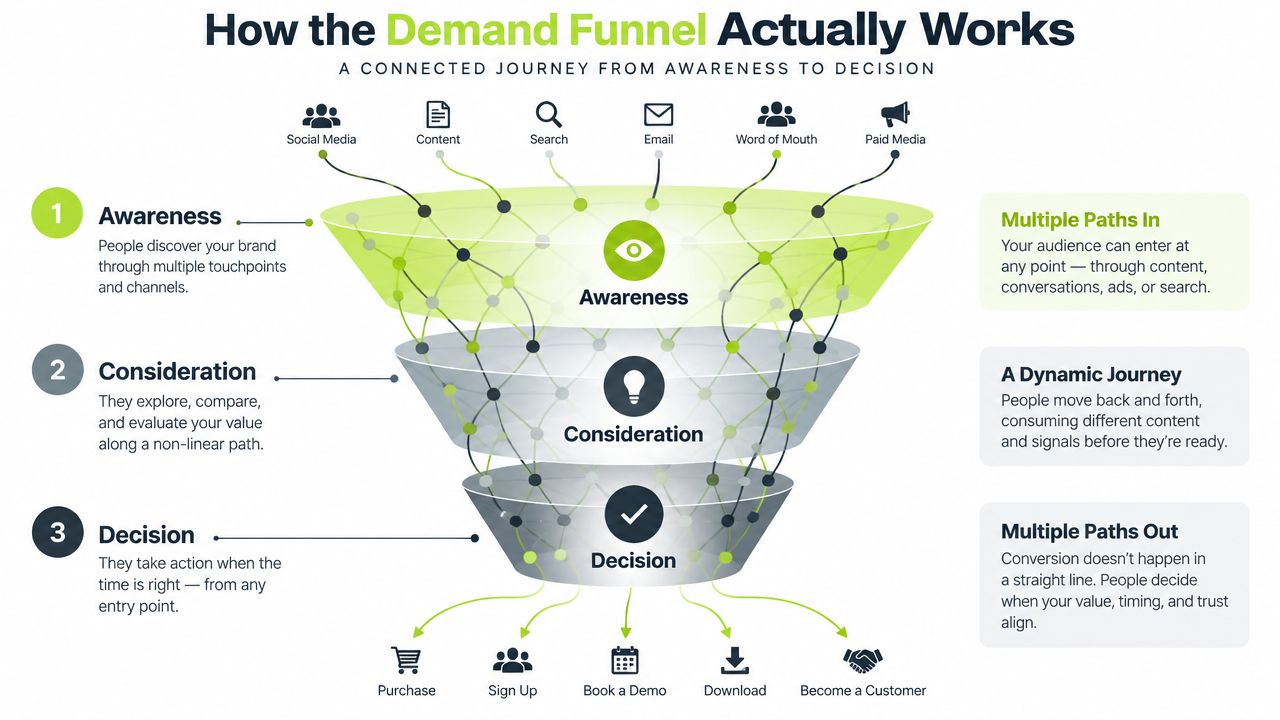
The traditional funnel suggests a neat sequence. A buyer sees an ad, downloads an asset, becomes a lead, receives nurture emails, and requests a demo. B2B buying rarely behaves that way. Several people from the same account may research different issues, revisit the same evidence, ask colleagues for recommendations, and return through a different channel months later.
Research cited by SoPro's demand generation statistics reports that 58% of B2B sales and marketing decision-makers use multiple outreach channels, but only 21% coordinate those channels effectively. The same research says 87% use intent signals, while fewer than half act on them. A separate benchmark in that research reports that buyers consume an average of 13.4 pieces of content before contacting sales, with 67% of the buying journey self-directed.
Awareness creates recognition
At the awareness stage, buyers may understand a business problem without knowing which category or approach will solve it. Your job is to make the problem easier to name and the consequences easier to evaluate.
Useful assets include practical guides, diagnostic content, founder commentary, research-led explanations, and problem-specific examples. Avoid turning every useful page into a form. If the first interaction demands contact details before offering substance, many self-directed buyers will move on.
AI-assisted research raises the standard. Content should answer specific commercial questions directly, define technical terms, show trade-offs, and make its evidence easy to interpret. Clear structure helps both human readers and systems that extract answers.
Consideration connects the problem to a solution
Consideration begins when the account compares approaches, vendors, or internal alternatives. Generic thought leadership stops being enough at this stage. Buyers need implementation detail, product boundaries, integration information, pricing logic, security answers, and credible proof.
Map content to stakeholder concerns. A technical evaluator may need architecture and deployment information. A finance leader may need a clear view of cost drivers and operational risk. An executive sponsor may care about business impact and adoption. One asset rarely satisfies the entire committee.
Decision removes avoidable uncertainty
The decision stage is where sales and marketing must work from the same account context. A useful handoff records which people engaged, what they reviewed, which signals appeared, and what remains unknown. Sales can then open with a relevant observation instead of repeating a generic pitch.
For a practical view of how these activities connect to pipeline creation, see this guide to building a pipeline in sales. The core principle is simple. Demand generation should make the next sales conversation more informed, not merely more frequent.
Inbound Pull and Outbound Push Strategies
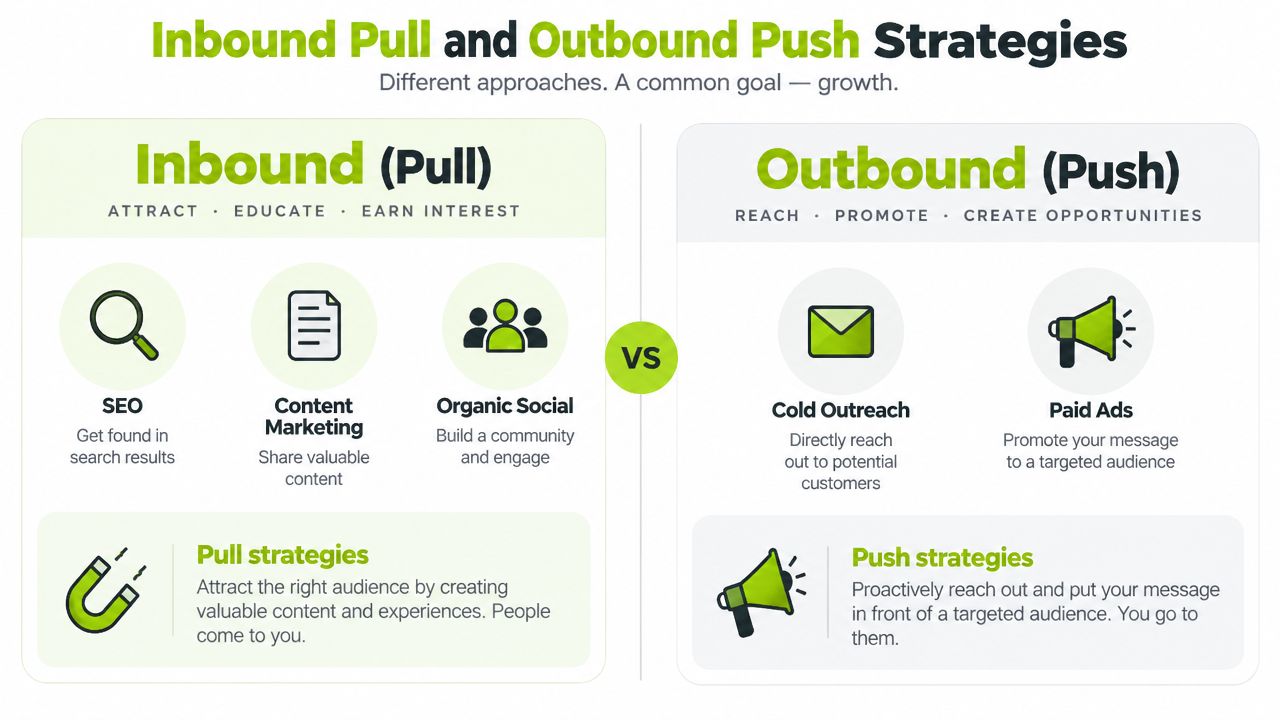
Inbound and outbound solve different timing problems. Inbound pull attracts people who are already looking for information or evaluating a problem. Outbound push lets you introduce a relevant problem or solution to accounts that fit your market, even when they haven't raised their hand publicly.
Inbound usually includes search content, product education, comparison pages, newsletters, communities, and organic social distribution. It compounds through discoverability and trust, but it takes time and depends on buyers finding the material. It also performs poorly when the content targets broad traffic rather than a commercially relevant audience.
Outbound includes targeted email, account research, paid account campaigns, partnerships, and direct conversations. It gives a SaaS company more control over which accounts it approaches and when, but poor targeting or weak relevance turns that control into noise.
Choose the balance by constraint
A new SaaS company with no category recognition may need outbound to start conversations while it builds an inbound foundation. A company with strong organic demand but weak account coverage may need focused outbound to reach segments that don't discover it naturally. A mature team may combine both around named accounts, using content to create familiarity and outreach to act on relevant signals.
The mistake is treating channel selection as an identity. “We're inbound” can become an excuse to wait for traffic. “We're outbound” can become an excuse to send at scale without improving the offer or message.
A stronger design assigns each channel a job:
- Inbound pull: Explain the problem, establish expertise, answer evaluation questions, and create assets that buyers can share internally.
- Outbound push: Select accounts, identify relevant people, interpret business context, and create a reason for a conversation now.
- Shared layer: Use one ICP, one message architecture, common qualification rules, and a CRM record that sales and marketing trust.
Use signals to connect the two engines
A buyer who reads an educational article may not be ready for outreach. A buyer who reviews pricing, compares competitors, returns to product documentation, or involves several colleagues presents a different situation. Signal-based prioritisation helps separate passive interest from active evaluation.
The 2026 outbound benchmark research from Orrjo reports average cold email reply rates around 1.9% to 3.4% and meeting-booked rates per outreach around 0.5% to 1.2%, with strong programmes reaching 3% or more for meetings. It also reports reply rates moving from 2% to 4% on cold-only sequences to 5% to 8% when audiences are demand-warmed. Treat those figures as benchmarks, not promises. The operational lesson matters more than the range: educate first where possible, then ask for a conversation when the message has context.
For teams deciding whether to build this capability internally or use specialist support, compare the practical model described in this outbound lead generation service for B2B SaaS.
Building Your Demand Generation Playbook
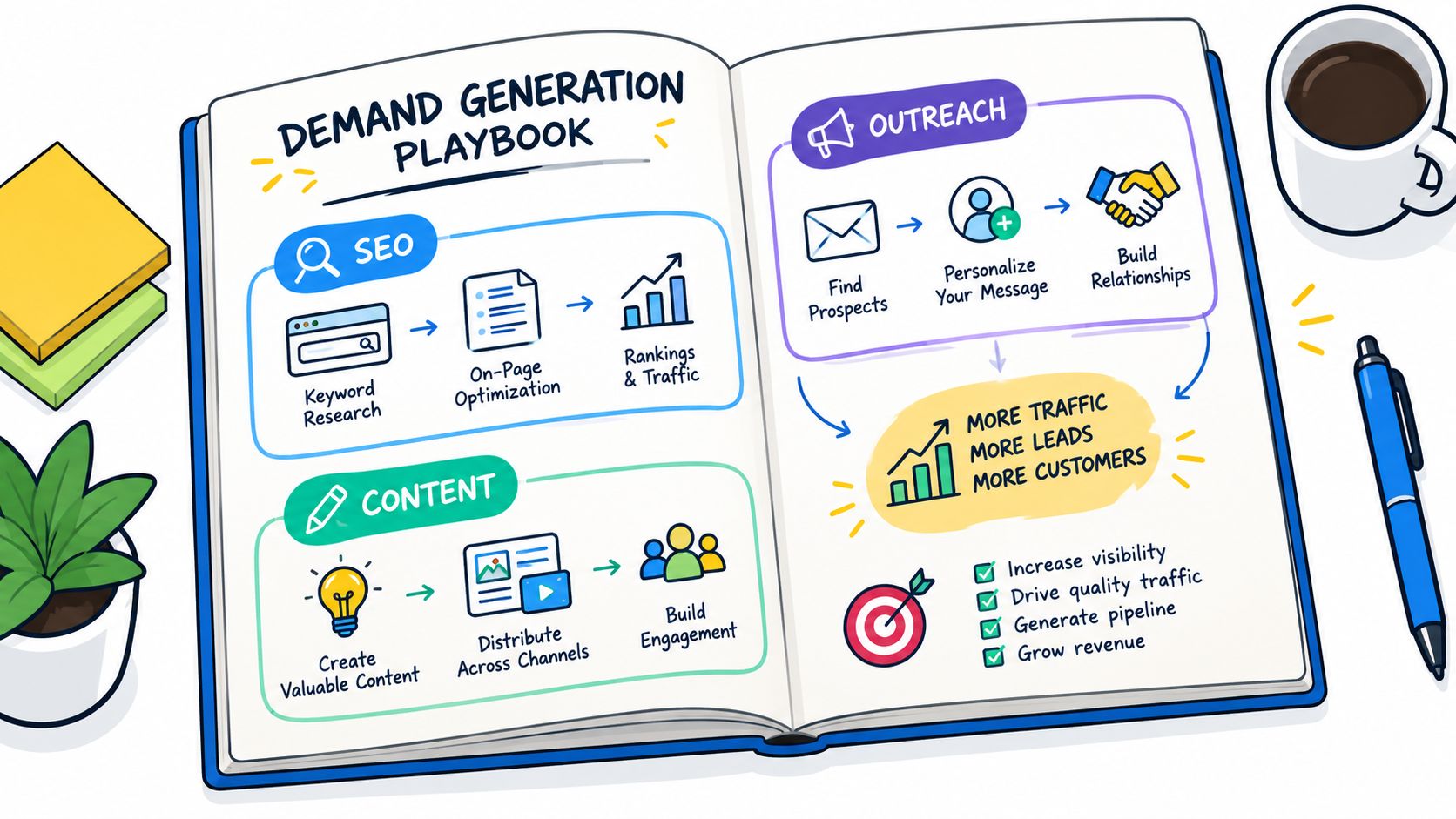
A playbook should tell a team who to target, what to say, when to act, and how to decide whether a conversation is worth pursuing. If it only contains channel tactics, it isn't a playbook. It's a list of activities.
Start with account qualification
Define your ideal customer profile at account level. Industry and company size may help, but they won't explain why an account should act now. Add the operational conditions that create a fit, such as a particular technology stack, hiring pattern, compliance requirement, delivery model, or visible workflow problem.
Then define buying roles. A champion, technical evaluator, budget holder, executive sponsor, and end user may all judge the same product differently. Your research and content should reflect those differences without creating disconnected messages.
Use signals as prioritisation inputs, not proof. A job vacancy, technology choice, website visit, or social interaction can justify investigation. It doesn't establish intent by itself.
Map the message to the buying committee
Write one message map before writing sequences. The map should connect:
- Business problem: What costly or risky situation does the buyer recognise?
- Operational consequence: What becomes slower, harder, or less reliable?
- Desired change: What would a better process enable?
- Proof: What evidence can you show without exaggeration?
- Reason to act: Why is this relevant to the account's current context?
Then adapt the emphasis by role. A finance stakeholder may need commercial clarity. A technical stakeholder may need evidence that the workflow is feasible. A founder may need a concise explanation of how the change affects growth and team capacity.
Make data quality part of campaign design
Your database needs ownership. Track whether records still fit the ICP, whether contacts remain in the right role, and whether enrichment is recent enough to support personalisation. ZoomInfo's benchmark guidance describes the underlying database as the biggest determinant of deliverability, reach, and conversion, and cites a practical threshold of 95%+ email deliverability plus quarterly enrichment cycles.
That threshold isn't a substitute for judgement. It's a reminder that a large list with stale records is an operational liability.
Design the handoff before launch
Decide what sales receives when an account becomes worth contacting. Include the account fit, relevant signals, stakeholders identified, content consumed where available, message angle, and unresolved qualification questions.
Use a CRM workflow that makes the handoff visible and reversible. A practical CRM with workflow automation can route records, flag missing fields, assign ownership, and preserve the reasoning behind a qualification decision.
Sequence design should feel like a useful progression, not repeated pressure. Start with a specific observation, offer a relevant insight, add proof or a useful resource, and make the meeting request proportionate to the evidence. Stop or change direction when the account gives a clear negative signal.
Measuring What Actually Matters
A demand generation dashboard can look busy while pipeline remains empty. Downloads, page views, replies, and opens may help diagnose distribution, but they don't prove that the right accounts are moving toward a commercial decision.
Measure at the layer where revenue becomes possible. That usually means qualified conversations, meetings attended, opportunities created, pipeline influenced, and progression after the handoff.
Separate activity from outcome
A useful scorecard has three levels:
| Measurement layer | What it tells you | How to use it |
|---|---|---|
| Activity | Whether distribution occurred | Diagnose reach and execution |
| Response quality | Whether the audience found the message relevant | Review positive replies, objections, and fit |
| Pipeline outcome | Whether demand became a sales asset | Track meetings, opportunities, and progression |
Don't treat a reply as a success by default. A polite response from a poor-fit account can consume more sales time than no response. Review whether the contact matches the ICP, whether the problem is real, and whether the conversation can progress.
The benchmark difference between cold-only and demand-warmed outreach gives teams a useful testing model. Compare audiences that receive only a direct sequence with audiences that first encounter educational content or signal-based engagement. The aim isn't to force every buyer through an identical nurture path. It's to learn whether context improves the quality of the resulting conversation.
Build feedback into the dashboard
Sales should record why a meeting was accepted, declined, or disqualified. Use those reasons to refine the target account definition and message map. If meetings happen but opportunities don't, investigate qualification and problem severity. If opportunities stall, inspect proof, stakeholder coverage, decision criteria, and handoff timing.
Track source information that normal attribution misses. Ask new prospects how they heard about you, then compare that answer with CRM activity. AI chat recommendations, private communities, peer referrals, podcasts, and internal sharing often leave incomplete digital trails.
Measure the conversation your programme creates, not the activity your tools can count.
Overcoming Common Implementation Challenges
The most expensive demand generation mistake is using automation to compensate for weak qualification. AI can research accounts, classify text, draft variations, and route records. It can't decide whether your product solves a meaningful problem for a specific company without clear rules and human review.
Poor data creates false confidence
A campaign may appear productive because it sends consistently. But if roles are wrong, companies fall outside the ICP, or personalisation uses outdated information, response quality deteriorates downstream. Check sample records manually before diagnosing copy. Review account fit, contact role, evidence source, and the age of each important field.
Deliverability deserves the same discipline. The benchmark guidance cited earlier connects clean data with inbox placement and usable sales conversations. If delivery quality falls, reduce the temptation to increase volume. Audit records, segmentation, sending practices, and message relevance first.
Generic messages hide a targeting problem
When every account receives the same promise, low response can mean more than weak copy. It may indicate that the segment is too broad or that the trigger doesn't distinguish active evaluation from general interest.
Rewrite around observable business context. A relevant message might refer to a hiring pattern, a new product launch, an implementation constraint, or a workflow that the account publicly describes. Keep the observation accurate and give the recipient an easy way to correct your assumption.
Automation needs a learning loop
Don't launch a complex workflow that nobody owns. Assign responsibility for reviewing replies, updating qualification rules, checking enrichment quality, and feeding sales objections back into campaign decisions.
A practical review asks four questions:
- Fit: Are the accounts commercially suitable?
- Context: Does the message reflect something true about the recipient?
- Timing: Is there evidence that the issue matters now?
- Outcome: Did the interaction create a qualified next step?
If the answer to the first three is weak, adding another AI tool won't fix the programme. Improve the decision rules before increasing execution speed.
Finalizing Your Demand Generation Strategy
B2B demand generation works when inbound education, outbound coverage, account signals, and sales follow-up operate as one system. Content should help buyers understand and evaluate the problem, while targeted outreach creates access to suitable accounts that may not discover you naturally.
The standard is qualified pipeline, not noise. Define the ICP, map stakeholder messages, maintain usable data, document the sales handoff, and review meetings and opportunities rather than celebrating raw activity. Keep testing because buyer behaviour changes, especially as AI chat becomes an earlier discovery point for software decisions.
Start by choosing one segment, one urgent problem, one proof-led message, and one measurement path from first engagement to opportunity. Then improve the system using real objections and sales outcomes.
H2 helps B2B SaaS and technology companies research suitable accounts, build qualified outbound conversations, and connect data, buying signals, enrichment, and CRM workflows into a workable GTM system. If your growth still depends on referrals or disconnected campaign activity, book an introductory conversation with H2 to discuss your audience, pipeline challenge, and next practical step.
