Your pipeline probably looks familiar.
A few deals come from referrals. A founder intro opens a door now and then. Someone fills in the website form when a webinar lands well or a post gets shared. Then the gap shows up. Sales wants more conversations, but nobody inside the company has the time to build outbound properly, and every attempt so far has felt heavier than expected.
That's usually the moment people start looking for an outbound lead generation service for B2B SaaS. They think they're buying meetings. In practice, they're buying a system that can repeatedly create the conditions for qualified conversations.
That distinction matters. If you treat outbound like renting calendar slots, you'll compare providers on volume, speed, and meeting counts alone. If you treat it like buying an operating system, you start asking better questions. Who defines the ideal customer profile? Who checks whether the data is reliable? Who sets up sending infrastructure? Who learns from replies and feeds that back into targeting and copy?
A managed service can solve a real workload problem. It can also disappoint fast if your offer is still fuzzy, your market is too broad, or your team can't handle the conversations once they arrive. Outbound doesn't fix weak positioning. It doesn't replace sales judgement. It gives a capable team a structured way to reach buyers who are unlikely to arrive on their own.
This is most useful for B2B SaaS teams that already have something proven enough to sell, plus the capacity to follow up properly. It's less useful for teams still changing the product every week or trying to discover whether anyone wants the category at all.
Practical rule: If you can describe who should buy, why they should care, and what happens after a positive reply, you're usually ready to evaluate managed outbound seriously.
Introduction
Think of a founder selling workflow software to operations leaders at mid-sized companies. The product is good. Existing customers stay. Referrals convert well. But growth comes in lumps. One strong month creates confidence, then the next month goes quiet because nobody built a repeatable way to create new conversations.
So the founder tries outbound in-house.
A sales rep buys a list. Marketing writes a short sequence. Someone connects a sending tool. A few replies come back, but many messages go nowhere, some addresses bounce, and nobody agrees on whether the problem is the audience, the offer, the copy, or the setup. Within a few weeks, outbound gets labelled as noisy, low quality, or “not right for us”.
That story doesn't usually mean outbound is broken. It usually means the team tried to run one visible part of outbound, sending messages, without building the rest of the machine around it.
The real buying decision
For an outbound lead generation service for B2B SaaS, the search often imagines a simple transaction. Give a provider a target market, get meetings back. But a good managed programme starts much earlier than inbox activity. It begins with commercial understanding, buyer selection, data work, qualification rules, infrastructure, and feedback loops.
That's why two providers can both say they “do outbound” while delivering completely different outcomes.
One may sell list-plus-send. Another may build a full operating system with research criteria, verified contacts, reply handling, and a way to improve targeting based on what prospects say. Those are not the same purchase.
Who should keep reading
This guide is for founders, CEOs, sales leaders, and growth teams in B2B SaaS that need more pipeline but don't want to build every moving part internally right away.
It's not written for teams hoping an agency will rescue an unclear offer. It's also not for teams that want to outsource responsibility for sales follow-up.
Here's the practical question underneath all of it. Are you trying to buy meetings, or are you trying to buy a repeatable outbound capability? The second framing usually leads to better decisions.
What an Outbound Lead Generation Service Means for B2B SaaS
Inbound is a bit like putting a well-designed shop on a busy street and waiting for the right people to walk in. Outbound is different. It's closer to building a research team, a delivery team, and a messaging team that decide who to approach, why them, and what to say before the first contact goes out.
That's why an outbound lead generation service for B2B SaaS shouldn't be defined as “cold email done for you”. That's only one visible layer.
B2B SaaS teams often need outbound because inbound has natural limits. SaaS website conversion benchmarks suggest websites may convert only about 1% to 3% of visitors into leads, which is one reason outbound remains strategically important when inbound traffic is limited or inconsistent, as noted in Belkins' SaaS lead generation benchmark discussion.
What managed outbound actually includes
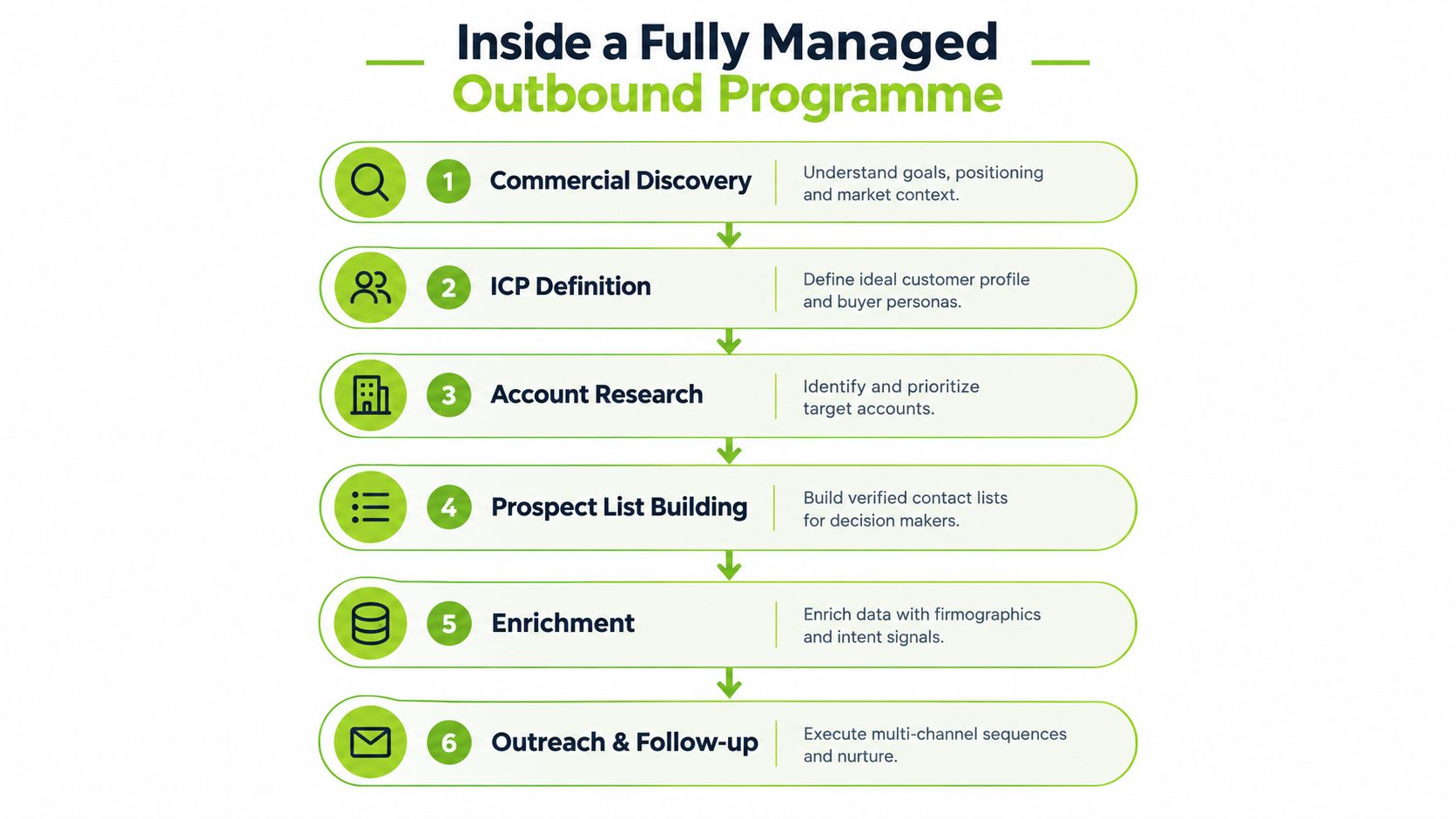
A real managed service usually combines several jobs that companies often split across sales, marketing, and operations:
- Audience definition so the team knows which companies and buyer roles are worth contacting.
- Account research so outreach starts from relevant business context rather than generic job titles.
- List building and enrichment so contact records are usable in the real world.
- Campaign execution across email and sometimes other channels.
- Learning loops so objections, reply patterns, and sales outcomes improve the next round.
If any one of those is weak, the visible result looks the same. Low reply volume, poor-fit meetings, or no meetings at all.
Managed outbound versus lists or appointment setting
Buyers often get confused.
A lead list provider gives you raw ingredients. You still need someone to decide who matters, validate the records, write the outreach, and manage deliverability.
An appointment setting service often focuses on booked calls as the product. That can work, but it can also hide weak targeting if the service isn't tightly connected to qualification and sales feedback.
A managed outbound service should sit one level deeper. It should own the operating logic behind who gets contacted, what counts as a fit, what gets tested, and how the programme improves.
The best managed outbound work looks less like hiring a sender and more like adding a specialist GTM function you don't yet have in-house.
For B2B SaaS, that matters because buyer groups are narrow. You're not trying to reach “any company that might need software”. You're trying to reach specific kinds of firms, with specific problems, through specific people who can influence a purchase.
Inside a Fully Managed Outbound Programme
When a managed programme works, it doesn't feel magical. It feels well built.
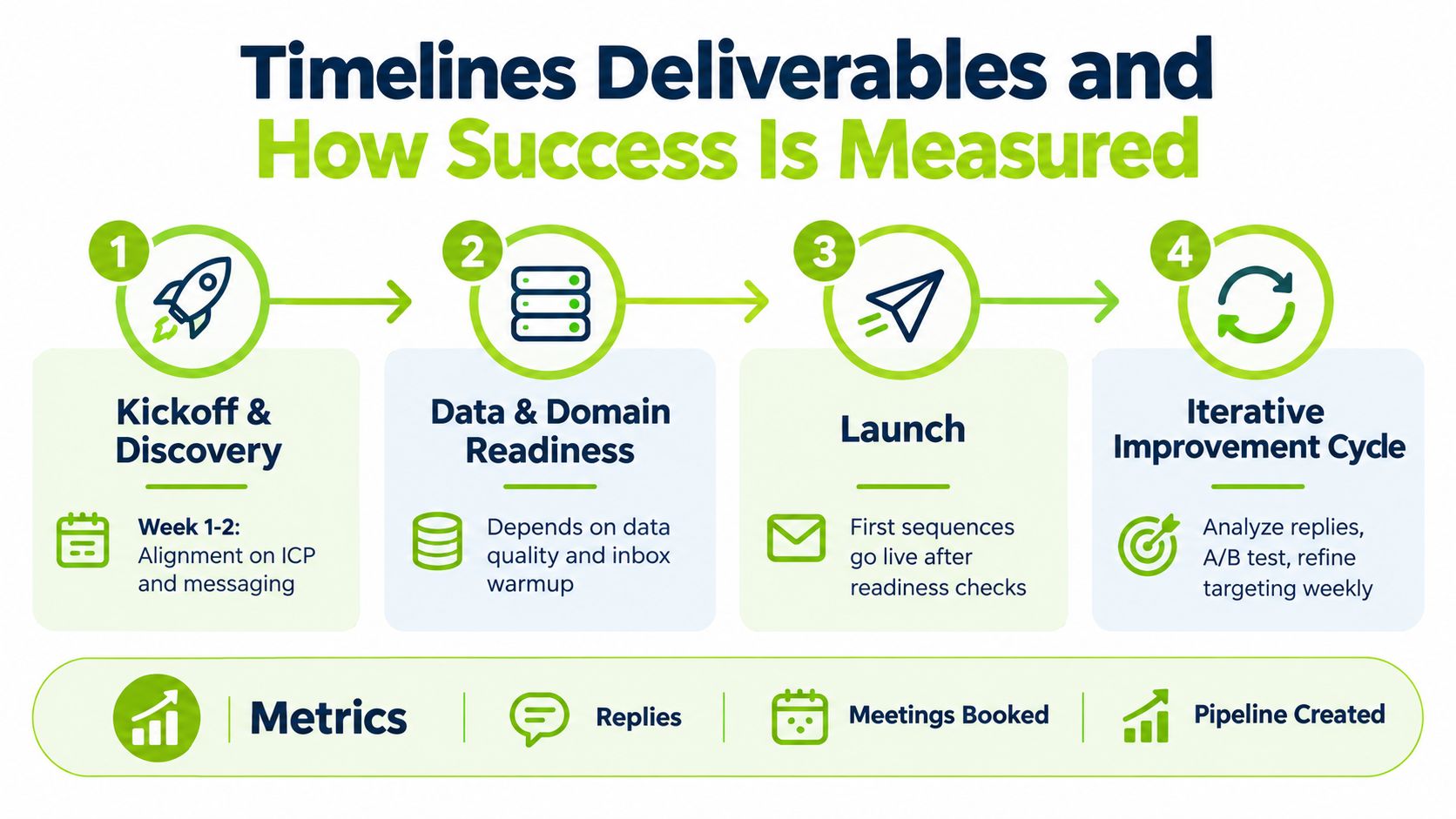
The pieces connect in a sensible order. Commercial discovery informs ICP definition. ICP definition shapes account research. Account research determines what list gets built. Data quality affects deliverability. Deliverability determines whether your message gets a fair chance. Replies then feed back into the next version of targeting and messaging.
That sequence is more important than most buyers realise.
Commercial discovery before campaign building
The first job isn't writing emails. It's understanding the commercial situation.
A capable provider should investigate sales calls, support conversations, customer stories, previous campaigns, and failed experiments. The point is to find usable patterns. Which customers buy quickly? Which ones stall? What language do buyers use when they describe the problem in their own words? What false assumptions keep appearing in calls?
That material shapes the ideal customer profile, but it shapes what counts as a meaningful reason to contact someone.
For teams comparing options, a fully managed outbound service should cover that early commercial work, not just the execution layer.
Research and data are part of the product
Good outbound research is selective. It doesn't pretend every company with a certain headcount is relevant.
Teams usually look at public company information, websites, hiring pages, technology usage, and relevant social activity to decide which accounts deserve attention. A vacancy or a tech choice doesn't prove intent by itself, but it can help narrow a market into a more sensible target list.
Then comes the contact layer. Many cheap programmes fall apart.
Independent research reported that strong B2B outbound setups can reach 95%+ deliverability, but SMTP validation alone only reaches about 88-92% accuracy, with inbox-confirmation testing adding another 3-5 percentage points according to the B2B Data Quality Report 2026. That's why data verification isn't admin work. It's part of campaign performance.
Infrastructure and messaging work together
Teams sometimes separate deliverability from copy as if they belong in different worlds. In practice, they affect each other constantly.
If the infrastructure is weak, strong messaging never gets seen. If the targeting is loose, inbox providers and recipients both get negative signals. If the copy is generic, even good delivery won't produce useful learning because the replies won't tell you much beyond “this didn't land”.
A managed programme should document things clearly enough that the client can understand:
- Who is being targeted
- Why those accounts were chosen
- How contacts were qualified
- What messaging angles are live
- How replies are categorised
- What changes are being made and why
That documentation matters because the asset isn't just this month's meetings. It's the decision logic behind the programme.
Reply handling and handover
One more point gets missed in many sales conversations. Replies are not a side effect. They are the feedback system.
Positive replies need triage and booking. Neutral replies need judgement. Objections need to be tagged so patterns become visible. Wrong-person replies can still improve account mapping. Even negative responses can refine who should never have been in the sequence.
That's why a managed outbound service should leave you with more than calendar activity. It should leave you with sharper market knowledge and a system your team could later operate, extend, or rebuild internally.
Timelines Deliverables and How Success Is Measured
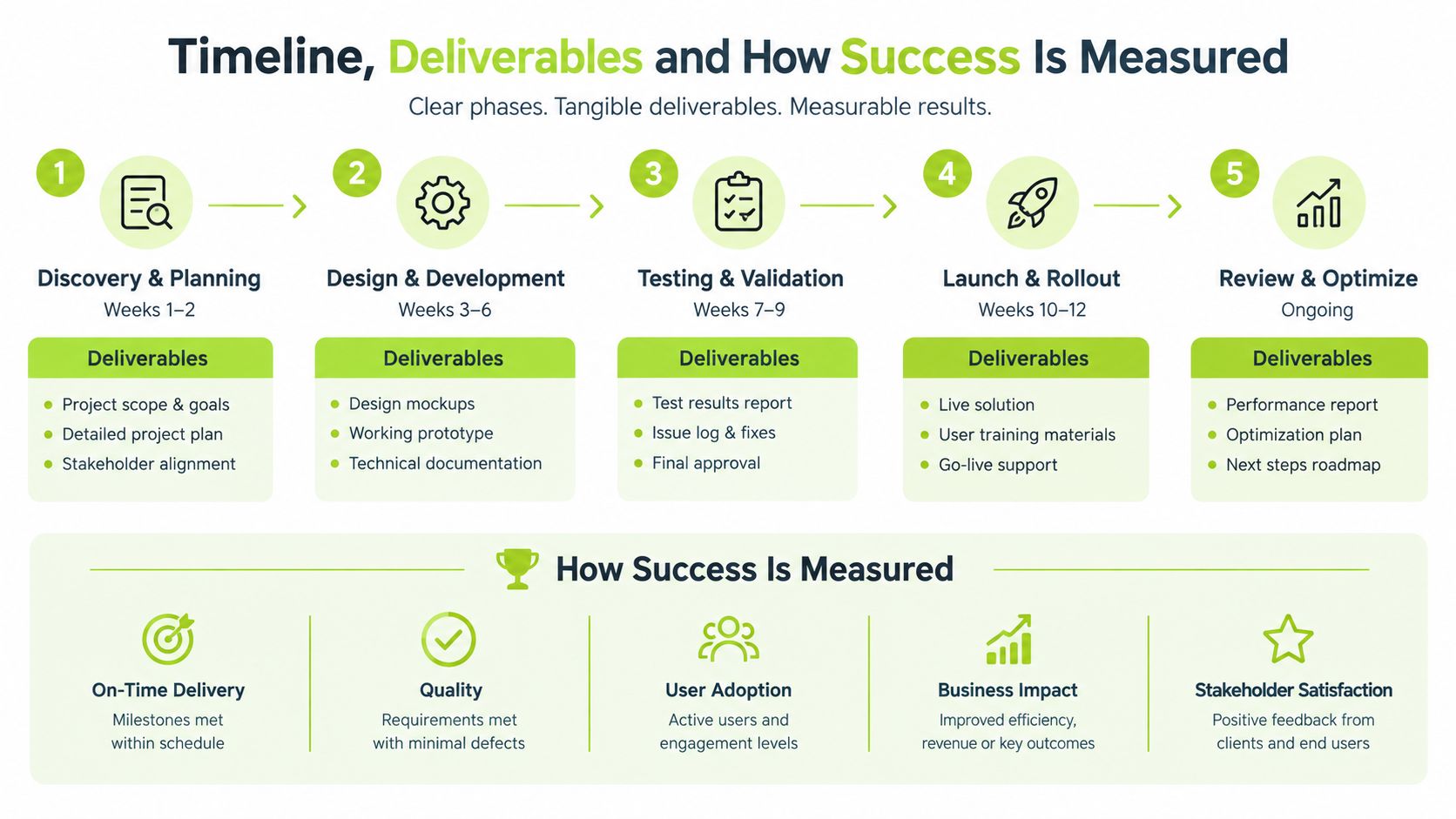
The biggest mistake in early expectations is assuming launch starts on contract date. It rarely does.
A managed outbound programme usually has a preparation phase that determines whether the launch has any chance of producing clean signal. If domains, inboxes, contact records, qualification rules, and message angles are all still unsettled, “launching fast” often just means learning less from bad conditions.
What usually happens first
Early work tends to focus on alignment and readiness.
That can include target market definition, buyer roles, exclusion criteria, research rules, contact verification standards, messaging angles, and infrastructure checks. Some teams are ready quickly. Others discover they have duplicate records, unclear qualification rules, or no agreement on what a good meeting looks like.
A useful way to judge a provider is by the deliverables they create before volume starts. Look for tangible outputs such as:
- ICP and qualification rules that your sales team can explain
- Named account criteria rather than a vague market description
- Verified prospect lists with rationale for inclusion
- Messaging variants tied to specific pains or situations
- Reporting categories for replies, objections, and next steps
How long learning takes
Outbound starts producing signal before it produces certainty.
Cold email benchmarks show an average reply rate of 3.43% across more than 20 million cold emails, with some SaaS and software campaigns sitting under 2%, according to Cleverly's cold email benchmarks by industry. The same reporting notes that strong campaigns can materially outperform the average, with top performers reaching 10%+ and some benchmarks citing 5% to 10% as good performance.
That benchmark matters less as a promise than as a framing device. Most outbound programmes won't get useful feedback from one email blast. They need enough clean sending, enough relevant targeting, and enough follow-up to show whether the segment and message are working.
Operator's view: Early outbound success is not “we sent a lot”. It's “we learned which audience-message pair produces qualified replies, and we can explain why”.
What to measure without fooling yourself
Vanity metrics create false confidence fast. Opens can mislead. Raw send volume proves almost nothing. Even booked meetings can hide poor qualification if sales rejects half of them.
A better measurement stack usually looks like this:
| Measure | Why it matters | What it tells you |
|---|---|---|
| Qualified replies | Shows message and audience fit | Whether the right people care enough to engage |
| Meetings booked | Confirms progression to conversation | Whether interest is actionable |
| Pipeline opportunities | Connects outreach to revenue process | Whether conversations are commercially relevant |
| Bounce and deliverability signals | Diagnoses operational quality | Whether your data and setup are holding up |
| Objection patterns | Improves future targeting and copy | Why buyers hesitate or disqualify |
The right provider should help you interpret these together. If replies are low, the issue might be targeting, copy, or inbox placement. If replies are healthy but meetings are weak, the qualification or handoff may be the problem. If meetings happen but pipeline doesn't follow, the market, offer, or sales process may need attention.
Pricing Models and What Drives Cost
Pricing gets misunderstood because buyers often compare visible outputs instead of underlying workload.
A cheap service can look attractive if the comparison is “they'll send messages for less”. But outbound cost usually tracks the amount of thinking and operational control inside the programme. Deep research, enrichment logic, repeated verification, deliverability management, copy iteration, and reply handling all take time and specialist attention.
That's why the pricing model matters less than what labour and systems it includes.
Common models you'll see
Some providers use a monthly retainer. Some run a pilot and then move into an ongoing arrangement. Some use a performance-aligned structure where part of the fee depends on meetings or other outcomes.
None of these is automatically better. The question is whether the commercial model fits the reality of your team and sales motion.
| Pricing Model | What Is Typically Included | Best Fit | Watch Out For |
|---|---|---|---|
| Monthly retainer | Ongoing research, list building, messaging, sending, optimisation, reporting | Teams that want continuity and regular iteration | Vague scope that turns into “we send emails” |
| Pilot plus ongoing | Initial setup, testing, early learning, then continuation if signal is good | Companies testing outbound in a new segment | Pilots that are too short to generate reliable learning |
| Performance-aligned | Usually some base fee plus outcome-linked payment | Teams that want shared incentives | Providers over-optimising for easy bookings instead of fit |
What actually drives cost
The hidden cost drivers usually sit upstream:
- Research depth affects how precisely accounts are chosen.
- Enrichment work affects whether records are useful for segmentation and routing.
- Verification effort affects bounce risk and wasted send volume.
- Deliverability oversight affects whether messages even arrive.
- Copy iteration affects how quickly the programme improves.
- Reply triage affects meeting quality and sales efficiency.
If you want a helpful mental model, think of data like ingredients in a kitchen. Better ingredients don't guarantee a great meal, but poor ingredients limit what any chef can do. Work on data enrichment services sits in that same category. It shapes the quality of everything that follows.
How to judge value
Compare providers against likely pipeline quality, not activity volume.
A list-plus-send offer may appear efficient, but if the audience is broad, the data is weak, and the qualification rules are muddy, you can spend months learning almost nothing. A more expensive managed programme may create fewer total touches while producing cleaner commercial feedback.
That's why pricing should be read as a proxy for scope, rigour, and ownership, not just output.
How to Choose the Right Outbound Partner for Your SaaS
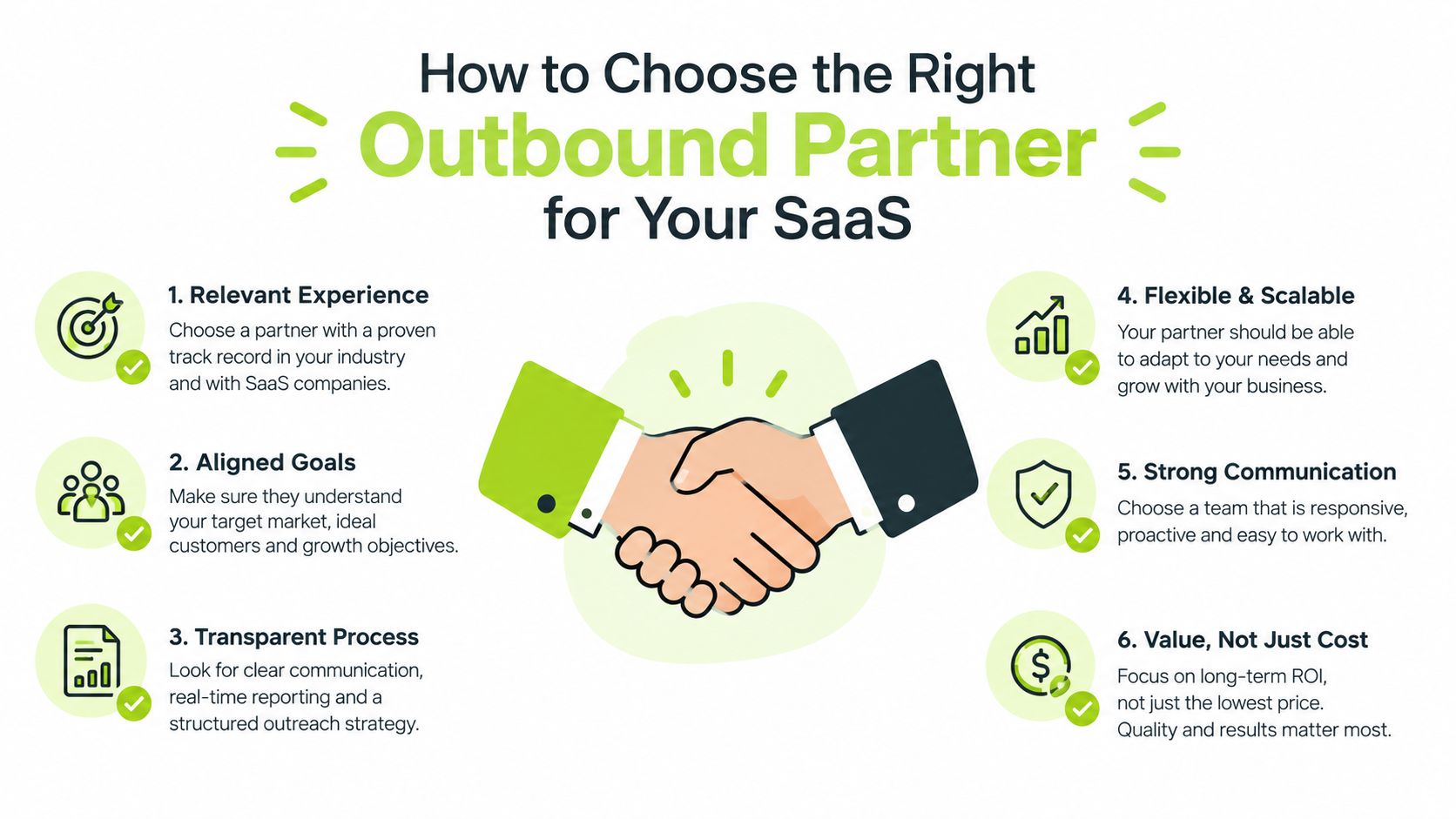
Most selection mistakes happen because buyers ask “How many meetings can you book?” before they ask “How do you decide who should be contacted, and what happens when the market pushes back?”
That single shift improves partner evaluation a lot.
You're not only choosing a supplier. You're choosing a method for turning market uncertainty into commercial learning.
What to test in a short intro call
In a first conversation, ask questions that reveal operating discipline.
- How do you define and refine ICP? You want a concrete process, not “we target decision-makers in your niche”.
- How do you qualify accounts and contacts? Good partners can explain inclusion rules and exclusion rules.
- How do you handle data quality? If the answer is just “we verify emails”, that's thin.
- How do you manage deliverability? You want signs of infrastructure discipline, not volume bravado.
- How do you learn from replies? Mature teams tag objections, route feedback, and change campaigns based on what they hear.
- What does reporting show? Transparency should include reasons behind changes, not just dashboard screenshots.
If the partner works with tools like Clay, that can be useful. If they use AI workflows, that can also help. But tooling alone isn't the differentiator. The important thing is whether they know where automation helps and where human judgement still matters.
Red flags that show up early
A few warning signs are consistent.
If a provider promises volume before asking detailed questions about your customers, they're probably selling throughput, not judgement.
Other red flags include generic sample copy, loose qualification language, fixation on send counts, and no clear explanation of how negative signal changes the campaign. Another common problem is treating every B2B SaaS company as if the same motion works for all of them. Selling developer tooling, vertical SaaS, and managed services usually requires different research and messaging logic.
Matching the need to the service
Different teams need different levels of help.
If you need the full programme run for you, a managed service makes sense. If you already have people and process but need the machinery built, a custom GTM system build may be the better fit. If your team wants to learn Clay workflows, qualification design, or AI-assisted prospecting internally, a private workshop may be more useful than outsourced execution.
That's why choosing well isn't just about asking “Who is good?” It's asking “What problem are we trying to solve right now?”
Making Outbound Work Consistently After Launch
Launch is where visibility begins, not where stability is guaranteed.
The programmes that keep working don't rely on one clever sequence. They compound because someone is paying attention to buyer language, disqualification reasons, handoff quality, and what happens after the meeting. Replies sharpen the targeting. Sales feedback sharpens the qualification. Deliverability discipline protects the channel over time.
For many B2B SaaS teams, outsourcing makes sense when internal capacity is the constraint. If your team can sell but can't spare the time to research accounts, verify data, manage infrastructure, write copy, and run the feedback loop, buying that capability is sensible. If you already have those muscles and want more control, building in-house may be the better long-term route.
A practical next step is simple.
- Clarify the offer so a provider can understand what makes a conversation worth having.
- Narrow the audience so early campaigns produce usable signal.
- Define sales capacity so positive replies don't sit untouched.
- Audit infrastructure risks because weak setup can sink decent targeting. A quick review of common email deliverability issues usually shows where operational drag hides.
Start focused. Let the programme earn the right to scale. Outbound usually gets expensive when teams increase activity before they've established commercial clarity.
If you treat an outbound lead generation service for B2B SaaS as an operating system, the buying decision gets easier. You stop asking who can send the most and start asking who can build a process your company can trust.
H2 helps B2B teams with Fully Managed Outbound, Custom GTM System Builds, and Private GTM Workshops. If you want to evaluate whether your audience, data, deliverability, and outreach process are ready for managed outbound, visit H2 and use the free GTM strategy or book an introductory call.
