You can feel when a pipeline is fake. The CRM has names in it, sales reps are busy, inboxes are full, and yet the month still ends with too few qualified conversations. The problem usually isn't effort, it's that the system leaks at every handoff.
That's why how to build a pipeline in sales is really a question of operating discipline. Strong teams don't just collect leads, they control who enters, what happens next, and where deals stall. Once you start measuring the funnel stage by stage, the issue shows up fast, and it's usually fit, qualification, routing, or follow-up, not raw volume.
Why Most Sales Pipelines Stall Before They Scale
A lot of teams begin with referrals or irregular inbound, then assume the answer is “more top of funnel.” That works until it doesn't. Once the warm network cools, the pipeline exposes what it always was, a loose collection of contacts rather than a measurable system.
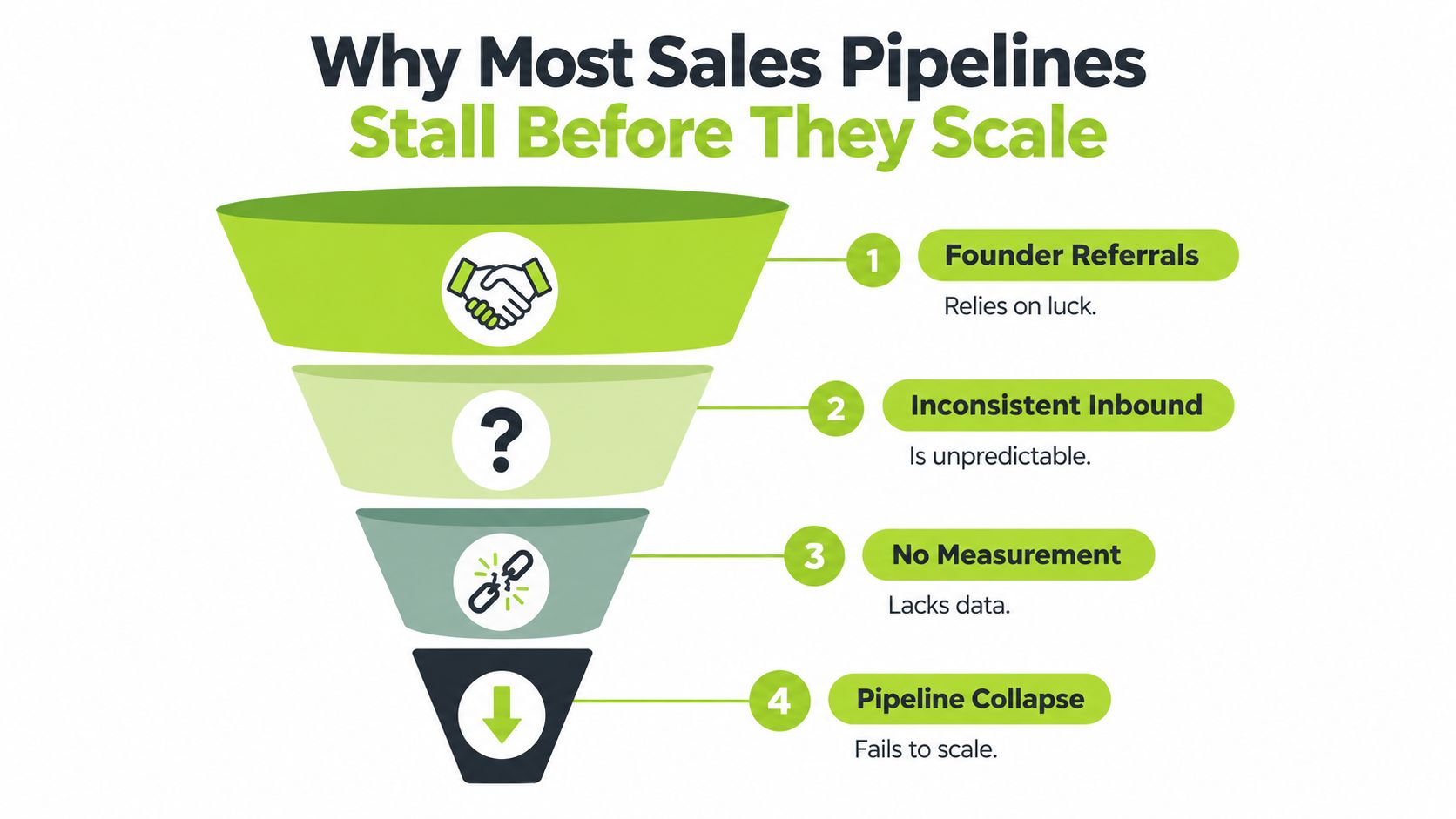
The leak is usually not where teams think it is
The hard lesson is that pipeline quality matters more than sheer activity. A 2026 benchmark summary says B2B SaaS funnels convert about 39% of leads into MQLs, 38% of MQLs into SQLs, and 37% of SQLs into closed deals, while another benchmark source places average B2B conversion across the whole funnel at about 2% to 5% from visitor to customer and opportunity-to-closed-won around 20% in many markets (CartFlows benchmark summary). Small leaks at each stage compound quickly.
What I see in practice is simple. Teams overvalue open rates, list size, and “activity,” then underinvest in stage definitions and handoffs. The pipeline looks healthy on a dashboard, but the next step is unclear, the criteria are fuzzy, and the rep is guessing.
Practical rule: if a deal can't move because nobody knows the exit criteria, it's not in a pipeline, it's in a holding pattern.
The fix is to treat the pipeline as a chain of conversion points, not a contacts database. That means clear ownership, consistent stage definitions, and a ruthless view of what belongs in active motion. If the system can't tell you where value is leaking, it can't be scaled.
Define Who Belongs in Your Pipeline Before You Prospect
The fastest way to clog a pipeline is to prospect before you define the target. Good outbound starts with the accounts that resemble past wins, not with a broad list and optimistic messaging. Closed-won patterns should shape the audience before a single email goes out.
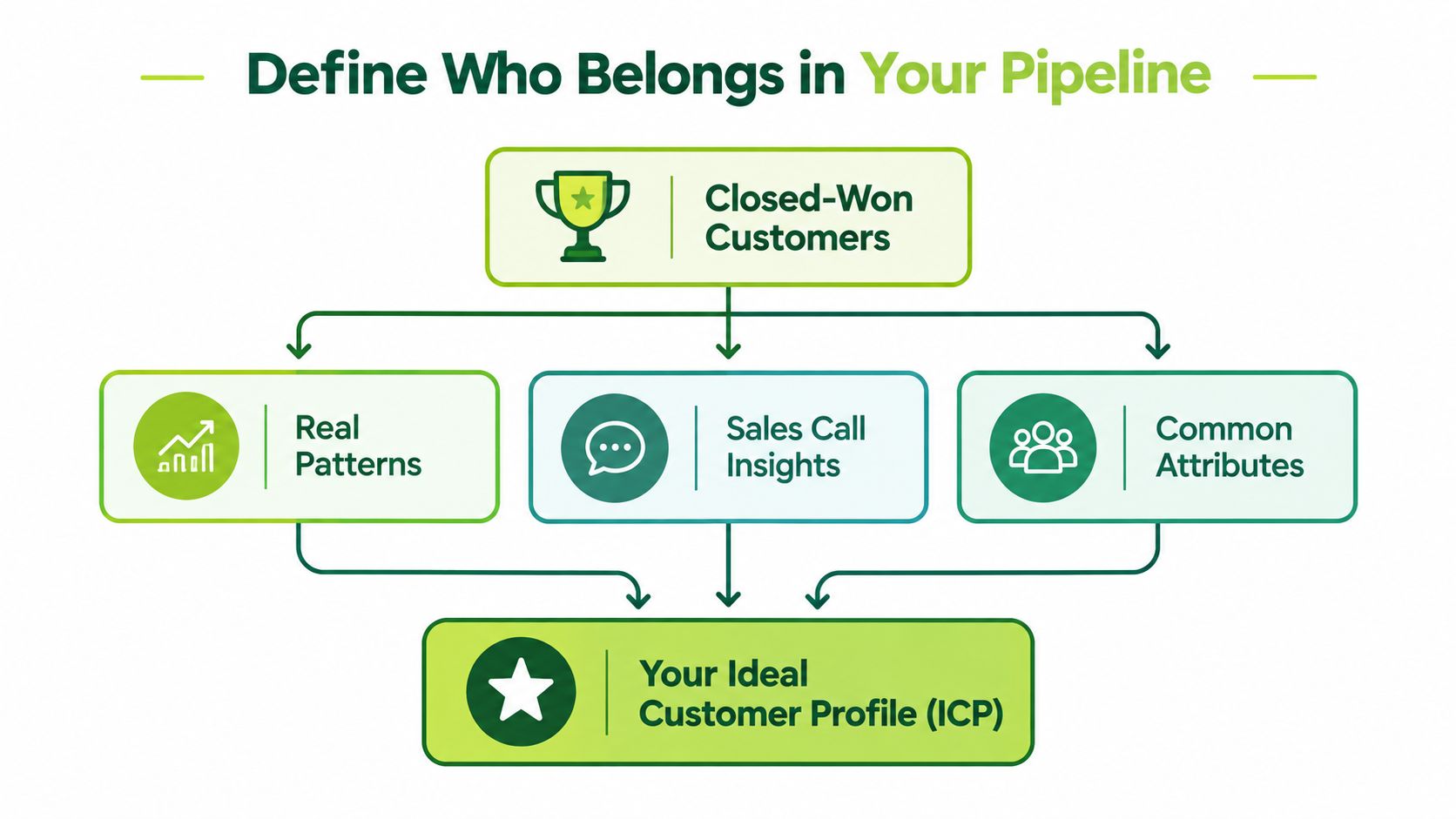
Build the ICP from proof, not preference
Start with real customers that bought, renewed, and used the product the way you wanted them to. Look for shared firmographics, tech stack traits, team shape, budget signals, and the original problem they were trying to solve. Sales call notes matter too, because they show which pain points surfaced early and which objections were deal-breakers.
That is where qualification gets concrete. If the same type of company repeatedly closes, that pattern is a better filter than a vague market description. When teams skip this step, they end up treating every prospect like a possible fit and every reply like progress.
Use the ICP to define who should never enter the active pipeline. Exclusion criteria help. A company can be active in market and still be the wrong size, wrong tech stack, wrong use case, or wrong buying structure for your motion.
Align the gate before the funnel opens
The gate has to be shared by marketing, SDR, and AE teams, or everyone invents their own version of qualified. The cleanest way is to document the rules in plain language, then map them to stage definitions and CRM fields. Public signals, like hiring activity or technology adoption, are useful filters, but they're not intent proof on their own.
If your team is cleaning data as often as it is prospecting, the problem may be upstream. A separate data enrichment workflow can help, and H2's overview of data enrichment services fits that operational gap when records are thin or inconsistent.
Stage rules only work when the same logic applies to every rep, every source, and every handoff.
The result is a pipeline that's explainable. You know why a record entered, why it advanced, and why it was excluded. That discipline is what keeps the funnel from filling with accounts that were never realistic to begin with.
How Prospecting Qualification and Staging Work Together
Once the ICP is clear, prospecting becomes a controlled workflow instead of a guessing game. The aim isn't to send more messages, it's to move the right account through discovery, enrichment, outreach, and routing without losing context. Every handoff should carry enough information for the next person to act.
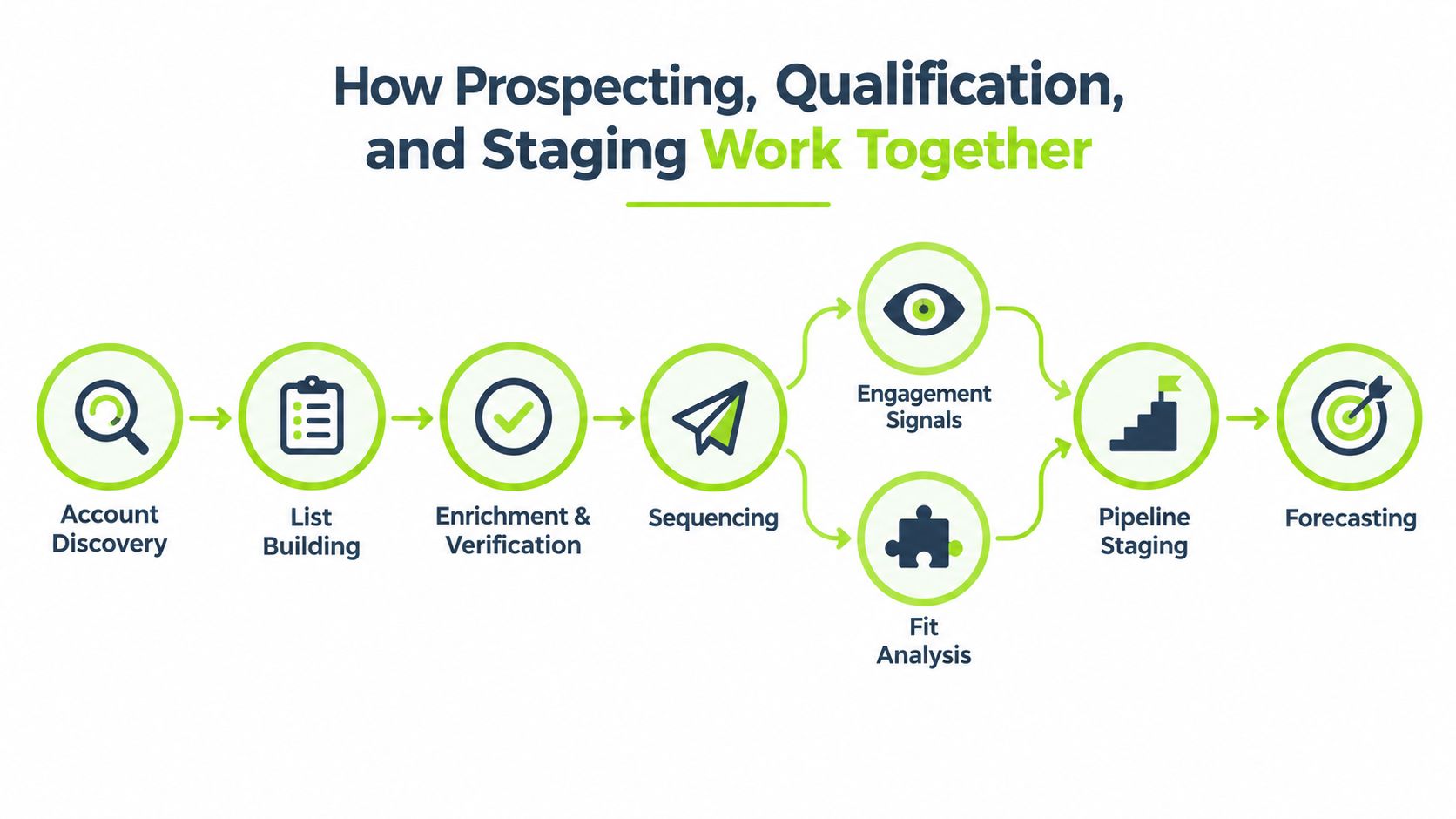
Make the workflow do the qualification
Account discovery should already be filtered by your ICP. Then list building, enrichment, and verification should clean the record before sequencing begins. If you're sending to stale or duplicate contacts, you're not prospecting, you're manufacturing noise.
Signal-first outreach beats spray-and-pray. An account that has a relevant hiring signal, a tech change, or a visible business event deserves a different message than a generic cold contact. But signals still need interpretation, because a public event isn't the same thing as active buying intent.
Route replies and movement with discipline
After sequencing, replies have to be handled quickly and consistently. A good response isn't just “positive” or “negative.” It should tell you whether the buyer fits, what problem they care about, and whether the account has a path into the next stage. That's the difference between engagement and qualification.
Healthy stage hygiene also depends on ownership. Marketing, SDR, and AE teams need to know who owns the record, what the SLA is, and what must happen before a lead becomes SQL or an opportunity. If that handoff is slow, even good demand goes cold.
Operational standard: no record should move because somebody feels hopeful. It should move because the required information is present.
If you want this system to hold up in the world, document every rule. Keep the fields tight, remove duplicate records, and make the CRM reflect actual buying progress instead of internal enthusiasm. That's what gives the pipeline a reliable shape day to day.
Forecasting Your Pipeline With Real Conversion Math
Forecasting gets easier when you work backwards from revenue instead of forwards from activity. The right question is not “How many names do we have?” It's “How much pipeline do we need, and what has to happen at each stage to get there?”
Start with stage assumptions, not optimism
A useful benchmark range from 2026 says adjacent pipeline stages often start around 20% to 30% conversion (Outreach benchmark guidance). That doesn't mean every team should use those numbers as a fixed target, but it does give you a starting point for modelling. If your real conversion is much weaker, the forecast should reflect that.
The table below is a practical way to translate quota into required volume. The exact numbers depend on your own historical data, average contract value, and close timing, so treat the assumptions as placeholders to be replaced by your actual rates.
| Stage | Assumption | Volume Needed | What to Improve |
|---|---|---|---|
| Closed-won target | Revenue goal set by the team | Depends on quota | Clarify target and timing |
| Opportunities | Based on your win rate and average deal size | Reverse from revenue | Improve qualification and deal quality |
| SQLs | Based on opportunity creation rate | Reverse from opp target | Fix routing, fit, and follow-up |
| MQLs | Based on lead-to-MQL conversion | Reverse from SQL target | Tighten scoring and ICP filters |
| Leads | Based on source performance | Reverse from MQL target | Improve list quality and messaging |
Diagnose the gap before adding more volume
When pipeline is short, teams often mislabel the problem. It might be volume, but it might also be fit, conversion, velocity, or deal quality. If the same source converts better than the rest, the issue isn't total lead count. If one ICP segment advances and another stalls, the problem is probably targeting or buying readiness.
That's why pipeline coverage and pipeline quality need to be separated. A crowded CRM can still miss target if the records are weak or late in the buying cycle. Segmenting by source, region, channel, and ICP fit gives you a clearer view of where the leak sits.
The practical habit is simple. Build the forecast from the bottom up, then test every assumption against reality. If the numbers don't hold, fix the stage where the math breaks, not the stage where the dashboard looks emptiest.
Tooling and AI Workflows That Keep Pipeline Predictable
Tools don't create pipeline discipline, they either support it or expose its absence. The best stack is the one that keeps data clean, routing fast, and ownership obvious after the handoff. Anything else becomes another place where records drift.
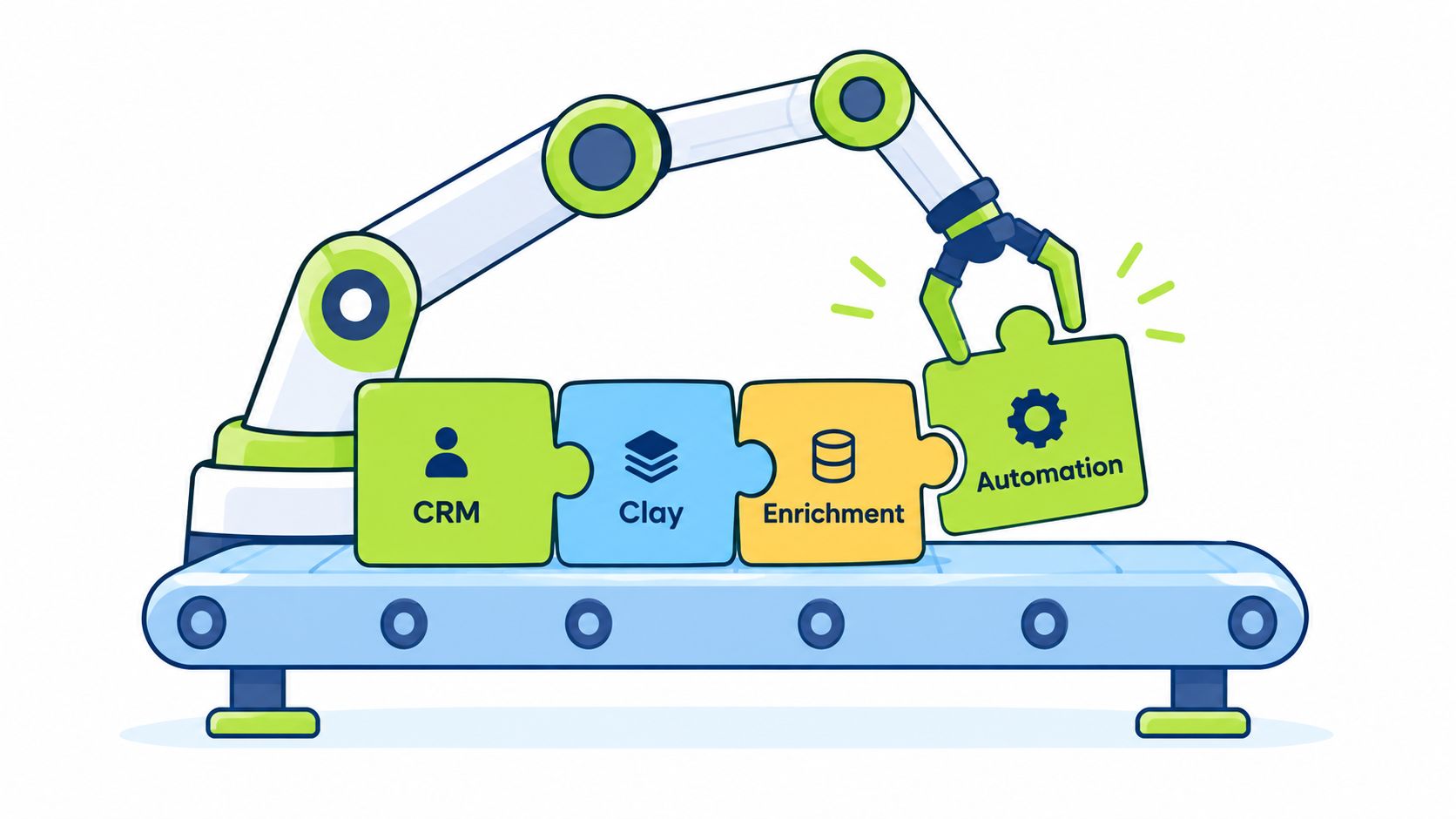
Automate the parts humans shouldn't carry
CRM automation is useful for routing, field completion, stage movement, and reminders. Enrichment tools are useful when the list is thin, the account data is stale, or the buyer context is incomplete. Clay can sit in that middle ground when the team needs flexible research and workflow logic, while the CRM stays the source of truth.
H2's own CRM workflow automation sits in the same operational category, especially where teams need routing, qualification logic, and cleaner handoffs rather than another disconnected tool. The point isn't to add software, it's to remove repeated manual intervention.
Keep judgment where automation gets risky
AI helps draft outreach and speed up research, but it can also magnify bad targeting. Recent industry coverage says more than half of teams are already using AI for personalised outbound emails, and the broader trend is shifting toward intent-based, signal-led outreach (Outreach prospecting coverage). That makes governance more important, not less.
Use approval rules around buyer events, enrichment thresholds, and send readiness. Keep humans in charge of ICP exceptions, message quality, and anything that affects compliance or deliverability. If the process can't explain why a record was enriched, scored, or routed, the workflow needs tighter rules.
The best setup is the one the team can maintain. If a workflow breaks every week, it's too clever. If it runs cleanly with clear fallback paths, it's doing its job.
Your Playbook to Build and Maintain a Healthy Pipeline
Healthy pipeline management comes down to a few essentials. Track reply quality, meetings booked, opportunity creation, and win rate at each handoff. Review stage definitions weekly, remove weak-fit accounts early, and compare real outcomes against the assumptions in your forecast.
Use feedback loops aggressively. Objections, lost deals, and stalled conversations should refine targeting and messaging, not just sit in a notes field. If your team keeps seeing the same problem, the market is telling you where the system is broken.
For teams that need more structure, the choice is usually between fixing a manual bottleneck with a custom system or outsourcing the motion entirely. H2's how to generate B2B leads pairs naturally with that decision because the answer depends on your capacity, your data quality, and how quickly you need qualified conversations. If the ICP is unclear, solve that first. If the process is clear but execution is inconsistent, systematise it before you scale it.
A pipeline only becomes predictable when the team treats it like an operating system, not a lead bucket. Build the gate, run the math, keep the handoffs clean, and the numbers get a lot easier to trust.
If you need a cleaner pipeline, H2 helps B2B teams define the right audience, build the operating system, and run outbound in a way sales can use. Visit H2 if you want a practical review of your ICP, handoffs, and pipeline readiness before you add more volume.
