An ICP scores the account; a persona shapes the message to the person inside it. Collapsing them is the single most common reason outbound wastes working hours.
The popular advice is to define both, then use them together. That misses the operational point: they aren't parallel descriptions. The ICP must filter accounts first, and persona mapping should guide who to contact and what to say only after an account qualifies. B2B buying groups can include 6–11 people, according to a 2021 Gartner finding cited by 6sense's discussion of B2B buying groups. A useful outbound system needs account fit and contact relevance, not a single ideal-buyer profile.
| Layer | What it decides | Where it earns its keep |
|---|---|---|
| ICP | Whether an organisation is worth pursuing | Account selection, scoring and market focus |
| Persona | Which person matters and what's relevant to them | Contact selection, message angle and objection handling |
What ICP and Persona Mean in B2B Outbound
Personalisation cannot rescue a prospect list built around job titles alone. Outbound teams that conflate ICP and persona reach plausible contacts without producing qualified conversations because they never establish whether the employer is a commercially suitable prospect.
An ideal customer profile (ICP) describes the type of organisation likely to get value from an offer and have the capacity to buy it. It covers industry, company size, geography, technology environment, commercial model, operating problem and purchasing capacity. Its job is to answer: Which accounts should the team pursue? Use it to set the threshold for spending research and outreach effort on a company.
A buyer persona describes an individual involved in a purchase within a qualifying organisation. It covers role, responsibilities, authority, objectives, concerns, information needs and influence over approval. It answers: Which person should the team contact, and what matters to them? The persona insights from SigOS offer examples of the human details worth capturing.
A job title doesn't qualify an account, and a good account doesn't make every contact relevant.
Consider a company that fits the ICP but a selected contact who has no role in purchasing. Keep the account; change the contact. When a contact matches the persona but their employer lacks the need or capacity to buy, exclude the account. Better copy will leave that qualification problem unresolved.
Buying authority also extends beyond a single persona. Forrester's 2021 survey of 950 recent B2B buyers found that 60% said they belonged to buying groups of four or more people, as reported in the 6sense buying-groups article. Map who can influence, approve, implement or block the purchase, then tailor outreach to each role.
Treat these as sequential filters inside Clay: qualify companies before using AI to research contacts and draft messages. Validate account fit through commercial outcomes and persona fit through relevant conversations. Revise the layer responsible for the failure instead of rebuilding both whenever a campaign disappoints.
How ICP and Persona Operate at Different Levels
The ICP and persona use different data, drive different decisions and need different validation. Put them in separate account and contact records, or the team won't know whether a campaign missed because it chose the wrong company or the wrong person.
Start with account fit
The account record should capture evidence about the organisation. Useful fields include industry, employee count, revenue band, geography, business model, technology environment, operating problem and ability to buy. Public company information, company websites, job postings and technology usage can help fill those fields. A signal such as a relevant vacancy may warrant investigation, but it doesn't prove that the company intends to purchase.
Account-level qualification should affect market segmentation, account scoring, territory design and list construction. Review the profile against commercial outcomes: historical win rate, retention, deal size, sales cycle and implementation effort. If a segment closes but requires unsustainable implementation work, that matters to account fit. B2B customer segmentation can help teams turn market distinctions into decisions about where to focus.
Then map the people
Contact records should capture role, responsibilities, decision authority, goals, concerns, decision criteria and information needs. Sales-call notes, customer conversations, support discussions and feedback from closed-won opportunities can help establish what those fields mean in practice. A title alone isn't enough: two people with similar titles can hold different responsibilities or influence.
Persona data should guide contact selection, message angle, objection handling and sales enablement. Check whether the right roles reply, whether meetings progress, and whether the people identified as influential appear in closed-won deals. These measures diagnose contact relevance and message fit. They don't tell the team whether the account itself was worth pursuing.
Keep those records distinct. A plausible job title at a commercially unsuitable company is not a qualified prospect. Separate account and contact data lets RevOps trace the cause of a poor result instead of collapsing two different decisions into one lead score.
ICPs and Personas Compared Side by Side
A clear division of responsibility makes the comparison useful. The ICP sets the account boundary; the persona helps the team work within that boundary.
| Criterion | ICP | Persona |
|---|---|---|
| Question answered | Which organisations should the team pursue? | Which people inside those organisations matter? |
| Level | Account | Individual contact |
| Typical data | Industry, size, geography, technology, operating need and buying capacity | Role, responsibilities, authority, goals, concerns and decision criteria |
| Useful evidence | CRM outcomes, company information, technology use and relevant account signals | Sales conversations, customer feedback, role context and buying-group outcomes |
| Qualification output | Include, exclude or prioritise an account | Select, deprioritise or adapt the approach to a contact |
| Message impact | Sets the organisation-level value proposition | Changes the angle, supporting evidence and objection response |
| Validation | Win rate, retention, deal size, sales cycle and implementation effort | Reply quality, meeting progression and influence in closed-won opportunities |
| Likely owners | RevOps, marketing operations, sales leadership and GTM strategy | Sales, marketing, enablement and the teams recording buyer feedback |
Conflicts between the layers are useful signals, not reasons to blend them. If an account scores well but the team can't identify a relevant contact, keep the account qualified while improving contact research or waiting for access to the right role. Don't invent persona fit to make the list look complete.
If a contact fits a persona but the organisation fails the ICP, don't let a familiar title overrule the account criteria. A contact's relevance can't turn a poor-fit company into a sound target. Exceptions should be recorded as deliberate tests, not added to the main audience without explanation.
The operating sequence is simple: use the ICP to choose accounts, then use personas to choose people and shape communication. That's the basis for making account selection and message decisions work together in a Clay workflow.
Using ICP and Persona Together Inside a Clay Workflow
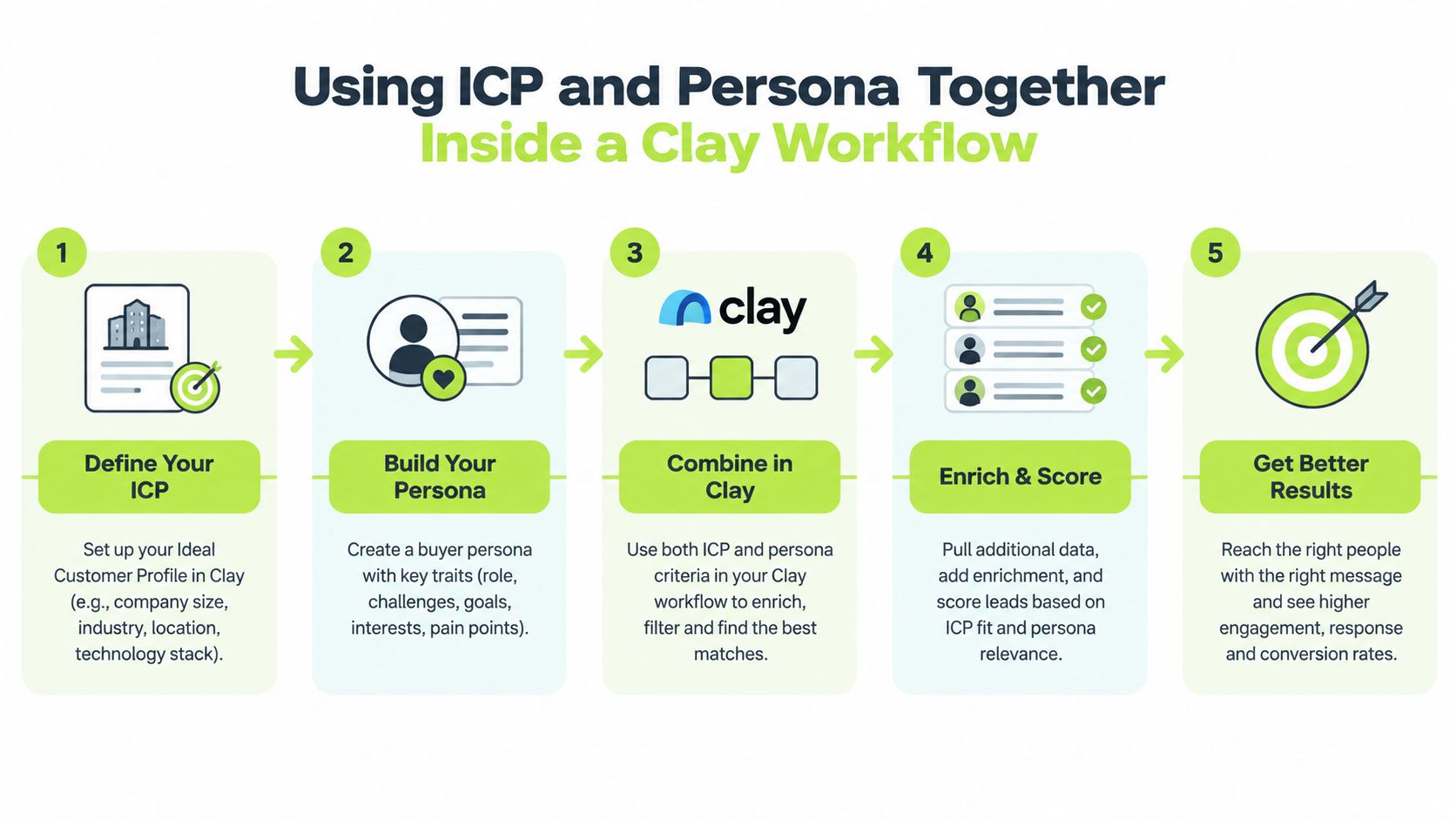
A Clay workflow should enforce the order of decisions. First, assess whether an account meets the ICP. Only then should the workflow find and prioritise relevant contacts. Automating the steps doesn't make the judgement automatic: the team still needs clear rules and reviewable evidence.
Apply account rules before contact rules
An account table can combine firmographic fields, technology indicators and relevant triggers. The workflow can apply explicit inclusion and exclusion rules, flag missing evidence and produce a reason for its account score. A human should review ambiguous records rather than treating an AI-generated classification as ground truth.
Once an account qualifies, the contact stage can find people whose responsibilities align with the buying process. A useful workflow distinguishes the economic buyer, technical evaluator and operational owner, then connects each role to a message angle. Data enrichment and validation can support this hand-off; Clay data enrichment explains how enrichment fits into an outbound system.
Consider a hypothetical database platform campaign. The account qualifies because its technology environment and operating needs match the offer, and available information indicates it can support a purchase. The economic buyer receives a message about commercial risk and value. The technical evaluator gets relevant detail about integration or security. The operational owner sees how the proposed change relates to workload and day-to-day processes.
Clay and AI can help gather evidence, apply repeatable account rules and organise contact research. They shouldn't decide what every role will care about without human review. Review the evidence behind classifications and make sure the message reflects the offer, the account context and the contact's responsibilities. Teams comparing their tooling options can use this outbound sales software comparison to assess how different platforms fit their workflow.
This sequence blocks a familiar failure: prioritising a strong job title at an unsuitable company. It also gives RevOps a useful audit trail, from account evidence to contact choice and message decision.
Building ICP and Persona Templates That Drive Decisions
Delete any template field that cannot change a decision. In Clay, each field should support account qualification, contact selection or a message the team can justify. Keep account fit and buyer relevance in separate records so a promising contact cannot override an unsuitable account.
Account template
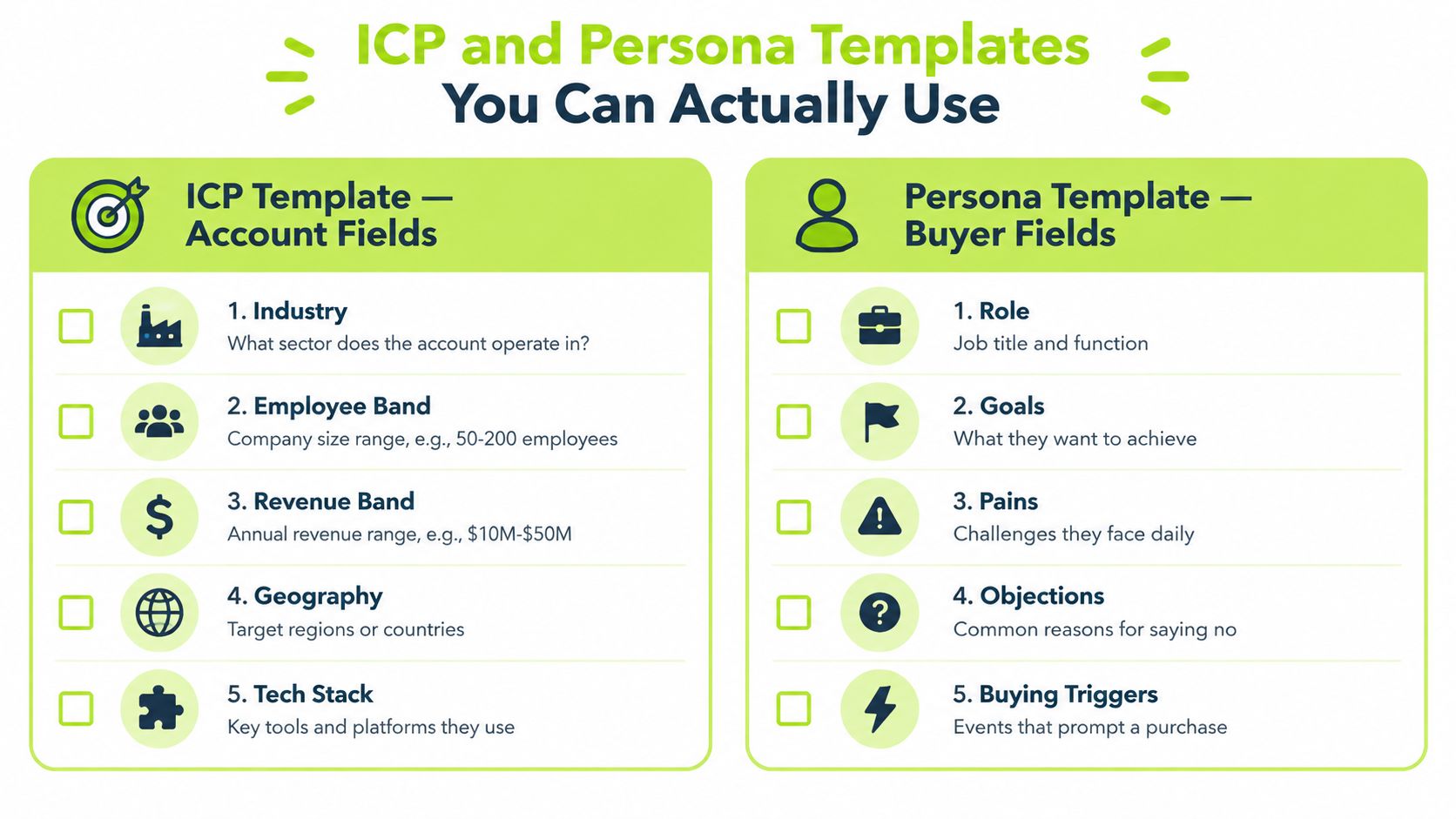
Build the ICP as an account-level record. Give each field a definition, an evidence source and a rule for qualifying, excluding or researching the account. Apply these rules before running contact research.
| Account field | What to record | How it affects qualification |
|---|---|---|
| Industry | Relevant sectors and exclusions | Prioritise sectors where the offer addresses a clear operating problem |
| Employee band | Company size range | Compare team scale with the need and delivery model |
| Revenue band | A known value or an evidence-based estimate | Assess whether the organisation appears able to buy |
| Geography | Supported locations and markets | Exclude places the offer cannot serve |
| Technology stack | Platforms or tools relevant to fit | Identify compatibility, displacement or implementation needs |
| Trigger event | Relevant hiring, migration or organisational change | Flag timing for investigation without assuming purchase intent |
For a hypothetical database platform, require a relevant database environment, a responsible team and evidence of an operating problem the platform addresses. Treat missing evidence as a research task. Keep estimates distinguishable from confirmed values, and require AI-generated classifications to retain their supporting evidence. A hiring signal earns a timing review; it does not satisfy the core fit criteria.
Contact template
Keep persona fields on contact records linked to qualified accounts. Define how each field changes contact selection or outreach:
- Role title and function: routes the contact to a relevant buying-group role.
- Decision authority: records whether the contact approves, evaluates, uses or champions the purchase.
- Success metrics: identifies outcomes worth discussing.
- Typical objections: guides the response and supporting evidence.
- Preferred channels: guides the approach and follow-up.
For the database platform, test a strategic and commercial message with a CTO, technical fit and workload with an engineering manager, and approval requirements, risk and purchasing terms with procurement. Record these as message hypotheses. A title alone does not establish authority, priorities or channel preferences.
Before launch or handover, check field definitions, evidence trails and whether records are current enough for their intended decisions. Track account qualification outcomes separately from contact-role accuracy so feedback reaches the right template. Assign an owner for exceptions, specify how missing data is handled and document which feedback warrants a field or rule change.
The team should be able to explain every qualification status and persona label without guessing.
When to Revise Each Layer Based on Commercial Evidence
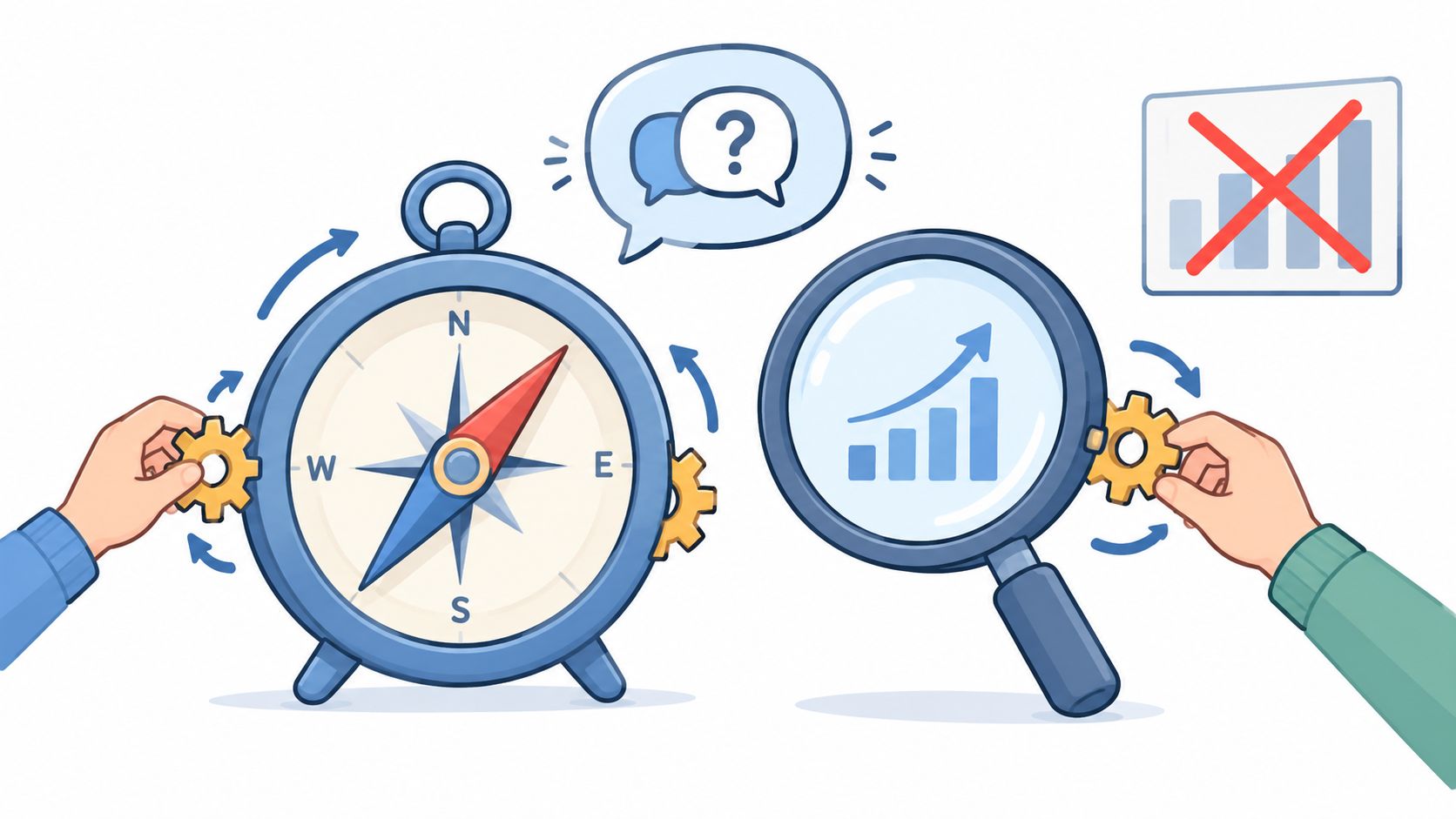
A high reply rate doesn't prove the ICP is right, and a quiet campaign doesn't automatically mean the persona is wrong. Engagement can help diagnose delivery and message issues, but changes to account or contact rules should follow commercial evidence: qualified conversations, objections, conversion by segment and opportunity outcomes.
Use this decision rule:
- Revise the ICP when repeated evidence shows that a different type of organisation gets better value or fits the commercial model more strongly.
- Revise the personas when the organisation type remains suitable, but deals are being bought through different stakeholders than the map describes.
- Change campaign timing when account fit and stakeholder roles hold up, but the urgency to act varies.
Suppose relevant hiring brings an account's technology environment and operating need into alignment with the offer. That trigger can justify investigating or prioritising the account; it doesn't establish purchase intent by itself. In another case, a well-qualified opportunity stalls because a technical evaluator or procurement contact wasn't included. That points to a persona or buying-group gap, not necessarily a flawed ICP.
Personalisation should also serve business outcomes, not decorative name insertion. Deloitte reports that B2B personalisation leaders have higher average order values and customer lifetime value, and are approximately three times as likely as less mature organisations to have exceeded their 2023 revenue goals by at least 10% (Deloitte Digital's B2B personalisation research). That finding supports treating relevant personalisation as a commercial capability, not a reason to personalise every message without evidence.
For a practical way to separate account prioritisation from contact signals, review B2B lead scoring. At each quarterly review, check whether account outcomes support the ICP, whether objections point to a missing persona, and whether changes in timing explain stalled opportunities. Record the evidence, decision and owner. If the evidence doesn't support a change, leave the rules alone.
Choosing How to Operationalise ICP and Persona in Your GTM
Choose the setup that removes your current pipeline bottleneck. If the team has research capacity but limited tooling, score accounts in the existing CRM, then use personas to select contacts and shape messages. Keep account qualification ahead of contact selection.
For substantial outbound volume, use Clay and AI to automate repeatable research, account scoring and contact routing. Treat ICP and persona as sequential filters, with separate checks for account quality and contact relevance. Keep scoring rules visible so RevOps can see why an account or contact qualified. Review AI-generated message decisions before scaling.
Choose outside support around the constraint you need to remove.
A proven offer, capacity for sales conversations and a pipeline shortfall make fully managed outbound a practical option when the team lacks time to operate campaigns. Disconnected data, qualification rules or CRM hand-offs call for a custom GTM system build. A private GTM workshop fits teams that want to build their own capability using live tools and workflows.
Use three questions to make the decision: Is the offer proven? Can the team handle the conversations? Is the pipeline shortfall urgent enough to justify outside support or system work? Keep delivery in-house when capacity covers the work. Buy support when a specific capability or workload gap blocks execution, and define which layer that support must improve.
H2 provides fully managed outbound, custom GTM system builds and private GTM workshops covering account selection, persona mapping and the wider outbound workflow.
If your ICP and persona rules need to operate together, visit H2 to discuss account qualification, contact research and workflow automation.
