Firmographics don't create pipeline. They create a starting list.
A company's industry, size and location can tell you whether it resembles your ideal customer, but they can't tell you whether the account has a live problem, the right buying group, or enough internal agreement to move. Two companies with the same headcount and technology stack may respond very differently because one has an urgent trigger and an available budget, while the other has no project and no internal owner.
That's why effective B2B customer segmentation should be treated as an operating system for go-to-market teams, not a research document. A useful segment changes who sales contacts, what they say, when they say it, how accounts are routed, and which opportunities receive attention. If it doesn't change a commercial decision, it's only a label.
Why Static B2B Customer Segmentation Fails
The popular advice is to divide the market by industry, company size, geography and job title, then create a persona for each group. Those fields are useful, but they rarely explain enough to support a reliable outbound motion. They describe what an account is, not what it's trying to do or whether it can buy.
Segmentation has a strong historical foundation. Wendell R. Smith's 1956 article, “Product Differentiation and Market Segmentation as Alternative Marketing Strategies”, argued that businesses could improve marketing efficiency by dividing broad markets into groups with different preferences rather than relying only on mass marketing. The principle still holds. The mistake is treating the resulting groups as permanent categories instead of hypotheses that must guide action.
A static segment might contain software companies with similar revenue, employee count and location. Yet one account may be replacing an ageing system, another may be hiring engineers to build internally, and a third may have already committed budget to a competing platform. The firmographic profile is similar. The commercial situation isn't.
The segment must earn its place
A segment is valuable only when it maps to a distinct sales or marketing decision. That decision might be:
- Routing: Send accounts with a complex buying committee to an enterprise specialist.
- Messaging: Lead with integration risk for technology teams and operating efficiency for finance-led buyers.
- Prioritisation: Work accounts showing a relevant trigger before otherwise similar accounts with no evidence of an active project.
- Coverage: Give high-fit, high-consensus accounts coordinated account-based attention rather than a generic sequence.
A statistically neat cluster doesn't automatically deserve a campaign. It may be too small to reach, impossible to identify in the CRM, or indistinguishable from another group once a salesperson starts a conversation.
Practical rule: If two segments receive the same message, follow the same qualification process and go to the same owner, they probably aren't separate commercial segments.
The operational alternative is to treat segmentation as a live pipeline. Start with a market hypothesis, define the account conditions that support it, add buying and organisational signals, then test whether the group produces a different sales outcome. Membership should change as the account's situation changes.
This approach also prevents overconfidence in buyer personas. A job title is a useful clue, but it doesn't reveal whether someone controls budget, can approve technical feasibility, or is just researching on behalf of another team. Account fit and buyer role need to be connected to current buying conditions.
Building a Multi-Layered Data Foundation
Static firmographic clusters rarely create pipeline by themselves. A useful segmentation model connects account fit with technology, organisational change, observed behaviour and current business needs. The goal is a data foundation that helps a team decide who to contact, why now and what evidence would change that decision.
Start with the fields your team can explain and maintain. Before buying more intent products, check whether the CRM has consistent account names, industry labels, employee counts, locations, technology fields and ownership rules. Missing or contradictory fundamentals make advanced scoring appear precise while reducing trust in every recommendation.
Organise the foundation by the commercial question each layer answers:
| Data layer | Examples | What it helps determine |
|---|---|---|
| Firmographic | Industry, company size, revenue, geography, business maturity | Whether the account fits the market |
| Technographic | Platforms, integrations, infrastructure and relevant software usage | Whether the solution can fit the account |
| Organisational | Hiring activity, leadership changes, team structure and operating capacity | Whether the business may be changing |
| Behavioural | Website engagement, content interaction, event participation and response history | Whether interest is observable |
| Needs and triggers | Public operational problems, replacement projects, expansion or compliance pressure | Whether timing and relevance are present |
Firmographics provide the first filter because they are comparatively observable. Technology and organisational records add context. An account using a compatible system may be a better technical prospect, while a new team or leadership change can signal a developing service gap.
Behavioural activity needs a cautious interpretation. A page visit or content download can reflect curiosity, research or an active project. It should influence prioritisation without becoming proof of purchase intent. Teams building prospecting workflows can use this guide to B2B intent data for a practical explanation of behavioural signals.
Audit the foundation before enrichment
Run a field audit before adding providers or automation. Look for duplicate account records, inconsistent labels such as “financial services,” “fintech” and “banking,” and outdated employee, leadership or technology data. Document each source and its last verification date so sales representatives can judge whether an attribute is usable.
Remove or deprioritise fields that do not support a decision. A field earns its place when it changes a campaign, routing rule, qualification question or account review. Otherwise, enrichment spend adds volume without improving execution.
Keep scoring interpretable. Give fit a stable role, then score relevance and timing separately. A strong-fit account with no active trigger may deserve less attention than a slightly smaller account with a clear operational problem and an identifiable owner.
A 2024 benchmark summary reported a 1.5-times revenue-growth advantage for companies using advanced behavioural and intent-based segmentation compared with companies relying only on firmographic segmentation. The source presents a benchmark comparison rather than a universal causal rule, so treat it as a reason to test richer inputs, not as a performance promise. The benchmark summary supports the operating principle: combine account characteristics with observable context, then refresh membership as campaign evidence changes.
Scoring for Buying Group Consensus
Firmographic fit does not show whether an account can buy. Consensus does. A company may match the ideal customer profile while its stakeholders disagree about the problem, budget, risk or implementation path.
B2B purchases commonly involve seven to ten stakeholders across IT, operations, finance and end-user functions, and 72% of purchases involve complex multi-stakeholder groups, according to Demandbase's buyer research. Those findings show why a single contact can create false confidence in an otherwise promising account.
Map influence before assigning priority. A user may feel the operational pain but lack budget authority. A finance approver may control spend without experiencing the problem. A technical evaluator can stop progress through integration, security or feasibility concerns. Procurement and legal may add approval gates. Treat these roles as separate evidence, not as one generic “decision-maker” field.
Score evidence of agreement
Build the account view around the buying group:
- Problem owner: the person who experiences the operational cost or risk.
- Champion: the stakeholder willing to advocate for change internally.
- Economic buyer: the person who owns or releases the budget.
- Technical validator: the person assessing integration, security and feasibility.
- Procurement and legal: the functions that can delay or veto the agreement.
- End-user representative: the person who can confirm whether the proposed workflow works in practice.
A missing role is useful information. An enthusiastic user with no path to budget authority may represent strong account fit but weak near-term consensus. That account belongs in a different campaign motion from one where the problem owner, champion and economic buyer are already connected.
Score observable evidence, including confirmed budget ownership, a named problem owner, internal advocacy, technical requirements, approval complexity and agreement on the business outcome. Keep consensus separate from account fit. A large, attractive account can remain a poor priority if no stakeholder owns the decision.
Use a visible B2B lead-scoring framework, but adapt it to buying-group evidence rather than hiding consensus inside an opaque ranking. Sales should be able to see why an account received its score and challenge a missing or stale signal.
Three practical bands work well: low consensus, contested consensus and ready consensus. Low-consensus accounts need education and research across multiple contacts. Contested accounts need stakeholder-specific proof, risk reduction and material that supports internal alignment. Ready accounts can receive a direct commercial conversation when the evidence shows that the relevant roles agree on the problem and next step.
Treat each segment as a live campaign pipeline. Re-score it as new stakeholders appear, objections surface or approval conditions change.
The best-fit account is not always the best next account. Prioritise the account that can recognise the problem, align the relevant roles and take a decision.
Validating Segments for Commercial Action
A segment earns a place in a campaign only when it changes a commercial decision. A mathematically neat cluster can still fail if it contains too few reachable accounts, hides different buying situations, or gives sales no clear reason to treat those accounts differently.
Start the review with the campaign, not the model. For each proposed segment, write the trigger, target roles, qualification question, message, route and expected outcome. Then test whether those choices differ from adjacent segments. If the same rep would use the same message and sales motion for both groups, the split has little operational value.
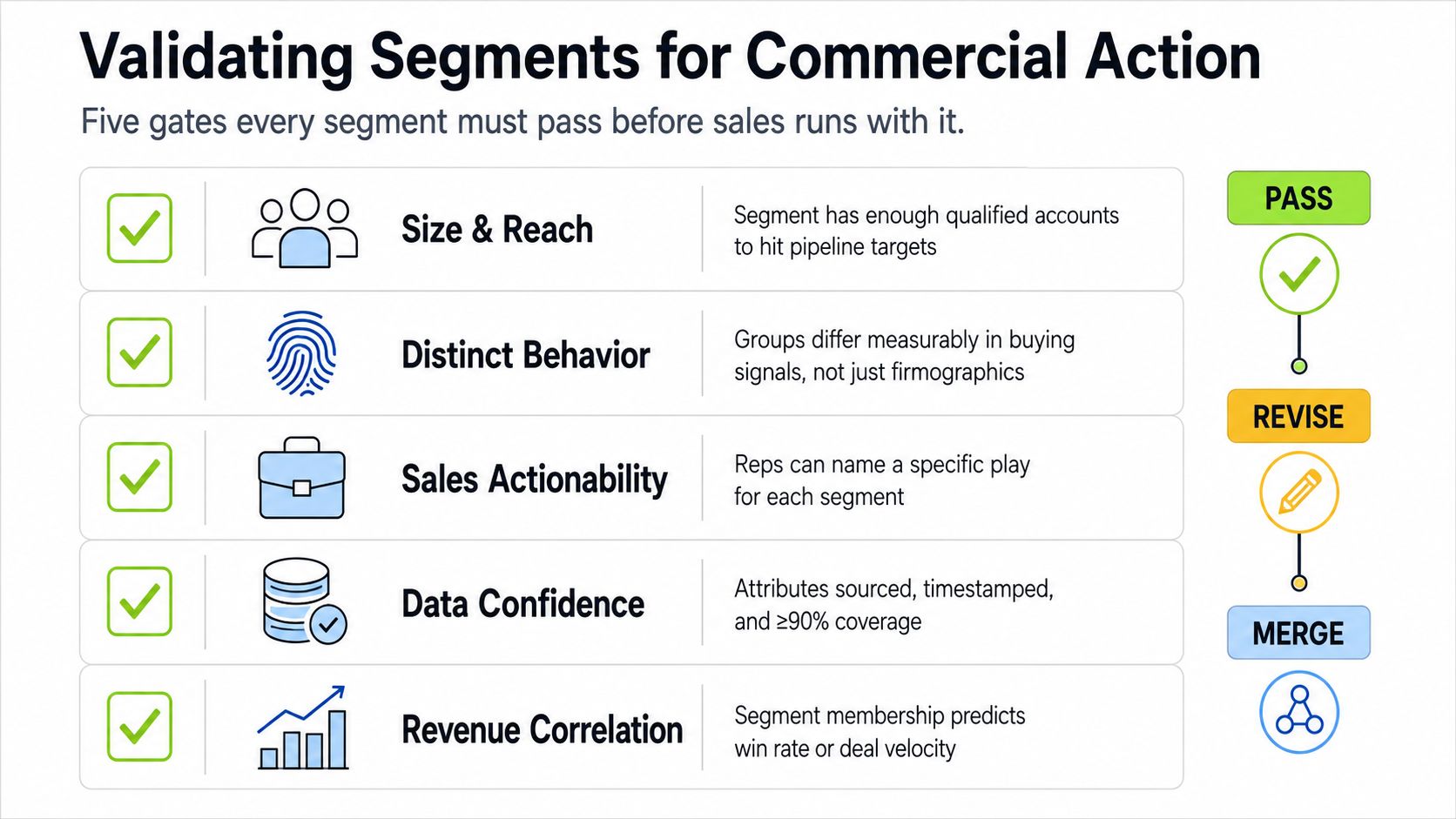
A practical acceptance review should cover five questions:
- Reachable volume: Are there enough qualified accounts for a genuine campaign or service motion?
- Distinct buying situation: Does the group differ in needs, buying signals, stakeholder structure or sales outcomes?
- Commercial action: Can reps state the opening message, route and qualification play?
- Data confidence: Are inclusion rules documented, sourceable and maintainable in the systems used by the team?
- Outcome relevance: Does membership relate to meetings, conversion, wins, retention, expansion or cost to serve?
The review should also test consensus risk. A segment may show strong firmographic fit while the account lacks a connected buying group. Separate account fit from readiness to act. Record whether a named problem owner exists, whether another stakeholder advocates for change, whether technical requirements are known and whether approval complexity could stall the opportunity.
The original section cited survey figures from the customer segmentation whitepaper. The useful lesson is broader than the reported percentages: validation and maintenance need named owners, visible rules and a defined refresh point.
Have sales, marketing and revenue operations inspect sample accounts together. Customer-facing experts can expose false distinctions quickly because they recognise when a profile does not match a real buying conversation. If a segment has no owner, qualification rule or refresh cadence, merge it into a broader group.
Treat the result as a live campaign pipeline. Re-score accounts as new stakeholders appear, objections surface or approval conditions change. The best next account is the one that can recognise the problem, align the relevant roles and take a decision.
Operationalising Segments in Outbound Campaigns
A segment earns its place only when it changes campaign decisions. Each account record should show why the account qualifies, which problem deserves attention, which contacts belong in the buying group, and who owns the opportunity.
Start with a campaign brief, not a static list export. Define the inclusion and exclusion rules, likely trigger, buying-group roles, proof points, disqualifiers, channel plan, handoff condition, and the question the campaign must answer. For example, a technology gap may be visible in the data without being a funded priority. The brief should make that uncertainty explicit.
Turn signals into different plays
Similar firmographic fit can require very different outreach:
- Urgent trigger, clear owner: Lead with the operational event and ask whether the account is evaluating options. Route the conversation to sales when the problem owner engages.
- Strong fit, weak consensus: Begin with the likely user or champion, then map finance and technical stakeholders. Give the champion material that supports internal agreement.
- Strong fit, technical friction: Address integration, migration, security, or implementation risk early. Bring in a technical resource before a generic business case stalls.
Match copy to the evidence. A hiring signal supports a question about capacity or workflow pressure. It does not establish an approved project. A technology match supports an integration angle, but it does not prove dissatisfaction with the current vendor.
Treat consensus as a campaign state, not a fixed account attribute. Re-score the account when a stakeholder appears, an objection surfaces, or approval conditions change. An account with excellent firmographic fit may still be a poor next action if no problem owner, advocate, or path to approval is visible.
Routing must reflect those states. Use CRM fields or workflow automation for segment, consensus band, trigger, source date, and owner. Set explicit responses for an interested reply, conflicting stakeholder signals, and failed enrichment. Manual exceptions will occur, but repeated exceptions usually indicate that the rules need revision.
Teams can use an outbound sales strategy as the execution layer, then adapt the motion to each segment's evidence and friction. Marketing automation can identify and enrich accounts. SDRs must test the buying situation through conversation, while sales and marketing review campaign outcomes together. An automated score prioritises work, but qualification determines whether an account can become pipeline.
Measuring Impact and Refreshing Models
Segmentation should be judged by pipeline outcomes, not by the number of groups produced or the sophistication of the algorithm. The right question is whether a segment helps the team spend time more intelligently and create better opportunities.
Track outcomes at segment level, but keep the definitions consistent. Useful measures include:
- Qualified-meeting rate: Whether contacted accounts produce conversations that meet the agreed qualification standard.
- Opportunity conversion: Whether qualified conversations progress into genuine opportunities.
- Win rate: Whether opportunities from the segment become customers more often than comparable opportunities.
- Pipeline velocity: How quickly qualified opportunities move through the sales process.
- Retention and expansion: Whether the segment supports durable customer value after acquisition.
- Cost to serve: Whether the commercial return justifies the research, enrichment and delivery effort.
The benchmark evidence cited earlier reported that 67% of net-new B2B revenue among above-average-performing organisations was concentrated in their top three named segments, and that Tier 1 ideal-customer-profile opportunities had a 36% higher win rate than opportunities from Tier 2 or Tier 3 segments. Treat these as comparative benchmark claims, not guaranteed effects. They support a disciplined portfolio approach, where teams concentrate effort on the segments that demonstrate commercial relevance instead of distributing resources evenly.
Build a feedback loop
Sales feedback should change the model. Capture objections such as “no budget,” “wrong owner,” “already solved,” “timing is unclear” and “security review is too difficult.” Then compare those objections with segment membership, trigger type, consensus score and message version.
Refresh membership when the market changes, packaging changes, data coverage drops, or buying behaviour shifts. A segment that once separated responsive accounts may become indistinguishable after the market matures. Collapse groups when their messages, qualification rules and outcomes converge. Split them only when the difference produces a distinct action and enough evidence to support it.
A useful operating rhythm includes a regular data review, a campaign performance review and a sales validation review. The specific schedule should match how quickly your market changes, but ownership must be explicit. Revenue operations can maintain definitions, marketing can monitor response patterns, and sales can confirm whether the profiles still describe real buying situations.
The strongest segmentation systems remain modest in complexity. They combine fit, behaviour, buying-group structure and consensus risk, then connect those inputs to routing and messaging. That turns B2B customer segmentation from a static report into a pipeline that learns from every reply, objection and opportunity.
H2 can help you turn segmentation rules into researched account lists, buying-signal workflows, qualification logic and outbound campaigns, whether you need a managed programme, a custom GTM system or practical team training. If your current segments aren't producing qualified conversations, visit H2 to discuss your audience, data and next commercial move.
