61% of B2B teams now use AI for lead scoring, while median MQL-to-SQL conversion sits at 13%, showing that most models need recalibration before they improve pipeline. The practical answer is to score in two layers, fit first and behaviour second, then validate the result against sales acceptance, conversion by score band and speed to follow-up.
That gap is the uncomfortable part of lead scoring B2B. More automation hasn't automatically produced better qualification. The strongest teams reach a 28% MQL-to-SQL conversion rate, compared with the 13% median reported in the same 2026 benchmark, so scoring quality can more than double the handoff rate when the model reflects actual buying conditions (Digital Applied's B2B lead generation benchmark).
The failure usually isn't a missing points field in the CRM. It's an operating model that rewards activity, hides its reasoning and never learns from what sales accepts. A score that can't explain itself becomes another dashboard metric, not a useful decision rule.
Why Most Lead Scoring Models Underperform
Lead scoring is often treated as a marketing setup exercise. Someone adds points for a form fill, an email open and a page visit, chooses an MQL threshold, then hands the result to sales. The workflow looks complete, but the commercial definition of quality remains unresolved.
That's why a high score can coexist with weak pipeline. Marketing may optimise for volume and engagement, while sales evaluates role, account fit, timing, authority and whether there's a credible problem to solve. If those teams use different definitions of readiness, the score formalises the disagreement.
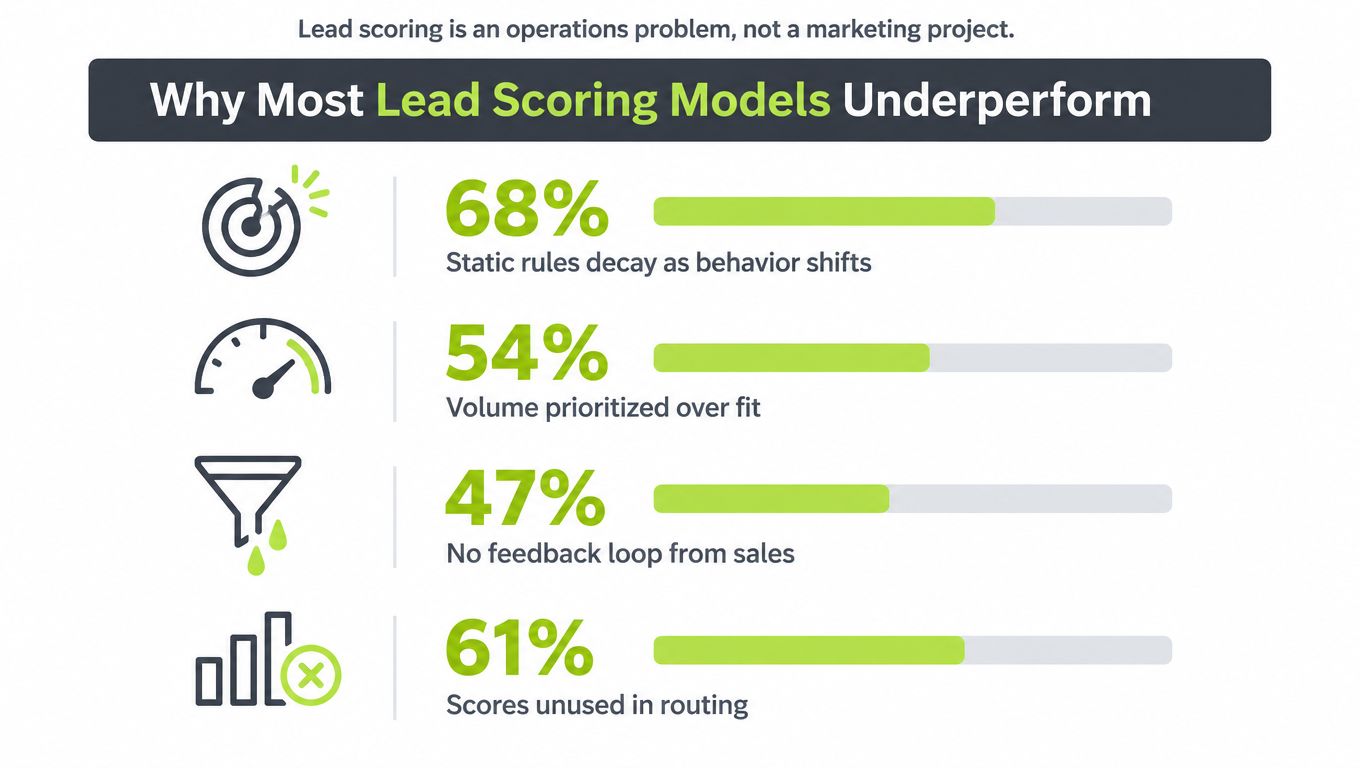
The gap between activity and qualification
The benchmark difference matters because it shows that a scoring system isn't valuable merely because it produces a number. A 13% median MQL-to-SQL conversion rate means most handoffs still fail to become accepted sales opportunities, while the 28% top-quartile rate points to a large operational gap rather than a marginal optimisation opportunity (Digital Applied's benchmark data).
Several patterns create that gap:
- Static rules: Buyer behaviour changes, but the original weights stay untouched.
- Passive engagement bias: Opens and page views inflate scores without proving active intent.
- Missing sales feedback: Reps reject leads, but nobody translates those decisions into new rules.
- Disconnected routing: A lead crosses the threshold but waits in an unowned queue.
Data quality compounds each problem. If company size, role or technology information is missing, a fit score can understate a strong account. A targeted data enrichment workflow can improve the inputs, but enrichment won't rescue a model whose threshold or definition of qualification is wrong.
Treat the score as an operating decision
A useful model answers three questions clearly:
- Should this account be able to buy from us?
- Is there evidence that buying may be active now?
- What should happen next, and who owns it?
The first question belongs to fit. The second belongs to behaviour and intent. The third belongs to routing, service levels and sales acceptance.
Automation can help once those decisions are explicit. A 2024 industry summary reports a 10% boost in overall revenue generation for organisations automating lead management, while structured or predictive scoring is cited as improving conversion or qualification accuracy by 25% to 40% versus manual or rule-based systems. Those figures support automation as an execution layer, not as a substitute for commercial judgement.
Practical rule: If a rep can't explain why a lead scored highly by looking at the CRM record, the model isn't ready for broad adoption.
Defining Fit Before Behaviour
Start with the customers you already won. The ideal customer profile shouldn't be a list of attributes that sounds plausible in a planning meeting. It should describe the accounts that bought, reached value, renewed or created the kind of commercial outcome your team wants more often.
Pull closed-won records and compare them with closed-lost and disqualified records. Look for repeated patterns in industry, company size, role, geography, operating model and existing technology. The point isn't to find a perfect description of every customer. It's to identify useful distinctions between accounts worth prioritising and accounts that consume sales capacity without a realistic path to value.
Build the fit layer from evidence
A practical sequence looks like this:
- Start with account characteristics. Identify the industries and company profiles where your offer solves a recognisable problem.
- Separate buying roles. A user, technical evaluator, budget owner and procurement contact shouldn't automatically receive the same fit treatment.
- Record disqualifiers. Include incompatible industries, unsuitable company types, non-business contact details or roles with no connection to the buying process.
- Check data availability. Don't create a scoring field that your CRM or enrichment process can't populate reliably.
- Review exceptions with sales. A useful model must account for valuable accounts that don't match the dominant historical pattern.
Keep the logic visible. Reps should be able to see which firmographic and role attributes contributed to the score, rather than receiving an unexplained grade from a separate system. Transparency makes it easier to challenge a bad input without rejecting the entire framework.
Turn customer patterns into weighted rules
Use weights to express commercial importance, not internal politics. If industry is a strong predictor of fit, it should carry more influence than a low-value profile field. If a role rarely participates in successful deals, it shouldn't receive a high score just because that title appears frequently in your database.
Fit also needs a ceiling. A poorly matched account shouldn't become sales priority because one contact consumed a large amount of content. Many teams need to resist the temptation to let behaviour overwhelm firmographic reality at this point.
The practical guidance on B2B prospecting is useful here because prospecting and scoring depend on the same discipline: define whom you can help, identify evidence of relevance and avoid mistaking available contacts for qualified buyers.
A transparent 0–100 model can work well, especially when it includes negative scoring for disqualifying attributes. The scale itself isn't the strategy. The value comes from documenting what each range means, which records qualify for sales attention and which signals can move a lead out of priority.
The fit layer should answer “worth pursuing?” before behaviour answers “worth pursuing now?”
Weighting Behavioural and Intent Signals Correctly
Behaviour should refine fit, not replace it. A senior buyer at a target account who requests a demonstration has a different commercial meaning from an unrelated visitor who opens several emails. Both are engagement events, but they don't represent the same buying signal.
Start by grouping activities according to the effort and commitment they imply. A pricing-page visit or comparison download can indicate active research. A demo request, reply, consultation request or explicit buying question usually gives sales a stronger reason to act. An email open, by contrast, is easy to trigger and can be affected by inbox technology, forwarding or routine scanning.
Give bottom-of-funnel actions more influence
A sensible hierarchy might look like this:
- Low-intent activity: An isolated email open or general blog visit should contribute little.
- Research activity: A technical guide, webinar or repeated product-page visit may indicate a developing project.
- Commercial activity: Pricing research, competitor comparison and solution-specific questions deserve stronger consideration.
- Direct intent: A meeting request, demo submission or reply that describes a need should receive the clearest priority.
The exact values must come from your own outcomes. Don't copy a points table from another company. A technical whitepaper may be highly relevant for one business and largely educational for another.
The B2B demand generation framework provides a useful reminder that content engagement needs commercial context. A lead can consume material because they're researching a category, supporting a colleague or learning about a problem they won't purchase around. The score should preserve that uncertainty until stronger evidence appears.
Add time decay and negative scoring
Old activity shouldn't look like current intent. Use time decay so that a recent action carries more weight than an identical action from a much earlier period. Subtract points for stale engagement, invalid contact details, unsubscribes, repeated inactivity or a clear mismatch with the ICP.
Negative scoring is especially important when passive activity has accumulated. Without it, a contact can keep a high score long after the buying window has closed. That creates false urgency and teaches sales reps to distrust every score.
A useful rule is to require a combination of fit plus recent intent before handoff. A highly suitable account with no current signal may belong in nurture or account research. A highly active contact with poor fit may need qualification, not immediate routing.
Don't let one event dictate the entire score. Use multiple signals, attach the reason codes to the CRM record and make the handoff explanation readable in a sentence. “Target account, technical buyer, recent pricing activity” is more useful to a rep than an unexplained total.
Rule-Based, Predictive and Automated Scoring Approaches
The right scoring architecture depends on the quality of your data, the volume of records and the team's ability to maintain the system. More complex doesn't always mean more useful. A transparent rule set that sales understands can outperform a predictive model that nobody trusts or can audit.
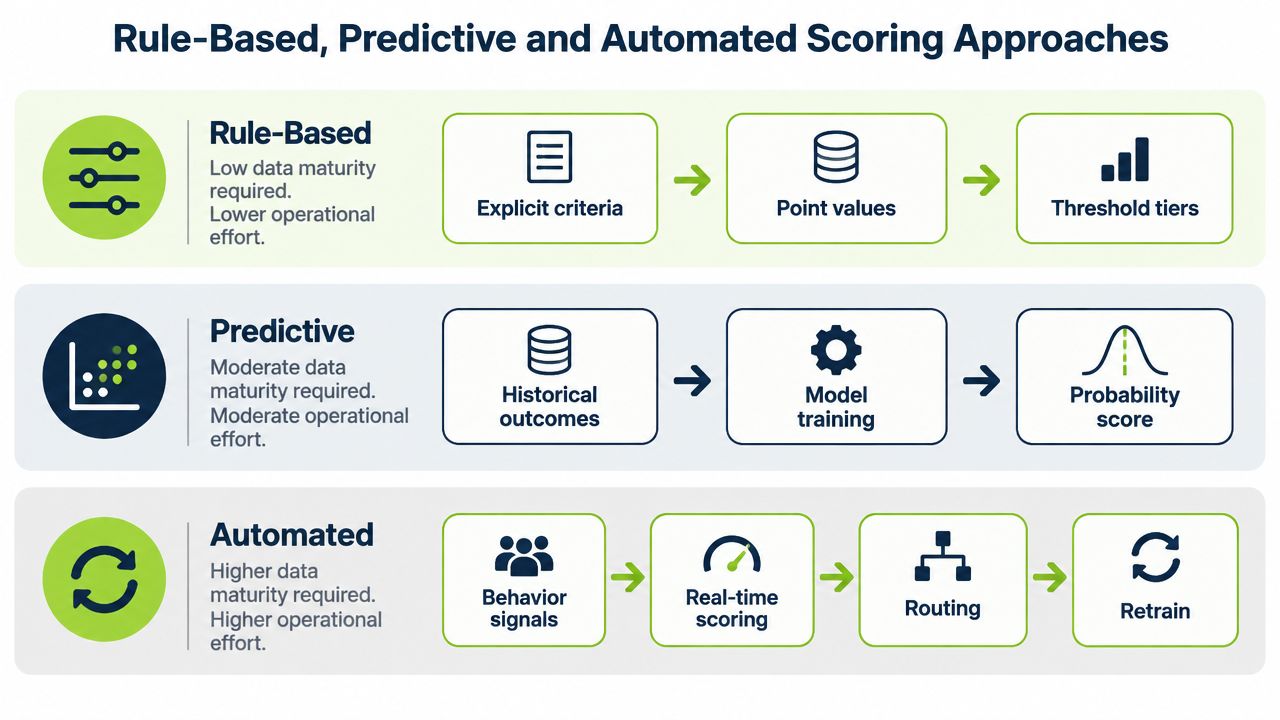
Choose the architecture that fits your maturity
| Approach | What it does well | Main trade-off |
|---|---|---|
| Rule-based | Makes criteria, weights and thresholds easy to explain | Requires regular manual review and can become brittle |
| Predictive | Finds patterns across historical outcomes that teams may overlook | Needs reliable training data and can feel opaque |
| Automated | Connects score changes to routing, alerts and nurture actions | Automates bad decisions if the underlying rules are weak |
Rule-based scoring is usually the sensible starting point. It gives marketing, sales and RevOps a shared language, and it exposes disagreements early. Predictive scoring becomes more useful when the CRM contains consistent outcome data and the team can test whether model outputs correlate with accepted opportunities.
The operational layer is separate from the scoring method. Whether the number comes from manual rules or a predictive engine, the CRM still needs to decide what happens next. Teams evaluating ways to score leads with real-time data should assess not just calculation speed, but also the visibility of reasons, routing controls and feedback capture.
Connect the score to a CRM workflow
A workable workflow is deliberately plain:
- A contact enters through a form, campaign, referral or outbound response.
- The CRM checks firmographic and role data against the fit rules.
- Behavioural events update the score, with stronger influence for active intent and deductions for stale signals.
- The score crosses a documented threshold.
- The CRM displays the reasons and routes the record by territory, segment, capacity or specialist knowledge.
- Sales accepts, rejects or reclassifies the lead using a required reason.
- Accepted and rejected outcomes feed the next review.
This design keeps routing close to qualification. A score sitting in a marketing platform doesn't create pipeline if nobody owns the next action.
Avoid the black-box trap
Predictive systems can be useful, but the model should still expose enough information for a rep to understand the decision. If the only explanation is “high propensity,” sales has no basis for a relevant first conversation and no practical way to challenge bad data.
Use predictive scoring as an adviser when trust is still developing. Compare its recommendations with a transparent fit-and-behaviour model, inspect false positives and false negatives, then decide whether the added complexity improves accepted opportunities. The most advanced tool is the one your team can operate, question and improve.
Testing Scoring Models and Monitoring Acceptance Rates
Launch day is the beginning of model management, not the finish. Buyer behaviour changes, products reposition and sales teams develop new qualification habits. A score that once identified useful opportunities can gradually become a proxy for whatever activity marketing happens to measure most consistently.
The first report should connect score output to sales action. Track sales-acceptance rate, conversion by score band and time-to-first-touch. These measures tell you whether the model identifies records that sales wants to work, whether higher scores correspond to better outcomes and whether routing creates a timely response.
Build a feedback loop sales will actually use
Make rejection reasons structured and specific. “Not interested” doesn't help recalibration, while “outside target industry,” “no active project,” “wrong role” or “duplicate account” points to a distinct rule or data problem.
Review the following together:
- Acceptance by score band: If low scores are accepted and high scores are rejected, your weights or threshold need attention.
- Conversion by score band: Higher bands should show stronger progression, although timing can vary by sales cycle.
- Time-to-first-touch: A strong lead that waits for ownership is an operational failure, not a scoring success.
- Reason-code patterns: Repeated rejection reasons reveal missing exclusions, weak fit fields or inflated behaviour weights.
- Score movement: Sudden jumps may indicate duplicate events, tracking changes or an integration problem.
A score is only validated when sales behaviour and pipeline outcomes support it.
Test thresholds without moving the goalposts randomly
Change one decision at a time. You might compare the existing MQL threshold with a stricter threshold for a defined cohort, or require a recent intent event alongside a high fit score. Keep the routing process, sales ownership and reporting definition stable while the test runs, otherwise you won't know what caused the result.
Don't judge a threshold by lead volume. A lower threshold may increase the number of handoffs while lowering acceptance quality. A higher threshold may improve relevance but hide useful early-stage accounts from nurture and account development. The right choice depends on the capacity and response model of your sales team.
Review the model monthly when it's new or unstable, then establish a regular calibration rhythm once the data becomes reliable. The operating guidance behind practical B2B scoring recommends monitoring acceptance, conversion by score band and time-to-first-touch rather than relying on the total score alone (Allied Insight's B2B scoring guidance).
Document every change. Record the rule, reason, date, expected effect and observed result. That history prevents teams from repeatedly adding and removing points based on the latest anecdote from a single sales call.
Account-Level Scoring for Complex B2B Buying Committees
A contact can look ready while the account remains unprepared. That happens when one person downloads a guide, requests information or visits pricing, but no one else at the company confirms the problem, evaluates the solution or controls the budget.
Complex B2B sales require account context. For deals above roughly $50,000, Gartner-cited guidance says the average buying committee includes 6–10 stakeholders (Graph Digital's lead-scoring guidance). Scoring only one contact can therefore hide important activity from technical evaluators, users, procurement and economic buyers.
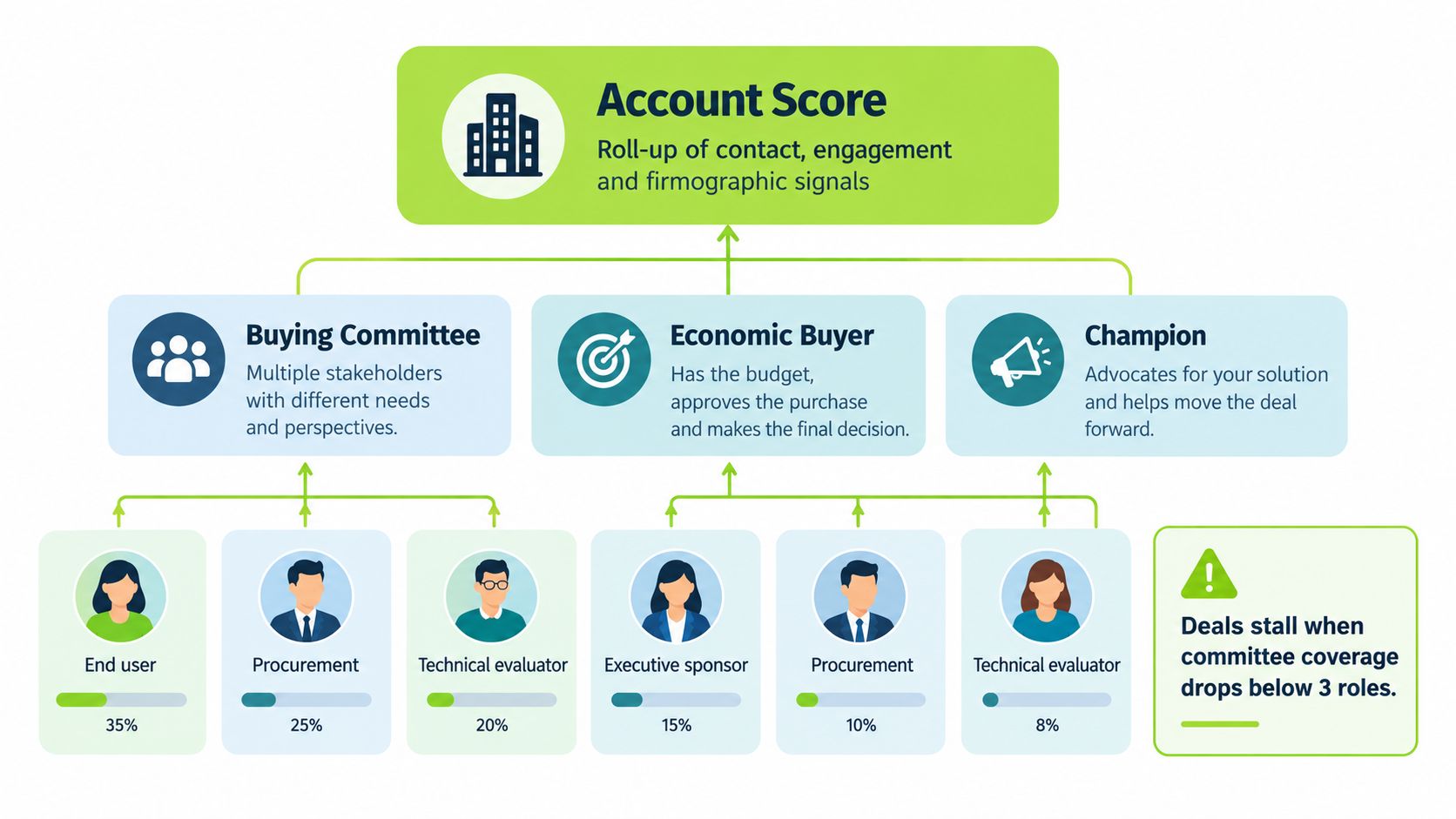
Move from lead priority to account readiness
The account score shouldn't just add every contact's activity together. That would reward a large number of low-value interactions and could allow one enthusiastic researcher to distort the picture. Instead, use the account layer to capture coverage, relevance and coordination.
Consider these dimensions:
- Coverage: Are multiple relevant roles engaged, or is activity concentrated in one contact?
- Role diversity: Does the account include a user, technical evaluator, champion or economic buyer?
- Signal quality: Are contacts taking actions that relate to evaluation, implementation or commercial approval?
- Fit consistency: Do the engaged people belong to an account that matches the ICP?
- Recency: Is the activity current enough to justify sales attention?
A champion can create momentum, but a champion alone doesn't guarantee approval. A technical evaluator can validate feasibility, but may not own the budget. The account score should make those gaps visible so sales can plan the next contact rather than treating a single high score as a complete opportunity.
Combine person and account signals carefully
Keep person-level scoring for individual outreach. Add account-level fields for the broader buying situation. A contact might have a high personal score because they requested a demonstration, while the account receives a moderate readiness score because no economic buyer or technical stakeholder has engaged.
That distinction creates better routing and better messaging:
- High contact score, low account score: Follow up with the contact and research missing stakeholders.
- Moderate contact scores across several roles: Treat the account as active because the pattern matters more than any one event.
- High account fit, weak recent behaviour: Prioritise research or targeted outbound rather than sending a generic sales alert.
- Strong activity from irrelevant roles: Verify the project before assigning significant sales capacity.
Account scoring also helps prevent duplicate outreach. If several contacts from one company are active, the CRM should show shared context, ownership and recent interactions. Without that view, multiple reps may contact the same account with conflicting messages, while another promising stakeholder receives no attention.
Make committee coverage operational
Assign account ownership before the score becomes urgent. Define who researches missing roles, who coordinates the opportunity and which signals trigger a multi-threading task. The system should also preserve the evidence behind the account score, including contact roles, relevant actions and the age of each signal.
Formal scoring is associated with about 138% ROI on lead generation, compared with 78% for organisations without scoring, and B2B firms are reported to see about a 77% lift in lead-generation ROI after introducing structured scoring (Graph Digital's benchmark summary). These figures are useful as directional benchmarks, but they don't remove the need to measure your own accepted opportunities and pipeline progression.
A practical account model can remain transparent:
- Fit establishes account eligibility.
- Contact activity shows individual interest.
- Role coverage indicates buying-group health.
- Recent intent determines urgency.
- Sales acceptance confirms whether the combined signal is useful.
The commercial outcome matters more than the elegance of the model. If account scoring gives reps a clearer reason to contact another stakeholder, improves handoff quality and reduces duplicate outreach, it is doing useful work. If it only creates another colour-coded field, remove the complexity.
H2 can design custom GTM systems around account research, buying signals, qualification, lead scoring and CRM routing, then document the decision rules and operating process for the team. Visit H2 to discuss a scoring workflow that connects prospect data with sales acceptance and qualified pipeline.
