You can feel when prospecting has gone off the rails. The inbox is busy, the list is long, the sequence is live, and still the meetings aren't the right ones. Maybe you've sent thousands of emails, got a few polite replies, and realised the people answering weren't the buyers you needed in the first place.
That's the trap many teams fall into. How to prospect is usually treated like a volume problem, but the core issue is usually sharper, better research, stronger positioning, and tighter prioritisation. Buyers are already doing their homework before they speak to sales, and buying groups are bigger than most outreach plans assume, so the job is to show up with something that fits the account, the stakeholders, and the timing.
The Targeting Problem Behind How to Prospect
A rep can follow the old playbook and still miss the mark. Four thousand cold emails in a month, a dozen replies, and zero meetings with the right fit points to a targeting and relevance problem, not a delivery problem.
Why more sends often make the same mistake louder
When outreach misses, extra volume usually repeats the same weak premise at a larger scale. The list is broad, the message is generic, and the sequence assumes one buyer with one concern. That is rarely how B2B deals work, especially when average of five decision-makers per B2B purchase (Wiza prospecting statistics) and almost every prospect has already researched before talking to sales.
Practical rule: if the first message could go to ten different accounts unchanged, it is too vague.
Prospecting starts with account context, then message design, then sequence design, then qualification. If any one of those is weak, sending more just scales the weakness.
The harder part is tailoring one offer to several stakeholder priorities without sounding repetitive or automated. A rep has to learn the account, map the internal audience, and adjust proof points by role. That takes more thought than writing another generic pitch, but it is the work that produces conversations worth advancing.
Researching Accounts and Defining Your ICP
Good prospecting starts before you write a single line of copy. Define the market you want with filters you can verify, then build from observable signals rather than fluffy persona language.
Use firmographic, technographic and trigger filters together
A practical ICP is easier to run when it's reduced to three buckets.
- Firmographic filters: industry, company size, and geography.
- Technographic filters: tools already in place, stack compatibility, and implementation fit.
- Trigger criteria: hiring changes, product launches, funding, or leadership moves.
Job postings are especially useful because they show what a team is trying to build, fix, or scale. Tech stack signals tell you whether the account can realistically adopt what you sell. Public chatter on review sites and community threads reveals the language buyers already use when they talk about the problem.
One useful workflow is to turn each account into a short brief. Include the current business context, the likely pain point, the buyer language you've seen, and the reason the account is worth reaching now. That gives sales a shared starting point instead of a loose list entry and a guess.
Turn a list into a researched opportunity
A static mid-market SaaS account becomes much more actionable when you score it on fit and timing. A company with the right stack, a relevant vacancy, and a fresh leadership hire is not just another name in the CRM. It's a researched opportunity with a reason to speak now.
That's where data enrichment earns its keep. If your team is still hand-juggling public data, contact details, and enrichment fields, a structured process matters more than clever copy. Data enrichment services can help here, but the point is the workflow, not the tool.
A clean one-page account brief should feed both messaging and qualification. It should answer three questions, who this account is, why now, and what has to be true for the meeting to be worth booking. If you can't write that clearly, the account isn't ready yet.
Building an Outreach Sequence Across Channels
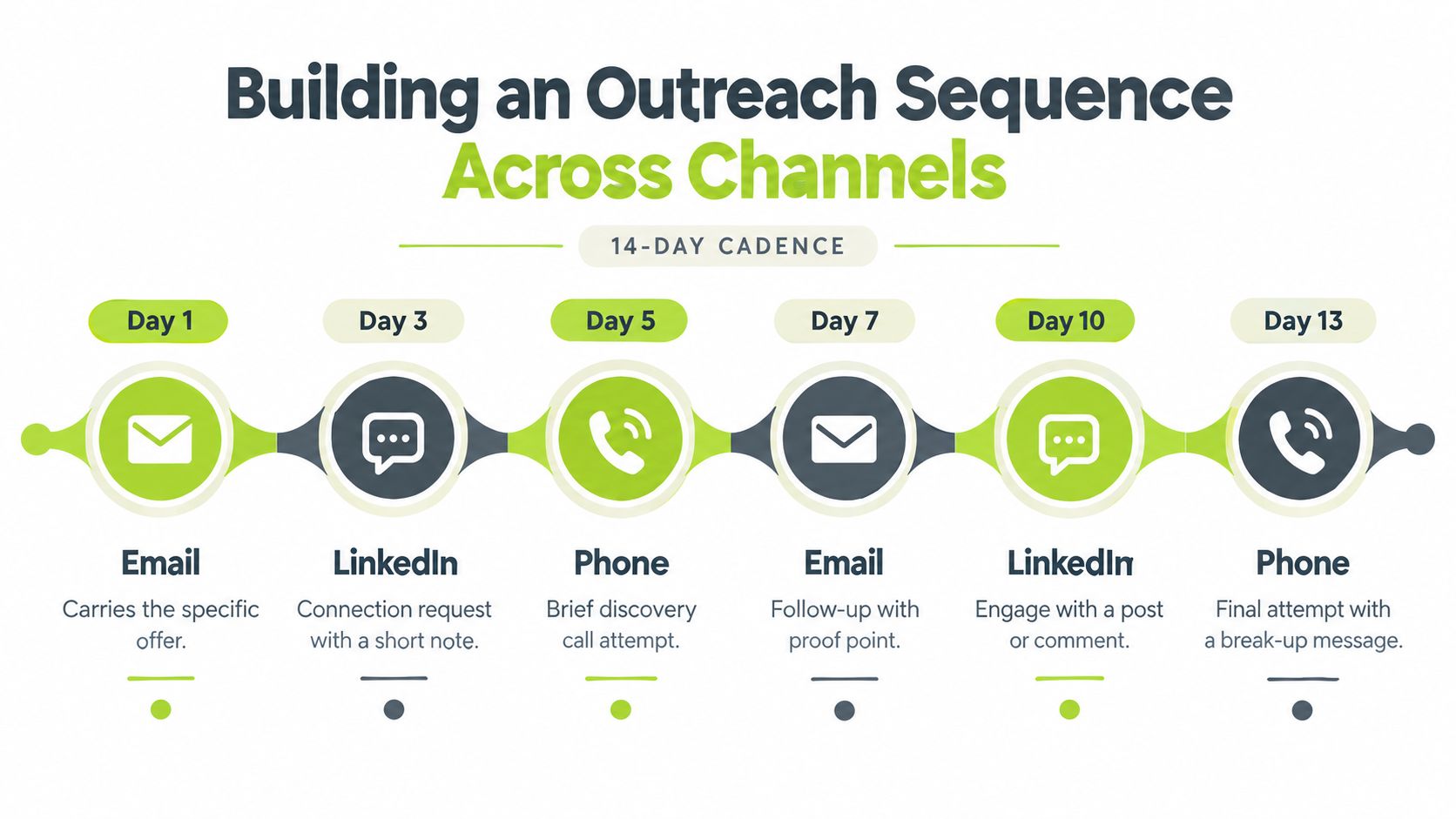
A prospect rarely replies because one channel finally “wins.” They reply because the sequence builds enough context, credibility, and urgency across touchpoints that the next step feels worth taking.
Assign one role to each channel
Email should carry the offer and the reason it matters now. LinkedIn should build familiarity before the send and keep the name recognizable after it. Calls should add urgency and give the prospect a faster way to respond than digging through an inbox.
A sequence does not need to be complicated to work. It needs rhythm. A 14-day cadence can include an opening email, a LinkedIn connect, a call attempt, a proof-based follow-up, another social touch, and a final voicemail or break-up note. The spacing matters because each touch needs enough room to land without turning into noise.
A proof-based follow-up can use a structure like this cold email follow-up template, but the angle should change. Add a new proof point, a relevant result, or a tighter reason to revisit now.
Practical rule: if two touches in the same week ask for the same thing, cut one of them.
Repetition is the common failure mode. A rep sends an email, then a near-copy on LinkedIn, then a voicemail that sounds like the email read aloud. Buyers notice that immediately. Keep the core offer stable, then vary the angle, proof point, or question so each touch adds something new.
Handle friction without breaking the cadence
Bad numbers, bounced addresses, and silent contacts happen. Update the record immediately and move on. A contact who engages on LinkedIn but ignores email should be handled differently from someone who never responds anywhere. Intent on one channel is still intent.
Silent prospects need a decision, not endless pressure. If they show signal, move them into a different path. If they do not, retire them cleanly. That keeps the programme disciplined and stops the team from confusing persistence with progress.
Writing Messages That Match Each Stakeholder
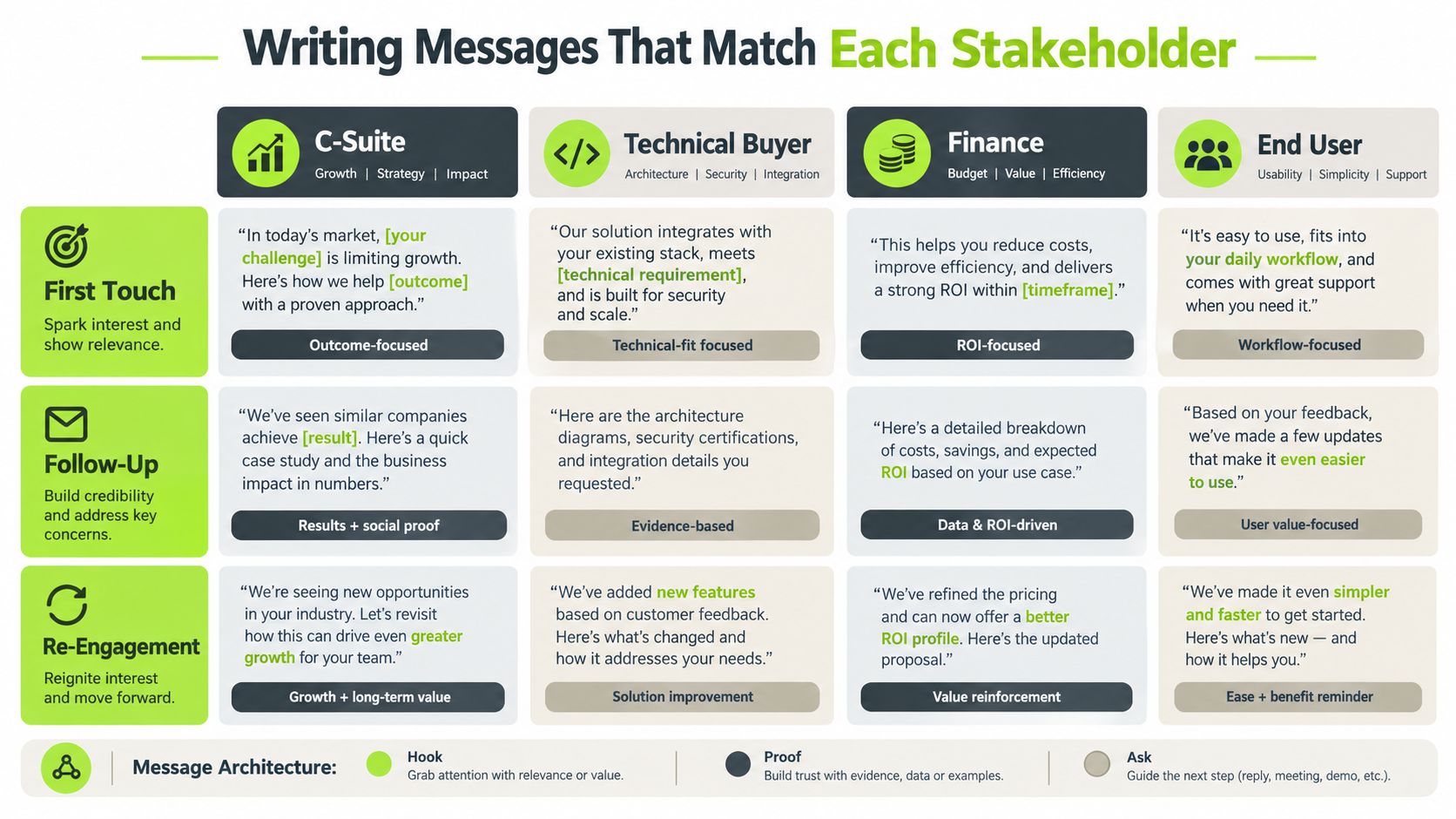
The message has to fit the audience, not just the account. One buyer cares about risk, another cares about implementation, another wants workflow relief, and a champion wants language they can reuse internally.
Lead with what the buyer already cares about
Economic buyers want outcome and risk. Technical buyers want integration, security, and operational fit. End users want time back and less friction in the workday. Champions want something they can defend in a meeting with their boss.
A first touch should start from research, not a generic promise. Mention the hiring move, the tech stack, the public trigger, or the operational gap you've observed. Then tie that observation to one credible reason to talk.
A follow-up should add a new proof point, not repeat the same ask. That might be a short customer pattern, a relevant comparison, or a better framing of the problem. Re-engagement should say why timing is different now, not pretend the earlier outreach never happened.
Use plain text, keep it short, and change the tone by channel
Cold email should be clean and plain. LinkedIn comments should sound lighter and more conversational. Voicemail should be brief, direct, and easy to understand on first listen. The same message can travel across all three, but the phrasing can't be identical.
Before and after matters here.
Seller language: we help companies improve pipeline efficiency with a scalable outbound system.
Buyer language: your team is hiring for the role that usually surfaces the process gap, so I thought it was worth reaching out.
That shift is the whole game. Buyers don't respond to your internal description of the product, they respond to the situation they're in and the cost of leaving it unsolved.
Qualifying, Scoring and Routing Replies
A reply is not automatically a meeting. Some replies deserve a calendar link, some deserve nurture, and some should be disqualified quickly so the team doesn't waste time.
Use one checklist across BANT, MEDDIC and CHAMP
You don't need three separate frameworks in day-to-day work. You need a simple filter that checks fit, urgency, authority, and next step. A reply that comes from the wrong industry, the wrong size band, or the wrong geography may be polite but still useless. Likewise, a reply that shows interest but also mentions procurement restrictions or a long budget delay is not ready for a meeting.
A strong triage process looks at three signal types.
- Firmographic signal: industry, size, stage, geography.
- Behavioural signal: reply sentiment, link clicks, page visits, engagement with proof content.
- Disqualifier signal: competitor lockout, budget timing, procurement constraints, or no real buying motion.
The handoff into CRM should capture the minimum useful context, not just “interested.” The rep who owns triage should decide whether the contact is an MQL, SAL, or nurture-only lead, and that decision should happen fast enough that the reply doesn't cool off.
| Prospect Scoring Matrix | Signal | Weight | A Criteria | B Criteria | C Criteria |
|---|---|---|---|---|---|
| Fit | Industry and company profile | High | Direct ICP match | Partial match | Weak match |
| Timing | Trigger and urgency | High | Active trigger | Mild signal | No clear timing |
| Authority | Role and influence | Medium | Decision-maker or strong sponsor | Influencer | No influence |
| Engagement | Reply sentiment and interaction | Medium | Positive and specific | Curious but vague | Passive or negative |
| Blockers | Budget and procurement | High | Clear path forward | Some uncertainty | Clear disqualifier |
Make the handoff operational
If the reply is hot, route it to a rep who can handle it the same day. If it's warm but incomplete, assign follow-up questions and keep it out of the meeting queue until the missing pieces are clear. If it's wrong-fit, log the reason so the list can be cleaned up and the pattern can be tracked later. CRM workflow automation can help here when the process is already defined.
A useful two-minute check is simple. Is this the right account, is there a real problem, is there a believable next step, and is there anything that should stop a meeting from being booked right now? If any answer is no, don't force the handoff.
Operating Rhythm, Measurement and Iteration
A prospecting programme gets better when it's run like an operating system, not a burst of activity. The point is to learn quickly, then lock in what works before the process gets noisy.
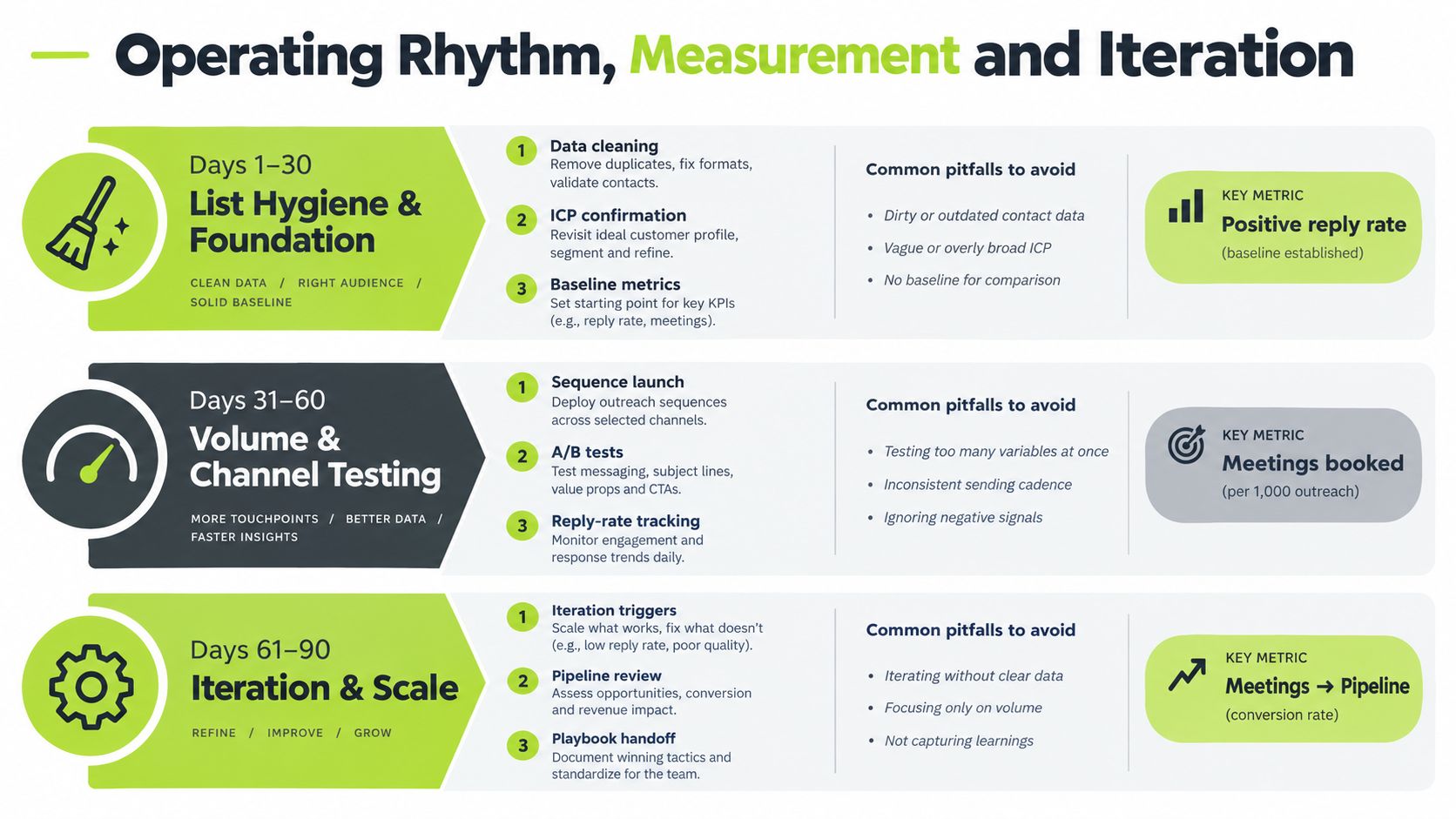
Use 30, 60 and 90 days as different jobs
The first 30 days are for list hygiene, ICP validation, and baseline measurement. That means confirming which accounts align, checking data quality, and watching how the first touches land. Don't optimise for volume yet.
Days 31 to 60 are for channel testing and message variation. Test subject lines, angles, send windows, and the balance between email, LinkedIn, and phone. Compare the result against a control so you can tell whether the change helped or just looked busy.
Days 61 to 90 are for formalising what's working. Tighten the winning sequence, retire the dead ones, and make the current version easy for someone else to run. Refresh copy on a cadence, not whenever someone feels like it.
Measure the right outputs, then react to clear triggers
Track reply rate by touch, qualified reply rate, meetings held, pipeline value per thousand sends, and cost per meeting. If reply rate drops below 1% over two weeks, something in the list, timing, or message has broken and needs a reset. If a new persona outperforms another by 50%, shift attention there and stop treating all roles as equal.
Common mistakes usually show up early. Teams lean too hard on one channel, ignore negative replies, keep sending to stale records after bounces, or refuse to admit that the list itself is the problem. Those are management issues, not copy issues.
The cleanest programme is the one that gets edited every week.
The discipline is simple. Keep the list fresh, keep the sequence honest, and keep the learning loop short enough that the market doesn't move past you.
When to Build, Buy or Outsource Your Prospecting Engine
A lot of teams ask whether they should build outbound in-house or hand it off too early. The question to focus on is whether the motion is strategic enough to keep close and stable enough to delegate safely.
Match the operating model to the business reality
In-house gives you control over the message, the list, and the learning loop. It also means you own the tools, the data work, the copy iterations, and the ramp time. Outsourcing can get a programme live faster, but it can also create distance from the buyer language if the partner doesn't understand the market well enough.
Hybrid is often the least romantic answer and the most useful one. Keep strategy, qualification, and commercial judgment internally, then outsource list production, cadence ops, or execution support where the work is repetitive. That gives you control without making your team do every manual step.
A managed partner can make sense when the offer is already stable, the team wants more conversations, and internal capacity is already stretched. A custom system build makes more sense when the main bottleneck is workflow, data, or routing rather than sending volume. H2, for example, offers fully managed outbound, custom GTM system builds, and private workshops, which covers those different needs without collapsing strategy and execution into one vague service.
| Build vs Buy vs Outsource: Decision Matrix | Dimension | Build In-House | Outsource to Partner | Hybrid Model |
|---|---|---|---|---|
| Control | Message and process ownership | Highest | Lower | High |
| Speed | Launch time | Slower | Faster | Medium |
| Capacity | Internal workload | Heavy | Light | Balanced |
| Learning | Feedback loop ownership | Direct | Shared | Direct on strategy |
| Risk | Brand and fit dilution | Lower | Higher if unmanaged | Moderate |
| Best fit | When to choose | Positioning still moving | Offer is locked and volume pressure is high | Strategy stays internal, ops need scale |
Use a simple decision rule
If volume demand is running well ahead of capacity and the offer is already locked, test a partner. If positioning is still changing, keep the strategy in-house until the message stabilises. If the bottleneck is not people but the system itself, build the workflow first and outsource less of the logic.
That's the cleanest dividing line. Don't outsource uncertainty. Outsource the repeatable work once you know what should happen.
If you want the practical version of how to prospect turned into a real operating system, the next step is to study the sections on account research, sequencing, messaging, and qualification and apply them as one flow, not four disconnected tactics. If you want help turning that into a system your team can run, visit H2 and use the idea as a starting point for a tighter outbound motion.
