58% of replies happen on the first email, but that still leaves 42% sitting in follow-up steps according to Instantly's 2026 cold email benchmark as summarised here. That's the part many teams underwork. They write a decent opener, then treat every later touch like a polite nudge instead of a fresh reason to answer.
A strong cold email follow up template isn't a reminder, it's a new message with a different angle, a smaller ask, and a clearer reason for existing. That matters because B2B reply volume is low, and the first send rarely carries the whole campaign. If you want consistent pipeline, the follow-up sequence has to do real work, not just occupy inbox space.
Why Most Cold Emails Stall After the First Send
The first mistake is simple. Many senders behave as if the campaign ends when the first email goes out, then they recycle a weak bump line and hope persistence fills the gap. But the benchmark above shows a different reality, 42% of replies sit beyond the opening send, so the ignored inbox still contains a material share of the opportunity.
Practical rule: if your follow-up could be swapped with the previous email and nobody would notice, it's not a follow-up, it's duplication.
What usually causes the stall
The fastest way to kill momentum is to repeat the original pitch. The second common failure is the lazy opener, things like “just bumping this” or “circling back,” which tell the buyer you don't have anything new to say. A third failure is no branching, meaning every non-reply gets the same next email whether the prospect opened, clicked, replied softly, or ignored the thread entirely.
That's why a cold email follow up template needs to be tied to signal strength, not just sequence order. A non-opener needs a different approach from someone who replied with interest but never booked. If you want a useful benchmark on how response rate thinking ties into sequencing, H2 has a practical breakdown of the mechanics in its guide on cold email response rate and what drives it.
The cost of stalling is bigger than one lost reply. In B2B outbound, the team that stops after one send usually hands those later touches to a competitor who's willing to keep the thread alive with better timing, better context, and a more relevant ask. That's why the follow-up isn't an afterthought, it's the part of the sequence where the seller proves they understood the account.
The Rules That Make Every Follow Up Template Work
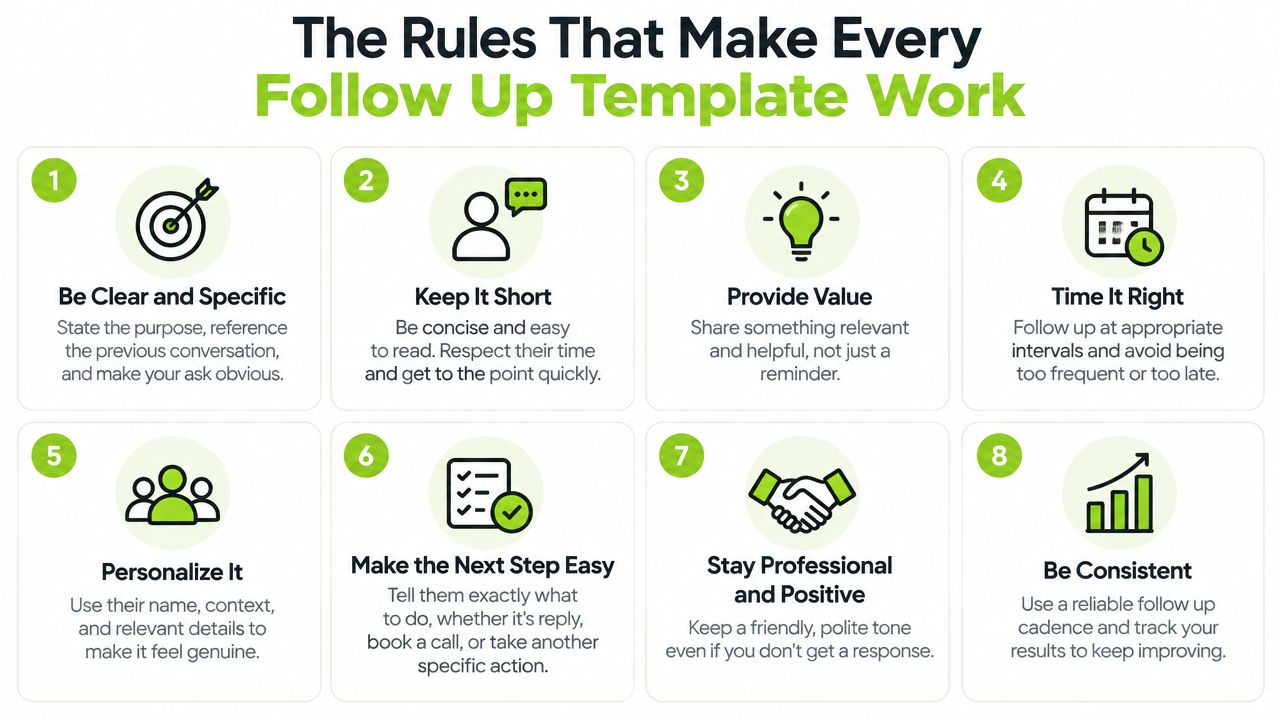
Every good follow-up obeys the same rules, even when the wording changes. If those rules aren't in place, the sequence turns into a string of awkward reminders. The trick is to make each message feel earned, not automated.
Add something new every time
The new-value rule is often overlooked. Every follow-up should add context, proof, a tighter offer, or a sharper question. If it only repeats the original email, the buyer has no reason to re-open the thread.
That doesn't mean you need a huge new asset on every touch. Sometimes the “new” thing is just a more relevant observation about their role, company motion, or market timing. The point is to earn a second look with information, not pressure.
Shrink the ask as the thread ages
The shrinking-ask rule keeps the sequence realistic. Early on, you can ask for a short call. Later, ask for a one-line reply. By the end, the cleanest CTA is often permission to close the loop or a simple yes/no signal.
The easier the reply, the less the buyer has to budget attention to answer you.
Rotate proof and preserve an exit
Use the social-proof rule to vary evidence. One touch can lean on a customer result, another can mention a short case line, and another can reference a peer or comparable company. Just don't stack proof so hard that the email starts reading like a brochure.
The specificity rule matters just as much. Name the trigger that justified the first send, the role, the company motion, or the signal that made the account worth contacting. Then finish with the exit rule, an explicit off-ramp so the prospect doesn't feel trapped in a drip. H2's best-practices guide on cold email best practices for response handling and next steps aligns with that same principle, the reply path should stay simple and human.
Three Ready-to-Use Follow Up Templates in Sequence Order
The cleanest sequences don't use three random bumps. They use three different messages for three different states of attention. That means each template needs its own job, its own ask, and its own reason to exist.
Template one, the value-add bump
Use this when: the first email had some relevance, but no reply yet, and the account signal is still warm enough that a useful extra artefact feels earned.
Subject: Quick idea for {Company}
Opener:
Hi {First name}, I noticed {specific company signal}. That usually changes how teams think about {pain area}.
Body:
I pulled together a short teardown of how this shows up in outbound, plus a 90-second Loom or one-page summary would make the point faster if you'd rather see it than read it. For teams in your spot, the issue is usually not whether the problem exists, it's whether the current workflow is already masking it.
CTA:
Would it help if I sent the Loom, or should I leave it there?
Variables to swap: {specific company signal}, {pain area}, {Loom or one-page summary}, {First name}.
This template satisfies the new-value rule and the shrinking-ask rule. It works because it adds a useful artefact and asks a question that's easier than booking time.
Template two, the trigger-based follow-up
Use this when: there's been silence after the first follow-up, but a fresh company event, hiring move, funding note, launch, or competitor mention gives you a new reason to write.
Subject: {Trigger} + {Company}
Opener:
Hi {First name}, saw {trigger}. That changes the pressure around {pain area} more than many expect.
Body:
The original note still applies, but this new signal usually shifts priorities. If the team is hiring, expanding, or changing focus, the old workflow often gets strained in a new way, especially when outbound has to move faster without becoming generic.
CTA:
Should I send the relevant note, or would you prefer I leave this one with you?
Variables to swap: {trigger}, {Company}, {pain area}, {relevant note}.
This is the strongest place to use the specificity rule and the social-proof rule together. If you mention a similar customer or a short example, keep it tight. The goal is to connect the trigger to a real operational consequence, not to paste in a case study wall.
Template three, the breakup email
Use this when: the sequence has aged out, the account hasn't engaged, and you need a clean final touch that preserves the relationship.
Subject: Should I close the loop?
Opener:
Hi {First name}, I haven't heard back, so I'm assuming this isn't a priority right now.
Body:
That usually means one of two things, either the timing is wrong, or the problem isn't urgent enough to justify a response. If it helps, I can either send one final note with the most relevant angle, or I can close the loop and leave you alone.
CTA:
If it's easier, just reply with “pause” and I'll stop.
This template satisfies the exit rule. It protects the thread from turning into noise and gives the buyer a clean way to end the exchange without friction.
Subject Lines That Earn the Open Each Time
Subject lines should change with the stage of the sequence. If the body is the message, the subject is the reason the prospect ever sees it. A lot of senders overthink the copy inside the email and underthink the line that sits on top of it.
Match the angle to the touch
| Touch | Angle | Hook | Example subject |
|---|---|---|---|
| 1st follow-up | Context-anchored | Remind them of the thread without sounding mechanical | Quick idea for {Company} |
| 2nd follow-up | Value-anchored | Offer a fresh asset, observation, or proof point | {Trigger} + {Company} |
| 3rd follow-up | Brevity-anchored | Keep it short and low-friction | Should I close the loop? |
| Final touch | Question-anchored | Invite a simple yes/no response | Worth a quick look? |
A/B testing should stay close to the same intent. For the context-anchored subject, test “Quick idea for {Company}” against “One thought on {Company}”. For the value-anchored line, test “{Trigger} + {Company}” against “A small note on {Trigger}”. For the final touch, “Should I close the loop?” can be compared with “Pause this?” when you want a cleaner exit signal.
If the subject line tries to re-sell the offer, it's too heavy. Its job is to remind, not to close.
Avoid emoji decoration, avoid “Following up” as a standalone subject, and avoid pretending the subject line is the pitch. The body should do the selling, the subject should earn the open by being specific, brief, or clearly connected to a real trigger. The point is simple, a better subject line can't fix a weak sequence, but a weak subject line will bury a good one.
Timing and Cadence That Matches How Buyers Actually Reply
Cadence only works when it respects how long buyers need to notice, process, and answer. A workable starting rhythm is day 3, day 7, day 14, and day 21, but that's a starting point, not a law. The reason those gaps tend to work is that they give enough space for the previous message to breathe without letting the thread go cold.
Adjust the clock by audience, not by habit
Send in the recipient's local morning when you can, ideally during the middle of the workweek. That gives the email a better chance of landing when the inbox is being actively cleared rather than buried under late-day clutter. Senior buyers usually need a little more breathing room, because their calendar pressure and delegation patterns are different from frontline managers.
Trigger strength matters too. A fresh hiring post, funding update, or competitor reference can justify compressing the schedule and sending the next message sooner, because the signal is still warm. If the previous email hasn't been opened, it's usually smarter to re-enter the thread within 48 hours while the intent memory is still live.
Skip the touch when the context says no
Don't mail the same person through a holiday window just because the sequence says it's time. The same goes for recent out-of-office replies, because a follow-up sent into an auto-reply often reads like poor judgement, not persistence. If the account has gone quiet for a while, a switch in timing or channel is usually cleaner than pretending the original cadence still fits.
The other practical adjustment is seniority. C-suite prospects often respond better to shorter gaps, not because they're magically more available, but because their attention moves through the funnel differently. The sequence should match how the buyer works, not how the sending tool wants the campaign to look.
When to Stop Emailing and Switch Channel
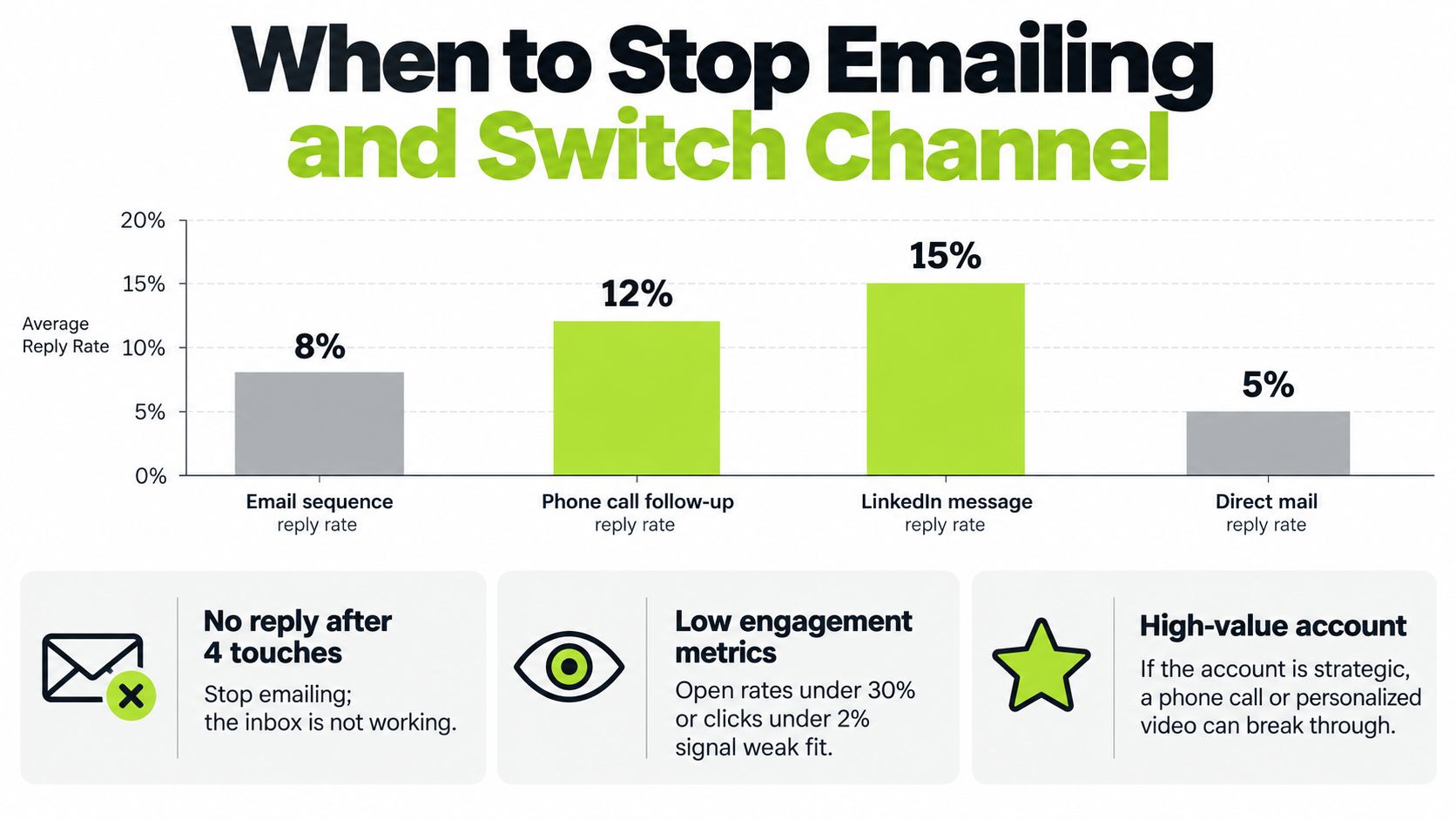
The best move in a stalled sequence is often not a fifth email. It's a channel switch with a reason behind it. Email loses effectiveness once the thread stops showing real signs of life, and pushing harder just creates more sameness.
Watch for three clear triggers
The first trigger is zero opens across two consecutive touches. That means the inbox route may be failing, the subject line isn't doing enough, or the contact isn't a fit for email-first outreach. A LinkedIn connection request with one short note referencing the original email is usually a cleaner next step.
The second trigger is a soft reply with no next action, such as “send more info” or “interesting, thanks.” That's a signal to move the thread somewhere more conversational. For a warm-but-busy prospect, a LinkedIn voice note or short direct message can work better than another inbox message.
The third trigger is a thread older than 30 days with no engagement. At that point, the sequence has likely moved from active follow-up into stale recall. For high-ACV deals, a phone call can be justified. For executive accounts with very low volume, a postal note or handwritten line can stand out precisely because it isn't another digital nudge.
Use the channel that fits the signal
A LinkedIn note should be short and specific, not a carbon copy of the email. A workable transition is, “Sent you a short note by email about {trigger}. Thought I'd connect here in case this is easier to catch.” A voicemail needs the same restraint, name, reason, and a clear exit, then stop talking.
The guardrail is simple. Never switch channel as a tantrum after silence. Switch because you can name the signal that justifies it, and because the next channel gives the buyer a better way to respond. If the thread has gone dead, the goal is to restart relevance, not to spray the same ask across more surfaces.
Customisation Rules and a Quick Pre-Send Checklist
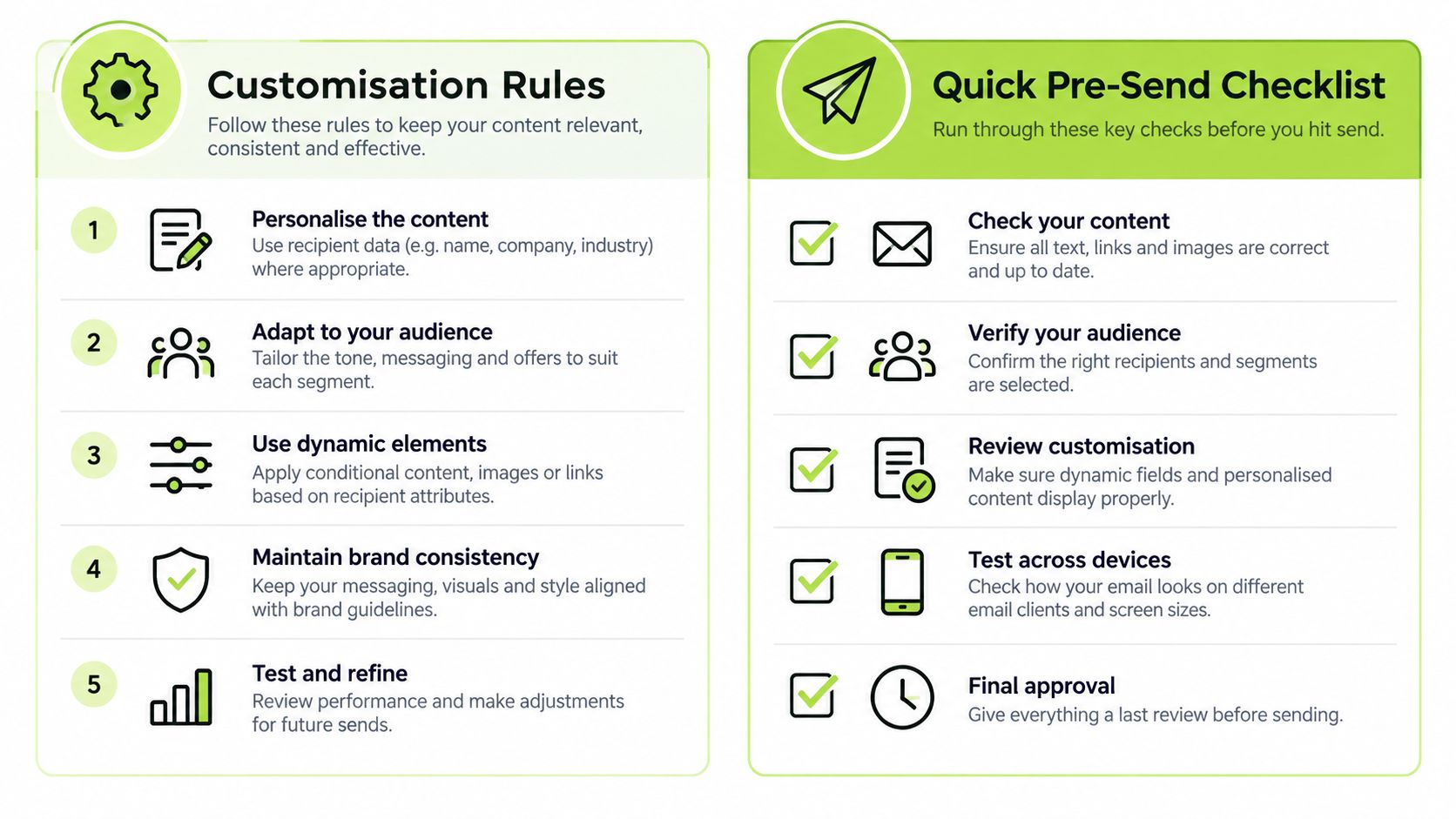
Templates only work inside a researched list. A generic message sent to a scraped list will always underperform a message built from real account context, because the copy has nothing solid to stand on. That's why the best teams treat customisation as a discipline, not a decoration.
The three customisation rules that matter most
First, swap at least one company-specific data point in every follow-up. Second, change the opening line on each touch so it doesn't look like a mail merge. Third, rewrite the CTA so it fits the prospect's actual buying stage, not the one you hoped they were in when you started the sequence.
A useful delivery check matters too. If the message is built on weak deliverability, even good copy won't have a fair chance. H2 has a practical guide on how to improve email deliverability, and that matters because the sequence can only work if the email reaches the inbox in the first place.
Run this before every send
- Name spelling: Check the first and last name carefully.
- Company match: Make sure the company name is current and exact.
- Trigger relevance: Confirm the signal is recent enough to justify the note.
- Role fit: Verify the person owns, influences, or touches the problem.
- Thread length: Keep the follow-up short enough to scan quickly.
- Plain-text feel: Make sure it reads like a person wrote it.
- From line: Confirm the sender name is familiar and professional.
- Mobile preview: Read it on a phone before sending.
- Link check: Test every link and CTA destination.
- Reply path: Make sure the buyer can say yes, no, or not now without friction.
The last judgement call is the simplest one. If the same template is going to a researched account, it can create a real conversation. If it's going to a broad, unqualified list, the sequence will feel busy without becoming effective.
H2 helps teams build outbound systems that make this kind of follow-up easier to run consistently, from research and copy to qualification and campaign management. If you want a sequence that matches signal strength, timing, and channel choice instead of relying on generic bumps, visit H2 and book a 15-minute introductory call.
