A content download doesn't prove that an account is ready to buy. Neither does a keyword search, a product-page visit, or a spike in visits from one company. These events tell you that someone is researching, but they rarely explain who is involved, what problem they need to solve, when a decision might happen, or whether your company belongs on the shortlist.
That distinction matters because B2B intent data is now embedded in outbound, account-based marketing, demand generation, and customer expansion. The category has attracted serious investment, but more data doesn't automatically produce better pipeline. Teams get value when they treat intent as evidence to investigate, then connect it to CRM history, account fit, commercial context, and human judgement.
The practical question isn't, “Which accounts are showing intent?” It's, “What should we do differently because this account is showing this signal now?”
Redefining B2B Intent Data for Modern GTM
B2B intent data is behavioural information that indicates an account may be researching a problem, category, supplier, or competing solution. The behaviour might include visits to your website, consumption of third-party content, searches around a topic, product comparisons, or engagement with an advert. These signals can reveal research activity before a prospect fills out a form or speaks to sales, but they don't establish purchase readiness on their own.
That distinction gets lost in vendor dashboards. A platform flags an account as “surging”, a score rises, and the account is pushed into an SDR sequence. The rep then sends a message that assumes the buyer has an active project. If the original event was a student researching a topic, an existing customer checking an alternative, or a competitor analysing your positioning, the outreach feels intrusive and irrelevant.
One recent analysis argues that intent systems often measure content consumption rather than genuine buying behaviour, and reports that only 26% of intent signals convert to qualified opportunities. That doesn't make the data useless. It means intent should usually act as a prioritisation input, not as a definitive qualification decision. See the analysis of B2B intent data quality for the wider argument.
What the signal can tell you
Intent data can help answer practical questions:
- Where should the team investigate first? An account researching a relevant topic may deserve attention before a similar account with no observable activity.
- Which message might be timely? A technology comparison, hiring pattern, or public discussion can inform a useful hypothesis about the account's situation.
- Which accounts should receive coordinated treatment? Marketing might personalise ads or content while sales researches contacts and timing.
- What evidence is still missing? A signal can show what you don't know, such as whether the account has a budget, project owner, or defined deadline.
The strongest workflows combine several evidence types. A third-party topic signal may identify early research. A visit to a pricing page may provide more specific context. A relevant job vacancy, role change, technology shift, or pain-language in a public discussion can add commercial meaning. None of those events proves a buying process, but together they can support a reasoned decision.
Practical rule: Treat intent as a reason to investigate, not permission to pretend you know the buyer's situation.
The business case for this discipline is clear. One widely cited estimate places the global B2B intent data market at $1.2 billion and projects growth to $4.8 billion by 2032, signalling sustained investment in systems that identify in-market accounts earlier. The market is expanding because teams want better prioritisation across outbound, ABM, and pipeline creation, not because every signal is accurate. (Market context for B2B intent data)
The Shift from Broad Prospecting to Signal-Based Targeting
Broad prospecting assumes that every account on a target list deserves roughly the same treatment. Signal-based targeting starts from a different premise: most accounts aren't ready for a sales conversation at the moment you contact them.
Research published through the LinkedIn B2B Institute popularised the estimate that up to 95% of potential buyers are out of market at any given time. That figure changed the operating logic of outbound. If a team treats the entire addressable market as immediately active, it spends time asking cold accounts to discuss a problem they may not currently prioritise. (The history and role of B2B intent data)
The same historical shift was reinforced by buyer-research findings that business buyers complete 57% of the purchase process before contacting suppliers and conduct an average of 12 online searches before visiting a specific brand's website. Buyers can form preferences, compare approaches, and eliminate vendors while remaining invisible to the sales team.
Why timing beats list volume
These conditions make indirect indicators useful. A research event doesn't tell you that an account will buy from you, but it may suggest that the account has moved from passive awareness into active investigation. That can change the order in which you research accounts, the message you choose, and whether you approach now or continue building familiarity.
The distinction between market coverage and sales readiness is important:
| Situation | Sensible response |
|---|---|
| Target account with no observable research | Maintain useful market coverage without forcing a sales conversation |
| Relevant third-party topic activity | Investigate the account, people, fit, and possible business context |
| First-party engagement with a specific commercial page | Review CRM history and choose a timely, relevant follow-up |
| Multiple corroborating signals | Prioritise human research and consider a tailored sales or marketing play |
Signal-based targeting therefore isn't a replacement for a well-defined ICP or a good message. It adds timing and context to those foundations. A poorly chosen account with a strong signal is still a poor account. A good account with weak evidence may need useful education rather than an aggressive sequence.
The operational change is substantial. Marketing, sales, and RevOps need shared definitions for what counts as a signal, which signals create an investigation task, and which signals justify a handoff. Without those rules, intent platforms produce attractive lists that don't change behaviour. With them, the data becomes a way to allocate scarce research and selling capacity.
Categorizing Intent Signals and Data Sources
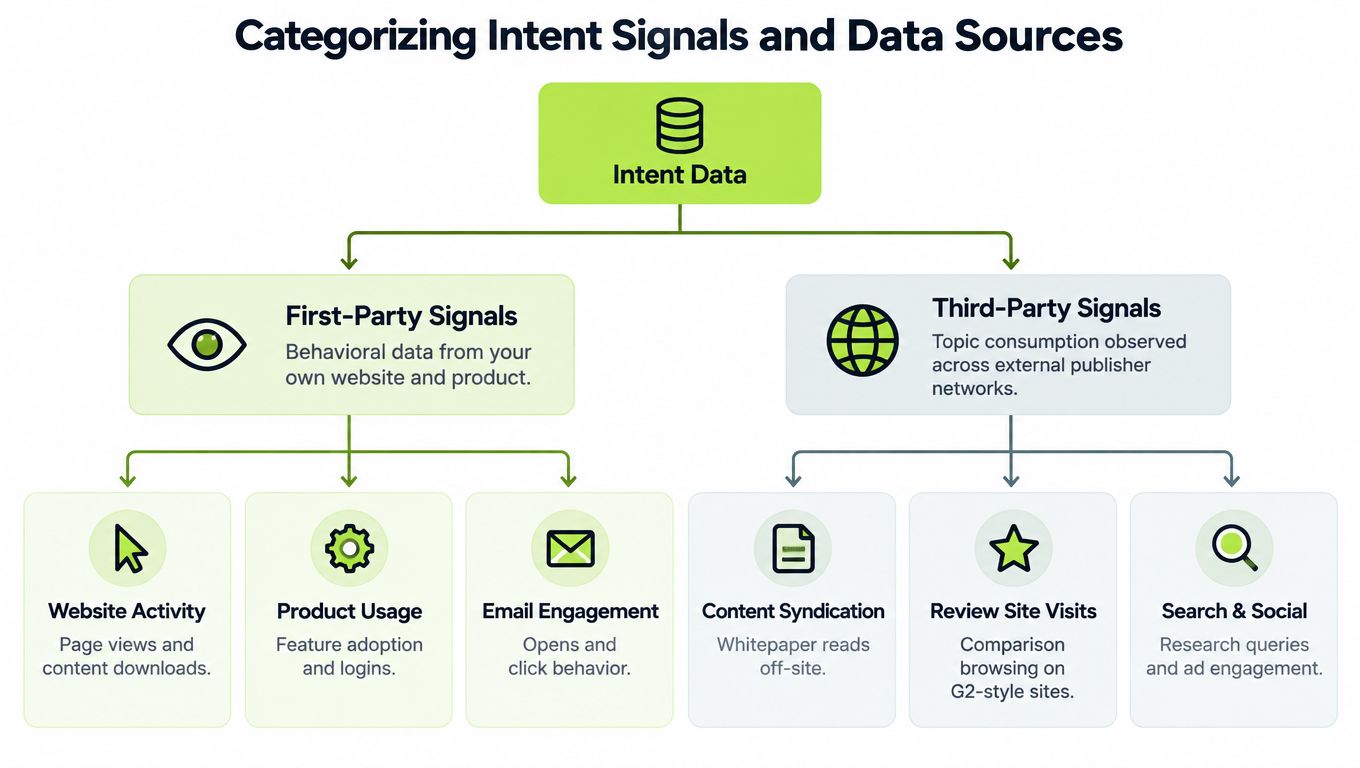
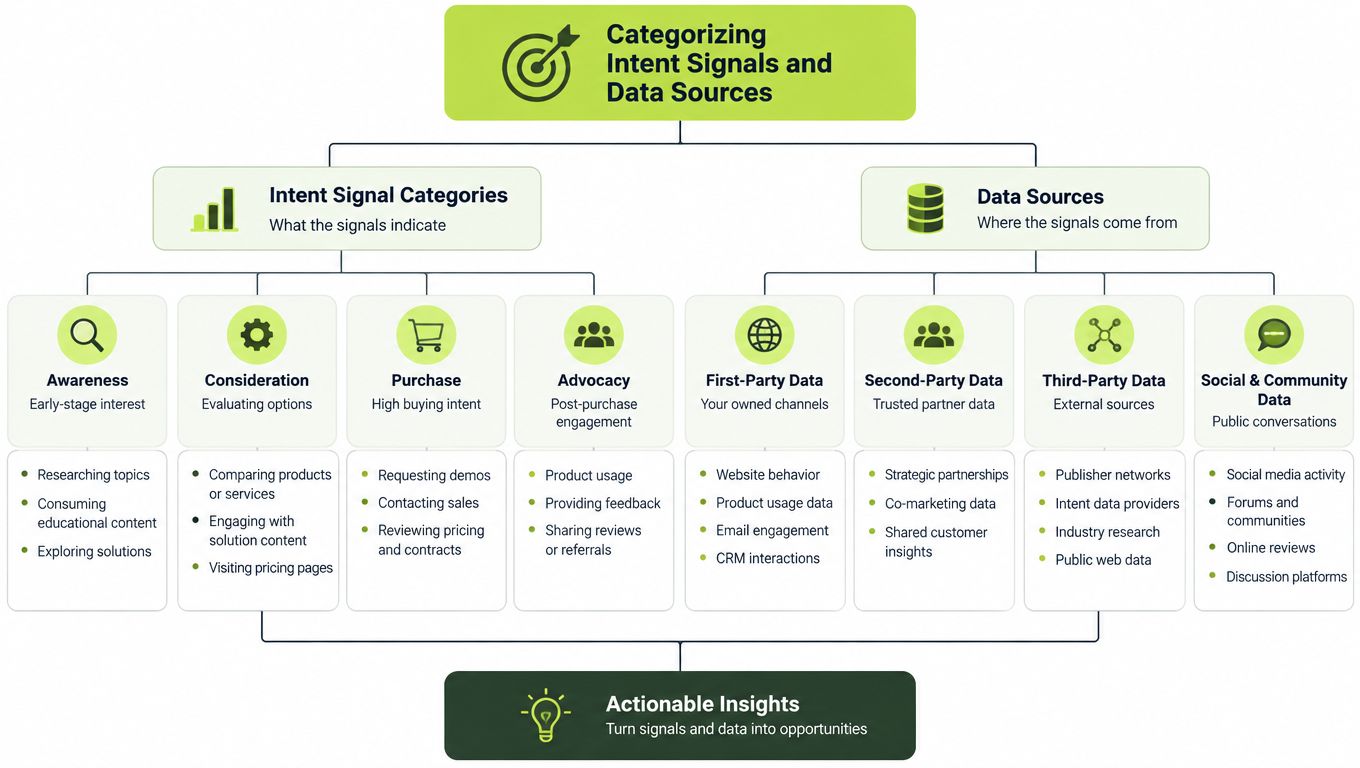
Start by separating signals according to where they originate and how close they are to a commercial decision. This prevents a low-context event, such as a single article visit, from receiving the same treatment as a direct comparison or a known opportunity.
First-party activity
First-party intent comes from properties your organisation controls. It can include visits to product, pricing, integration, or comparison pages, content downloads, email clicks, product logins, and feature usage. The advantage is context. You know which asset or page received attention, and you can often connect the activity to an existing account or contact.
The limitation is coverage. First-party data only shows activity from people who have already encountered your brand. It can also be misleading. A customer may visit a product page while researching an expansion, a job candidate may browse your website, or one employee may consume content without representing the wider buying group.
Third-party research
Third-party intent captures activity outside your own properties. Common sources include publisher networks, content syndication, review sites, search behaviour, and advertising engagement. These signals can expose earlier category research, especially among accounts that haven't interacted with your brand.
They also require more caution. You may not know which person performed the activity, what prompted it, or whether the account is researching for a live project. A topic surge is a useful prompt for account research, not a factual description of the account's buying stage.
Commercial and contextual triggers
Some of the most useful evidence doesn't look like conventional intent data. A role change can put a potential champion into a new company. A vacancy can reveal a capability gap. A technology choice can suggest an operating environment. Public language about a problem may help you understand how the account describes its own situation.
None of these events establishes purchase intent. Use them as contextual triggers that improve the quality of a hypothesis. A vacancy for database engineers might indicate growth, internal investment, or a hiring experiment. It doesn't automatically indicate that the company needs an external database service.
A practical qualification record should therefore preserve the evidence rather than hide it behind a single score. Include the signal source, event date, account match, relevant people, interpretation, contradictory evidence, and next action. The guide to sales buying signals is useful background for distinguishing observable triggers from assumptions.
Map signals to decisions
Use different signals for different actions:
- Early research: Add the account to a monitored or lightly personalised nurture path.
- Relevant account activity: Ask a researcher or SDR to verify fit, existing relationships, and current context.
- Specific commercial behaviour: Tailor outreach around the observed problem without claiming to know more than you do.
- Corroborated evidence: Route the account to a named owner with a clear reason for contact and a defined follow-up window.
The important design choice is not the score itself. It's the rule that connects evidence to an action someone can explain later.
Applying Intent Signals to Outbound and Account-Based Marketing
A useful outbound workflow doesn't tell a rep, “This account is hot.” It tells them why the account is worth examining, what evidence supports that view, and what action is appropriate.
Consider a target account that matches your ICP and begins researching a topic related to a problem your service addresses. The signal enters the CRM with the topic, source, timestamp, and account match. Before anyone sends an email, the researcher checks whether the account is already a customer, has an open opportunity, has recently rejected the problem, or falls outside the service geography.
That check often changes the next step. An existing customer may need an expansion conversation. An account with an open opportunity belongs to the account executive, not an SDR. A company that doesn't fit the commercial model should be suppressed. Only the remaining accounts move into a research queue.
A practical outbound sequence
The messaging should reflect the evidence without exposing private tracking or making an unsupported claim. Instead of writing, “I saw your team researching database reliability,” use the signal to investigate the business and write about a plausible situation.
For example:
- Research the account: Review its website, public hiring, product pages, technology environment, leadership changes, and recent commercial activity.
- Identify the relevant role: Find the person who would own the problem, influence the decision, or feel the operational cost.
- Form a restrained hypothesis: Explain the business situation you can reasonably observe, not the presumed intent behind an anonymous event.
- Offer a specific reason to reply: Ask whether the issue is relevant, or provide a useful observation that makes correction easy.
- Route the response properly: A positive reply should reach the right owner with the research evidence attached.
The result is different from a bulk sequence. The signal determines which account deserves attention, while the research determines what the rep says.
ABM needs coordinated treatment
Account-based marketing benefits when sales and marketing use the same evidence but choose different actions. Marketing might place an account into an educational audience, adapt website content, or promote a relevant point of view. Sales might research the buying group and wait for an additional trigger before starting direct outreach.
That coordination is especially useful when an account shows early research but no evidence of a defined project. Marketing can build familiarity while sales avoids forcing a premature conversation. If the account later visits a specific commercial page or a known contact engages directly, the routing rule can change.
The signal should change the workflow, not just add another column to a spreadsheet.
Teams that work with specialised GTM providers often use public company information, technology signals, hiring patterns, and social activity to build a more precise account hypothesis. The quality comes from the combination. A technology match alone is weak. A technology match plus a relevant role, a business change, and language that describes the problem gives a rep a more credible reason to reach out.
Measure the workflow at the level where decisions happen. Track whether accounts were correctly matched, whether research was completed, whether the message reflected the evidence, whether replies were qualified, and whether sales accepted the handoff. Reply volume can diagnose messaging, but it doesn't prove that the intent model is working. The stronger test is whether prioritised accounts create better-qualified conversations than comparable accounts handled without the signal.
Evaluating Intent Data Quality and Signal Precision
Intent data decays. An account that researched a topic recently may have been exploring a new initiative, checking a competitor, producing content, or conducting routine market research. As time passes, the event becomes less useful for deciding what a rep should do today.
That makes recency a qualification variable, not a reporting preference. A signal captured recently may justify research. The same signal after a longer delay may belong in monitoring or nurture. Your rules should reflect the buying cycle, signal type, and expected response time rather than applying one universal window.
A 2025 benchmark across 47 deployments found median first-pass precision of 0.51 for topic-based third-party intent signals, rising to 0.63 in mature programmes. The benchmark defined precision as the share of flagged accounts showing CRM-corroborated engagement within 30 days, which makes the lesson practical: validation matters more than raw signal volume. (B2B intent data benchmark methodology)
Build a verification loop
A reliable validation process links each signal to the CRM and checks what happened shortly afterwards. The system should record whether the account had a relevant contact, whether a known person engaged, whether sales accepted the account, and whether a meaningful conversation followed.
That doesn't mean every signal must generate a meeting. The purpose is to learn which signals are useful for which decisions. A topic surge may be good for account discovery but poor for immediate outbound. A first-party visit may support a timely follow-up but still require account-level matching. A review-site comparison may deserve a different play from a general content read.
Use a scoring model that people can inspect. It should show:
- Signal type: What happened and where it came from.
- Freshness: When the event occurred and when it should expire.
- Account resolution: How confidently the activity maps to the company.
- Fit: Whether the account matches the commercial and operational ICP.
- Corroboration: Whether CRM activity or public context supports the interpretation.
- Action: What the owner should do, and what would stop the process.
This is more useful than a score that rises because several weak events happened close together. A high score without an explanation creates false urgency and makes it difficult for sales to challenge bad data.
The same principle applies to lead scoring design. A practical B2B lead-scoring framework can help separate fit, behaviour, readiness, and disqualifiers instead of blending everything into an opaque number.
Watch for false confidence
A system can look successful while producing little commercial value. More alerts, more accounts, and more activity may indicate that the platform is collecting data efficiently, not that the team is finding better opportunities. Review false positives with sales and classify the reason: poor account match, stale event, irrelevant topic, customer activity, competitor research, or insufficient commercial context.
Then change the rule that caused the error. Suppress known customers from acquisition plays. Tighten topics around the language your buyers use. Shorten the action window for volatile signals. Add a human review step where the cost of a bad handoff is high.
Integrating Intent Data into the Revenue Stack
More intent data will not fix disconnected revenue operations. A feed that sits in an ignored dashboard adds cost without changing a decision. A feed pushed into the CRM without ownership, validation, routing, or suppression rules gives sales another source of noise. Signals also decay quickly, so workflows must record when an event occurred and limit how long it can influence action.
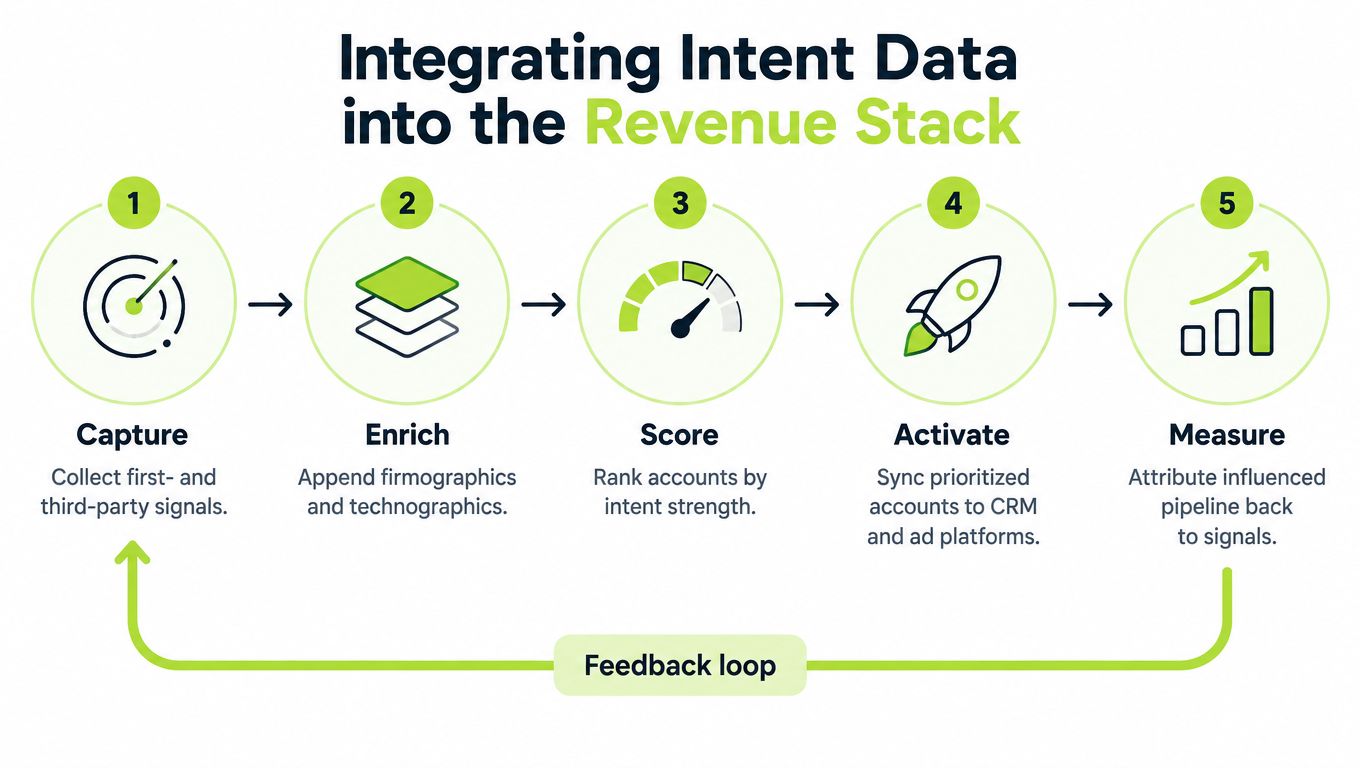
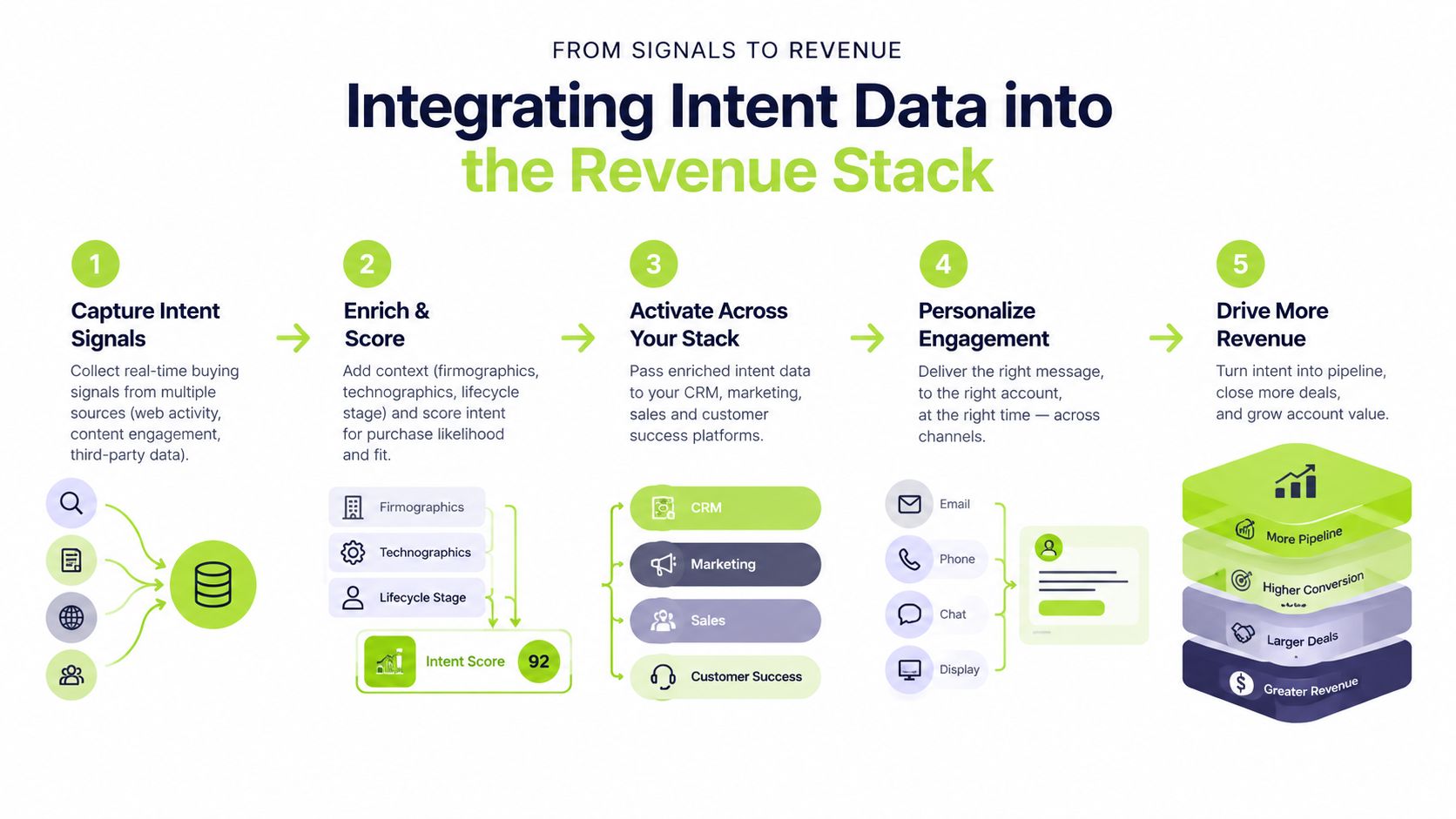
Intent becomes orchestration infrastructure when it changes a defined operating step. A signal can update an account field, trigger enrichment, create a research task, adjust an audience, notify an owner, or pause an account's generic sequence. Each action needs a stated purpose, an owner, and a fallback for incomplete or contradictory data.
Connect the operating layers
A workable architecture connects five layers:
- Capture: Collect first-party activity, third-party research, CRM events, and relevant external triggers.
- Resolve: Match each event to an account, contact, opportunity, customer record, or suppression list.
- Interpret: Combine the signal with fit, timing, commercial context, and evidence that may disprove the initial reading.
- Activate: Route the account to sales, marketing, nurture, advertising, or human research.
- Learn: Feed outcomes back into topics, thresholds, ownership, and messaging decisions.
The labels matter less than the handoffs. RevOps should be able to identify the account owner after a trigger, define what happens when an open opportunity exists, and give reps a way to mark a signal as irrelevant. That feedback should affect later qualification rather than disappearing in a private note.
CRM integration needs more than an “intent score” field. Store the original event, source, date, topic, confidence, and action history. Pair this record with CRM routing and workflow automation so teams can validate the account, preserve the evidence, and audit why a task or handoff occurred.
Keep people in the loop
Automation should manage repetition, not make unsupported commercial claims. Human judgement belongs in account interpretation, ambiguous prioritisation, message selection, and decisions involving existing relationships or sensitive context.
An automated workflow can identify a target account, enrich its record, check for a recent role change, and create a research task. A person should decide whether the evidence supports contacting a particular executive and whether the proposed message is relevant and respectful. This division also makes qualification explainable. Sales can challenge a recommendation without rejecting the entire system.
A 2026 survey of more than 320 B2B decision-makers found that 53% had not fully integrated intent data into their broader marketing stack, while 76% were using or exploring it. Among fully implementing teams, 72% reported improved lead quality. (Survey findings on intent data integration)
Integration is an operating design task, not a clean-up step after procurement. Define validation rules, ownership, audit history, signal expiry, and exception handling before adding sources. The goal is fewer unexplained tasks and better-qualified decisions, not a larger volume of alerts.
Selecting the Right Vendor and Building Your System
Choose an intent vendor based on the operating problem you need to solve, not its feature list. A company identifying anonymous category research needs a different system from a team tracking review-site comparisons, first-party website activity, or job changes.
Start with a narrow pilot and require vendors to show the evidence behind each signal. Ask how accounts are resolved, how quickly data decays, which markets are covered, and whether the feed reaches the tools where sales and marketing work. Clarify whether the provider owns the source, licenses it, or combines multiple feeds. That distinction affects transparency, exclusivity, compliance, and how confidently your team can explain a recommendation.
Use a practical evaluation checklist
Assess each provider across these areas:
- Source quality: Can the vendor explain what creates the signal and what it cannot reveal?
- Resolution: Does the data identify only an account, or can it support research into relevant people and buying roles?
- Freshness: Does the signal remain useful during your sales cycle and action window?
- Coverage: Does it include your regions, industries, languages, and target account types?
- Integration: Can it sync with your CRM, marketing automation, advertising, and sales engagement tools?
- Explainability: Can a rep see why an account was selected instead of receiving an unexplained score?
- Commercial fit: Can you run a controlled pilot without adopting a system the team cannot operate?
- Governance: Can you manage consent, suppression, duplicates, retention, and ownership?
Signal volume is a poor buying criterion. Compare the research queue produced by each provider, how many accounts match your ICP, and how many sales considers worth contacting. Review signal age at the moment of action. A broad feed creates little value if records are stale, CRM matches are wrong, or reps cannot act before interest fades.
Decide what to build
A lightweight setup can work when the team has a defined ICP, a clean CRM, clear ownership, and someone responsible for maintaining routing rules. A custom system fits better when data is scattered across tools, qualification depends on several account-specific conditions, or manual research consumes selling capacity.
A managed programme may suit a company with a proven offer and enough capacity to handle conversations, but not enough time or appetite to run research, enrichment, deliverability, copywriting, routing, and campaign learning internally. Capability should guide the choice alongside budget.
Before committing, audit a sample of current intent records. Check account matches, signal dates, duplicate records, existing customer status, disqualifiers, and the action taken. Validate records against CRM history before assigning scores or creating tasks. Then run a pilot with explicit success criteria, a named owner, a review cadence, and a stop rule if the evidence does not justify continued investment.
Intent data should support a qualification workflow that combines machine-detected activity with human judgement. Keep the evidence, expiry logic, CRM checks, and reason for each handoff visible so sales can challenge a recommendation without rejecting the system.
H2 provides custom GTM system builds that connect buying signals with account research, enrichment, qualification, lead scoring, CRM routing, and workflow automation. Human review remains part of the process for ambiguous cases. If your team needs more qualified outbound without another disconnected data feed, visit H2 to discuss your audience, current stack, and the intent workflow you want to improve.
