A trigger-aware sales motion can win at nearly twice the rate of generic prospecting. Champify's 2025 research found a 37% win rate for accounts showing active buying triggers, compared with 19% for cold outreach. Salesloft's analysis of B2B buying signals puts the implication plainly: the signal itself isn't the strategy. The advantage comes from identifying the right account, understanding what changed, and routing a relevant action while the change still matters.
Organisations typically hold more activity data than their sales teams can utilise. The challenge lies in prioritisation. A pricing-page visit, a new executive, a technology change and a hiring pattern should not all trigger the same alert, as they do not carry equivalent evidence of an active buying motion.
What Sales Buying Signals Actually Are
Four checks separate a sales buying signal from background activity. A signal is an observable behaviour, intent event or context shift that raises the probability that a specific account is evaluating a solution like yours now. It must connect to a real account, indicate a meaningful change or behaviour, and be recent enough for a seller to act within the campaign window.
That definition excludes much of the activity labelled as intent. A single anonymous page visit, an email open or a top-of-funnel download may show curiosity, yet rarely demonstrates that a buying group is forming. A usable signal adds context: it links the account to a person or stakeholder group, identifies the research topic, and gives the rep a reason to contact the account.
Buyers rarely announce their plans through a form. The 6sense's 2024 Buyer Identification Benchmark supports an account-level view of buying activity, where several relevant people and behaviours can reveal evaluation more clearly than one captured lead. That changes the operating question from “Who filled in a form?” to “Which account is showing coordinated evidence, and what should sales do next?”

A usable signal has an owner
Before routing an alert, check four things:
- Account identity: Can you connect the event to a named company rather than a broad audience?
- Attribution: Do you know whether the behaviour came from a relevant employee, stakeholder group or verified company activity?
- Timing: Is the event fresh enough to support an action now?
- Business relevance: Does it relate to a problem your offer solves?
A form fill is explicit, but it still needs qualification. A repeat visit from several stakeholders is implicit, yet may be more useful if it points to a coordinated evaluation. The difference between a lead and a signal is context, not the channel that captured it.
That context must reach sales in a usable format. Include the account, observed event, likely topic, recency and recommended next action in the alert. A practical companion is this guide on how to qualify a lead. Detection creates value only when an owner can decide whether the account deserves attention and route it to the right motion.
The Three Layers Every Signal System Needs
A durable signal system combines three layers rather than buying a feed and calling the problem solved. Each layer answers a different question: what did the account do, what is changing around it, and what is it researching elsewhere?
First-party behaviour
First-party data is closest to the buying experience because it comes from your own properties or product. Useful examples include repeat pricing-page visits, product-trial activation, repeated logins, integration activity, support searches, technical-document engagement and downloads from people who match your ideal customer profile.
This layer usually deserves the greatest weight because the account has interacted with your offer directly. A product trial or request for implementation information is stronger than an anonymous category surge. Even then, context matters. One person browsing a pricing page may be researching for a competitor comparison. Several relevant stakeholders returning to pricing and technical content suggests a more developed evaluation.
Company signals
Organisational change explains why the account might be in market. Examples include growth in a target function, a new commercial leader, a technology change, a funding event, a new operating location, regulatory pressure or a strategic expansion.
These signals don't prove that the company wants your product. They show that the conditions around a potential purchase have changed. A company hiring revenue operations staff may be building capability, but it may also be solving the problem internally. The rep still needs to connect that context with a problem your offer addresses.
Third-party intent
Third-party data can reveal research activity outside your properties. Topic surges, competitor comparisons, review-site activity and category-level searches may help identify accounts that aren't yet visible in your CRM.
The limitation is attribution. An external topic surge can be interesting without being actionable. It becomes more useful when paired with a verified account, a relevant organisational change or first-party behaviour.
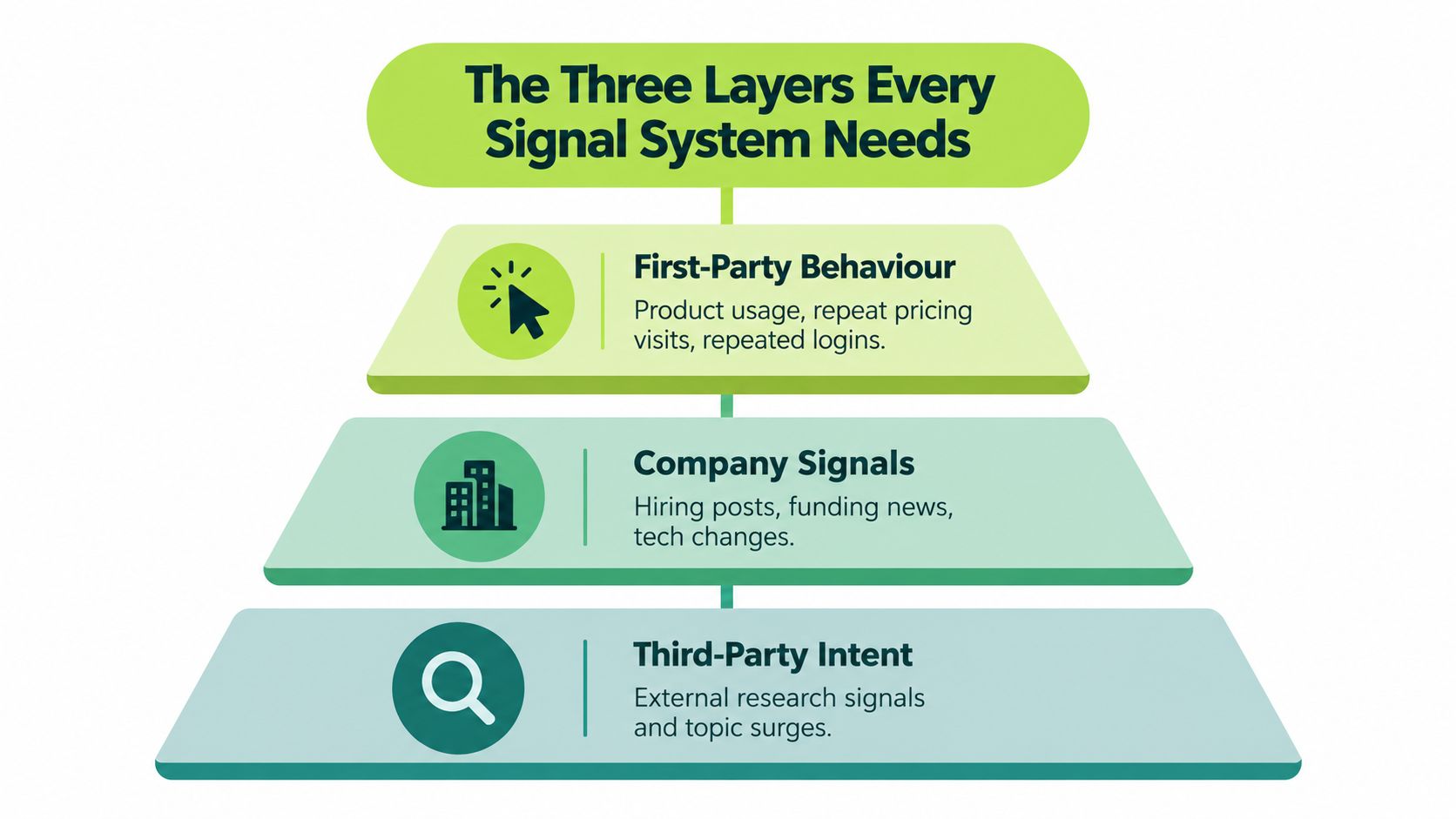
Practical rule: Treat third-party intent as a discovery layer, first-party behaviour as evidence, and organisational change as context. The combination is more useful than any layer on its own.
A good workflow therefore doesn't route every external alert to an SDR. It checks whether the account fits, looks for a second layer, and then decides whether the appropriate action is immediate outreach, monitoring or nurture.
Buying Signal Examples Across Real Channels
Signals appear in different places, and their value changes with context. The difference between weak and strong evidence usually comes down to repetition, stakeholder coverage and proximity to an evaluation milestone.
A website visit is weak when it comes from one unidentified browser and stops at the homepage. It becomes stronger when several people from the same account return to pricing, integrations and comparison pages, especially after consuming an evaluation asset. In the product, a trial activation is useful, but an activated integration, a newly added seat or a support question about usage limits indicates deeper involvement.
Email and content activity needs the same treatment. An isolated click on a broad article shouldn't trigger a high-touch sequence. A reply, a colleague forward or a case-study click following a pricing visit gives the seller a clearer reason to engage. The message should refer to the evaluation path, not pretend that every click signals a buying committee.
Third-party and social signals are useful when they add context. A category search spike, a review-site comparison or a competitor review can indicate research, but it doesn't establish intent by itself. A hiring manager discussing the need to scale a function, a champion engaging with a relevant post or an executive sharing a market change can help explain the account's priorities. None should be treated as an automatic invitation to send a generic pitch.
| Channel | Weak Signal | Strong Signal | Layer |
|---|---|---|---|
| Website | One anonymous visit | Repeat pricing and technical visits from multiple stakeholders | First-party behaviour |
| Product | Trial activation without further activity | Integration connected, seat added and key feature explored | First-party behaviour |
| Email and content | One broad-content click | Reply or colleague forward after evaluation content | First-party behaviour |
| Third-party research | General category activity | Account-level comparison activity paired with a company change | Third-party intent and company signals |
| Social | One like or passive view | Relevant stakeholder comments or executive engagement tied to a visible priority | Company signals and third-party context |
| Sales conversation | General interest | Questions about implementation, security, timing or internal approval | First-party conversation data |
The strongest pattern is not a single channel. It is layer convergence. When a company signal, first-party behaviour and stakeholder activity appear close together, the rep can form a testable hypothesis about what is happening. That hypothesis should guide research and messaging, not replace qualification.
Ranking Signals by Predictive Value
Signal volume is a poor proxy for signal quality. Rank sales buying signals by the additional evidence they contribute over a well-defined cold account, not by how easy they are to collect.
The highest tier usually contains relevant technology adoption, growth in the buying function and an adjacent purchase. Prospeo's analysis of 1 million B2B software purchases found that AI tool adoption correlated with +46%, while headcount growth and recent software purchases each correlated with +38%. The same analysis found a much weaker relationship for newer office openings at +11% and increased job postings at +7%. The underlying B2B buying-signal analysis is useful because it challenges the assumption that every visible change has equal predictive value.
A relevant technology change often signals an active operational decision. Headcount growth can indicate budget and capacity in the target function. An adjacent purchase can show that the account is already funding the problem area. These signals still need fit and timing, but they often provide more incremental evidence than broad awareness activity.
A practical hierarchy
| Tier | Example Signals | Why It Ranks Here |
|---|---|---|
| Highest | Relevant tool adoption, AI adoption, adjacent software purchase, repeated first-party evaluation by several stakeholders | Shows investment, operational change or coordinated research |
| Middle | Funding event, leadership hire, relevant content download, category research surge | Provides context or potential timing, but needs corroboration |
| Lowest | Generic ad click, single-page visit, isolated social interaction, broad aggregated intent score | Often lacks account specificity, depth or evidence of a buying group |
Funding and leadership changes can be valuable, especially when they connect to a clear mandate. A new commercial leader may review the existing stack, but the hire alone doesn't prove an active project. A content download may be closer to a buying process, but it needs subject matter, repeat behaviour or stakeholder coverage to carry weight.
Job postings deserve careful handling. A role increase can signal investment, but the finding above shows why more visible hiring isn't automatically more predictive. A posting may indicate activity without indicating an imminent purchase. The best use is to combine it with a technology change, first-party evaluation or a problem-specific description in the role.
Generic intent scores belong at the bottom unless your team can explain exactly what they represent. An aggregate score that bundles anonymous research from many accounts gives a rep a number, not a reason to call. Use it to create a watchlist, then look for account-level confirmation.
For the scoring mechanics that turn this hierarchy into a repeatable process, see lead scoring for B2B. The important discipline is to spend enrichment and monitoring budget on signals that change your decision, rather than collecting more activity that leaves prioritisation unchanged.
Scoring Signals Without Drowning in Noise
A scoring model should help a seller answer one question: what should I do next with this account? It shouldn't create a false sense of precision.
Use four factors, each assessed as a qualitative band or mapped to a small internal scale. The exact values should come from your own pipeline history, not a vendor's default settings.
Recency
Fresh signals deserve more attention than stale ones. A new technology adoption, recent pricing visit or current hiring change can support action now. An old event may still matter as background, but it shouldn't carry the same urgency.
Frequency
Count repetition across time and people. One visit is weak. Repeated visits from several stakeholders show a pattern. Frequency is especially useful for distinguishing accidental browsing from a developing evaluation.
Depth
Measure how far the account goes. A homepage visit has little depth. A path through comparison content, technical documentation, pricing and implementation material shows more commitment. A security questionnaire or detailed integration question indicates still greater involvement.
Seniority
Weight the role and influence of the person showing the behaviour. A budget holder, executive sponsor or functional leader may deserve more attention than an unconnected researcher. Seniority shouldn't erase the value of technical stakeholders, because technical validation often determines whether a deal can progress. It should influence routing and messaging.
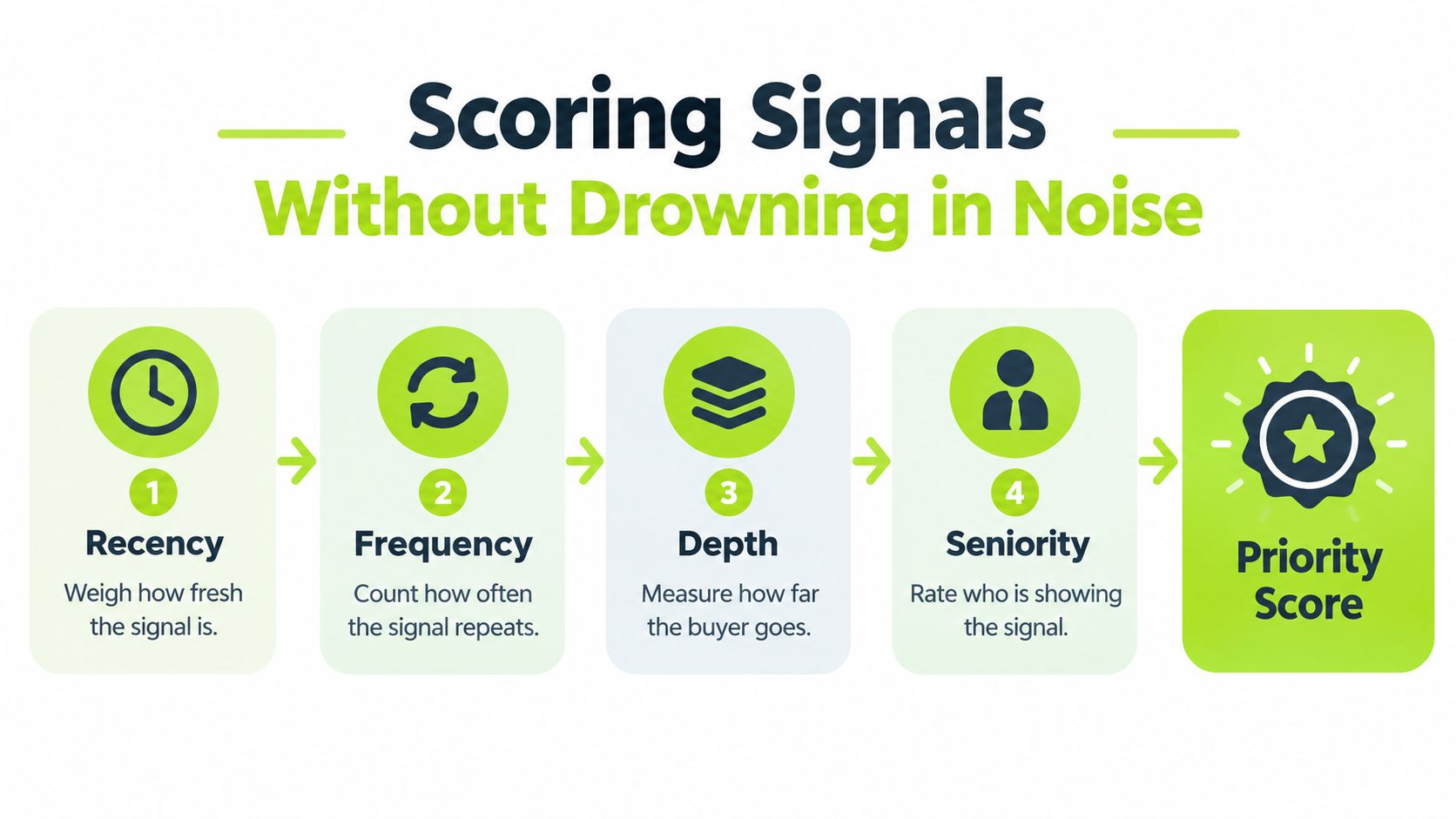
Combine the four factors into a priority score, then connect score bands to workflow decisions:
- Hot queue: A recent, repeated and deep pattern involving relevant stakeholders. Route it to a senior rep for account research and custom outreach.
- Warm queue: A credible signal with partial confirmation. Add it to a signal-aware sequence and require a second account check before escalating.
- Nurture queue: An isolated or stale event with weak fit. Monitor for another layer instead of interrupting the account with immediate outreach.
Don't hide the evidence behind the score. Store the signal type, source, date, account, people involved and recommended action alongside the total. A seller should be able to understand why an account is hot without opening several tools.
A score is useful only when it changes routing. If every account still receives the same sequence, the model is decoration.
Review false positives and missed opportunities regularly. If hot accounts rarely produce meaningful conversations, the issue may be weak depth rules, poor identity resolution or an overvalued third-party input. If reps ignore warm alerts, the threshold may be too low or the message may not give them enough context.
Turning Signals Into Outbound Action
Suppose an account has adopted a relevant AI tool and has recently hired a senior commercial leader. The system shouldn't immediately launch a five-step sequence. First, the rep confirms the technology change, checks whether the leader owns the relevant function and looks for a second piece of evidence, such as product research, a related hiring pattern or an explicit operational priority.
The rep then maps the likely buying committee. The new leader may own the budget, but operations, finance, security and the people responsible for implementation can influence the decision. The aim isn't to contact everyone with the same message. It's to understand which stakeholder has the problem, who can sponsor a change and who may block it.
Message selection follows the trigger
The opening line should refer to the observed event and its plausible business meaning. An account that has adopted an AI tool may be reviewing productivity, workflow or governance. An account with a new VP of Sales may be rebuilding its commercial process. The rep should choose one hypothesis and make it easy for the buyer to correct.
A weak message says the company is growing and offers a generic demo. A stronger message acknowledges the specific change, names the adjacent problem the seller helps with, and offers a useful next step. That might be a short comparison, an implementation checklist or a focused conversation, depending on the signal depth.
The cadence should stay connected to the original evidence:
- Immediate first touch: Reference the event and the likely problem without overstating intent.
- Value-led follow-up: Share a relevant point of view or asset tied to the same change.
- Final check-in: State what was observed, invite correction and give the buyer an easy way to decline.
Hot accounts deserve custom research and a senior seller. Warm accounts can enter a templated sequence where the trigger changes the opening and supporting proof. Low-score accounts should remain in nurture until another signal changes the decision.
The operating model resembles a disciplined form of outbound lead generation, but the list is dynamic. Replies, objections, meetings and disqualifications should feed back into the weights. If accounts with a specific trigger consistently reach discovery, increase its priority. If a popular signal produces polite curiosity but no opportunities, reduce its weight or require corroboration.
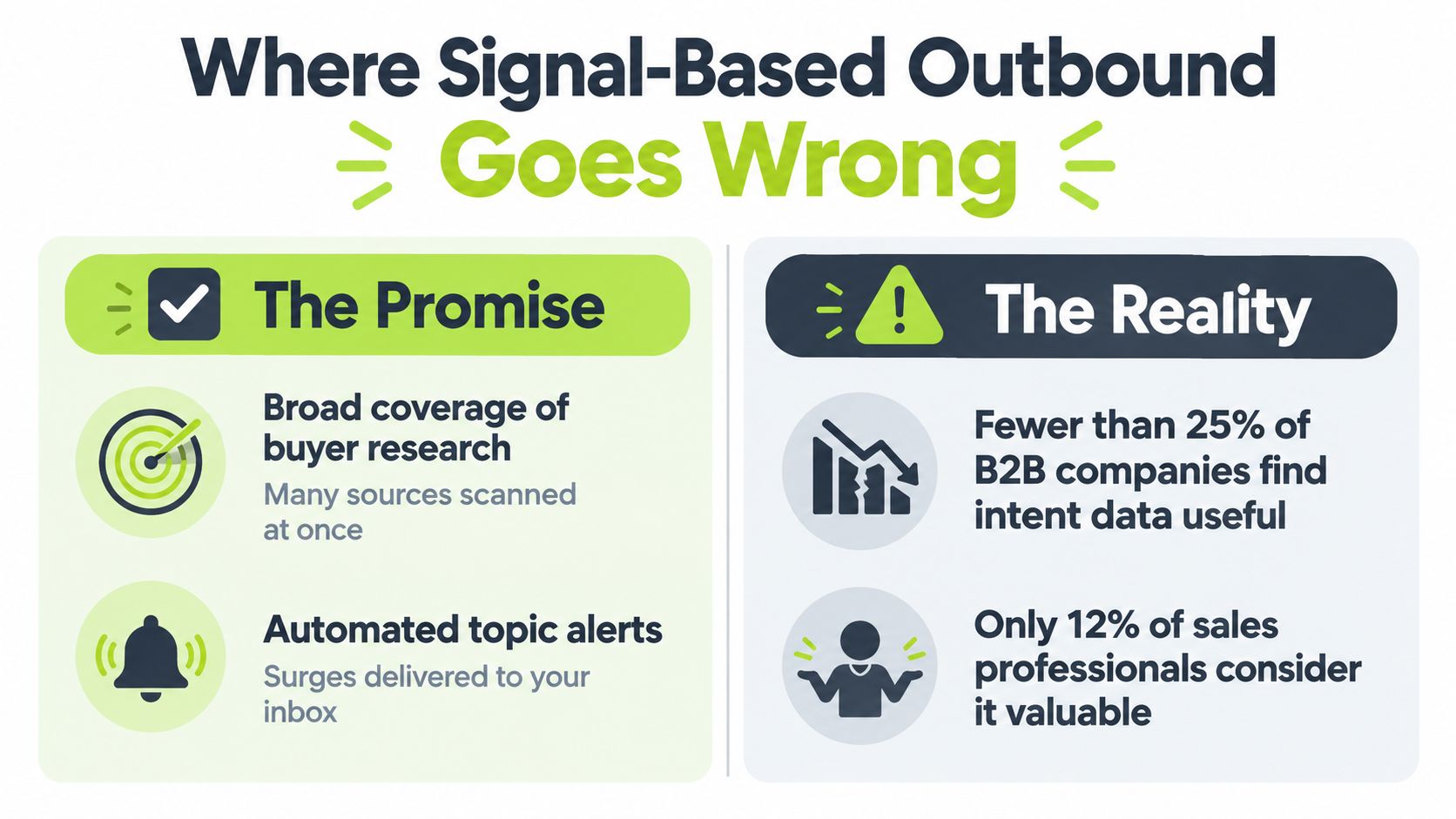
Where Signal-Based Outbound Goes Wrong
Signal-based outbound fails when teams treat activity as a decision rather than evidence. Third-party intent platforms are not a silver bullet. 6sense's benchmark illustrates the gap between collecting buyer activity and finding signals a team can use. The harder question is what happens after an alert arrives.
The common failure is signal sprawl. A team adds vendors, alerts and dashboards, then asks SDRs to interpret everything without changing territories, thresholds or messaging. Alerts accumulate, sellers chase curious contacts, and high-priority accounts receive the same treatment as weak research. A useful signal that reaches the wrong workflow still produces no pipeline.
Digital behaviour has blind spots too. Buyers discuss budgets privately, compare vendors through existing relationships and involve stakeholders whose activity never reaches an intent platform. Treating an anonymous page view as account certainty creates false confidence. Use digital activity to form a qualification hypothesis, then look for corroborating evidence before increasing outreach intensity.
The operational warning signs
- Alert fatigue: Reps stop checking the feed because every event appears urgent.
- Misrouting: A signal reaches the wrong territory, role or seller and expires before correction.
- Weak attribution: Anonymous activity is recorded as confirmed account engagement.
- Curiosity mistaken for intent: A researcher receives sales pressure without evaluation depth.
- No feedback loop: The team never compares signals with opportunities, so weak weights remain in production.
A smaller, ranked set of first-party and organisational signals usually creates a cleaner workflow than anonymous research spikes. The practical test is simple: can a rep explain what changed, why it matters to the account and which action the evidence supports?
A Practical Buying Signal Checklist for This Week
Start with a minimum viable system. Choose three first-party sources, such as pricing activity, product usage and high-intent content or support conversations. Add one firmographic or organisational feed covering changes that matter to your market. Leave third-party intent out until the account identity, routing and feedback process work reliably.
Then write the operating rules:
- Define the evidence: Record the account, event, date, stakeholder and source.
- Apply four factors: Score recency, frequency, depth and seniority using your own internal bands.
- Set an activation threshold: Decide what evidence moves an account from monitoring into active outbound.
- Assign ownership: Route hot accounts to a named seller and define the response expectation.
- Choose the message: Match the first line and offer to the event, not merely to the account's industry.
- Review outcomes: Track signal-to-opportunity conversion weekly against a control group of unflagged outbound accounts.
The final comparison matters more than open or click activity. If flagged accounts don't create more qualified opportunities than the control group, the system isn't proving incremental value. Investigate identity quality, signal depth, timing and sales follow-up before adding another data source.
Watch for three problems during the first week: too many accounts crossing the threshold, sellers receiving alerts without usable context, and signals arriving after the relevant buying window. Fix those workflow issues first. More data won't repair a routing rule that nobody trusts.
H2 can build a custom GTM system that brings buying signals into account qualification, lead scoring, enrichment and CRM routing, or run the research and signal-aware outbound for you through a managed programme. Visit H2 to discuss your target accounts, current data and the buying signals your sales team needs to act on.
