Outbound lead generation is the proactive, system-driven process of identifying, qualifying, and engaging ideal buyers before they express inbound intent. Average cold email reply rates sit at 3.43%, with good campaigns reaching 5% to 10%, so the objective isn't to send more messages, but to create qualified conversations from carefully selected accounts.
The popular advice is still wrong in a familiar way. It treats outbound as a volume contest, where a larger list and a busier sequence compensate for weak targeting. In a saturated B2B market, that approach damages sender reputation, wastes sales capacity, and produces activity without pipeline.
Modern outbound is closer to revenue engineering. It combines commercial research, account selection, buying signals, contact verification, deliverability controls, relevant messaging, and feedback from live sales conversations. Email may be one channel, but the system determines whether that channel reaches the right person with a credible reason to respond.
Redefining Proactive B2B Outreach
The phrase “cold email” has become shorthand for outbound lead generation, but it describes only one execution method. Outbound lead generation starts earlier, with a decision about which companies deserve attention, which people influence the purchase, and what evidence suggests the problem may matter now.
That distinction matters because broad-blast prospecting fails in predictable ways. A generic list creates irrelevant messages. Irrelevant messages create low engagement and complaints. Poor engagement and complaints make it harder for future messages to reach valid inboxes. The sequence can fail before the recipient has a fair chance to evaluate the offer.
Benchmark data puts the average cold email reply rate at 3.43%, while good campaigns typically land between 5% and 10%, and elite campaigns exceed 10% according to cold email benchmark data from EmailChaser. The same benchmark set notes that top-quartile campaigns reach about 5.5%, which means roughly 97 out of every 100 cold emails still don't receive a reply. That isn't evidence that outbound is dead. It shows why precision matters.
From activity to a controlled revenue engine
A functioning outbound programme answers four questions before anyone presses send:
- Who fits: Which industries, company conditions, roles, and commercial circumstances match the offer?
- Why now: What observable signal justifies contact at this moment?
- Why this message: Which buyer problem can the sender discuss without inventing urgency?
- What happens next: How will a reply be qualified, routed, and progressed?
This is why outbound has become an operating system rather than a standalone marketing channel. Sales, marketing, revenue operations, and sometimes engineering all contribute inputs. The system turns market information into a controlled set of conversations, then uses objections and outcomes to improve the next campaign.
A practical guide to b2b outbound lead gen is useful for mapping the moving parts, but the central principle is simple: the list is not a spreadsheet, it is a set of commercial hypotheses. Each account should have a defensible reason for inclusion.
Teams also need a repeatable research method. A clear prospecting process helps separate account discovery from qualification and outreach, preventing researchers from treating every scraped contact as a sales opportunity.
Practical rule: Don't scale a campaign until you can explain why each segment should care, how the data was verified, and what sales action follows a positive reply.
The Core Components of a Modern Outbound System
Modern outbound depends on several connected components. Copywriting matters, but it can't rescue an unverified list, weak infrastructure, or an offer that doesn't match the account's circumstances.
Audience discovery and signal detection
The system begins with account discovery. Researchers may examine public company information, employer job postings, technology usage, leadership changes, product activity, or relevant social signals. Tools such as Clay can combine sources and support structured research, while AI workflows can summarise evidence and apply defined rules.
A signal is not the same as intent. A company hiring for a role may be expanding, replacing someone, or collecting options. A technology choice may indicate compatibility, but it doesn't prove dissatisfaction or budget. Treat signals as reasons to investigate, not permission to claim that a buyer is ready.
The output should be a qualified account hypothesis, such as: this company appears to fit the service profile, this role is likely involved, and this observable change creates a relevant problem to explore.
Enrichment and verification
Raw account data needs enrichment before it reaches a sequence. That process can add role information, company context, technology details, and evidence supporting the chosen message. Contact verification then removes invalid or uncertain records.
This stage protects both performance and reputation. The 2026 benchmarks cited by Expandi classify a bounce rate below 2% as strong, while rates above 5% are poor, and top-performing campaigns often require inbox placement of 95% or higher according to email marketing KPI benchmarks. These thresholds make list quality an operational requirement, not a research preference.
Infrastructure and deliverability
Sending infrastructure determines whether carefully written messages are seen. Teams need disciplined mailbox management, controlled volumes, monitoring, suppression rules, and clear opt-out handling. Bulk senders also need one-click unsubscribe support under requirements introduced by major mailbox providers, as summarised in outbound lead generation guidance from Prospeo.
The sequence should stop immediately when someone replies, opts out, or is identified as unsuitable. Continuing to send after a response signals that the system values automation over the recipient's context.
Campaign execution and feedback
Campaign execution includes the message, channel selection, follow-up logic, qualification criteria, and CRM routing. Email may be combined with calls or LinkedIn activity, but coordination matters more than adding channels for its own sake.
Feedback closes the loop. Qualified replies, objections, wrong-person responses, unsubscribes, bounces, and sales outcomes should change the next audience or message decision. Open rate alone isn't a reliable commercial metric, because privacy features and client-side preloading can distort it. Qualified reply rate, meeting rate, opportunity quality, and pipeline progression provide a more useful view.
Outbound Lead Generation vs Outbound Marketing
Outbound marketing and outbound lead generation both initiate contact, but they operate at different levels of focus. Outbound marketing is usually broader and one-to-many, using paid media, events, sponsored content, or mass email to create awareness and demand. Lead generation is narrower, selecting accounts and people with the aim of starting qualified sales conversations.
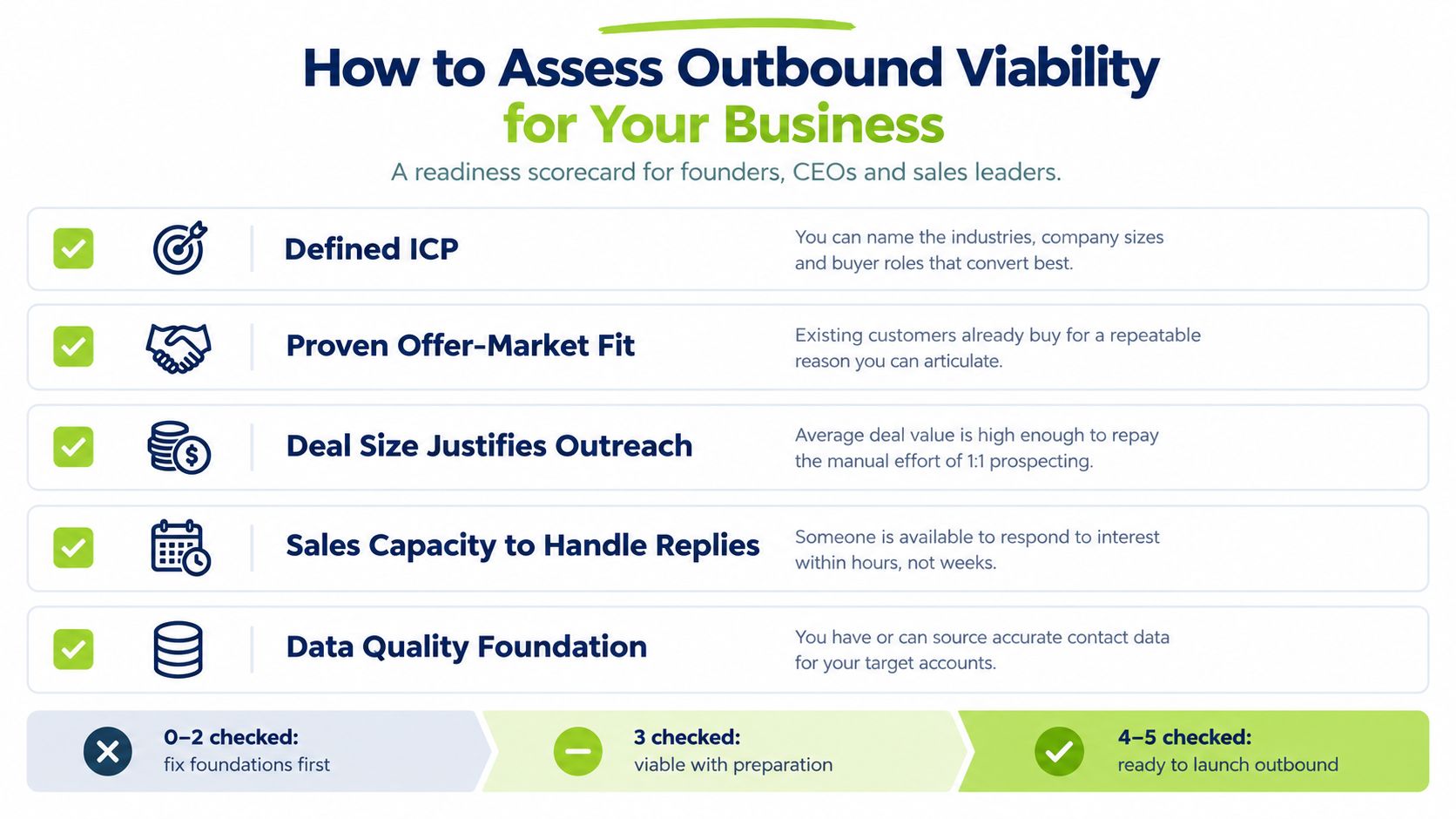
The distinction affects ownership and measurement. Marketing may optimise reach, impressions, cost per lead, and influenced pipeline. A sales development or revenue team may optimise qualified replies, meetings, opportunity creation, and the quality of handoffs to account executives.
Where signal-led targeting fits
Signal-led targeting sits between list building and prospecting. A workflow might identify a company using a relevant platform, find a matching vacancy, enrich the likely buyer, and draft a message that references the business context. Clay and AI can accelerate the research, but the workflow still needs rules that a human can inspect.
That explainability matters. If nobody can state why an account was selected, the system is probably collecting data rather than qualifying demand. Signals can support prioritisation, but they don't establish purchase intent on their own. Zeliq's overview of lead generation captures the broader shift towards proactive acquisition across channels, while the practical boundary remains the commercial decision to contact a specific person for a specific reason.
An outbound marketing campaign might make a market aware of a category. A lead generation campaign turns a defined account hypothesis into a conversation. The two can reinforce each other, but they shouldn't be evaluated with the same operating metrics.
Choosing the right motion
Use broader outbound marketing when the problem is category awareness or market education. Use targeted lead generation when the market is identifiable, the buyer is reachable, and the offer can be connected to a concrete business issue.
An ICP-defined outbound outreach guide can help teams formalise that choice. The useful question isn't whether one approach is superior. It's whether the team needs more people to recognise a problem, or needs a specific set of accounts to discuss solving it.
Common Misconceptions About Cold Outreach
Cold outreach creates bad decisions when leaders interpret symptoms as causes. A campaign underperforms, the team blames email, and the company abandons a potentially useful channel without examining its inputs.
The first misconception is that cold email is dead. The available benchmarks show something more nuanced. Typical B2B campaigns produce about 1% to 5% replies, with platform-wide averages around 3.43%, while some large-sample research reports response rates near 8.5% when verified lists and personalised follow-up sequences are used, as discussed in B2B outbound benchmarks for 2026. Performance is limited, but the result depends heavily on data, relevance, and execution.
A low reply rate doesn't automatically mean the offer is wrong. It may mean the campaign targeted the wrong role, used stale contact data, reached the inbox inconsistently, or described a problem too broadly.
Open rates aren't the verdict
Open rates attract attention because they're easy to see, but they don't show whether the recipient is a viable buyer or whether the sales team can create an opportunity. Privacy controls and automated preloading make opens an unreliable standalone indicator.
Track the sequence through a commercial lens:
- Qualified replies: Did the recipient identify a relevant problem or situation?
- Meeting conversion: Do suitable replies become conversations?
- Sales acceptance: Does the sales team agree that the meeting is worth taking?
- Opportunity quality: Does the account progress beyond an introductory exchange?
- Pipeline contribution: Does the activity create real commercial potential?
Better copy can't fix broken inputs
Strong copy helps when the audience and offer are credible. It can't fix a broad list, a damaged sender reputation, or a message built on an unsupported assumption. The practical diagnosis should move upstream, from wording to selection, verification, delivery, and qualification.
One 2026 benchmark report cited by Belkins gives a much lower 0.45% average reply rate for 2025, with the second half of that year at 0.40%, while another report found a 4.5% sequence reply rate and described only one in 20 cold emails as receiving a reply, as summarised in cold email response rate analysis. The variation reinforces the point: definitions, samples, list quality, and sequencing change the result.
Don't ask whether cold email works in the abstract. Ask whether this audience, this offer, this data set, and this sending environment can produce a qualified conversation.
How to Assess Outbound Viability for Your Business
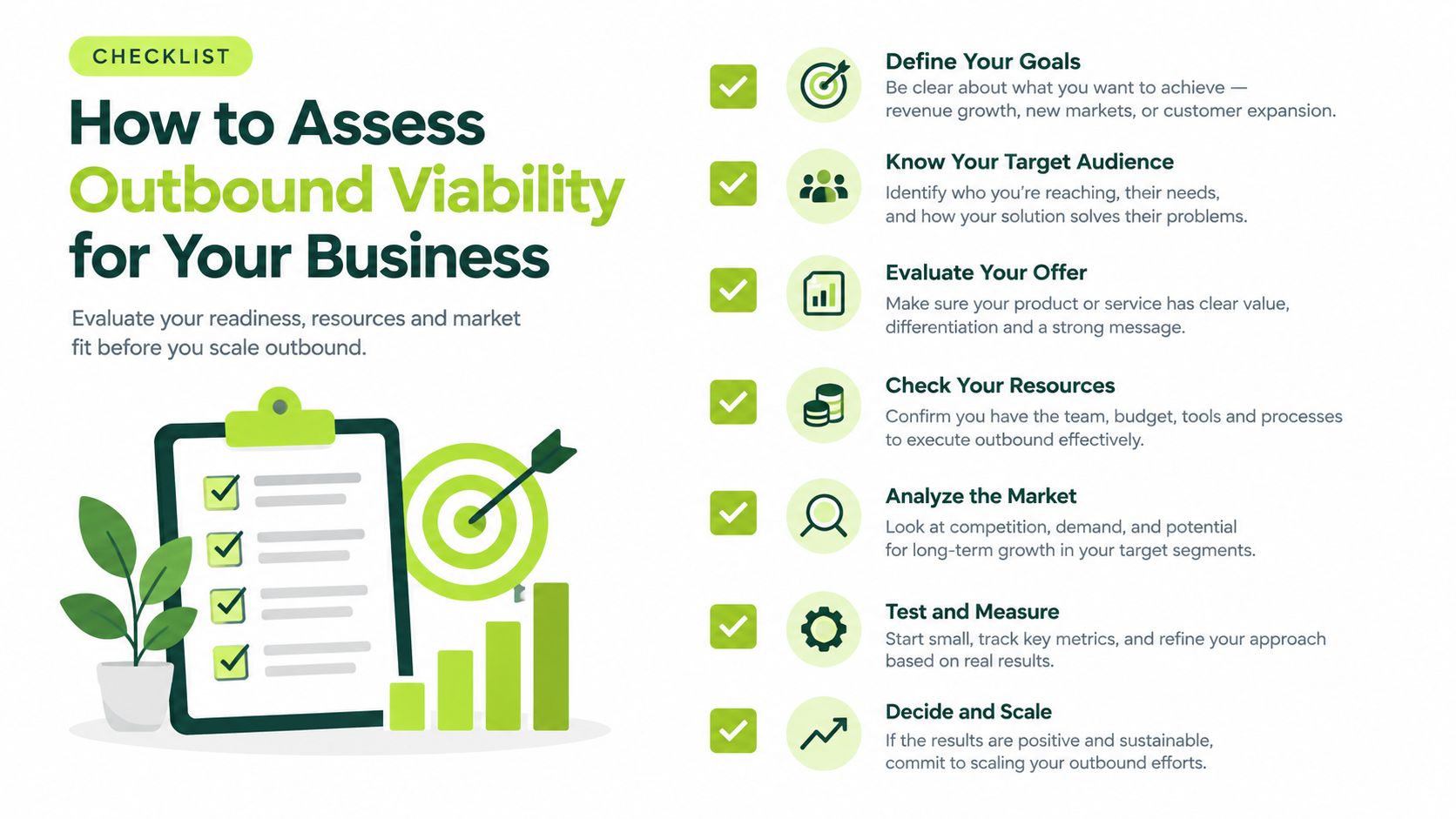
Outbound isn't a universal first move. It works best when a company can describe its buyer, explain the commercial problem it solves, and respond properly when a prospect shows interest.
Start with the offer
Review recent sales conversations, proposals, support discussions, customer stories, and lost opportunities. Look for repeated reasons buyers moved forward, recurring objections, and language customers use to describe the problem. If the offer changes for every prospect, outbound will produce inconsistent learning because the team won't know whether the audience or the positioning caused the result.
A viable offer doesn't need perfect messaging. It does need a clear commercial hypothesis that a prospect can understand without a long explanation.
Define the account and buyer
Write the ICP in operational terms. Include the industries, company conditions, buyer roles, exclusions, and observable signals that justify research. “Technology companies” isn't an ICP. A useful definition specifies which technology companies, which internal problem, which role feels it, and what evidence suggests the problem may be active.
Then test whether the market is identifiable. Can you find enough relevant accounts through public information, company websites, job postings, technology usage, or other appropriate sources? If the answer is no, the team may need a different acquisition motion or stronger positioning before investing in outbound.
Check sales capacity and data quality
A reply creates work. Someone must respond quickly, qualify the context, schedule the next conversation, and record the outcome. If interest sits in a shared inbox or waits for an overloaded founder, the campaign will generate frustration rather than learning.
Use this readiness test:
- Offer clarity: Can the team state the problem, buyer, and outcome in plain language?
- ICP definition: Can researchers identify strong-fit accounts and exclude poor fits?
- Signal availability: Is there observable evidence to guide prioritisation?
- Contact access: Can the team source and verify relevant professional contacts?
- Sending discipline: Can the business protect inbox placement and manage opt-outs?
- Reply ownership: Is someone accountable for fast, thoughtful responses?
- Learning process: Will sales feedback change targeting and messaging?
A referral-led business often turns to outbound because inbound enquiries are irregular or founder relationships limit growth. That can be a sensible reason to build the system, but it doesn't remove the need for a specific offer and a qualified audience.
Building vs Outsourcing Your Outbound Engine
The internal versus outsourced decision isn't only about headcount. It concerns who owns the research, data operations, deliverability risk, campaign learning, reply handling, and documentation.
An internal SDR team offers proximity. Reps can sit beside founders, product specialists, and account executives, then feed objections back into positioning quickly. The trade-off is operational drag. Hiring doesn't automatically create a working system, and the team still needs data providers, enrichment workflows, sending infrastructure, quality controls, training, and management.
A managed partner can bring those capabilities together sooner, but the company gives up some day-to-day control. The partner also needs accurate commercial context and fast feedback from the internal sales team. Outsourcing won't compensate for an unclear offer or an unavailable subject-matter expert.
| Factor | Internal SDR Team | Managed Outbound Partner |
|---|---|---|
| Strategic control | The company owns priorities and daily decisions. | The partner runs agreed processes with shared review points. |
| Commercial proximity | Reps work directly with founders, sellers, and product teams. | The partner needs structured access to internal knowledge and feedback. |
| Data operations | The company builds enrichment, verification, and CRM workflows. | The partner can manage research and list operations as part of delivery. |
| Deliverability | Internal owners carry sender reputation and monitoring responsibilities. | The partner manages the sending programme within agreed controls. |
| Learning speed | Learning depends on hiring, training, and management capacity. | Existing workflows can support faster testing across defined segments. |
| Long-term ownership | Knowledge can become an internal capability if documented. | Knowledge needs deliberate handover, documentation, and governance. |
| Best fit | A validated motion that justifies a dedicated team and ongoing management. | A team that needs pipeline but lacks the time or appetite to operate outbound internally. |
A custom GTM build is the middle path. The company can commission account research, signal detection, enrichment, qualification, CRM routing, or AI-assisted workflows, then operate the system internally. A private workshop can also help a team learn where automation is useful and where human judgement must remain in the process.
For a closer view of the operating model, see this outbound lead generation service for B2B SaaS. The decision should follow capability and commercial readiness, not a generic preference for agencies or internal teams.
Next Steps to Launch Your Outbound Strategy
Start with a commercial audit, not a sequence. Review previous campaigns, sales calls, proposals, customer stories, objections, lost deals, and dormant opportunities. The aim is to find the buyer language and account conditions that deserve a structured test.
Then define a narrow first campaign. Specify the account criteria, relevant roles, inclusion and exclusion rules, evidence required for qualification, and the problem the message will address. Keep the initial scope controlled enough that the team can inspect records and understand why each prospect received the message.
Build the learning loop before launch
Set up the workflow that turns activity into decisions:
- Research records: Store the evidence supporting account selection.
- Verification status: Mark whether contacts are current and suitable for outreach.
- Message variants: Test distinct commercial angles, not cosmetic wording changes.
- Reply categories: Separate interest, objection, timing, wrong person, opt-out, and irrelevance.
- Sales feedback: Record whether a meeting was qualified and what happened afterwards.
Measure qualified conversations and pipeline outcomes, while using bounce and reply data to diagnose system health. Don't let send volume become the target. More activity can hide deteriorating data and deliverability.
A multichannel plan may be appropriate when the audience is reachable across email, phone, and LinkedIn, but adding channels won't repair weak account selection. The core outbound sales strategies should follow the evidence available in your market and the capacity of your sales team.
Launch only after the response path is ready. Someone should own replies, calendar coordination, qualification, CRM updates, and feedback to the campaign operator. The first campaign isn't a final answer about the market. It's a controlled test that should make the next decision more informed.
H2 helps B2B companies research the right accounts, build signal-led data workflows, manage deliverability, write and test campaigns, and handle qualified replies through Fully Managed Outbound, Custom GTM System Builds, and Private GTM Workshops. Visit H2 to book a 15-minute introductory call about your audience, current pipeline challenge, and the outbound capability you need.
