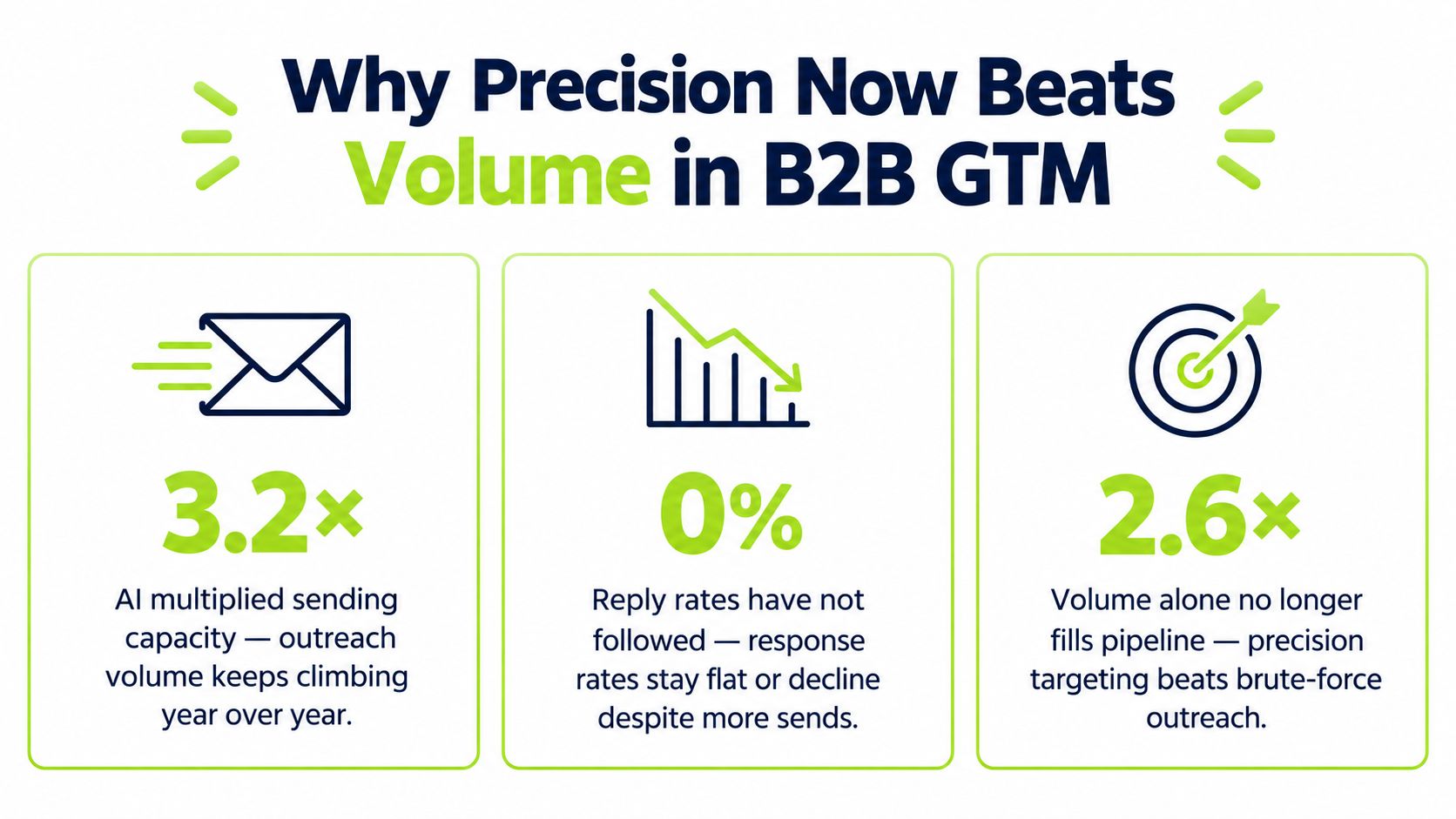
Most B2B go-to-market advice starts with a channel checklist: publish content, add LinkedIn, send more email, automate follow-up, and watch the pipeline grow. That sequence is backwards. AI has increased sending capacity, but response rates haven't followed, and crowded inboxes now punish weak relevance long before a clever subject line can help.
A practical go-to-market strategy for B2B starts with a narrower question: which small group of accounts has a credible reason to care now, and what evidence supports that judgement? From there, the work becomes a connected system of market selection, qualification, messaging, infrastructure, sales motion and feedback. The objective isn't to contact the largest possible audience. It's to find the smallest viable audience that can produce qualified conversations repeatedly.
Why Precision Now Beats Volume in B2B GTM
The popular assumption is simple: if a campaign produces too little pipeline, increase the number of prospects and send more messages. That approach made sense when outbound was treated as a high-volume activity. It makes less sense when most messages receive no response and buyers can recognise generic automation instantly.
A 2026 analysis of more than 2M cold emails found an average reply rate of 2.09%, while other B2B benchmarks place typical reply rates in the 3% to 5% range, with top-performing campaigns exceeding 8% when lists are verified and follow-up is disciplined. The spread isn't a promise of performance. It shows how strongly outcomes depend on audience quality, relevance, deliverability and execution.
Practical rule: If you can't explain why an account belongs in a campaign, adding it to the list will probably reduce learning quality rather than increase pipeline.
The system comes before the copy
A weak audience creates noisy replies. Noisy replies make it difficult to tell whether the problem is the offer, the message, the timing or the list. The team then changes several variables at once and learns very little.
Precision-first GTM reverses that sequence:
- Select tightly: Define the market by business context, problem and disqualifiers.
- Qualify with evidence: Combine several weak signals instead of treating one signal as intent.
- Write a hypothesis: State the buyer problem, why it might matter now and what response would validate it.
- Protect delivery: Treat domains, inboxes, contact verification and sending practices as part of strategy.
- Close the loop: Feed replies, objections and meeting quality back into account selection.
That makes outbound a measurement system, not a send-volume exercise. It also explains why managed outbound and GTM engineering increasingly combine research, enrichment, qualification rules and controlled testing. The rest of the strategy should follow the same principle: choose the narrowest audience that can support the commercial goal, then expand only when the evidence earns expansion.
Defining Your Market and Ideal Customer Profile
An ideal customer profile isn't a description of everyone who could technically use your product. It's a decision tool for identifying companies where fit, urgency and ability to buy overlap. If the definition includes almost every company, it won't help sales prioritise accounts or help marketing write relevant messages.
Start with evidence that already exists inside the business. Review successful sales calls, lost opportunities, support conversations, customer stories and previous campaigns that failed. Record the words buyers use for the problem, the event that made it urgent, the alternatives they considered and the reason they delayed or acted.
A useful ICP document should include:
- Firmographic fit: Industry, business model, geography and organisational complexity.
- Operational fit: The process, technology or capability that creates the need.
- Trigger context: Hiring activity, leadership changes, public initiatives, technology choices or other observable events.
- Buying constraints: Budget ownership, implementation burden, procurement requirements and internal expertise.
- Disqualifiers: Conditions that make a sale unlikely even when the company looks superficially relevant.
Public company information, websites, technology choices, hiring activity and relevant social activity can help prioritise accounts. None of these signals proves purchase intent by itself. A company hiring an engineer might be expanding, replacing a departing employee or maintaining a standard recruitment process. Treat the signal as a reason to investigate, not a reason to send automatically.
Score combinations, not assumptions
Build qualification rules that combine multiple signals. For example, an account might need strong firmographic fit, a relevant technology environment and a current trigger before it enters a high-priority campaign. Keep the logic explainable. Someone reviewing the record should understand why it passed, what evidence is missing and who owns the next decision.
A score should support judgement, not disguise the absence of it.
Consider a software development studio that has grown mainly through referrals. Its first outbound list might include every company with an engineering team, but that audience is too broad to produce useful learning. A stronger approach would identify companies with a specific technical need, a delivery gap or a hiring pattern that makes external development support plausible, then separate high-fit accounts from firms that only match the industry label.
The studio can test one tightly defined segment, compare reply themes and inspect meeting quality before adding another. This is also the practical distinction between an ICP and a persona. For a fuller explanation of how ICPs guide sales prioritisation, What Is ICP in Sales provides useful context. The final output shouldn't be a static slide. It should be a living set of research fields, decision rules and disqualifiers that improves as sales conversations reveal more.
Choosing the Right Channels and Messaging for Senior Buyers
Channel choice should follow the buying situation, not the preferences of the marketing team. Deal size, buyer seniority, sales-cycle complexity and available sales capacity all change the right mix.
| Channel | Best For | Typical Deal Size | Key Risk |
|---|---|---|---|
| Outbound email | Focused account lists and identifiable business problems | Larger or considered B2B purchases | Irrelevance and deliverability damage |
| LinkedIn-led outreach | Senior buyers who value context and visible credibility | Complex, relationship-led opportunities | Superficial personalisation |
| Inbound content | Buyers researching a problem independently | Broad range, especially repeatable offers | Slow compounding and weak commercial intent |
| Partner motion | Markets where trusted providers already influence decisions | Larger or ecosystem-dependent purchases | Passive partnerships without shared execution |
Senior buyers often want to understand the problem without entering a sales process immediately. Recent buyer data reports that 61% of B2B buyers prefer a rep-free buying experience and 73% avoid suppliers that send irrelevant outreach, while 92% start with at least one vendor already in mind. Those figures, reported in recent B2B outbound buyer research, make generic interruption especially costly.
Use channel combinations deliberately
Lead with LinkedIn when the prospect's role, public context or visible professional activity gives you a credible reason to start there. A thoughtful connection or comment can establish context before email supports the conversation. Lead with email when the problem is easier to explain privately, the account trigger is concrete or the buying group needs a direct, searchable message.
Inbound content works best when buyers are actively researching a recognised problem and the business can afford to build authority over time. Partner motions fit when a complementary firm already has trust with the target audience and can make a specific introduction or joint offer. None of these channels should be added merely to appear multichannel.
Write from the buyer's circumstances. “We help companies improve engineering” is an offer statement. “Your team is hiring around a capability that often creates delivery pressure, and there may be a way to reduce the gap without adding a permanent function” is a testable hypothesis, provided the evidence is real and the language remains appropriately cautious.
AI can help gather account context, suggest research fields and produce message variations. It shouldn't decide whether a weak signal is meaningful or turn a public detail into false familiarity. Human judgement belongs in qualification, interpretation and final review. Examples of how teams combine channels can be found in B2B marketing case studies LinkedIn email, but the decision rule remains local: use the channel that best matches the buyer's context and your ability to follow through.
Pricing and Sales Motion Decisions That Shape Your GTM
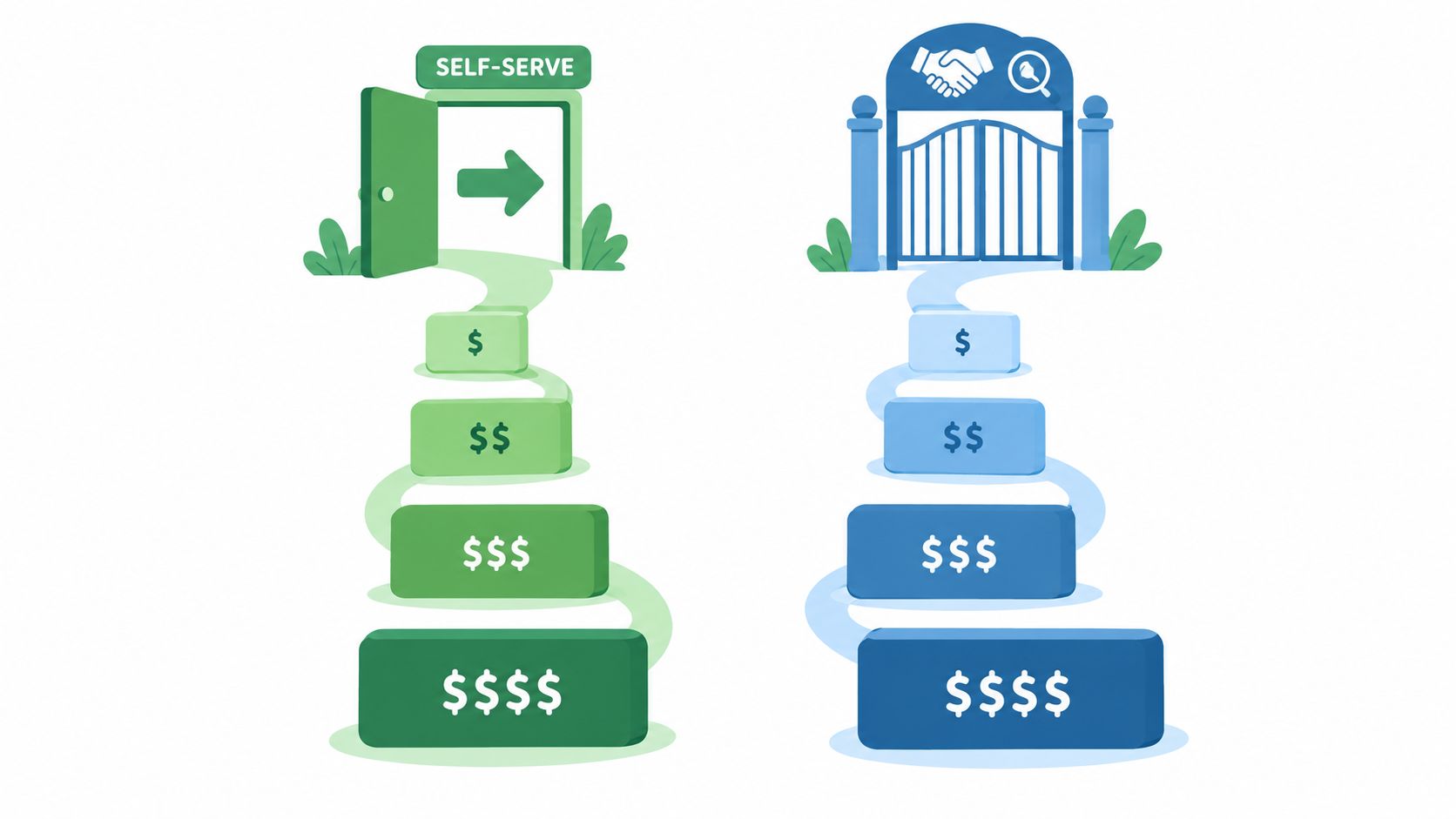
Pricing isn't a line at the end of a GTM document. It determines how much explanation buyers need, who must be involved, how quickly they can evaluate the offer and whether self-serve acquisition is commercially sensible.
A low-friction product with clear time-to-value can support inbound, product-led adoption or a lightweight sales assist. A high-value service or technically complex platform usually needs qualification, discovery, proof and stakeholder coordination. The mistake is copying a sales motion from a company with a different price, buyer and implementation burden.
Match the motion to the economics
Use pricing assumptions as hypotheses. Define the value metric, the likely buyer, the approval path and the amount of sales involvement required. Then test whether the packaging attracts the accounts defined in the ICP or merely creates low-quality interest.
Pipeline planning must reflect deal complexity. Recent B2B benchmark reporting places common pipeline coverage targets between 3.1× and 4× quota, with enterprise teams often aiming for 5× or more because longer cycles and lower win rates create more uncertainty, as documented in B2B sales benchmark reporting. The implication isn't that every company should adopt the same target. It's that price, sales cycle and qualification discipline determine how much pipeline depth the operating model needs.
A managed database services firm illustrates the choice. If its buyers are senior technical leaders, the work carries meaningful operational risk and the engagement requires trust, a self-serve checkout may create activity without producing viable customers. A focused outbound motion can instead identify accounts with relevant capacity or support gaps, qualify the environment and offer a conversation suited to the buying committee.
Choose among three broad motions:
- Founder-led: Useful while the offer and message are still being validated, because founders can interpret objections quickly.
- SDR-led outbound: Appropriate when the ICP, qualification rules and handoff process are stable enough for repeatable execution.
- Account-based: Suitable when a small number of high-value accounts justify research across several stakeholders.
The choice should also reflect conversation capacity. Generating demand that sales can't handle creates slow follow-up and poor buyer experience. Packaging, pricing, channel and team capacity must therefore be designed together.
Building the Outbound Engine
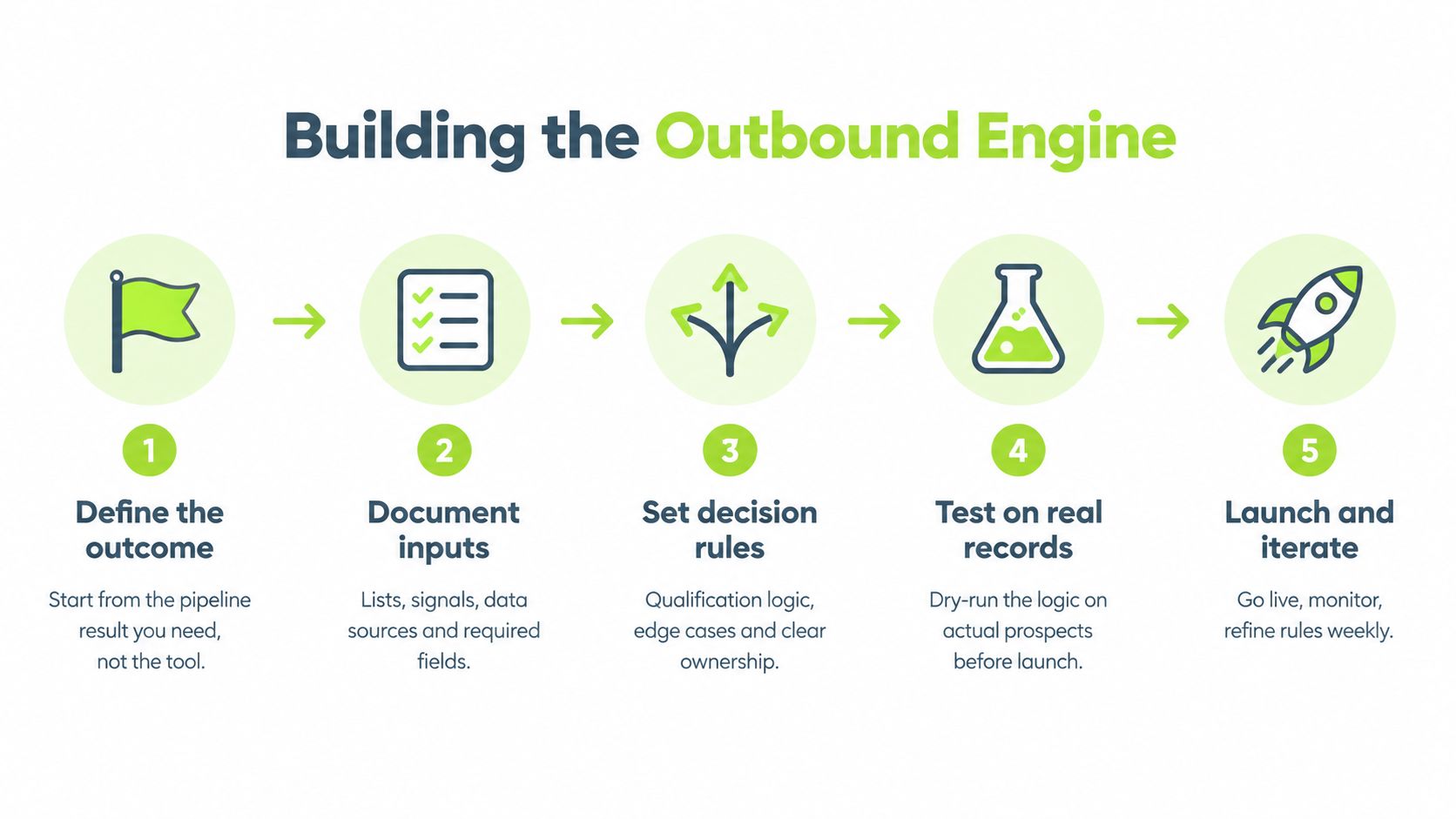
Outbound fails most often in the joins between activities. Research sits in one tool, enrichment in another, sending happens elsewhere and qualified replies arrive without clear ownership. A reliable engine starts with the commercial outcome and documents the operating path before anyone builds automation.
Build the operating logic first
Define the pipeline result you need, then document:
- Required inputs: Account fields, contact roles, technologies, triggers, exclusions and evidence sources.
- Qualification rules: Conditions for priority, campaign entry, routing and rejection.
- Edge cases: Duplicate accounts, incomplete records, existing opportunities, competitors and unclear ownership.
- Responsibilities: Who researches, reviews, launches, handles replies and updates the CRM.
- Fallback paths: What happens when data is missing or the automation can't make a reliable decision.
Construct lists from the ICP rather than buying broad databases. Enrich only the fields that affect a decision. Verify contacts before sending, remove duplicates and make sure each qualified reply reaches someone who can act. A technically impressive workflow that routes a good reply to an unattended inbox is still a failed GTM system.
Sending infrastructure also needs preparation. Domains, inboxes, data quality and deliverability affect when campaigns can launch. Teams comparing best email warmup tools should treat warm-up as one part of a wider readiness process, not as permission to send irrelevant messages at scale.
For background on the commercial role of this system, see outbound lead generation. The practical value comes from connecting research, qualification, message delivery and CRM ownership.
Launch controlled campaigns
Write a hypothesis before launch. State which segment you're targeting, what problem you believe matters, what evidence supports that belief and what reply or meeting outcome would challenge it. Change one meaningful variable at a time where possible, and review actual replies rather than relying on engagement metrics alone.
Benchmark guidance gives SDR teams a useful capacity check. Outbound-only programmes commonly produce 8 to 12 meetings per SDR per month, while higher-performing teams can reach 18 to 25, according to Demandbase's B2B GTM guidance. These are planning references, not quotas to impose without considering list quality, offer complexity, sales capacity and meeting standards.
Explainable rules matter after handover. A team should be able to see why an account passed, which fields supported the decision and how to adjust the workflow when sales feedback changes the target segment. That turns outbound from a campaign owned by one operator into a system the wider revenue team can inspect and improve.
Measuring What Actually Predicts Pipeline
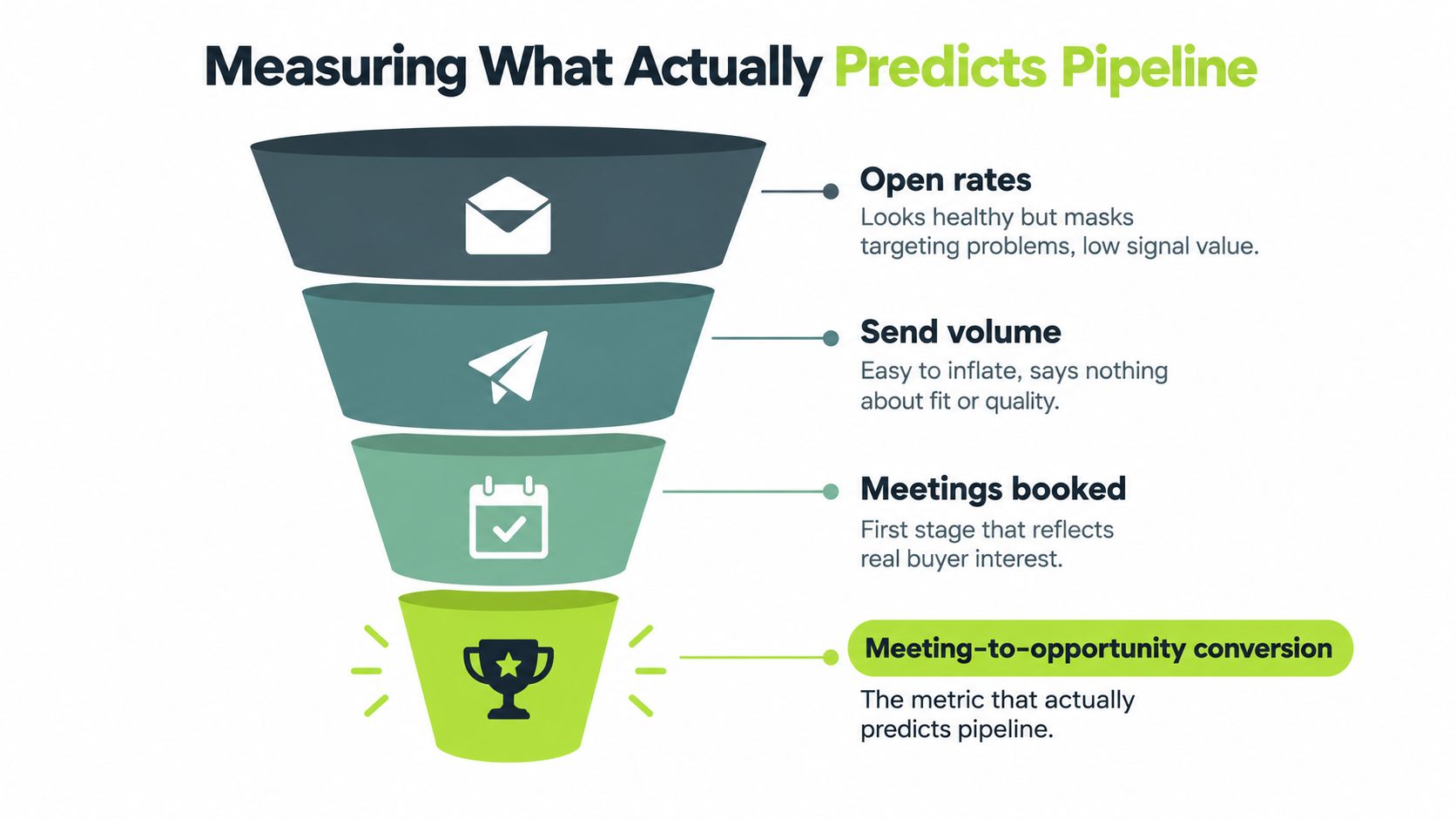
Open rates and send volume are easy to report because tools display them prominently. They're weak indicators of commercial health. A campaign can produce attractive activity while targeting the wrong companies, reaching the wrong roles or creating meetings that never become real opportunities.
The more useful question is whether qualified conversations convert into opportunities. Benchmark guidance explicitly treats meeting-to-opportunity conversion as a stronger quality metric than meeting volume, because high meeting numbers with weak conversion often indicate an ICP or messaging mismatch rather than poor rep performance. That distinction changes coaching. Instead of telling a rep to send more, the team examines account selection, buyer relevance and the promise made in the message.
Work backwards from coverage
Pipeline coverage sets the required depth of the whole GTM system. If the business needs 3.1× to 4× quota in pipeline, or 5× or more for some enterprise motions, then marketing, outbound, partners and inbound must contribute to enough qualified opportunity creation. The target should influence audience size, sales capacity and the number of experiments the team can support, as outlined in B2B pipeline benchmark research. Avoid treating coverage as a forecast decoration. It is an operating constraint.
Calculate backwards using your own commercial assumptions:
- Revenue target: The amount the business needs to close.
- Required pipeline: Apply the coverage level appropriate to the sales cycle and win-rate uncertainty.
- Required opportunities: Divide pipeline by the average opportunity value.
- Required qualified meetings: Divide opportunities by your observed meeting-to-opportunity conversion.
- Required account activity: Estimate the volume of high-fit accounts needed to create those qualified meetings.
The final input should come from observed performance, not a borrowed benchmark. Early in a motion, use conservative assumptions and update them as opportunities progress.
Track three measures together: qualified meetings, cost per qualified meeting and outbound-sourced pipeline share. Add reply themes, objections and disqualification reasons as qualitative evidence. If several well-fit accounts raise the same objection, review the offer or positioning. If replies are positive but meetings remain weak, inspect the call to action and booking process. If meetings happen but opportunities don't, re-rank the segment and revisit the qualification rule.
For a practical framework connecting account quality to prioritisation, see B2B lead scoring. The point isn't to replace judgement with a dashboard. It's to give judgement better evidence.
Your First 90 Days and When to Get Help
Use the first month to define the ICP, document evidence rules, interview buyers and write messaging hypotheses. During the second, prepare data, sending infrastructure, CRM routing and small controlled campaigns. During the third, review replies and meeting quality, re-rank audiences, refine qualification and expand only the plays that create credible opportunities.
Build internally when the team has time to research, handle conversations and maintain the system. Outsourcing fits a business with a proven offer and conversation capacity but no appetite to manage the operational detail. RevOps teams with data, routing or workflow problems may need a custom build, while teams that want capability transfer can use private GTM workshops.
Run this checklist before launch:
- Audience: Can you explain why each account belongs?
- Evidence: Are signals combined and documented?
- Message: Does it describe the buyer's situation rather than only your offer?
- Handoff: Does every qualified reply have a clear owner?
- Measurement: Are you tracking opportunity quality, not just activity?
Book a 15-minute introductory call when you need an external pressure test before committing budget or capacity.
H2 helps B2B companies turn precision-led GTM thinking into managed outbound programmes, custom research and routing systems, or practical team workshops. Visit H2 to discuss your audience, current pipeline constraint and the next GTM decision worth testing.
