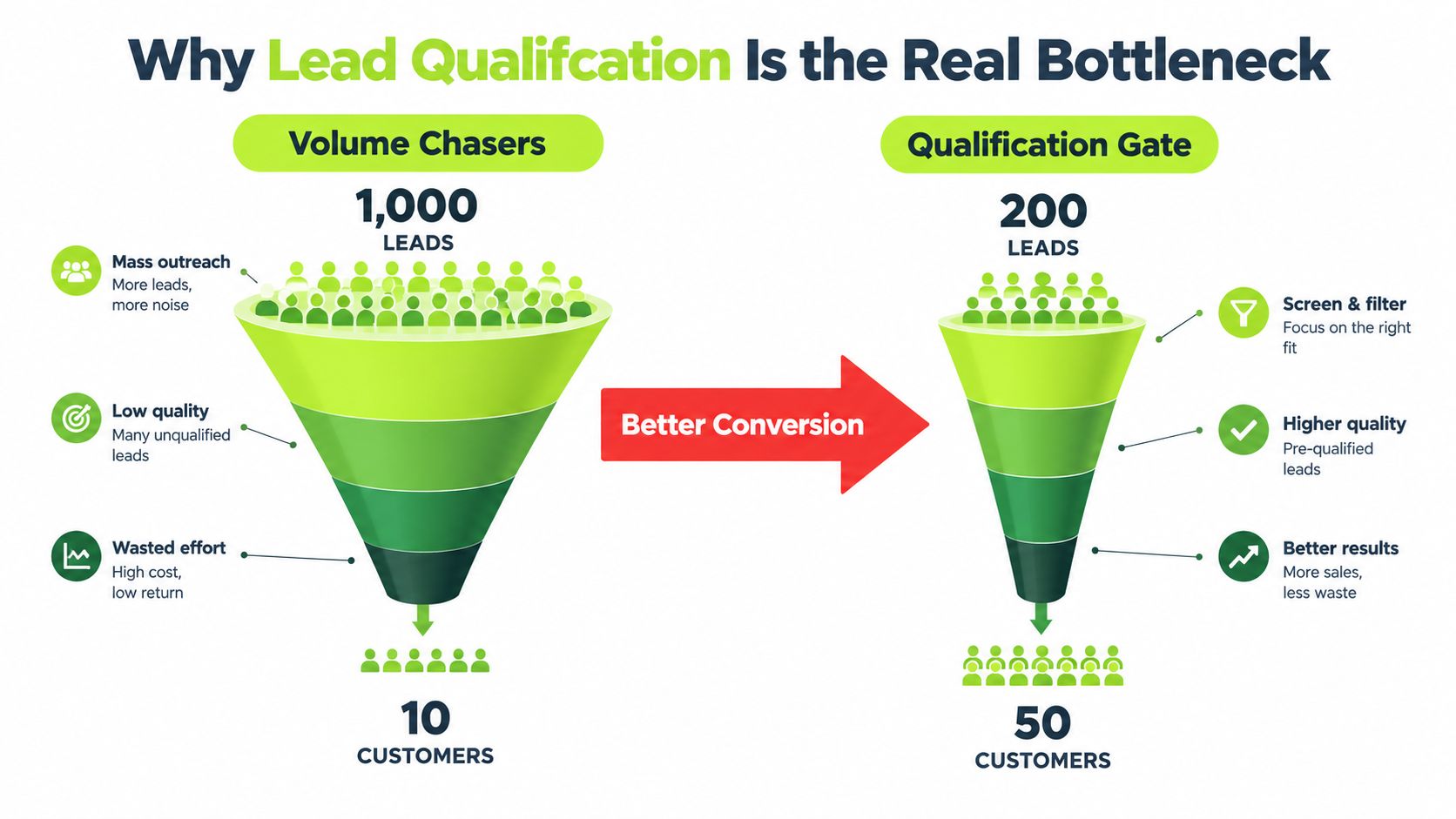
Only 25% of marketing-generated leads are sales-ready when first created, and 67% of lost sales opportunities are attributed to poor qualification. Qualifying a lead means deciding where your team's time belongs, not completing a checklist for every person who raises a hand.
That distinction changes the operating model. A lead can be interested but outside your ideal customer profile, or a perfect-fit account can be researching without visible activity. The job is to separate those cases, route each one appropriately, and make the decision quickly enough for genuine buying intent to remain useful.
Why Lead Qualification Creates the Bottleneck
Only 25% of marketing-generated leads are sales-ready at creation, while 67% of lost sales opportunities are attributed to poor lead qualification. Those figures expose a capacity problem, not just a demand problem. Marketing can increase form fills and campaign responses, but sellers still have limited time to investigate accounts, run discovery and create opportunities. The benchmark data on lead quality and qualification supports a practical conclusion: qualification determines which leads receive expensive human attention.
The common failure starts when forms, content offers and outbound replies enter one sales queue. The CRM grows, follow-up slows, and leadership blames lead volume or messaging. In practice, the queue is missing routing logic. A lead may show interest without fitting the customer profile, while a strong-fit account may show little public activity before a buying conversation begins.
What qualification actually decides
Qualification answers a narrower commercial question: should this lead receive active sales attention now? It is a routing decision, not a checklist exercise or a prediction of whether someone will eventually buy. The correct outcome may be sales follow-up, SDR validation, nurture, disqualification or a deliberate do-nothing status.
Use four decision areas:
- Fit: Does the account match the customers your offer serves well?
- Intent: Is there evidence of an active problem, evaluation or buying conversation?
- Ability: Is there a credible route to budget, authority and implementation?
- Timing: Is a decision window, trigger or business consequence present?
Keep fit separate from intent. A high-intent lead from an unsupported segment can waste seller time, while a high-fit account with quiet research may deserve targeted monitoring rather than immediate outreach. Page visits, email opens and generic content downloads are noisy signals. They should not override a poor fit or create urgency without stronger evidence.
Weak systems compress these judgments into labels such as “interested”, “engaged” or “hot”. Those fields produce activity without shared standards. Two SDRs can interpret the same label differently, and neither can explain why one lead reached an AE while another entered nurture.
Practical rule: A qualification rule works only when another operator can apply it without asking what the original operator intended.
Only 39% of firms apply lead qualification criteria consistently, leaving about 55% of leads unworked or mishandled. The operational lesson is clear: documented criteria do not improve pipeline quality unless people apply them the same way and record the reason for each route.
The fix is not a larger CRM form. Define a small set of observable conditions, assign each condition to a route, and make “do nothing” explicit when evidence is insufficient. That keeps sellers focused on plausible opportunities and gives managers a usable record for improving the rules.
Writing Explicit Qualification Rules
Start with the account, not the form submission. Your ideal customer profile should describe the organisations that can benefit from the offer and move through a buying process you can support. Useful dimensions include industry, company size, geography, technology environment, business model and the problem your product solves.
Don't write “mid-market technology companies with interest”. Write a rule that can be checked. For example, an account might fit when it operates in a supported market, uses a relevant technology stack, has a team affected by the problem, and falls within the segment your sales motion can serve. The precise boundaries depend on your offer. The important point is that fit must be observable before intent is interpreted.
Turn vague interest into evidence
Next, define what would count as a meaningful buying signal. A demo request is different from a newsletter subscription. A detailed reply describing an operational problem is different from a single page visit. A prospect who explains the desired outcome, decision process or implementation timing has given the seller more useful evidence than someone who has merely consumed content.
Use the familiar buying dimensions as prompts:
- Budget: Is there an existing allocation, financial capacity or a credible route to funding?
- Authority: Is the contact a decision-maker, an active participant or able to introduce the economic buyer?
- Need: Has the prospect described a problem your offer can solve?
- Timing: Is there a decision window, trigger or consequence attached to the problem?
These aren't compulsory questions to ask in a rigid sequence. In some sales motions, asking for budget before understanding the challenge creates friction. In others, budget is a hard constraint that should be checked early. Treat the dimensions as decision inputs, then adapt the conversation to the complexity of the purchase.
Define the routes before assigning criteria
A rule without an outcome is just documentation. For every condition, specify what happens next:
| Lead condition | Operational route |
|---|---|
| Strong fit and credible active intent | Immediate sales assignment |
| Strong fit with weak or unconfirmed intent | Nurture and monitored re-engagement |
| Unclear fit or incomplete data | Human review |
| Clear mismatch with the ICP | Disqualify with a reason |
| Existing account or owner | Preserve ownership and notify the right person |
Write rejection rules with the same care as acceptance rules. A lead outside the geography you serve may be disqualified, while an incomplete record may deserve review rather than rejection. A personal email address might lower confidence, but it shouldn't automatically erase a potentially valuable founder or consultant without a separate policy.
Qualification criteria also need an owner. Marketing, sales and revenue operations should agree on the conditions, the data source, the route and the review cadence. If sellers reject leads for reasons that never appear in the model, the system will keep producing the same disagreement.
Building a Two-Axis Scoring Model
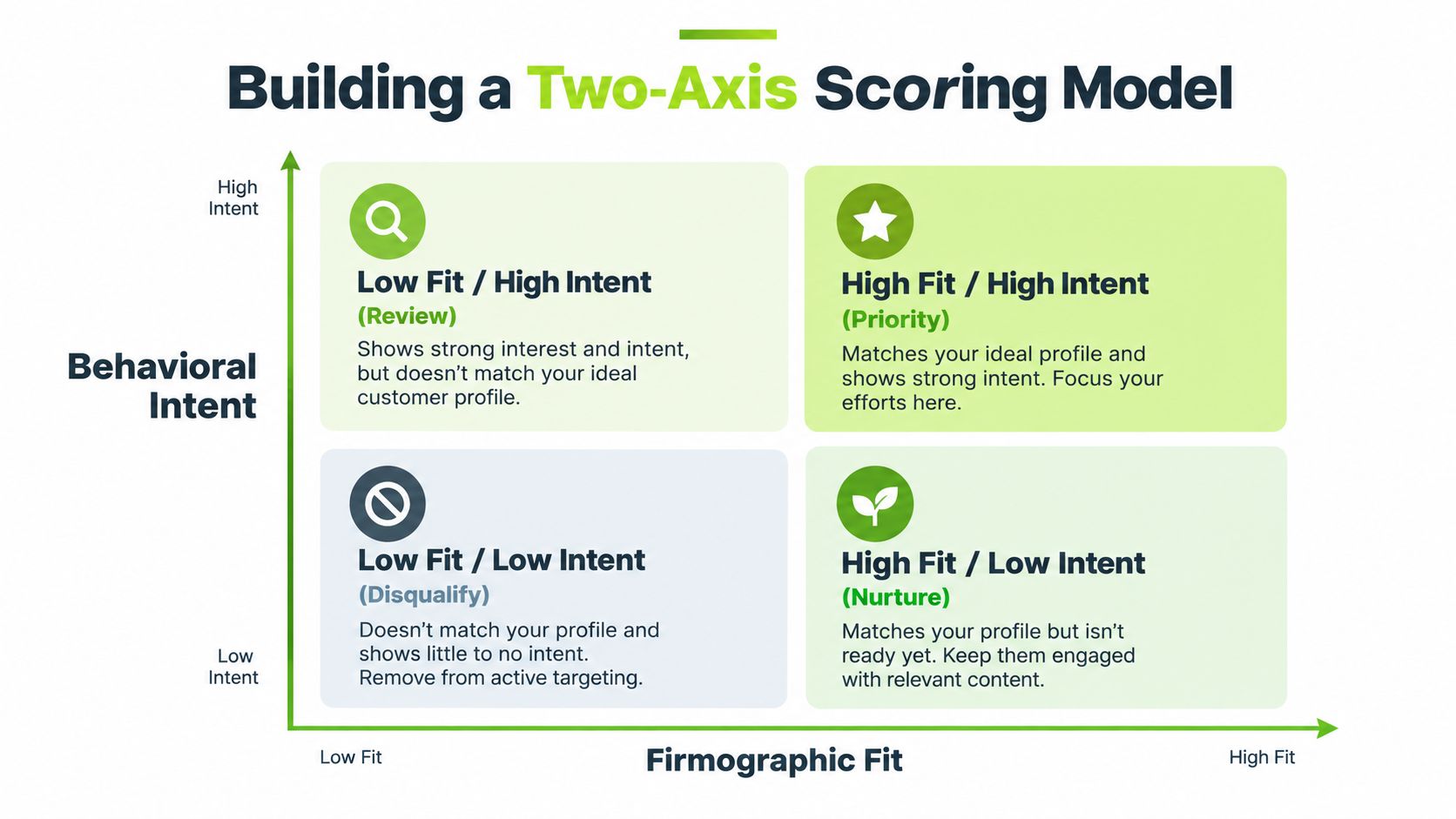
A scoring model should decide where a lead goes next, not just decorate a dashboard. Separate fit from intent because they answer different operational questions. Fit asks whether the account matches the business you can serve. Intent asks whether there is a credible reason to engage now.
That separation exposes cases a single score hides. A large target account with little visible intent belongs in nurture, not an aggressive sales sequence. An account showing intense activity but falling outside the ICP needs review or disqualification, not automatic promotion. Qualification works better when the model distinguishes a promising account from a timely buying signal.
A commonly cited benchmark reports that firms implementing lead scoring see a 77% increase in lead-generation ROI, while organisations that get scoring right show a 192% higher average lead qualification rate than those that don't. The same source reports that only 44% of companies use any lead-scoring system. The lead-scoring benchmark and modelling guidance provides useful context, but these figures do not justify adding complexity without a clear routing decision.
Build fit and intent as separate inputs
Build the fit score from firmographic and technographic attributes, including industry, company size, geography and technology environment. Build the intent score from behaviours such as repeat visits, a direct enquiry, a relevant reply, a demo request or evidence that the prospect is investigating a known problem.
Activity volume can distort the result. Email opens, generic downloads and broad website visits may help with prioritisation, but they rarely establish that an account has a problem, authority or an active buying window. Give stronger signals more weight when they carry clear context, not just more activity.
Use the two axes to determine the route:
- High fit, high intent: Prioritise for immediate human follow-up.
- High fit, low intent: Add to relevant nurture and monitor for a stronger trigger.
- Low fit, high intent: Send to review, particularly when the signal is unusually specific.
- Low fit, low intent: Disqualify or place in low-touch monitoring.
A numeric model is not always the right choice. A binary or tiered rule set can work better for a team handling limited volume or incomplete data. Match the model's sophistication to input quality and to the decisions it must support. If the team cannot explain why a record crossed a threshold, the score will create arguments instead of useful pipeline movement.
Test the model against pipeline evidence
Start with records the team understands well. Compare the attributes and signals associated with closed-won, closed-lost and no-decision outcomes. Look for patterns separating a productive first conversation from a polite enquiry that could never progress.
Test the proposed rules against recent records before making them operational. Check whether high-priority leads produce better conversations, whether activity is allowing low-fit accounts through, and whether missing data is suppressing strong prospects. Keep an audit trail of each score component, so a seller can challenge a result with evidence rather than opinion.
The guidance on B2B lead scoring using fit and behavioural signals is useful for evaluating weights, thresholds and validation instead of treating qualification as one opaque number. Review the model when the offer, ICP, sales capacity or acquisition mix changes. Scoring is a prediction aid, not a permanent truth.
Routing Leads with Speed and Structure
A qualified lead can still disappear when ownership and next action are unclear. Buyers often compare suppliers in parallel, so the first credible response can influence which conversation develops. Historical benchmarks report that contacting a lead within five minutes can make qualification roughly 21 times more likely than waiting 30 minutes or more. Another benchmark summary reports a 7x uplift when responding within the first hour. The speed-to-lead qualification benchmarks support a practical operating rule: qualification ends with a routed action, not with a score sitting in the CRM.
Routing should answer three questions immediately: does the account fit, is there evidence of active intent, and who should act? A useful sequence is:
- Capture the enquiry. Record the contact, account, source, request and timestamp.
- Check existing ownership. Send current customers, open opportunities and known accounts to the responsible person before any new assignment.
- Enrich the record. Add relevant firmographic and technographic details while the response window is still open.
- Evaluate fit and intent. Apply the documented criteria, including exclusion rules, review states and explicit do-nothing outcomes.
- Assign ownership. Route high-fit, high-intent records to the appropriate SDR or AE by territory, segment or specialism.
- Trigger the first touch. Create an alert, task or sequence with a defined service-level expectation.
- Use a review queue. Hold incomplete, ambiguous or unbooked records for examination instead of allowing them to vanish.
Sequence control prevents avoidable pipeline noise. If round-robin assignment runs before the CRM checks existing ownership, two sellers may contact the same account with conflicting messages. If enrichment waits for a manual review, the team trades response speed for certainty that automation could have supplied. A do-nothing rule also protects seller time. A record with weak fit and no confirmed intent can remain in low-touch monitoring until new evidence appears.
Speed does not mean sending every submission to an AE. Only 25% of marketing leads are immediately sales-ready, according to the benchmark cited earlier. The operational lead-qualification benchmarks describe a practical order of operations: capture, enrichment, ICP checking, routing and rapid first touch. Rapid triage and full sales pursuit should remain separate decisions.
Automate validation, enrichment, duplicate checks and obvious routing. Keep human review for conflicting signals, unclear fit, strategic accounts and conversations where intent needs confirmation. Manual research earns its cost for high-value or unusual records. It becomes a bottleneck when sellers repeat basic company research for every enquiry.
Routing also needs a shared operating agreement between sales and marketing. Define who owns each category, what “accepted” means, how quickly follow-up should occur, and what happens after rejection. A practical guide to marketing and sales alignment explains why a fast handoff still fails when the receiving team disputes the criteria or lacks a defined next step.
Avoiding False Positives From Noisy Signals
Qualification breaks down when a signal gets treated as intent. A hiring advert, technology change or social interaction can suggest a business problem, but none proves that the account is preparing to buy. The result is a larger prospect list and a weaker pipeline, because correlation has been mistaken for buying activity.
A hiring post may concern a function unrelated to your solution. A technology change may reflect a completed project, an inherited stack or a decision made long ago. Social engagement may come from someone researching a topic without authority, budget or an active initiative. Each signal needs context before it changes a routing decision.

Combine evidence before routing
Review signals across separate evidence layers:
- Firmographic evidence: The account fits the ICP and operates in a market you can serve.
- Technographic evidence: Its tools or architecture make the problem plausible.
- Behavioural evidence: A person has taken an action connected to the problem or evaluation.
- Contextual evidence: A change, deadline or business event could make action timely.
- Conversational evidence: A contact confirms the problem, priority, stakeholders or next step.
No single layer should carry the whole decision. An ICP-matched account with a relevant technology stack may still have no active project. A form submission may show interest without proving fit. A conversation that confirms urgency and ownership provides stronger evidence than repeated low-context engagement.
The guidance on separating fit and intent in B2B qualification supports treating fit and intent as separate inputs rather than collapsing them into one engagement score. If the evidence remains uncertain, route the record to review or low-touch nurture instead of forcing a sales-ready decision.
Set a stopping point
Every noisy signal needs an exclusion rule. A hiring post should not trigger sales routing when the role is unrelated to your solution, the account falls outside your service area or the posting no longer suggests an active initiative. A technology signal should not qualify an account when another department uses the tool or your product does not address the resulting problem.
Use explicit time windows, while treating recency as supporting evidence rather than proof. Then require a second-contact validation step. The seller should establish what prompted the investigation, whether the problem is active, who is involved and what happens if the organisation does nothing.
Do-nothing test: If the prospect takes no action, what changes for the business, and by when?
An answer of “nothing material” does not always justify disqualification. It usually means the account belongs in low-touch nurture rather than immediate sales capacity. This rule preserves future opportunities while preventing weak signals from consuming seller time.
Record the reason for every rejection. “No current project”, “wrong use case”, “signal unrelated to buying” and “outside ICP” reveal whether targeting is noisy, content attracts the wrong audience or qualification rules are too aggressive. Those patterns improve routing decisions more reliably than adding another untested signal.
Turning Qualification Rules Into CRM Workflows
Your CRM should make the agreed decision visible and executable. Store the input data, the fit and intent results, the rule that fired, the route, the owner and the reason for any review or disqualification. A seller shouldn't have to reverse-engineer a score from scattered fields.
A practical workflow has five states:
- New: The record is captured and checked for duplicates or existing ownership.
- Enriching: Firmographic and technographic data is being gathered.
- Routed: The lead passed the relevant criteria and received an owner.
- Review: Data is incomplete, signals conflict or the case needs human judgement.
- Nurture or disqualified: The lead has a documented reason and a defined future path.
Set alerts for high-fit, high-intent records and create tasks for qualified leads that don't book. Build a fallback queue for enrichment gaps. Without those paths, automation makes the wrong decision faster.
Use CRM workflow automation for lead routing and qualification to connect forms, enrichment, scoring, ownership and follow-up. Keep the rules explainable, test them against real records and review outcomes with sales. Closed-won and closed-lost feedback should change the model when the evidence changes, not when someone feels that lead quality has improved.
H2 can build a custom GTM system around your ICP, data sources, qualification rules, lead scoring and CRM routing, or run the research and outreach process for a team that needs more qualified conversations. If your pipeline is slowed by vague criteria, manual enrichment or unreliable handoffs, visit H2 to discuss the bottleneck and book a 15-minute introductory call.
