82% of executives believe their marketing and sales teams are aligned, while 65% of frontline staff disagree. That gap proves alignment is rarely a culture issue, but a structural definitions problem.
Weekly meetings won't fix a revenue process where marketing, sales, and leadership use different meanings for “qualified”, “target account”, “accepted lead”, and “pipeline”. The teams can communicate constantly and still lose opportunities because nobody agrees on what should happen next.
Marketing sales alignment works when people share the same operating rules. They need one view of the ideal customer, one set of qualification criteria, one ownership model, and one way to measure whether a handoff produced commercial progress. Everything else is a supporting activity.
The Hidden Misalignment in Your GTM Engine
The most dangerous assumption in a B2B go-to-market team is that alignment already exists because the departments attend the same meetings. A weekly stand-up can create the appearance of cooperation while marketing routes weak opportunities, sales ignores useful signals, and executives review dashboards that hide the disagreement.
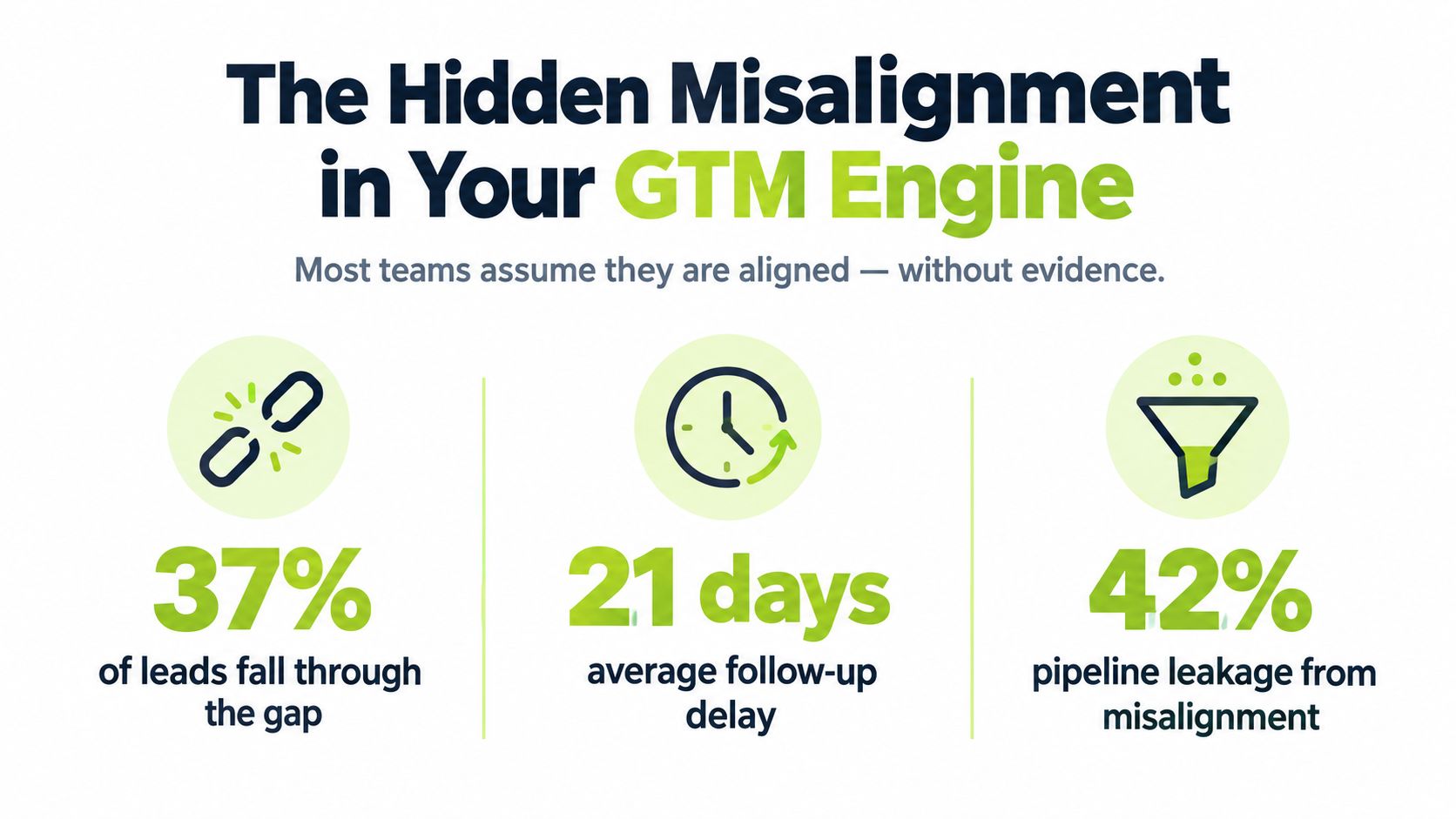
The perception gap is severe. Independent coverage of Forrester-reported research says 82% of executives believe marketing and sales work well together, while only 65% of frontline practitioners agree. The same source reports that just 8% of companies describe alignment as strong.
That isn't a personality problem. It usually means the people closest to the work are dealing with undefined rules. Marketing may count a form submission as a qualified lead. Sales may require evidence of a live business problem, a suitable company, and a credible buying path. Both teams then defend their own numbers.
Audit the definitions before the meetings
Start by comparing the language used in four places:
- Marketing campaigns: What conditions make a contact or account worth routing?
- Sales acceptance: What evidence makes a seller willing to spend time?
- CRM stages: What observable event moves an account from one stage to the next?
- Leadership reporting: Which numbers are treated as evidence of progress?
If those answers differ, more communication will only create more opportunities to misunderstand one another. The fix is a written operating model that makes the disagreement visible and gives each team the same decision rules.
Practical rule: Never ask whether sales and marketing are aligned. Ask whether two people from those teams would make the same decision when shown the same account.
Alignment also has two separate dimensions. Teams can agree on the handoff while pursuing different audiences, or agree on the target market while failing to route and follow up on active demand. Treating both failures as “communication” produces vague remedies. Treating them as separate operating problems gives RevOps something it can repair.
The Quantifiable Business Case for Alignment
Alignment matters because it changes how efficiently a company turns market attention into revenue. It isn't merely a nicer working relationship between departments. When teams share definitions, signals, and accountability, improvements can appear across lead quality, conversion, retention, forecasting, and account growth.
A peer-reviewed study on sales and marketing alignment reported support for eight performance links, including more qualified leads, higher lead conversion rates, improved new-account acquisition, better forecast accuracy, stronger customer retention, larger average account billing, revenue growth, and higher quota attainment. The important point isn't one isolated metric. Alignment can affect the full commercial chain, from targeting through retention.
Industry benchmark research has reported similarly large differences. Highly aligned B2B organisations were described as achieving 24% faster three-year revenue growth and 27% faster three-year profit growth. The same research reported that strongly aligned firms grew revenue at around 20% annually, compared with a 4% decline among poorly aligned peers. These figures frame alignment as an operating advantage, not a soft cultural preference.
Read the numbers as a systems problem
Another historical benchmark reported 32% year-over-year revenue growth for highly aligned organisations versus a 7% decline for laggards. That represents a 39-percentage-point spread in annual revenue performance. It also reported that aligned organisations could be 67% better at closing deals, with 38% higher win rates and 36% higher customer retention. Sales teams in aligned organisations were reported to be 103% more likely to exceed targets. These figures are summarised in the Growth Syndicate's marketing and sales alignment research.
Those benchmarks don't mean every business will reproduce the same results. They do show why founders and CROs should stop treating alignment as a meeting cadence. The commercial question is whether your process helps the right account progress, gives sellers usable context, and records why an opportunity advances or stalls.
A useful leadership dashboard therefore connects:
- Targeting: Are both teams working from the same ICP and account list?
- Action: Does a meaningful signal create a clear owner and next step?
- Progression: Do qualified accounts become real opportunities?
- Outcome: Does the motion produce revenue and retention?
If the dashboard stops at leads created, it measures marketing activity rather than shared pipeline performance.
Building a Shared Language for Qualified Leads
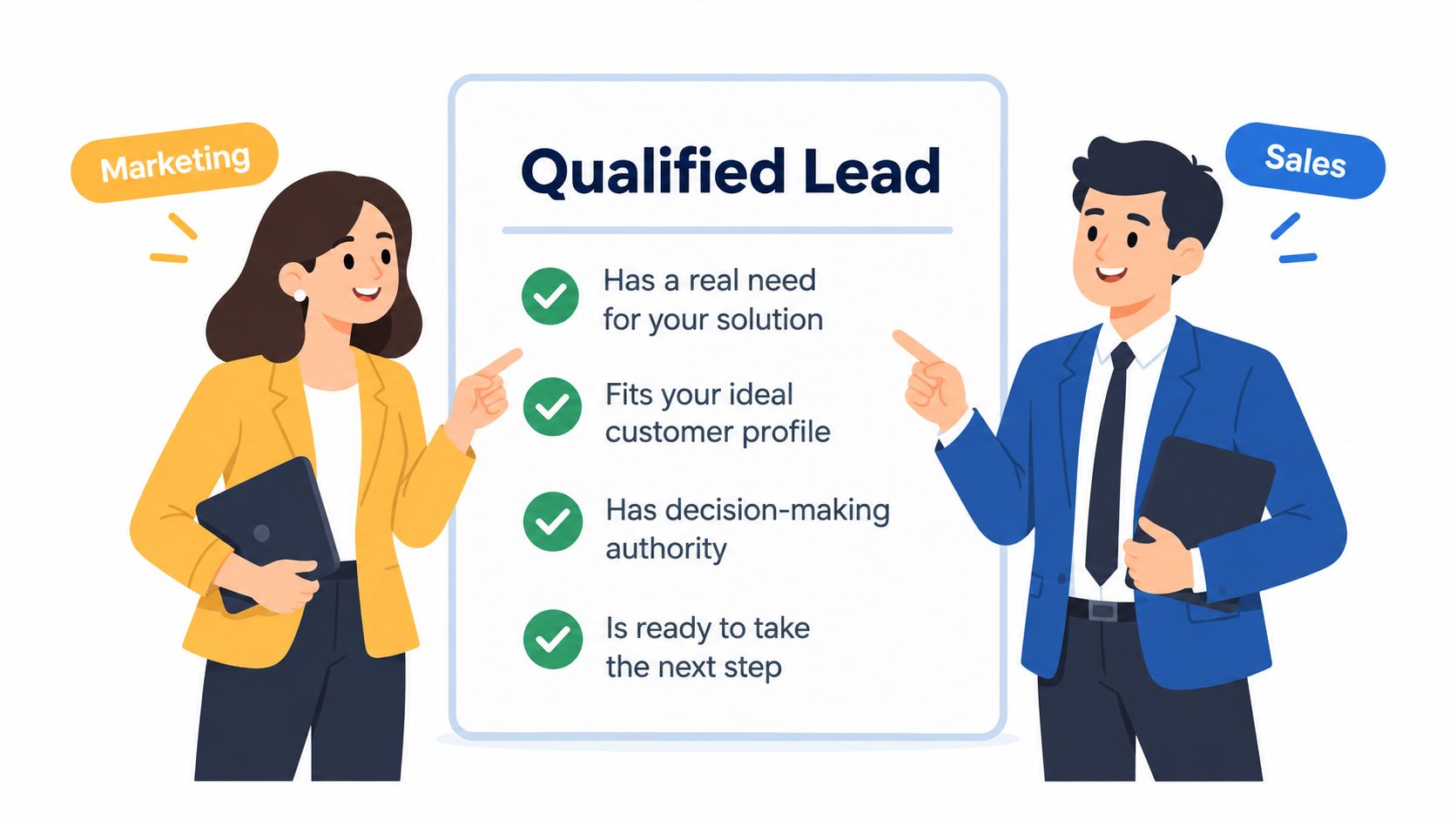
A qualified lead isn't a universal category. It's a decision rule your company creates for a specific market, sales motion, and offer. If marketing and sales haven't written that rule together, each team will implicitly substitute its own definition.
Build the definition from evidence, not preference. Review closed-won and closed-lost opportunities, listen to sales calls, examine support conversations, and compare the accounts that reached a useful commercial conversation with those that never progressed. Look for repeated patterns in company type, operational problem, technology environment, urgency, buying role, and access to a decision process.
Separate fit from readiness
A strong qualification model has at least three layers:
- Firmographic fit: The organisation operates in a market, geography, company profile, or technology environment you can serve effectively.
- Problem fit: The account has a problem your offer addresses, expressed in language that appears in calls, enquiries, or operational evidence.
- Readiness: A relevant person or buying group has shown a reason to explore a solution now, not just general interest.
Don't collapse these into one score. A perfect-fit account may have no current project. A poor-fit account may download several assets and still never become a viable customer. Sales and marketing need to know which condition is missing so they can choose between outreach, nurture, research, or rejection.
Write the acceptance test
Put the criteria in a shared document and CRM field structure. For every qualified lead or account, record:
- Why it fits: The firmographic or operational evidence.
- What changed: The trigger, problem, initiative, or buying signal.
- Who is involved: The known champion, user, decision-maker, technical evaluator, or blocker.
- What sales should do: The recommended action and context required.
- What happens if rejected: A reason code, recycling path, and owner for the next review.
The B2B lead scoring guide can help teams think through scoring logic, but scoring must support judgement rather than replace it. A number in a CRM isn't qualification unless the underlying evidence is relevant and inspectable.
Have sales validate the definition against live opportunities. Have marketing test whether it can identify enough accounts to support demand generation. If either team can't use the rule in its daily work, the rule is too abstract.
Creating Service Level Agreements and Shared Metrics
A shared qualification definition fails if nobody has to act on it. The service-level agreement should function as an internal contract between marketing, sales, sales development, and RevOps. It must describe the event that creates responsibility, the person who owns the next action, the evidence they receive, and the response expected.
Avoid vague commitments such as “sales will follow up promptly”. Write an operational rule instead. For example, a qualified account may require the assigned owner to accept, reject, or request context, while marketing may be responsible for supplying account evidence and maintaining the relevant nurture path. The exact response window should reflect your sales motion and capacity, not a copied industry standard.
Put both teams under obligation
Marketing's commitments might include:
- Maintaining agreed account and contact data.
- Supplying the context behind a trigger.
- Routing only records that meet the qualification criteria.
- Recording campaign and engagement history in the shared system.
- Recycling rejected accounts using standard reasons.
Sales' commitments might include:
- Accepting or returning every routed record.
- Recording the reason for rejection.
- Taking the agreed next action.
- Updating account and opportunity stages.
- Returning objections and market feedback to marketing.
The SLA should also define exceptions. What happens when a contact is invalid, the account already has an owner, the signal is too weak, or the opportunity isn't ready? Without a recycling rule, rejected leads disappear and marketing learns nothing.
Measure the path, not the department
Use shared metrics that expose the point of failure:
| Metric | What it reveals |
|---|---|
| Qualified-account acceptance | Whether sales agrees that the definition produces usable opportunities |
| Sales action rate | Whether accepted demand receives the required follow-up |
| Stage conversion | Where accounts stall or leave the journey |
| Pipeline velocity | Whether qualified opportunities progress efficiently |
| Revenue from qualified accounts | Whether the process creates commercial value |
Review these measures by segment, account tier, source, and play. A blended result can hide a broken motion inside an otherwise healthy average. A monthly review should end with a decision, an owner, and a change to the process when the evidence supports it.
Designing the Handoff Process for Sales Engagement
The handoff is not the same problem as audience coverage. Influ2's 2025 sales and marketing alignment research found that 36% of companies report an effective handoff while still having a large cold-sales audience, and 53% report handoff misalignment between marketing and sales. The implication is important: a clean transfer can't repair a disagreement about who should be targeted in the first place.
Use two operating paths, then choose deliberately.
| Operating path | Best fit | Main risk |
|---|---|---|
| Structured handoff | High-volume inbound or clearly defined qualification events | Sellers treat alerts as administrative tasks if context is weak |
| Fluid collaboration | Account-based motions with several stakeholders and overlapping engagement | Ownership becomes ambiguous without a named account owner |
A structured handoff for routing and a collaborative account model are needed after acceptance. Marketing can continue engaging the wider buying group while sales develops the active conversation. No team should assume that one contact represents the whole opportunity.
Make the transfer carry useful context
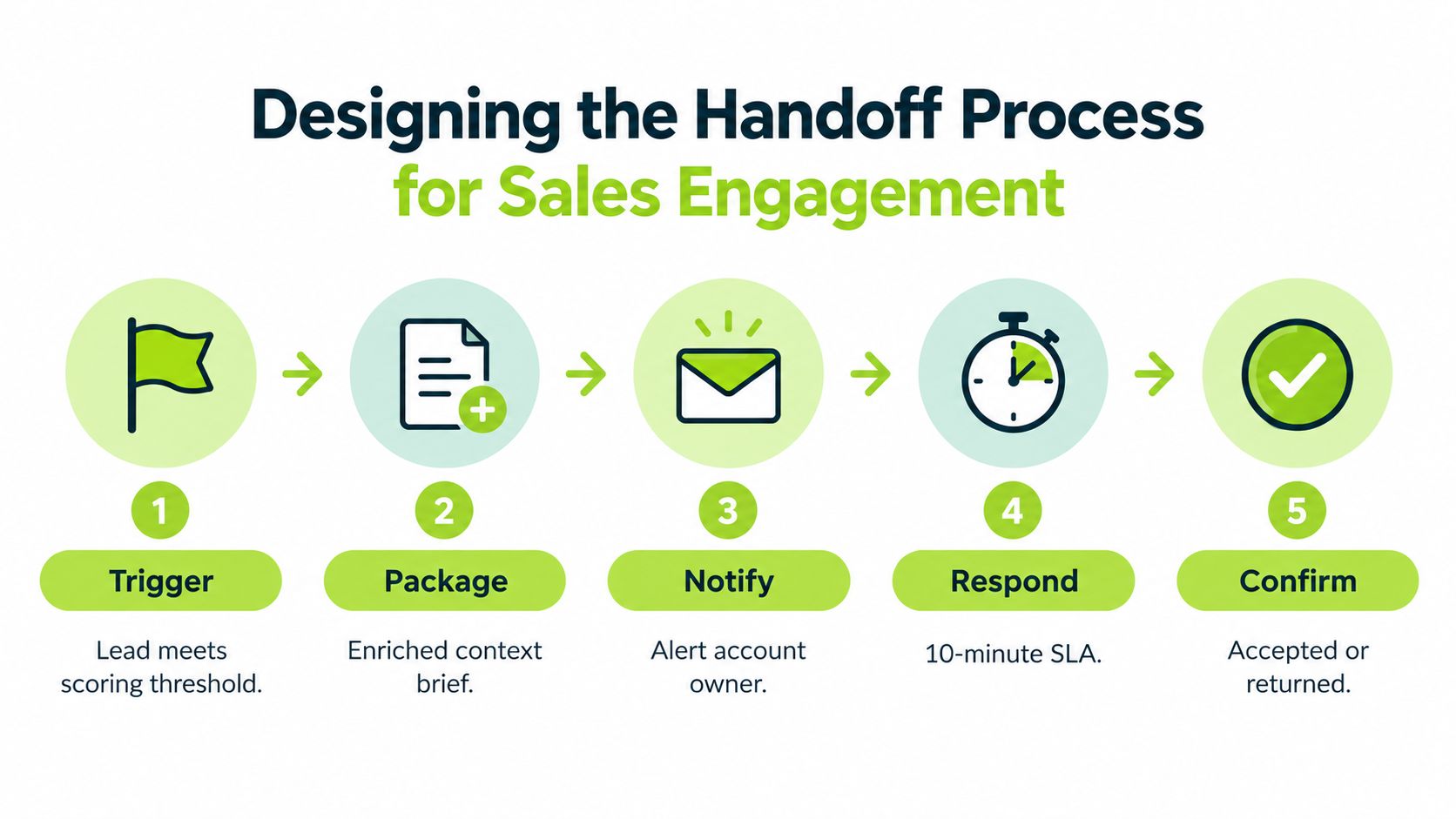
Before a human seller receives the record, automation should check ownership, match the account, enrich the record, apply the qualification rules, and identify duplicates. The alert should include the trigger, relevant activity, account fit, known stakeholders, previous conversations, recommended message, and required next action.
A CRM workflow automation guide is useful when designing the routing logic, but software won't resolve unclear ownership. The CRM should enforce a decision that the teams have already agreed on.
The receiving seller needs a simple response state: accepted, rejected with a reason, or returned for missing information. Marketing then knows whether to continue nurture, correct the data, add another stakeholder, or remove the account from the play.
Adapt the model to deal complexity
Alignment shouldn't look identical across every segment. The Influ2 research notes that marketing has greater importance in opportunities below $50K ACV, while sales involvement becomes more important as deal size rises. Use that distinction to decide where automated nurture can do more work and where sellers need earlier involvement in account research, discovery, technical validation, and stakeholder coordination.
Roadmap to Transform Your GTM Collaboration
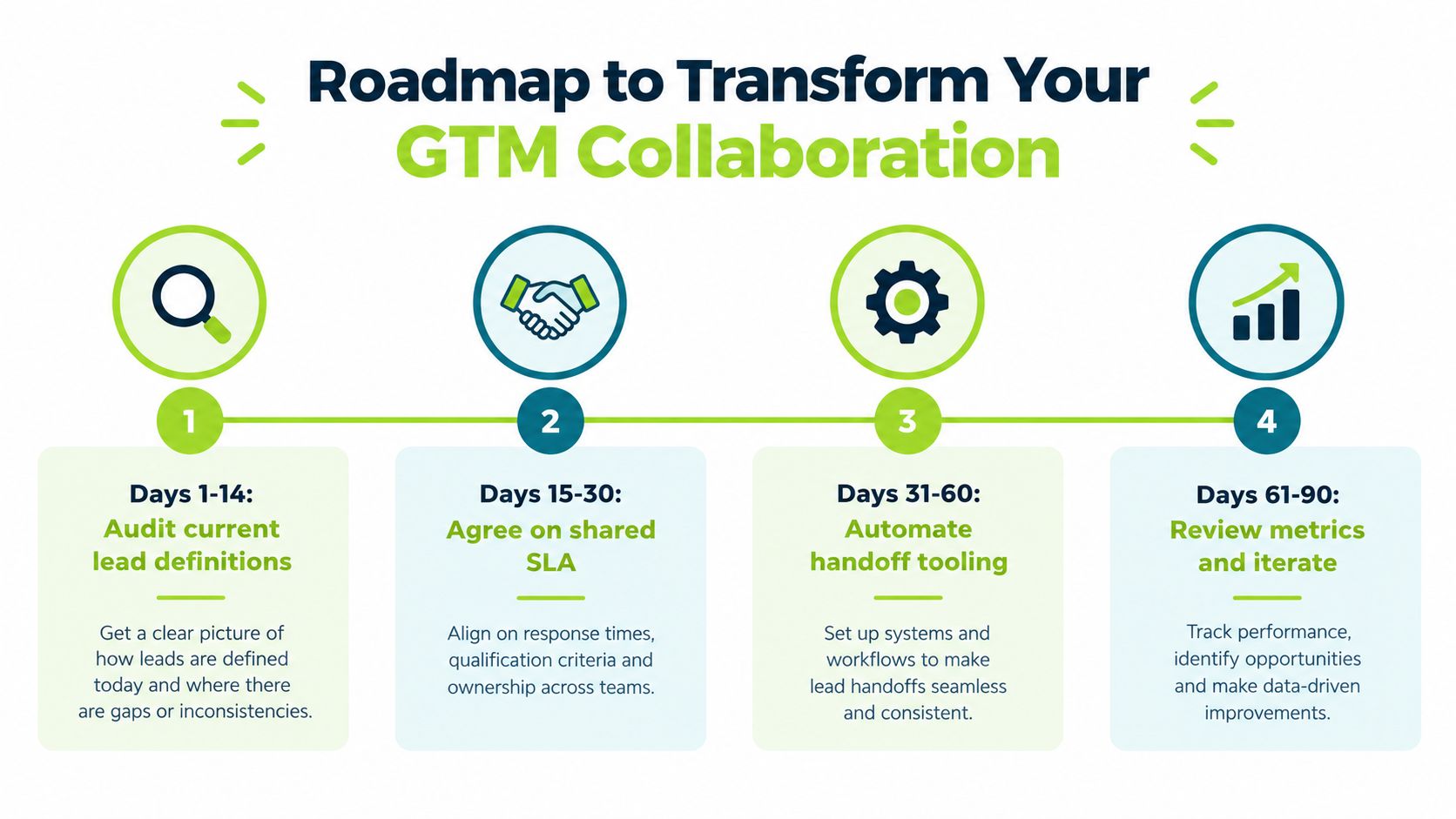
A practical transformation starts with the process, not the software. Give the team a short sequence of decisions that produces visible operating changes and leaves enough time to test them against real records.
Start with discovery
Interview frontline sellers, marketers, SDRs, and RevOps. Ask each person to define a qualified lead, explain what makes an account worth pursuing, and describe what happens after a handoff. Compare those answers with CRM fields, routing rules, dashboards, and closed-lost reasons.
Map several recent opportunities from first signal to outcome. Mark every point where ownership changed, data went missing, the next action was unclear, or one team stopped seeing the account. This gives leadership a factual baseline instead of another opinion-led alignment workshop.
Design the operating rules
Write the shared ICP, account tiers, qualification criteria, journey stages, SLA, rejection reasons, and feedback requirements. Keep the first version narrow enough to use. A precise rule for one motion is more valuable than an all-encompassing framework nobody follows.
The B2B go-to-market strategy guide can provide a broader planning context, but your alignment rules must reflect your actual market, sales capacity, and buying process.
Build, test, and review
Configure CRM fields, routing, enrichment, alerts, dashboards, and lifecycle automation. Test the workflow with real examples, including duplicates, missing owners, poor-fit accounts, recycled leads, and existing opportunities. Ask a seller and marketer to process the same records independently, then compare their decisions.
After launch, review exceptions rather than just activity totals. Look for unaccepted alerts, repeated rejection reasons, stalled accounts, missing buying roles, and opportunities where marketing and sales disagree about the next action. Use those patterns to revise the definition and retrain the teams.
A custom build may be appropriate when data, qualification, routing, and CRM workflows are fragmented. A managed outbound programme may suit a B2B company with a proven offer but limited internal capacity for research, enrichment, campaign management, and reply handling. The choice depends on the bottleneck, not on the size of the technology stack.
Frequently Asked Questions About Revenue Alignment
Who owns a lead during the overlap?
Ownership should follow the next action, not the department that first detected interest. Marketing can own nurture and buying-group coverage while sales owns an accepted active conversation. Record both responsibilities in the CRM so shared work doesn't become ownerless work.
Should the model change for smaller and larger deals?
Yes. Smaller transactions can often rely more on marketing education and automated progression, while complex deals need earlier sales involvement, deeper account research, and explicit stakeholder coverage. The deal-size distinction described in the handoff section is a reason to create segment-specific plays rather than one universal SLA.
Can teams align without new software?
Yes. Start with a shared document, CRM fields, clear ownership, reason codes, and a recurring review. Automation becomes valuable when manual routing or data quality creates repeated failure, but no platform can compensate for a qualification rule that sales and marketing interpret differently.
What should leadership inspect first?
Ask to see rejected leads, unworked signals, recycled accounts, and stalled opportunities. Those records expose the definitions and ownership problems that polished pipeline dashboards often conceal.
H2 can help B2B teams turn alignment rules into working GTM systems through audience research, qualification logic, data enrichment, CRM routing, workflow automation, and managed outbound execution. Visit H2 to discuss your market, handoff friction, and the next practical improvement.
