The strategy slides are finished. The personas look sensible, marketing has campaigns ready, and sales still can't explain why the pipeline isn't moving. Meanwhile, someone is fixing prospect records in a spreadsheet because the CRM routing rules don't match how the team sells.
GTM strategy and operations connect commercial choices to repeatable execution. Strategy determines which buyers matter and why they should buy. Operations determines who acts, what evidence they need, how work moves between teams, and what happens when the original assumptions prove wrong.
What GTM Strategy and Operations Actually Mean
A GTM strategy should make choices clear enough to exclude attractive distractions. It defines the target market, the problem worth solving, the offer, the route to buyers and the commercial conditions under which that route makes sense.
Operations makes those choices executable. An ideal customer profile becomes research criteria. A positioning statement becomes a message hypothesis. A qualified lead definition becomes a routing rule with an owner, acceptance criteria and a fallback when information is missing.
The distinction matters because a team can agree on strategy while making incompatible daily decisions. Marketing might optimise for replies, sales might accept only active evaluations, and RevOps might route every contact with a matching job title.
The execution gap is an operating problem
The research summary published by LeanData reports a 45-point gap between perceived importance and execution effectiveness: 83% of B2B professionals considered GTM strategy very important, but 38% rated execution very effective. The same research identifies poorly integrated systems and data sources as the largest strategy-design challenge for 48% of respondents.
Those findings don't prove that every weak campaign has an operational cause. An uncompetitive offer or poorly chosen market still needs strategic correction. They do justify checking execution before replacing the channel or rewriting the entire positioning framework.
A practical operating model should answer:
- Ownership: Who approves an account for outreach, and who accepts the resulting conversation?
- Decision rules: What evidence qualifies, excludes or pauses an account?
- Hand-offs: What context moves with the record, and how does the receiving team acknowledge it?
- Exceptions: Who resolves conflicting evidence or an account without an obvious owner?
- Learning: Which commercial observations trigger changes to targeting, messaging or the offer?
Practical rule: A strategy isn't operational until another team member can apply it to an unfamiliar account without guessing what the founder meant.
The first useful deliverable is therefore a runbook, not another presentation. It should describe the workflow, its owners and the decisions that need judgement. Automation can follow once those rules are clear enough to test.
Defining the ICP, Buying Jobs and Motion Selection
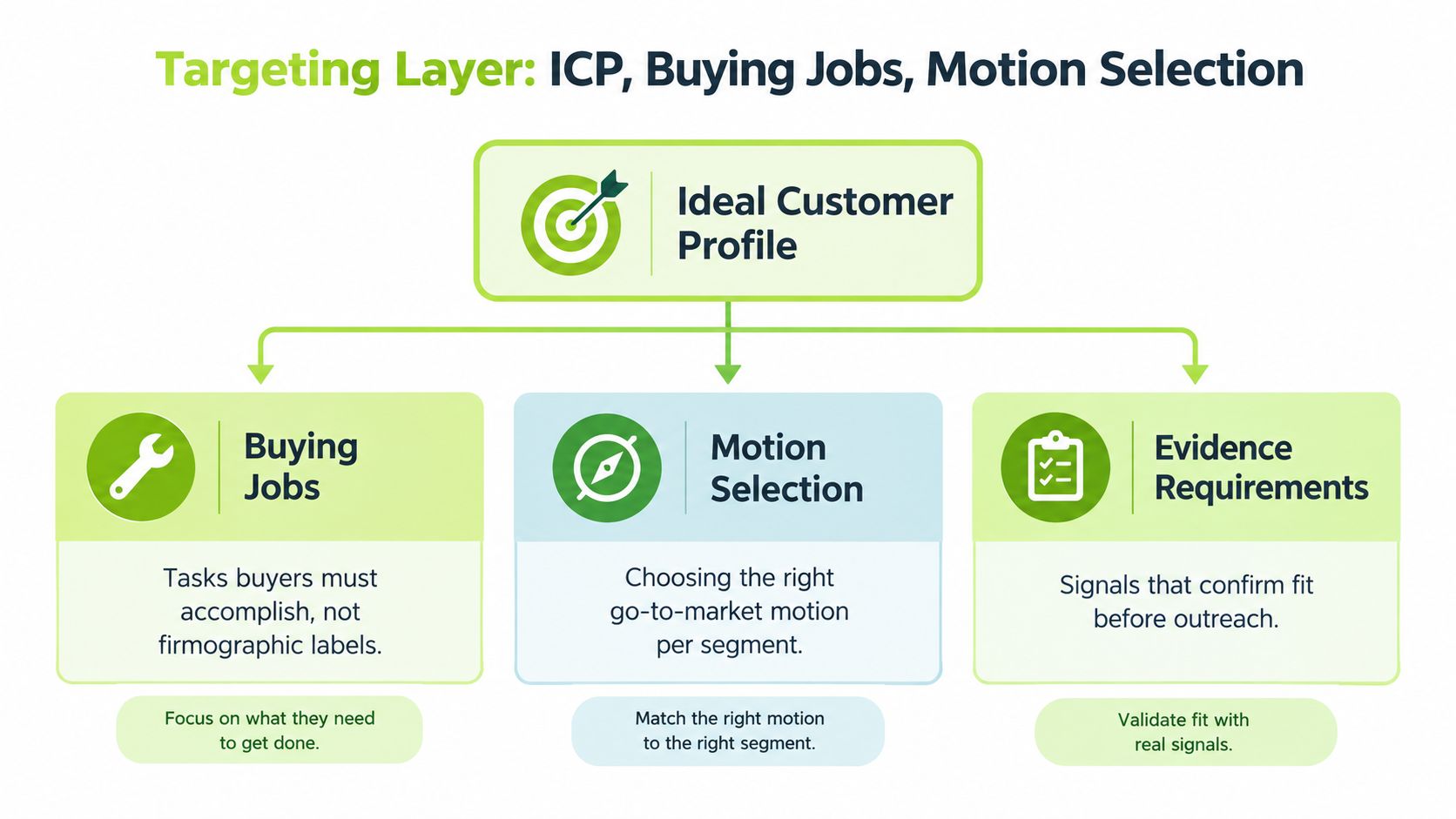
A useful ideal customer profile, or ICP, describes an organisation with a problem the business can credibly solve. Industry, company size and geography narrow the search, but they don't explain why a buyer would change anything.
For example, a hypothetical managed database provider might investigate software businesses with growing operational demands and limited specialist database capacity. That's more useful than targeting technology companies generally because a researcher can look for relevant workloads, team structure and support requirements.
The distinction between an organisation's suitability and an individual stakeholder's concerns is explained in ICP versus buyer persona. Both matter, but they answer different questions.
Match the intervention to the buying job
Gartner's B2B buying journey research identifies four broad buying categories, problem identification, solution exploration, requirements building and supplier selection, and six buying jobs that buyers revisit. It also reports that 75% prefer a rep-free sales experience, while buyers using supplier-provided digital tools alongside a representative are 1.8 times more likely to complete a high-quality deal than those using the tools independently.
The operational lesson isn't to remove sellers. It's to reserve their attention for interpretation, uncertainty and decisions that self-service information doesn't resolve.
| Buyer's immediate task | Appropriate intervention |
|---|---|
| Recognise an operational problem | A specific observation, diagnostic question or educational resource |
| Explore possible approaches | A useful comparison with explicit trade-offs |
| Define requirements | A scoping conversation or evaluation checklist |
| Assess suppliers | Evidence of suitability and a clear implementation discussion |
These aren't rigid funnel stages. An account evaluating suppliers may return to requirements when another stakeholder joins.
Choose a motion the team can sustain
Outbound suits an identifiable audience where a relevant problem can be investigated before contact. Inbound suits questions buyers already seek answers to. Account-based marketing, or ABM, concentrates coordinated effort on selected accounts. Product-led growth, or PLG, requires a useful self-service experience, while a partner motion depends on complementary access and clear incentives.
The choice should reflect offer complexity, available capacity and how buyers can evaluate value. Running every motion at once makes ownership and learning harder.
Finally, separate fit from intent. A relevant technology deployment or vacancy may justify research, but it doesn't establish an active purchase process. Record the observed fact separately from the commercial hypothesis so the outreach doesn't pretend to know more than the evidence supports.
Data, Signals and AI as a Decision Layer
A CRM record should help someone make a decision, not store information. The useful output is an explainable recommendation: investigate, contact, nurture, exclude or ask for human review.
That requires a continuously maintained account profile combining CRM history, behavioural and transactional information, and relevant third-party evidence. Each input needs enough context for an operator to judge whether it still applies.
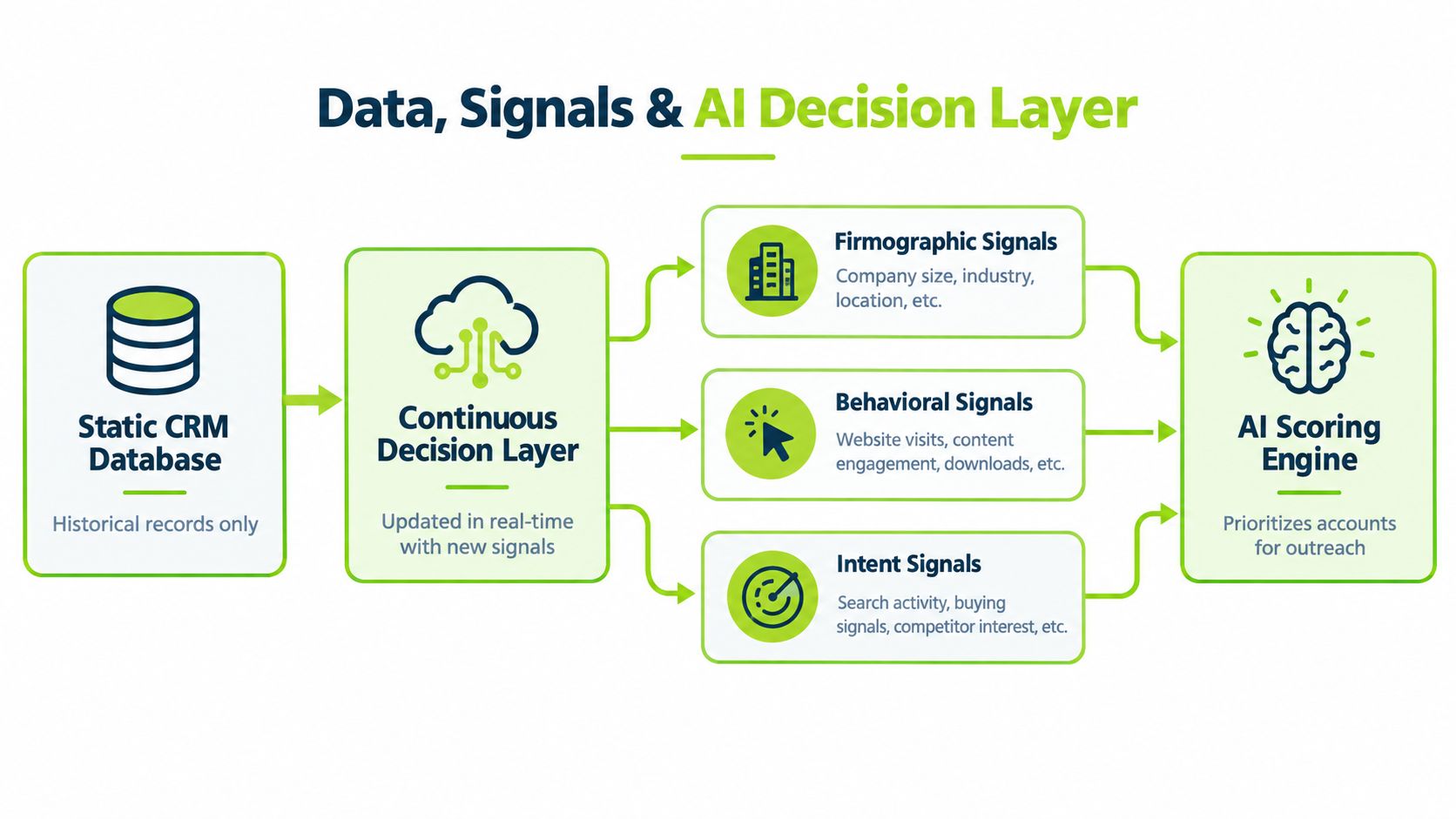
Clari's research on AI-ready GTM data found that 55% of organisations reported conflicting pipeline signals from disconnected sources, 48% said their revenue data wasn't AI-ready, and 42% lacked formal governance frameworks for accuracy and control. Adding an AI-generated score doesn't resolve those underlying disagreements.
Make the evidence inspectable
An AI research task should return structured evidence rather than an unsupported verdict. A useful record includes the original source, supporting extract, retrieval timestamp, account identity, confidence tier and reason code.
| Evidence status | Recommended treatment |
|---|---|
| Direct and relevant | Apply the documented qualification rule |
| Plausible but incomplete | Request corroboration or human review |
| Conflicting, stale or unattributed | Hold the decision and investigate |
Confidence should describe the strength of the evidence, not how confidently a model writes. A polished explanation without a traceable source remains unsuitable for automatic qualification.
Deduplication also belongs before enrichment. Use a consistent account identifier, preserve parent-company relationships and avoid treating every subsidiary or domain variation as an unrelated prospect. Otherwise, the team can pay repeatedly to research the same organisation.
Control spend before scaling research
Run inexpensive exclusion checks before deeper website analysis or paid enrichment. Use deterministic rules for straightforward field matching, and reserve model reasoning for tasks that require interpretation.
- Set stopping conditions: Missing sources, conflicting identities and sensitive inferences should stop automatic progression.
- Preserve an audit trail: Record which rule and model produced the decision, including human overrides.
- Track research economics: Calculate cost per qualified account from enrichment, model usage and review work, rather than judging tools by subscription cost alone.
- Test on real records: Include awkward cases, not just obvious matches.
For teams separating reporting from decision automation, Menza's guide to AI-powered data analysis for teams provides related reading. The practical prospecting considerations belong alongside that broader analysis, including those covered in using AI for sales prospecting.
The aim is a research process whose decisions can be challenged, corrected and reproduced.
Build, Buy or Outsource
The right operating option depends on the bottleneck, not the team's enthusiasm for automation. A business with proven messaging and insufficient execution capacity needs a different solution from a RevOps team repeatedly repairing account ownership.
Internal development offers direct control, but someone must maintain integrations, monitor failures and update rules when the sales process changes. Buying software can provide components, but it doesn't supply the commercial judgement needed to configure them.
Matching your situation to the right GTM operating option
| Situation | Best fit | Why |
|---|---|---|
| An established operator can own delivery and maintenance | Build internally with selected tools | The team retains control and can adapt workflows directly |
| Existing campaigns work, but research or routing is manual | Commission a custom system build | The project addresses a defined bottleneck without replacing the whole motion |
| A proven offer needs outbound execution beyond internal capacity | Fully managed outbound | Research, campaign operations and follow-up sit with a dedicated delivery team |
| The team has tools but lacks the skills to use them reliably | Private workshop | Training addresses capability rather than adding another system |
| The offer and audience remain uncertain | Commercial validation before extensive automation | Infrastructure won't settle an unresolved value proposition |
A custom GTM system build makes sense when the outcome can be specified: identify suitable accounts, qualify evidence, enrich approved records and route them correctly. Acceptance should depend on behaviour with real records, including failure handling, rather than a successful demonstration alone.
A fully managed outbound programme fits an execution-capacity problem. The internal team still needs to supply commercial context, handle sales conversations and explain which opportunities deserve more attention.
Evaluate the whole operating burden
Tool selection should follow workflow design. Clay may suit research and enrichment orchestration, while an existing CRM or a custom component may handle other decisions. The relevant comparison is how each option handles access permissions, debugging, retries, documentation and handover.
CodeWords' comparison of Gumloop alternatives for GTM is useful related reading when comparing automation approaches. A shortlist should still be tested against the team's actual records and maintenance capacity.
A private GTM workshop is appropriate when an operator needs to improve judgement and execution within an existing stack. It isn't a substitute for ongoing campaign ownership.
Buying software purchases capability. Outsourcing transfers defined work. Neither removes the need for an accountable commercial owner.
Data sensitivity also affects the choice. Before commissioning work, establish who can access source data, where it will be processed, and how access will be removed at handover.
Operating Model Ownership, Hand-offs and Quality Controls
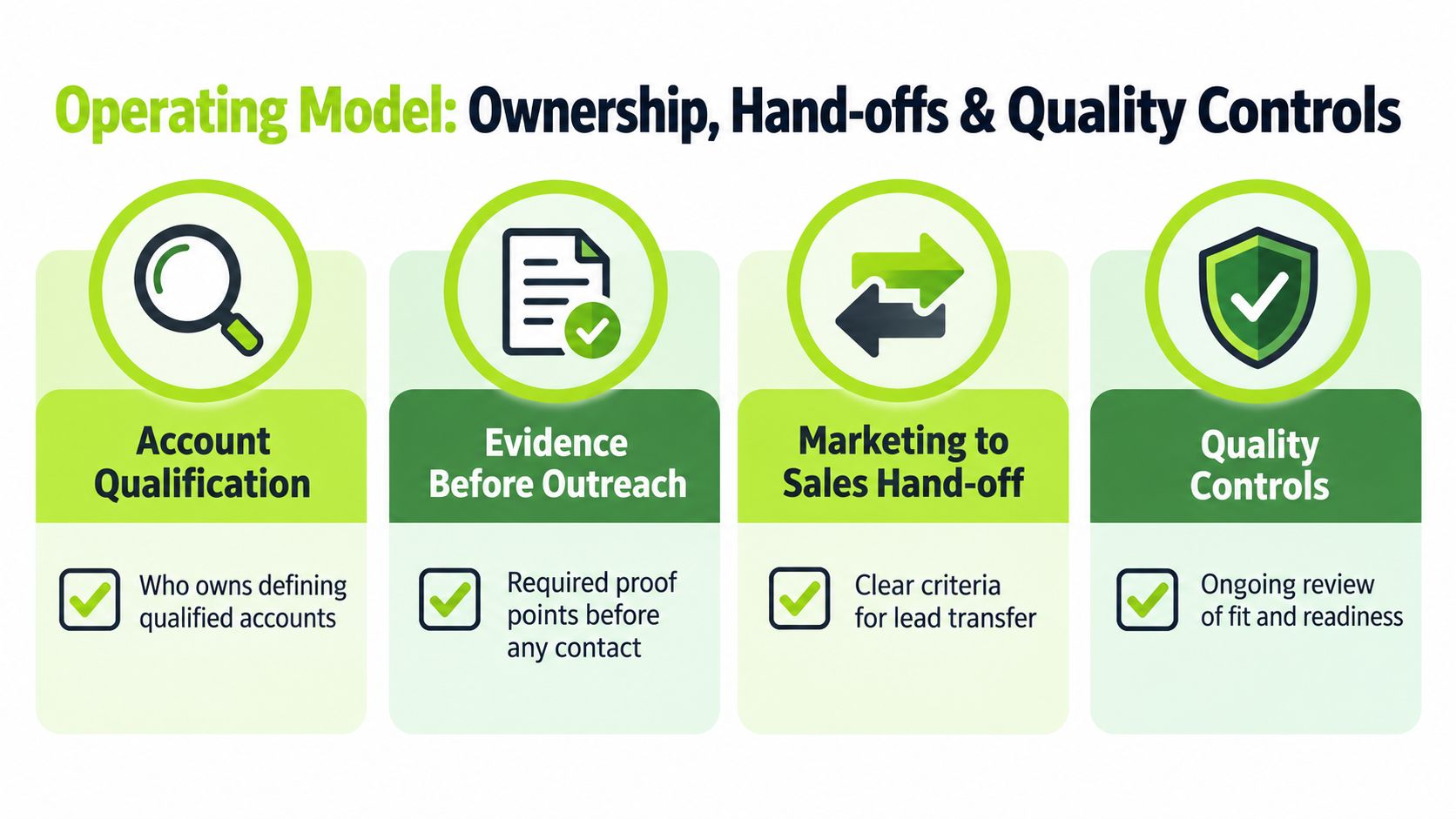
Every live campaign needs a named owner for commercial judgement and a named owner for operational reliability. Those responsibilities may sit with the same person in a small business, but neither should disappear into a shared inbox.
Marketing can propose audiences and message tests. Sales should define conversation acceptance and supply objections. RevOps should maintain field definitions, routing logic and exception queues. The underlying agreements matter more than department labels, as outlined in marketing and sales alignment.
A worked pre-launch checklist
For a hypothetical UK outbound launch, approval should cover more than copy:
- Data readiness: Confirm qualification evidence, contact verification, deduplication and account ownership.
- Sending readiness: Verify domain authentication, inbox configuration and monitoring before releasing campaign volume.
- Delivery controls: Assign responsibility for complaints, failed delivery and campaign pauses.
- Contact handling: Test opt-outs, suppression checks and exclusion across connected tools.
- Sales hand-off: Transfer the original evidence, conversation context and agreed next action.
Google's sender requirements require authentication for Gmail senders. Bulk senders of 5,000 or more messages daily to personal Gmail accounts must use SPF, DKIM and DMARC and provide one-click unsubscribe for promotional messages; reported spam rates must stay below 0.3%, with below 0.1% the healthier target.
These are launch controls, not reasons to increase volume up to a threshold.
Record permission and exceptions
Under the ICO's B2B marketing guidance, PECR's email consent rules don't apply to corporate subscribers such as limited companies, limited liability partnerships and government bodies. Sole traders and some partnerships are treated as individuals, so marketing email generally requires specific consent unless the soft opt-in applies.
That exception requires details obtained during a sale or negotiation, promotion of similar products or services, and an opt-out both at collection and in subsequent communications. The workflow should record subscriber status and the applicable contact justification.
The ICO's detailed data protection guidance also makes clear that personal data obligations still apply in B2B marketing. Identify the sender, provide an opt-out and retain appropriate suppression records rather than allowing deleted contacts to be imported again.
Crescade's practical marketing ops strategy framework provides supporting reading for formalising operational responsibilities. During weekly reviews, unresolved exceptions should receive an owner and a recorded resolution.
The benchmark isn't more automation. It's an explainable priority, an accountable action and a buyer response that informs the next decision.
Metrics That Reflect the Operating Loop
Sending more email isn't evidence that the team has improved its GTM system. Activity metrics describe throughput. They don't establish account relevance, buyer progress or commercial value.
McKinsey's guidance on B2B growth recommends combining CRM, behavioural and transactional data into unified customer profiles, with next-best-action recommendations inside frontline workflows. It also recommends measuring commercial outcomes such as conversion velocity, deal size and retention, rather than activity volume or email engagement alone.

Separate the stages that require different decisions
A useful review page distinguishes:
- Account relevance: Does the organisation meet the evidence standard?
- Problem acknowledgement: Has someone confirmed the issue, rather than merely replied politely?
- Qualified conversation: Is there a relevant stakeholder and a credible reason to continue?
- Meeting progression: Did the conversation happen and produce an agreed next step?
- Opportunity creation: Has sales accepted a defined commercial opportunity?
Treating every positive reply as equivalent makes message testing unreliable. A request for general information and an active evaluation need different follow-up, even if both receive the same sentiment label.
Calculate cost against accepted work
Cost per qualified account = total account-research and qualification cost ÷ accounts accepted under the agreed qualification rule.
In a hypothetical workflow, the numerator would combine data purchases, enrichment credits, model usage and researcher review time for the same account cohort. The denominator would include only accepted accounts after deduplication and review, not every company processed.
That calculation can expose a false economy. A cheaper enrichment step may produce more ambiguous records, leaving sellers to do the missing research. Conversely, expensive research may be unnecessary for accounts excluded by a basic eligibility check.
| Weekly observation | Decision to investigate |
|---|---|
| Frequent qualification overrides | Tighten evidence rules or source selection |
| Repeated wrong-person replies | Revisit stakeholder mapping |
| Relevant conversations without progression | Examine urgency, offer and next-step quality |
| Accepted opportunities progressing slowly | Review requirements, stakeholders and sales execution |
Each review should end with an owner and a testable change. Keep delivery and engagement metrics for diagnosis, but retire them as standalone proof of GTM success.
What Good GTM Operations Look Like in the Wild
Published engagements involving Ravn, Full Scale, Main Street DBAs, Consider It Done Technologies, Korporatio and Grafbase illustrate different operating problems. They shouldn't be treated as interchangeable proof that a particular channel or tool will work for every business.
Ravn's engagement concerned building outbound beyond reputation and referrals. Full Scale's work focused on analysing and prioritising companies, using public information and AI-assisted website analysis to distinguish suitable accounts from poor fits. Those are different interventions: establishing a motion versus improving the account-selection layer.
Different offers require different evidence
Main Street DBAs used database-administration vacancies, technology platforms and team capacity to investigate possible support gaps. Grafbase's engagement, delivered with QC Growth, drew on platform-engineering roles, competing technologies, relevant social engagement and indications of dissatisfaction.
Korporatio's campaigns reflected founders' company stage, jurisdiction and structural needs. Consider It Done Technologies illustrates the importance of assessing supplied leads alongside subsequent commercial progression, rather than treating delivery as the endpoint.
| Engagement | Operating lesson |
|---|---|
| Ravn | Build a repeatable route beyond existing relationships |
| Full Scale | Investigate what an account actually does before prioritising it |
| Main Street DBAs | Connect technical context with possible capacity constraints |
| Consider It Done Technologies | Assess lead suitability and downstream progression separately |
| Korporatio | Match the message to the buyer's organisational circumstances |
| Grafbase | Combine relevant signals around a specific technical offer |
These examples don't establish that every engagement used an identical workflow. Nor should pipeline be presented as closed revenue, leads as booked meetings, or scored accounts as qualified opportunities.
The transferable practice is narrower and more useful: choose evidence that fits the offer, define what the team will do with it, and evaluate the resulting commercial conversations.
H2 offers fully managed outbound, custom GTM system builds and private workshops for teams that need clearer execution, better qualification or stronger internal capability. Visit H2 to arrange an introductory call about the current bottleneck or explore the free GTM strategy.
