A founder opens a spreadsheet with thousands of AI-enriched companies. Every row has a score, a summary and a confident reason to reach out. Almost none of it tells the sales team who to contact first, why now, or whether the underlying evidence can be trusted. That's the gap this guide closes. Learning how to use AI for sales prospecting isn't about finding a clever prompt. It's about building a controlled pipeline where data, rules and human judgement each do a defined job.
Why AI Prospecting Needs an Operating System
A common starting point looks like this. A team buys a data tool, enriches a broad list, asks a model to score fit and generate opening lines, then sends the output to sales. Within days reps are working duplicates, companies that fail basic criteria, and accounts where the supposed buying signal is a single job advert. Volume rises. Qualified conversations don't.
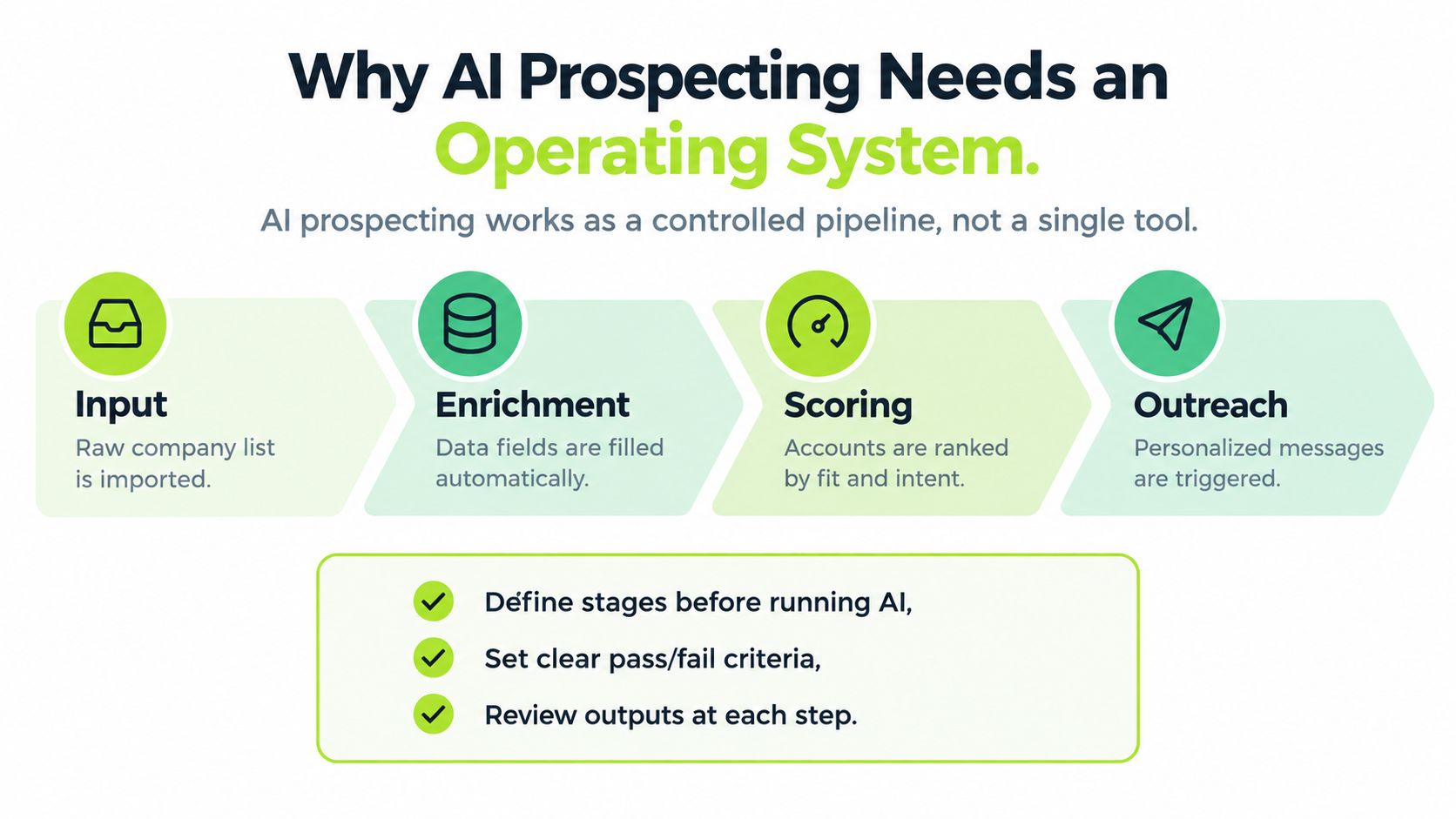
The practical answer is to treat AI as one stage in an operating system, not as the system itself. Inputs, decision rules, quality checks, ownership and the CRM destination get defined before automation starts. The model summarises public information, classifies accounts against explicit criteria and drafts research-based messages. Deterministic rules and people handle qualification, compliance and final commercial judgement.
Why adoption is rising and why that isn't enough
AI-assisted prospecting became mainstream by 2024. Salesforce's sixth State of Sales report, based on a double-anonymous survey conducted from 8 March to 18 April 2024, found 81% of sales organisations were experimenting with AI or had fully implemented it, split between 40% experimenting and 41% fully implemented, according to Salesforce's State of Sales AI statistics for 2024. The same source reports that 83% of sales teams using AI experienced revenue growth that year, compared with 66% of teams not using AI.
Those figures describe association, and they don't prove a tool caused growth. The useful signal is narrower. In AI-using organisations, 80% of representatives said it was easy to obtain the insights needed to close deals, versus 54% without AI. Better access to customer information is exactly where prospecting benefits, provided the information is sourced, dated and checked.
The broader picture points the same way. Stanford University's 2025 AI Index reported organisations using AI in at least one business function rising from 55% in 2023 to 78% in 2024, with generative AI use rising from 33% to 71%, as detailed in Stanford's 2025 AI Index economy chapter.
Adoption at that scale flattens the tooling advantage. Competitors have access to similar models and similar data. The workflow around the model is what separates a pipeline that produces qualified conversations from one that produces confident noise.
Practical rule: If a workflow can't explain why an account was selected, it isn't ready to decide who receives outreach.
Start with the ICP and disqualifiers
Preparation work comes before any prompt. The ideal customer profile, or ICP, should be built from closed-won and closed-lost records plus customer interviews, rather than a brainstorming session. Closed-lost evidence matters because it produces disqualifiers, the conditions that remove an account even when surface fit looks strong.
Useful preparation pulls specific fields into one place before enrichment spend begins:
- Firmographic inputs: Industry, company size, geography and growth stage define the outer boundary of the market.
- Offer fit evidence: What the company builds, sells or operates, taken from its website and public descriptions.
- Exclusions: Competitors, existing customers, unsuitable business models and regions the team can't serve.
- Buyer roles: Job titles and seniority levels that own the relevant problem or budget.
- Known constraints: Minimum size, required technology, regulatory limits or service capacity.
A fuzzy ICP can't be rescued downstream. A model asked to find "growing B2B companies that need better processes" will return fluent reasoning for almost any account. Tight criteria give the classification step something testable to work against.
Three input types, three different jobs
Effective prospecting combines three categories of input. Firmographic data covers industry, headcount, location and stage. Technographic data covers the technology a company uses. Behavioural data covers observable activity such as relevant vacancies, website changes or credible engagement. The three-input model is set out as necessary for effective AI prospecting in Rox's guide to AI sales prospecting.
Each type answers a different question. Firmographics answer whether the account could buy. Technographics answer whether the offer fits the existing stack or replaces part of it. Behavioural signals suggest timing, and timing only. A vacancy or technology choice is a prioritisation signal, not proof of buying intent.
Implementation risk sits in people and process as much as data. Salesforce found 33% of sales-operations professionals using AI cited insufficient resources or headcount, and another 33% cited inadequate employee training. Teams planning a build should assign ownership for data quality, prompt changes and error correction before launch. Teams structuring this work can compare approaches in Stimulead's 2026 prospecting playbook, which covers current operating patterns.
Reusable Prompt Patterns for Account Research
With inputs fixed, prompts become a specification task. A good prospecting prompt doesn't ask the model to "research this company." It gives the model explicit rules, named evidence fields, a fixed output format and a requirement to show its working. Anything less produces prose that reads well and audits badly.
The classification pattern
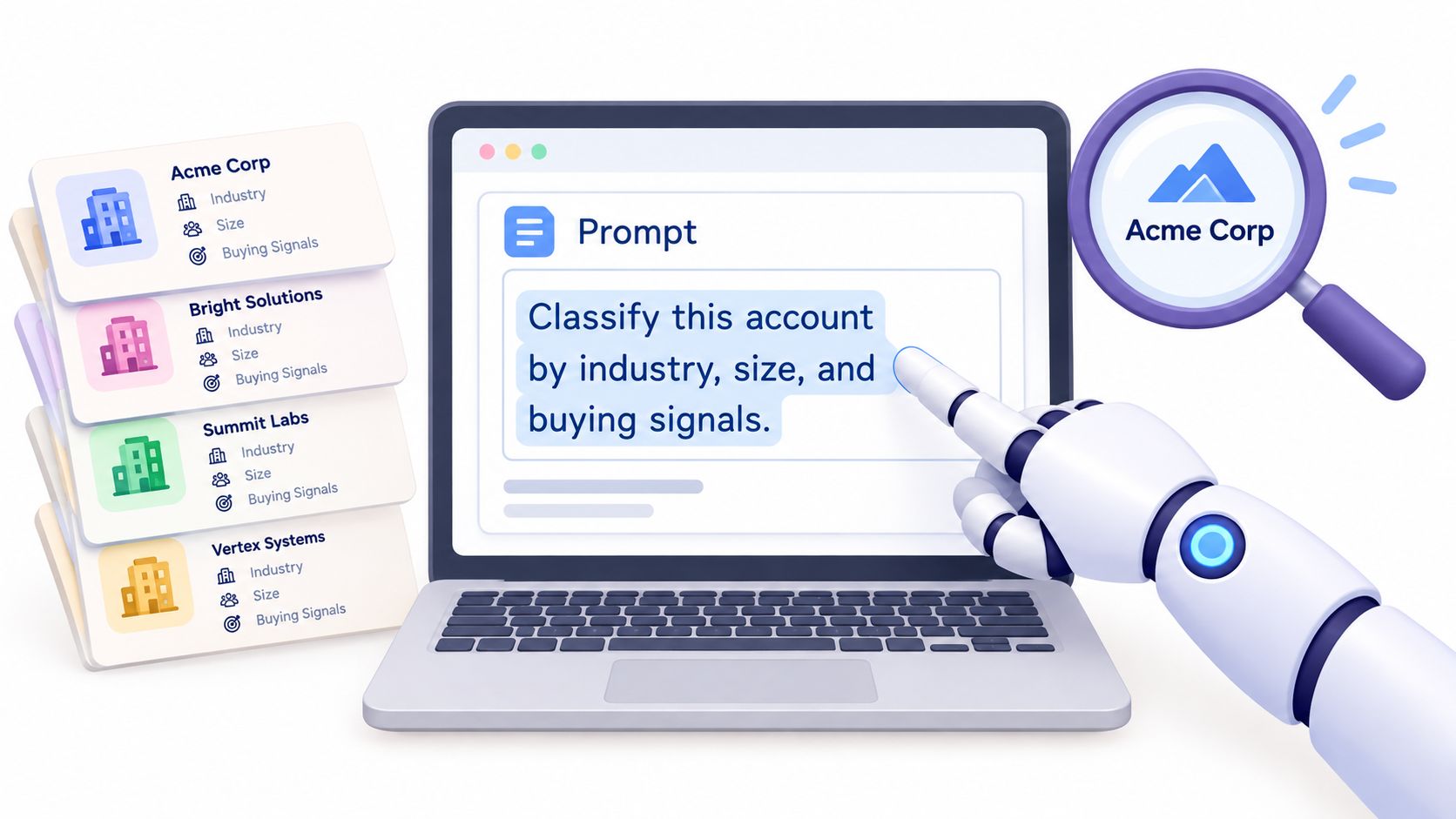
The core pattern has four parts. First, state the ICP criteria and disqualifiers as numbered rules. Second, supply the evidence available for the account, such as website text, firmographic fields and signal data. Third, require a verdict per rule with a short quoted or paraphrased source. Fourth, require a confidence score and a flag where evidence is missing or contradictory.
A Clay-style column prompt might read, in shortened form: classify the company against rules 1 to 6, return JSON with fields for verdict, evidence, source URL, date observed and confidence, and return "insufficient evidence" rather than guessing. Structured output matters because downstream routing depends on fields, not paragraphs.
Clean inputs make this pattern reliable. Company names, domains and legal entities often arrive in inconsistent formats, which breaks matching and deduplication. The background in normalized business entity records explained helps teams understand why standardised entity data improves record matching before any model runs.
The hypothesis pattern
Classification answers fit. A second, separate prompt should generate hypotheses about likely business problems, clearly labelled as hypotheses. Mixing the two tasks in one prompt lets speculation contaminate the score. Keeping them apart means a rep can see what is evidenced and what is inferred.
Two guardrails apply to both patterns:
- Deterministic gates stay outside the prompt: Geography, size bands and exclusion lists should be enforced by rules, not by asking the model to remember them.
- Version every prompt: Log the prompt version against each output so score changes can be traced to wording changes.
Teams that haven't separated company-level fit from individual buyer roles should fix that first, since prompts inherit the confusion. The distinction is covered in H2's comparison of ICP and persona definitions.
A Worked Clay Workflow From List to Scored Accounts
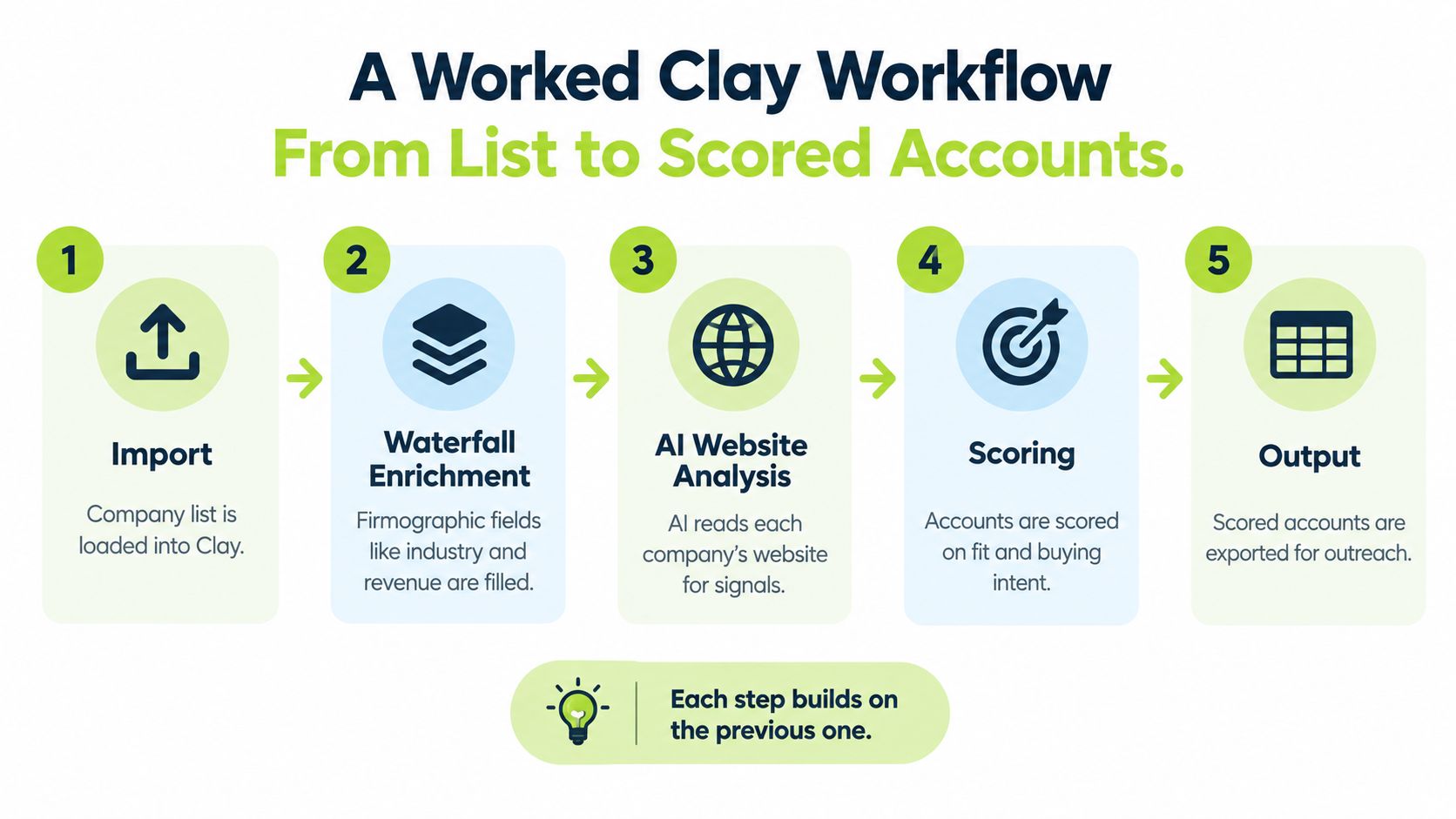
Consider a hypothetical B2B services firm targeting mid-sized software companies. The workflow begins with a raw company table in Clay containing name, domain and source list. Nothing else runs until domains are normalised and duplicates removed, because enrichment spend on duplicate rows is pure waste.
How the tables connect
Waterfall enrichment fills firmographic fields first. Clay checks one data provider, then falls back to another only where fields remain empty, which controls cost per record. Columns for industry, headcount, country and funding stage populate at this stage, each carrying the provider name so provenance survives later steps.
An AI website analysis column runs next, but only on rows that pass the firmographic gates. The prompt reads the company's own description of what it does and classifies it against the offer. A software studio that builds products for clients scores differently from a SaaS product company, even if both share an industry label in a database.
Scoring happens in a dedicated step, not inside the research prompt. Points come from the rubric, fit criteria met, disqualifiers triggered, signal strength recorded separately. Each scored row carries a reasoning field so a rep or RevOps lead can inspect why the account ranked where it did.
Routing splits the output three ways:
- Pass: Records meeting the threshold move to the CRM with score, evidence and suggested buyer roles attached.
- Review: Low-confidence or contradictory records go to a holding view for human inspection.
- Reject: Disqualified accounts stay in the table with the disqualifying rule recorded, preventing re-enrichment later.
The most valuable column in the table is often the rejection reason, because it stops the same poor-fit account reappearing in every future list.
Contact finding runs last, after account qualification. Finding people at companies that later fail fit checks burns credits and creates contact records nobody should email. Sequencing account qualification before contact enrichment is the single simplest cost control in the build.
Quality Controls and a Confidence Model for Signals
Most AI prospecting failures share one cause. A detectable online event gets treated as purchase intent. A company hires a sales leader, adopts a tool or posts on social media, and the workflow marks the account hot. None of those events, alone, shows an active buying process.
Data quality compounds the problem. Salesforce reporting notes that 46% of sales professionals with AI say data-quality issues harm sales, and 51% say security concerns have delayed AI initiatives, as set out in Salesforce's State of Sales report. Weak evidence scored confidently produces irrelevant outreach at scale.
Score the signal separately from the account
A workable confidence model keeps two scores apart. Account fit comes from ICP criteria. Signal confidence comes from the strength, recency and independence of the evidence. High-priority outreach requires strong fit plus at least two independent evidence sources, each stored with source and date. Guidance on distinguishing genuine triggers from noise is covered in H2's guide to sales buying signals.
Confidence Model for AI Prospecting Signals
| Signal Type | Example | Confidence Contribution | Review Trigger |
|---|---|---|---|
| Firmographic change | New office in a served region | Low alone | Only signal present |
| Technographic | Uses a platform the offer replaces | Medium | Source older than the review window |
| Hiring | Vacancy naming the relevant problem | Medium | Role is junior or unrelated team |
| Behavioural | Repeated engagement with relevant content | Medium to high | Single anonymous visit |
| Corroborated pair | Hiring plus technology change | High | Sources trace to the same origin |
Deterministic checks before outreach
Several controls belong in rules, not prompts. Deduplicate before enrichment. Validate email addresses independently of the provider that supplied them. Set spending limits on paid data calls per run. Route low-confidence and contradictory records to human review rather than letting a threshold pass them.
Weekly sampling closes the loop. Reviewing a sample of false positives and false negatives shows whether the rubric, the data or the prompt is at fault. Without that review, errors compound while dashboards still show healthy enrichment volume.
Measuring Cost and Benefit Without Fooling Yourself
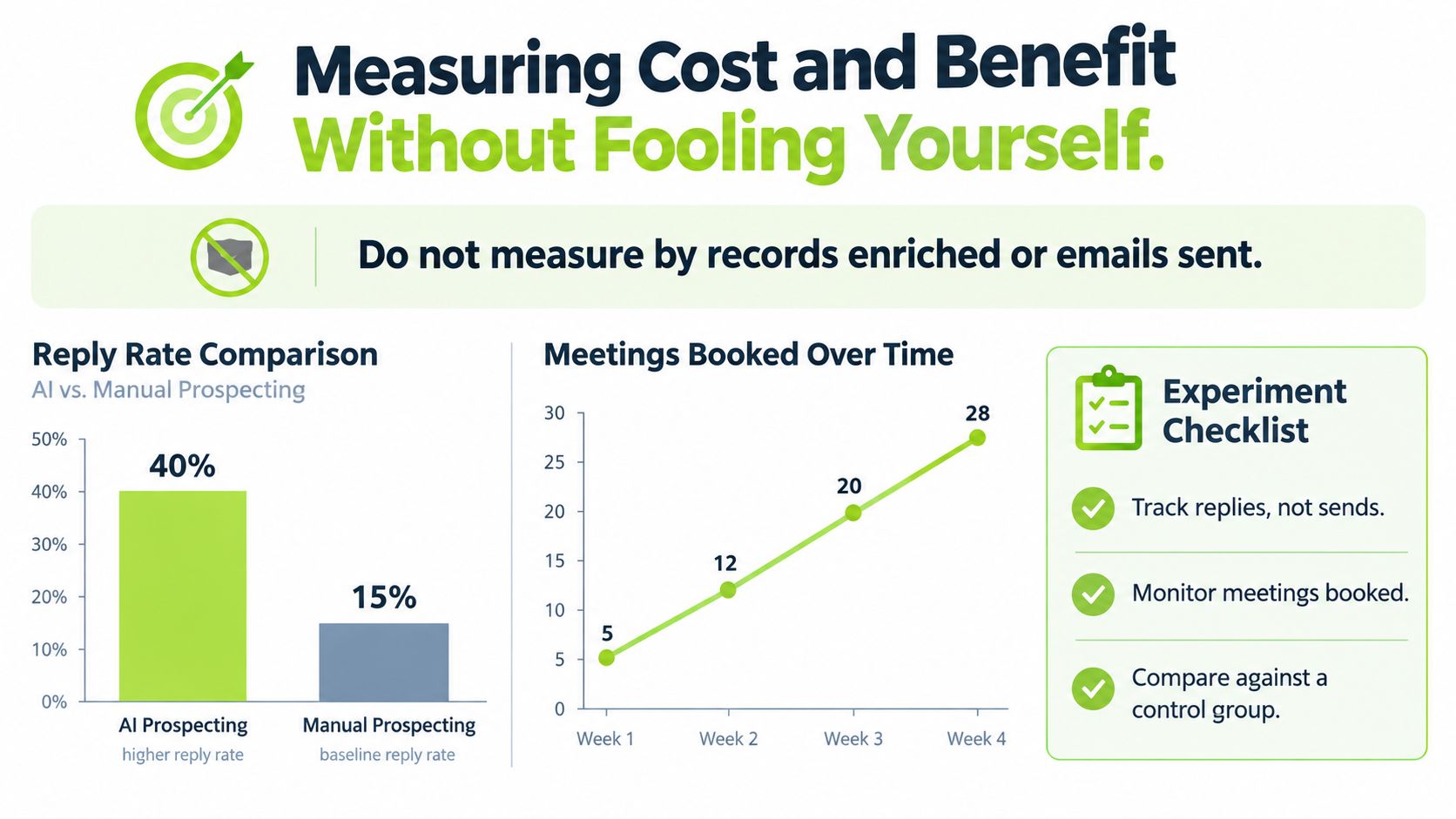
Records enriched and emails generated are input metrics. They measure activity the system produced, not value the business received. A workflow can hit every volume target while creating no qualified pipeline, and the dashboard won't show the difference.
Adoption figures need careful handling too. Reporting cited in R-Sun's analysis of AI-driven B2B sales states 87% of sales organisations use AI in some form, while 55% of sales professionals use it for prospecting and 38% plan to do so. Those numbers show how common the practice is. They don't prove AI caused any particular outcome for any particular team.
A benchmark sequence that holds up
Start with a two- to four-week control period using the existing process. Then run an AI-assisted cohort against a matched control and compare outcomes that sit close to revenue:
- Verified-contact rate: Share of contacts that survive independent validation.
- Positive-reply rate: Replies showing interest, not total replies including objections and unsubscribes.
- Qualified-meeting rate: Meetings that meet the team's own qualification standard.
- Pipeline per account contacted: The metric that exposes whether better targeting beats bigger lists.
Log the full cost side alongside results. Enrichment spend, model calls, correction time and cost per verified account belong in the same view as reply and meeting rates. Research time saved only counts when it converts into better qualification and more conversations.
Warning sign: If saved research time turns into larger lists rather than better conversations, the workflow has scaled the wrong thing.
Gartner predicts that 95% of seller research workflows will begin with AI by 2027, compared with less than 20% in 2024, a projection published on Gartner's sales AI topic page. That makes measurement discipline more important, not less. When every competitor starts research with AI, the differentiator is whose system proves its output quality.
Outreach Integration, Deliverability and Compliance
A scored account list creates no value until messages reach inboxes lawfully. Deliverability and compliance aren't finishing touches. They're constraints that should shape list size, targeting precision and sending volume from the start.
Gmail bulk sender requirements
Google treats a sender reaching 5,000 or more Gmail accounts within 24 hours as a bulk sender. From February 2024, bulk senders must authenticate outgoing mail, avoid unwanted messages and provide a simple unsubscribe mechanism, as set out in Google's email sender guidelines. Bulk senders must use SPF, DKIM and DMARC, while smaller senders need at least SPF or DKIM.
Spam complaint rates carry hard thresholds. Google recommends keeping the user-reported spam rate below 0.1% and preventing it from reaching 0.3%, above which senders may lose access to mitigation. Irrelevant targeting drives complaints faster than almost anything else, which makes qualification quality a deliverability issue. Practical setup detail sits in H2's email deliverability best practices guide.
AI has a legitimate role here, within limits. Reply classification can sort positive responses, objections and unsubscribes quickly, and suppression rules can remove unsuitable contacts before the next send. None of that compensates for unauthenticated domains or a list built on weak fit.
PECR and the corporate subscriber distinction
UK teams must classify contacts before messages are generated. The ICO's PECR guidance states that the electronic-mail marketing consent rule does not apply to corporate subscribers, so organisations can generally receive B2B marketing emails without consent, but sole traders and some partnerships are treated as individual subscribers and require specific consent unless the existing-customer soft opt-in applies, per the ICO's guide to PECR on electronic mail marketing.
The soft opt-in has conditions. Details must have been collected during a sale or negotiation, marketing must concern similar products or services, and a clear opt-out opportunity must be given at collection and in every message. Every marketing email must also identify the sender and provide a valid contact address and unsubscribe route.
One distinction deserves emphasis in workflow design. A publicly available email address is not evidence of consent to marketing. Account-level evidence that justifies research and person-level permission to send are separate fields, and the workflow should store them separately with source and date.
A Practical Starting Point and Decision Sequence
One B2B team I worked with spent its first month on AI prospecting building nothing. They wrote down their ICP criteria, listed the disqualifiers reps applied instinctively, and baselined reply rates on the manual process. The automation they shipped in month two held up because the rules existed before the tooling did.
The market context makes the same argument for patience. McKinsey estimated generative AI could add $0.8 trillion to $1.2 trillion in productivity across sales and marketing, yet its 2024 research found only 21% of surveyed commercial leaders had fully enabled enterprise-wide adoption. A gap that wide favors small, testable builds over broad rollouts.
A workable sequence for the first build:
- Pick one bottleneck. Account research or scoring. The full prospecting motion can wait until the first piece proves itself.
- Define inputs and rules. ICP criteria, disqualifiers and evidence fields, written down before tooling choices.
- Run a control period. Baseline the current process on reply and meeting quality so the build has something to beat.
- Build with checkpoints. Prompts paired with deterministic gates, a human review queue and cost caps on every run.
- Log and review weekly. Sources, costs, corrections and downstream outcomes in one place, so qualification stays explainable when a rep asks why an account scored the way it did.
Teams wiring models directly into their own stack will find implementation detail in the frontier LLM integration docs from Openbase. The documentation choice matters less than the discipline around it: versioned prompts, per-run cost caps and logged outcomes that survive an audit.
Build-versus-buy turns on internal capacity. A team with a proven offer but no operators can run a fully managed programme. A team with ops capacity in place may get more from a custom system build or private training, the three routes H2 offers. The deciding question is who owns data quality, error correction and weekly review once the workflow is live.
Teams that want this kind of controlled AI prospecting pipeline built and run for them can use H2's fully managed outbound, commission a custom GTM system build, or train internal operators through a private workshop. Each route starts with the same foundations covered above: defined inputs, explainable qualification and measurement against qualified conversations rather than send volume. H2 offers a short introductory call to discuss which route fits the current team and pipeline goals.
