Email copywriting is the practice of writing email messages to produce a measurable reader action, such as a reply, click, meeting, purchase or continued conversation. In 2024, the channel reached 4.48 billion email users, while global email marketing revenue was projected at $12.33 billion, making the quality of the words commercially significant at scale.
But what is email copywriting when a campaign underperforms? Most guides answer with subject lines, persuasion and calls to action. That answer is incomplete. In B2B, copy is only one layer of a system that also includes audience selection, contact data, offer quality, sender authentication and sales follow-up.
A polished email sent to the wrong buyer is still a bad campaign. A relevant message that never reaches the inbox isn't a copywriting failure either. Strong operators diagnose the failure layer first, then change the words only when the evidence points there.
Why Most B2B Email Campaigns Fail Before Copy Matters
A weak reply rate doesn't prove that the writing is weak. It may indicate that the campaign targets companies without the problem, contacts without buying influence, an offer without a compelling reason to act, or a sending setup that prevents delivery. Treating every failure as a copy problem leads teams to rewrite subject lines while leaving the actual constraint untouched.
The first diagnostic question is simple: did the right message reach a plausible buyer at a credible moment? If the answer is no, copy optimisation is premature.
A practical failure model
Separate the campaign into five layers:
- Audience: Are the accounts likely to experience the problem your product solves?
- Data: Is the person relevant, and are the company facts accurate and current?
- Offer: Is the proposed next step valuable enough to justify a reply?
- Infrastructure: Are authentication, reputation, list hygiene and delivery controls working?
- Copy: Does the message turn a relevant situation into a clear, low-friction action?
These layers interact, but they shouldn't be confused. A hiring pattern can identify an account worth investigating, yet it doesn't establish purchase intent. A technology choice can support a hypothesis, but it doesn't prove that the company wants to switch providers. The copy has to present the signal as a reason to explore, not as certainty.
Practical rule: Copy should make a qualified conversation more likely. It shouldn't compensate for an unqualified audience or broken sending infrastructure.
SPF identifies authorised sending systems for a domain. DKIM adds a cryptographic signature so recipients can validate message ownership and integrity. DMARC sets policy for authentication failures and aligns the authenticated domain with the visible From domain. Microsoft's email authentication guidance explains why these controls belong upstream of copy testing.
Diagnose before rewriting
If authenticated emails aren't reaching the inbox, investigate authentication, reputation, bounces, complaints and suppression rules. If delivery is healthy but qualified replies remain weak, inspect the audience, problem hypothesis, evidence, proof and call to action.
This distinction changes the operator's behaviour. Instead of asking, “Which subject line gets more opens?” ask, “Which layer prevents a suitable buyer from starting a useful conversation?” That question produces cleaner tests and protects the team from random optimisation.
The Five Core Components of B2B Email Copy
A B2B email has five connected copy components. Each one answers a different question in the recipient's decision process, from recognition in the inbox to confidence about the next step.
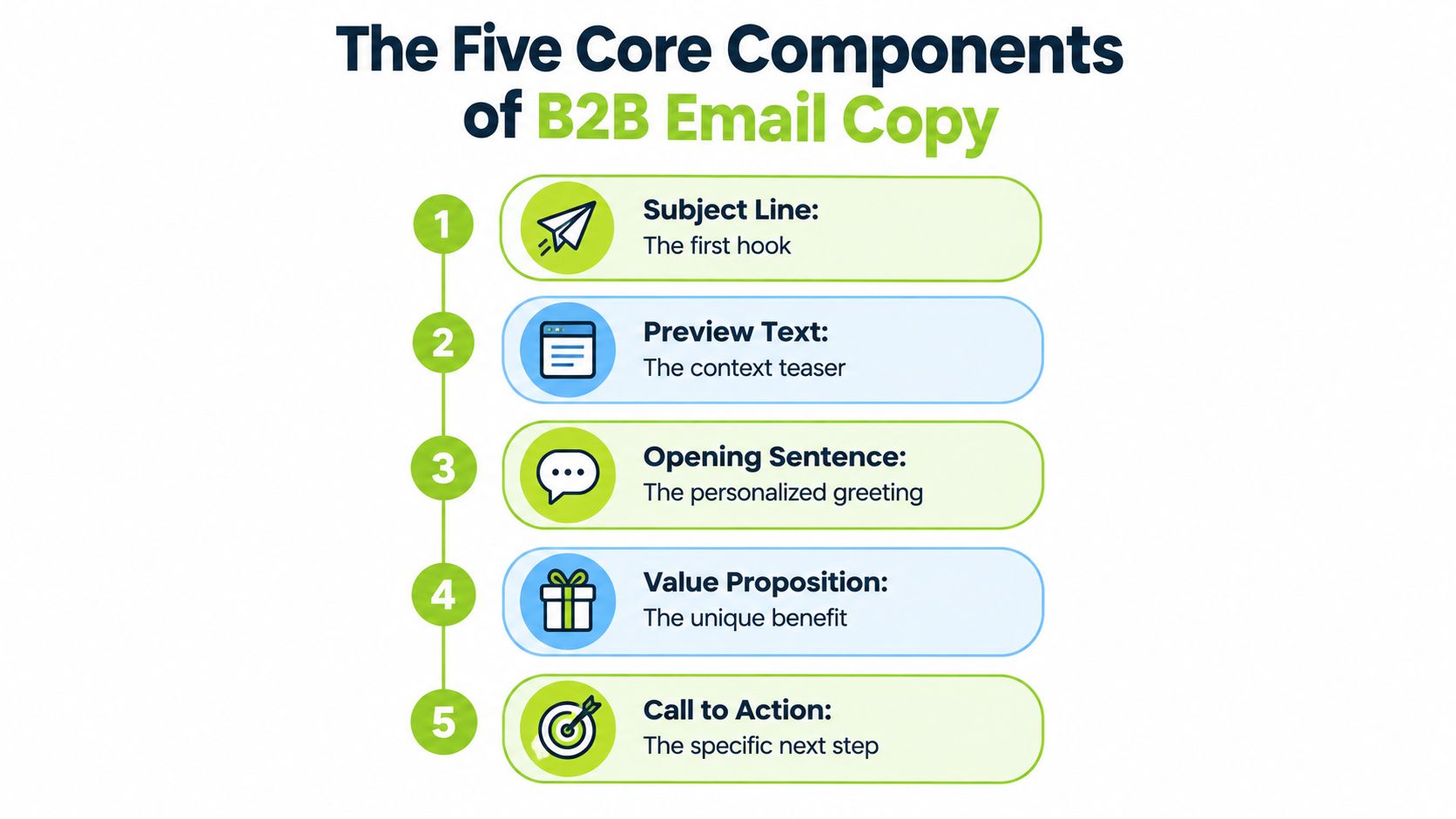
Subject line and preview text
The subject line earns attention without pretending to know more than you do. “Question about your developer hiring” is more credible than “Drive transformational growth”, especially when the campaign is based on a hiring signal. The subject should frame the reason for contact, not carry the entire sales pitch.
The preview text supplies context. If the subject introduces a business circumstance, the preview can state the working hypothesis: “Wondering whether release pressure is affecting platform work.” Together, they should help the reader understand why the email might deserve attention.
Opening sentence
The opening sentence answers why this company, why this person and why now. Use decision-relevant evidence, such as a relevant vacancy, technology choice or market change. Avoid shallow personalisation that adds a first name but no commercial meaning.
For example, “Saw you're hiring a database administrator” is a fact. “Saw you're hiring a database administrator, which may mean the team is carrying more operational work than its current capacity allows” is a hypothesis. The second version gives the reader something to confirm or correct.
Value proposition
The value proposition connects the observed condition to a plausible outcome. Don't describe every feature. Explain the problem you believe exists, the consequence it may create and the type of help available.
A useful proposition might be: “We help software teams cover database operations when hiring is slower than the workload.” It stays narrow enough to be credible and specific enough to invite a response.
Call to action
The CTA should request one defined next action. “Open to comparing notes?” is appropriate when the goal is qualification. “Would a short conversation next week be useful?” is more direct when the account and problem fit are stronger.
The CTA should also make declining easy. A prospect who can reply “not a priority” has a human decision point, which is preferable to forcing a click through a generic booking funnel.
For broader guidance on message structure and practical copywriting strategies, focus on the same principle: clarity beats decorative language. Audit every email by asking whether each component adds evidence, meaning or momentum.
Cold, Nurture and Transactional Copy - When Each Job Changes
Email copywriting changes with permission level, buying stage and desired action. A cold B2B email asks a stranger to consider a relevant conversation. A nurture email speaks to someone who has already shown interest. A transactional message confirms an action the recipient has taken.
Using the same persuasive style across all three creates friction. Cold outreach needs restraint and qualification. Nurture copy can develop an idea over time. Transactional copy should prioritise accuracy, reassurance and a clear explanation of what happens next.
| Copy Type | Desired Action | Permission Level | Key Constraint |
|---|---|---|---|
| Cold outreach | Reply or accept a relevant conversation | Low or unestablished | Evidence must be credible without feeling intrusive |
| Nurture email | Click, learn, activate or continue evaluating | Established | The message must advance the buyer's understanding |
| Transactional email | Confirm, complete or understand an action | Triggered by recipient behaviour | Accuracy and usability matter more than persuasion |
Cold outreach
Cold copy should lead with a business circumstance and a cautious hypothesis. It shouldn't claim that a scraped signal proves intent. A technology choice may justify investigation, but not a confident statement that the buyer needs your service.
Personalisation has a credibility trade-off. A message containing many researched details can feel invasive if none of them clearly explains the reason for contact. Use the smallest amount of evidence needed to make the hypothesis relevant, then invite correction.
Nurture email
Nurture copy has more permission to educate. A newsletter might earn a click to a useful analysis. A trial email might help a user activate an important workflow. A renewal message might reduce uncertainty and protect an existing relationship.
The copy can be more explanatory because the recipient has already entered the relationship. Even so, give each email one dominant job. Multiple competing CTAs make measurement difficult and leave the reader unsure where to start.
Transactional email
Transactional copy confirms what happened and what the recipient should expect. A password reset, order confirmation or service update doesn't need a dramatic hook. It needs precise language, recognisable sender details and an obvious next action.
For a useful reference on how to polish your emails for better responses, pay attention to tone, structure and reader effort. Professionalism isn't stiffness. It's making the intended action easy to understand.
Outbound Email Examples That Connect Business Signals to Conversations
The strongest outbound emails don't begin with a product description. They begin with a reason to investigate an account. Public company information, employer job postings, technology usage and relevant social activity can support that investigation, but each signal remains evidence for a hypothesis rather than proof of intent.

Hiring signal
Subject: Database operations at {{company}}
Hi {{name}},
I noticed {{company}} is hiring for a database administration role. That may mean the team is managing more operational work than its current capacity supports, although I may be misreading the situation.
We help technology companies cover database operations while they build internal capacity. Is this an area you're actively trying to improve, or is the role unrelated?
This message works because it separates the observed fact from the interpretation. The question gives the recipient an easy way to correct the premise, and the CTA seeks qualification rather than a premature sales meeting.
Technology signal
Subject: Your use of {{technology}}
Hi {{name}},
I saw that your team uses {{technology}} in its product environment. Teams using it often reach a point where reliability, cost control or specialist support becomes a wider operational concern, though that may not be relevant at {{company}}.
We help teams address that work without immediately adding another internal specialist. Is this a current consideration, or should I close the loop?
The copy doesn't assume dissatisfaction. It connects a technology choice to possible consequences and leaves room for a “no”.
Market change
Subject: Supporting delivery during {{change}}
Hi {{name}},
It looks like {{company}} is expanding into {{market or product area}}. That can create pressure on engineering, data or operational teams before the new work becomes predictable.
We help B2B technology teams add focused support around that transition. Would it be useful to compare how you're handling the additional workload?
Signals should guide research, not replace it. Resources on how to prospect with intent signals can help operators organise evidence and avoid treating every public action as buying intent. For a complementary view of commercial triggers, see sales buying signals.
Across all three examples, the copy has four jobs: identify a relevant circumstance, state a plausible consequence, describe a focused form of help and ask for a low-friction response. It doesn't need theatrical persuasion. It needs enough relevance for the right person to continue the conversation.
Measuring Email Copy Performance Beyond Open Rates
Open rates are weak evidence for B2B copy decisions because privacy features and automated scanning can distort them. A recipient may appear engaged without reading the message, or may read it without generating a dependable open signal.
Judge copy against the commercial action it was designed to produce. For outbound, that usually means qualified replies, booked meetings and resulting opportunities. For nurture, the relevant action may be a meaningful click or product activation. For transactional email, successful completion and reduced confusion matter more than persuasion.
Separate delivery from persuasion
Use two diagnostic tracks:
- Delivery track: Check SPF or DKIM configuration, DMARC alignment, bounce signals, complaint signals, suppression rules and sender reputation.
- Persuasion track: Review segmentation, the problem hypothesis, evidence quality, proof, offer relevance and CTA clarity.
If messages aren't reaching inboxes, changing the opening sentence won't repair the underlying issue. If delivery is healthy but qualified replies are weak, investigate whether the campaign selected the right accounts and whether the copy gives a credible reason to respond.
A reply isn't automatically a success. “Remove me” indicates that the message reached the recipient but failed the relevance test. “Send details” may show interest, yet still require qualification. Define what counts as a useful reply before launch so the team doesn't optimise for activity that sales can't progress.
Build a controlled testing loop
Change one meaningful variable at a time where practical. Test the opening premise against another premise, or compare two CTAs that ask for the same level of commitment. Changing the audience, offer, copy and follow-up schedule simultaneously makes the result difficult to interpret.
Track the path from target account to qualified conversation to opportunity. The email deliverability best practices layer belongs beside the copy report, not underneath it, because infrastructure problems and persuasion problems require different interventions.
When to Ins Source Outbound Copy versus Outsourcing to Experts
The decision to build internal email copywriting capability or commission managed outbound work depends on commercial maturity, available capacity and operational discipline. Internal ownership makes sense when the offer is understood, sales can respond quickly and someone has time to research accounts, maintain data quality, run tests and learn from replies.
It also requires more than a writer. A functioning programme needs audience definition, contact verification, sending infrastructure, campaign management, reply handling and feedback from sales. Teams adopting Clay workflows or AI-assisted prospecting need people who can verify evidence, control costs and remove unsupported claims before anything reaches a prospect.
When internal ownership fits
Build internally when:
- The offer is proven: Sales can explain who buys, why they buy and what objections appear.
- The team has capacity: A founder, marketer or SDR can maintain the workflow rather than treating outbound as occasional spare-time work.
- Feedback is accessible: Sales conversations feed directly into targeting and messaging decisions.
- The data process is manageable: The team can define qualification rules and keep CRM records usable.
- Learning is strategic: The company wants to develop Clay, research and campaign skills as a lasting capability.
Internal ownership gives the team tighter control over tone and commercial nuance. It also carries the cost of training, maintenance and slower iteration when the operator has competing priorities.
When external support fits
Outsourcing is more practical when the company has a proven offer, capacity to take sales conversations and a need for more pipeline, but lacks the time or appetite to operate the programme. A managed provider can combine research, data engineering, enrichment, copywriting, deliverability, testing and reply handling into one operating process.
H2 offers fully managed outbound, custom GTM system builds and private GTM workshops, combining commercial research with Clay and AI workflows where appropriate. The cold email lead generation agency perspective is useful when assessing whether the actual need is writing alone or a broader outbound system.
Don't outsource a vague offer and expect copy to create product-market fit. External execution accelerates a clear commercial direction. It can't invent credible evidence where the business hasn't yet defined its market.
Putting It All Together - A Diagnostic Checklist for B2B Operators
A reliable email copywriting process moves from infrastructure to audience, evidence, message and measurement. That order prevents operators from polishing language before confirming that the campaign can reach and interest an appropriate buyer.
Use this review before launch and again when results disappoint:
- Verify the sending foundation: Confirm authentication, alignment, list hygiene and suppression controls.
- Define the account fit: State which companies are likely to experience the problem and which are not.
- Confirm the buyer: Check that the contact can understand, influence or own the relevant business issue.
- Validate the signal: Record the evidence and separate the fact from the hypothesis it supports.
- Test the offer: Ask whether the proposed conversation or resource is useful enough to justify attention.
- Audit the five components: Review the subject line, preview text, opening sentence, value proposition and CTA as one connected argument.
- Match the permission level: Use restraint for cold outreach, education for nurture and precision for transactional messages.
- Measure the commercial path: Track qualified replies, meetings and opportunities, then use objections and sales feedback to decide what changes next.
The right optimisation target is the first broken layer, not the most visible metric.
A campaign with healthy delivery but poor-fit replies needs better targeting or a sharper problem hypothesis. A campaign with relevant replies but few meetings may have a weak offer, unclear CTA or slow follow-up. A campaign that generates meetings but no opportunities may require stronger qualification, different accounts or a more accurate value proposition.
That is the practical answer to what is email copywriting. It isn't decorative writing added to an email system at the end. It's commercial reasoning expressed in words, tested against the behaviour of suitable buyers and kept separate from problems that copy can't solve.
H2 helps B2B technology and service companies research suitable buyers, build evidence-led outbound systems and write campaigns designed for qualified conversations. Visit H2 to discuss your audience, current outbound challenge and whether managed execution, a custom GTM system or a practical workshop fits your team.
