Most advice about hiring a cold email lead gen agency is backwards. It treats outbound like a software problem. Buy more tools, automate more steps, send more volume. That's how teams end up paying retainers for busywork while reply quality collapses.
The buying question is simpler. Can an outside team improve fit, signal quality and operational discipline faster than you can build it yourself? If the answer is yes, outsourcing can work well. If the answer is no, an agency just gives you a more expensive version of your current confusion.
A lot of agency sales pages still sell scale as the prize. That's stale thinking. Current benchmark reporting shows a sharp split between poor high-volume AI outreach and far stronger performance from tightly targeted, signal-based campaigns, with broad AI-heavy outbound dropping below 1% reply rates while tighter campaigns can reach 5% to 12%, and even 15% to 25% in ultra-targeted cases according to Readsignal's 2026 outbound analysis. If you remember one thing from this guide, remember this: volume amplifies quality problems just as fast as it amplifies good execution.
What a Cold Email Lead Gen Agency Actually Does
A proper cold email lead gen agency doesn't just rent you software seats or hand over a scraped CSV. It runs an outbound operating system on your behalf.
That usually means the agency owns targeting, list building, enrichment, email infrastructure, copywriting, sequencing, sending, reply handling and meeting handoff. In other words, it sits somewhere between a specialist outbound team and an outsourced sales development function. That's different from a freelancer writing a few emails, and different from an SDR-as-a-service provider who mainly books calls from your existing process.
It's not magic. It's disciplined execution.
The strongest agencies don't “hack growth”. They do boring things well, repeatedly. They set up sending domains, warm inboxes, verify contacts, segment lists properly, write concise copy, watch reply patterns, suppress bad data, and tighten targeting every week.
That sounds less exciting than AI autopilot. It's also why good operators outperform volume shops.
Practical rule: If an agency talks more about send volume than list quality, reply quality, or infrastructure health, walk away.
The numbers support that caution. A large 2025 B2B cold email dataset found the average reply rate across all campaigns was just 0.45%, with replies peaking at 0.54% in February and dropping to 0.35% in December. The same dataset found morning sends between 8 AM and 12 PM also hit 0.54%, and founders and owners replied at 0.57% versus 0.42% for C-level executives according to Belkins' cold email response rate study. That's a useful reality check. Good outbound isn't about blasting harder. It's about improving timing, segmentation and audience choice.
What separates agencies from adjacent options
Use this quick filter:
- Freelancer: Good if you only need copy or list help.
- SDR-as-a-service firm: Better if you already have infrastructure and messaging, but need booking capacity.
- Traditional demand-gen agency: Better for paid media, content, or inbound systems.
- Cold email lead gen agency: Best when you need the full outbound machine built and run.
A serious agency earns its fee by compounding small gains across the whole chain. Better account selection improves copy relevance. Better verification protects deliverability. Better reply handling turns interest into booked conversations. None of that is glamorous. All of it matters.
The Core Components of a Managed Cold Email Programme
Managed outbound works when every layer supports the next one. Most weak programmes fail because one broken link poisons the whole chain.
Research and targeting come first
Everything starts with ICP definition and signal research. The agency needs to know which companies fit, which roles matter, and what observable signs suggest the timing is right. That can include job posts, technology usage, growth signals, buyer pain visible on the company site, or account-level context pulled into tools like Clay, Apollo, LinkedIn Sales Navigator, or specialist enrichment workflows.
Weak inputs produce weak outputs. If the list is broad, no copywriter saves it.
Infrastructure and sending keep the programme alive
After research comes the technical layer. Serious agencies set up dedicated sending infrastructure, rotate inboxes, verify contacts, and monitor domain health so campaigns can keep running without trashing reputation.
Independent benchmark guidance says healthy inbox placement sits around 95%+, bounce rates should stay below 2%, and spam complaints should stay below 0.1%. The same guidance notes that poor list hygiene, weak verification and broken authentication reduce sender reputation, which then reduces future inbox placement. It also points to SPF, DKIM and DMARC as the first diagnostic layer when performance drops, as explained in Forman & Norden's cold email benchmark guidance.
That's why a managed service isn't just copy plus sequencing. It's operations.
Copy, reply handling and handoff close the loop
Once the data and infrastructure are solid, the agency writes the sequence and manages the inbox like a live sales channel. That means testing angles, reviewing objections, qualifying interested replies, and handing off meetings with enough context for sales to run a good call.
A serious programme usually has several functions running at once:
- Strategist: Defines ICP, offer angle and testing priorities.
- Copywriter: Writes and iterates the sequences.
- Deliverability operator: Protects sender health and inbox placement.
- Inbox manager or SDR: Sorts replies, qualifies interest and books meetings.
You can see that model in a fully managed outbound service, where the provider handles research, verification, infrastructure, campaign management and reply handling as one connected system.
Good cold email performance comes from coordination. Great copy on a bad list still loses. Great infrastructure with weak positioning still loses.
The metrics that matter also change by stage. Early on, you care about bounces and inbox placement. Then you care about reply quality. Later, you care about held meetings and opportunities created. Opens and clicks are secondary at best.
Who Should Consider Hiring One
Not every company should hire a cold email lead gen agency. Many shouldn't.
The best buyers already have enough clarity to benefit from outsourced execution. They know who they want to reach, they can explain the problem they solve, and someone internally can run a competent sales call when a meeting lands.
Good fit versus bad fit
The strongest fit usually looks like this:
| Buyer Profile | Likely Fit | Key Signal |
|---|---|---|
| Founder-led B2B company with a proven offer | High | The founder can describe a narrow buyer and a clear commercial problem |
| Sales-led SaaS or tech-enabled service business | High | AEs or founders are ready to work booked meetings consistently |
| Lean team with no in-house outbound operator | Medium to high | The business needs execution capacity across data, copy and deliverability |
| Pre-revenue startup still testing who buys | Low | Messaging and ICP are still unstable |
| Company expecting an agency to create demand from a weak offer | Low | Internal team blames channel execution for product or positioning problems |
| Team that wants full control over every message and approval | Low to medium | Slow approvals will kill iteration speed |
The internal capacity test
A cold email lead gen agency makes sense when your team can't reasonably hire all the pieces at once. Most companies don't have a copywriter, deliverability specialist, data operator and SDR sitting idle.
It also makes sense when founder time is better spent elsewhere. If you're deep in product, hiring, fundraising, or closing later-stage deals, outsourced outbound can remove operational drag.
But there are clear no-go cases:
- No outbound proof at all: If nobody has ever closed from outbound, treat agency promises cautiously.
- No one to take calls: Booked meetings are worthless if your team can't run them well.
- No CRM discipline: If lead handoff vanishes into spreadsheets, you won't learn anything.
- No appetite for collaboration: Agencies need product context, call feedback and message approvals.
If you want a black-box pipeline machine, you're probably shopping for disappointment.
The best clients don't outsource judgment. They outsource specialised execution.
The Real Pros and Cons of Outsourcing Cold Email
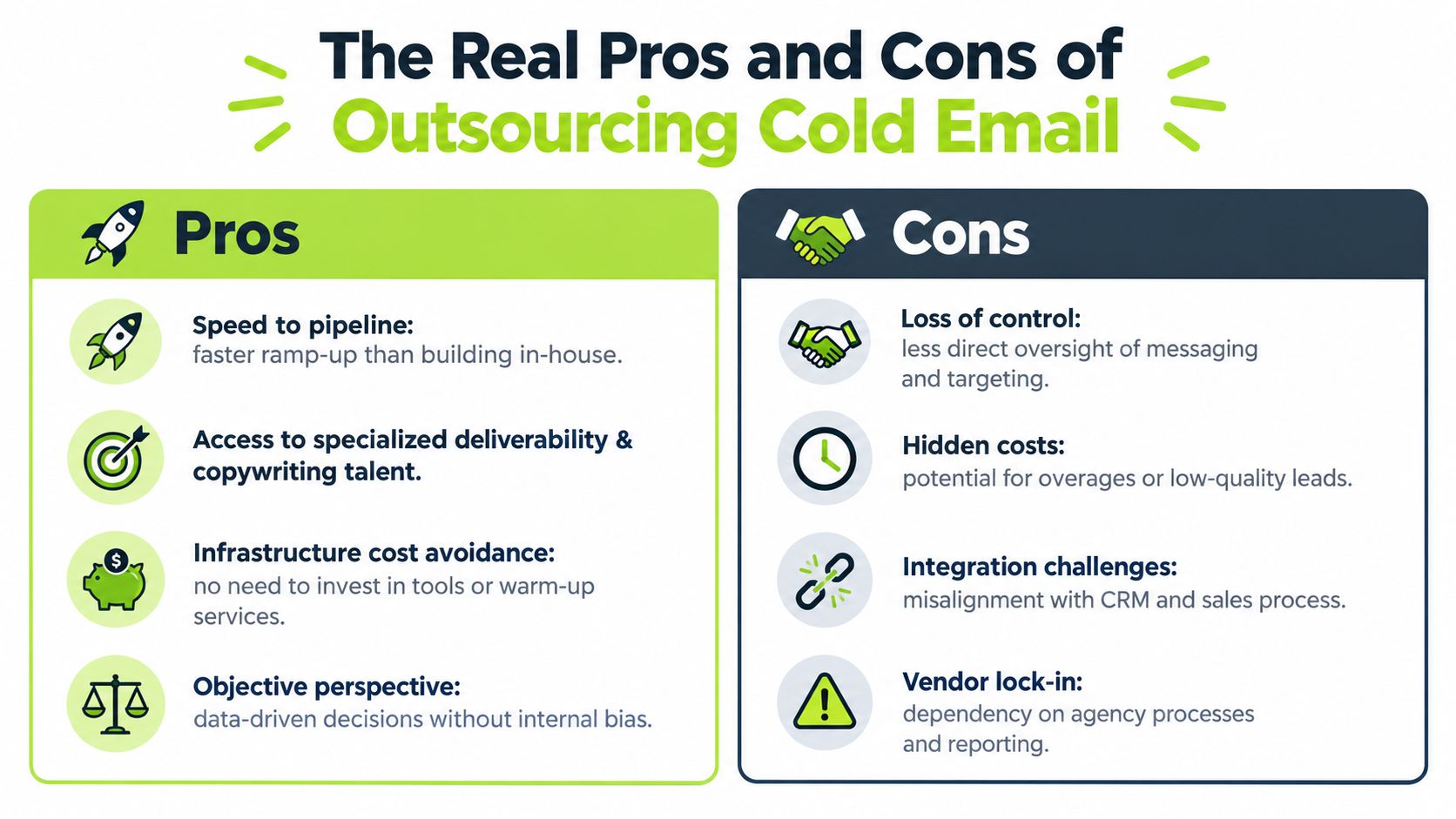
Outsourcing cold email is not a shortcut to pipeline. It is a bet that an external team can produce better signal, faster iteration, and cleaner execution than two hires you manage yourself. If they cannot do that, the retainer is dead weight.
Where outsourcing helps
The biggest advantage is speed to a working programme. A competent agency already has the operators, process, and tooling to stand up targeting, list building, copy, sequencing, testing, and meeting routing without you spending months recruiting.
Specialist pattern recognition matters too. Agencies that run enough volume across enough accounts spot weak lists, tired angles, and reply-quality problems earlier than a first-time internal hire usually will. The good ones protect focus. They kill low-signal segments fast and shift effort to messages that produce useful replies, not just activity.
That outside pressure can be healthy.
Internal teams often keep bad campaigns alive because too much ego is tied to the original idea.
Where agencies overpromise
The common failure is simple. Buyers pay for output and get theatre.
Weak agencies sell volume because volume is easy to report. Big send counts, positive open rates, and long prospect lists look busy in a dashboard. None of that tells you whether the campaign is creating qualified conversations or teaching you anything about market demand.
This is the trade-off that matters. You are not hiring an agency to send email. You are hiring them to produce signal you can trust.
If the agency cannot tell you which segment replies with pain, which offer gets dismissed, which job titles engage but do not book, and which objections repeat across positive threads, they are running a mailroom, not an outbound programme.
The cost comparison buyers should make
A retainer only makes sense against the internal alternative.
A typical agency fee often sits in the same budget range as one solid full-time outbound hire, but the in-house route rarely stops at one person. To run cold email well, you usually need at least two functions covered consistently: campaign strategy and copy on one side, data and systems on the other. If those skills sit in one person, quality usually slips somewhere. If they sit across two people, your cost climbs fast, and management time climbs with it.
That is why outsourcing can be the right call for a company with a proven offer and no appetite to build outbound operations from scratch. You get execution capacity now, not after a hiring cycle.
The downside is control. Internal teams learn faster because the feedback loop is closer. Agencies can hide weak thinking behind polished reporting, and they rarely know your buyers as well as your closers do. You also still owe the programme real input from your side: call reviews, objection notes, exclusions, offer changes, CRM hygiene, and fast approvals. Without that, performance stalls and nobody learns much.
The blunt trade-off
Use an agency when you need execution speed, already know who should buy, and can judge success by conversation quality instead of meeting count.
Build in-house when outbound is becoming a core capability and you want tighter control over testing, sales feedback, and accumulated knowledge.
Wait on both if your ICP, offer, and sales motion are still shifting. In that situation, an agency usually amplifies confusion rather than fixing it.
The right decision is not about sending more. It is about whether an outside team can produce cleaner signal and stronger operating discipline than your internal option for the same spend.
What Good Performance Looks Like in 2026
Volume still fools buyers of agency services. It should not. A cold email programme is healthy only if it produces clean signal, protects domain reputation, and turns replies into sales conversations your team wants.
Judge system health before copy angles
Start with whether the machine is stable.
Independent 2025 research covering 7.5 million cold emails found 128,605 bounces, which equals a 1.71% bounce rate and an implied 98.29% deliverability rate. The same study reported an average unsubscribe rate of 0.36%, with a 0.46% high in September and a 0.26% low in December, according to Cleverly's cold email statistics roundup.
Those numbers matter because poor infrastructure corrupts every performance readout that comes after it. If bounce rate rises, inbox placement usually worsens. If unsubscribes climb, targeting or message fit is off. If an agency cannot explain suppression rules, verification standards, inbox rotation, and what they changed after a dip, you are not buying an operating team. You are buying sends.
Practical guidance on email deliverability issues helps when reply volume drops and nobody can tell whether the problem sits in targeting, copy, or sender reputation.
Use reply quality as the primary benchmark
Reply rate still matters, but raw reply rate is a weak scoreboard on its own.
Current benchmark data puts average reply rates around 3.43%, with 5%+ generally considered solid and 10%+ considered excellent on tight segments. The same benchmark reporting says well-targeted campaigns typically reach the 5% to 10% range, while weak targeting or poor offer alignment often sit at 1% to 3% even with healthy infrastructure, according to Cleverly's 2026 cold email benchmarks by industry.
Use those ranges to challenge agency reporting. A 6% reply rate means very little if half the responses are opt-outs, referrals to generic inboxes, or prospects asking you to stop. A 3% reply rate can be more valuable if the account fit is tight and the replies come from buyers with a live problem.
| Metric | Good performance | Red flag |
|---|---|---|
| Deliverability | Stable delivery with low bounces and controlled unsubscribes | Rising bounces, rising unsubscribes, vague reporting |
| Bounce rate | Below the benchmark danger zone cited earlier | Above the benchmark threshold and blamed on “data noise” |
| Reply rate | In the solid benchmark range, with relevant buyer responses | Inflated by broad lists, opt-outs, or low-fit replies |
| Reporting focus | Positive replies, qualification rate, held meetings, pipeline created | Opens, clicks, send counts, raw contacts added |
Open rates are weak evidence. Subject lines can inflate them without improving buyer fit. Meeting counts can also mislead if no-show rates are high or qualification is loose.
Good agency performance in 2026 looks disciplined. Stable sending. Tight targeting. Credible reply quality. A clear line from campaign output to pipeline, not just activity.
How to Vet and Choose the Right Agency
A serious cold email lead gen agency should be easy to interrogate. If the sales call feels slippery, the delivery probably will too.
Start with infrastructure discipline
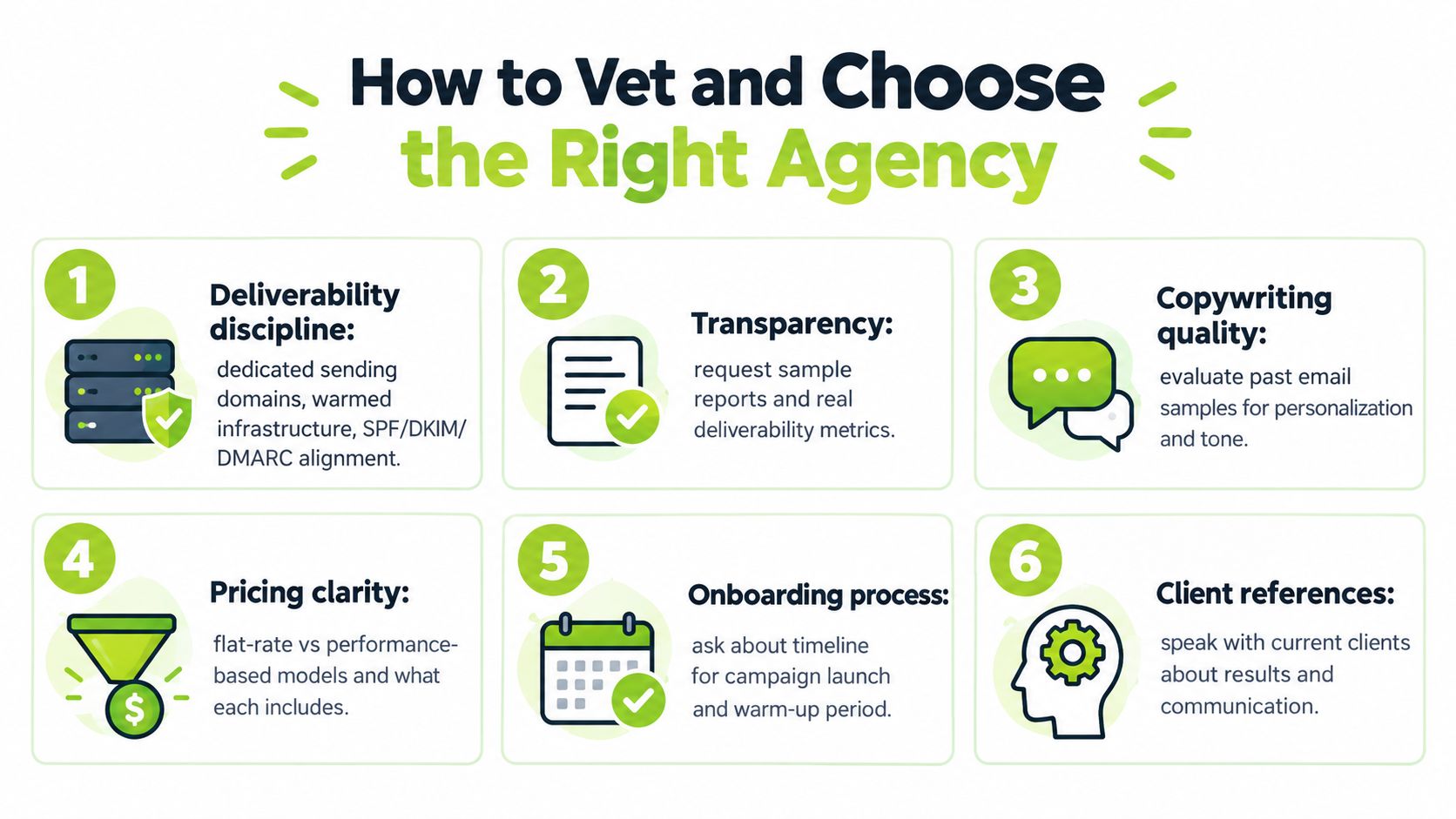
Ask blunt questions about how they protect sender reputation. You want to hear about dedicated sending domains, inbox rotation, suppression rules, verification steps, and how they monitor authentication alignment. You also want to hear what they do when metrics deteriorate.
If they answer with “we've got a proprietary system” and nothing concrete, keep looking.
Then test research quality
The next layer is signal quality. Ask how they choose accounts, how they validate fit, and what triggers they use beyond basic firmographics. A lot of agencies still rely on broad database exports and call it targeting.
Request examples. Not polished screenshots. Real campaign samples with the subject lines, first emails, follow-ups and reply outcomes. You're not just looking for writing skill. You're looking for whether they can make a commercial case to a specific buyer.
A useful benchmark when comparing options is to review how firms frame an outbound lead generation service for B2B SaaS, because the better examples tie research, targeting, copy and sales handoff together instead of treating them as separate products.
Inspect reporting and commercial alignment
Ask to see a reporting pack before you sign. Weekly reviews should show list quality, deliverability health, reply categories, meetings booked, meetings held, and pipeline created or influenced. If the deck is mostly opens and click maps, that's a warning sign.
Use these vetting prompts:
- Deliverability question: What do you monitor every week to protect inbox placement?
- Data question: How do you suppress bad-fit contacts, unsubscribes and duplicates?
- Copy question: Show me two live sequences and the reply patterns each produced.
- Commercial question: What happens if performance is poor after the initial learning period?
- Exit question: Who owns the domains, copy, lists and account data if we part ways?
Buyers should treat agency selection like hiring an operator, not buying software. You are buying judgment under feedback, not just output volume.
Reference checks matter too. Founder-to-founder calls usually tell you more than any case study page.
Pricing, Contracts and Onboarding Expectations
Cold email agencies price in different ways, but the labels often hide the same underlying economics. You're paying for research, infrastructure, campaign management and iteration. The important part is whether the model pushes the agency toward quality or toward volume.
Pricing models and trade-offs
Some firms charge a flat monthly retainer. Some charge per meeting. Some use hybrids with a base fee plus performance tiers. Pure performance deals exist, but they're rarer than founders think, and often come with narrow definitions that protect the agency more than the client.
Use this comparison to frame the discussion:
| Pricing Model | Typical Range (USD) | Common Contract Length | What You Actually Get |
|---|---|---|---|
| Flat monthly retainer | Varies by agency and scope | Usually multi-month | Infrastructure, targeting, copy, sending, reporting, reply handling |
| Per-meeting model | Varies by qualification standard | Usually multi-month or pilot-based | Incentive tied to volume of booked calls, sometimes at the expense of fit |
| Hybrid retainer plus performance | Varies by base fee and output terms | Usually multi-month | Shared risk, but only if qualification rules are clear |
| Pure performance | Varies widely | Often restrictive or selective | Usually available only for narrow offers, strong ICPs, or proven conversion history |
I'm intentionally not giving hard price bands here because agency pricing varies too much by market, targeting complexity and meeting definition. What matters more is contract structure.
Terms worth negotiating
Focus on these points:
- Kill clauses: Tie them to deliverability failure, reporting quality, or clear non-performance, not just vague dissatisfaction.
- IP ownership: Clarify who owns domains, copy assets, campaign data and enrichment outputs.
- Pilot option: Prefer a paid pilot before any long commitment.
- Qualification standard: Define what counts as a booked meeting and who makes that call.
What onboarding really looks like
A real onboarding process isn't instant. Expect an early phase for ICP alignment, offer sharpening, exclusions, account research, and infrastructure preparation. Then comes list building, copy testing, launch, early diagnostics and several rounds of adjustment.
Buyers usually make bad decisions when they judge too early or too blindly. Don't expect instant certainty from the first wave of replies. But don't tolerate opaque reporting either. You should be able to see what's being tested, what's failing, and what changed as a result.
When Outsourcing Pays Off and What to Do Next
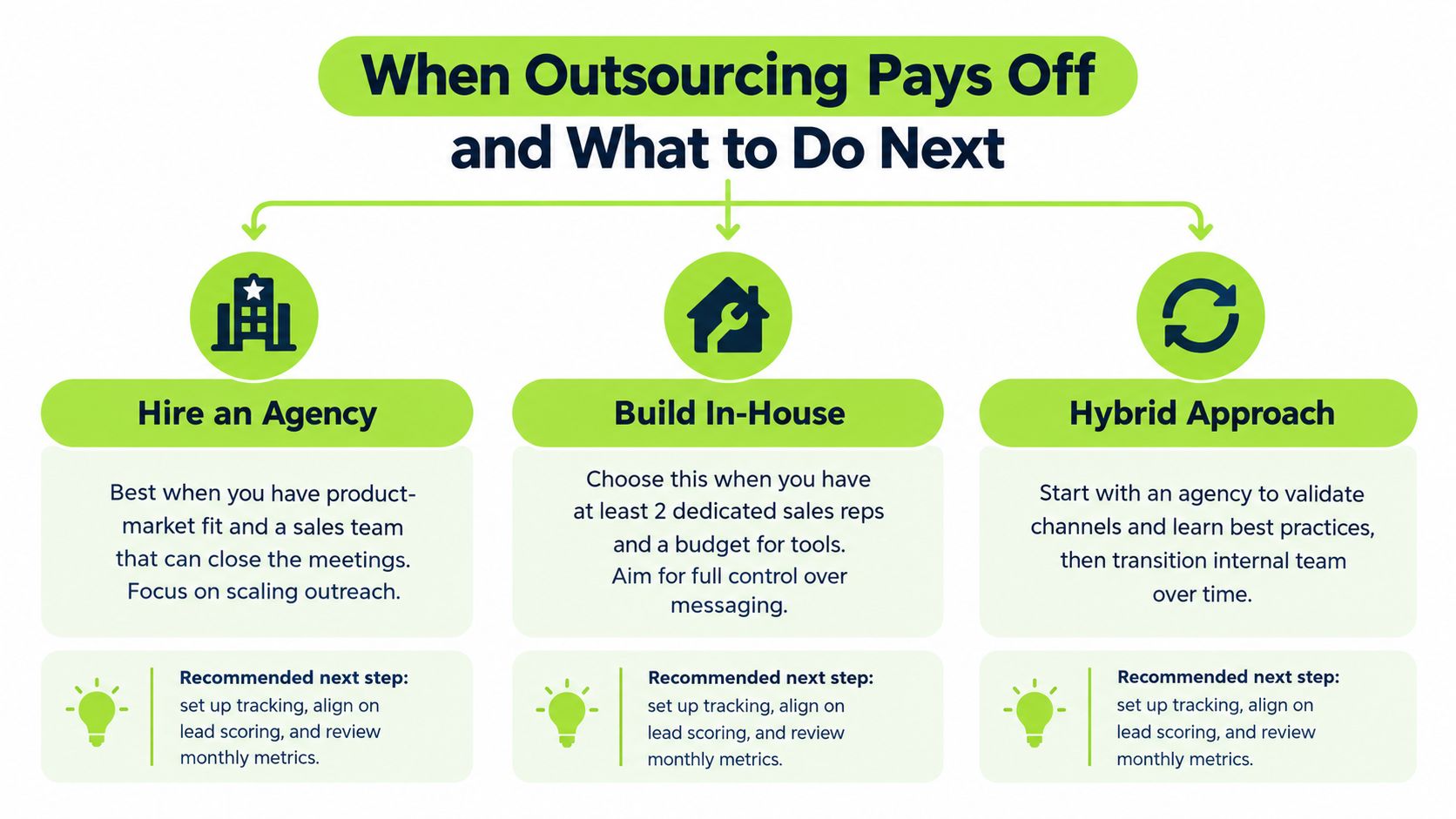
The decision usually comes down to three paths. Hire, build, or hold. The process is often overcomplicated.
Hire when the commercial basics are already there
Outsourcing pays off when you have product-market fit, a clear buyer, a credible offer, and someone internally who can convert meetings into pipeline. In that situation, an agency can add speed and operational rigour without forcing you to build the whole function.
The economics make sense. You are not paying the agency to discover whether anyone cares. You are paying it to run a difficult channel better than your current capacity allows.
Build when control is the real priority
Build in-house if you already have at least one operator who understands outbound and you want the learning loop to stay internal. That path is slower at first, but it can be smarter if outbound will become a permanent strategic capability.
It's also better when your offer is nuanced and close coordination with product, sales and leadership matters daily.
Hold when the inputs are still unstable
Don't hire anyone yet if your positioning changes every week, your buyer is still fuzzy, or nobody can explain why prospects should take a first call. In that state, a cold email lead gen agency won't fix the root problem. It will just expose it faster.
Use this decision filter:
- Hire: Clear ICP, working offer, sales capacity, runway to let the programme learn.
- Build: Experienced internal operator, appetite for control, willingness to invest in systems.
- Hold: Unstable messaging, no sales follow-through, weak product-market signal.
The next move should be practical. Shortlist a small set of agencies. Give each the same brief. Ask for sample reporting, sample campaigns, a pilot structure, and a clear definition of success and failure. Then compare them on fit, signal quality and operational discipline, not on promised send volume.
H2 runs managed outbound for B2B teams that need targeting, research, cold email copy, sending infrastructure, deliverability oversight, reply handling and meeting booking without building the entire operation in-house. If you want a practical conversation about whether outsourcing cold email is the right move for your stage and sales motion, visit H2.
