Lead qualification is the structured process of deciding whether a prospect is suitable, relevant and ready for a sales conversation, and how much attention that prospect deserves. It works like a filter. B2B marketing teams and outbound sales reps need a clear way to decide which records deserve research, calls and follow-up, and which need more time before sales attention.
So here is the question most qualification checklists never ask. If the person who replies to a cold email cannot get a purchase approved, has the team qualified a lead, or found a friendly contact?
That gap is where pipeline goes wrong. A record can look perfect on paper, tick every firmographic box and still go nowhere, because nobody has checked whether the organisation can buy. A more useful view treats qualification as a decision about the whole buying group. If finance, legal, security or an executive sponsor is missing, record that as an explicit gap rather than letting one responsive contact carry the deal.
Understanding what lead qualification means, and writing the rules down before adding volume, is what separates a busy sales diary from a forecast a founder can trust.
Defining Lead Qualification in Plain Terms
Three words carry the definition. Suitable means the account fits the ideal customer profile on industry, size, geography and whether the offer can be served there. Relevant means it has a problem the offer solves. Ready means someone inside can act within a realistic timeframe. The BANT framework explainer from Amolino describes qualification as assessing whether a prospect is sufficiently suitable, relevant and ready for a sales conversation, and dates the four-question BANT model to IBM in the 1950s.
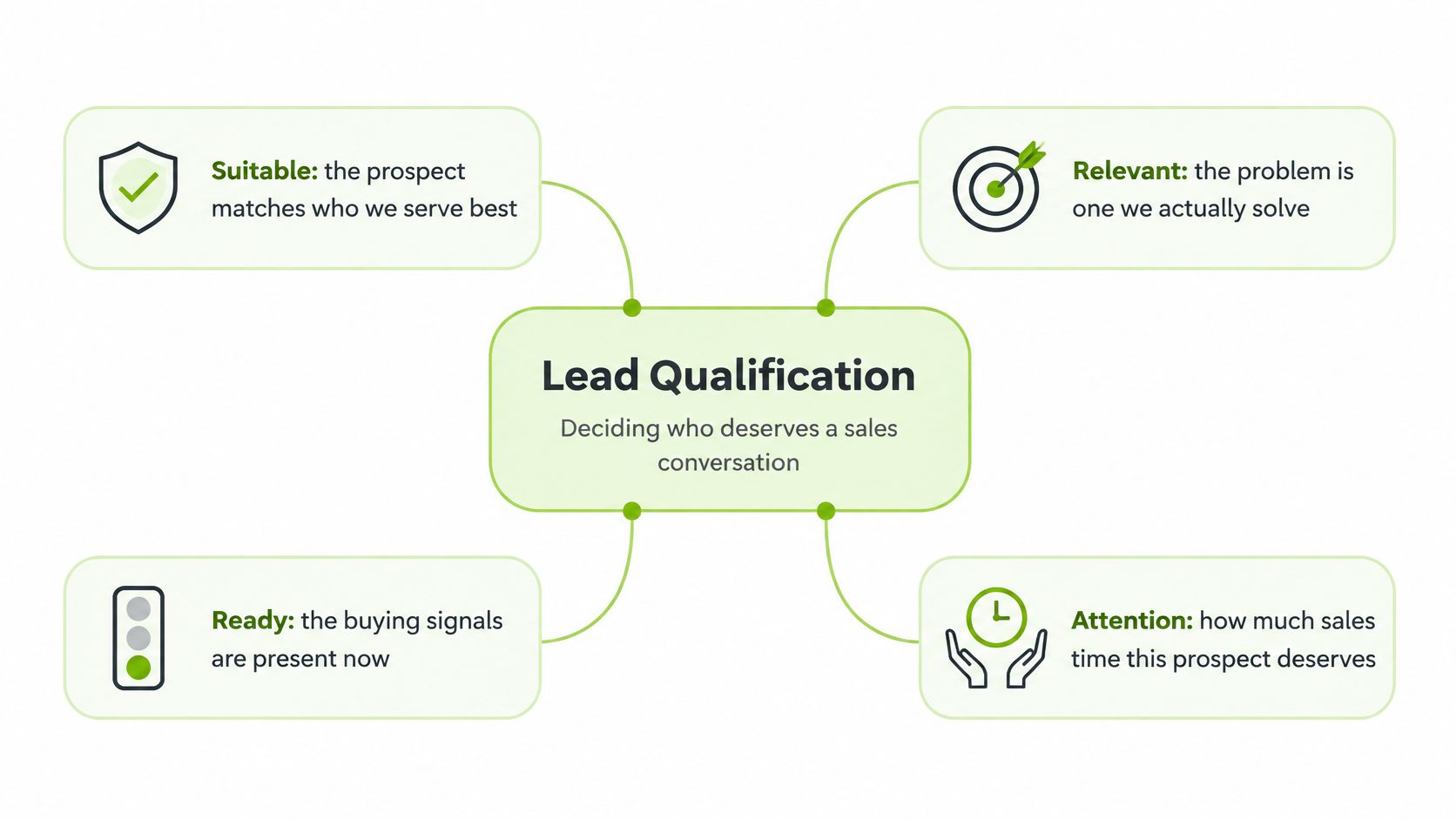
Think of a clinic running triage. There's a fixed number of appointments each week, so someone has to decide who is seen first, who is booked for a later follow-up, and who isn't booked at all. A sales team has the same constraint: a finite number of discovery calls, research hours and follow-up sequences. Qualification is the triage desk, not the diagnosis.
Two things it doesn't do. It doesn't prove a prospect will buy, and it doesn't need every answer before a first call. Budget is often unknown early, and urgency sometimes only appears once the business case is written.
Every qualified record should therefore carry one of three outcomes:
- Move to sales now: the evidence supports a conversation this week, with the reason logged.
- Hold in nurture: a plausible fit with a missing piece, plus a named owner and a review date.
- Disqualify: outside the profile or no route to a buyer, with the reason recorded rather than left silent.
Practical rule: if a record has no outcome and no reason, it hasn't been qualified. It's just sitting in a list.
How Leads Move from Capture to Sales Conversation
A captured contact isn't pipeline. Four stages separate a name in a spreadsheet from a live deal, and each hand-off should demand evidence rather than optimism.
| Stage | What It Means | Evidence Needed to Advance | Published Conversion From This Stage |
|---|---|---|---|
| Lead | Contact captured from a form, list or event | Valid contact details and a recorded source | About 31% reach MQL |
| MQL | Engaged record that broadly matches the profile | Repeated engagement plus fit data | About 13% reach SQL |
| SQL | Sales accepts the record for active work | Named owner, relevant problem and an agreed next step | No published benchmark, so set a baseline from your own accepted meetings |
| Sales opportunity | Active deal with defined decision criteria | Mapped buying group, decision criteria and timeline | Final stage, so measure win rate rather than onward conversion |
Those first two rates come from the lead qualification statistics compiled by Landbase, which reports approximately 31% conversion from lead to MQL and about 13% from MQL to SQL, while noting the figures vary substantially by market, channel, offer and qualification definition. Treat them as a shape, not a target.
Why the numbers fall at each hand-off
The drop is the useful part. An MQL can match a broad profile and still lack a material problem, a budget holder, timing or any reason to change. Engagement measures curiosity. Sales readiness measures whether a buying process can start.
Write the criteria as observable tests instead of adjectives: the account fits the ICP, the problem is relevant, a plausible owner is named, a trigger is corroborated by a second source, and a next step is mutually agreed. Each test is answerable yes or no by looking at the record.
Clean inputs matter here more than clever scoring. If capture is messy, every later percentage is unreliable, which is why the mechanics of web scraping for lead generation are worth understanding before building filters on top of scraped lists. Deduplicate on company domain, verify contact details, and store the source against every record so a bad batch can be traced.
CRM routing then does the sorting: high-confidence records to sales, plausible fits into nurture with a review date, poor fits suppressed. H2 measures success by qualified conversations, booked meetings and the opportunities those meetings create, and treats opens and raw send volume as diagnostic signals rather than the outcome.
The audit to run monthly is simple. Compare conversion by source, segment, score band and salesperson, then check whether the earlier labels predicted the later outcomes. Reviewing MQL to SQL conversion rates alongside call outcomes shows which filters deserve tightening, including the false positives sales rejected and the good accounts marketing wrongly suppressed.
The Four Questions Behind BANT
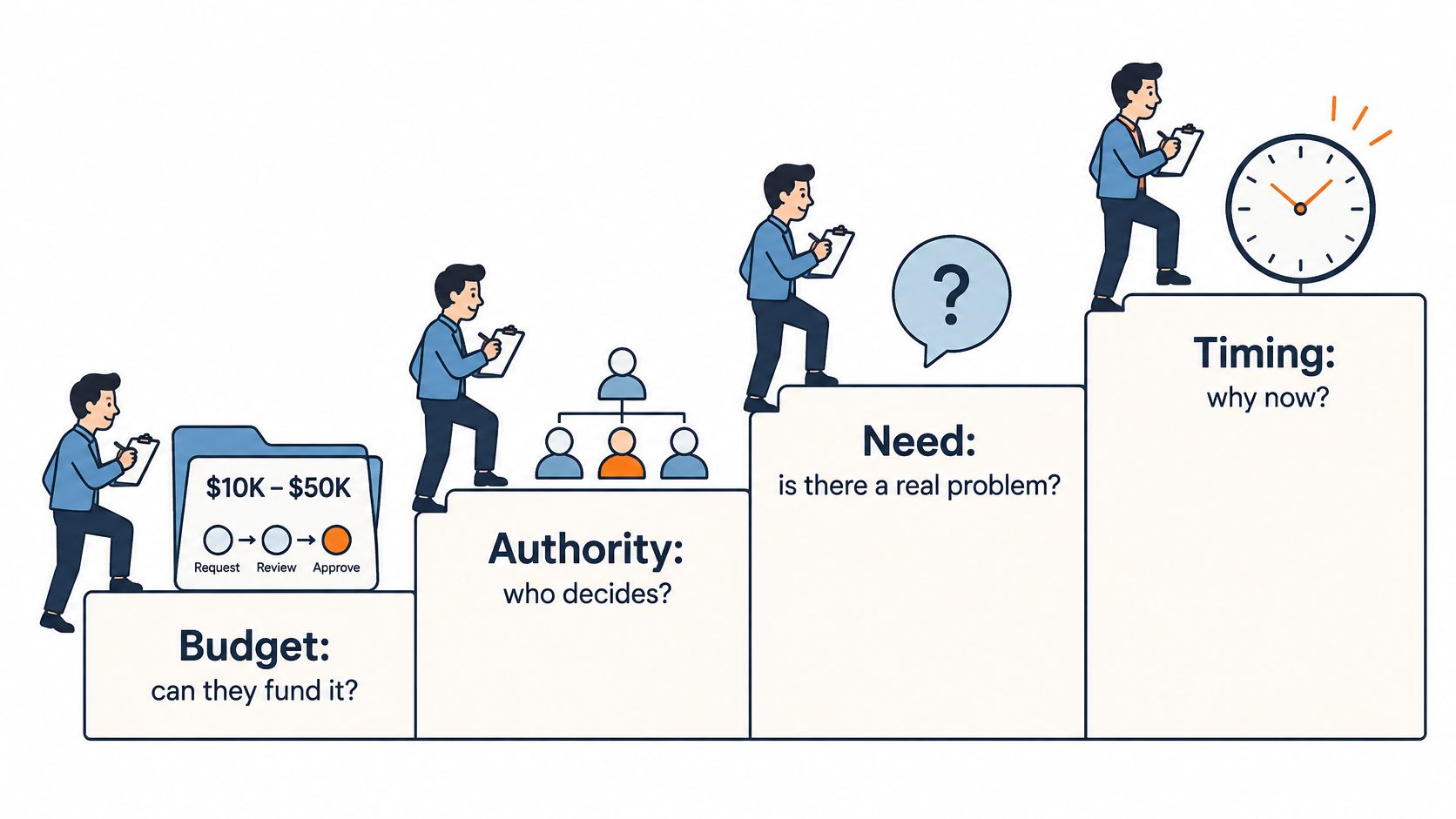
BANT survives because it turned qualification from individual salesperson judgement into a repeatable decision rule for a large sales organisation. Use it as a conversation guide, in asking order, and record evidence rather than a tick.
Budget comes first only in the sense of feasibility: can the organisation fund a purchase in this area? Record a range, the approval route, or a stated constraint such as a frozen discretionary spend line. A vague "there's money somewhere" isn't evidence.
Authority asks who influences or approves. Record names, roles, and who has signed off similar spend before. In most mid-market deals the answer is a group, not a person.
Need is the one to spend longest on. Capture the problem in the buyer's own words, then ask what it costs to leave it unsolved. That sentence becomes the business case later.
Timeline should be a date or a trigger event, such as a contract renewal or a new hire in the team that owns the problem. "Sometime this year" is a wish, not a timeline.
The HubSpot guide to sales qualification makes the point that a contact may not control budget or make the final decision, yet can still open the buying group and clarify the process. That record stays live with the gap noted, not marked unqualified because one answer is unknown.
| Criterion | Question It Answers | Evidence to Record | If the Answer Is Missing |
|---|---|---|---|
| Budget | Can the organisation fund a purchase in this area? | Budget range, approval route or stated constraint | Ask how the budget cycle and existing spend work |
| Authority | Who influences or approves the decision? | Names and roles of the decision group | Ask who else needs to be involved and record the gap |
| Need | Is there a genuine business problem? | The problem in the buyer's own words | Ask what happens if the problem is left unsolved |
| Timeline | When does the prospect expect to decide or implement? | Target date or trigger event | Ask what event would make the problem urgent |
Every missing answer becomes the next qualification question, never a rejection.
Qualifying Accounts and Buying Groups, Not Just Contacts
One responsive contact doesn't prove a deal. The Demandbase State of the B2B Buyer report finds that 72% of B2B purchases involve complex, multi-stakeholder buying groups, with as many as 10 different decision-maker functions inside those committees. A single-contact checklist can't see any of that.
Three states that aren't interchangeable
- Qualified account: the organisation can realistically buy. The problem is real, the money exists somewhere, and a process could run.
- Qualified contact: the person is relevant, engaged and worth talking to. Useful, but not the same thing.
- Qualified opportunity: a live deal with a mapped process, named stakeholders and agreed decision criteria.
Account-level conditions decide which state a record is in: the business problem, the teams affected, the economic buyer, technical or legal blockers, procurement steps, competing priorities, and the strength of an internal champion. Working through market mapping before outreach makes those conditions visible across a whole segment rather than one lucky reply.
Then separate buying intent from research activity. Three examples show why:
A job vacancy for a database administrator suggests a capability gap. It doesn't prove the company will buy external support instead of hiring. Confidence: medium. Expiry: while the vacancy is live.
A technology choice shows an environment, not dissatisfaction. Confidence: low on its own. Expiry: refresh at each data pull.
A pricing page visit shows evaluation, possibly by a student, a competitor or an intern. Confidence: low until a second signal corroborates it. Expiry: days, not months.
Record missing stakeholders as explicit gaps. "Economic buyer not identified" is a field value, not an assumption that the first person who replied speaks for the organisation. The repeatable process is to treat weak signals as research hypotheses, test them against account context, and route only supported accounts to sales.
Scoring Leads Without Relying on One Signal
Scoring is arithmetic applied to two different kinds of input, and mixing them up is the most common cause of bad hand-offs.
Fit properties versus engagement actions
The HubSpot lead scoring documentation separates property values (company size, industry, location, job function, seniority, stated budget) from actions (repeat website visits, email clicks, event attendance, form submissions, downloads). Properties answer "does this account resemble the ideal customer?" Actions answer "is this person engaging now?" A senior buyer at the wrong company and an intern at the right one can score identically if the model blurs the two.
Negative rules matter as much as positive ones. Add points for a target seniority or company type, subtract for an unsuitable location, an organisation too small to serve, or any other exclusion. Subtraction is what stops enthusiastic but impossible buyers reaching a salesperson.
Reliable properties depend on the underlying data, so company data enrichment is usually the first fix when scores look sensible but routing doesn't. Headcount bands, region and industry codes need to be consistent before weights mean anything.
Walking the bands to the threshold
A worked model in HubSpot's lead funnel webinar documentation uses a 50-point threshold for a marketing-qualified lead. Each band triggers a different action, which is the part worth copying.
| Score Range | What the Record Shows | Action |
|---|---|---|
| 0-9 | A single response to the company | Keep in marketing nurture |
| 10-29 | At least two interactions | Keep engaging and monitor for more signals |
| 30-49 | Two or more interactions plus qualification and demographic data | Review for sales readiness before routing |
| 50 or more | Threshold met | Send to sales as an MQL and review within the agreed window |
One download or email click never crosses that hand-off line. Repeated interaction plus fit data is required, which is the whole argument against single-signal qualification. For a marketing-side view of how these rules sit alongside campaign planning, the lead qualification guidance from Crescade is a useful companion read.
Two safeguards before trusting any threshold. Test it against leads sales already accepted and rejected, and check whether the band predicted the outcome. Then document what sales must do after routing and how quickly the record must be reviewed, because a score with no owner and no clock is just a number.
A high score should trigger research, routing or human review. It should never create an opportunity by itself.
A Worked Example of Qualifying 100 Accounts
The arithmetic below is a hypothetical illustration, not a benchmark. Say a team starts with 100 accounts that all look vaguely plausible, then applies four filters in order.
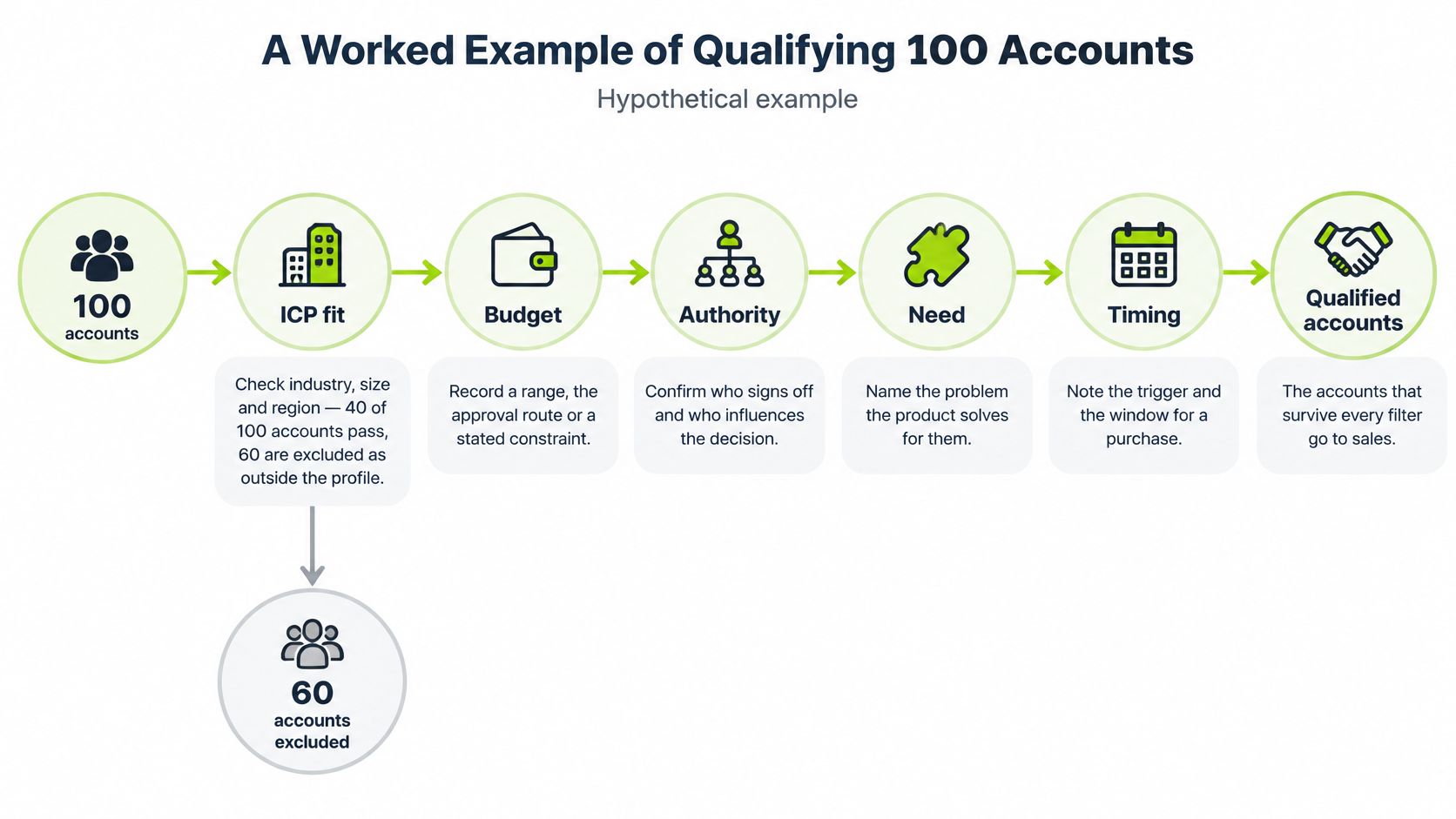
- ICP fit. Check industry, size and region. 40 of 100 pass; 60 are excluded as outside the profile, with the exclusion reason stored so they don't reappear in the next list build.
- Corroborated trigger. Require two independent sources for the problem, for example a relevant vacancy plus a public statement about the team's capacity. 16 of the 40 pass. The other 24 are held as unsupported single signals, not deleted.
- Owner and buying group. 10 of the 16 have a named owner who can convene the decision. The remaining 6 are recorded as a gap with no economic buyer identified, rather than assumed to be represented by whoever replied.
- Agreed next step. 6 of the 10 accept a meeting or a qualified follow-up and move to sales with the reason logged.
| Filter | What It Tests | Accounts Passing | What It Removes |
|---|---|---|---|
| 1. ICP fit | Industry, size and region | 40 | 60 accounts outside the ideal customer profile |
| 2. Corroborated trigger | A problem supported by two independent sources | 16 | 24 accounts resting on one uncorroborated signal, held for research |
| 3. Owner and buying group | A named owner who can convene the decision | 10 | 6 accounts with no identified economic buyer, recorded as a gap |
| 4. Agreed next step | A meeting or qualified follow-up accepted | 6 | 4 accounts with no commitment to a next conversation |
| Result | Accounts reaching sales with a recorded reason | 6 | 94 held in nurture or excluded |
Reading the results after the calls
The filters aren't the finish line. Of those 6 conversations, count how many confirmed the problem, how many revealed a blocker nobody had mapped (procurement, security review, an incumbent contract), and how many stalled without a decision date. Each pattern points at one filter. Unmapped blockers mean the buying-group test was too shallow. Stalls mean the trigger test accepted curiosity as urgency.
Tightening qualification is also what makes an outbound programme feel reliable to the sales team receiving it: an estimated 80–90% of the leads H2 provided to CIDT were qualified. The counts above are illustrative, and every team's filters will differ by offer, deal size and market.
Set Your Qualification Rules Before You Scale
Volume magnifies whatever rules already exist, including the unwritten ones. Five decisions are worth writing down this week.
- Stage evidence: state what a record must show to become an MQL, an SQL and an opportunity. Repeated engagement plus fit data before MQL; a named owner plus an agreed next step before SQL.
- Disqualification: name the exclusions (outside the profile, no relevant problem, no route to a buyer) so disqualifying is a recorded decision rather than silence.
- Recycling: define where a disqualified record goes, who owns it and when it returns, for example a nurture review at 90 days or on a trigger event.
- Review window: fix how long an SQL can sit without activity before it returns to marketing, and who enforces that.
- Human override: keep scored routing separate from judgement, with a named person able to accept or reject a routed record and a reason logged.
The hardest rule to implement alone is usually the last one, because it needs data, routing and ownership wired together rather than agreed in a meeting. H2 runs fully managed outbound for teams that want qualified conversations without building the programme internally, and an introductory call covers the market, audience and current challenge. Teams that need the rules embedded in the CRM can review custom GTM system builds, which cover research, qualification, enrichment and CRM workflows built around the client's team and are quoted to scope.
Write the five rules down first, then decide what to hand over. H2 builds qualification, scoring and routing into custom GTM systems, and runs fully managed outbound for B2B teams that need qualified conversations rather than longer lists. Visit H2 to book a 15-minute introductory call and talk through the market, the audience and the filter that's currently letting the wrong accounts through.
