More scripts don't fix a weak sales process. They often make it worse, because reps repeat claims that buyers can't verify, chase accounts that should've been excluded, and advance deals on polite replies instead of evidence.
A useful sales playbook template starts somewhere else. It defines who qualifies, what proof is required at each stage, when outreach stops, and who owns each decision. Copy comes last, after those rules are clear.
What Goes in the Sales Playbook Template
A sales playbook template is one shared file that a B2B team copies so targeting, claims and CRM behaviour don't depend on one founder remembering what worked. It isn't a folder of scripts. It's an operating file with seven blocks, each with one owner and a test for when that block is ready.
The design principle is buyer verification. For every row, teams should be able to answer two questions. What can the buyer check without a rep, and where must a person add context that a web page can't provide?
The seven blocks to copy
| Block | Write this | Owner | Ready when |
|---|---|---|---|
| Offer boundaries | Who you serve, what you refuse, the meeting question | Founder or sales lead | A stranger can separate a fit from a non-fit |
| ICP and disqualifiers | Segment, size, tech, trigger, exclusions | RevOps or founder | An account can be included or excluded without a call |
| Qualification evidence | Problem, stakeholder, consequence, process, timing, next step | Sales lead | No stage move without a score and a note |
| Outreach sequence | Channel, attempts, spacing, new reason each touch, stop rule | SDR lead | Every attempt is logged and opt-outs suppress |
| Objections and claims | Concern, approved claim, proof asset | Marketing and sales | The claim matches the website |
| Routing | Match, dedupe, owner, fields, hold path | RevOps | Weak or duplicate records never enter a sequence |
| KPIs and review | Six metrics, monthly sample, retirement rule | Sales lead | A dated review note exists each month |
Offer boundaries come first for a reason. A team that can't state what it refuses will write an ICP that includes almost everyone, and the first meeting will drift. The buyer should be able to verify the boundary on the website, through clear fit and non-fit language. A rep adds value by testing borderline cases against the stated rule, not by inventing a new rule per deal.
ICP and disqualifiers belong in the same block. Inclusion criteria without exclusions produce broad lists and irrelevant outreach. Teams looking to streamline sales with standard procedures often find the same lesson in documented procedures generally. A procedure only helps when it tells someone what not to do.
Why buyer consistency matters more than script volume
The Gartner press release dated 25 June 2025 reports that 61% of B2B buyers prefer an overall rep-free buying experience, 73% actively avoid suppliers that send irrelevant outreach, and 69% report inconsistencies between a supplier's website and its sales representatives. Read those three numbers together. Adding touchpoints to a contradictory message doesn't build trust. It multiplies the contradiction.
The question isn't only what reps should say. It's what the buyer must be able to verify without a rep, and where expert guidance is genuinely necessary.
Each sales stage should therefore map to a buyer task, such as problem definition, internal consensus, fit assessment, risk reduction or commercial approval. The template should state which information lives on the website, which belongs in outbound messages, which belongs in discovery, and which belongs in follow-up material. A claim that only exists in a rep's email, with no proof asset behind it, fails that test.
Playbook adoption also needs honest reading. Aberdeen research on sales playbooks reported playbook use at 42% of Best-in-Class companies, compared with 29% of average organisations and 14% of laggards. That's an association, not proof that a document raises revenue. Stronger firms may run tighter operations overall. Copy the table, name one owner per row, and pass the ready-when test before any copy is written.
How to Set ICP and Qualification Rules
A rep marks a deal qualified because the call went well. Six weeks later it stalls, because nobody confirmed a budget owner, a decision date or who else has to agree. That is what qualification without rules produces: confident pipeline built on tone. The fix is an ICP block where every row names the evidence a buyer can verify, one owner and a ready-when test, all agreed before a single sequence exists.
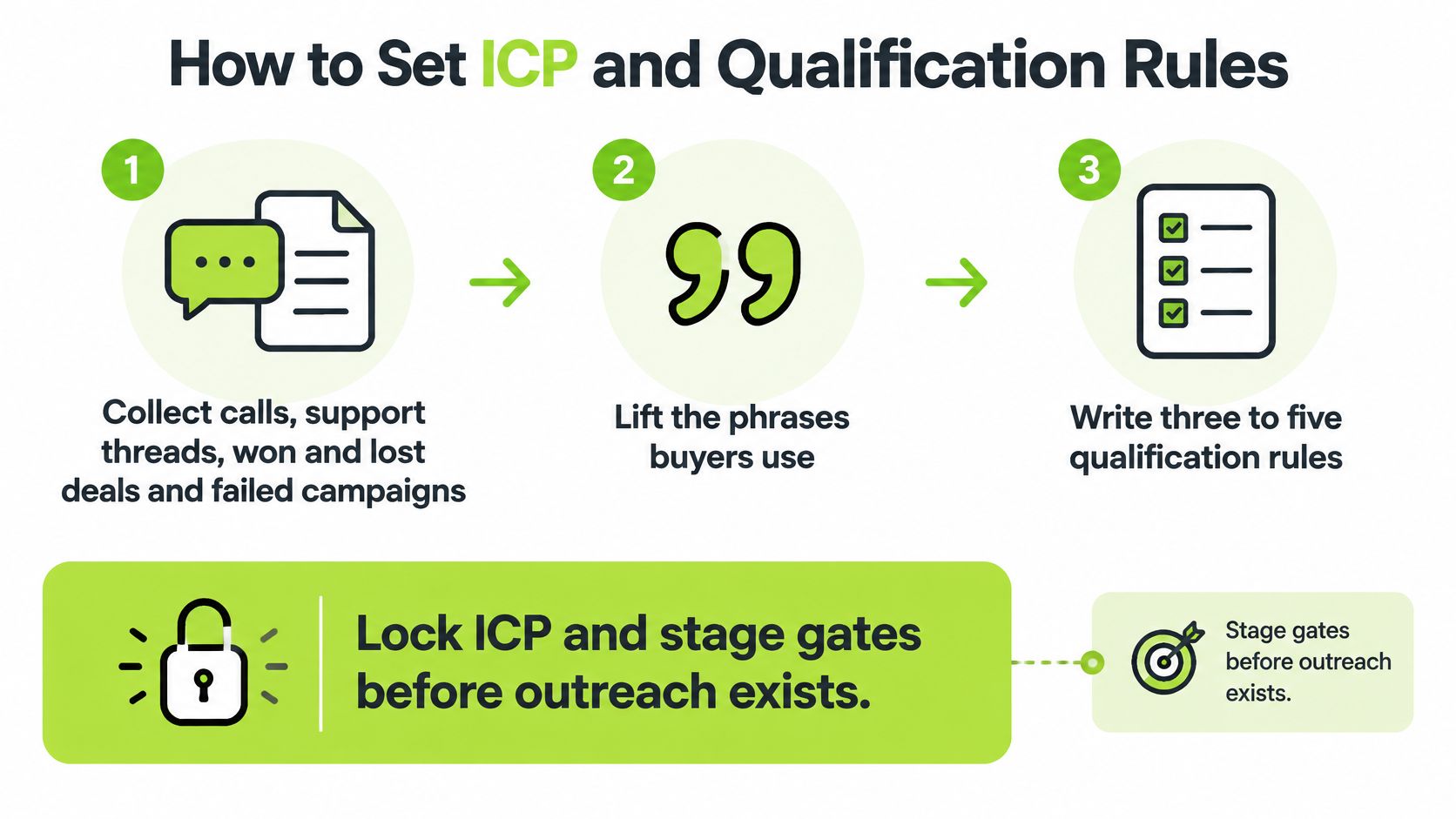
The six setup actions
- Collect the raw material. Gather sales calls, support threads, won and lost deals and failed campaigns. Lift the phrases buyers use for their problems, because internal product language rarely matches buyer language.
- Write three to five checkable ICP rules. Each rule must be verifiable in public data, such as segment, size band, tech stack or a live trigger like a relevant vacancy. Put disqualifiers beside them, including wrong sales motion, no budget owner or competitor lock-in. The distinction in the guide to ICP versus persona matters here: the ICP decides which accounts qualify, while personas describe the people inside them.
- Set the minimum evidence per stage. A confirmed problem, an affected stakeholder, a measurable consequence, the decision process, timing and a mutually agreed next step. A stage advance missing any of these gets sent back rather than debated.
- Require a score and a note together. A structured field without free-text evidence invites guesswork, and a note without a score can't be audited at scale.
- Add a multi-threading checkpoint. One positive contact isn't organisational consensus. The template should force a record of who else assesses the purchase and what each person needs to see.
- Audit five records a week. Send back any stage advance that lacks evidence, and record where leakage happens by segment, source, rep and reason lost.
Why the evidence gate carries the weight
Qualification exists because friendly conversations feel like progress. A warm reply proves someone is willing to talk. It says nothing about whether the account fits, whether the problem is worth solving or whether anyone else will approve a purchase. The stage gate turns each of those into a question with a required answer, so a deal only moves forward when something verifiable happened.
The same logic drives the multi-threading check. Complex B2B purchases are rarely decided by one person, and a champion who can't name the other stakeholders is a warning sign inside the deal. The playbook row should ask who else must agree, what each role needs to verify independently, and what evidence survives if that champion changes jobs. Those fields push the rep to map the account instead of betting the forecast on a single voice.
| Stage | Minimum evidence | Do not advance if |
|---|---|---|
| Research | Account fit, trigger, source and date | Firmographics or trigger are missing |
| Engaged | Reply or meeting request logged, suppression checked | Opt-out, wrong person or a complaint risk |
| Discovery | Problem, stakeholder, consequence and timing | Tone is positive but the note is empty |
| Opportunity | Decision path, other roles, agreed next action | One contact is treated as the whole buying group |
| Proposal | Terms, risk questions, owner of internal approval | No multi-thread checkpoint is recorded |
Consider a labelled hypothetical. A 40-person software studio is hiring its first RevOps lead, uses a CRM the seller supports, and names a founder as budget owner. That account passes the ready-when test: segment, size, technology and trigger all check out in public data, and the row names the founder as the role who signs. The same studio with no RevOps hire, no named owner and a request for consumer marketing support fails at research stage, before a rep spends a week on it.
How to Specify Sequences and Routing
Specify one motion and its stop rules. A sequence without a stop rule isn't persistence. It's an open-ended nuisance that eventually draws complaints and damages sender reputation.
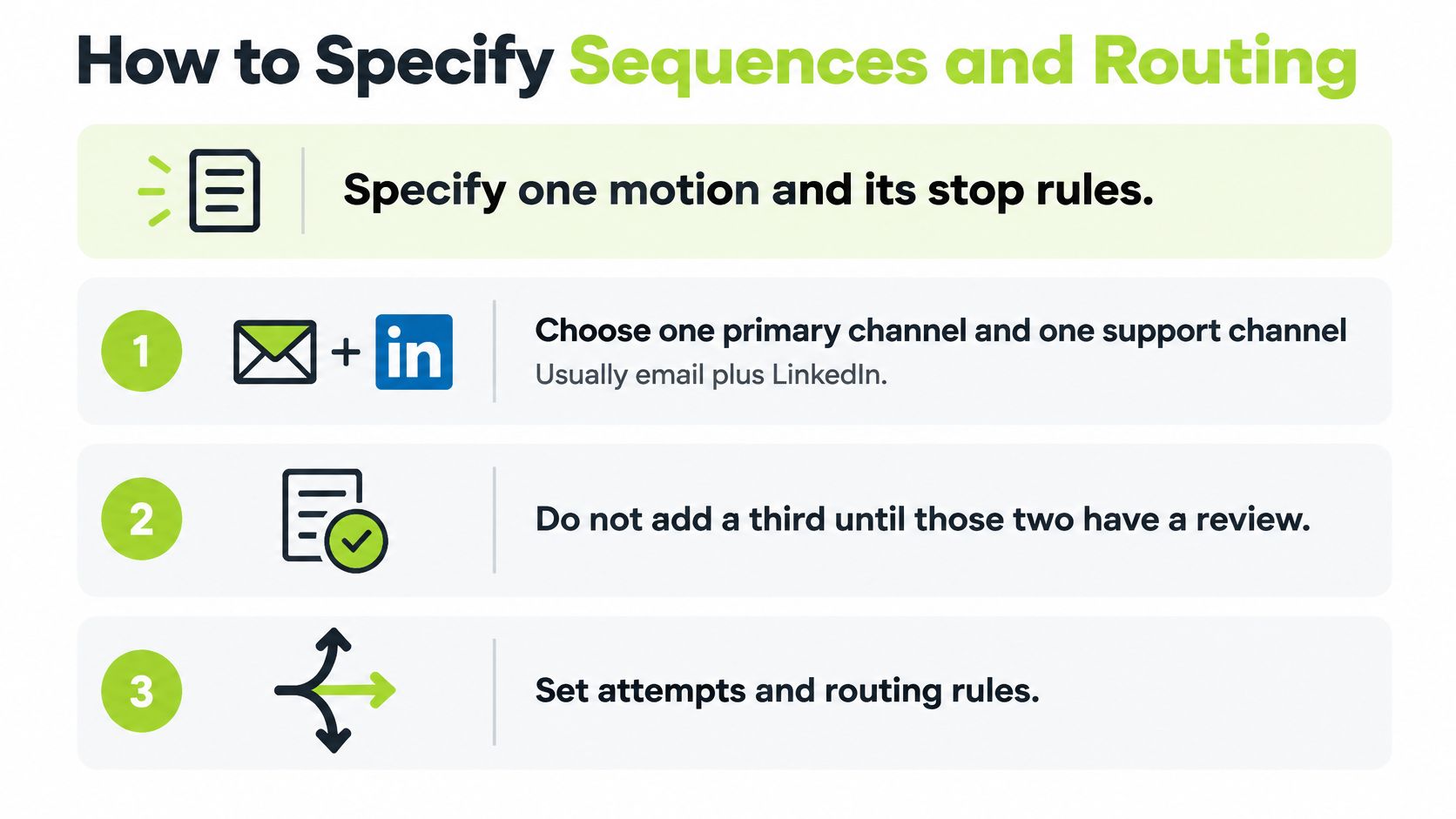
The six design steps
- Choose one primary channel and one support channel. Email plus LinkedIn is the usual pairing. Don't add a third channel until those two have been reviewed, because each new channel multiplies the routing and suppression work. The explanation of what a sales cadence is covers how channels and timing fit together as one structure rather than separate blasts.
- Set attempts and spacing as a testable default. Five touches is a reasonable starting hypothesis for many B2B motions, judged on reply quality, meetings and complaints rather than treated as a quota.
- Give every touch a new reason. A sharper problem statement, a public observation, a useful resource or a close-the-loop note. Repeating the same pitch louder doesn't count.
- Write three objections the team hears. Each one needs the underlying concern, an approved claim and a proof asset the buyer can verify independently.
- Document the routing path. Match or create the account, dedupe it, assign an owner, write the next step, and hold the record when the signal is ambiguous instead of auto-enrolling it.
- Add the deliverability baseline. Authentication, DNS, suppression and unsubscribe handling belong in the playbook, not in a separate technical document nobody reads.
Follow-up data supports persistence with limits. HubSpot's sales statistics roundup cites research reporting that 80% of successful sales take five or more follow-up calls, while separate HubSpot research says about 55% of cold callers make only three to five attempts, 26% make just one or two, 13% make six to eight, and 4% make nine to twelve. Those figures come from different sales contexts, so they justify testing a defined sequence. They don't prove every market needs twelve touches.
The Gmail baseline and a worked example
Google's sender guidelines state that from February 2024, senders to Gmail accounts must authenticate with SPF or DKIM, maintain valid forward and reverse DNS, and keep reported spam rates below 0.3%, with Google recommending below 0.1%. Bulk senders above 5,000 messages per day to Gmail must also support one-click unsubscribe. A well-written campaign that ignores those thresholds still creates operational risk, so Postmaster Tools checks belong in the weekly routine. The same discipline applies after the first sale, since the handoff from initial interest to repeat orders depends on records and next steps surviving beyond the first conversation.
Here's a labelled hypothetical five-touch sequence for the software studio ICP. It's illustrative, not a universal cadence.
- Day 0 email: Names the hiring-led problem, specifically the first RevOps hire inheriting an undocumented pipeline.
- Day 3 LinkedIn: A short connection note referencing the same trigger, with no pitch attached.
- Day 7 email: A public observation about the studio's hiring page and what it suggests about growth pressure.
- Day 12 call and email: A brief call attempt followed by a useful checklist the new RevOps lead could use in week one.
- Day 18 close-the-loop note: A clear stop offer, so silence has an easy and polite exit.
After the close-the-loop note, the sequence ends if there's no reply. Every attempt and opt-out gets logged in the CRM, because unlogged attempts make both coaching and suppression unreliable.
Which KPIs Show the Playbook Is Working
Measure pipeline behaviour, not whether anyone opened the file. Page views on a playbook document tell a sales leader almost nothing. Six numbers, reviewed monthly, show whether the rules are changing what reps do.
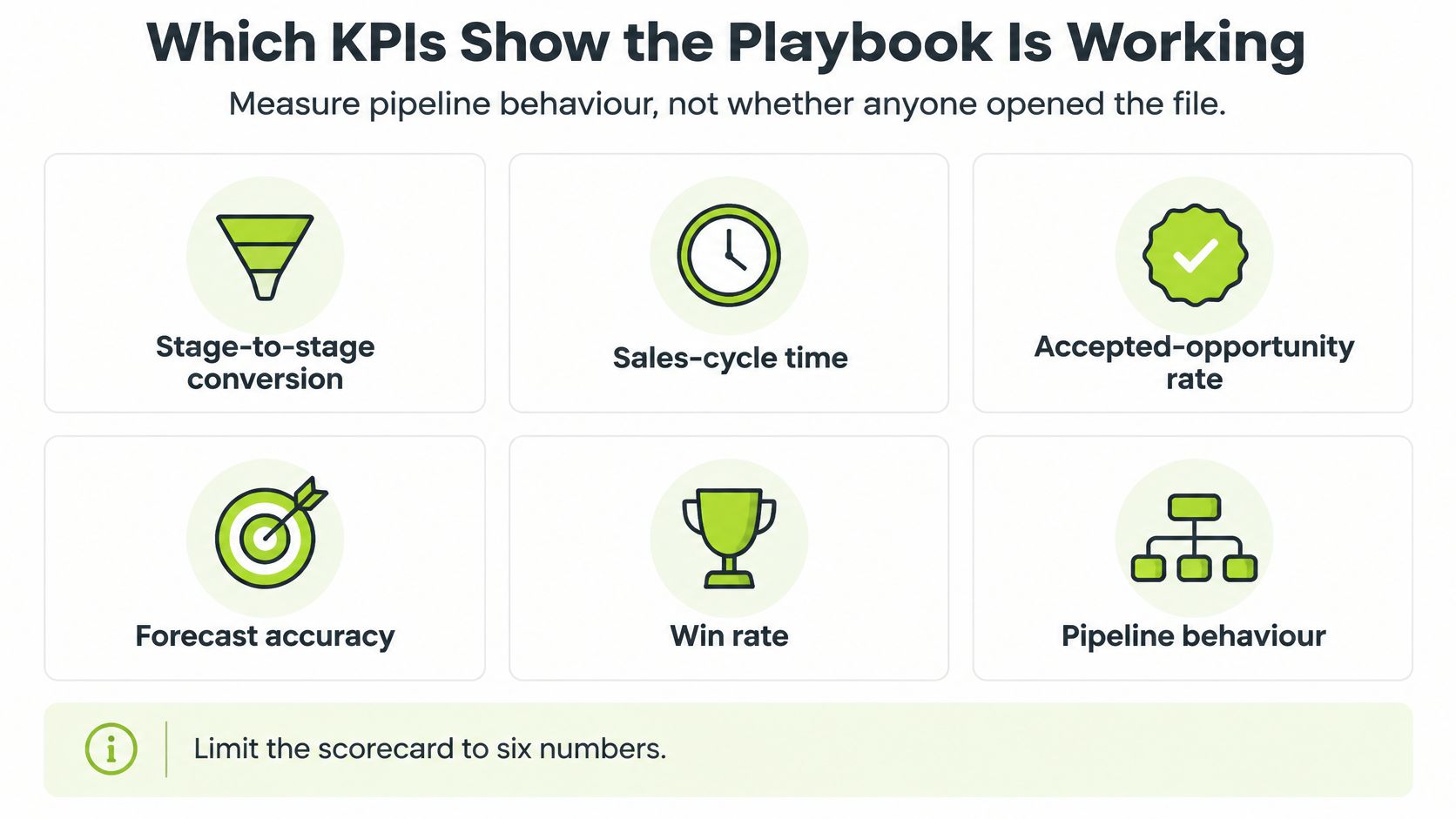
The six-metric scorecard
| Metric | Definition | Review cut |
|---|---|---|
| Stage-to-stage conversion | Share of opportunities moving to the next stage | Segment, source, rep, loss reason |
| Sales-cycle time | Days from first contact to close | Segment and deal size |
| Accepted-opportunity rate | Share of handed-off leads the sales team accepts | Source and owner |
| Forecast accuracy | Forecast compared with closed amount per period | Rep and stage |
| Win rate | Won deals as a share of decided deals | Segment and loss reason |
| Required-field completion | Share of records with the required fields filled | Rep and record owner |
Each metric needs its review cut, because an aggregate number hides where leakage sits. A falling discovery-to-opportunity conversion in one segment is a targeting or evidence problem. The same fall concentrated in one rep's pipeline is a coaching problem. The guide on how to build a pipeline in sales connects these stage measures to the wider pipeline system they sit inside.
Practical rule: Speed isn't value. Faster AI-generated copy doesn't prove better qualification, better meetings or better opportunities.
Data quality as the gate behind every metric
Bad inputs produce confident-looking nonsense. Salesforce's State of Sales statistics report that 84% of data and analytics leaders agree AI outputs are only as good as their data inputs, while 46% of sales professionals using AI agents say data-quality issues are hurting their sales efforts. A playbook that measures outcomes without gating inputs will misread both.
The template should therefore define the controls behind the scorecard:
- Required fields: The fields that must exist before a record enters a sequence or advances a stage.
- Acceptable evidence: What counts as proof for each field, rather than a rep's impression typed after a call.
- Validation checks: Email address and company-status verification before enrolment, not after a bounce.
- Deduplication: One account record with one owner, so two reps don't run parallel sequences at the same company.
- Source and date: Where enrichment came from and when, so stale data can be spotted and refreshed.
- Human review queue: A hold path for ambiguous signals instead of automatic enrolment.
Hold automation when industry, size, technology or role is missing. A lead score computed on empty fields isn't objective, however precise the number looks. Track the supporting health measures too, including invalid-address rate, duplicate rate, enrichment cost and the share of records corrected by hand. Retire any playbook line that replies no longer support, and keep the scorecard to one page inside the playbook. A new dashboard project can wait until those fields exist and stay filled.
Keep the Playbook Current
Most playbooks die of good intentions. The file ships, everyone agrees it looks thorough, and within a quarter the offers have moved, buyers have raised new objections, and reps have built workarounds nobody wrote down. Maintenance therefore belongs inside the template itself, carried by the same structure the rest of the file uses.
The monthly review routine
Name one editor, because a committee discusses wording while stale guidance stays live. The editor runs a 30-minute monthly review built on that month's replies, objections and loss reasons. The seven-block structure earns its keep here. Each row already names an owner, the evidence a buyer can verify without a rep, and a ready-when test, so the meeting tests every line against fresh evidence instead of debating phrasing.
Role-play one live deal in that meeting. Written procedures alone don't transfer skill, because reps need to hear how guidance sounds under pressure and where it breaks. Version the file, date every change, and delete lines the evidence no longer supports rather than layering new advice over old contradictions.
When the script and the website disagree, change both in the same review. Fixing one side recreates the inconsistency buyers already notice.
AI use needs governance, not enthusiasm
Adoption has outrun operating discipline. The Highspot State of Sales Enablement 2025 report found that 90% of surveyed organisations were already using AI for go-to-market work or planned to begin in 2025, while 47% reported difficulty with customer experience and 41% with buyer engagement.
Turn that gap into monthly checks rather than a ban. For AI-assisted research or drafted messages, the playbook row should name the source of truth, the human approval point, a cost cap and an exception path for records the workflow can't handle. AI sits in the file as a controlled workflow with its own ready-when test, checked like any other line. A blanket instruction to automate personalisation, with no quality check, produces fluent messages built on wrong facts.
Diagnosing failure by symptom
| Symptom | Likely cause | Fix |
|---|---|---|
| Reps ignore the file | No named editor and no practice | One editor and one live deal rehearsed each month |
| Every reply becomes an opportunity | No evidence gate | Block the stage change without score and note |
| Sequences draw complaints | The same pitch repeated | New reason on each touch and a complaint review |
| AI notes sound certain but are wrong | Empty fields treated as facts | Hold the record and store source plus date |
| Website and rep disagree | Claims live only in the playbook | Change the site and the script in one review |
| Handoff loses context | Free text and no owner | Required fields and a named next step |
Use the table as a weekly diagnostic. Match each symptom to one cause and apply one fix, then check the following week whether the symptom moved. Teams that change five things at once learn nothing about which change worked.
Choose In-House Build or Outside Help
Decide on capacity, not enthusiasm for templates. A playbook file is cheap to write and expensive to operate, because the cost sits in research, evidence audits, reply handling and monthly revision. The honest question is whether someone on the team can own that work every week.
Keep the build in-house when the offer is proven and one named person can own the file, the CRM fields and the weekly evidence audit. Start with one segment, prove the rules hold, and expand only after the scorecard stays clean. Small scope beats a detailed document that nobody maintains.
The gap is an operating system rather than a document when lists stay broad, messages stay generic, handoffs stay manual, or nobody has time to run research and handle replies. Three routes fit three different gaps:
- Custom system build: Fits when qualification, enrichment and routing don't fit a stock template. With H2's system builds, the customer's team receives the working system, access, documentation and a practical runbook after handover.
- Fully managed outbound: Fits B2B teams with a proven offer and capacity to take more sales conversations, but without the time or appetite to build an outbound function in-house. Details sit on the fully managed outbound service page.
- Private GTM workshop: Fits a team that'll keep the work and needs practice on its own market, tools and live questions. The private GTM workshops page describes that format.
Check current pricing on the H2 pricing page rather than relying on figures quoted elsewhere, since scope drives cost. Before any conversation, prepare the draft template, one real lost-deal reason and a small CRM sample showing current field completion. Those three artefacts reveal more about readiness than any strategy document. No results are promised for a new engagement, because outcomes depend on the offer, list quality and the team's capacity to work the conversations created.
H2 helps B2B teams turn a static playbook into a working outbound system, covering audience research, qualification rules, campaign execution and the CRM discipline that keeps evidence attached to every deal. Teams that have the template drafted but lack the capacity to run it can book an intro, and a free GTM strategy is also available as a starting point. Visit H2 to discuss which route fits the current gap.
