Your SDR sends a thoughtful cold email to a well-matched account. Nothing happens. Two days later, they send a shorter follow-up. Still nothing. Someone suggests calling, someone else says to try LinkedIn, and by Friday nobody knows whether the prospect is being pursued, nurtured or forgotten.
That pattern creates more than missed replies. It makes performance difficult to diagnose because each rep follows a different rhythm, uses a different message and stops at a different point. A sales cadence replaces that guesswork with a controlled process. It gives your team clear entry conditions, planned interactions, decision rules and a human handoff when a prospect shows interest.
By the end of this guide, you'll be able to explain what a sales cadence is, design one for a B2B audience, choose sensible channels, measure pipeline impact and recognise when persistence has become noise. If you're building a broader outbound system, a practical growth hacking playbook for marketers can also help connect audience research, experimentation and campaign execution.
Introduction Why Follow Up Feels Random
The problem usually starts with a reasonable assumption: if the first message is good enough, the right prospect will respond. When the reply doesn't arrive, the team improvises. One SDR sends a “just checking in” email. Another makes a call without knowing what the prospect received. A founder jumps into the thread, while the CRM still shows the original contact as untouched.
This isn't a discipline problem in teams. It's a system problem. Without agreed rules, every salesperson has to decide who to contact, when to follow up, what to say next and when to stop. Those decisions consume attention, and busy reps tend to make them inconsistently.
A silent inbox isn't a sales decision. It's only an incomplete signal.
Suppose an SDR contacts an operations leader about a workflow problem. The first email introduces the idea, but the prospect is busy. A later call could test whether the issue matters now. A LinkedIn interaction could create recognition. A final message could offer a useful resource and give the prospect an easy way to decline. Each touch has a different job, rather than repeating the same request.
That difference matters because persistence and repetition aren't the same thing. Persistence means giving a relevant buyer several reasonable opportunities to engage. Repetition means sending the same claim through the same channel while learning nothing from the lack of response.
A cadence makes the process testable. You can compare whether the audience was right, whether the message angle resonated, whether the spacing was appropriate and whether positive replies reached a salesperson quickly enough. You can also identify where a process breaks, such as poor account selection, missing contact data or an unclear handoff.
The rest of the article treats a cadence as a small revenue operating system. It's not merely a string of follow-up emails. It's the set of rules that controls how a prospect enters, progresses, pauses, exits or becomes a live sales conversation.
What a Sales Cadence Really Means
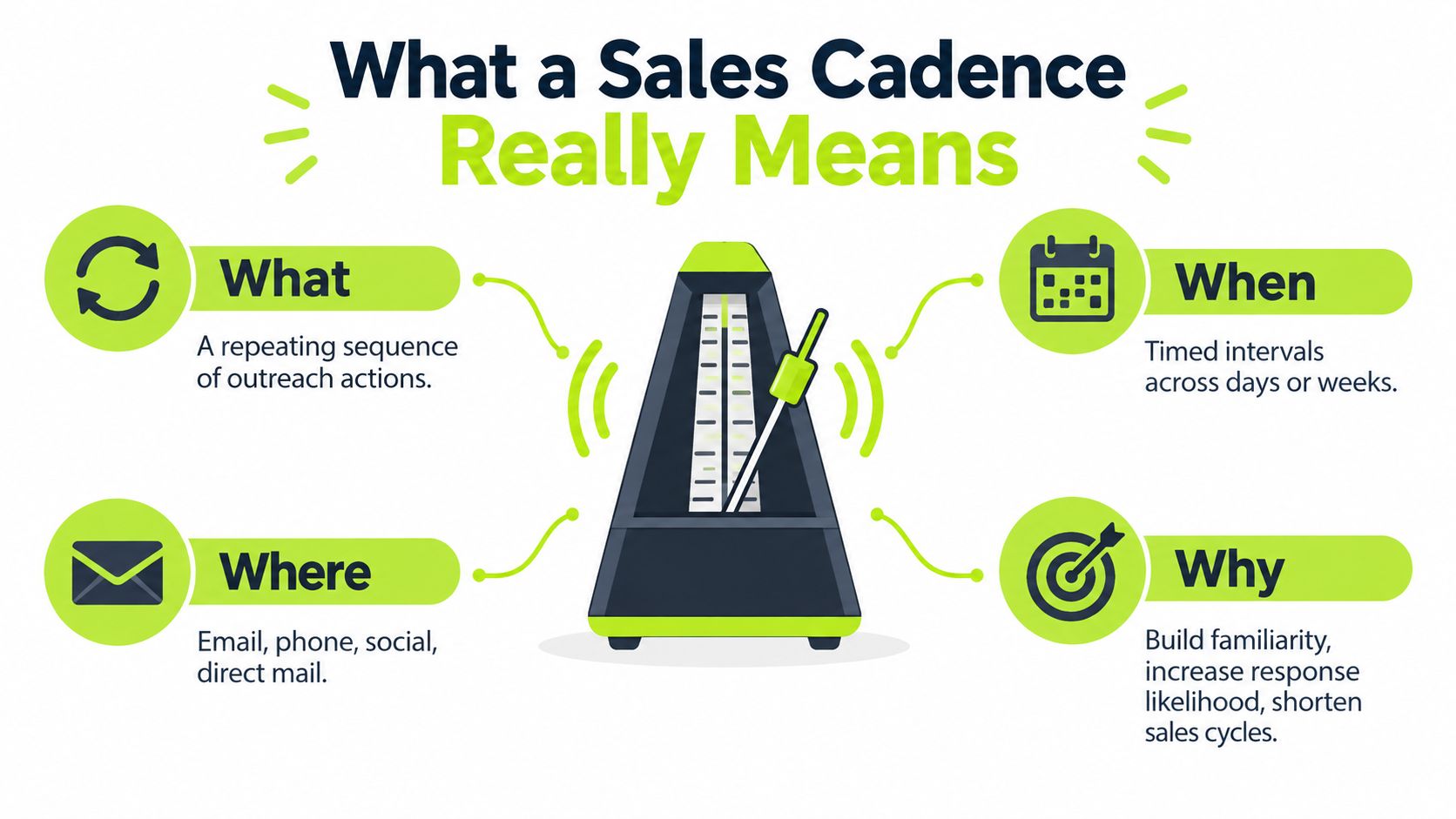
A useful answer to what is a sales cadence starts with four questions:
- What will the team do?
- When will each interaction happen?
- Where will the interaction take place?
- Why is the team making contact?
A cadence is a planned, repeatable sequence designed to move a prospect towards a defined next step, usually a reply, discovery call or meeting. The “what” might be an email, call, LinkedIn interaction or research task. The “when” establishes the interval between touches. The “where” defines the channels. The “why” connects each action to a commercial objective.
Think of the cadence as a rhythm
A musical group doesn't ask each performer to choose a random tempo. The rhythm coordinates different instruments while allowing each one to play a distinct part. A sales cadence does something similar. Email may establish context, a call may test urgency, and LinkedIn may make the seller recognisable before a more direct conversation.
Industry descriptions commonly place a B2B cadence at approximately 8 to 12 touchpoints over 2 to 4 weeks, with touches often separated by 2 to 3 days. Those are practical conventions, not universal rules, and the appropriate pattern depends on deal value, urgency, seniority, market norms, channel permissions and the personalisation required. SalesHive's overview of outbound cadence practice provides useful context for those conventions.
The sequence also needs an operating state. A prospect enters after meeting your inclusion criteria. They continue while the cadence remains relevant. They leave when they reply, book a meeting, opt out, become disqualified or reach the sequence limit.
It isn't an automated email blast
Automation can schedule a task or send an approved message, but it shouldn't decide that every prospect deserves the same treatment. A strong cadence changes after a reply, pauses after a meeting is booked and suppresses a contact who asks not to be contacted.
That's why a cadence needs success measures beyond opens or clicks. Positive replies, qualified conversations, meetings and opportunities tell you whether the process creates commercial movement. A high volume of activity can still produce weak results if the list is poorly targeted or the handoff is slow.
You should be able to describe your current process in operational terms: who enters, what happens next, how long the team waits, what each touch contributes and which event ends the sequence. If you can't answer those questions, you probably have disconnected follow-ups rather than a defined cadence.
Core Components That Make Cadences Work
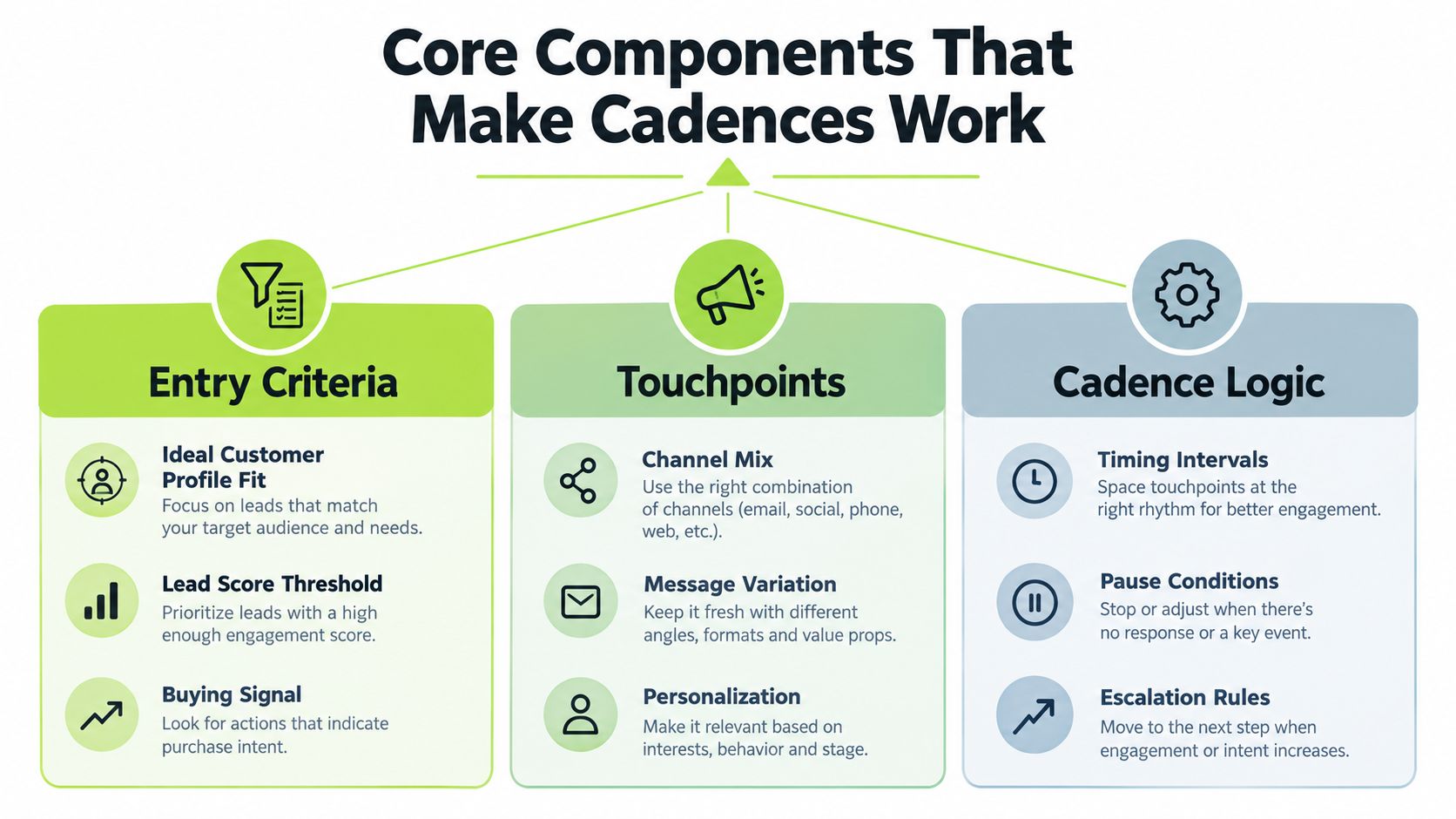
A reliable cadence has three connected parts: entry criteria, touchpoints and cadence logic. Remove one, and the sequence becomes either indiscriminate, repetitive or impossible to improve.
Entry criteria protect the team's attention
Before enrolling a contact, define the minimum conditions that make outreach sensible. These might include fit with your ideal customer profile, a relevant role, usable contact data, an account-level business problem or a buying signal. A founder at a target company may qualify for one message, while a junior employee at the same company may need a different route or no outreach at all.
Entry rules also prevent automation from turning weak data into high-volume activity. Record the reason for inclusion in the CRM so another salesperson can understand why the contact entered the cadence.
Touchpoints need different jobs
Each interaction should add a new reason to engage. That reason could be a relevant business trigger, a quantified problem, a useful proof point or a low-friction question. The message should never repeat the original value proposition with a different subject line.
A practical touch map might assign roles like these:
- Email establishes context: Keep the first message focused on the prospect's situation and one clear next step.
- Phone tests urgency: Use the call to learn whether the issue exists, matters now or belongs with someone else.
- Social interaction builds recognition: Engage where appropriate, without pretending that a like or connection request proves buying intent.
- Research supports relevance: Give the rep enough context to make the next conversation specific rather than generic.
If your team uses social APIs or automated publishing tools, document permissions, frequency controls and account ownership carefully. Guidance on token management for social media APIs is relevant whenever several tools interact with social accounts.
Cadence logic controls the state
The technical advantage of a cadence is that it behaves more like a state machine than a list. A prospect can be new, contacted, engaged, qualified, paused, disqualified or handed off. Each state should trigger an appropriate action.
Practical rule: Every positive reply needs a named owner, a qualification step and a clear response expectation.
For example, an interested reply should stop automated touches and create a task for the assigned salesperson. An objection should move the contact to a message designed for that objection, not back to the original sequence. An opt-out should suppress future outreach and record the reason.
You can audit your current process with a simple question: does it specify entry, message purpose, timing, response handling, exit conditions and CRM capture? A lead follow-up system can help teams connect those rules to day-to-day workflow rather than leaving them in a document nobody checks.
SDR Outreach Examples Across Channels
A sales development representative (SDR) cadence works best when each touch has one job and every response changes the next action. For example, a B2B software team targeting operations leaders might begin with a workflow problem that the account is likely to face, then test whether that problem is active.
The first email introduces the issue and asks whether it is on the prospect's agenda. A later call refers to that context and tests urgency. A LinkedIn interaction can build recognition, while a follow-up email adds a practical observation instead of repeating the product pitch. A reply should exit the automated sequence and create a human-led conversation.
For a strategic account, the sequence may start with company research and stakeholder identification. The rep then sends a concise point of view, calls with a question rather than a monologue, and shares evidence that helps the buying group assess the issue internally. Account complexity and the cost of irrelevant outreach should shape the schedule.
| Cadence pattern | Channels and timing | Best use case |
|---|---|---|
| Single channel | Email touches spaced across several days, with a new message angle each time | A focused audience with strong email access and a clear written value proposition |
| Email and phone | Email establishes context, phone tests urgency, later email adds evidence | B2B teams that need both scalable reach and live qualification |
| Multichannel | Email, phone, LinkedIn and research tasks, each with a distinct role | Strategic accounts where recognition and stakeholder context matter |
| Signal-led | Faster human action after a relevant account or buyer signal, followed by adaptive outreach | Inbound, event, referral or high-intent situations |
Reporting on 321,000 tracked sales meetings found that 85% resulted from phone calls, 8% from email and 7% from LinkedIn, according to MediaPost's coverage of multichannel outreach. The finding supports testing phone alongside email, not copying one channel mix for every audience.
Set a clear operational rule before launching: Day 1 email, Day 3 call, Day 6 LinkedIn, then stop on reply. Adjust the spacing when account signals, permissions or buying context justify it. The rule gives reps a controlled path while preserving an exit condition.
Use a cold email follow-up template for structure, then replace generic wording with account-specific evidence. Teams reviewing 2026 B2B sales automation tactics can automate scheduling and status changes while keeping research, judgment and responsive conversations with people.
How to Measure Cadence Performance
A cadence can look busy while producing little pipeline. Measuring every activity equally creates the wrong incentives, especially if reps optimise for touches delivered rather than qualified conversations created.
Start with a KPI ladder. The first useful signal is a positive reply, meaning the prospect shows relevant interest rather than sending an automatic acknowledgement or a polite rejection. The next is a qualified meeting, followed by opportunity creation and eventual revenue attribution. Each step removes more noise.
That infographic includes illustrative values, but your team should use its own verified CRM data. The operating principle is more important than any generic benchmark: measure commercial progression, not just contact volume.
Diagnose the right layer
If positive replies are weak, inspect audience fit, research quality and the first message angle. If replies exist but qualified meetings remain low, review qualification rules, the call to action and the salesperson's response. If meetings happen but opportunities do not, investigate discovery quality, offer fit and handoff expectations.
Useful diagnostic measures include:
- Positive reply rate: Indicates whether the audience and message create relevant interest.
- Qualified meeting rate: Shows whether replies convert into conversations worth a salesperson's time.
- Opportunity creation: Connects meetings to a genuine commercial process.
- Touches per qualified conversation: Helps reveal whether effort is being spent efficiently.
- Channel conversion: Shows whether email, phone, social or a combination contributes to progression.
- Time to first response: Exposes delays after a prospect signals interest.
- Handoff quality: Records whether the salesperson received context, qualification notes and a clear next action.
Measure the leak, not just the activity. A high touch count can hide poor targeting, weak messaging or a slow response to interested buyers.
Compare cadences by segment rather than blending every audience together. A founder-led technology company, an enterprise buying committee and a referral contact shouldn't sit in one performance average. Keep the variables visible: audience, message angle, channel mix, spacing, owner and exit reason.
A well-run review produces a specific decision. Keep the audience and revise the opening message. Keep the message and change the interval. Remove a channel that creates no qualified conversations. Or stop optimising the sequence and fix the list.
When Persistence Hurts and How to Pause
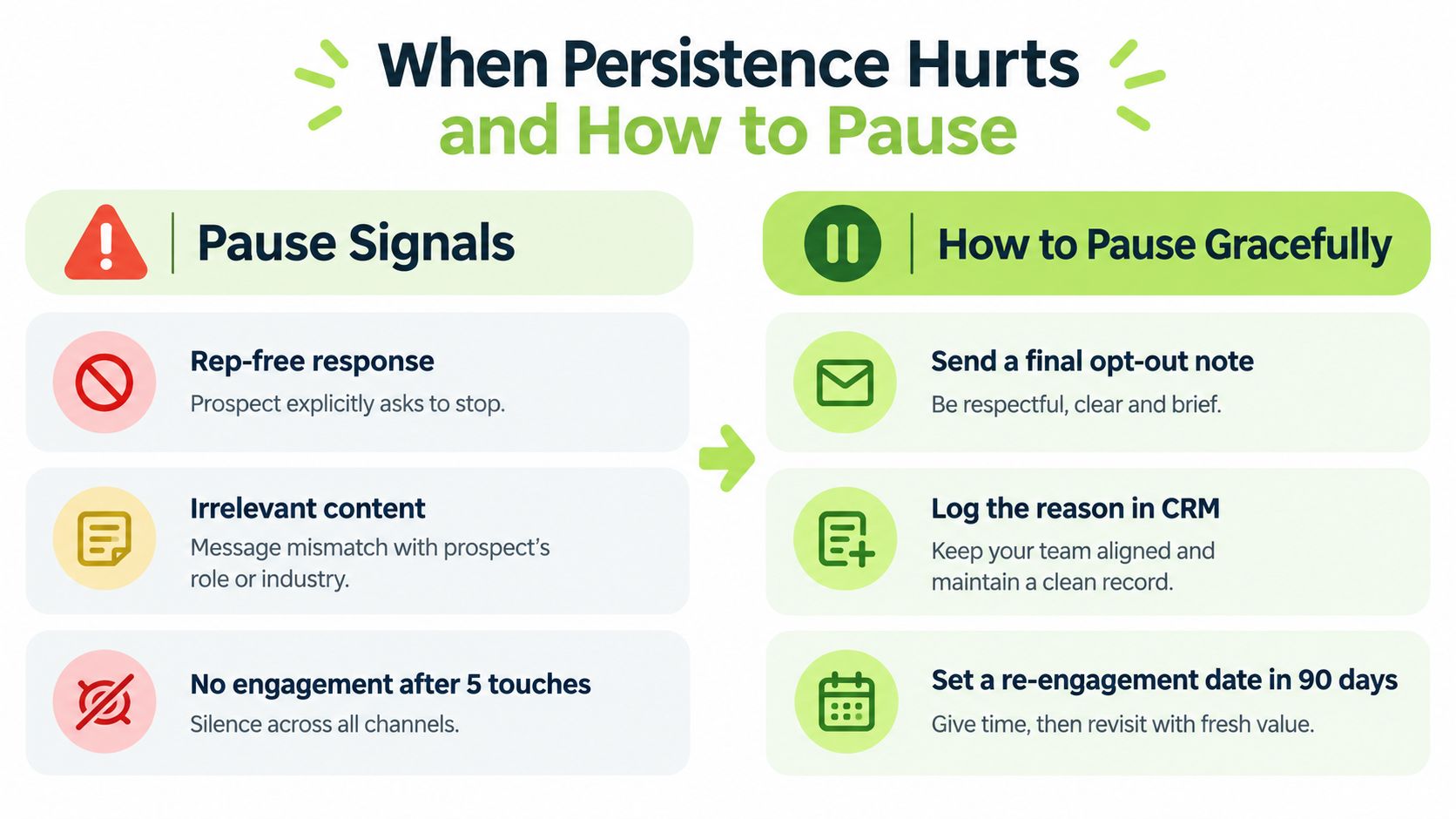
A founder keeps receiving the same outreach after saying nothing, while an SDR keeps adding tasks because the cadence has not reached its final step. That pattern can turn persistence into pressure. Gartner found that 61% of B2B buyers prefer a rep-free buying experience, and 73% actively avoid suppliers that send irrelevant outreach, according to Gartner's buyer research. A cadence therefore needs rules for earning attention, pausing contact and closing the loop.
Silence can mean private research, a competing priority or weak relevance. Repeating the same claim does not clarify which explanation applies. It can make the company appear inattentive, while a respectful pause preserves the option of a later conversation.
Use explicit pause and exit rules
Exit immediately after a clear negative response or opt-out. Suppress contacts who change roles, leave the company or no longer match the audience. For a practical rule, change the status to Not Now after two non-responses, suppress the contact for 90 days, and record the reason as No Priority. Restart only after a new trigger, such as a relevant hire or technology change.
A lower-frequency nurture route can suit a valid account that is not ready. It should still have an exit condition. Restarting because time has passed is not enough. A new operational challenge, company change or direct request for information gives the salesperson a reason to return with a different message.
Recent buyer research reported that economic pressure caused 62% of buyers to engage sellers earlier, while buyers defined purchase requirements before speaking with sales in 83% of cases. The practical response is to provide useful context early, then respect the buyer's ability to investigate independently. Early contact should support research, not attempt to replace it.
Make the pause useful
A final note can close the loop without pressure. Acknowledge that the issue may not be a priority, offer a clear opt-out and state that contact will stop. Log the status and reason in the CRM so another salesperson does not restart the same sequence.
Treat not now as a controlled state, not a permanent rejection or permission to continue indefinitely. If a new stakeholder appears, write a fresh message rather than transferring the previous contact's assumptions. If a new business trigger appears, explain why it makes the conversation relevant now. The handoff should include the trigger, pause reason and next permitted action.
Systemise or Outsource Your Sales Cadence
Founders and SDR leaders usually face three options. Run the cadence manually, build a connected outbound system or use a managed partner to operate the programme. The right choice depends on workload, internal skill, data quality and the importance of learning quickly.
Running it internally works when the team has time to research accounts, write messages, maintain records, monitor deliverability, handle replies and review performance. It gives salespeople close contact with buyer language, but the process can become inconsistent when the same people are also responsible for closing deals.
A custom system becomes useful when manual bottlenecks are the main constraint. It can connect audience discovery, enrichment, qualification, buying signals, CRM routing and task creation. The system should encode decisions clearly, include fallback paths and leave ownership with named team members. Automation should reduce repeated administration, not remove judgement from account selection or reply handling.
Choose based on operational reality
A managed programme suits a B2B company with a proven offer, capacity to take conversations and limited appetite for running outbound internally. A provider can handle research, list building, verification, infrastructure, copywriting, testing, reply handling and meeting booking, while the client supplies commercial context and feedback.
The trade-off is control. Outsourcing only works when the external team can access accurate product information, buyer insight and prompt feedback from sales. Without that collaboration, the cadence may be orderly but commercially weak.
Before choosing a path, ask:
- Who owns the audience definition? Someone must decide which accounts and roles belong in the process.
- Who approves the message? Copy needs commercial context, not just grammatical polish.
- Who handles replies? A positive response should reach a qualified human owner quickly.
- Who reviews outcomes? Meetings and opportunities should shape targeting and message changes.
- Who maintains the system? Data, integrations, permissions and CRM states need ongoing ownership.
H2's cold email lead generation agency guide can help leaders assess what a managed model involves before committing. Whichever route you choose, document entry rules, touch purposes, pause conditions, exit states and handoff requirements before increasing activity. A cadence becomes scalable when another capable person can operate it without guessing.
H2 helps B2B companies research suitable audiences, build controlled outbound campaigns and connect qualification, messaging, reply handling and meeting booking into a consistent process. Visit H2 to book a 15-minute introductory call about your audience, current cadence and next pipeline constraint.
