A lead follow up system only works when it reacts fast, and when it reacts with enough context to matter. Contacting a lead within one hour makes you nearly seven times more likely to have a meaningful conversation, and waiting 24 hours or longer changes the odds dramatically.
That headline is useful because it corrects the usual mistake. Many teams assume the problem is only slow response time, then build automation that sends messages quickly but still misses the buyer's stage, the right owner, or the right record. The actual job is to make speed, relevance, and data quality work together.
Why Lead Follow Up Systems Fail (And How to Avoid It)
Only 37% of organisations respond within one hour, and 23% never respond at all, which is why so many inbound opportunities go stale before a rep ever speaks to them. The common failure is not lack of intent. It's a system that depends on individual discipline instead of a designed workflow, which means leads wait through weekends, hand-offs break, and the first real reply arrives after the buyer has already moved on or found another vendor. Source data on one-hour response behaviour
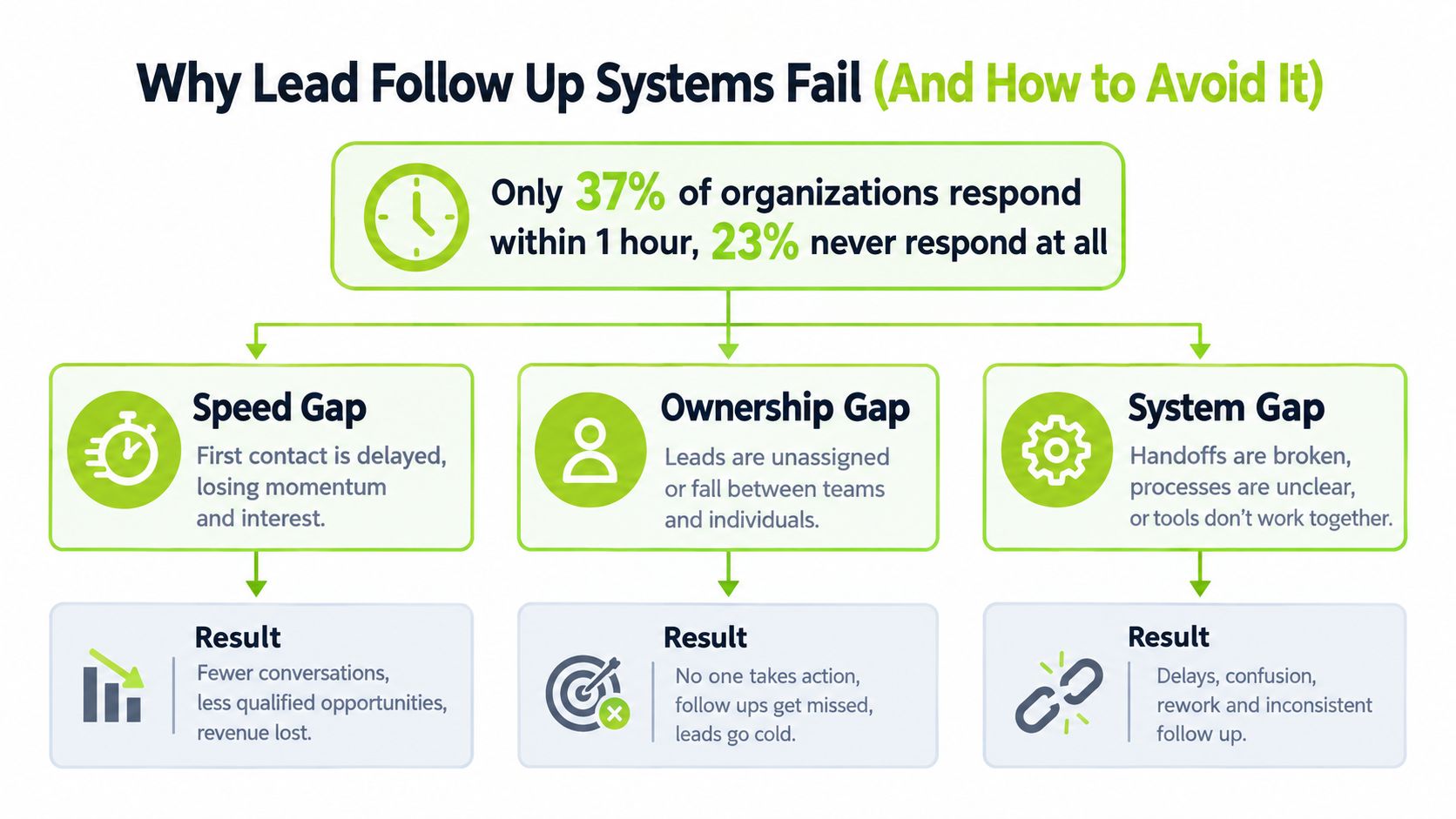
The three gaps I see most often
The first gap is speed, but speed by itself is not enough. Teams chase fast first responses, then send the same thin “just checking in” message to every lead, which creates activity without progress. The second gap is ownership, where records sit unassigned, or bounce between SDRs, AEs, and managers without a clear decision-maker. The third gap is systems, where the CRM, routing rules, and reminders don't line up, so the process looks automated while the follow-through still depends on memory.
A good follow-up system fixes all three at once. It gives every lead an owner, a deadline, and a route that reflects buying intent. It also distinguishes acknowledgement from a real conversation, because those are not the same thing and shouldn't be measured as if they are.
A lead that gets acknowledged is not a lead that got worked.
A quick self-audit for your current process
Use this as a blunt scorecard, not a theory exercise.
- Response timing: Do high-intent leads get a same-day human reply, or just an automated acknowledgement?
- Ownership clarity: Does every inbound record have one named owner within minutes?
- Sequence quality: Do later touches add new evidence, or repeat the same ask?
- Data hygiene: Are duplicates, stale contacts, and missing fields slowing the process down?
- Escalation: Does anything happen when the assigned rep misses the SLA?
If you're missing two or more of those, the issue isn't just rep behaviour. It's the design of the system itself. A clean lead follow up system removes ambiguity before it removes delay.
Designing Speed-to-Lead SLAs That Actually Work
A speed-to-lead SLA should reflect buyer intent, not a random internal target. A demo request or pricing enquiry deserves immediate human attention. A content download, by contrast, often needs a slower, more useful response that preserves the account for nurture instead of forcing a premature sales call.
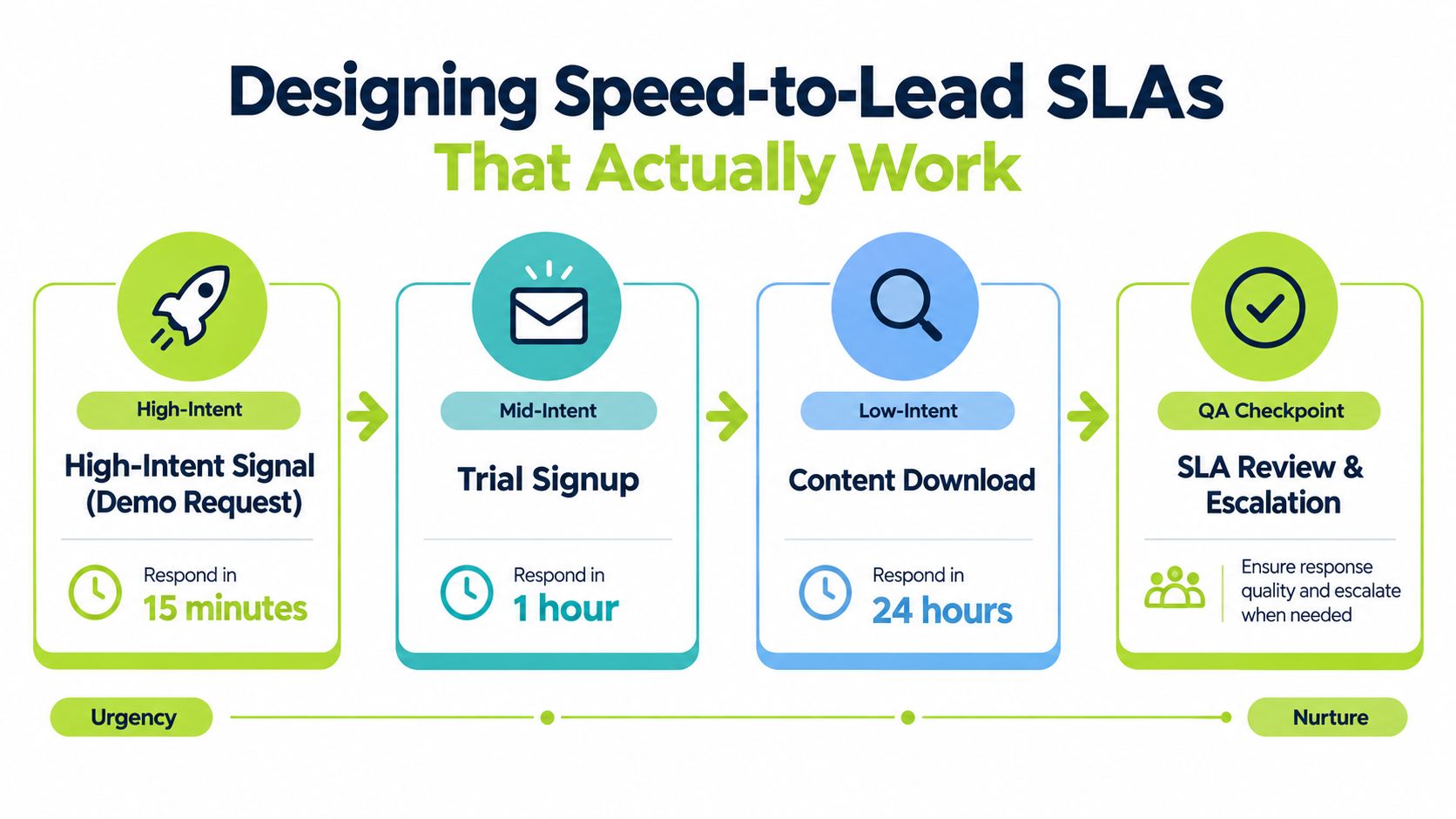
Build tiers instead of one universal rule
High-intent signals should move fast. That means demo requests, pricing page enquiries, trial sign-ups, and any form that clearly signals active buying should trigger a same-day human task, not just a queue entry. Lower-intent signals should still be handled quickly, but with a different expectation. The point is to match effort to urgency, not to pretend every lead deserves the same treatment.
A practical build has four parts. First, route the lead into the CRM the moment it arrives. Second, assign the owner automatically. Third, send an acknowledgement that confirms receipt. Fourth, create a task with a deadline that a manager can inspect directly. If the rep misses it, escalation should happen automatically rather than rely on someone remembering to nudge them.
Here's a resource I often point teams to when they're trying to connect routing, alerts, and task ownership in one workflow, the Voicedial.ai lead automation overview is a useful reference point for thinking about trigger-based follow-up.
Measure the SLA like an operator, not a marketer
The wrong metric is just “average response time.” That hides slow outliers and makes the process look healthier than it is. Track the median and the 90th percentile response time, then pair those with contact rate and qualified-lead rate by source. That mix tells you whether you're improving speed, or just generating more noise.
A simple escalation rule works better than elaborate theory. If an SDR doesn't act within 15 minutes on a high-intent lead, the task should roll to a team queue or alert the manager. For broader teams, the internal alignment between sales and marketing matters too, and this guide on marketing and sales alignment is worth reading if hand-offs keep breaking between functions.
Keep the SLA humane
Unrealistic SLAs burn reps out and produce sloppy replies. A five-minute target makes sense for high-intent leads. A one-hour ceiling is usually enough for ordinary inbound. The SLA should create urgency without turning the queue into a panic machine.
Building Multi-Touch Sequences With Clear Stopping Rules
A disciplined sequence usually needs about 5.7 attempts to create a positive outcome, according to Lead follow-up best practices. The same research puts the average rep at roughly 1.3 attempts, leaving a large gap between the persistence that can work and the follow-up teams deliver. The answer is not unlimited outreach. It is a sequence that increases relevance, covers different buying stages, and stops when the record shows that pursuit no longer makes sense.
Design the sequence around new evidence
The first touch should be fast and personal, ideally within five minutes for a high-intent signal. The next touch, within 24 hours, should add useful context rather than repeat the opening message. Later touches should change both channel and purpose. Email provides detail, phone creates urgency, and LinkedIn can help when the buyer is active there. Each contact should introduce new evidence, such as a business trigger, a quantified problem, a customer example, or a diagnostic question.
If the message has not changed, the prospect has no new reason to reply.
Sequence design should reflect buying stage, not just elapsed time. Early touches can confirm the trigger and establish relevance. Middle touches should test priority, surface objections, or answer a likely question. The final touch should make the next decision easy, whether that means booking time, declining, or moving into a lower-frequency nurture path.
| Attempt | Timing | Channel | What changes |
|---|---|---|---|
| 1 | Within 5 minutes | Email or call | Confirm receipt and reference the trigger |
| 2 | Within 24 hours | Add a useful detail or answer a likely question | |
| 3 | Days 2 to 4 | Phone or LinkedIn | Surface objections or confirm priority |
| 4 | Days 4 to 7 | Bring a customer example or business trigger | |
| 5 | Final attempt | Any relevant channel | Offer a clean close or move to nurture |
Set the end point before the sequence goes live. Endless “checking in” messages waste rep time, can hurt deliverability, and make the buyer responsible for ending an interaction the seller should manage. A finite cadence gives the rep a clear hand-off rule and makes performance easier to review.
Stop for real reasons, not convenience
An opt-out stops outreach immediately. An invalid contact pauses the record until the data is corrected. A poor-fit qualification moves the account out of active pursuit. A booked meeting pauses the sequence, because further automated chasing signals that the CRM and sales workflow are out of sync.
A reply should also change the workflow. Route a buying signal to an owner, assign an objection for handling, and suppress generic touches while a human conversation is active. For teams comparing sequence logic with scheduled reminders, the reminder email for follow-up guide offers a practical reference for how a planned touch should behave.
The Hidden Problem, Data Integrity in Your Follow-Up System
Follow-up quality depends on the records behind it. Validity's 2025 CRM Data Management report found that 76% of organisations said less than half of their CRM data was accurate and complete, while 37% said poor data was directly costing them revenue. Companies also reported losing an average of 16 sales deals per quarter for that reason. Validity CRM data report coverage Automation can multiply those errors when the underlying record is weak.
Automation makes bad records move faster
A duplicate contact creates double outreach, unclear ownership, and conflicting messages. A stale record can send a lead to the wrong person, trigger an unsuitable sequence, or mark someone as contacted when no conversation occurred. Speed without reliable data produces irrelevant follow-up.
Strong systems therefore need more than workflows. Set required fields, track the source and timestamp of each record, deduplicate contacts, verify contact details, define suppression rules, and create fallback paths. Assign a named owner to exceptions. For teams tightening workflow ownership around CRM records, CRM workflow automation explains how to connect routing rules directly to the CRM.
A useful test is whether a rep can understand the record before sending the next message. If the answer depends on searching across systems or guessing which field is current, the automation is not ready to scale.
Buying signals need interpretation
A hiring event or technology change can justify a fresh review, but it does not prove purchase intent. One signal may show that an account deserves closer attention. It does not justify an immediate hard pitch.
Treat signals as context, not conclusions.
Record why the account qualified, which evidence supported that decision, and when the evidence should be refreshed. If the evidence becomes stale, review the account before returning it to active follow-up. This protects relevance across buying stages and prevents teams from scaling assumptions that looked reasonable weeks ago but no longer apply. A clean CRM lets automation improve coverage without sacrificing judgment.
Routing Leads to the Right Owner With Smart Scoring
A lead follow up system performs better when urgency, fit, and ownership are set together. A pricing-page repeat visitor needs different treatment from a mid-market operations leader who downloaded a technical whitepaper and then stopped engaging. Routing both records into one queue creates avoidable delays and weakens relevance.
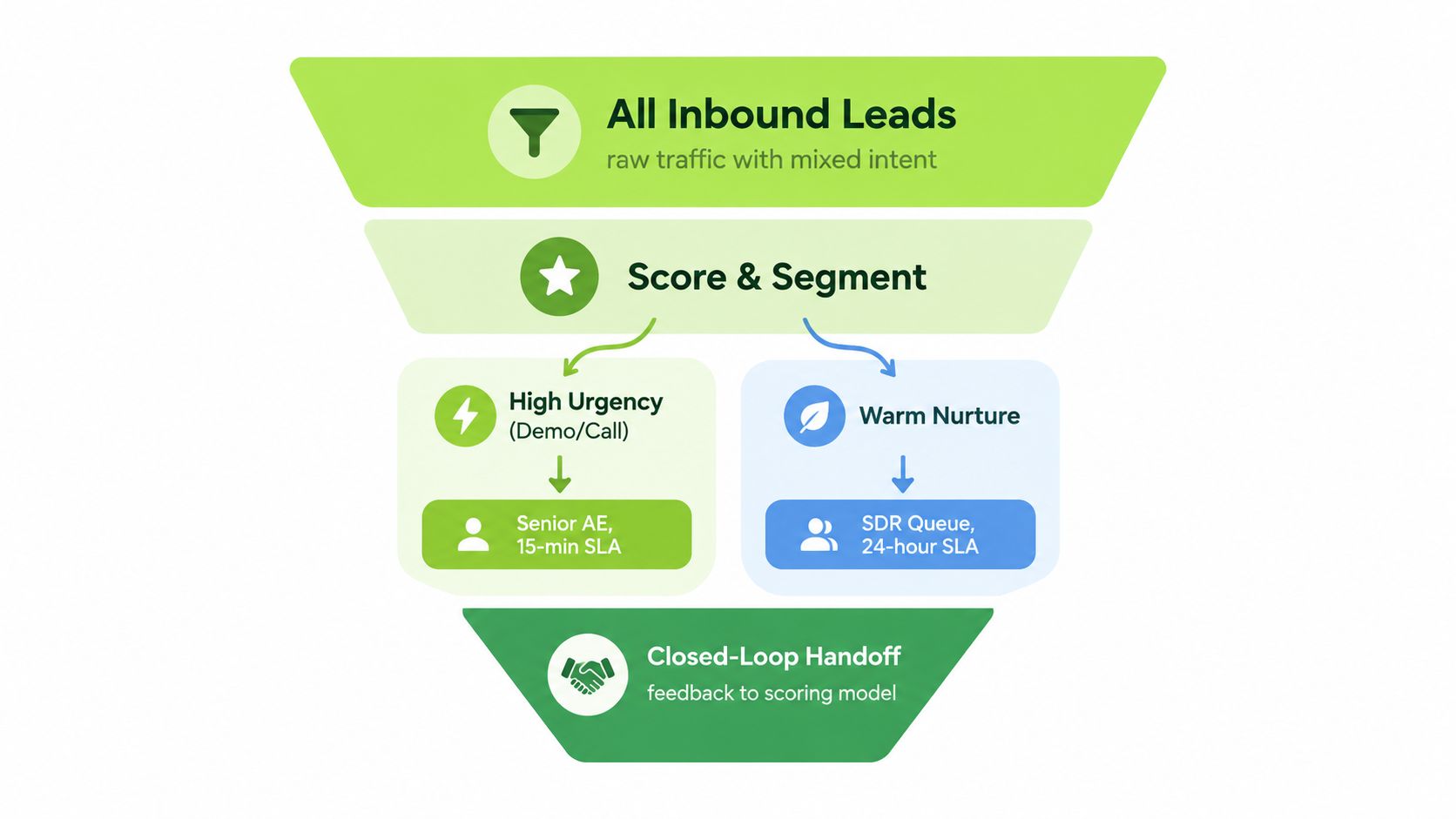
Score for urgency and fit together
Behavioural signals show how active a buyer may be. Firmographic signals show whether the account matches your target. A useful scoring model weighs both, then routes the record according to the combined picture. Strong engagement from a poor-fit account calls for caution. A good-fit account with limited activity usually belongs in nurture rather than immediate escalation.
Routing scenarios make the distinction practical. A founder who repeatedly visits the pricing page may warrant a fast human response from a senior owner. A mid-market operations lead who downloads a technical whitepaper may fit a slower SDR-led path with educational messaging. These records represent different buying stages, so sending the same sequence to both wastes attention and reduces relevance.
Closed-loop handoff beats static rules
The routing model should be judged by outcomes, not by its score alone. If high-scoring leads convert poorly, the model is too generous. If low-scoring leads repeatedly become opportunities, it is too conservative. Review those outcomes with enough context to separate weak scoring from poor messaging, bad timing, or incomplete records.
Ownership must stay aligned with the routing rules. A lead moving from inbound to SDR to AE needs a clear handoff, accepted responsibility, and a defined next action. Otherwise, response time suffers even when the workflow appears automated. Closed-loop handoff keeps scoring connected to real outcomes instead of leaving the model unchanged after launch.
For teams that want a practical resource on workflow ownership, the guide to help desk leads is worth a look because the same logic applies to routed sales records. Review routing and handoff performance together, since speed has little value when the record reaches the wrong owner.
When to Build Internally Versus Outsourcing Your Follow-Up
Some B2B teams can build this themselves. Many can't, at least not quickly. The difference usually comes down to bandwidth, technical ability, and whether the team can maintain the system after launch. A lead follow up system is not a one-time project. It needs ongoing tuning, QA, and ownership.
Build when you want control, outsource when you need speed
An internal build makes sense when the team already has CRM discipline, clear commercial rules, and someone who can own the workflow after it's launched. It also makes sense if the business wants long-term control over routing logic, qualification, and reporting. The trade-off is time. The team has to design, test, and maintain the system while still hitting pipeline targets.
Outsourcing works better when the company has a proven offer, enough sales capacity to take conversations, and no appetite for building the engine itself. H2's Fully Managed Outbound service, for example, covers market research, audience definition, prospect list building, data enrichment, contact verification, sending infrastructure, campaign strategy, copywriting, testing, reply handling, and meeting booking. H2 also builds custom GTM systems and runs private workshops for teams that want the process but not the day-to-day burden.
Use the commercial goal to decide
If the problem is pipeline generation and the team can handle meetings, managed outbound is often the practical route. If the problem is a broken CRM handoff, weak qualification, or inconsistent routing, a system build may be the better fit. If the team needs capability transfer, a workshop can be enough to get the internal group moving without committing to a full external programme.
The right answer depends on the bottleneck. Don't outsource a data problem as if it were only a messaging problem. Don't build a complex internal system if nobody on the team can keep the rules current. The best decision is the one that removes the constraint your team is feeling, not the one that sounds most impressive.
Tracking Health Metrics and Optimizing Over Time
A follow-up system needs visible health metrics. Nucleus Research found that mobile CRM access increased productivity by 14.6%, social CRM capabilities added 11.8%, and combining both was associated with a 26.4% average productivity improvement. Nucleus CRM productivity survey The practical point is straightforward: reps can only act on information they can see at the moment they work.
Watch the right dashboard, not just the busiest one
Track speed-to-lead by source, contact rate by sequence stage, reply rate by sequence stage, qualified-lead rate, meeting rate, and opportunity creation rate. These measures expose problems that activity totals conceal. A team may send a high volume of email while creating little pipeline. It may also respond quickly while qualifying poorly.
Use the metrics to isolate the bottleneck. High contact rates with low qualified-lead rates usually point to weak targeting or scoring. Strong qualified-lead rates with slow response times usually indicate a routing or staffing problem. Low meeting rates alongside reasonable reply rates suggest that the message, offer, or buying-stage fit needs work.
Optimise in small, controlled moves
Test sequence length, channel mix, and scoring thresholds one variable at a time. Changing several inputs together makes the result impossible to attribute. Adjust SLA targets when lead volume or staffing changes by season, then compare conversion data before keeping or removing a rule.
As noted earlier, 60% of surveyed B2B software buyers used AI in sales departments or processes in 2025. Automation therefore has a place in lead follow-up, but it should support judgement rather than replace it. Human review remains necessary for ambiguous fit, sensitive sectors, conflicting signals, and exceptions that do not belong in a fixed workflow.
Review the dashboard and underlying records before changing the sequence. A weak result often starts with missing, duplicated, or misrouted data rather than poor copy.
If your lead follow up system produces noise instead of qualified conversations, H2 can help diagnose where the hand-off breaks and what to automate versus leave to human judgement. Visit H2 to discuss the workflow, data quality, and outreach process behind it.
