A prospect who receives a response within the first hour is nearly seven times more likely to qualify than one contacted after an additional hour, according to a Harvard Business Review lead-response study. That finding changes how you should think about a reminder email for follow up. It isn't a polite afterthought sent when a salesperson runs out of ideas. It's a controlled decision about whether there is still a credible reason to continue the conversation.
A useful reminder reduces the effort required to reply, adds relevant context or closes the loop. A weak one merely repeats the original message and transfers the sender's uncertainty to the recipient. The difference comes from timing, message purpose, qualification and clear stopping rules.
Why a Reminder Email Is Worth Treating as a System
A silent prospect is a decision point, not an instruction to send the next scheduled message. They may be busy, unsure who owns the decision, waiting for internal input or unconvinced that the request deserves attention. InsideSales research reported that sales representatives made only 1.3 call attempts on average before abandoning a new lead, while teams making at least six attempts could contact up to 90% of leads. The same source reported that only 27% of internet leads were contacted, with an average response time of 39 hours and 22 minutes. You can review the findings in the InsideSales follow-up research.
Persistence matters, but repetition is not persistence. Every reminder takes inbox space, asks the recipient to make another decision and creates work for the sales team. The next message should earn its place by giving the prospect a better reason to reply than the previous message did.
Give every touch a job
A reminder sequence should assign a clear purpose to each touch:
- Confirm receipt: Check that a proposal, document or meeting detail reached the right person.
- Reduce decision effort: Replace an open-ended request with a simple choice, such as whether the topic is relevant this quarter.
- Add useful context: Share a relevant observation, resource or commercial implication that was absent from the previous email.
- Close the loop: Give the prospect a straightforward way to decline, defer or ask you to stop.
If a planned touch does none of these jobs, remove it. “Just following up” describes the sender's activity, not the recipient's reason to respond.
Your CRM should record the original enquiry or interaction, assign ownership, set a response deadline and schedule a next action when no reply arrives. A CRM with workflow automation can connect those states, but the workflow still needs human judgement. Automation can prevent forgotten leads and duplicate messages. It cannot determine whether a silent contact has received a useful new reason to engage.
Practical rule: Never add a reminder because the sequence says so. Add it because the recipient has a new, relevant reason to reply.
Speed and persistence solve different problems
Fast first response and sustained follow-up belong to different parts of the process. The Harvard Business Review lead-response research examined how quickly companies handled new enquiries, while a reminder sequence addresses what happens after the initial response window has passed. The published summary of the Harvard Business Review research supports that distinction.
Respond quickly when a buyer submits an enquiry or requests a demo, because that action signals current intent. Later reminders need a separate cadence and a separate reason. A cold prospect may need a sharper business angle. An inbound lead may need a clear next step. Someone who attended a meeting may need ownership confirmation or one decision question.
The operating model is straightforward: respond quickly to raised hands, then make every later touch justify itself. Record who owns the conversation, what action is pending and which event suppresses further reminders. That turns follow-up into a repeatable process rather than a habit, while leaving room to stop when the next message would add no value.
Matching Timing to the Type of Follow Up
There is no universal reminder interval because the recipient's level of intent changes the cost of delay. A cold prospect hasn't agreed to engage. An inbound lead has already created a buying signal. A post-meeting contact has shared context and may be waiting for a specific action.
Use elapsed business days, the prospect's time zone and the nature of the request. Check holidays and out-of-office notices before scheduling another message. If a prospect says they're away, pause the sequence until the stated return date rather than stacking reminders in their absence.
| Scenario | First reminder | Second reminder | Expected reply rate |
|---|---|---|---|
| Cold outreach with no reply | After several business days, once the original message has had time to be seen | About a week later, with a materially different reason to respond | Context-dependent, and qualified replies matter more than a fixed target |
| Inbound enquiry or demo request | As soon as practical, with a useful acknowledgement or next step | Within the next few business days if there is no response | Higher intent is possible, but relevance and speed determine quality |
| Post-meeting action or proposal | Within one business day with a recap and ownership confirmation | After several working days, with one specific decision question | Depends on the agreed action, buying committee and decision stage |
Cold outreach needs patience and a new angle
For a cold introduction, the first reminder should make the original message easier to understand, not louder. Reference the business context that made the account relevant, then ask one small question. A later touch can offer a useful observation, a relevant asset or a permission-based close.
Avoid sending a second version of the same pitch after a short interval. The prospect hasn't promised to respond, so repeated urgency feels manufactured. A cold sequence should stop when there is no evidence of fit, when the contact declines or when your original premise no longer applies.
Inbound follow up should protect intent
An enquiry, demo request or pricing question deserves a different response path. Confirm that the request reached the right person, answer the obvious next question and offer a low-friction route to continue. If the request needs internal routing, tell the prospect who owns it rather than leaving them to wonder.
A reminder after an inbound action shouldn't ask whether they saw your last email if you can instead provide what they need to move forward. A useful next step might be a choice between two meeting windows, a short answer to the stated requirement or a request to confirm the best stakeholder.
Post-meeting follow up should preserve the agreement
After a meeting, send a concise recap while the discussion is still fresh. Record the problem discussed, the agreed owner, the next action and any date that matters. If you've sent a proposal, don't forward it repeatedly. Ask one decision-focused question tied to the outstanding issue.
A stalled post-meeting thread may indicate a missing stakeholder, unresolved risk or a change in priority. Your next email should test that possibility. “Is the commercial case still under review, or has another priority taken over?” creates a more useful response path than “Any thoughts?”
Templates and Subject Lines You Can Send Today
Generic subjects such as “Following up” hide the reason for the email. A stronger subject preserves context or signals a new reason to open the thread. Use the original thread where possible, especially when the conversation already contains the relevant proposal, question or meeting details.
Four patterns work across most B2B sequences:
- Question-based: “Worth reviewing for [company]?”
- Value-add: “One observation on [specific priority]”
- Trigger-event: “[Company] hiring for [relevant function]”
- Permission-based close: “Should I close this out?”
The subject should be specific enough to orient the recipient without forcing them to reconstruct the entire conversation. Keep the body shorter than the original message and make the ask answerable in one sentence.
Cold touch two
Subject: One idea for [specific priority]
Hi [Name],
I wanted to add one relevant observation to my note about [business problem].
I noticed [specific company context or trigger]. Teams in that position often need to [outcome], but the first bottleneck is usually [specific issue].
Would it be useful to compare how you're handling that today, or should I close the loop?
Best, [Your Name]
This works when the second email contributes a reason to reconsider the message. For more variations, adapt the cold email follow-up template to the trigger, audience and offer you can support.
Cold touch three
Subject: Close the loop on [topic]
Hi [Name],
I haven't heard back, so I may have the wrong timing or the wrong contact.
Is [topic] relevant to your team this quarter?
If not, no problem. I can close this out and won't send further reminders.
Best, [Your Name]
The value of this message is its clarity. It doesn't pretend that silence means interest, and it gives the recipient a simple way to correct your assumption.
Inbound check-in
Subject: Your [enquiry or demo] request
Hi [Name],
Thanks for reaching out about [specific request].
I can help with [direct answer or next step]. To point this in the right direction, would you prefer:
- A short call to discuss [option A], or
- A written answer about [option B]?
If someone else owns this internally, feel free to point me to them and I'll coordinate directly.
Best, [Your Name]
This email respects the prospect's original action. It doesn't make them repeat their requirements, and the two-option structure makes routing easier.
Post-meeting recap
Subject: [Company] and [topic] next step
Hi [Name],
Thanks for the conversation. My understanding is that you're looking to [stated outcome], with [constraint or priority] shaping the decision.
We agreed that [person or team] would review [proposal, technical detail or document], and the next step is [specific action].
Does that still reflect the plan, or has anything changed since we spoke?
Best, [Your Name]
A recap should confirm shared understanding before you ask for a decision. If the agreement is wrong, discovering that early saves more time than pushing for a meeting.
Permission-based close
Subject: Should I close this out?
Hi [Name],
I wanted to make one final check on [topic].
If it's relevant this quarter, I can send [specific next step]. If priorities have changed, just reply “close” and I'll stop contacting you about it.
Which is more accurate?
Best, [Your Name]
Before launching any template in Outreach, Apollo, HubSpot or Salesloft, check the recipient name, company, trigger and quoted business problem. Review the mobile preview, confirm that every merge field has a fallback and make sure the single ask is visible without scrolling. Never leave a case study, calendar link or attachment in the message unless it supports the reason for this particular touch.
Personalisation That Reduces Reply Effort
Personalisation isn't the number of tokens in the first line. It is the relevance of the next action. A reminder earns attention when the recipient can immediately see why you're writing, what changed and how to answer without composing a considered essay.
Compare these two cold reminders:
Generic:
“Hi [Name], just checking whether you saw my previous email. Let me know if you have any questions.”
Relevance-led:
“Hi [Name], I noticed your team is hiring for platform engineering. Is reducing the handoff between development and infrastructure a priority this quarter, or is that outside your remit?”
The second message gives the prospect a reason, a context and a correction path. It also distinguishes a busy prospect from an irrelevant contact. A short “not my area” reply is useful qualification.
| Touch type | Generic version | Reply effort version |
|---|---|---|
| Cold outreach | “Just following up on my last email.” | “Is [specific problem] on your roadmap, or should I speak with someone else?” |
| Inbound enquiry | “Checking whether you need anything else.” | “Would you like the pricing details, or would a short requirements call be more useful?” |
| Post-meeting follow up | “Any thoughts on the proposal?” | “Should we revise the scope around [agreed priority], or is the proposal ready for internal review?” |
For an inbound nudge, use the prospect's own words. If they asked about implementation, answer implementation first. If they requested pricing, don't send a generic meeting request and make them ask again.
For a post-meeting message, personalise around the agreement, not scraped profile information. Mention the stated outcome, unresolved objection or named stakeholder. That makes the email function as a working record rather than another sales pitch.
Use this writing check before sending:
- Trigger: Did I reference a real event, request, priority or stated outcome?
- Specific asset: Did I identify the proposal, page, document or observation that matters?
- Answer path: Can the recipient reply with a short choice, correction or referral?
- Removal: Have I deleted sentences that invite an automatic “thanks” without moving the deal?
- Restraint: Did I avoid details that could make the message feel like surveillance?
The strongest signals come from the prospect's own words and actions. Over-personalising early outreach with scraped interests, personal posts or irrelevant company trivia can undermine trust rather than build it.
When to Stop Reminding and Switch Channel
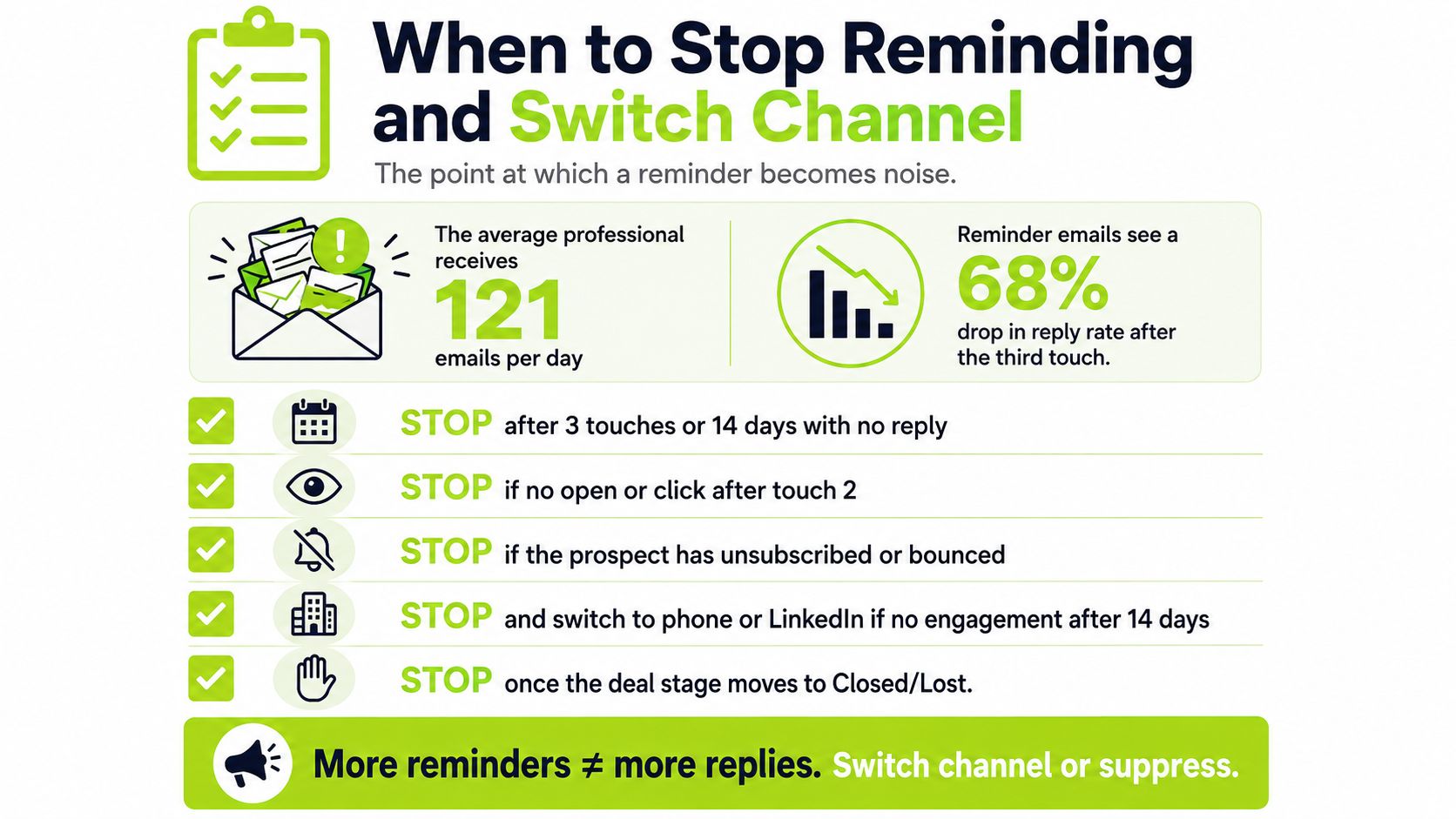
More follow up isn't automatically better. Recent workplace research cited by Clean Email's email productivity report found that 68% of surveyed professionals associate email overload with stress and burnout, while 73% reported that their email volume increased during the previous 12 months. A reminder that adds no value contributes to the problem you're asking the prospect to solve.
The stopping decision should depend on both engagement and fit. An opened thread with a previous objection deserves a different treatment from an unopened message sent to a contact who was never a clear buyer.
Use explicit stop rules
- No engagement: Suppress the contact and record the reason. Re-enter them only when a genuine trigger creates a new case for contact.
- Repeated opens without action: Change the question once, then stop. Opens don't prove intent, and privacy technology can distort open data.
- A clear pause: Confirm the requested timing, set a future task and remove the contact from the active sequence.
- A changed premise: If the role, project, technology or business situation has changed, don't keep using the old message.
- A decline or unsubscribe: Stop immediately. Don't switch channels to work around a direct request.
- A missing stakeholder: Ask who owns the decision, then suppress the original contact unless they invite continued involvement.
A channel switch can make sense when email is no longer the right medium and there is a legitimate business reason to use another route. A short LinkedIn message or phone call should introduce a distinct purpose, not repeat the entire email sequence. For example, ask whether the contact is still the right owner, or refer to a previously agreed action that requires clarification.
The final email should make it easier to say no than to avoid you.
Use language that preserves the relationship:
“I'm going to close this thread so I don't add noise to your inbox. If [topic] becomes relevant later, reply here and I'll pick it up.”
That close creates a clean CRM state, gives the prospect control and protects your team's capacity. A suppressed contact isn't a lost asset. It's a contact you can revisit when evidence, timing or ownership changes.
For teams also dealing with delivery problems, separate list quality and sender health from copy decisions. Guidance on email deliverability issues can help diagnose whether silence reflects poor targeting, inbox placement or a weak offer.
Building a Sequence You Can Measure and Improve
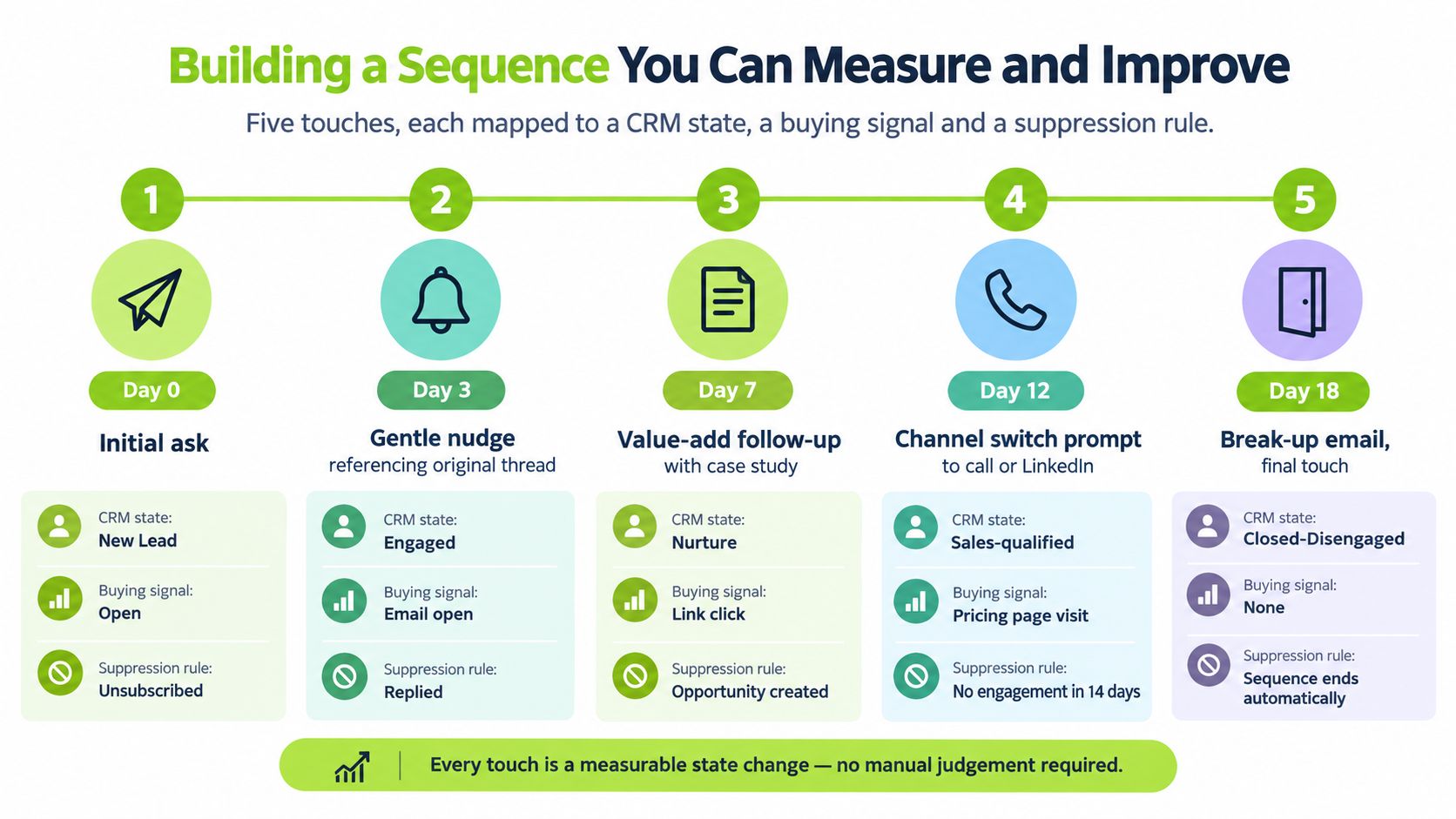
A sequence becomes dependable when every touch changes a CRM state or tests a buying signal. Define the state before writing the email. “New lead,” “engaged,” “qualified,” “opportunity” and “closed-disengaged” should each have an owner, an entry condition and a suppression rule.
The sequence below is a practical model for cold outreach. Adapt the intervals when the message follows an inbound request or an agreed post-meeting action.
| Touch | Timing | Purpose | Exit condition |
|---|---|---|---|
| Initial message | Day 0 | Make one relevant request | Reply, unsubscribe, bounce or qualification change |
| First reminder | Day 3 | Reference the original thread and simplify the response | Reply, disqualification or suppression |
| Value-add touch | Day 7 | Add a relevant observation or resource | Click, reply, opportunity creation or suppression |
| Channel decision | Day 12 | Ask whether another channel or owner is more appropriate | Conversation, referral or no-engagement rule |
| Permission-based close | Day 18 | Close the loop without pressure | Sequence ends, contact is suppressed or reactivated later |
The exact five-touch structure should never override context. An inbound demo request may require immediate human handling, while a post-meeting proposal may need a recap before any reminder. The framework is useful because it forces the team to define what each email is for.
Measure qualified movement
Track reply rate by touch, but don't treat all replies as equal. A “not me” response can improve targeting. A positive reply that never becomes a qualified conversation may reveal weak qualification or an unsuitable offer.
Prioritise these measures:
- Reply rate by touch: Shows where attention or message relevance declines.
- Qualified conversations: Separates useful commercial responses from automatic or irrelevant replies.
- Meetings created: Indicates whether the next step is clear and attractive.
- Time to first reply: Helps identify whether response handling or message timing is slowing progress.
- Disqualification and unsubscribe signals: Shows whether targeting or persistence is creating avoidable friction.
- Re-engagement after suppression: Reveals whether later trigger-based outreach is more effective than continuous reminders.
If replies stall, inspect the first reminder and the permission-based close before adding more touches. A weak first reminder usually means the new reason to respond isn't strong enough. A weak close often means the sequence hasn't given the prospect a comfortable way to correct your assumption.
Run a weekly review using the same audience definition and one controlled change at a time. Compare the reason for contact, the question, the timing and the exit rule. Ask salespeople which replies were qualified, which objections repeated and where ownership broke. Then update the CRM logic, copy or qualification criteria, not all three at once.
A reminder email for follow up should make your pipeline easier to understand. If the system can't tell you why the next touch is scheduled, what signal would stop it or what outcome it is trying to create, the sequence isn't ready for automation.
H2 helps B2B teams build and run targeted outbound systems, from audience research and cold email copywriting to follow-up execution, reply handling and CRM workflow automation. Visit H2 to discuss your audience, current sequence and the specific bottleneck preventing more qualified sales conversations.
