In 2025, 76% of CRM users reported that less than half of their organisation's CRM data was accurate and complete, according to Validity's survey of 602 CRM users and stakeholders. A useful prospecting list template therefore needs more than names and email addresses. It should record which accounts qualify, what evidence supports outreach, who owns the next action and when a record should be excluded.
Copy-Ready Prospecting List Fields and Account Structure
The template below can be copied into Google Sheets, Excel or a CRM import file. Its purpose is to make each targeting decision inspectable, rather than leave the reasoning inside a researcher's head.
All company details and dates in the example are hypothetical. The review interval is an illustrative operating rule, not a legal requirement or a universal standard.
Prospecting list template fields
| Field | Purpose | Example value |
|---|---|---|
| Account ID | Unique key that links every contact to one company | ACME-001 |
| Company name | Legal and trading names to catch variants | Acme Analytics Ltd (trading as Acme) |
| Domain | Primary match key for deduplication | acme.example |
| Country | Routing and regulatory checks | United Kingdom |
| Industry | Segment definition for testing | B2B SaaS, logistics software |
| Employee count band | Firmographic fit | 50–199 employees |
| Target role and seniority | Buying-committee mapping | Head of RevOps, Director |
| Contact name and email | Outreach recipient | Name and work email |
| Email verification status | Deliverability gate before launch | Verified on launch date |
| Source URL | Evidence trail for every claim | Company careers page URL |
| Signal type and date | Trigger that justifies timing | Database administrator vacancy, 3 March |
| Qualification rationale | Why the account passed | Fits ICP size, uses target platform |
| Last verified date | Shows whether the row is still current | 3 March |
| Owner | Accountability for corrections | Sales lead |
| CRM status | Handover state | Ready to sequence |
| Next review date | Retirement trigger for stale rows | 2 April (30-day window) |
Account-level fields describe the organisation: its identity, domain, location, industry and size. Contact-level fields describe the individual: name, role, email and verification status. Keeping these separate prevents a departing buyer from making the whole account appear unsuitable.
In a spreadsheet, each contact can occupy a separate row while sharing the same account ID. In a CRM, the cleaner structure is an account record linked to separate contact records.
Resolving company-name variants
The deduplication rule should match on domain first, then parent company. Subsidiaries and name variants should resolve to a canonical account, with the original entity name retained where it matters for routing or compliance.
For example, a hypothetical export might contain Acme Analytics Ltd and Acme, both using acme.example. Those entries belong under ACME-001, not separate accounts assigned to competing sales representatives.
The source field should identify the actual page supporting a fact, rather than a generic homepage. Where a segment includes creators or creator-led businesses, the BeatAPI guide to creator contacts provides a focused reference for public contact information; availability still doesn't establish permission to send marketing.
Release rule: No row leaves the sheet without an account ID and a verification date.
How to Qualify Accounts Before Adding Contacts
A researcher finds a strong job title at a company outside the target market. If the email address goes into the sheet anyway, every later step inherits a bad decision. Account qualification comes first because a verified contact cannot rescue a company that should never enter a campaign.
Qualification and contact collection stay separate decisions: the company earns its row first, and how to qualify a lead becomes relevant only after the account has passed. Treat each record as a gate with three outcomes: pass, research hold, excluded.
The qualification sequence
-
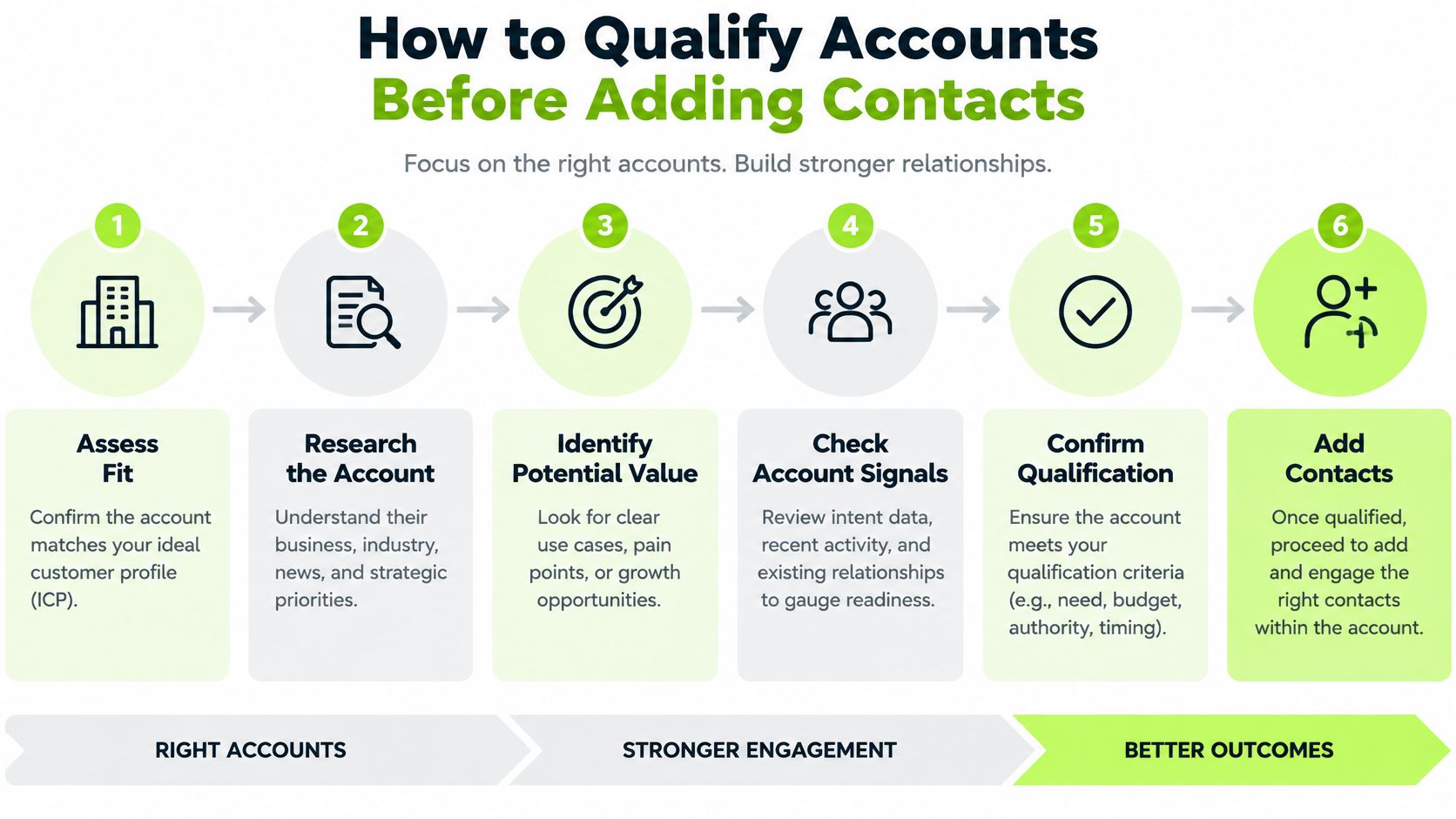
Define the ideal customer profile. The ideal customer profile, or ICP, sets limits for geography, employee count, revenue band, industry, technology stack and business model. Loose descriptions such as growing technology companies leave researchers applying different standards to the same account.
-
Create the account record first. The company must pass the initial fit check before personal contact details are added. Starting with an attractive job title reverses the decision and encourages weak account matches.
-
Map the buying committee. Identify the two or three roles that could realistically own the problem, influence a solution or approve spending. Seniority alone is not enough: a director in an unrelated department may have no useful connection to the offer.
-
Record evidence for each fit decision. Each material judgement needs a source URL and a short note saying what the source establishes. A copied company description without supporting evidence does not count as confirmation.
-
Add a dated trigger. A relevant vacancy, technology change or leadership event can justify further attention. The common slip is writing a confident buying-intent claim when the source establishes only an organisational change.
-
Verify immediately before launch. Email status, current role and company status all need checking close to send time. An email verifier confirms the address; it does not confirm that the recipient still owns the relevant responsibility.
-
Route with an owner, status and next action. A CRM handover should say who acts and what happens next, such as reviewing an ambiguous role or approving a campaign. A completed import is not the same as an actionable handover.
The visual provides a compact account-screening reference.
Qualification criteria, evidence and exclusions
| Criterion | Evidence to record | Exclude when |
|---|---|---|
| Fit | Company size, industry and technology from a cited source | Outside the ICP limits or no confirmed match |
| Authority | Role and seniority of the contact with a source | Role has no link to the problem being sold |
| Need | Public evidence of the problem, such as a job post or stated goal | No evidence beyond the company existing |
| Timing | Dated signal with source and date, checked against the signal review window | Signal has passed its review window |
| Exclusion | Existing customer, competitor, or legal or regional restriction | Any exclusion matches, regardless of other fit |
For teams designing a commercial screening process, Visbanking commercial prospect insights provide another reference for structuring qualification. The operating requirement stays the same: an explicit pass, hold or exclude decision, rather than an unexplained score.
A hard mismatch belongs in excluded status. Incomplete evidence belongs in research hold, with a named reviewer and a question to resolve. Missing evidence is a reason to pause, not a reason to guess.
Signals That Justify Research and Those That Do Not
A signal is evidence worth investigating. Purchase intent is a stronger claim about a buyer's interest in acquiring a solution, and a public event usually can't establish that by itself.
The distinction affects both targeting and copy. A salesperson can reasonably investigate a newly advertised technical role without claiming that the company is looking for an external supplier.
Signals, what they suggest and what they do not prove
The review windows below are suggested working rules, not measured expiry dates. Each team should adjust them to its market and record the chosen rule in the template.
| Signal | What it suggests | What it does not prove | Review window |
|---|---|---|---|
| Relevant job vacancy | A possible capacity or skills gap | That the hiring manager is evaluating the service | 30 days, working rule |
| Technology change | A tool switch that may create integration needs | That the buyer wants a replacement | Before launch and whenever implementation status changes |
| Leadership change | A new owner may review priorities | That budget has been approved | 90 days, working rule |
| Funding announcement | Capacity to invest in growth | That outbound is the chosen channel | 90 days, working rule |
| Public social engagement | Interest in a topic | That the person is ready to buy | 30 days, working rule |
Signal expiry means a review is due, not that the company automatically becomes unsuitable. The researcher should check whether the event remains relevant, has been resolved or no longer supports the proposed message.
For example, an old funding announcement might remain useful company background while providing no credible reason for contacting a particular buyer today. H2's explanation of sales buying signals helps distinguish events worth investigating from unsupported assumptions about readiness.
A database vacancy example
Suppose a company advertises for a database administrator. A managed database provider could investigate whether the vacancy relates to a supported platform, an expanding workload or a temporary support gap.
The researcher should then inspect the job description, technical environment and likely operational owner. If the vacancy concerns an unsupported platform, the account should fail that campaign's qualification check.
If the relevant facts remain unclear, the record should stay on hold. The vacancy alone doesn't justify placing the hiring manager into a sequence or stating that the company needs outsourced support.
Every signal row needs a source URL and a date. A compelling interpretation without either is an unverified hypothesis.
UK Consent Fields to Add Before You Send
The ICO's business-to-business marketing guidance distinguishes corporate subscribers, including companies, limited liability partnerships and government bodies, from individual subscribers, including sole traders and some partnerships: unsolicited B2B marketing email can generally go to corporate subscribers without PECR consent, while individual subscribers require specific consent or a valid soft opt-in. The ICO also explains that data-protection law can still apply when a business contact's personal data is used.
Every UK contact therefore needs a subscriber classification before entering an email sequence. A work-looking address isn't enough to establish the applicable rules.
Permission fields checklist
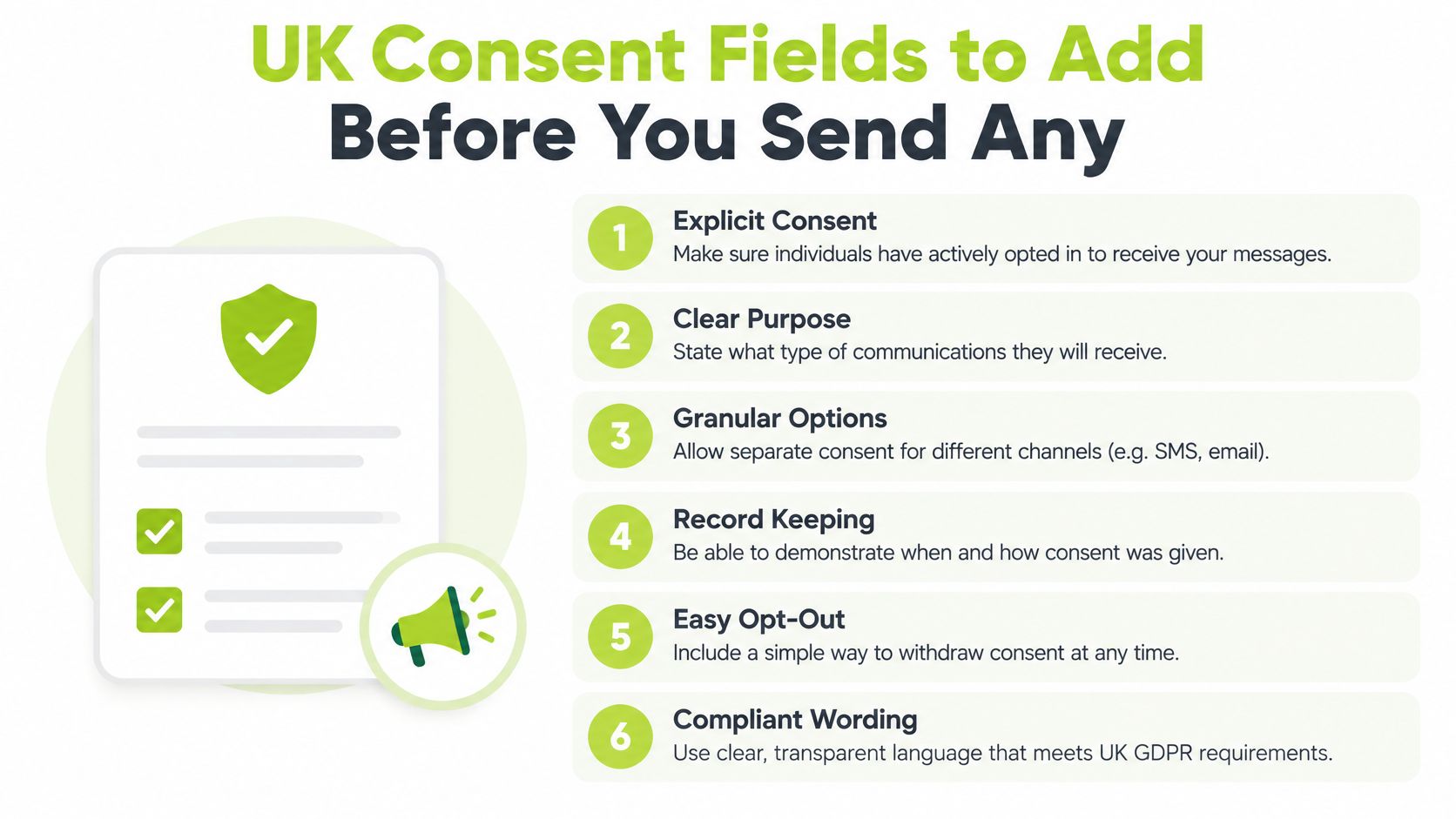
- Company type and contact type: Record the legal form and subscriber classification so routing follows the recipient category.
- Lawful basis: Document the data-protection basis being relied on, separately from any PECR consent requirement.
- Source: Retain where the details and classification came from, so another reviewer can inspect the decision.
- Suppression status: Make objections and opt-outs visible to every sending workflow.
- Email consent, phone consent and text consent: Keep separate channel fields rather than a single consent flag.
- Consent wording or source and consent date: Preserve what was agreed, where the evidence sits and when it was obtained.
Under the ICO's electronic and telephone marketing guidance, consent, where required, must cover the organisation and the specific communication type. A generic consent field marked yes can't demonstrate that scope.
The checklist visual supports the permission review.
Soft opt-in evidence
The ICO's direct marketing planning guidance sets out the narrow soft opt-in conditions: details obtained directly during a sale or negotiations, marketing for similar products or services, and an opt-out opportunity at collection; the sender must also identify itself and provide a valid opt-out address in every marketing message.
Separate fields should capture acquisition method, prior purchase or expressed interest, product similarity, the collection-stage opt-out and current suppression status. Missing evidence in any required field should make the contact ineligible for soft-opt-in treatment.
This is general guidance, not a determination for a particular campaign. Teams should check current ICO guidance for their circumstances, apply a separate consent check for each country outside the UK and re-check any field whenever its supporting source changes.
Keeping the List Accurate After Launch
In 2025, companies reported losing an average of 16 sales deals per quarter because of poor-quality data, according to figures from Validity's State of CRM Data Management report. Maintenance therefore needs an owner and a launch-blocking process, not just a reminder to tidy the CRM.
A record can remain deliverable while becoming commercially wrong. The audit should inspect targeting decisions as well as email status.
A repeatable maintenance routine
-
Audit each new segment. A practical sampling approach is to manually check 50–100 records for company fit, contact relevance, email deliverability, evidence quality and duplicate status, as described in Smarte's prospecting analysis. The sample should include records from across the segment rather than only the most complete entries.
-
Calculate field-level accuracy. The formula is correct values divided by audited values. In a hypothetical calculation, 80 correct domains out of 100 audited domains gives 80% domain accuracy; that result says nothing by itself about role accuracy.
-
Block launch when critical fields fail. Domain, role, email status and exclusion status need agreed acceptance thresholds. A good overall average shouldn't conceal a failed suppression check or a cluster of incorrect company matches.
-
Separate targeting tests. Narrow segments should reflect meaningful differences in ICP or trigger. Holding messaging constant initially makes it easier to investigate whether audience selection explains a change in response.
-
Measure commercial progression. Positive-reply, qualified-meeting and opportunity rates show different stages of progress. Teams should define each stage and denominator rather than combine every reply or meeting into a single success count.
-
Refresh or retire records. A refresh cadence should determine when a verification date becomes too old for active use. Overdue records should leave the launch queue until reviewed, rather than remain available indefinitely.
Closing the correction loop
Every correction needs a named owner, a change date and a brief reason. A bounced address, departed contact or incorrect company match should produce a corrected record or an explicit retirement decision.
AI-assisted research needs the same discipline: generated summaries should retain their underlying evidence, with ambiguous classifications sent for human review. An unsupported summary shouldn't overwrite a confirmed fact.
Audit standard: A flagged error isn't a resolved error. The owner must record the correction or explain why the record was retired.
Performance benchmarks are directional, not campaign promises. Any comparison retained in the template should include its source, sample size, segment definition and measurement date.
Decide Whether to Run the List In-House or Outsource
The decision depends on commercial readiness and operating capacity, not spreadsheet size. A well-maintained list still needs people who can run campaigns and progress the conversations.
The decision tests
- Proven offer: Customers already buy the offer, and its message has been tested. If not, outsourced volume won't resolve uncertainty about what buyers value.
- Sales capacity: Representatives have calendar space and follow-up time for additional conversations. Without that capacity, list building isn't the immediate bottleneck.
- Outbound capability: The team has time and skills for research, data checks, sending, deliverability, reply handling and meeting booking. If this is missing, outsourcing may fit.
The image captures the operating choice.
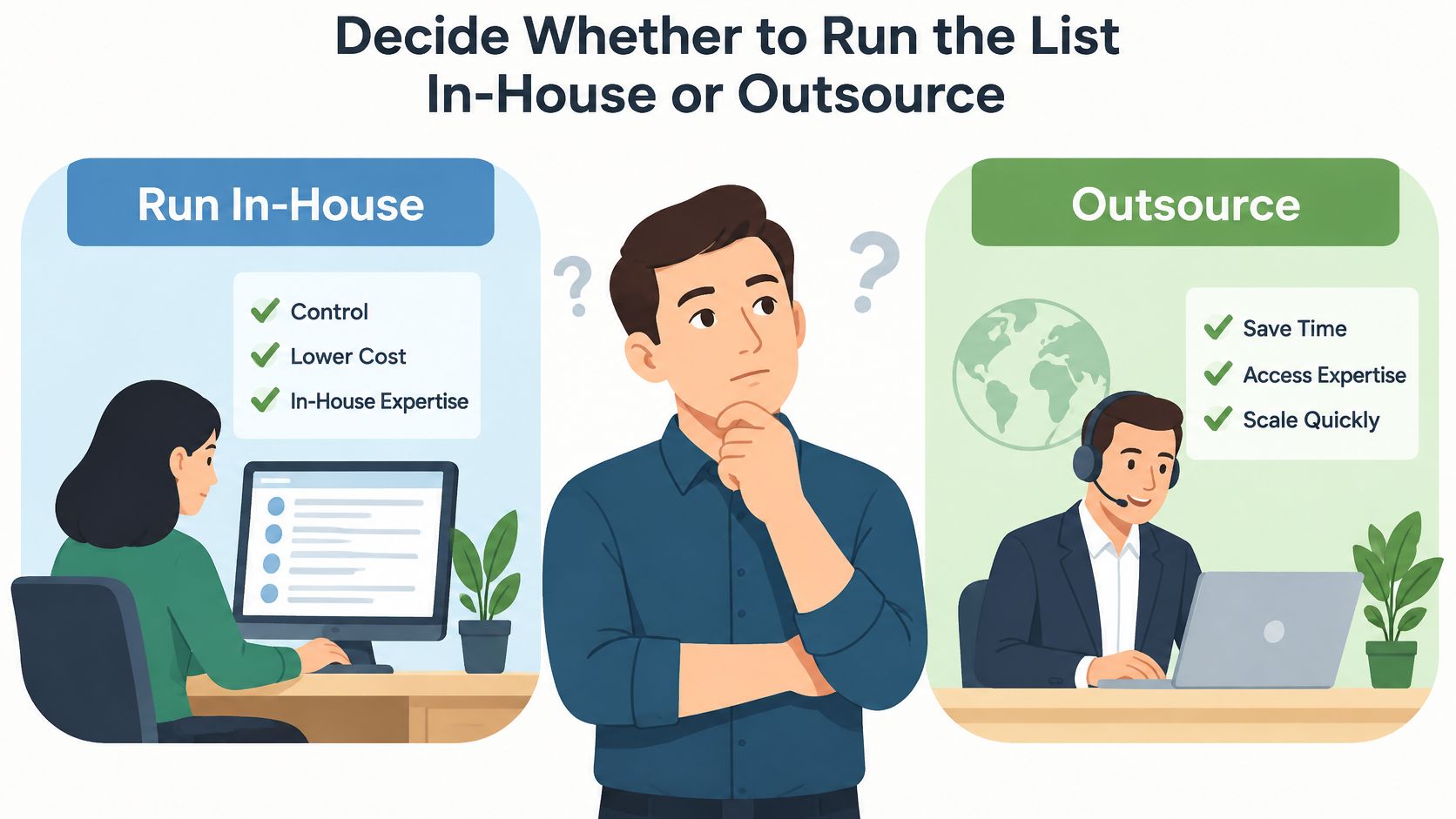
In-house operation retains direct control but consumes staff time. Teams considering whether to delegate admin work to remote staff should distinguish administrative support from ownership of targeting and campaign decisions.
Outsourcing reduces internal operating work but gives the team less direct control over daily execution. ICP limits, exclusions and review rules should be agreed before handover; H2's guide to B2B lead generation outsourcing provides further decision criteria.
H2's fully managed outbound service covers research, list building, verification, campaigns, reply handling and meeting booking, with conversations and next steps recorded in the client's CRM; teams building internally can consider private GTM workshops. The starting point is an intro explaining where growth is stuck, after which H2 shows the audience, infrastructure and campaign it would build.
H2 offers fully managed outbound and custom GTM systems that connect prospect research, qualification and CRM handover. Teams with unreliable lists or unclear exclusion rules can visit H2 to book an intro and discuss where growth is stuck.
