The global B2B sales-outsourcing services market was estimated at $10.7 billion in 2025, according to Dataintelo. External prospecting is a substantial business-services category, but spending more on it doesn't automatically create useful pipeline.
B2B lead generation outsourcing makes sense when a company has a proven offer, room for more sales conversations and too little internal prospecting capacity. The budget decision should turn on qualified conversations and opportunities, not the number of contacts delivered. The contract should also make clear who pays when a campaign produces activity without commercial progress.
Outsourcing Options for B2B Lead Generation
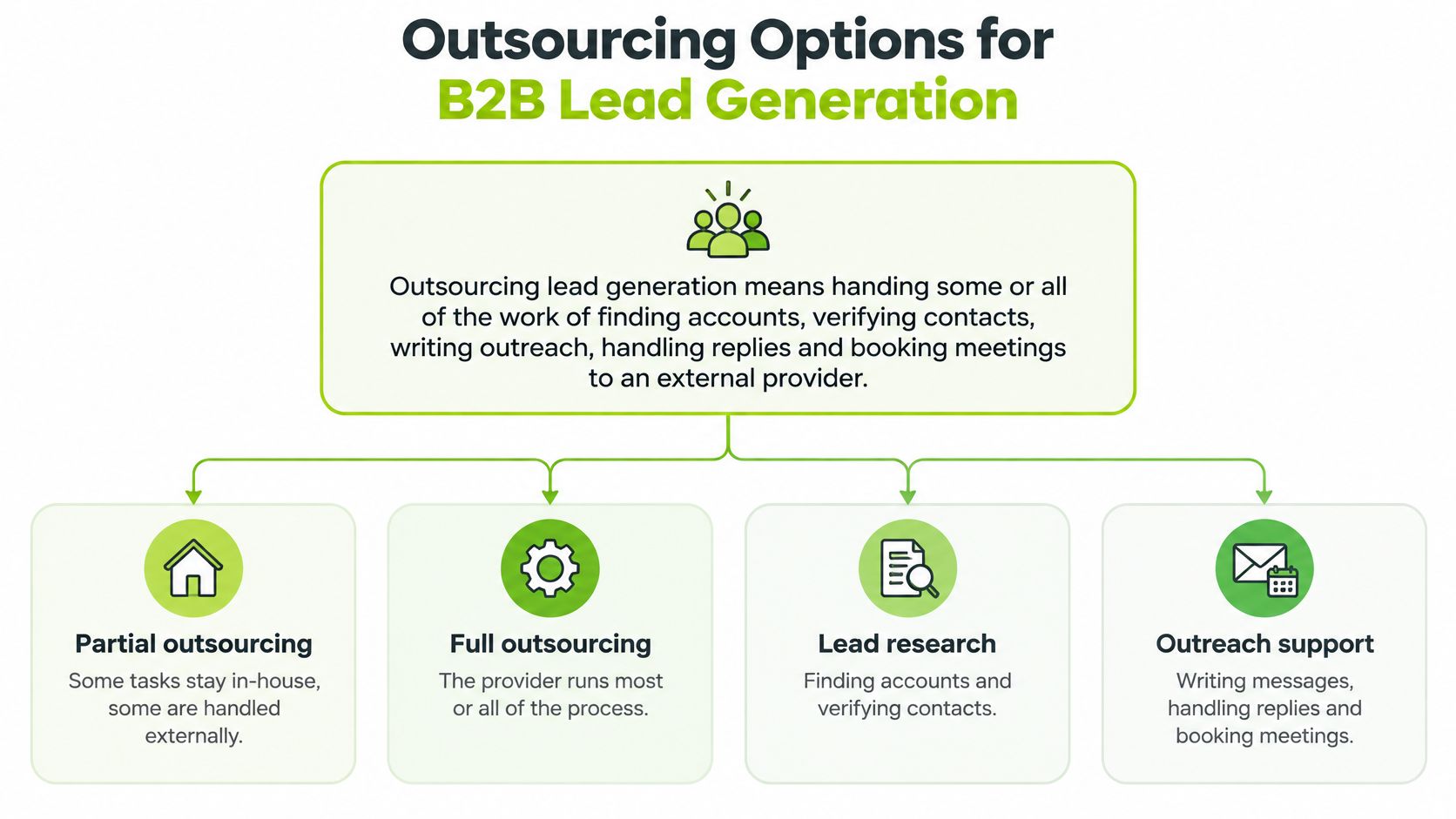
Outsourcing lead generation means handing some or all of the work of finding accounts, verifying contacts, writing outreach, handling replies and booking meetings to an outside team. The client's sales staff usually run discovery, progress opportunities and close business.
In a 2025 Sopro survey of 300 senior B2B sales and marketing decision-makers in the UK and US, 78% said outbound sales outreach was essential to their growth strategy, as published by MarketingProfs. That establishes outbound as a mainstream choice, not proof that every business needs a fully outsourced programme.
The options separate by who owns execution and who makes targeting and messaging decisions.
Outsourcing options compared
| Option | What the provider runs | Best fit | What stays with the client |
|---|---|---|---|
| Fully managed outbound | Research, lists, campaigns, reply handling and meeting booking | Proven offer, capacity for more conversations, no time to build outbound | Sales conversations and next steps |
| Custom GTM system build | Data sources, enrichment, scoring, qualification and CRM routing | Manual bottlenecks or disconnected tools; team will run the system | Operating the system after handover |
| Outsourced appointment setting | Booking meetings using client scripts and target lists | Clear ideal customer profile and tested offer | Targeting, messaging and qualification rules |
| Bought lead lists | Contact data only | Team already has outreach skills and sending infrastructure | All campaign work, deliverability and compliance |
| Private GTM workshop | Training on research, list building, qualification and tools | Team wants lasting in-house capability | All execution |
Consider a software consultancy whose founder still researches every prospect. Buying contacts might remove some searching, but it won't solve campaign writing, reply handling or follow-up. A managed programme addresses that wider execution gap.
A RevOps team with capable campaign operators but unreliable Salesforce records has a different problem. A custom system that verifies contacts, removes duplicates and routes qualified accounts may be the better purchase.
Name the gap before buying support: missing pipeline, broken data, a manual bottleneck or missing skills.
These aren't interchangeable services. Paying for training won't create spare operating capacity, and paying for appointment setting won't fix an undefined target market.
Deciding Whether to Outsource or Build In-House
Outsourcing is a capacity and specialisation decision, not just a cheaper alternative to hiring. A founder should compare the work that needs doing with the organisation's ability to manage it.
The decision test below needs a commercial override: a full sales diary isn't permission to generate more meetings. Prospecting capacity and closing capacity are separate constraints.
Outsource or build in-house decision test
| Criterion | Points towards outsourcing | Points towards in-house |
|---|---|---|
| Offer validation | Offer is proven but growth relies on referrals | Messages and offer still being tested |
| Sales capacity | Reps have no spare time to take more meetings, signalling a capacity problem that must be resolved before launch | Reps have spare time and want to own prospecting |
| Team skills | No one can build lists, write copy or manage deliverability set-up | Team already runs outbound with clean data |
| Data quality | Duplicate records and manual research slow the team | CRM is clean and routing is automated |
| Budget and timing | Pipeline is needed within the next quarter | Team can absorb a longer build |
| Control | Leadership is happy to set targeting rules and review replies | Leadership needs direct control of every message |
If most criteria point towards outsourcing, a managed programme usually fits, provided sales can take the resulting conversations. H2's fully managed outbound is best for B2B teams with a proven offer, capacity to take more sales conversations and a need for more pipeline, without the time or appetite to build an outbound function internally.
If most criteria point in-house, build the capability first. Mixed results often justify repairing data and routing before handing execution to an external team. A clear division between commercial choices and operational ownership, explored in GTM strategy and operations, prevents a provider inheriting contradictory rules.
A hypothetical capacity decision
Consider a 12-person SaaS company with two account executives, a proven offer, full diaries and no spare research time. The lack of prospecting capacity points towards outsourcing, but the full diaries argue against launching extra meeting generation immediately.
The sensible move is to free selling time, remove low-value meetings or add closing capacity before increasing outbound. Otherwise, the company pays to create conversations it can't progress.
Automation also brings maintenance, integration and quality-control work. Truespeak's guide to AI automation costs and tradeoffs provides a useful framework for comparing internal ownership with agency delivery.
An undefined ideal customer profile remains a stop sign. Without a clear description of suitable customers, outsourcing becomes a paid test of an undefined market.
Selection Criteria for Choosing a Provider
A provider should survive operational scrutiny before receiving access to the company's brand, CRM or sending infrastructure. A polished proposal isn't enough.
Questions that belong in the evaluation
-
Outcomes. What counts as a qualified conversation, and which conditions make it an opportunity? Require a written definition covering account fit, relevant role, business problem and an agreed next step, rather than accepting lead counts alone.
-
Data sources. Where do contacts come from, how are they verified and what permits contact in each market? Enrichment, the addition of missing information to records, doesn't itself establish permission to send.
-
Research method. How are accounts selected and poor fits excluded? Request a sample account list with the evidence behind each inclusion, not simply a spreadsheet of plausible job titles.
-
Sending infrastructure. Who checks authentication and monitors complaints? Google's sender guidance requires SPF or DKIM for senders to personal Gmail accounts, with requirements applying since 1 February 2024, and recommends user-reported spam rates below 0.1%, never reaching 0.3%.
-
Compliance. Who owns opt-outs and shared suppression lists? The FTC's CAN-SPAM guidance requires US commercial email opt-out mechanisms to remain operational for at least 30 days, with requests honoured within 10 business days. Outsourcing doesn't remove the sender's obligations.
-
CRM recording and handoff. Will every reply, meeting and next step appear against the correct account? H2 records conversations and next steps in the client's CRM, rather than leaving sales to reconstruct context from inboxes.
-
Reply handling. Who responds to interest, referrals, objections and sensitive complaints, and within what agreed window? Require a named backup when the primary owner is unavailable.
-
Reporting. What is the review cadence, how is each metric defined and who owns it? Sales and the provider need access to the same underlying records, including rejected meetings.
-
Exit terms. Who retains contact data, campaign copy, sequences, accounts and documentation when the engagement ends? Ownership and export arrangements belong in the contract.
Check ownership, not just technical competence
The same principle applies when choosing a business technology consultant: technical capability must come with clear responsibilities and a workable handover. A system that only its supplier understands creates avoidable dependency.
For UK or EU prospecting, US compliance isn't sufficient. PECR and UK GDPR may apply to UK activity, while other markets require their own assessment; establish the applicable rules and lawful basis before sending.
Reject opaque delivery: guaranteed meeting numbers without qualification criteria, no sample research and reluctance to share reporting are reasons to walk away.
Pricing and Engagement Models Compared
The pricing model decides who carries the risk of a weak campaign. A low unit price can still leave the client paying for irrelevant records, unusable meetings or a system nobody operates.
The contract should distinguish delivery obligations from commercial outcomes. A provider can control research quality and reply handling, but can't control a buyer's budget or the client's ability to close.
Pricing and engagement models
| Model | How it is charged | Who carries the risk | What to check |
|---|---|---|---|
| Monthly managed programme | Recurring fee for research, campaigns and reply handling | Client carries commercial risk; provider carries agreed delivery obligations | Written scope, minimum term, included channels |
| Project-based system build | Fixed fee for a defined outcome, inputs and integrations | Shared; defined scope limits surprises | Acceptance tests, change requests and ongoing support fees |
| Workshop or training | Fixed fee per session or course | Client carries adoption risk | Hands-on follow-up and an operating handbook |
| Per-meeting or per-lead | Charged for each booked meeting or lead | Provider carries volume risk; client still carries qualification and conversion risk | Written qualification definition and dispute process |
| Bought lead list | Charged per record or per list | Client carries all campaign risk | Data age, consent basis and duplicate rate |
Per-meeting and per-lead agreements move volume risk towards the supplier. They can also reward booking a call with anyone willing to attend.
Protect against that incentive by defining acceptable accounts, relevant roles, exclusions, attendance requirements and replacement conditions. A booked meeting with an unsuitable company shouldn't become payable merely because a calendar invitation exists.
A hypothetical cost comparison
A £3,000 monthly fee producing 15 qualified conversations costs £200 per qualified conversation. The same hypothetical fee producing 60 unqualified leads costs £50 per lead, but none meets the commercial standard.
The cheaper-looking unit isn't the better outcome. Compare recurring and project fees using qualified conversations and resulting opportunities, while allocating system-build costs across an agreed operating period rather than treating the build as free after handover.
The budget should also include:
- Operating costs. Data subscriptions, enrichment credits, sending tools and CRM access.
- Internal effort. Approval time, technical support and sales feedback.
- Change costs. New markets, integrations, extra channels and support beyond the agreed scope.
Current H2 prices, currencies and billing periods should be checked on the pricing page. Before signing, confirm the engagement's inclusions, minimum term and extra costs rather than treating a headline fee as the complete budget.
Mapping Buying Groups and Pre-Contact Research
A reply from a suitable contact doesn't establish that an account can buy. Demandbase's State of the B2B Buyer report reports that 72% of B2B purchases involve complex buying groups.
Map the economic buyer, who controls spending; the technical evaluator, who assesses feasibility; the end user; procurement; and a potential internal champion. The same person may hold several roles, but those responsibilities still need to be understood.
Establish a credible buying path
- Map responsibility. Identify who owns the problem, who can approve action and who could block implementation.
- Match the message. Give technical evaluators implementation evidence and economic buyers a commercial reason to act.
- Set progression criteria. Specify which roles must participate before an account advances, without demanding the entire committee at an introductory meeting.
The provider should also investigate whether the account has already started evaluating alternatives. Empact Partners' buyer-journey statistics report that 94% of buyers had ordered their shortlist by preference before engaging a seller, while 90% conduct research before first contact.
Those findings challenge the assumption that better cold-email copy alone will create demand. Useful outreach needs credible evidence, clear differentiation and a relevant reason to engage.
Research accounts before requesting meetings
Job postings, product launches and technology changes can support a problem hypothesis. They don't prove purchase intent, so account notes should separate observed facts from assumptions; market mapping provides a structured starting point.
Cold email should be an entry point rather than the whole programme. McKinsey's B2B research reports buyers using up to, and sometimes more than, ten channels during a purchase, with eight in ten decision-makers rating omnichannel selling as effective as or more effective than traditional methods.
Sales needs account context in the CRM so a conversation can continue coherently across those channels.
Measuring Pipeline Beyond Lead Counts
Activity counts describe work completed. Pipeline outcomes describe commercial progress.
A contact record, positive reply and accepted opportunity aren't interchangeable. The provider's output should be judged on qualified conversations and opportunities from suitable accounts, with activity metrics used to diagnose the process.
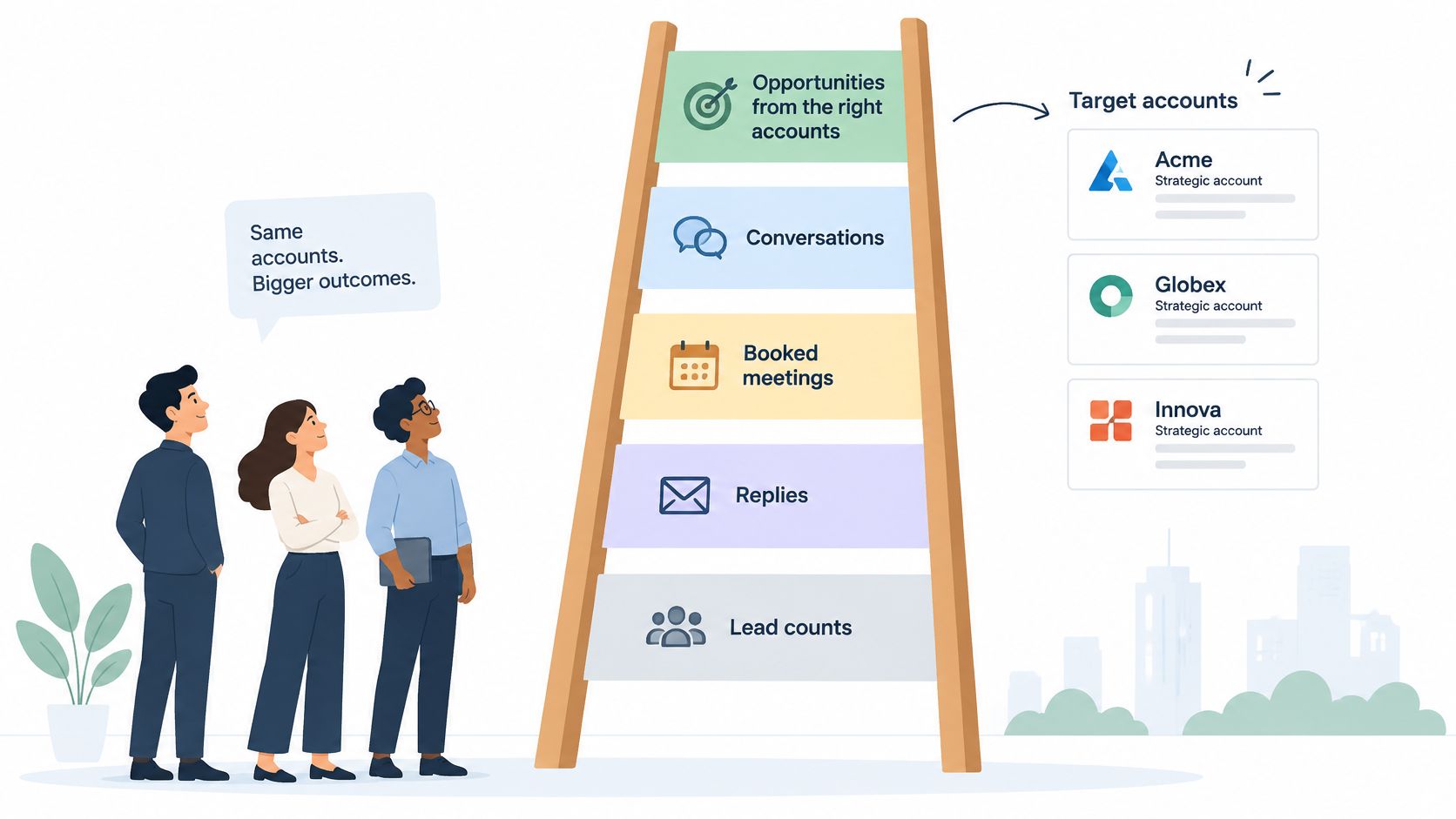
Outsourced pipeline metrics, from early to late
| Metric | What it shows | Where it misleads |
|---|---|---|
| Leads delivered | Records passed to sales | Reflects list size, not fit |
| Replies | Interest or a closed door | Includes out-of-office messages, referrals and objections |
| Booked meetings | Calendar activity | Doesn't show whether the buyer qualifies |
| Qualified conversations | Meetings matching the written ideal customer profile and qualification rules | Needs clear criteria agreed in advance |
| Sales-accepted meetings | Sales agrees the meeting is worth taking | Depends on consistent acceptance and follow-through |
| Opportunities created | Pipeline entered into the CRM | Can lag initial outreach while sales validates the purchase |
| Stakeholder coverage | Relevant roles engaged per target account | Needs contacts mapped in the CRM |
| Pipeline value | Value of opportunities created | Isn't attributable without agreed rules |
These measures don't form a perfectly linear funnel. Stakeholder coverage can deepen throughout an opportunity, while sales acceptance may happen before a conversation takes place.
Record the reason behind each status change. A rejected meeting caused by the wrong company size calls for a targeting change; rejection because a prospect never agreed to discuss the problem calls for better qualification.
A hypothetical account-level example
Consider a campaign targeting 400 accounts with three contacts per account. Suppose 30 accounts engage across two or more relevant roles, while a separate campaign produces 120 replies from isolated contacts.
The cross-role engagement is a stronger account-progression signal because sales has several routes to understand the problem and establish a buying path. It still isn't proof of an opportunity: those contacts could disagree, lack urgency or have no budget.
The CRM should therefore capture more than contact activity:
- Role coverage. Which buying responsibilities are represented by engaged contacts?
- Problem confirmation. Has a prospect acknowledged the issue, or is it still an outreach hypothesis?
- Next action. Who agreed to do what, and what evidence would justify advancing the account?
- Source and influence. Did outbound create the opportunity or contribute to an existing buying process?
For technical sales, a user may recognise the problem while an engineering leader controls implementation and finance approves spending. Counting those contacts separately hides the relationship that matters.
A busy calendar isn't a pipeline report. Sales must be able to explain why each accepted conversation deserves further effort.
Agree definitions before launch, then review replies and sales-accepted meetings together. That prevents weak account fit being blamed on copy, or weak copy being blamed on targeting.
How to Onboard and Govern an Outsourced Programme
A 90-day operating sequence should create clear ownership, controlled tests and an evidence-based renewal decision. It isn't a promise that every sales cycle will produce closed revenue within that period.
The client briefs H2 once, and H2 takes the outbound work from there. H2 researches the market, builds the infrastructure, writes the campaigns, launches experiments and improves the system, leaving the client's team to focus on sales conversations.
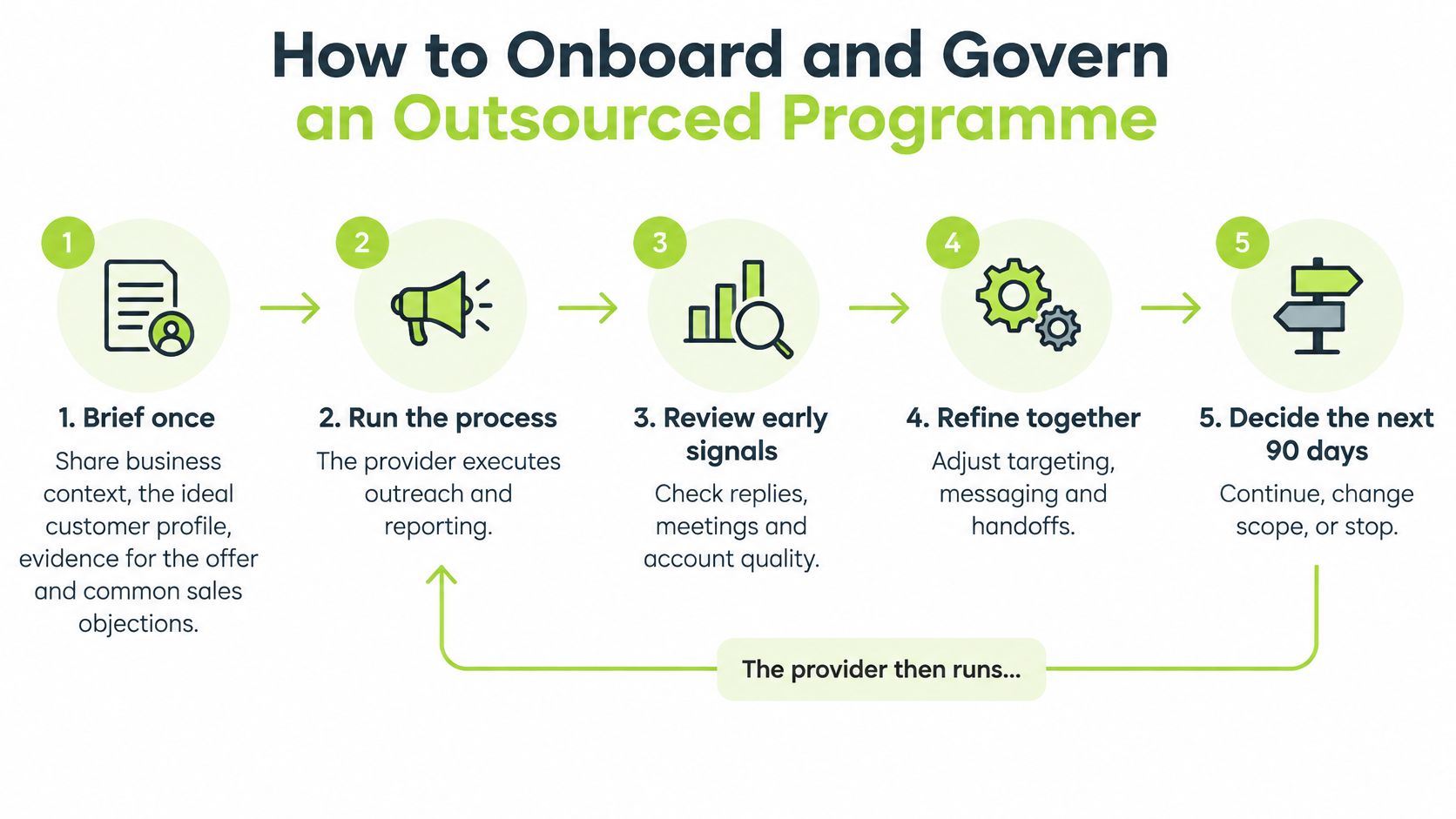
Establish the operating rules
-
Brief once. Share the business context, ideal customer profile, offer evidence, exclusions and common objections. Include lost-deal notes and unsuccessful campaigns, not just polished marketing material.
-
Agree success and ownership. Document qualified-conversation and opportunity criteria, with a named owner for each metric. A shared sales playbook template helps keep messaging, qualification and handoffs consistent.
-
Prepare domains and inboxes. Verify SPF or DKIM authentication before sending and assign responsibility for monitoring sender health. Treat technical readiness as a launch gate, not an administrative task to finish later.
-
Create shared suppression. Appoint an opt-out owner and ensure exclusions reach every active sequence. Test the process with a dummy suppression record before contacting prospects.
Run, learn and make the renewal decision
-
Launch a controlled test. Begin with a tightly defined audience and a clear problem hypothesis. Check spam complaints daily and pause when complaint patterns deteriorate, rather than using the maximum permitted threshold as an operating target.
-
Route replies to a named salesperson. Track median and 90th-percentile time to first human response, which together show typical performance and slower cases. A Harvard Business Review audit of 2,241 US companies found only 37% responded to web-generated leads within an hour and 23% never responded, as summarised by Venture Harbour. That evidence concerns web-generated leads, not a cold-outbound response benchmark, but it makes neglected handoffs a clear governance risk.
-
Review replies and objections weekly. Sales should explain why meetings were accepted, rejected or advanced. Change a specific assumption, such as the target role or problem framing, rather than rewriting every campaign element at once.
-
Decide at day 90. Scale activity that creates qualified conversations, repair promising segments and stop activity with no credible commercial path. Where opportunities remain open, assess their evidence and next steps rather than declaring all unfinished deals failures.
Governance needs a visible record of decisions, owners and unresolved issues. Tuff's guidance on how to track progress throughout project implementation offers a useful way to organise that accountability without turning every review into another status meeting.
Decide and Book a Fit Call
Outsource when a proven offer needs more prospecting capacity and sales can handle the conversations. Build data and routing first when operations are the bottleneck, and train the team when lasting internal capability is the goal.
H2's fully managed outbound service includes email, LinkedIn, reply handling and meeting booking, with conversations and next steps recorded in the client's CRM. For teams held back by manual research, qualification or unreliable handoffs, custom system builds address the operating problem rather than adding campaign activity.
An introductory call should centre on the business, target audience and current constraint. Before committing, confirm current pricing, currency, billing period, scope, minimum term and additional costs.
No provider can guarantee a commercial result. Any programme, including H2's, should earn continued investment through useful conversations, sales acceptance and credible opportunities.
H2 offers fully managed outbound, custom GTM systems and private workshops for B2B teams that need better prospecting execution or stronger internal capability. Visit H2 to book an introductory call about the business, its target buyers and the constraint preventing more qualified sales conversations.
