A multi channel approach gives each channel a defined job in reaching the same buying group. Its value depends on channels working from shared records and clear next steps, not merely running side by side.
Treat the channels as one operating system. Account records, the language used to describe a problem and agreed handoffs should travel with the buyer. If someone switches from email to a call, the next person needs to know what was discussed and what should happen next.
Without that connection, email, LinkedIn and calls become separate races. Each person optimises their own activity, while buyers repeat context or hear different versions of the offer. A shared record keeps the message and handoff aligned.
What a Multi Channel Approach Means in B2B
Multichannel puts email, phone, social and content beside one another. Omnichannel puts those channels on one customer record, with shared messages and a handoff the next person can use.
In B2B, a multi channel approach is that second arrangement for a buying group. The record, the problem language and the next step travel with the account. A move from email to LinkedIn, or from a call to a workshop, should not reset the conversation.
Channels work like a relay. Each leg has a runner, and the baton has to change hands. Drop the handoff and the next person starts cold. The prospect repeats the context, or hears a second version of the offer.
Buyers use an average of 10 interaction channels during a purchase, up from five in 2016, according to McKinsey's Global B2B Pulse, covering nearly 4,000 decision-makers across 13 countries. Common touchpoints include a supplier's website, in-person sales, videoconferencing, email, online chat, mobile applications and procurement portals. In February 2021, McKinsey reported that 83% of B2B decision-makers viewed omnichannel selling as at least as effective as traditional sales approaches, up from 54% at the start of the pandemic.
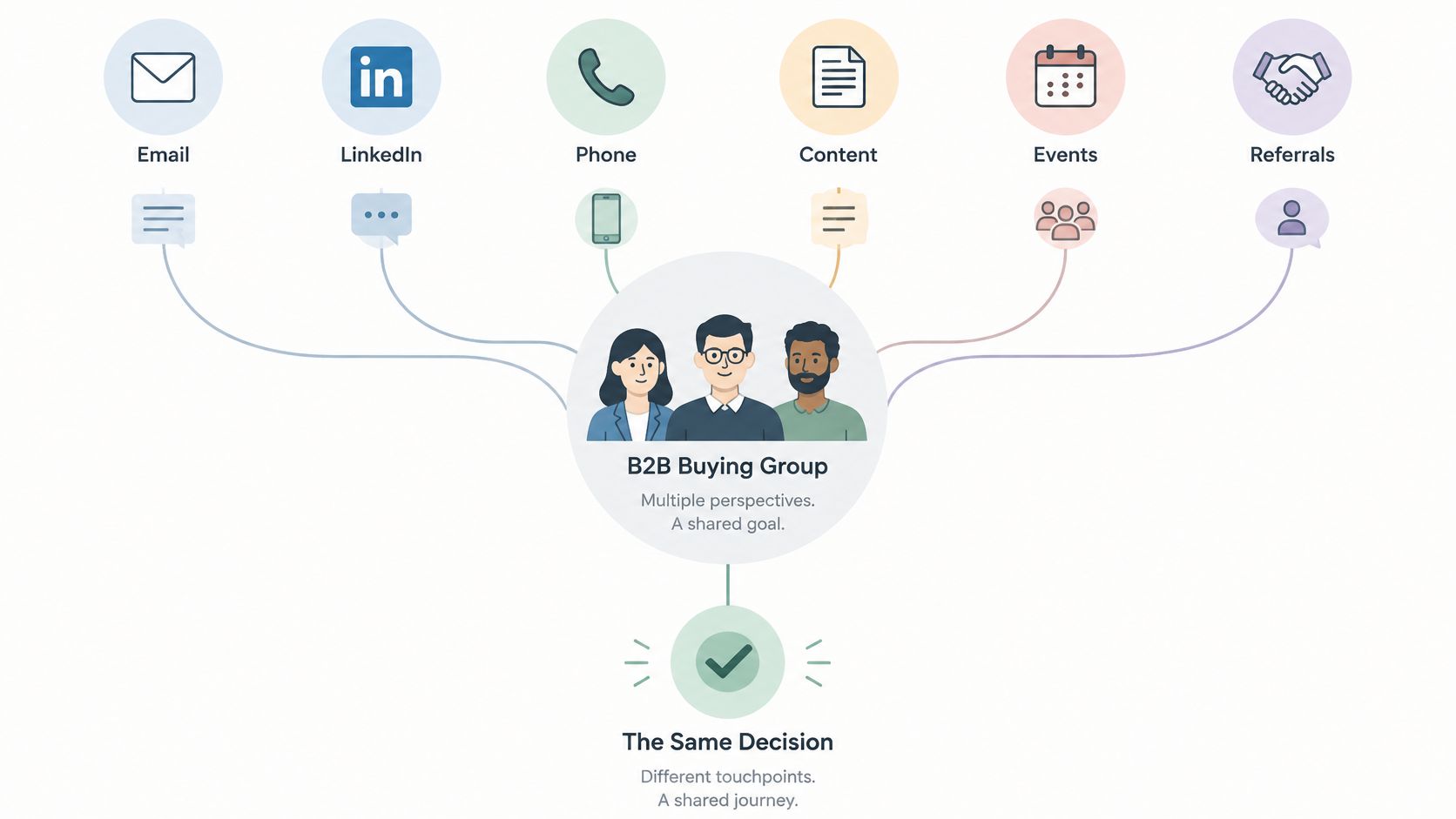
The same positioning and the same qualification logic should show up on every channel, with a clear next step. An outbound email might open the account. A later website visit, LinkedIn reply, sales call or workshop booking belongs on that same record. The message can then match the stage.
PostSyncer's multi-channel campaign roundup shows how coordinated consumer campaigns are assembled. Use it for the idea of coordination, not as a template for a B2B buying group.
Unplanned switching is where the system breaks. Sales calls the account on Tuesday. Marketing emails another stakeholder on Wednesday. Neither can see the other's note. If a prospect could receive three contacts from your team, and none of those people would know about the others, you still have separate tactics.
Channel Roles and Where Each One Earns Its Place
Give each channel one main job, such as opening a conversation, adding context, qualifying, checking fit or reinforcing recognition. The table sets out typical roles, not fixed rules. A channel can change job between stages. A webinar might open a cold segment, then later support a shortlist.
| Channel | Main job | Strength | Limit | Effort |
|---|---|---|---|---|
| Cold email | Open a conversation | Scalable and measurable | Needs authenticated sending and lawful consent | Medium |
| Add context and social proof | Precise role targeting | Weak profiles and loose targeting waste the reach | Medium | |
| Phone | Qualify and handle objections | Direct and fast feedback | Time-heavy, with limited daily reach | High |
| Website and content | Let buyers verify fit independently | Available at any time | Only works if the right buyers find it | Medium upfront |
| Events and webinars | Build trust with a group | Reaches several stakeholders at once | Turnout is uncertain | High |
| Paid advertising | Reinforce recognition | Reaches named accounts | Attribution is noisy, and cost rises with competition | Medium |
| Referrals and partners | Introduce warm contacts | High trust | Can't be scaled on demand | Low to medium |
Limits that change the decision
Cold email only scales when the sending setup and the opt-out rules are under control. A large list with a poor domain is a liability, not a channel.
LinkedIn reaches a named role, but the profile and the list do the selling before the note does. A thin profile makes precise targeting look like spam.
Phone gives the fastest read on objections. It also burns the most time per account, so it belongs after a signal, not as a blanket first touch.
Website and content can answer an evaluator at any hour. They do nothing for buyers who never arrive, so another channel has to point people there.
Events and webinars put several stakeholders in one room. Empty seats make the cost hard to justify, so the invite list matters more than the slide deck.
Paid advertising can keep a known account seeing the same point. Credit for the meeting will be messy, and bids climb once competitors want the same names.
Referrals and partners arrive with trust already attached. You can't order more of them next week, so they support a plan rather than carry it.
Name one owner for each row in your own market. Shared ownership usually means nobody suppresses a duplicate touch.
Advantages and Trade-Offs for B2B Go-to-Market
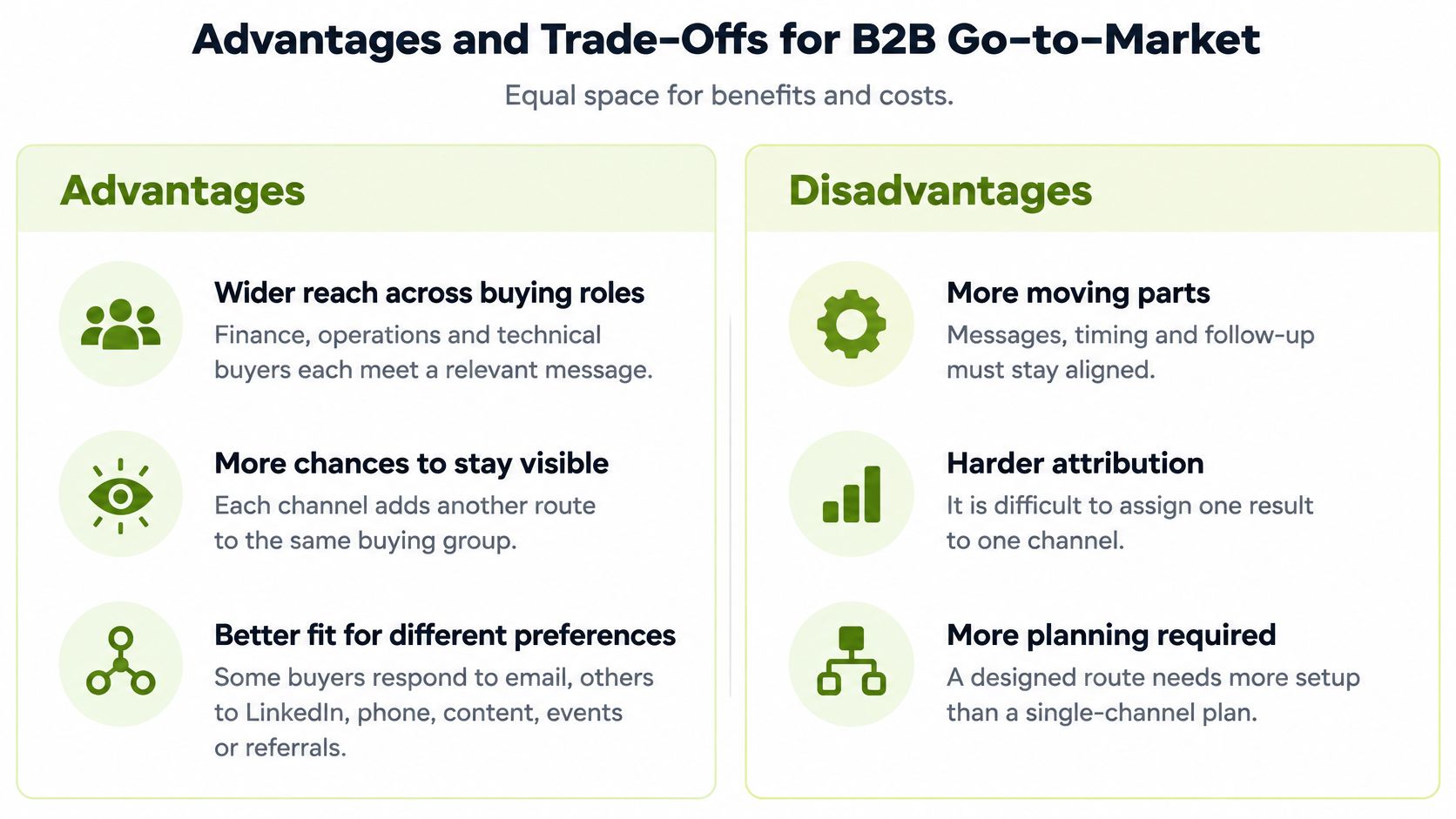
Advantages
- Wider reach across roles: Finance, operations and technical buyers can each meet a relevant channel instead of one generic note.
- Format fit: Remote and self-serve routes sit alongside a human conversation, so a buyer isn't forced into a single format.
- Stronger recognition: Repeated, relevant contact is easier to remember than one isolated email.
- Clearer evidence: Tracked together, channels show which combinations move deals, not just which inbox was busy.
Disadvantages
- Higher operational load: More people and tools have to stay in step.
- Heavier data rules: Suppression, consent and duplicate contacts multiply with every new route.
- Fatigue and mixed messages: Silos produce conflicting claims and too many touches.
- Staffing cost: Several channels run properly cost more than one channel run properly.
Kushwaha and Shankar's 2013 study in the Journal of Marketing found multichannel shoppers spent approximately 1.5 times as much as catalogue-only customers and about 5.5 times as much as web-only customers. Those buyers were retail shoppers, so don't paste the multipliers into a B2B forecast. The point that travels is narrower. Channels add value when they make buying easier.
LinkedIn often looks like the cheap extra channel. Linkboost's guide to LinkedIn engagement is a practical check on what steady profile activity takes before social is treated as free reach. The same caution applies when inbound pages and outbound notes describe different problems. A short read on inbound and outbound working as one motion shows why the website has to agree with the email.
A multi channel approach pays off when the buying group is large, the sale is complex, and the team can run at least two channels well. One well-run channel beats three weak ones.
How to Choose Channels for Your Market
The buyer decides the channel. The team's favourite tool doesn't.
Checklist before you add anything
- Buying group size: One founder is a different plan from finance, operations and a technical evaluator.
- Where they already look: Match the first touch to that place, not to an unused login.
- Deal size and cycle length: A long, risky purchase needs proof and a human conversation. A smaller purchase may not.
- Contact data quality: A channel that needs a direct dial fails if the dial is wrong.
- Capacity to send and to publish: Unstaffed channels go stale within weeks.
- Need for a person: Some risk only falls after a live conversation. Don't hide that step.
Say a 50-person software company sells to operations directors across three departments. Cold email and LinkedIn can make first contact. A technical guide can serve the evaluator. A call waits until a champion is named. Paid advertising waits until the offer has shown it converts. That mix is a hypothesis, not a template.
McKinsey's survey of approximately 3,600 B2B decision-makers found that more than 70% preferred remote interactions with suppliers, 97% were willing to make digital self-service purchases worth more than $50,000, and only about 25% wanted to return to exclusively in-person engagement with sales representatives. Treat those figures as indicative, not universal. They still justify a self-serve route for evaluators, with a person available when risk or internal consensus needs one. Empact's buyer-journey figures add a further caution. 94% of B2B buyers use AI during the buying process, and 67% prefer a buying experience with no sales representative involved. Again, indicative. Outbound that interrupts self-education can hurt. Offer context, then point to proof a buyer can check alone.
If you are still sorting owned, paid and earned routes, compare digital marketing types before you lock a mix. Don't add a channel you can't staff or measure. Don't copy a competitor's mix without testing it on your own audience.
A minimum set
Start with two or three channels. Each needs a named owner, one job and one success measure.
Answer these five questions before you add a fourth.
- Which buying role is currently unserved?
- What job will the new channel do that an existing one can't?
- Who owns it every week?
- What will you stop doing to fund the time?
- Which single measure will show it helped a qualified conversation?
How to Sequence and Connect Channels
A fixed sequence sends step three even after the buyer has already replied. A designed route changes with each reply.
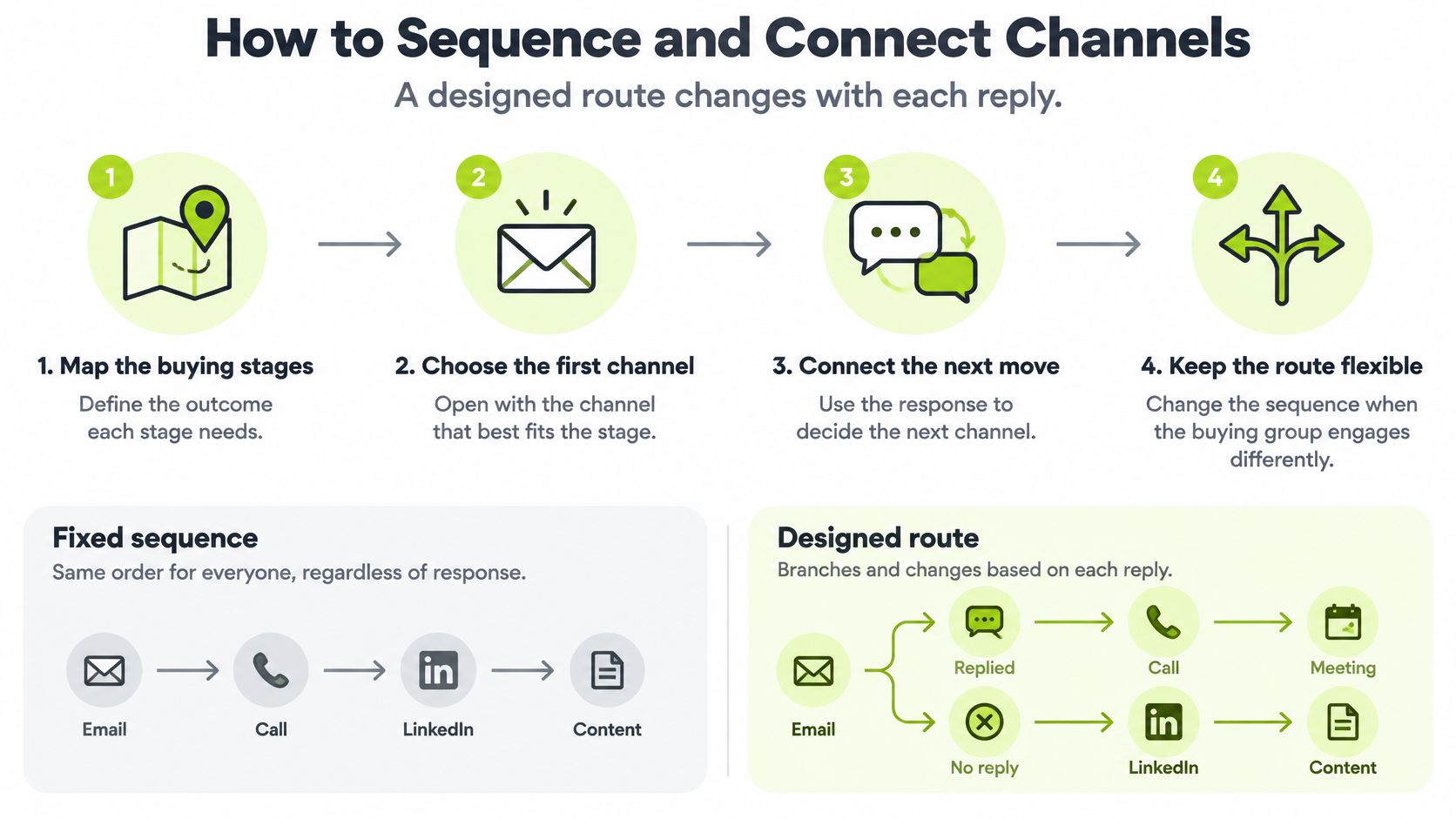
- Map the stages. Name the outcome each stage needs, such as recognition, problem agreement or a named champion.
- Assign one channel to each stage. Don't give three channels the same job on the same day.
- Set entry and exit rules. A positive reply moves the contact to a call and off the email steps.
- Set suppression and frequency. No account should be contacted by several people at once.
- Write shared language. Email, social and the call notes should describe the same problem.
- Log every touch on the account. The CRM is the baton.
- Review replies each week. Change the route when the replies say the stage was wrong.
A labelled 21-day route
For that same 50-person software company, one hypothetical route looks like this. Day 1, a cold email to the operations director. Day 3, a LinkedIn connection with a short relevant note. Day 6, a follow-up email with a technical guide. Day 10, a call only to contacts who replied positively. Day 14, a case study for the committee once a champion is named. A reply on day 2 skips the later cold steps.
H2 usually works with a customer's existing stack, beginning by identifying what already works, what needs to stay and where the handoffs break. New tools don't fix a route that nobody logs.
When the switch isn't planned
A study with researchers from ESCP Business School, Swinburne University and Monash University, reported by Inside Retail, found that only about 22% of consumers who switched channels did so intentionally or in advance. About 20% were forced to switch by outside circumstances, such as an item being out of stock. 58% showed low-to-moderate intentional cross-channel behaviour. That is consumer evidence. B2B buyers are just as messy. Availability, friction and a colleague's forwarded link will move people off your sequence.
Watch for these breaks.
- Demo, then a cold email: The prospect requests a demo on the website and gets a generic cold email the next morning.
- Unlogged social reply: A LinkedIn reply to an email never hits the CRM, so the next contact repeats the first question.
- A document that vanishes: A phone request for a document never reaches the account record, so nobody sends it.
Connecting Outbound Systems, Clay and AI Workflows
Every channel runs on the same data. Account records, contact records, enrichment, qualification rules and CRM logging have to agree, or the route in the last section falls apart.
A plain Clay-style flow is a table of accounts, enrichment steps that add firmographic or technology fields, a rule that scores fit, then a push of qualified records into the CRM and the sending tool. Clay is one option among CRMs, data providers and custom code. Use it where the logic is clearer in a table. Don't rebuild a CRM that already holds the account history. A practical map of a GTM tech stack helps you see which system should own the record before you add another.
Use AI to draft research notes and to summarise a call. A person still reviews fit before anyone qualifies the account or sends outreach. In the design and build step, H2 connects the right sources, enrichment, qualification and integrations around the customer's actual logic, rather than around a tool demo.
Deliverability and consent
Google's sender requirements, in force from February 2024, treat senders of close to 5,000 or more messages to personal Gmail accounts in 24 hours as bulk senders. Bulk senders must authenticate with SPF, DKIM and DMARC, keep valid forward and reverse DNS records, use TLS, and make unsubscribing easy. Authentication failures or invalid DNS can mean temporary or permanent delivery failures, or the spam folder.
The UK Information Commissioner's Office explains that PECR rules for electronic mail, including email and text, don't apply in the same way to corporate subscribers. Sole traders and some partnerships are treated as individual subscribers. Marketing those people by electronic mail generally needs specific consent unless the soft opt-in applies. Messages also need a valid contact address so people can opt out. Classify each contact. A company-domain address isn't automatically treated like a sole trader. Moving someone from email to phone or social doesn't remove the opt-out duty.
Systems checklist
- Clean CRM IDs: One account ID, used by every tool.
- One owner per channel: Named, not "the team".
- One suppression list: Shared across email, dialler and social tools.
- Audited AI output: Checked against the source page or call note before it is used.
Measuring Multi Channel Results Without False Precision
Measure qualified conversations, booked meetings and the opportunities those meetings create. Treat opens and raw send volume as diagnostic signals, not the result. H2 uses that same split. Volume explains a problem. It isn't the win.
Say a cold email gets no reply. Three weeks later the same account reads a case study and books a call. Last-click credit gives the whole result to the case study and misses the email. The email may have done nothing. It may also have made the later page familiar. You can't see that from one click.
Academic research on customer journeys, published via ScienceDirect, identifies carryover effects, where exposure in one period influences later behaviour, and spillover effects, where one channel changes how another performs. It proposes first- and higher-order Markov models for sequential paths in datasets with at least seven online channels. Related Bayesian attribution work models direct effects, decay over time, channel interaction and differences between customers, with uncertainty bounds around the estimates. Those models aren't a B2B benchmark. They are a warning against a single neat percentage.
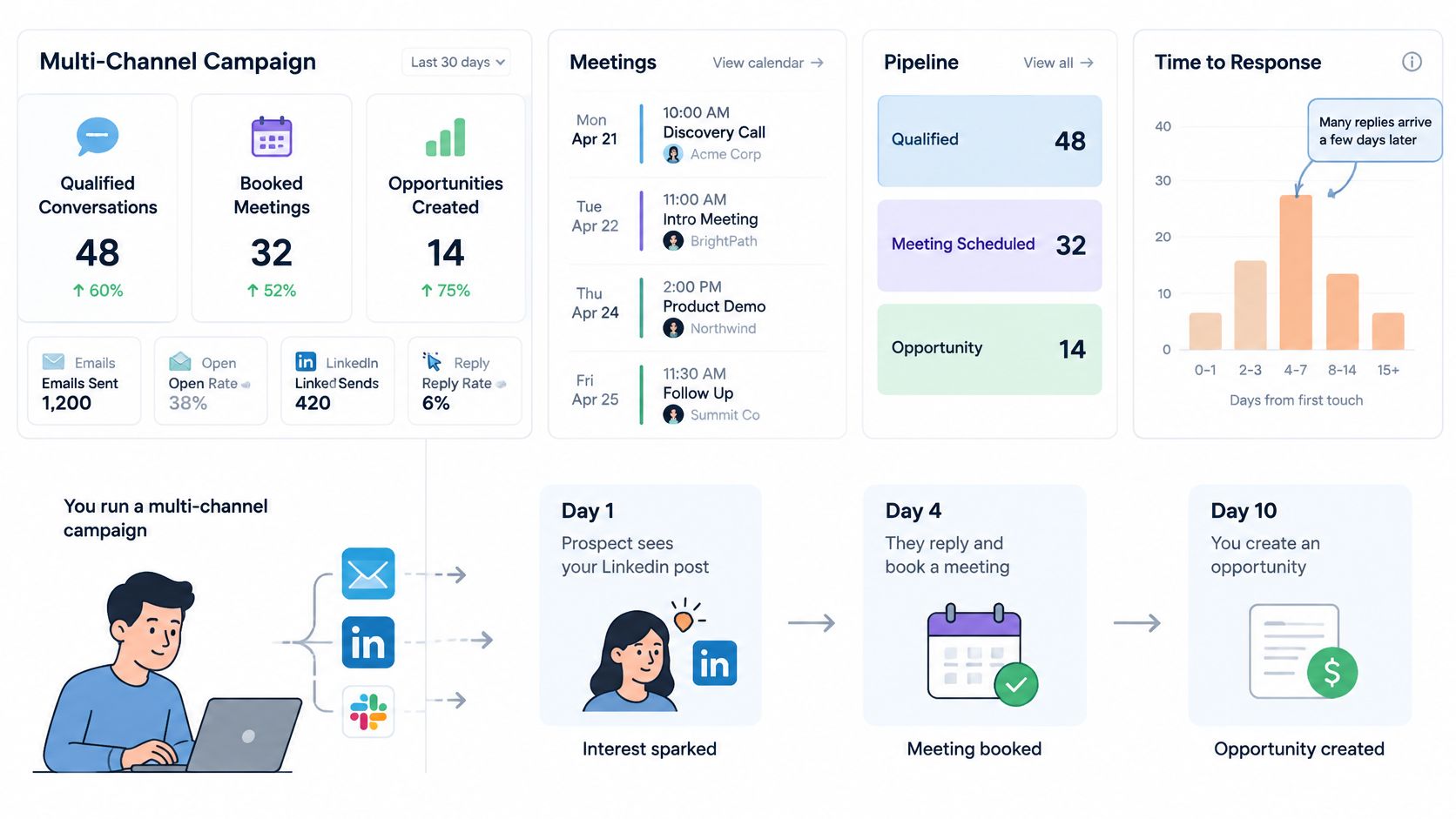
| Stage | Outcome to track | Diagnostic signal |
|---|---|---|
| Account recognition | Target accounts engaged | Opens and profile views, read as diagnostic only |
| Problem validation | Relevant replies from the right roles | Reply content, objections and tone |
| Stakeholder mobilisation | More than one contact engaged in the account | Number of active contacts per account |
| Qualified conversation | Qualified meetings booked | Meeting acceptance and fit against criteria |
| Opportunity | Opportunities created and moved forward | Stage changes recorded in the CRM |
A working method
Record each account in order. First exposure, engagement, reply, meeting, opportunity stage. Compare a channel combination with a baseline such as email-only outreach. Control for segment, deal size and sales-cycle length, or a long enterprise deal will look "better" than a short one for reasons that have nothing to do with the channel. Review the pattern with sales before you move budget.
Anonymous visits and AI-led research often stay invisible. Report direction and ranges. Don't publish an exact credit split you can't defend. Repeated weak touches can also suppress a later call. Cut those before you add spend.
Deciding Whether to Build In-House or Outsource
Three questions sort the choice. Is the offer already proven? Does the business have capacity to take sales conversations? Can the team run several channels and the data systems well?
If the offer is proven and capacity is the gap, fully managed outbound covers research, infrastructure, campaigns and optimisation. If the gap is one manual bottleneck in data, scoring or routing, a system build connects those pieces around the current process. If the gap is skill, private GTM workshops suit teams learning Clay and AI workflows on their own market. For a wider look at when outside help fits, see B2B lead generation outsourcing.
The price depends on the markets and channels, the research and data required, the systems to connect, and how much the team wants to run itself, all agreed before the fee is set. Current ranges sit on the pricing page. The first step is a short intro. You say where growth is stuck, and H2 shows the audience, infrastructure and campaign it would build.
Outsourcing is the wrong answer when the offer is unproven. The first job is then to validate the message, not to add channels around it.
H2 builds fully managed outbound and custom GTM systems so B2B teams can run several channels from shared records, clear handoffs and a route that changes when buyers reply. If your contacts still don't know what each other sent, start with a conversation about the audience and the break in the process at H2.
