What happens to the best-fit accounts that research a problem but never fill in a form? A channel comparison based only on visible leads won't answer that question. Inbound marketing attracts buyers through useful content and discoverability; outbound marketing reaches companies selected by the seller.
Neither approach wins universally. The useful decision is which deserves more weight in each market, and how both can support the same buying journey without confusing activity with pipeline.
Inbound and Outbound Marketing Compared
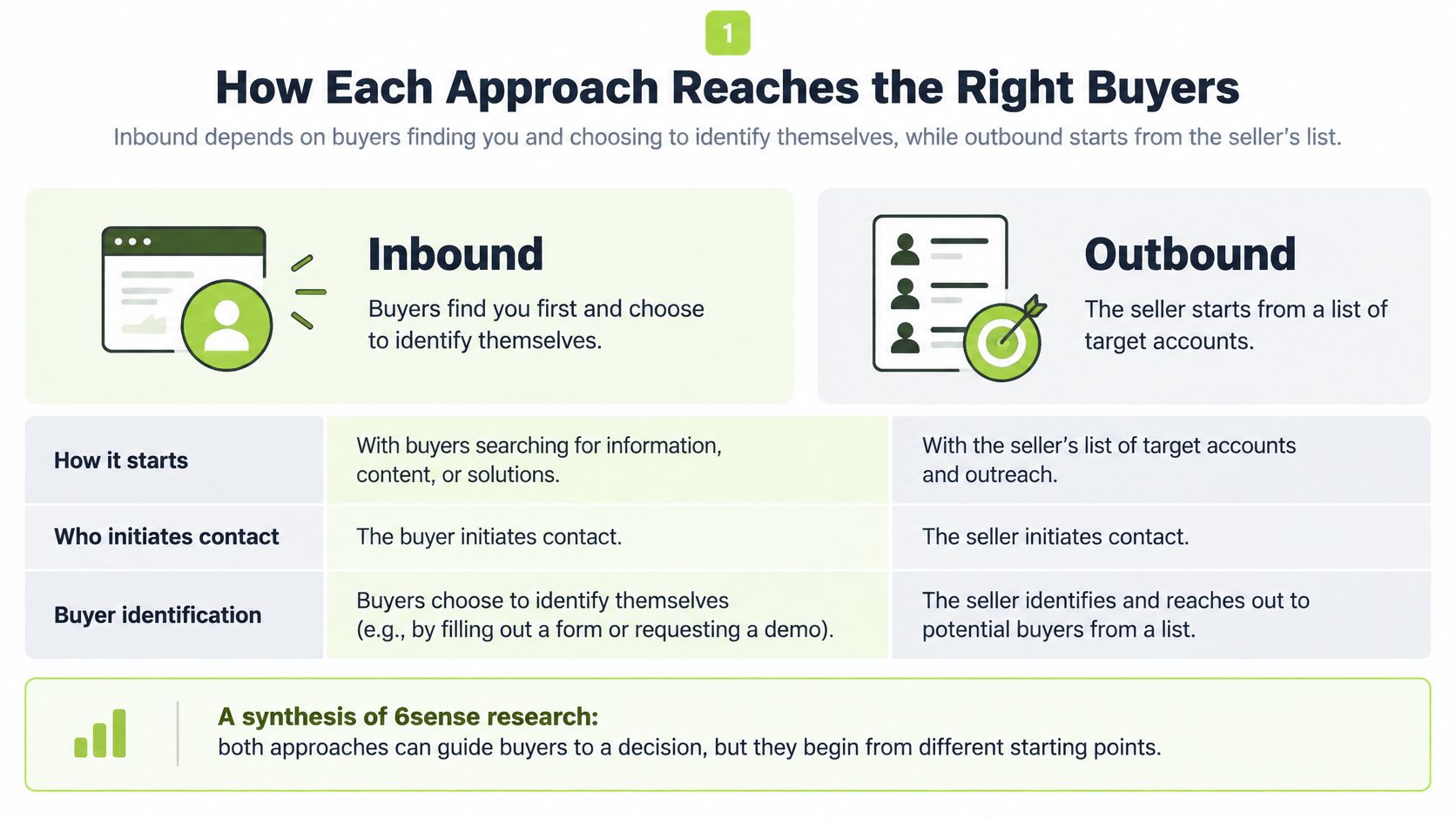
Inbound starts with buyer interest. Outbound starts with account selection. Both can lead to a sales conversation, but the initial contact comes from different directions.
Inbound includes search-visible articles, comparison pages, social posts and website enquiry paths. Outbound includes email, phone, LinkedIn, advertising and account-based outreach, where teams coordinate contact around selected companies.
The term inbound marketing is generally attributed to HubSpot founders Brian Halligan and Dharmesh Shah, with the concept introduced around 2005 and documented in 2009, according to the archived inbound marketing paper. The distinction describes how attention and contact begin, not two entirely separate kinds of persuasion.
Inbound and outbound marketing compared
| Criterion | Inbound marketing | Outbound marketing |
|---|---|---|
| Starting point | Buyers who are already searching or reading | Companies chosen by the sales or marketing team |
| How buyers are reached | Search, content, social posts and website conversion paths | Email, phone, LinkedIn, advertising and account-based outreach |
| Who starts the contact | Usually the buyer | Usually the seller |
| Typical audience | Visible, active researchers in the market | Named accounts that fit the ideal customer profile |
| Time to first pipeline | Often a longer build while content and search visibility develop | Can be faster once data, domains and messages are ready |
| Main resources | Content, SEO, design, web analytics and conversion work | Research, data, copywriting, sending setup and sales follow-up |
| Targeting control | Limited to who finds and engages with the company | Set by the ideal customer profile and account rules |
| Measurement focus | Traffic, enquiries and lead quality | Replies, qualified conversations and opportunities |
| Best fit | Markets with active search demand and a clear problem | New markets, named account lists or slow visible demand |
These are typical operating patterns, not promised outcomes. An established website may already produce enquiries, while an outbound programme may need substantial preparation before contact begins.
Choose by market coverage
A useful distinction is demand capture versus account coverage. Inbound gives interested buyers a way to discover and approach a supplier. Outbound lets a team investigate and contact suitable companies whether or not those companies have made their interest visible.
Decision rule: Choose the channel weighting by the buyers that need reaching, not by a preference for content or cold email.
Most B2B teams need a deliberate weighting of both. Market maturity, sales capacity and buyer behaviour matter more than a universal verdict about which channel is better.
How Each Approach Reaches the Right Buyers
Private research creates a gap between buyer interest and identifiable enquiries. A company can have useful content and relevant visitors without knowing which accounts deserve commercial attention.
A 6sense buyer-research guide, synthesising buyer research, reports an average of 13 content pieces consumed during the journey, comprising eight from vendors and five from third parties, and says only 3% of website visitors self-identify through forms. These are reported summary figures, not a forecast for an individual website.
Discoverability isn't identification
Inbound teams can publish educational pages, integration guides, comparison content and LinkedIn posts. Community participation and third-party coverage give buyers other ways to investigate a supplier without making an enquiry.
Form submissions therefore describe identifiable demand, not everyone considering the problem. Last-touch reporting also can't establish everything a buyer read before making contact.
The starting points differ even when both approaches eventually direct buyers towards the same website.
Content planning should start with questions buyers need answered, rather than a publishing quota. Feather's guide to content planning for inbound lead generation provides a supporting resource for organising that work.
Hypothetical example of unseen demand
Consider a software firm with strong referrals and a credible website, but few identifiable enquiries. Its team could build a targeted account list around a specific operational problem and send a relevant email, rather than waiting for those companies to discover the firm independently.
That doesn't mean the team has identified anonymous visitors. It has selected plausible buyers using account evidence, then offered a reason to engage.
The distinction matters when interpreting signals:
- Weak evidence: A page visit, job advert or social interaction suggests something worth investigating.
- Stronger evidence: A repeated problem pattern, organisational change and demonstrable product fit together support a more credible outreach hypothesis.
- Explicit evidence: A buyer describes a requirement, requests information or confirms a relevant problem.
Outbound's useful role isn't to claim certainty about invisible demand. It's to reach suitable accounts that haven't entered the visible inbound process.
Before outreach begins, the company should be easy to validate. Clear service pages, relevant technical explanations and attributable third-party proof give a recipient somewhere useful to go after receiving a message.
Time, Resources and Conversion Benchmarks Compared
Conversion benchmarks help teams frame questions, but they don't settle channel allocation. Different qualification rules, account values and acquisition costs can produce very different commercial outcomes.
A 2026 benchmark covering 28,400 B2B leads across 47 accounts, reported by Visionary Marketing, gives the following conversion rates. These are directional figures from a single dataset, available here through a published summary, not universal targets.
Conversion benchmarks from one 2026 B2B dataset
| Funnel stage | Inbound | Outbound |
|---|---|---|
| MQL to SQL conversion | 18.4% | 9.2% |
| Opportunity to close conversion | 28.7% | 17.1% |
| Visitor or prospect to customer | 0.42% | 0.19% |
MQL to SQL means marketing-qualified lead to sales-qualified lead. Opportunity to close means an opportunity becoming a won deal. The final row measures the reported visitor or prospect starting population through to customer.
Those starting populations aren't identical. A website visitor, a researched account and a qualified contact represent different levels of engagement, so end-to-end rates require particular care.
Higher inbound conversion is consistent with buyers arriving with existing interest. It doesn't prove that choosing inbound causes better results, or that every inbound enquiry fits the offer.
Interpret cost alongside conversion
A separate Prospeo comparison, citing a 939-company benchmark, reports approximately 14.6% inbound versus 1.7% outbound lead-to-customer conversion, with estimated customer-acquisition costs of about $200 and $400, respectively. These are that comparison's estimates, not transferable budgets for a particular B2B market.
Hypothetical calculation: Applying the first dataset's MQL-to-SQL rates to equal groups of a hundred appropriately classified leads would produce about eighteen inbound and nine outbound sales-qualified leads. This arithmetic illustrates the conversion gap, not a forecast.
The outbound group might still cost less to reach in a particular campaign. It might also require more research or yield more valuable accounts. Neither possibility can be resolved from conversion rates alone.
A lower conversion rate isn't automatically worse economics. The team must compare acquisition effort with the value and likelihood of the resulting opportunities.
A fully loaded cost review should include:
- Research and data: Account discovery, enrichment, verification and rejected records.
- Infrastructure: Tooling, mailboxes and campaign operations.
- Commercial work: Copywriting, qualification and sales follow-up.
- Opportunity value: Expected deal value and progression, not merely meeting volume.
The customer acquisition cost calculator can help organise the cost calculation. The useful comparison is cost per suitable customer, with equivalent cost boundaries for both channels.
Targeting, Qualification and UK Compliance Rules
Define the ideal customer profile, meaning the characteristics of companies the offer can serve well, before choosing a channel. Sector, operational problem, company structure, technology and buying roles should become explicit qualification criteria.
Inbound engagement helps prioritise responses, while outbound research determines which accounts receive contact. Neither a content download nor a matching job title should override poor commercial fit.
Match contact intensity to evidence
Accounts with a plausible need but unclear urgency suit educational material or a low-pressure invitation. Several independent indicators can justify a direct problem-based message, while explicit enquiries need a clear owner and responsive sales handling.
A useful qualification record separates observed facts, inferred problems and confirmed requirements. That prevents a research assumption from becoming a supposed buying signal as it passes between marketing, sales and RevOps.
For teams developing their approach, the prospecting by email guide supports campaign planning. The privacy-first insights from CrowdTamers offer additional operational context, but official guidance should govern legal decisions.
Classify recipients before sending
The Information Commissioner's Office guidance on B2B marketing says PECR's electronic-mail consent requirement doesn't apply to corporate subscribers, including limited companies, limited liability partnerships and government bodies. Senders must still identify themselves, provide a valid contact address and respect opt-outs.
Sole traders and some partnerships are individual subscribers, so unsolicited marketing generally requires specific consent or a valid soft opt-in. Personal-data obligations can also apply when business contact details identify a person.
A generic address isn't a compliance shortcut. The ICO's detailed marketing guidance makes clear that electronic-mail marketing rules can apply to generic as well as personal addresses. A named employee at a limited company doesn't automatically become an individual subscriber because the address contains their name.
Each prospect record should retain:
- Entity and contact category: The recipient organisation's legal type and the contact's role.
- Source and basis: Where the details came from and the relevant lawful basis where personal data is used.
- Suppression status: Opt-outs and other restrictions that prevent further contact.
- Reason for sending: The evidence connecting the account, problem and offer.
These fields turn compliance and relevance into record-level decisions rather than campaign-wide assumptions.
Measuring Each Channel Without Overrating It
Traffic, replies and meetings describe activity at different stages. None establishes commercial value alone, and a busy calendar can still contain few credible opportunities.
A practical measurement ladder runs from attention, through qualification, to opportunities, pipeline and closed revenue. Teams should preserve those distinctions rather than reporting every positive interaction as a lead.
Metrics to track for each channel
| Measure | Inbound | Outbound |
|---|---|---|
| Early signal | Traffic and enquiry volume | Reply volume and reply quality |
| Qualification | Sales-accepted leads and enquiry quality | Meetings held and objections raised |
| Commercial value | Opportunities and pipeline influenced | Opportunities created and pipeline |
| Operating risk | Form and page conversion quality | Complaint rate and unsubscribe handling time |
For inbound, examine which enquiries sales accepts and why others are rejected. For outbound, distinguish genuine problem discussions from polite refusals, referrals and requests to stop contact.
Meeting show rate and opportunity progression help reveal whether booked calls deserve the label qualified. CRM records should retain account context and the reasons sales accepts or rejects an opportunity.
Treat deliverability as a constraint
Google's sender guidance recommends keeping user-reported spam rates below 0.1% and preventing them from reaching 0.3% or higher; its bulk-sender requirements include one-click unsubscribe for marketing and subscribed messages, a visible unsubscribe link, and a recommendation to fulfil requests within 48 hours. The same guidance says bulk senders exceeding the complaint threshold can become ineligible for mitigation until they remain below it for seven consecutive days.
Authentication, unsubscribe handling and suppression checks belong in campaign operations. If complaint indicators worsen, the team should investigate targeting, frequency and message relevance before increasing volume.
A monthly review sheet can remain simple:
| Channel | Qualified conversations | Opportunities | Complaint rate | Unsubscribe handling time | Objection notes |
|---|---|---|---|---|---|
| Inbound | CRM total | Sales-accepted total | Applicable email reporting | Recorded processing time | Repeated enquiry gaps |
| Outbound | CRM total | Sales-accepted total | Sender reporting | Recorded processing time | Repeated reply themes |
An unavailable measure should be marked unavailable, not recorded as zero. Each review should produce a decision, such as narrowing a segment, improving a qualification question or addressing an unanswered buyer concern.
A B2B Example of Inbound and Outbound Working Together
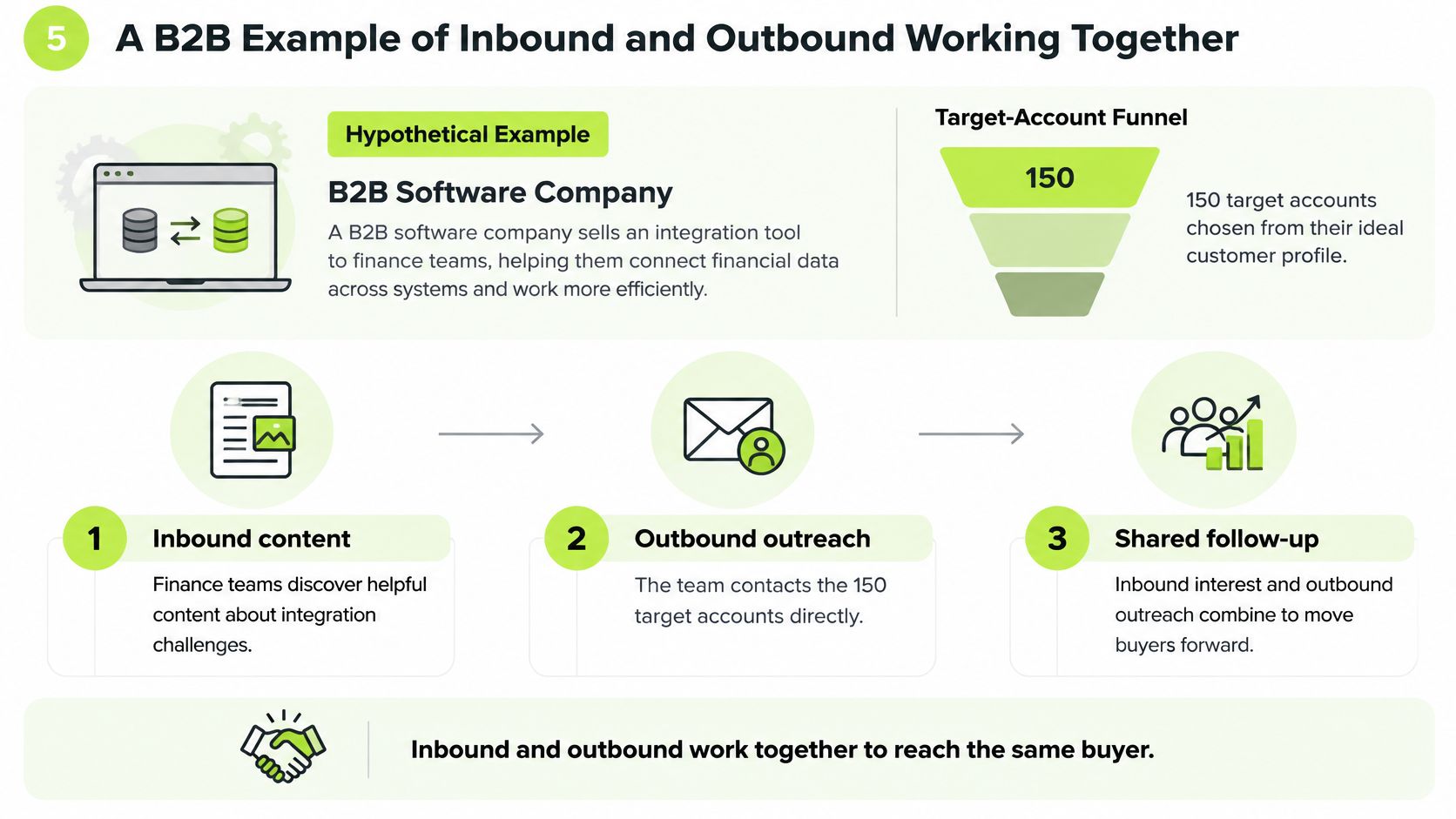
Hypothetical example: A B2B software company sells an integration tool to finance teams. It selects 150 target accounts using its ideal customer profile, with the aim of investigating a defined market rather than maximising email volume.
The combined journey includes content, direct contact and a shared follow-up process.
From account selection to a useful conversation
The team builds its list from public company information, technology use and finance-role details. Each record states why the account might need the tool and which assumptions remain unverified.
The first email focuses on manual reconciliation between systems, rather than listing every integration feature. It asks whether the problem is relevant, giving the recipient room to correct the hypothesis instead of pressing immediately for a demonstration.
After contact, an account reads an integration guide and visits the pricing page. Where that activity can legitimately be associated with the account, the team flags it for review, rather than treating it as an automatic instruction to book a sales call.
The subsequent action follows the evidence:
- Confirmed problem: A reply describing reconciliation delays goes to sales with the account context attached.
- Unclear relevance: The team offers a useful explanation or asks a narrow qualifying question.
- Opt-out or poor fit: Further campaign contact stops, with the reason recorded.
Let objections change the content
In this hypothetical campaign, replies raise security-review and implementation-cost questions. Marketing works with technical and sales colleagues to publish a comparison page and a short FAQ answering those concerns.
The next campaign uses those answers where relevant. Accounts that don't reply may also encounter the material through search or LinkedIn, although exposure shouldn't be assumed merely because the content exists.
Outbound opens the conversation, inbound keeps it credible.
Timing remains important. G2 buyer research, reported in Octo Agency's buyer-journey summary, found that 62% of software buyers preferred meeting a salesperson only during evaluation or decision in 2025, up from 46% the previous year. That preference supports giving early-stage recipients a useful self-education route rather than forcing every interaction into a meeting request.
The marketing and sales alignment guide is relevant to defining shared ownership and handoffs. Sales should receive the problem hypothesis, observed engagement, confirmed requirements and outstanding questions in one record.
H2's onboarding and investigation follows the same evidence-gathering principle: the client supplies calls, support conversations, past campaigns, customer stories and failed attempts. H2 investigates them to uncover audiences, pains, language and buying triggers.
The hypothetical company's advantage isn't just running more channels. Its team uses what buyers say to improve both the next message and the information buyers can inspect independently.
Choose Your Mix and Test One Outbound Pilot
Lean towards inbound when buyers already search for the category, the team can publish useful material consistently and the current pipeline allows time for content development. The priority is answering real buying questions and converting suitable enquiries reliably.
Lean towards outbound when entering a new market, reaching named accounts or investigating demand that isn't visible through enquiries. The priority is a defensible account list, a specific problem hypothesis and sales capacity to handle responses.
A combined approach fits markets where buyers research actively but strategically important accounts rarely identify themselves. The weighting should follow the gap in market coverage, not an arbitrary budget split.
Check pilot readiness
Before sending, the team should confirm:
- Offer readiness: A proven offer and a clear explanation of the problem it solves.
- Sales readiness: Capacity to qualify and progress additional conversations.
- Data readiness: Verified contacts, documented account fit and completed compliance fields.
- Infrastructure readiness: Sending domains and mailboxes configured for the target market, with authentication and unsubscribe handling checked.
- Learning readiness: Named owners for replies, CRM updates and commercial feedback.
The pilot should test one coherent segment. Mixing unrelated industries, problems and buying roles makes weak results harder to diagnose because the team can't tell which assumption failed.
Choose the operating model
Fully managed outbound best suits B2B teams with a proven offer, spare sales capacity and a need for more pipeline, without the time or appetite to build the function internally. H2 offers fully managed outbound and custom GTM systems; its fully managed outbound service page explains the managed route.
A prospect starts by booking an intro and explaining where growth is stuck. H2 then shows the audience, infrastructure and campaign it would build to address that constraint.
Whether the pilot runs internally or with support, the decision to expand should follow qualified conversations, opportunity progression and operating health. Useful objections may justify refining the message; repeated poor fit may require changing the segment.
The next investment should address the diagnosed constraint. More content won't fix an unsuitable offer, and more outreach won't fix a broken sales handoff.
H2 offers fully managed outbound and custom GTM systems for B2B teams that need to reach suitable accounts beyond visible inbound demand. Visit H2 to book an intro, explain where growth is stuck and discuss the audience, infrastructure and campaign that could support the next pilot.
