Marketing has a prospect list, sales has a CRM, and someone still moves records between spreadsheets before campaigns can start. The tools are connected, but nobody can explain why an account reached the wrong salesperson or received another email after opting out.
A GTM tech stack is the connected set of systems a B2B company uses to find buyers, start conversations, and store and act on the results. Its real test isn't the number of integrations. It's whether reliable records reach the right person with a clear next action.
The Layers That Make Up a GTM Tech Stack
A kitchen needs more than an oven to produce a meal. Ingredients, storage, preparation and timing must work together. A GTM tech stack works the same way: buying capable applications doesn't establish the rules that connect them.
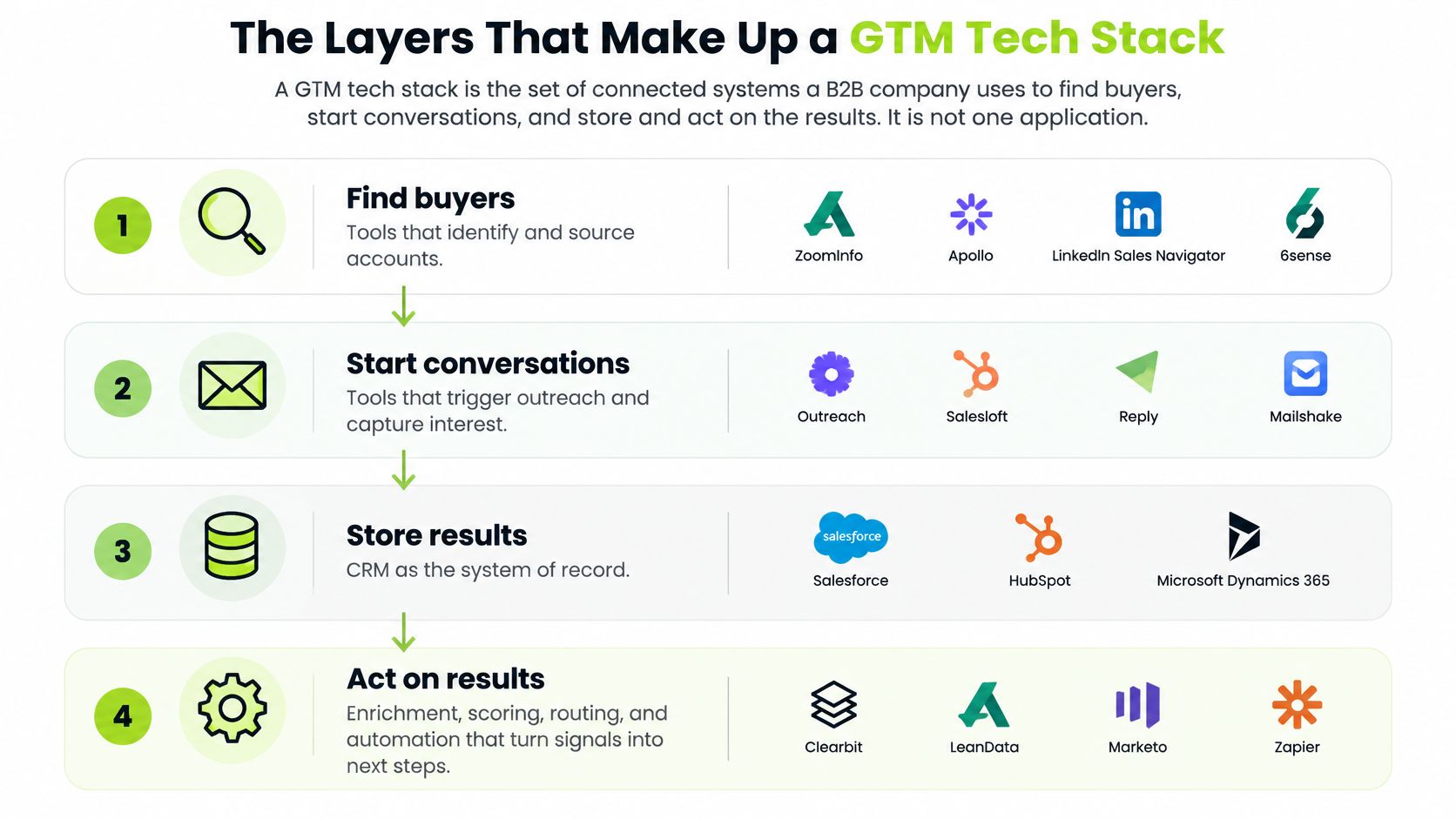
The foundational layers are data and enrichment, workflow automation, CRM, and sales engagement or outreach. Reporting deserves a separate place in an operating map, although that fifth layer is an editorial addition rather than part of the four-layer finding below.
Core layers of a B2B GTM tech stack
| Layer | Main job | Typical tools | What breaks without it |
|---|---|---|---|
| Data and enrichment | Find and verify accounts and contacts, add missing fields | Clay, Apollo, ZoomInfo | Prospect lists rely on guesses and incomplete records |
| Workflow automation | Pass signals between tools and apply decision rules | n8n and similar automation tools | Teams copy data between systems by hand |
| CRM | Store accounts, contacts, ownership and deal status | HubSpot, Attio, Salesforce | No single record of truth for sales and marketing |
| Sales engagement and outreach | Run sequences and campaigns and track replies | Sequencing and sending tools | Campaigns run without clear suppression or reply handling |
| Reporting | Measure conversations, meetings and pipeline by source | Dashboards built on CRM data | Performance is judged on activity, not outcomes |
Enrichment means adding useful information to an existing record, such as company size or a verified contact address. Automation moves that information and applies agreed rules; it shouldn't independently redefine what makes an account suitable.
The CRM, or customer relationship management platform, stores the agreed commercial record. Outreach tools execute approved campaigns, while reporting connects those activities to conversations and opportunities.
Architecture matters more than tool count
A 2026 Intempt analysis of 62 company stacks found all four foundational layers in every stack, with 15 to 54 tools among companies past $1 million in revenue, and sample adoption of 71% for Clay, 48% for n8n, 39% for HubSpot and 32% for Attio. Those adoption figures are directional observations from that sample, not market shares.
Tool counts reflect different channels, volumes, and operating needs. A larger stack is not necessarily more capable, especially when overlapping applications hold conflicting information.
Execution controls matter too. NotFair's documentation on approval-gated campaign tools offers a useful reference when considering where campaign actions should require approval rather than run automatically.
A practical inventory should place every current application against these layers. Mark missing functions, duplicate capabilities and tools without a named owner before considering another purchase.
How Data Moves From Signal to Sales Action
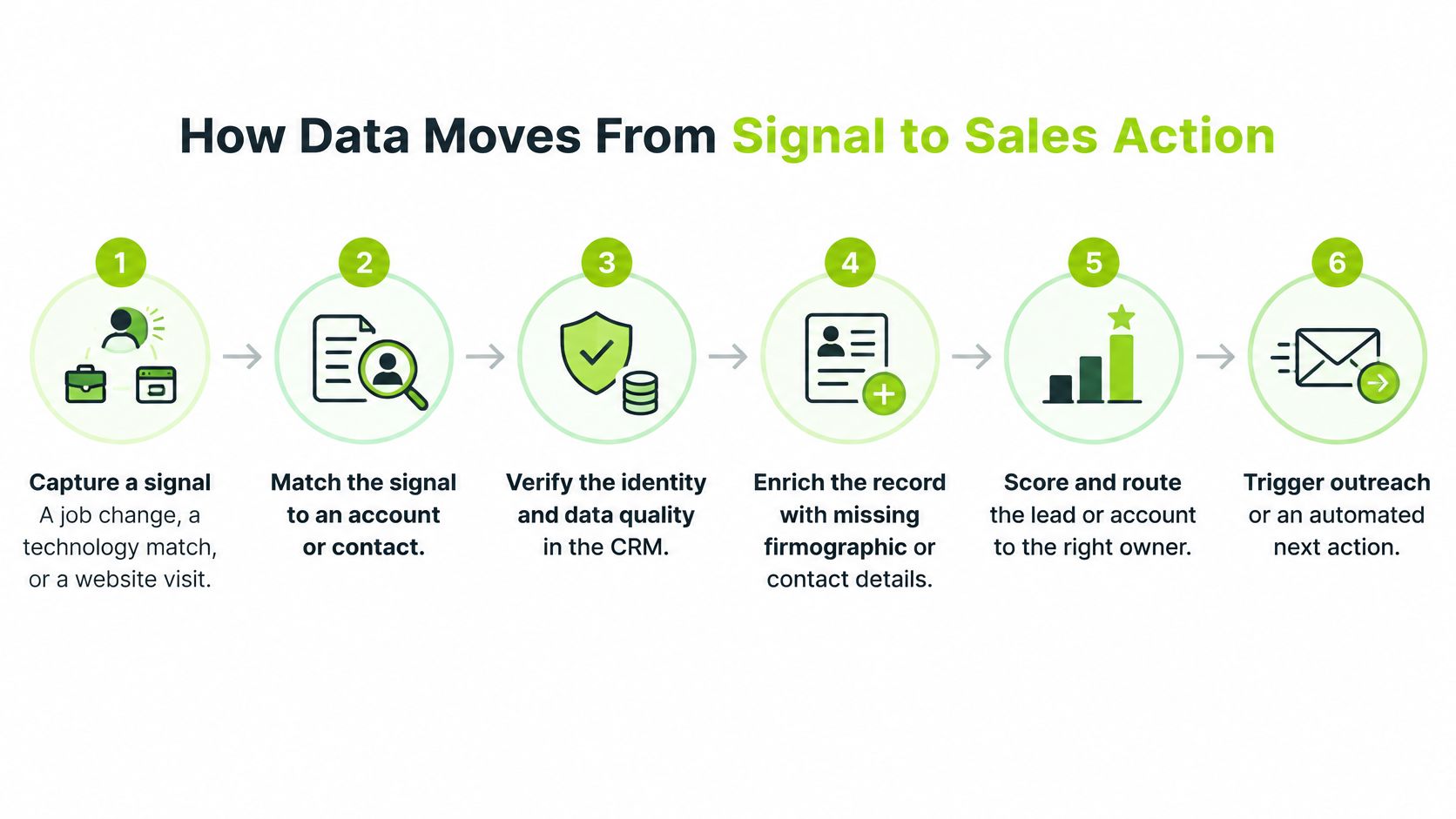
A useful inspection follows a lead from its first signal to the salesperson's response. Consider a hypothetical software account advertising a role connected to a relevant technology.
- Capture the signal. Store the vacancy and its origin. A job posting can justify investigation, but doesn't establish buying intent.
- Match the account and contact. Search existing CRM records before creating anything new. A failed match can separate the signal from an active customer or open opportunity.
- Add enrichment. Fill missing fields and retain the source, timestamp and confidence. Record enrichment cost so repeated lookups don't become invisible expenditure.
- Apply scoring and routing. Check the commercial criteria and assign the appropriate owner. Missing evidence should produce a review task, not an invented answer.
- Create a sales action. Generate an approved sequence entry or research task. Incomplete records should remain outside campaigns.
- Write back the outcome. Store replies, rejection reasons and sales decisions in the CRM so later targeting reflects actual feedback.
Inspect the handoffs, not just the connections
The 2026 GTM Engineering Stack Benchmark, a practitioner sample of 228 people across 32 countries, reported adoption of 92% for CRM platforms, 84% for Clay, 71% for AI coding tools, 65% for contact and company data providers such as Apollo and ZoomInfo, and 54% for n8n. Its Clay finding and the company-stack analysis use different samples and mustn't be combined.
An API is a defined way for applications to exchange requests and information. API rate limits can interrupt that exchange, while changes in provider accuracy can alter the quality of records arriving successfully. Workflows need failure logs, retries with increasing delays, and review queues for contradictory answers.
Where relevant social activity supplies a signal, the Instagram API integration guide provides a starting reference for examining that connection. Social interaction should remain research context, not automatic proof of commercial interest.
A successful API request proves that information moved, not that a salesperson should act on it.
H2 usually starts with the customer's existing stack, identifying what works, what must stay and where handoffs break. The same inspection can begin internally: trace a real lead and note every manual transfer, missing decision and unexplained delay.
Fixing Data Quality Before You Automate
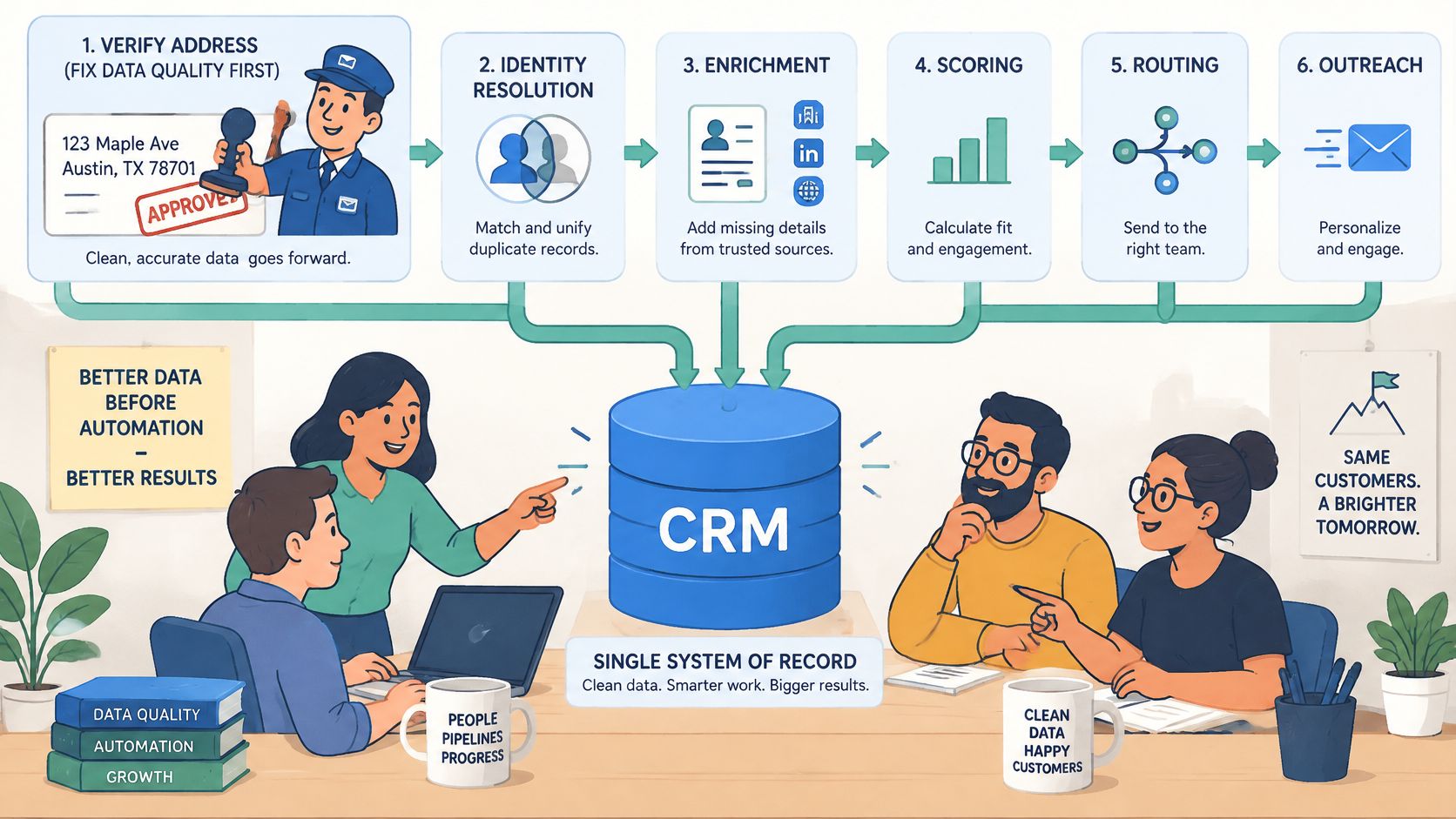
More automation won't repair an uncertain identity. It can spread the wrong record faster. Like a post office checking an address before dispatch, a GTM team should verify identity before enrichment, scoring, routing or outreach.
The CRM should be the system of record, meaning the authoritative home for account identity, contact relationships and ownership. Other applications can contribute information without becoming competing authorities.
Resolve identity before adding information
A Vandfort analysis of Salesforce data reported an 80% duplicate rate among records arriving through APIs, including marketing tools, sales tools and web forms, compared with 19% for direct imports. This describes that analysis, not an expected duplicate rate for every CRM.
Different systems use different match keys, the fields used to identify the same person or company. Email, company domain, name and phone can produce conflicting matches.
The matching order should be explicit:
- Normalise domains. Remove formatting differences and distinguish a company's website from unrelated domains.
- Standardise company names. Apply consistent treatment of punctuation and legal suffixes.
- Use deterministic matching. Accept exact matches where identifiers are reliable.
- Apply confidence-scored fuzzy matching. Compare ambiguous names and supporting fields without assuming similarity proves identity.
- Review uncertain matches. Send low-confidence candidates to a person rather than automatically merging them.
Duplicate contacts can receive repeated messages. Duplicate accounts can split ownership, consume enrichment credits and distort attribution, the process of connecting outcomes to their sources.
Measure the entry points
Track duplicate rate by ingestion source, not just an overall CRM percentage. Inspect new duplicates after integrations change, preserve merge history, and block activation until required fields and ownership pass validation.
The readiness gap is visible in LeanData's AI GTM customer survey: 93% of surveyed B2B teams ran at least one AI agent, 31% believed their infrastructure was fully ready, 55% named data quality as the leading challenge, and 70% said poor data degraded GTM execution.
H2 defines the commercial outcome, inputs, decision rules, integrations, edge cases and ownership before a custom build expands. Comparing data enrichment tools becomes more useful once those requirements are settled.
For teams connecting commerce outcomes, guidance on how to find net sales reports in BigCommerce can help locate the relevant reporting view. The same discipline applies: confirm which record and field represent the outcome before feeding it into GTM reporting.
Where AI and Automation Fit the Stack
AI fits best where outputs can be checked against evidence and rules. In HubSpot's 2024 State of Sales report, based on more than 1,400 sales professionals, 81% said AI reduced time spent on manual tasks and 78% said it made them more efficient.
Those are self-reported benefits, not evidence that unsupervised qualification works. A sensible division keeps repeatable preparation separate from commercial judgement.
Automate preparation, retain judgement
| Task suited to AI assistance | Check before use |
|---|---|
| Account research | Claims link to relevant source material |
| Data summarisation | Summary preserves uncertainty and important exceptions |
| Message drafting | Copy accurately reflects the account and offer |
| CRM administration | Updates use approved fields and retain history |
Qualification, buying-intent decisions and outreach suitability still need human judgement when evidence is ambiguous. A plausible explanation isn't a substitute for a supported decision.
McKinsey's B2B growth analysis reported 19% of B2B sales forces successfully implementing generative-AI use cases and 23% experimenting or developing them; related findings showed 21% of commercial leaders reporting fully enabled enterprise-wide adoption for B2B buying and selling, and 22% reporting specific pilots.
Test the commercial value
McKinsey's sales productivity analysis reported 10% to 15% efficiency improvements among companies equipping sales teams with technology, including automation, and estimated generative-AI productivity potential equivalent to approximately 3% to 5% of current global sales expenditure. These figures don't guarantee revenue or pipeline.
Start with a measurable bottleneck. Assess enrichment through verified-record rate, routing through assignment accuracy, and research through time saved alongside error rate. Expansion should depend on useful, checked outputs rather than impressive demonstrations.
Choosing Tools Around Team Workflows
The starting point is the workflow, not the product catalogue. Each workflow needs an input, an owner and an output before a tool can be judged fairly.
Criteria for keeping, adding or removing a GTM tool
| Criterion | Question to ask | Warning sign |
|---|---|---|
| Workflow owner | Who runs this tool each week and fixes it when it breaks? | No named owner after launch |
| Data portability | Can records and fields be exported in a standard format? | Core data is locked inside one vendor |
| Integration maintenance | Who updates the connector when an API changes? | Failures appear only as missing data |
| Total operating cost | What do licences, data credits, mailboxes and staff time add up to? | Cost is judged on the licence line alone |
| Failure recovery | What happens when enrichment fails or returns partial data? | Incomplete records reach campaigns |
| Measured contribution | Which qualified-pipeline metric changes when this tool is used? | Usage is tracked but outcomes aren't |
Ownership should follow actual work. Marketing might supply an account list, RevOps validate and assign it, SDRs produce accepted conversations, and account executives record opportunity decisions. Every handoff needs an acceptance condition.
Portability protects continuity. An inexpensive tool becomes difficult to replace if account identifiers, custom fields or decision history can't leave it.
Maintenance requires visibility. A connector that stops updating records without warning is more dangerous than a visible failure; the operator needs an alert and a recovery procedure.
Operating cost includes human repair work. A cheaper licence can still cost more if staff repeatedly clean exports or correct assignments.
Recovery should preserve safe behaviour. Failed enrichment should create a pending record, not a campaign-ready contact with blank fields.
Contribution should connect to commercial progress. Activity volume alone doesn't establish that the tool improves accepted conversations or qualified opportunities.
Consolidate without removing essential functions
The 2026 LeanData survey of 201 enterprise B2B leaders reported an average stack reduction from 62 tools to 37 in one year, while 82% prioritised clean data, defined processes and reliable routing before scaling AI, and only about one-third had the supporting systems; within that same enterprise sample, 40% reported data-quality issues affecting routing or assignment and 32% reported duplicate or mismatched lead-to-account records. These findings describe the surveyed enterprise leaders, not every B2B team.
Removing a specialist tool may lower cost while weakening coverage, deliverability, qualification or reporting. Keep tools with a distinct, measured role; add tools for an evidenced capability gap; remove overlapping tools only after testing the replacement workflow.
Consolidation succeeds when the team removes unnecessary work, not merely applications.
The guide to CRM with workflow automation supports that assessment. Follow five real records from discovery to sales feedback and record where each stalls before changing the stack.
Protecting Sender Reputation in Outbound Email
Gmail bulk-sender requirements and spam-rate thresholds
Google's email sender guidelines introduced the following bulk-sender requirements from February 2024, including the 5,000-message daily trigger, authentication requirements, recommended below-0.1% spam rate, 0.3% ceiling, and seven-consecutive-day recovery condition.
| Requirement | Threshold or rule | What it means for outbound |
|---|---|---|
| Bulk sender trigger | 5,000 or more messages per day to Gmail accounts | Bulk sender rules apply once volume reaches this level |
| Email authentication | SPF, DKIM and DMARC; visible From domain aligns with SPF or DKIM | Authenticate every sending domain before launch |
| Unsubscribe | A straightforward unsubscribe option | Build it into every message, not only some sequences |
| Spam-rate target | Keep the user-reported spam rate below 0.1% | Set an internal alert before this level |
| Spam-rate ceiling | 0.3% or above | Sender loses access to delivery mitigations |
| Recovery period | Below 0.3% for seven consecutive days | Bulk senders can regain eligibility only after this period |
Sender reputation resembles a credit score: it takes time to build and can deteriorate after poor sending decisions. Authentication and complaint thresholds are operating requirements, not guarantees of inbox placement.
Make deliverability an operating responsibility
SPF identifies authorised sending systems. DKIM adds a digital signature that helps receiving systems verify the message. DMARC sets policy and reporting around authentication and domain alignment.
Alignment means the visible From domain must align with either the SPF or DKIM domain. A campaign tool showing a connected mailbox doesn't, by itself, prove that the sending domain is correctly authenticated.
The stack needs controls beyond message delivery:
- Authenticated domains. Check every domain used for outbound before launch and after infrastructure changes.
- Shared suppression. Keep opt-outs and exclusions available wherever campaigns are created.
- Complaint monitoring. Inspect available provider reputation information alongside campaign and mailbox activity to investigate problems.
- Contact removal. Exclude unsuitable or disengaged contacts rather than continuing sequences indefinitely.
Reply handling belongs here too. A prospect who declines further contact shouldn't remain eligible just because the response sits in an inbox rather than the CRM.
List selection, message relevance and complaint behaviour all affect delivery. Sending software can't compensate for an audience that doesn't want the messages.
An email deliverability audit can structure the checks. Before the next campaign, the operator should confirm authentication across every sending domain and configure an alert ahead of Google's recommended spam-rate target.
A Worked Example for a Ten-Person B2B Team
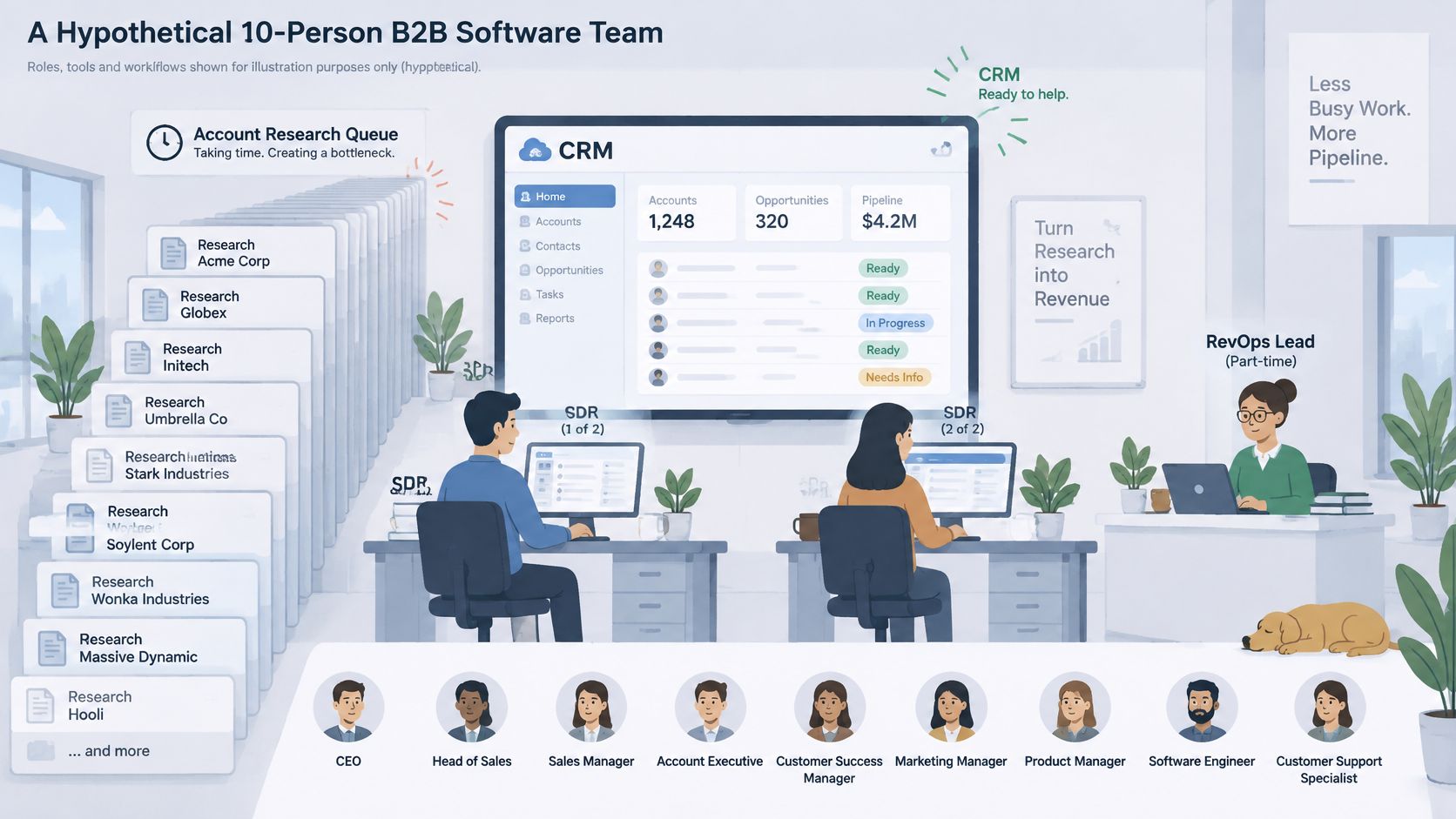
The following scenario and all its figures are hypothetical. A ten-person software company has two SDRs, a part-time RevOps lead and a CRM; each SDR spends about six hours a week researching accounts.
The team doesn't need a wholesale replacement. It needs a dependable way to prepare accounts for SDR review without disguising uncertain information.
Build around the decisions
- Define the bottleneck and outcome. The target is less account-research time while preserving SDR acceptance quality. Sending more emails isn't the success measure.
- Map the CRM record. The RevOps lead identifies account ID, company domain, fit evidence, current owner and research status. Existing customer and opportunity exclusions become explicit.
- Enrich missing fields. The workflow retains source, timestamp and confidence. If a provider returns a conflicting domain, the record enters review rather than overwriting the CRM.
- Apply explainable scoring. Confirmed fit criteria support prioritisation. An ambiguous company description produces an unresolved status, not a confident classification.
- Route accepted accounts. SDR assignment follows an agreed ownership rule and response-time target. Unavailable owners have a defined fallback.
- Measure the result. Verified-record rate, research time saved and SDR acceptance rate determine whether the workflow is useful.
Each stage is tested on real records before expansion. The trial should include awkward cases, such as subsidiaries, missing domains and accounts already owned by another seller, rather than only clean examples.
Calculate capacity before claiming pipeline
In this hypothetical calculation, research falls from 12 hours to 6 hours across both SDRs each week. That returns six hours weekly, or about 24 hours over a four-week month, before any change in pipeline.
Those hours are available capacity, not booked meetings or revenue. The sales leader still needs to establish whether SDRs use the recovered time productively and whether account quality remains acceptable.
Measurement check: A faster workflow isn't an improvement if sellers spend the saved time correcting its output.
H2's build process follows three stages: frame the problem, design and build, then prove and hand over. The important principle is that handover follows evidence of workable decisions, not merely a functioning integration.
Before trusting the result, the team should examine the baseline period, sample size and other workload changes. A quieter sales week or an easier account segment could otherwise make the workflow appear more effective than it is.
Where to Start and When to Get Help
Choose a measurable bottleneck, such as research time, enrichment accuracy, scoring or CRM routing. A proposed 30-day test can give the team a bounded evaluation period, with a named owner, a documented baseline and a clear acceptance measure.
Expansion should wait until pilot records pass validation and the chosen measure improves without unacceptable errors. A workflow that saves time but repeatedly assigns customers to outbound campaigns hasn't passed.
Signs that outside help may be useful
- No operating capacity. The team lacks time to build, monitor or maintain the workflow.
- Repeated repair work. Every integration creates another manual clean-up task.
- Unusual commercial rules. Standard product settings can't express the required decision.
- Persistent record problems. Duplicates or routing errors remain after the pilot.
A scoped build should specify the commercial outcome, inputs, decision rules, integrations, edge cases and ownership. Testing should use real records, and handover should include access, documentation and clear operating responsibilities.
H2 builds focused systems around audience discovery, buying signals, enrichment, qualification, CRM routing and operational workflows. Its process includes defining what happens when information is missing or contradictory, rather than treating exceptions as someone else's problem.
Teams needing implementation can consider custom GTM system builds, while teams planning to design the workflow internally can consider private GTM workshops. An introductory conversation can establish the business, audience and current challenge before any scope is agreed.
H2 offers fully managed outbound and custom GTM systems for teams that need more reliable research, qualification and sales handoffs. Visit H2 to book an introductory call or explore the free GTM strategy, starting with the specific bottleneck preventing suitable accounts from becoming qualified conversations.
