The most popular lead generation advice for SaaS is to do more of it. Bigger lists, more sending inboxes, longer sequences, another data provider. It looks like progress because it produces a number that goes up every week.
Constraint is rarely volume. It's judgement: knowing which companies have a problem worth paying to fix, which of them can buy, and which will never convert however good the email is. Treat that judgement as the work and contact volume takes care of itself. Treat contact volume as the work and the pipeline stays thin.
Buyers now do most of their evaluation before a salesperson appears. Gartner-related figures reported by Perform Digital put B2B buyers at only about 17% of their purchasing time meeting potential suppliers, and a 2025 survey cited there found 67% preferred a rep-free buying experience. The shortlist often forms while your first email is still unread.
That flips the job. Lead generation for SaaS has to make a company findable, credible and relevant before contact, then qualify hard once contact happens. It also has to be comfortable excluding accounts, which is where most programmes fail.
What Lead Generation for SaaS Actually Is
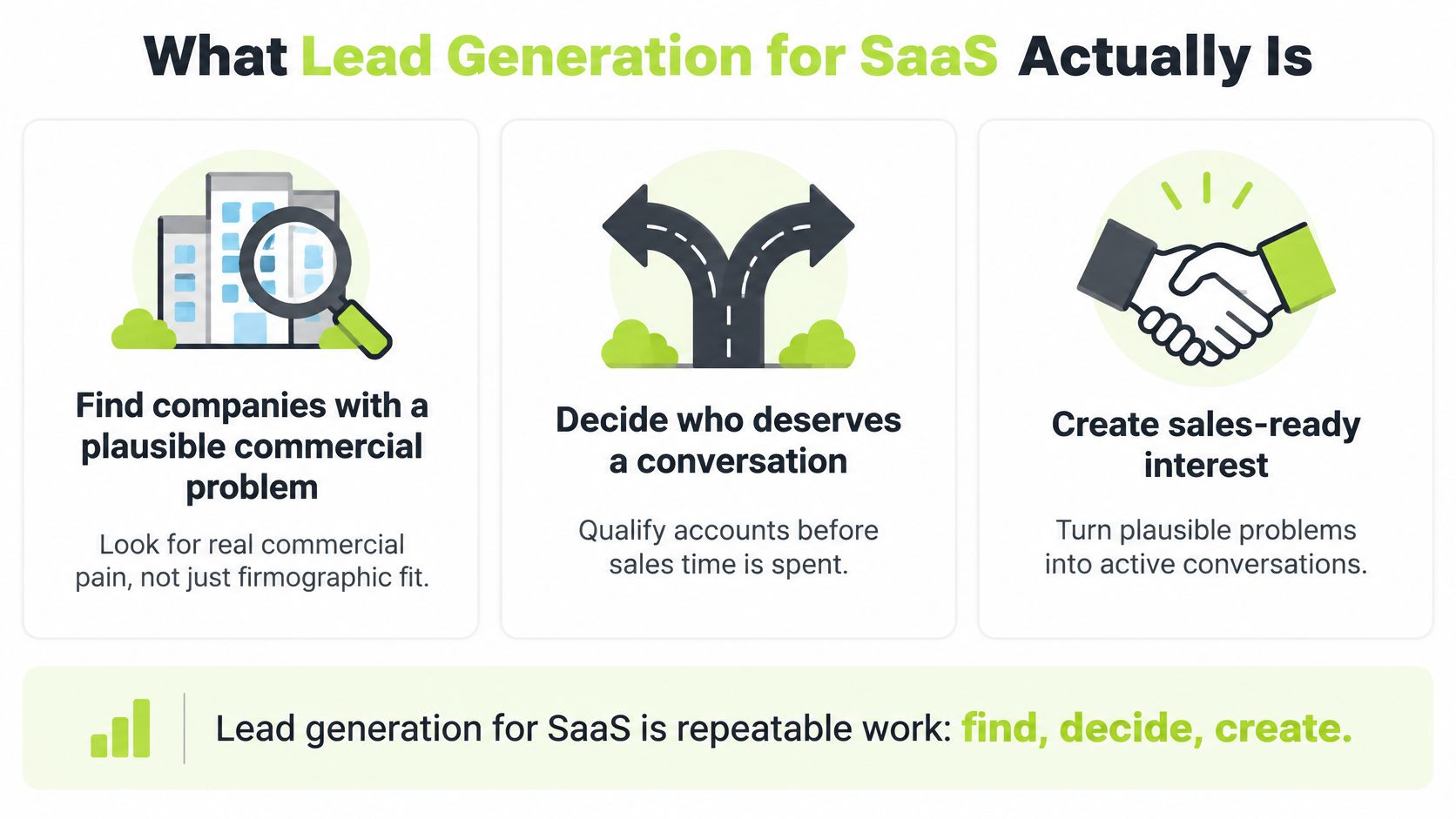
Lead generation for SaaS is the repeatable work of finding companies with a plausible commercial problem, deciding which ones deserve a sales conversation, and creating enough interest for that conversation to happen. The output is an account with a name, a reason and a next step. A contact record is an input at best.
Many companies build a net when they need a filter. A net hauls in everything in the water and leaves the sorting to whoever is downstream. A filter keeps the accounts whose problem the product solves and lets the rest pass without wasting anyone's afternoon. The difference shows up in sales capacity, not in the dashboard.
The market explains why generic lists stopped working. Zylo's SaaS statistics compilation places the global SaaS market at $408.21 billion in 2025 and forecasts $465.03 billion in 2026, roughly $56.82 billion of additional annual market value in a single year, with a 13.32% compound annual growth rate projected from 2025 to 2034. The same compilation reports organisational SaaS adoption rising from 71% in 2018 to 95% in 2023.
Read those two facts together. Almost every company you would want to sell to already runs cloud software. Prospecting is therefore about replacement, consolidation, expansion or a workflow that has broken, not about explaining what the cloud is. An email that introduces a category to someone already three tools deep reads as noise.
The discipline has three jobs: define the market, including who to exclude; be present where buyers form a shortlist, which increasingly means inside AI-assisted research; and judge the work by qualified conversations and pipeline rather than contacts.
The list mechanics underneath all of this are ordinary craft. CleanMyList's guide to prospecting stages and proven tactics covers how sourcing, verification and sequencing fit together once the market definition is settled.
The working definition: a lead is an account with a reason to change and a person who can act, not an email address on a list.
Stage Benchmarks for a SaaS Pipeline
Start with the numbers, then decide where your funnel leaks. These are published ranges from a SaaS lead generation benchmark compilation, not targets to hit.
SaaS lead-stage benchmarks and what to do with them
| Stage | Benchmark | What a weak result usually means | Response |
|---|---|---|---|
| Website visitor to lead | 1–3% of visitors | Offer, page or audience is unclear | Fix the page and the audience before scaling traffic |
| Lead to marketing-qualified lead | About 31% of leads | Fit rules are missing or too loose | Score observable fit and drop poor-fit records |
| MQL to sales-qualified lead | 13–40% of MQLs | Thresholds are too loose near 13% or too tight near the top | Require evidence of intent, then review false positives and false negatives monthly |
The same compilation puts B2B SaaS websites at roughly 1–3% visitor-to-lead conversion, about 31% of leads becoming marketing-qualified, and 13–40% of MQLs reaching sales-qualified, depending on how strict qualification is. That spread at the last stage is enormous, and it's a design choice rather than a market fact.
Loose rules swell the MQL count and burn sales time on conversations that were never going to close. Rules that are too tight drop a real buyer before a human being has looked at the record. Both failures cost pipeline; only one shows up in a report.
Fit is observed, intent is inferred
Split the score in two and keep them separate.
Fit is observable and mostly firmographic plus technical: employee range, geography, industry, technology environment and the role of the contact. Intent is inferred: repeat visits, product-page activity, pricing interaction, trial behaviour, a relevant job posting, or a documented operational trigger such as a migration or a new support team.
Give each field a weight, require a minimum amount of evidence before anything routes to a human, and store the source evidence beside the score. A sales rep who can see that an account scored highly because of a pricing-page visit and a database hiring advert will trust the queue. One who sees a bare number will ignore it within a fortnight.
Calibrate against meetings, not opens
Review the model monthly against accepted meetings, qualified opportunities and pipeline. Email opens and raw form fills tell you about deliverability and copy, not about whether the qualification logic is right.
Then use the output to route accounts. High fit with high intent gets fast human follow-up. Lower-confidence records go to a research queue or automated nurture instead of competing for the same SDR hour. The MQL to SQL conversion rate guide goes deeper on where to set that threshold.
Diagnostic rule: if visitor-to-lead looks healthy and the SQL rate sits near the bottom of the range, the leak is in qualification, not traffic.
Accounts Worth Excluding Before Outreach
Ask a SaaS founder what's blocking pipeline and the answer is usually "not enough leads". The more common cause is a target list full of accounts that were never going to buy, being worked by a team with no time to notice.
Buyer behaviour supports the contrarian read. Research summarised by Infuse from its voice-of-the-buyer study indicates that 61% of enterprise technology buyers were evaluating, planning or had already eliminated one or more platforms because of AI, compared with only 13% adding platforms. The same research identifies integration with the existing stack, quantifiable ROI and a clear explanation of what a product does as central evaluation criteria. Consolidation, not expansion, is the mood.
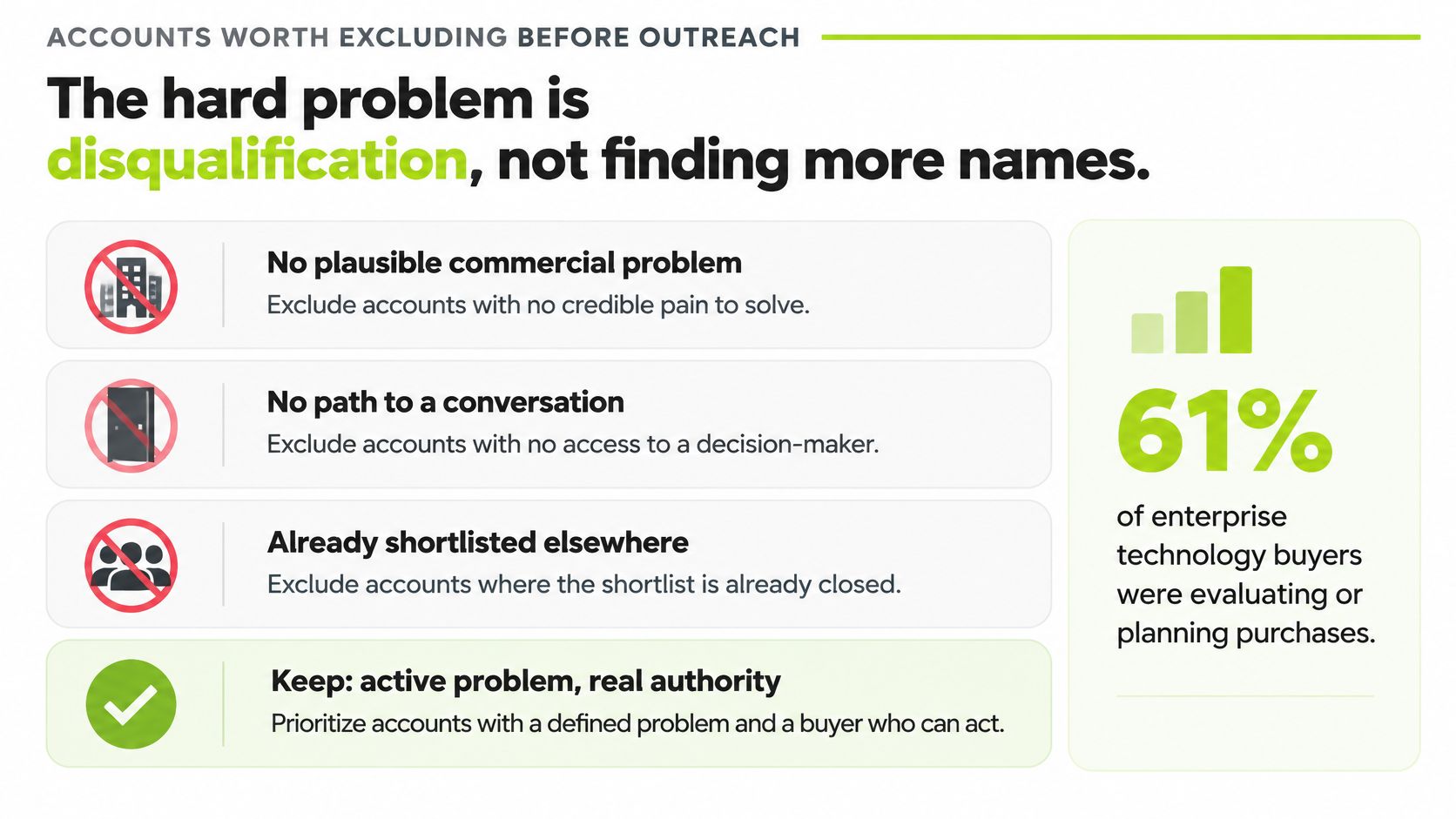
That changes what a qualification call is testing. It isn't only whether the pain exists. It's whether the account has permission to act, budget to change and a stack that can absorb another tool.
Negative signals and where the account should go
| Signal | What it proves | Route |
|---|---|---|
| Incumbent or overlapping tools | Possible consolidation, not automatic demand | Displacement only if the cost of the current tool is evidenced |
| No workable integration | The product cannot fit the stack | Exclude or park |
| No quantifiable cost of the problem | ROI will be hard to defend | Education, not a sales meeting |
| Restructuring or budget pressure | Weak permission to buy | Nurture until the constraint changes |
| Relevant hiring or capacity gap | A reason to investigate only | Research, then outreach if fit still holds |
| Failed rival implementation | A possible switching moment | Sales outreach with specific proof |
Treat these as first-class data rather than notes in a rep's head. Incumbent and adjacent technologies, procurement restrictions, a failed implementation history, budget pressure and relevant hiring all belong in the account record with a confidence level and a date.
A vacancy is the clearest example of a signal people misread. A job advert for a data engineer tells you a company is investing in data. It doesn't tell you they are buying this quarter, that the budget exists, or that the hiring manager owns the problem. It's a reason to look, and sometimes a reason to write, never proof of intent.
The practical habit is to document exclusions. Write down why an account was left out, what evidence supported it and when the decision was made. Six months later that note is the most useful page in the record, because markets move and yesterday's disqualification becomes today's opportunity.
Working habit: record the reason for exclusion with the same care as the reason for outreach.
The measurement shift follows. Compare qualified opportunities from a smaller, evidence-backed market against opportunities from a broad list. If the smaller market produces more conversations that sales accepts, the list was never the problem.
Channels for Buyers Who Shortlist with AI
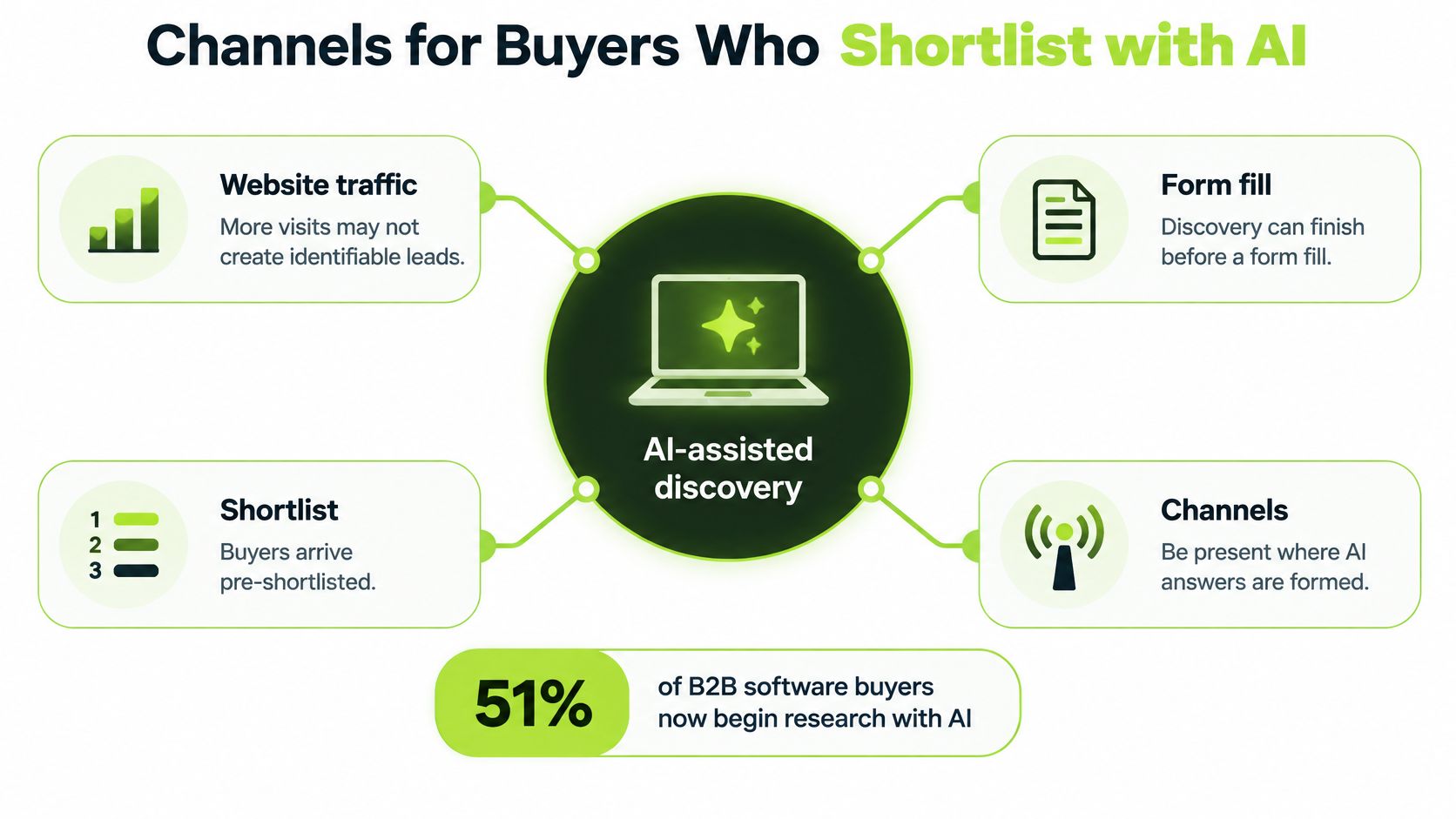
More traffic doesn't reliably produce more identifiable leads, because discovery can finish before anyone visits your site. Buyer research from the Innovative Group state-of-the-buyer study reports that 51% of B2B software buyers now begin vendor research inside an AI chatbot, up from 29% twelve months earlier. A second survey cited there found that 82% of buyers had sourced software recommendations from an AI chatbot during the previous two years, while review sites influenced 38% of shortlists and AI chatbots 37%.
The buyer arrives pre-shortlisted. Your job is to be one of the plausible answers, and then to be findable when they check.
The assets that win a place on the shortlist
Five things do most of the work, and none of them is "create useful content" in the abstract.
- Customer evidence with context: the outcome, the starting situation and the constraints, so a reader can judge whether their case is similar.
- Comparison pages that state differences plainly: including where a competitor is the better fit. Buyers use these to eliminate options, so honesty gets you further than a rigged table.
- Integration detail: what connects to what, and what the migration path looks like.
- Pricing context: enough to judge fit, even as a range or a starting tier.
- Third-party references: review-site profiles, partner directories and independent write-ups, because AI answers and buyers both lean on them.
Then monitor what gets said about you. Incorrect AI descriptions of the product, missing integrations and outdated pricing are all fixable, and none of them announce themselves. Check the answers a buyer would get, not the ones you'd like.
Channels matched to the shortlist moment
| Channel | Buyer moment | What to put in market | Metric |
|---|---|---|---|
| Search and product pages | Anonymous evaluator checking a claim | Plain differences, integrations and enough pricing context to judge fit | Comparison-page engagement |
| Review sites and partners | Shortlist influence before contact | Customer evidence with the outcome and the context, plus third-party references | Shortlist inclusion |
| AI chatbot answers | Research started inside a chatbot | Correct product description, integrations and current pricing | Incorrect or outdated AI descriptions found |
| Outbound | An account with a documented trigger, not a job advert or tool sighting alone | The role, the technology environment and one problem | Sales conversations |
| Branded research | A buyer already comparing named vendors | Consistent proof across the site, reviews and sales conversations | Branded research |
The point of the table is sequencing, not ranking. Search and product pages serve a person checking a claim they half-believe. Review sites and partners shape what gets recommended. Outbound earns its place only when an account shows a documented trigger, and the message should name the role, the technology environment and the specific problem.
Measure shortlist inclusion, branded research, comparison-page engagement and sales conversations. Organic sessions and MQL counts alone will hide the work that moves a SaaS buyer. A multi-channel approach explains how these channels reinforce each other rather than competing for credit.
How to Run the Lead Generation Cycle
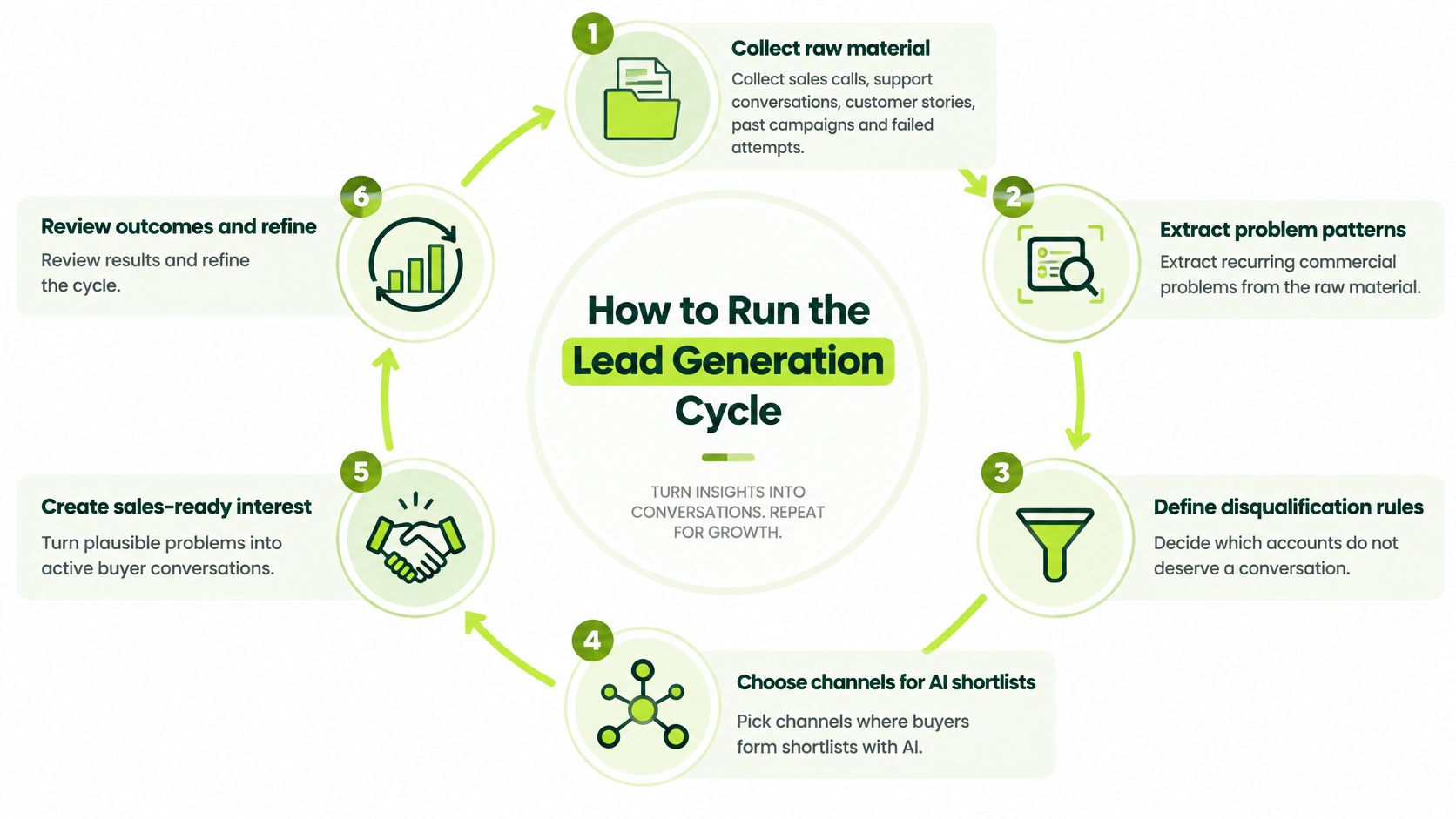
A campaign is an event. A cycle is a system that gets slightly better every month. Run these eight steps in order, then repeat them.
-
Collect raw material. Pull sales calls, support conversations, customer stories, past campaigns and failed attempts. The reason is simple: your market's language lives in those transcripts, and no keyword tool will hand it to you.
-
Extract the problem patterns. Turn the raw material into a short list of commercial problems, the roles who feel them and the events that make them urgent. Write these down before anything else.
-
Define exclusion rules. Decide which accounts do not deserve a conversation, using the negative signals in the previous step of your thinking. Rules written after the list exists get bent to fit it.
-
Build lists from public evidence. Company information, job postings, technology use and relevant public activity all help. Store why each account was included, and treat a vacancy or a tool sighting as the start of research rather than proof of intent.
-
Set infrastructure before volume. Authenticate sending domains with SPF, DKIM and DMARC, keep one central suppression list, and pass opt-outs between the sending tool and the CRM. Gmail treats a sender as a bulk sender when it sends close to 5,000 or more messages to personal Gmail accounts in 24 hours, counting messages from the same primary domain, and since February 2024 has required bulk senders to authenticate, avoid unsolicited mail, offer easy unsubscribe and keep user-reported spam below 0.1%, with 0.3% or higher a serious compliance risk (Gmail's bulk sender guidelines). Don't treat 5,000 as a target; reputation degrades long before that.
-
Write short messages tied to one trigger. Reference the role, the technology environment and a single problem. Test one variable at a time, or you'll learn nothing from the result.
-
Launch a controlled batch and learn from it. Change targeting, message or timing based on replies, objections and booked meetings. A batch that produces no objections usually produced no attention either.
-
Record and review. Put the conversation, the evidence and the next step in the CRM, then review false positives and false negatives by segment each month.
Onboarding for a managed programme follows the same order: the client supplies calls, support conversations, past campaigns, customer stories and failed attempts, H2 investigates them to uncover audiences, pains, language and buying triggers, then builds precise lists and mobile-first messages, launches controlled campaigns, and uses each reply, objection and booked meeting to improve the next iteration.
The legal mechanics of commercial email
Deliverability and consent sit inside this cycle, not outside it. US CAN-SPAM rules require accurate From, To, Reply-To and routing information, no deceptive subject lines, advertisement identification where required, and a valid physical postal address. The opt-out must keep working for at least 30 days after the message is sent, be honoured within 10 business days, charge no fee, ask for no more than an email address and require no more than an email reply or one web page (FTC CAN-SPAM compliance guide).
Where tools fit, and where they don't
Clay can sit beside your CRM and data providers where a rule calls for it. The system is the commercial rules, the evidence standards and the routing logic. A tool that enriches a bad list faster just produces a bigger bad list.
If nobody owns steps four to seven, that's an operating-capacity problem, not a copy problem. Hiring a better writer won't fix a list nobody is qualifying.
Measure Buying Progress Not Contact Volume
The reason to measure progress rather than contacts is that most of the buying decision happens without you. In 6sense's 2024 B2B Buyer Experience research, which surveyed 2,509 recent B2B buyers, 69% of the purchase process occurred before buyers engaged sellers, 85% established purchase requirements before contacting sales and 81% had chosen a preferred vendor before speaking with a sales representative.
The 2026 edition tightens the picture. 6sense's 2026 buyer research reports that buyers first engage sellers roughly 59% of the way through an average 10.3-month buying cycle, by which point 91.4% have ranked their shortlist and the pre-contact favourite wins 82% of deals. Selection accounts for about 60% of the journey.
So store, for every priority account, the public signal, the buying-group role, any known requirement and previous interactions. Route the account to research, nurture or sales based on that evidence. A booked meeting is not automatically progress if the buyer never had you on the list.
Separate the measures: meetings, opportunities and pipeline are three different numbers. Only the last one pays.
A hypothetical shows why the middle stage matters more than traffic. Take 1,000 visitors converting at 2%, which gives 20 leads. A 31% lead-to-MQL rate leaves about 6. A strict 20% MQL-to-SQL rate leaves about 1 sales-qualified opportunity. This is arithmetic on published ranges, not a forecast. Moving that middle threshold changes sales workload far more than another 1,000 anonymous visitors ever will.
Filtering a large universe down to a small, evidenced one is where the advantage lies. H2 turned 50,000 companies into a focused ABM audience and scored 50,000 leads for a client for exactly this reason.
Keep pipeline separate from closed revenue, and don't combine figures from different programmes into one dashboard. LiveDocument's list of key metrics for lead generation covers the supporting measures worth tracking alongside accepted meetings and qualified opportunities. Compare all of them, monthly, against your false positives and false negatives by segment.
Choose In-House or Managed Outbound
The build-or-buy decision is a capacity question, not a budget one. Both routes work when the offer is proven. Neither fixes a product nobody wants.
Run the cycle in-house when someone can own list quality, sending infrastructure and weekly learning, and when sales has room to take the conversations. That's a real role, not a side task for a founder who also runs marketing.
Choose fully managed outbound when the offer is proven and the team can take meetings, but nobody has the time or appetite to run research, data, infrastructure, copy, tests and reply handling. H2's fully managed outbound service covers research, infrastructure, campaigns and optimisation end to end, with the managed plan including market research, strategy and campaign testing, and conversations and next steps recorded in the client's CRM.
Two other routes solve different problems. Custom GTM system builds fit a defined bottleneck such as enrichment, scoring or CRM routing that your team will operate after handover. Private GTM workshops suit a team that wants to learn the judgement rather than hand over the campaign.
Current scope and pricing sit on the H2 pricing page. If the diagnosis is unclear, the wider guide to B2B lead generation outsourcing sets out what to keep in-house and what to hand over.
H2 builds fully managed outbound programmes for B2B teams with a proven offer and the capacity to take more sales conversations, covering the research, infrastructure, campaigns and optimisation that rarely gets time to run properly, plus custom GTM systems where a single bottleneck such as qualification or CRM routing is holding pipeline back. If your funnel looks like the ones above, an account base of plausible problems, a shortlist that forms before contact and a weak MQL-to-SQL step, the next step is a 15-minute intro call to explain where growth is stuck and see the audience, infrastructure and campaign H2 would build around it. Book one at H2.
