If a lead generation campaign only looks healthy when the send count is high, the measurement is pointed at the wrong thing. Replies and meetings matter, but they arrive late. Data setup, qualification rules and the handoff decide whether those replies were ever worth having.
A useful campaign is one system. The audience definition says who is in and who is out. Buyer questions rewrite the message. Sending controls and CRM routing decide whether a fit account becomes a conversation with an owner. Volume is a diagnostic, not a result.
The question worth asking first is simple. Which stage is leaking, and who is responsible for closing it this week?
The Parts of a Lead Generation Campaign
A lead generation campaign is six linked parts: defining the audience, researching accounts, building the data and sending setup, running outreach, handing qualified leads to sales, and measuring results. Each part has an output the next part can use. Miss an owner and the fault shows up later, usually mislabelled as a bad list or weak copy.
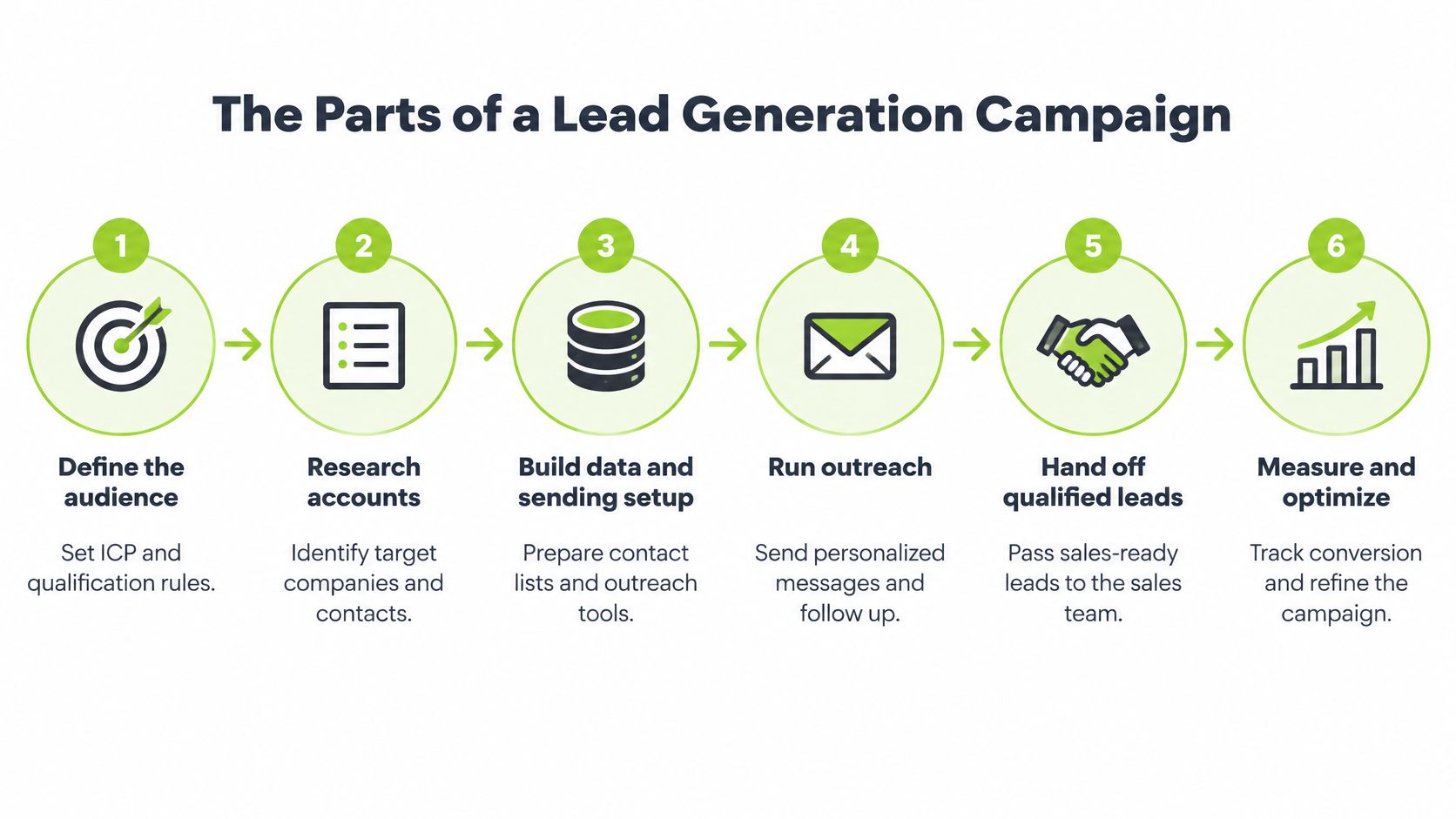
| Stage | What it produces | Usual owner |
|---|---|---|
| Audience definition | Ideal customer profile and disqualification rules | Marketing and sales leadership |
| Research | Scored account list with buyer questions | Research lead |
| Data and sending setup | Verified contacts and authenticated sending domains | RevOps |
| Outreach | Sequences, replies and booked conversations | Campaign owner |
| Handoff and qualification | Routed leads and CRM tasks | RevOps and sales |
| Measurement and optimisation | Stage conversion report and test results | Growth lead |
Buyers do not stay on one path
McKinsey's December 2021 B2B research found that B2B customers regularly used ten or more channels to interact with suppliers, compared with five channels in 2016. A single cold email sequence cannot carry that journey. The same research found that 94% of respondents considered the modern combination of face-to-face, remote and online engagement at least as effective as the pre-pandemic model.
Picture a software firm that only tracks inbox replies. A buyer skips the email, reads a product page, and later asks a colleague after a webinar. If research, content and sales do not share one set of rules, that account never gets scored, even though the interest was real.
Before you launch: Every stage needs a named owner, a defined output and a handoff date. If any of the three is blank, the campaign is not ready to send.
Define the Audience and Qualification Rules
Start with an ideal customer profile (ICP). Write the firmographic fields in plain language: company segment, employee range, geography and technology stack. Then add the problem the buyer is trying to solve, and the trigger that makes them act now. A profile without a trigger produces a large list of companies that look right and are not buying.
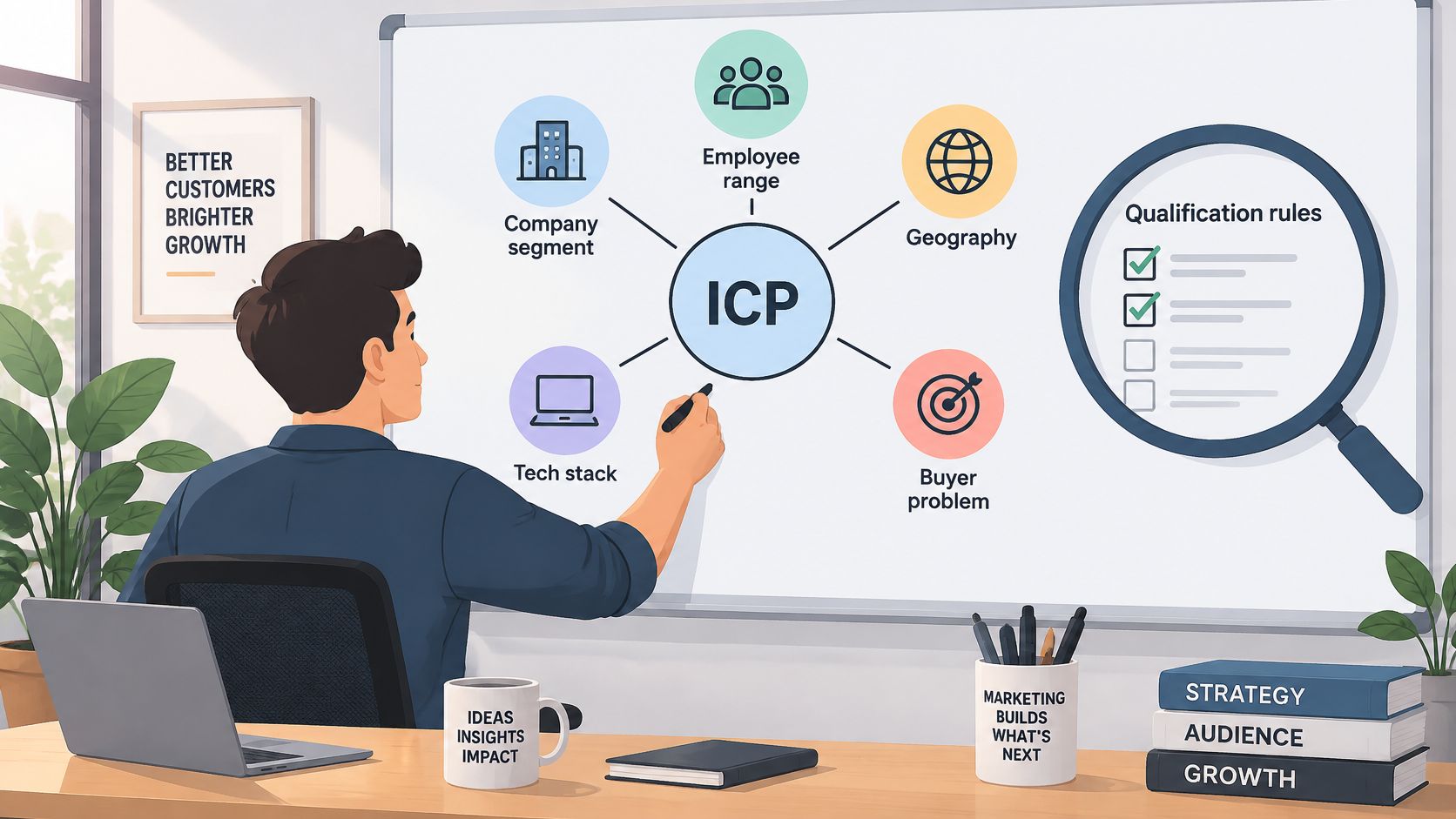
Two different kinds of rule
Hard exclusions remove an account whatever else is true. An industry the offer cannot serve, or a company too small to buy, should never reach sales. Weighted signals only rank the accounts that remain. They do not rescue a poor fit.
Take a labelled hypothetical. A software firm sells integration support to companies with 50 to 500 staff that use a specific CRM. Agencies are excluded. Companies under 20 staff are excluded. Among the rest, a stated integration problem scores highest, a matching technology stack scores next, and a recent hiring signal scores lower. A vacancy is a reason to look, not proof of intent.
Put this on one page the sales team can read without a meeting.
- Named criteria: each field, what counts, and what does not.
- Points: the weight of each signal, with a written reason.
- Pass threshold: the score that creates a sales task.
- Rejection reasons: a short standard list, so "no" means the same thing every week.
A tidy document is still a guess until someone validates the ICP with real data from won deals, lost deals and conversations sales would not take again. The pass rules then need to match how to qualify a lead, or marketing and sales will argue about the same account twice.
Score twenty accounts by hand. Ask a salesperson whether they agree with each result. Where they disagree, change the rule before anyone builds a list of hundreds.
Research Accounts and the Questions Buyers Ask
The most useful research output is often the question a buyer still cannot answer, not another firmographic tag. Start inside the company, because that is where buyers already use their own words.
In onboarding and investigation, the client provides calls, support conversations, past campaigns, customer stories and failed attempts, and H2 investigates them to uncover audiences, pains, language and buying triggers. Note the phrase the buyer uses for the problem, and the moment that made them act. A lost deal that died on packaging is more instructive than a job title that merely matches the ICP.
External signals are clues, not proof
Public company information, websites, job postings, technology usage and relevant public activity come second. A vacancy, a technology choice or a social interaction does not by itself show purchase intent. Treat each one as a reason to look closer.
When database support became a priority for one client, H2 generated 134 leads by following that operational need rather than a broad industry slice. The lesson is narrow. A repeated problem can be a better selection rule than a demographic match, and only if the team can see the problem in the source material.
Sort questions into a simple taxonomy: pricing, packaging, capabilities, integrations, demos or trials, onboarding and service, and security. Count them across calls, replies, website sessions and lost deals.
An analysis from Storylane, based on internal data from approximately 68,000 B2B SaaS deals, found conversations dominated by practical questions: pricing and packaging 23.1%, capabilities 19.3%, integrations 9.9%, demos or trials 8.8%, and onboarding or service 6.8%. Security and compliance accounted for only 1.5%. That is one dataset, not a benchmark for every market.
What to log for two weeks
- Sales calls: the owner logs the question that stalled the deal.
- Support tickets: the owner logs the words customers use for the same pain.
- Past replies and lost deals: the owner logs the objection that ended the thread.
- Web sessions: the owner logs which page the visitor opened before leaving.
Feed the frequent categories back in. Pricing questions tighten qualification. Integration questions change the first message. A category that rarely appears should not dominate the sequence just because it is easy to write about.
Set Up Data, Deliverability and CRM Handoffs
Deliverability is an operating control, not a line in the copy deck. Since February 2024, Gmail's sender requirements have set specific thresholds for outbound email.
| Requirement | Applies to | Threshold or action |
|---|---|---|
| SPF or DKIM authentication | All senders to Gmail personal accounts | Required |
| Valid forward and reverse DNS, TLS | All senders to Gmail personal accounts | Required |
| Spam rate | All senders to Gmail personal accounts | Keep below 0.3% |
| Spam complaint target | Bulk senders | Keep below 0.1% |
| SPF, DKIM and DMARC with domain alignment | Senders above 5,000 messages a day | Required |
| Simple unsubscribe mechanism | Senders above 5,000 messages a day | Provide one |
Google advises bulk senders to keep spam complaints below 0.1%, because higher rates can already harm inbox delivery. Senders at or above 0.3% can lose access to delivery mitigations until the rate stays below that level for seven consecutive days. Check complaints daily, suppress people who are not interested, and do not raise volume while complaints are still high.
Treat a rising complaint rate as a stop sign, even when replies still look acceptable. The next week's reach is what you are protecting.
One source of truth
Name a single system of record for accounts and contacts. Define unique keys, required fields, deduplication and the suppression list. Say which event creates a CRM task or an opportunity review. Add a fallback when data is missing or conflicts, and keep an audit note on why each account was included, excluded or routed.
Thin records are where enrichment either helps or creates noise. Practical contact data enrichment strategies are worth reading before you buy fields you will never use in a rule. The plumbing around keys, duplicates and routing is covered in data engineering best practices.
Compare enrichment, sending and CRM tools on five things only: authentication support, deduplication, API access to campaign and CRM events, bounce and complaint reporting, and suppression handling. A tool that cannot show those events will hide the failure until pipeline is already thin.
Launch only when four checks pass. Authentication is confirmed, the list is verified, complaint monitoring is live, and CRM routing has been tested with ten real records. Launch timing depends on the state of the data and the sending infrastructure, not on a date someone put in a slide.
Write Outreach and Respond Within Minutes
Outreach across email and LinkedIn works as a sequence where each step adds evidence rather than repeating the same ask. The first message needs one problem, one reason it applies to this account, and one simple next step. Anything beyond that belongs in the second or third touch.
Some buyers will not take a call yet. Give them something they can use alone: a plain explanation of the problem, the qualification criteria in the open, relevant proof, and an answer to a likely internal objection. The sales conversation then validates a decision instead of being the only place information exists.
Segment before you write
A labelled hypothetical makes the split obvious. A company with several regional sites gets a sequence aimed at the head-office decision-maker. A single-site firm gets a shorter sequence aimed at its operations lead. Same offer, different owner, different length.
H2 ran this exact split for HotelPORT, routing each property into a distinct campaign based on its structure and likely decision-maker. Structure told the team who to write to. A single sequence would have addressed the wrong person at many of those accounts, and every misplaced message would have read as generic no matter how good the copy was.
In the launch and scale step, H2 builds precise lists and mobile-first messages, launches controlled campaigns, and uses each reply, objection and booked meeting to improve the next iteration. The sequence stays a draft until those replies exist. A message that answers an objection raised last week will outperform a clever line written before anyone responded.
Speed is a routing rule
A Harvard Business Review audit of 2,241 US companies, summarised by Martal, found that only 37% responded to web enquiries within one hour, while 23% never responded. Among companies that did respond, the average delay was 42 hours. A lead waiting nearly two days for a first reply has usually cooled, found an alternative, or been reassigned inside the buying company.
| Finding | Reported figure | What it means for a campaign |
|---|---|---|
| Web enquiries answered within one hour | 37% of 2,241 US companies | Most leads wait too long for a first reply |
| Web enquiries never answered | 23% of 2,241 US companies | Leads are lost before any sales conversation |
| Average delay among companies that did respond | 42 hours | Speed is a routing problem, not only an effort problem |
Response time works like a relay handoff: the runner matters less than whether the baton changes hands. Route each form submission or positive reply to a named owner the moment it lands. Send an acknowledgement, start qualification, and alert a person when the lead matches the ICP. Timestamp creation, first attempted contact, first reply and the qualification outcome, then segment results by response-time bucket so you can see which stage slow replies are dragging down.
If leads arrive in the evening, at weekends or across time zones, set on-call ownership. Otherwise a handoff failure gets blamed on the message, and the copy gets rewritten to fix a problem that was never in the words.
Measure Stage Conversion Before Judging Results
Raw lead volume flatters a campaign that is mostly unfit contacts. A benchmark synthesis citing MarketingSherpa, published by Statistics Fundamentals, reports that only about 27% of marketing leads are sales-ready when first generated, while roughly 79 to 80% of marketing leads never convert to sales. Optimise for qualified conversations, and read each stage on its own.
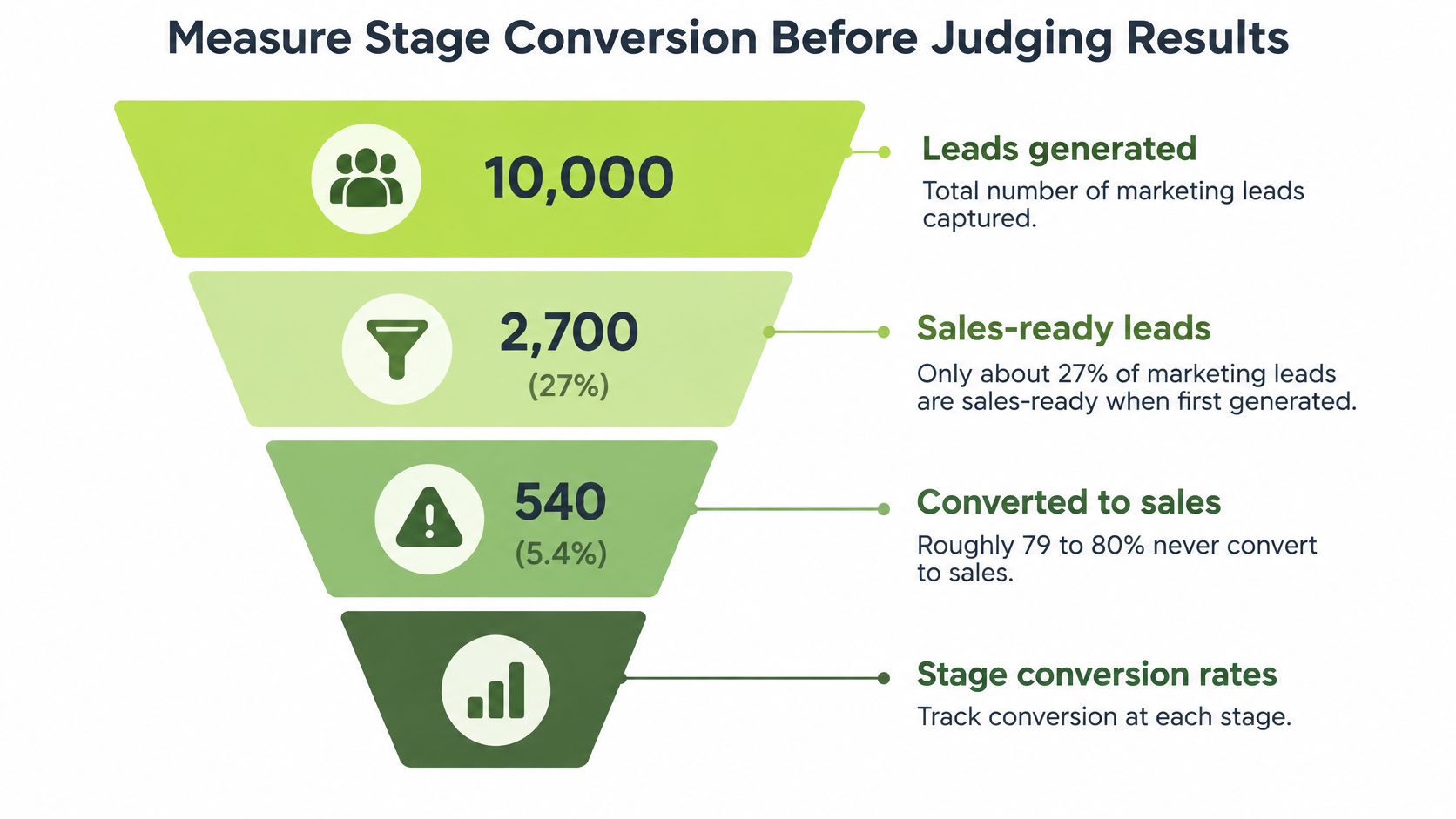
Keep the words tight. A lead is a captured contact. A qualified lead meets the agreed ICP and rules. A booked meeting is on a calendar. An opportunity is a sales record with a stated next step. Pipeline is the value of open opportunities, not the count of people who filled in a form.
| Metric | How to calculate | If it is low, check |
|---|---|---|
| Lead to qualified | Qualified leads divided by total leads | Targeting, form fields or ICP rules |
| Qualified to meeting | Booked meetings divided by qualified leads | Message relevance or offer clarity |
| Meeting to opportunity | Opportunities divided by held meetings | Discovery quality or sales fit |
| Positive reply rate | Positive replies divided by delivered messages | Angle or audience relevance |
| Spam complaint rate | Complaints divided by delivered messages | List quality, volume or unsubscribe path |
A labelled set of sums
Say a campaign captures 200 leads, qualifies 40, books 8 meetings and creates 2 opportunities. Lead to qualified is 20%. Qualified to meeting is 20%. Meeting to opportunity is 25%. These figures are an illustration, not a target. The weakest stage is where the next test belongs. Here, targeting and the offer both look thin, so you would not start by rewriting discovery questions.
Change one variable at a time. Move the audience, the message angle or the follow-up timing, and hold the rest still. Wait for qualified outcomes, not opens. Then keep the change, alter it, or drop it. Use each reply, objection and booked meeting to update the list, the wording and the timing.
Calibrate scores against accepted leads, held meetings and opportunities. Opens and clicks do not tell you whether the rule was right.
Worked Example From Account List to Pipeline
This is a labelled hypothetical, not a benchmark. A B2B software firm starts with 300 accounts in three segments, scored with the ICP rules and weights already agreed with sales. Hard exclusions remove poor-fit industries and companies below the size floor. Scoring leaves 180 accounts for the first sequence.
Before anyone sends, the team verifies contacts, authenticates the sending domain and pushes ten real records through CRM routing. Two of those ten fail a required field. The team fixes the fallback, then launches. That pause is the point of the gate.
What the first fortnight produced
Over two weeks the 180 accounts receive a three-step sequence on email and LinkedIn. Each step adds a proof point rather than repeating the ask. The sequence captures 60 leads.
- 24 meet the agreed rules, so lead to qualified is 40%.
- Those 24 produce 6 booked meetings, so qualified to meeting is 25%.
- The 6 meetings produce 2 opportunities, so meeting to opportunity is 33%.
Each opportunity has a stated next step in the CRM. Contacts without that step are not counted as pipeline, however promising the email thread looked.
The lowest stage is qualified to meeting, at 25%. The team tests the message angle first and leaves targeting unchanged. Rewriting the ICP now would mix two causes, and the next readout would be impossible to trust.
Response routing is checked on its own track. Leads contacted within five minutes are marked against response-time buckets in the CRM, separate from the stage rates. A slow bucket can make a sound message look weak. If the fast bucket converts and the slow bucket does not, the fix is ownership, not copy.
The rates above are arithmetic for this illustration. They are not a standard to hit, and a different offer would move them for reasons that have nothing to do with effort.
Decide Whether to Run the Campaign In-House or Outsource
Test the team on four questions before choosing a route. Does the offer have proof from paying customers? Can the team take sales conversations at the volume the campaign will create? Can it build the data and sending setup inside the launch window? Does every handoff have a named owner?
If two or more answers are no, building the whole motion in-house usually stalls on the missing piece. Capacity and proof are different problems, and they need different help.
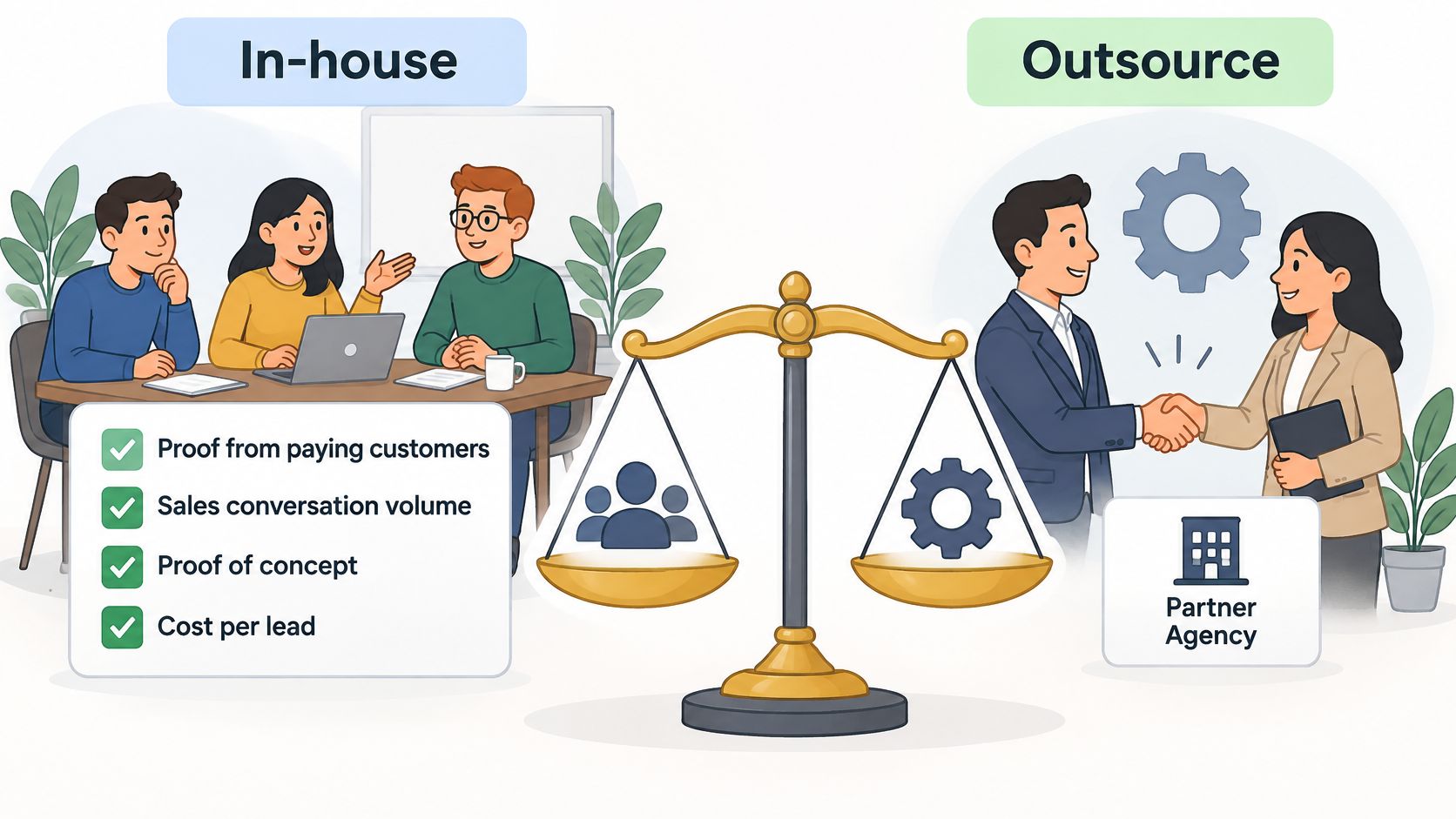
Fully managed outbound fits a team with a proven offer and no internal capacity to run the motion. A system build fits a team whose bottleneck is specific, such as enrichment, qualification or CRM routing. Private GTM workshops fit a team that wants to learn the work and keep it. The trade-off between keeping control and handing over execution is set out in this guide to B2B lead generation outsourcing. Where the gap is SDR headcount, rather than the system around them, Hire SDRs is a different kind of option.
A prospect starts with H2 by booking an intro and saying where growth is stuck. H2 then shows the audience, infrastructure and campaign it would build. For a campaign, the client shares the business, the market and the goals, and H2 works out the outbound strategy, systems and launch plan. Pricing and terms sit on the pricing page. Ask what the first conversation covers, and read the current terms there before you agree a scope.
H2 builds and runs B2B lead generation campaigns as connected systems, from audience rules and data setup through outreach, handoff and stage measurement. If the leak is capacity, routing or a message that never learns from buyer questions, an intro call is the cleanest way to see what should be built first. Visit H2 and say where growth is stuck.
