A prospect appears in the CRM twice, assigned to different salespeople. Both records enter an email sequence, while the dashboard counts the same potential opportunity twice. Every integration shows a successful run.
Bad data rarely fails loudly. A renamed provider field, a duplicate contact or a retried batch can produce incorrect routing and inflated pipeline reporting before anyone notices. For founders and RevOps teams, the visible problem is often manual clean-up rather than an obvious engineering error.
Data engineering best practices make records dependable before people or automation act on them. That means defining schemas, checking data at system boundaries, preserving identity, making retries safe and monitoring business outcomes rather than job completion alone.
The problem isn't limited to sales systems. In its 2025 State of Analytics Engineering report, dbt Labs found that 56% of respondents identified data quality as a problem.
A successful API request proves that a system accepted a request. It doesn't prove that the resulting record, assignment or follow-up action is correct.
A hypothetical prospect pipeline provides a practical thread through these practices: source records arrive, transformations standardise them, identity rules merge duplicates, and controlled writes update the CRM. The same principles apply to financial reporting, product analytics and operational data products.
1. Define schemas and data contracts before building pipelines
A schema defines structure. A data contract defines expectations. The schema specifies columns, types, keys and permitted values; the contract adds field meanings, quality requirements, freshness targets and ownership.
For a prospect pipeline, company_domain might mean the employer's canonical domain, not a personal website or parent-company domain. That distinction affects account matching even when every value is technically a valid string.
NIST's Research Data Framework treats accuracy, completeness, update status, consistency and other quality attributes as lifecycle concerns. A contract turns those broad requirements into rules that engineers and consumers can review.
Define the fields that change decisions
A useful starting contract includes:
- Identity: The persistent contact identifier and the source identifier used to resolve it.
- Meaning: Whether
last_contactedmeans an email was sent, a call occurred or a reply arrived. - Allowed changes: How producers announce renamed fields, changed types and removed values.
- Responsibility: The named owner who resolves failures and approves exceptions.
Suppose an enrichment provider replaces company_domain with website. The ingestion adapter should either map the new field through an approved change or reject the incompatible payload. Accepting a missing domain leaves routing teams to discover the problem later.
Contracts belong in version control alongside transformations. Strict enforcement adds maintenance work, so teams should prioritise decision-driving fields rather than imposing identical controls on every optional attribute.

2. Validate data at every boundary
A record can pass ingestion checks and still become unusable during transformation. A join might remove its account reference, or a mapping rule might turn an unfamiliar job title into an incorrect qualification category.
AWS's data-pipeline guidance recommends validation across processing stages to isolate failures. For CRM workflows, checks belong at ingestion, after transformation and immediately before destination writes.
Passing validation means that a record meets specified rules, not that every fact is true. A correctly formatted work email doesn't establish that the person still works at the company or that the mailbox accepts messages.
Separate rejection from uncertainty
Different failures need different handling:
- Hard failure: Missing identity prevents a safe upsert, so the record enters quarantine.
- Soft warning: An uncertain seniority classification permits storage but blocks automated qualification.
- Relationship failure: A contact references an unknown account, so account resolution runs before routing.
- Destination failure: A CRM rejects an owner identifier, so the write stops without discarding the source record.
Each rejected record needs a rule name, source reference, run identifier and correction status. Sensitive values should remain in restricted storage rather than appearing in broadly visible alerts.
For example, a prospect with a usable identity but an unrecognised department can remain available for review without entering a department-specific campaign. This distinction matters in B2B data enrichment, where added information can remain uncertain.
A defined process for exception resolution and drift detection helps teams correct recurring failures instead of accumulating an ignored rejection queue.
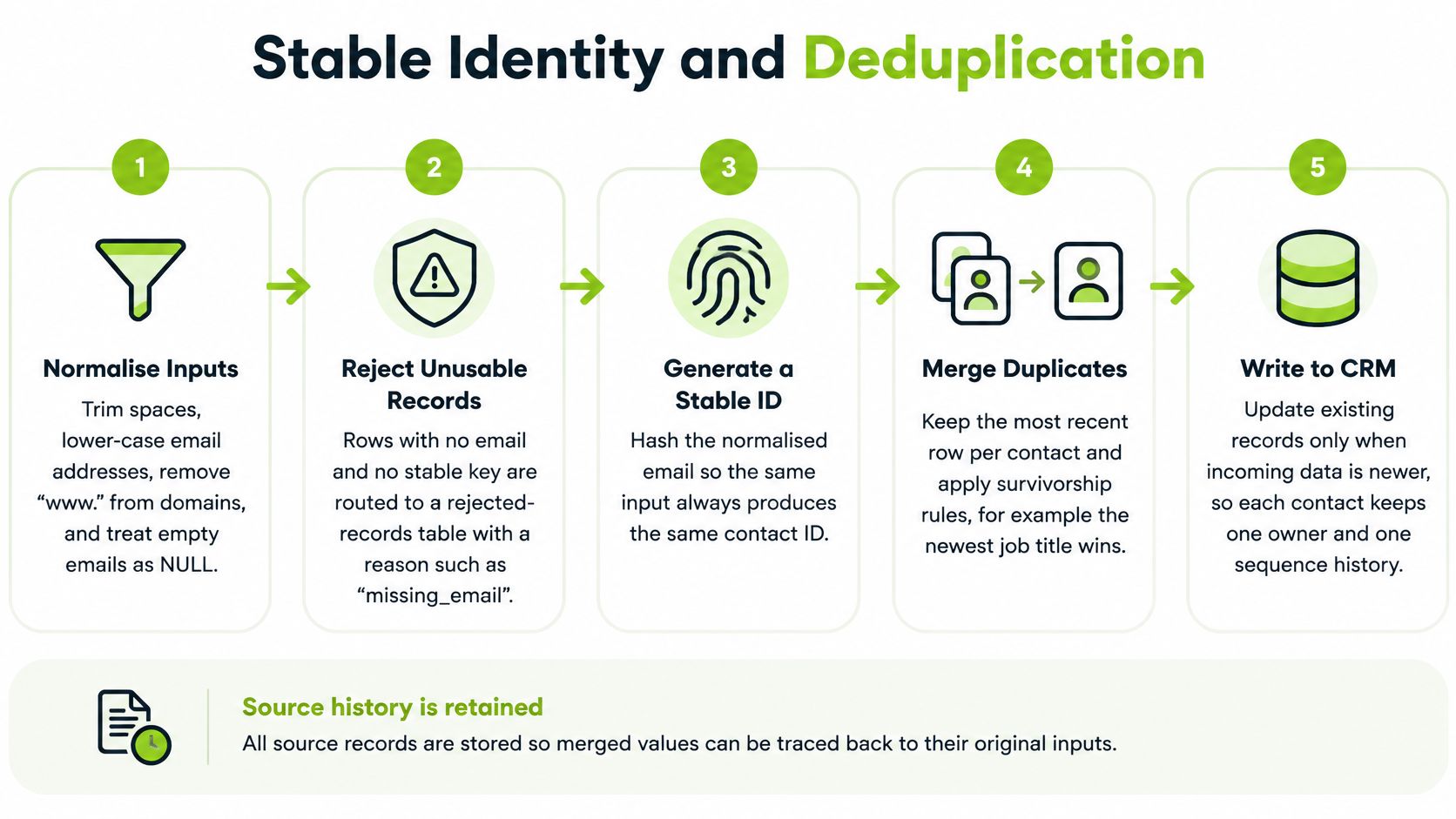
3. Establish stable identity and deduplicate records
Identity resolution decides which records represent the same entity. Deduplication then consolidates those records according to documented rules, rather than merely deleting repeated rows.
An email address can help match contacts, but it isn't an immutable person identifier. People change employers, shared mailboxes exist, and providers correct addresses. A persistent internal contact_id, supported by source-to-contact mappings, gives the pipeline a safer foundation.
Worked example of a prospect-data pipeline
The following example is hypothetical. Placeholder values represent personal data rather than live contact details.
Sample input
- Event-list record:
source_id=event_alpha;email=<work email with surrounding spaces>;company_domain=<company domain with www prefix>;title=VP Engineering. - Webinar record:
source_id=webinar_beta;email=<same work email>;company_domain=<canonical company domain>;title=VP of Engineering.
Transformation: The pipeline trims whitespace, applies its documented email-matching policy, parses the company domain and resolves both source records to the existing internal identifier contact_amber. It retains both source references and chooses the title using a documented freshness and verification rule.
Output: A canonical staging record contains contact_id=contact_amber, the standardised domain, the selected title and both provenance references. A CRM MERGE or equivalent upsert uses contact_id as its match key.
Failure case: If a source row lacks a usable identity, the pipeline quarantines it rather than guessing a match from name and employer alone.
Hashes can make matching keys deterministic, but they neither resolve identity changes nor anonymise the underlying personal data. Ambiguous matches should remain separate until reviewed.
4. Design pipeline writes to be idempotent
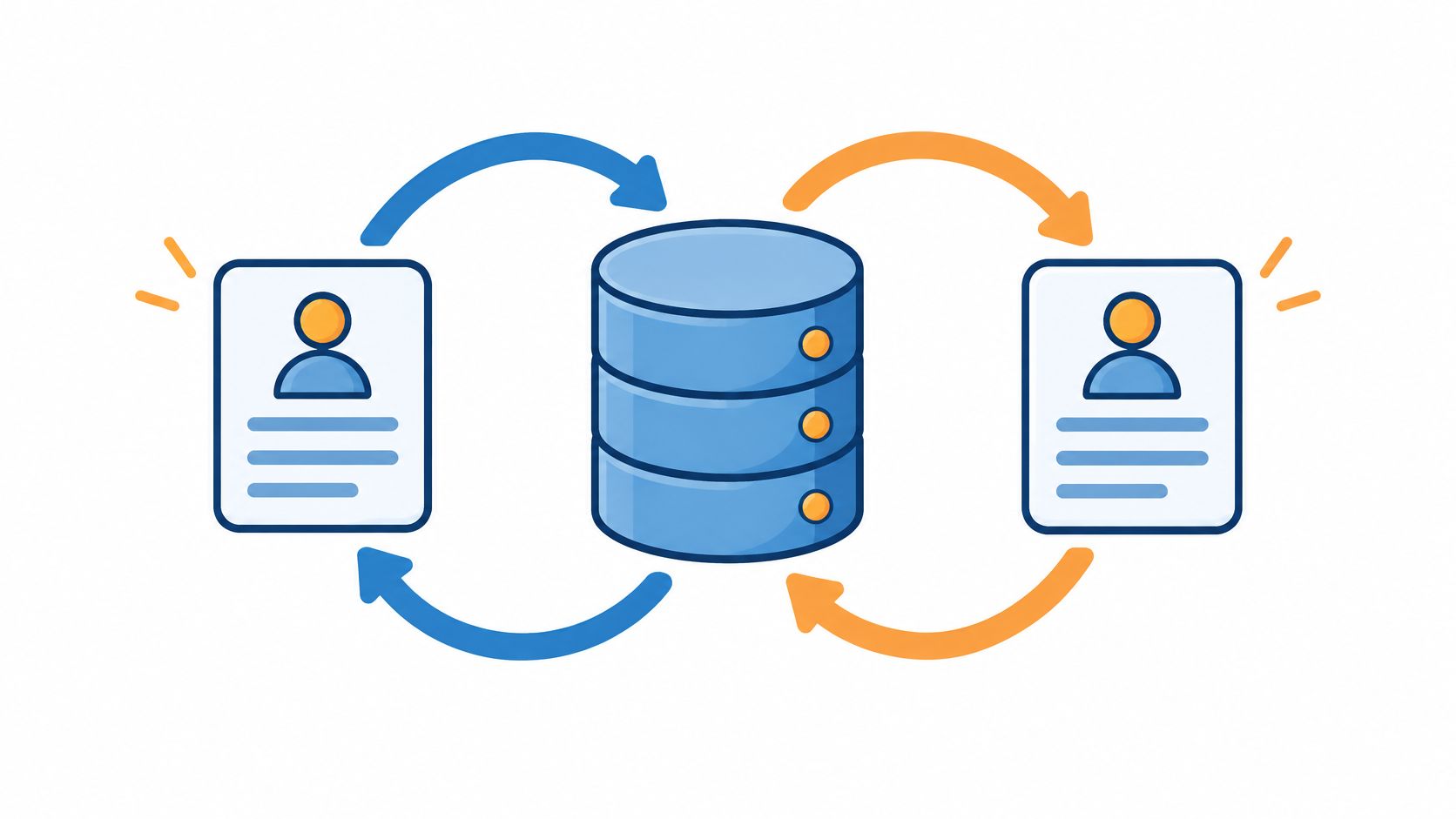
A CRM accepts a contact update, but the connection closes before the pipeline receives confirmation. The next run repeats the request. An idempotent write leaves the intended destination state unchanged when the same operation repeats.
AWS's pipeline reliability guidance recommends documented processing logic, retries, notifications and logging. Safe retries also require deliberate write semantics, not just an orchestrator's retry setting.
For the hypothetical contact, the write matches contact_id=contact_amber and updates approved attributes. An unrestricted insert would create another row; a correctly keyed upsert updates the existing record.
Protect side effects separately
CRM storage and sequence enrolment are different operations. Preventing duplicate contacts doesn't automatically prevent repeated outreach.
- Stable operation key: Identify the intended enrolment using the contact, campaign and campaign version.
- Unique action record: Enforce uniqueness in a durable action ledger before dispatch.
- Destination support: Reuse the destination's idempotency mechanism where available.
- Uncertain outcome: Reconcile a timed-out request before resending when the destination offers no safe deduplication.
A check followed by an unprotected insert isn't enough: concurrent workers can both observe that no action exists. A database uniqueness constraint or transactional claim should coordinate them.
Practical rule: A backfill may need to repair contact attributes without repeating the historical actions those attributes originally triggered.
Tests should replay identical input and compare stored state and action records. Volatile timestamps shouldn't form part of identity or operation keys, because they change on every attempt.
5. Set retry limits and handle failed jobs deliberately
Retry temporary failures, not unchanged bad input. A brief service interruption may clear; a missing required field won't repair itself while the pipeline waits.
A retry policy should specify maximum attempts, maximum elapsed time and increasing delays with jitter, which spreads requests rather than having every worker retry together. Where a provider supplies retry instructions, the integration should respect them.
Classify the failure before acting
A useful operational split is:
- Transient service failure: Retry within a bounded time budget.
- Invalid payload: Quarantine with the failed validation rule.
- Authentication failure: Pause the affected integration and alert its owner.
- Unknown write outcome: Reconcile destination state before repeating an action.
- Exhausted retries: Move the job or record to a durable failure queue.
In the hypothetical pipeline, an enrichment request encounters a temporary rate limit. The worker delays and retries without creating another contact or starting another sequence enrolment.
If the same request instead lacks the contract's required identity field, the worker sends it directly to quarantine. Repeating it would consume capacity without improving the result.
Failed-job records should retain the original payload in access-controlled storage, attempt history, error category and replay status. Operators also need to know whether downstream tasks received partial results.
Unlimited retries can conceal an outage while consuming API quota. Immediate failure everywhere creates unnecessary manual intervention, so retry budgets should reflect the integration's behaviour and the workflow's deadline.
6. Build reliable pipelines with clear dependencies and backfill paths
Scheduling tasks at different times isn't the same as declaring dependencies. A scoring job scheduled after enrichment can still run against incomplete data when enrichment takes longer than expected.
AWS defines reliable workloads in terms of correct, consistent operation throughout their lifecycle. That includes recovery, not merely a successful initial deployment.
Dependencies should describe readiness conditions. A downstream task may require a completed source partition, passing quality checks and a published dataset version, rather than a finished upstream process.
Separate correction from live execution
A maintainable pipeline keeps distinct stages for:
- Ingestion: Preserve source extracts within the retention policy.
- Transformation: Produce versioned, validated staging data.
- Publication: Expose an approved dataset or destination update.
- Action: Apply routing, notifications or enrolment under separate controls.
For example, the prospect scoring task depends on enrichment and current CRM status. If enrichment fails, the pipeline should mark scoring as blocked or stale rather than presenting incomplete scores as current.
A backfill reprocesses an explicitly bounded historical range. It should record the transformation version, limit concurrency and define whether current destination values may be overwritten.
Historical corrections require particular care around human decisions. Replaying an older owner assignment shouldn't replace a salesperson's newer approved assignment without an explicit rule.
Recovery runbooks should explain how operators pause publication, inspect affected records, replay safely and verify reconciliation. Keeping raw extracts helps recovery, but retaining everything indefinitely creates unnecessary privacy and storage exposure.
7. Manage data freshness with explicit service levels
A recently completed pipeline can publish old data. Job completion time, ingestion time and source update time describe different things, so freshness monitoring should distinguish them.
Google Cloud's data-quality framework separates freshness from volume, completeness, validity, consistency, accuracy and uniqueness. That distinction prevents a populated, well-formed dataset from being treated as current by default.
For a prospect record, the pipeline should preserve the source's stated update time where available, the retrieval time and the last successful verification time. An unavailable source timestamp should remain unknown rather than being replaced with a misleading current value.
Match service levels to consequences
Freshness requirements should follow the decision:
- Suppression and replies: Delays can cause unwanted follow-up, so stale status should block sending.
- Routing ownership: Updates need to arrive before another workflow assigns the record.
- Company descriptions: Slower refreshes may be acceptable when they don't determine immediate action.
- Financial reporting: Freshness should align with the reporting cut-off and reconciliation process.
In the hypothetical pipeline, enrichment might remain usable while suppression status has expired. The CRM can retain the contact, but the action stage should wait for a current suppression check.
A freshness target needs a defined response when it's missed. A warning without ownership doesn't protect the workflow.
Service levels should state the dataset, acceptable age, measurement method, owner and breach action. Refreshing every attribute continuously adds cost without necessarily improving decisions; selective refreshes are often the better design.
8. Track lineage so every field can be traced to its source
When a salesperson challenges a job title, the team needs more than the current value. Lineage records where data originated, how it changed and which downstream systems used it.
Table-level lineage shows dependencies between datasets. Field-level lineage goes further, connecting a particular output attribute to its source and transformation rule.
For the hypothetical contact, title=VP of Engineering should carry a provider reference, source record identifier, retrieval time and selection-rule version. The record should also explain why that source won over the alternative title.
Preserve decision provenance
Useful lineage metadata includes:
- Source provenance: Provider, extract and original field.
- Transformation provenance: Run identifier and deployed code version.
- Decision provenance: Matching, scoring or survivorship rule applied.
- Destination provenance: CRM identifier and write outcome.
This makes a provider correction actionable. Engineers can identify affected contacts, rebuild the relevant outputs and inspect any downstream qualification decisions.
The distinction between collecting information and deriving a decision matters in data enrichment. A provider-supplied employee count and an internally inferred account tier shouldn't share an indistinguishable provenance label.
Lineage also helps impact assessment before a schema change. Teams can identify which routing rules and reports consume the field before renaming it.
Full field-level tracking can create substantial metadata work. Starting with critical datasets and decision-driving fields offers a practical balance, while keeping personal values out of broadly accessible lineage logs.
9. Apply access controls, data minimisation and consent-aware handling
Prospect data often combines names, work contact details and commercially sensitive CRM notes. Each integration should receive only the fields and permissions needed for its task.
The Identity Theft Resource Center's 2021 report attributed 179 US data compromises to human and system errors. Configuration and ordinary handling therefore deserve engineering controls alongside protection against deliberate attacks.
An enrichment worker might need a company domain and work email, but not call notes, opportunity values or unrestricted CRM export access. Production credentials shouldn't appear in source code, sample files or shared debugging messages.
Make restrictions executable
- Least privilege: Separate read, update and export permissions.
- Environment separation: Use synthetic or appropriately protected test data outside production.
- Retention: Apply documented expiry and deletion rules to raw files, queues and backups.
- Auditability: Record administrative changes and sensitive access without logging unnecessary personal data.
- Suppression: Check opt-outs and other exclusion rules immediately before dispatch.
Suppose contact_amber opts out after enrichment but before sequence enrolment. The final action gate must consult current suppression state, not rely on an eligibility flag calculated earlier.
UK teams also need to assess applicable UK GDPR and PECR obligations. A work email isn't, by itself, permission to send marketing, and legal advice should address the actual audience and circumstances.
Teams can build a data governance roadmap around named owners, access reviews, retention and incident handling. Governance documents are useful only when pipeline behaviour enforces the relevant decisions.
10. Test pipelines and monitor data quality in production
Tests check intended behaviour; monitoring checks continuing behaviour. A transformation can pass its test suite and later fail when a provider introduces an unfamiliar input.
In dbt Labs' 2024 survey of 456 data practitioners and leaders, data quality and observability was the most frequently selected area for increased tooling investment. Operationally, those checks need owners and response paths, not just dashboards.
Test behaviour, then observe outcomes
The hypothetical pipeline needs tests covering:
- Normalisation: Whitespace and domain variants resolve as intended.
- Identity: Repeated source records map to the same contact without merging unrelated people.
- Replay safety: Reprocessing doesn't duplicate CRM records or action requests.
- Failure handling: Invalid records enter quarantine with usable diagnostic context.
- Suppression: A newly excluded contact cannot proceed to dispatch.
Production monitors should cover source age, rejected records, input and output volumes, unresolved identities, reconciliation differences and duplicate action attempts. Enrichment match rates and routing distributions can expose problems that infrastructure metrics miss.
A provider format change might leave the job technically successful while most records lose their account reference. Monitoring business-level completeness catches the issue; a green task status doesn't, which explains why green dashboards can lie.
The same controls apply to Clay lead-generation workflows: automation doesn't remove the need to validate outputs and destination effects.
AI-generated transformations should face the same tests, code review and deployment controls as human-written changes. Every production defect should add a regression test, while alerts should identify the affected dataset, failed rule, owner and safe next action.
Which practice prevents which failure in a GTM data stack
| Item | Main failure it prevents | Typical GTM example | Documented reference |
|---|---|---|---|
| Define schemas and data contracts before building pipelines | Silent schema changes breaking downstream systems | A vendor renames company_domain, and a contract catches the change before CRM routing breaks | dbt model contracts documentation |
| Validate data at every boundary | Invalid or incomplete records reaching sales workflows | Quarantine a prospect with a malformed email before CRM import | Great Expectations documentation; dbt data tests |
| Establish stable identity and deduplicate records | Duplicate contacts, outreach, and inflated metrics | Normalize email addresses and merge repeat contacts from separate event lists | Fundamentals of Data Engineering by Joe Reis and Matt Housley |
| Design pipeline writes to be idempotent | Retries creating duplicate records or actions | Use a CRM upsert keyed by contact ID so rerunning a batch does not duplicate contacts | Stripe API idempotency documentation |
| Set retry limits and handle failed jobs deliberately | Runaway retries, hidden failures, and lost records | Retry an enrichment API rate limit with backoff; quarantine permanent input errors | Apache Airflow task retry documentation |
| Build reliable pipelines with clear dependencies and backfill paths | Out-of-order jobs and unrecoverable historical errors | Skip lead scoring when overnight enrichment fails, then backfill after recovery | Apache Airflow DAG and backfill documentation |
| Manage data freshness with explicit service levels | Stale data driving routing or outreach decisions | Reverify job titles periodically while updating reply status through webhooks | dbt source freshness documentation |
| Track lineage so every field can be traced to its source | Slow incident investigations and hidden downstream impacts | Trace a lead score to its enrichment fields and scoring transformation | OpenLineage specification; dbt dependency graph |
| Apply access controls, data minimisation and consent-aware handling | Excessive exposure or use of personal data without appropriate controls | Enforce opt-out suppression before contacts reach a sequencing tool | ICO UK GDPR guidance |
| Test pipelines and monitor data quality in production | Undetected regressions, drift, and declining data quality | Alert when an enrichment provider's match rate suddenly drops | dbt data tests documentation |
Start With the Fields That Drive Routing and Reporting
The strongest starting point isn't a platform migration. It's a small, explicit agreement about the fields that determine routing, scoring and reporting, followed by controls that keep those fields dependable.
A team might begin with contact identity, account identity, owner, qualification status, suppression status and source provenance. The exact set depends on the workflow, but each field needs a meaning, owner, acceptable state and correction path.
Turn a narrow scope into an operating standard
A practical implementation sequence is:
- Write the contract: Record field meanings, keys, permitted values and change ownership.
- Validate the boundaries: Check source input, transformed output and destination requirements.
- Prove identity: Test repeated records, changed attributes and ambiguous matches.
- Prove replay safety: Repeat a run and inspect both stored records and external actions.
- Make failures recoverable: Give quarantined records an owner, reason and replay procedure.
- Review recurring problems: Use a weekly failure review to improve rules and regression tests.
The review should distinguish provider defects, transformation bugs and unclear business decisions. A disputed qualification rule isn't necessarily a coding problem; commercial owners may need to define what should happen before engineering can enforce it.
A working pipeline also needs visible limits. If enrichment is stale, identity is uncertain or suppression cannot be checked, the system should expose that condition and apply the agreed fallback rather than manufacture confidence.
Keep the architecture proportional
A small workflow may need little more than version-controlled transformations, database constraints, structured logs and a clear runbook. More complex environments may justify orchestration, automated lineage and dedicated observability, but additional tools don't replace ownership.
Nor does every anomaly require a full shutdown. Invalid identity may block a record, a source-wide schema change may stop publication, and an optional missing attribute may only require a warning.
Teams commissioning outside design work should retain those distinctions after handover. H2 builds custom GTM systems around the client's sources, commercial rules and existing operations, then tests real records and fallback paths and trains the people responsible for running them.
The System Builds page sets out scope and process. A useful starting discussion centres on a broken handoff, the affected records, the decisions the system must make and who will own exceptions.
Dependable data engineering makes the result explainable and recovery repeatable. A contact should reach the correct destination for a traceable reason, without a retry becoming another record or another unwanted message.
H2 offers custom GTM system builds covering enrichment, qualification, CRM routing and workflow automation, with documentation and operator training. Teams dealing with duplicate records, unreliable handoffs or unsafe retries can visit H2 to discuss the workflow, its decision rules and the controls it needs.
