The usual Clay lead generation advice starts with adding more providers, more AI research and more personalisation fields. That's the wrong starting point. A dependable workflow needs clear rejection rules, evidence behind every claim and a stop condition for records that remain uncertain, before anyone adds another enrichment column.
What Clay Lead Generation Is and When It Fits
Clay lead generation means building an account or contact list, adding information from different sources and filtering the results against an ideal customer profile, or ICP. The ICP describes the businesses and buyers worth pursuing.
Clay works as a workspace where each row represents a company or contact. Columns hold information, data lookups, AI research or decision rules. The useful output isn't a fuller spreadsheet. It's an explainable list of suitable prospects that a sales team can act on.
The terms that matter
- Enrichment means adding information to an existing record, such as a company's sector or a contact's work email.
- Waterfall means querying providers in sequence until a provider returns the required value. Clay's waterfall documentation explains the provider ordering and conditional runs.
- Exclusion rules are conditions that remove a record from consideration, such as an unsupported region, an unsuitable business model or an existing customer relationship.
Clay should sit between research and execution. Sending happens through a separate outreach tool or CRM, while sales opportunities remain in the CRM.
A readiness check
Clay fits a team with a proven offer, a written ICP, a named table owner and enough sales capacity to handle replies. It fits poorly when the offer is untested, the buyer is unclear or the objective is only to collect more contacts.
The readiness test is practical:
- Buyer clarity: Can the team describe its target buyer in a sentence?
- Exclusion clarity: Can the team name three reasons to exclude a company?
- Reply ownership: Who will answer interested prospects this week?
Clear answers make a pilot realistic. Missing answers call for commercial decisions, not additional automation.
Workflow Stages From Account List to CRM
Build the workflow around explicit outputs and pass rules. Cheap filters should run before paid lookups wherever the required information is already available.
| Stage | Clay action | Output field | Pass rule |
|---|---|---|---|
| 1. Define ICP and exclusions | Write criteria as filter columns | icp_fit, exclusion_reason | Rejected rows stop before any paid lookup |
| 2. Import and deduplicate | Import accounts and deduplicate by web domain | company_domain_key | One row per company |
| 3. Firmographic enrichment | Add headcount, sector, location and funding | Field values with source and date | Missing required values go to review, not guessed |
| 4. Account scoring | Apply weighted ICP criteria | fit_score, scoring_version | Only accounts above the team's threshold continue |
| 5. Contact identification | Find roles that own the problem | contact_role, role_fit | Roles outside the target list are dropped |
| 6. Waterfall email lookup | Query providers, then verify returned emails | verified_email, email_provider, email_status | Only verified addresses continue |
| 7. Signal check | Research accounts above the threshold | signal_fact, evidence_url | Signals are corroborated before use |
| 8. CRM push | Map fields and send accepted records | crm_record_id, source, status, owner | Duplicates are blocked and an owner is assigned |
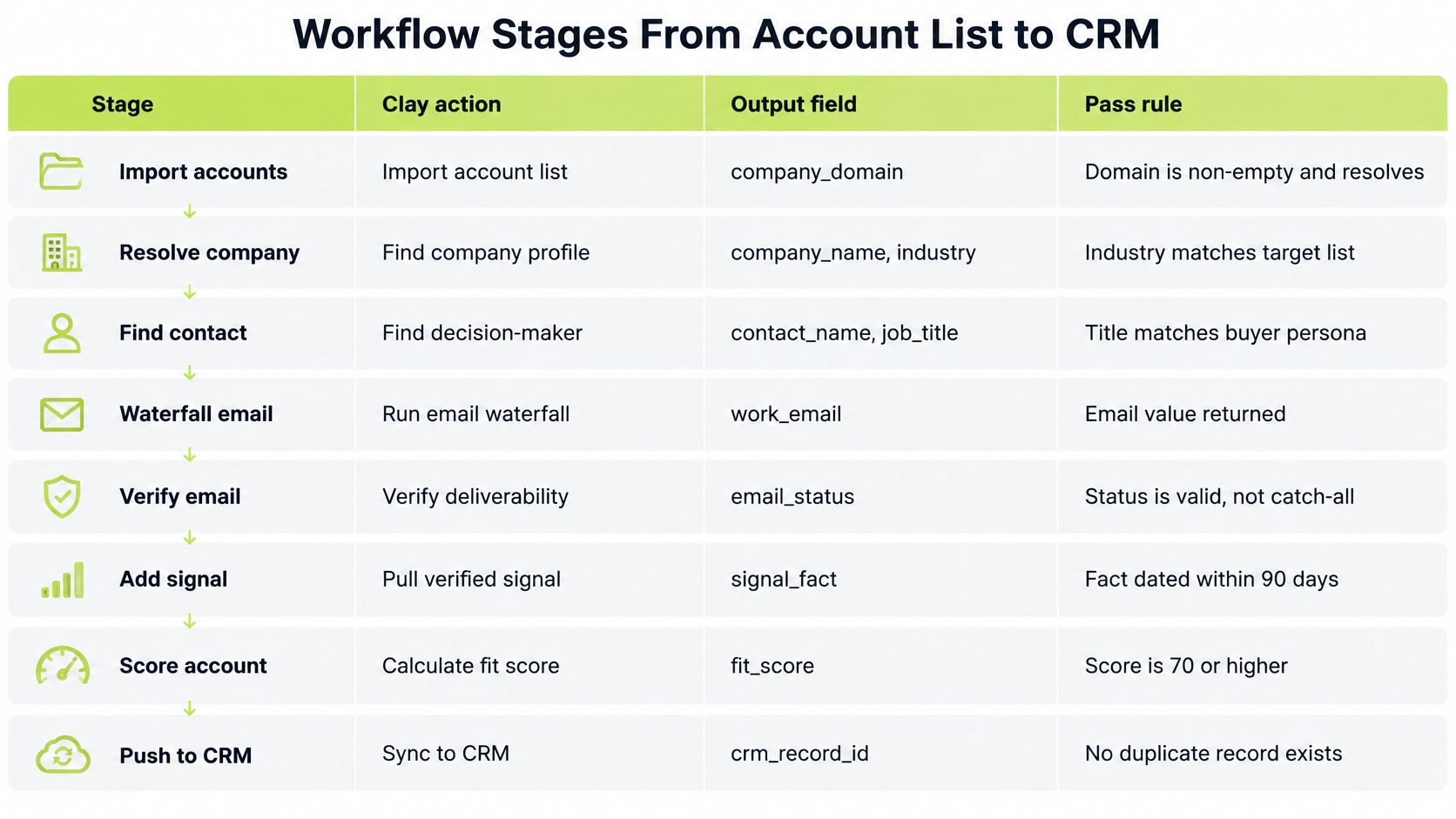
The table defines the operating order and acceptance rules. Any sample thresholds in the visual are illustrative, not recommended defaults.
Make the score explainable
Firmographics are company characteristics such as size, sector and location. Enrich only the characteristics that affect eligibility or prioritisation. Funding, for example, doesn't deserve a column unless it changes a commercial decision.
Separate hard exclusions from weighted preferences. An unsupported location should reject an account rather than merely subtract points that unrelated strengths can offset.
The team should choose its own scoring scale and acceptance threshold. Every score needs a readable explanation, such as target sector confirmed, suitable company size and relevant operating model. Unknown information must remain unknown rather than receiving a favourable default.
Paid research may be necessary to resolve missing eligibility data. That's different from running every available enrichment on every imported row.
Design the handover before building
Name each output field before configuring the workflow. Generic labels such as “AI result” or “enrichment output” make it difficult to trace why a record passed.
Store original provider results separately from accepted values. That preserves the evidence when a reviewer resolves a disagreement or overrides a field.
Handover rule: Every exported record needs an owner, a status and enough evidence for another operator to reconstruct its acceptance decision.
Assign a named reviewer to the weekly audit. After launch, only the table owner should change filters or scoring weights, with the date and reason recorded in a change log.
CRM mapping also needs explicit overwrite rules. A newly returned provider value shouldn't replace a sales-verified field without a check, or remove an existing suppression status.
How to Run Waterfall Enrichment Without Wasting Credits
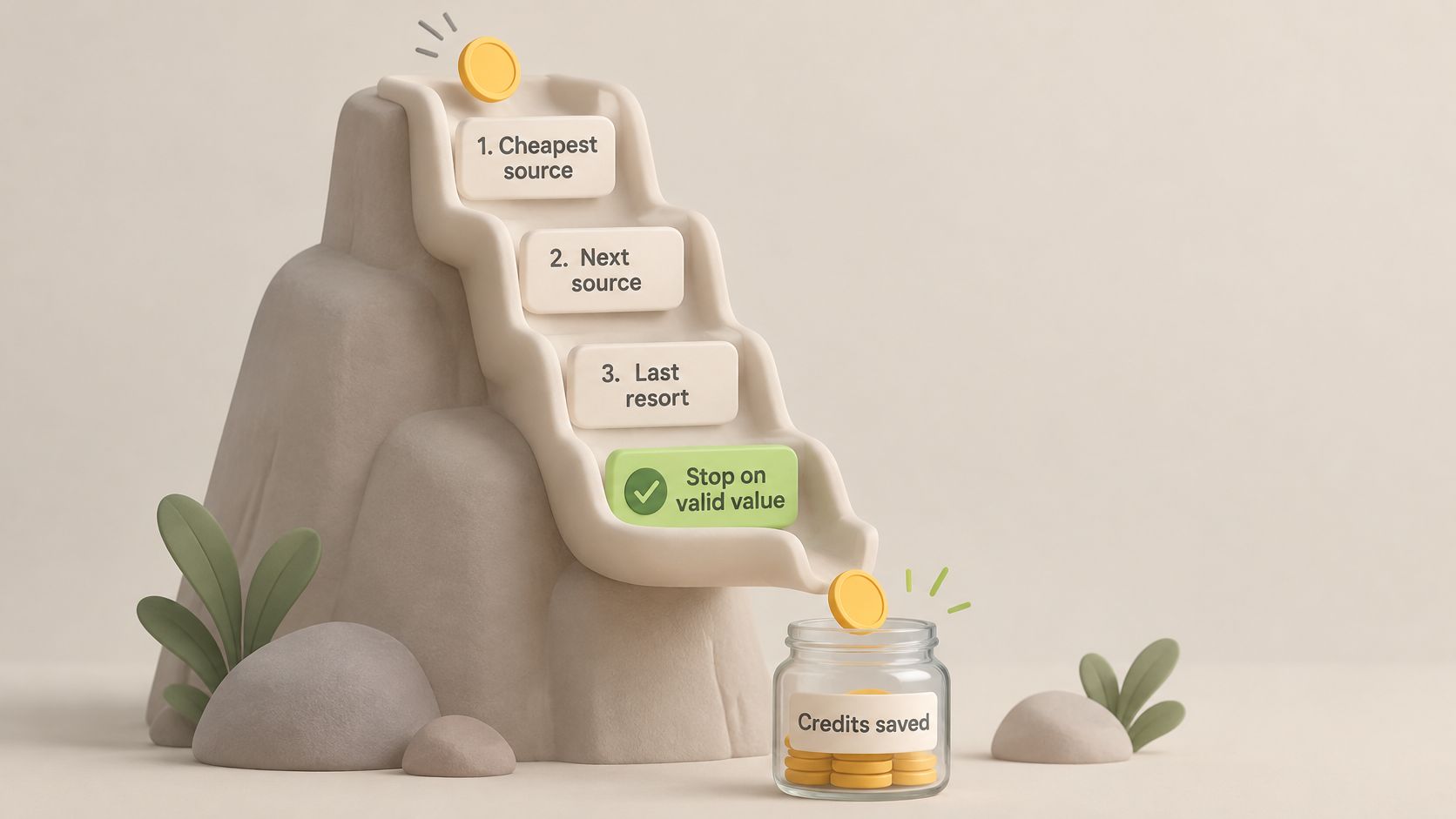
A waterfall saves credits only when its stop rules are stricter than “a provider returned something.” Clay's enrichment lesson describes ordered queries, stopping after a valid value is found, and refunds for email-provider lookups that return no email. Treat each returned field as evidence to assess, not as an automatic pass.
- Set the provider order. Start with a lower-cost source that covers your target market. Use specialist providers only for records still missing a required field.
- Gate each lookup. Run the next provider only when the earlier step leaves that field unresolved. Don't trigger expensive research for rows already meeting the pass rule.
- Define “usable” per field. A returned email, for example, is not accepted until it passes your verification gate. For company or role data, set an allowed age and require a source you can inspect.
- Keep the audit trail. Store provider, lookup status and timestamp beside the accepted value. Use an explicit
no_data_foundstatus so an empty result cannot be mistaken for a successful match. - Test on actual records. A practical pilot might use 100 to 200 rows from the target segment. Compare accepted, usable results with credits consumed, not just cells populated.
- Separate outcomes. Mark records accepted, rejected or unresolved. Missing data alone does not establish poor account fit, and conflicting results should not pass automatically.
- Review marginal value. Check whether each provider adds usable contacts or resolves a decision-relevant gap. Pause a source that spends credits without doing either.
An illustrative credit calculation
This hypothetical calculation is not Clay pricing or observed performance. It assumes a charge for every queried row, no refunds, and excludes verification, AI research and other costs.
| Provider | Credits per row | Rows queried | Contacts found | Credits spent |
|---|---|---|---|---|
| Provider A | 1 | 1,000 | 600 | 1,000 |
| Provider B | 3 | 400 | 100 | 1,200 |
| Provider C | 5 | 300 | 45 | 1,500 |
| Total | Not applicable | 1,000 unique accounts | 745 | 3,700 |
Under these assumptions, the sequence finds 745 contacts for 3,700 credits, or about 5 credits per contact found. That is not the cost per accepted prospect. Verification failures, role mismatches and later exclusions reduce the usable total.
Provider C needs a stricter pass rule because each lookup costs more. Keep it for valuable accounts when its results resolve meaningful uncertainty, and exclude low-priority segments if the added contacts do not justify the spend.
Evaluate independent coverage
More providers do not guarantee more independent evidence. As a practical risk, providers drawing on overlapping underlying data may reproduce the same gaps or errors. Track whether each source contributes new, verifiable information, and stop when results conflict or remain ambiguous rather than letting AI choose a convenient answer.
The B2B data enrichment guide offers context for structuring the data process. A smaller accepted list can be the right result. Coverage matters when the added records are suitable, supported by evidence and worth pursuing.
Evidence Rules for Qualifying Prospects
A match isn't a qualification. A work email establishes contactability, not a reason to buy.
Use evidence tiers to control what automation may do. Hard facts can satisfy defined field-level checks. Indicators trigger investigation. Hypotheses require review and must never become assertions merely because AI produced fluent text.
| Signal | Evidence type | Automatic action | Corroboration before outreach |
|---|---|---|---|
| Verified work email from provider | Hard fact | Passes the email gate after verification | No additional signal check, but role fit remains required |
| Published company size or sector | Hard fact | Used as an ICP filter | No, store source and date |
| Open role for database administration | Indicator | Triggers account research | Yes, confirm relevance to the problem being addressed |
| Software detected on company website | Indicator | Triggers account research | Yes, confirm active use |
| Social post describing a relevant problem | Indicator | Triggers manual review | Yes, read the post itself |
| AI-written claim about a pain point | Hypothesis | Routed to review | Yes, must cite a supporting source line |
| Conflicting provider results for a field | Conflict | Routed to review or excluded | Yes, resolve before use |
Evidence must support the exact claim
A database-administration vacancy establishes that a company advertised a role. It doesn't establish inadequate support, approved budget or willingness to outsource.
Likewise, a technology detection may identify something worth checking without proving current usage. The accepted claim must be no stronger than the evidence.
Clay's AI lead generation guidance recommends returning “none found” rather than guessing, filtering invalid, catch-all and role-based emails, and reviewing generated copy before sending.
Require every AI research field to return the supporting source URL and source line alongside its conclusion. If the source supports only part of the conclusion, the unsupported portion must be removed.
Audit decisions, not writing quality
A suggested weekly audit is a sample of 30 accepted records. The reviewer should compare each accepted field with its underlying source, rather than checking whether the row merely looks plausible.
- Classify the cause: Log stale provider data, wrong roles, misread pages and unsupported inference separately.
- Fix the rule: Correct the prompt, provider order or acceptance condition responsible for the error.
- Check downstream records: Hold affected exports until the team understands which records share the failure.
- Assign resolution: Record who can clear a held record and what evidence is required.
The distinction between fit and genuine qualification is developed further in the lead qualification guide.
If a required fact is missing, contradictory or unsupported, the record stops. It doesn't receive a weaker invented claim in the opening line.
A held record may re-enter after the conflict is resolved. Until then, exclusion is safer than treating uncertainty as approval.
Writing Outreach From Verified Signals and Sending Safely
A verified signal earns a place in outreach only when the record shows what supports it. Keep evidence tiers visible in Clay: a current company page is stronger than a provider summary, while an AI inference is not a fact. Use the strongest source available, and stop the record when sources conflict or leave the key point ambiguous. Don't spend credits enriching a record that has already failed its evidence check.
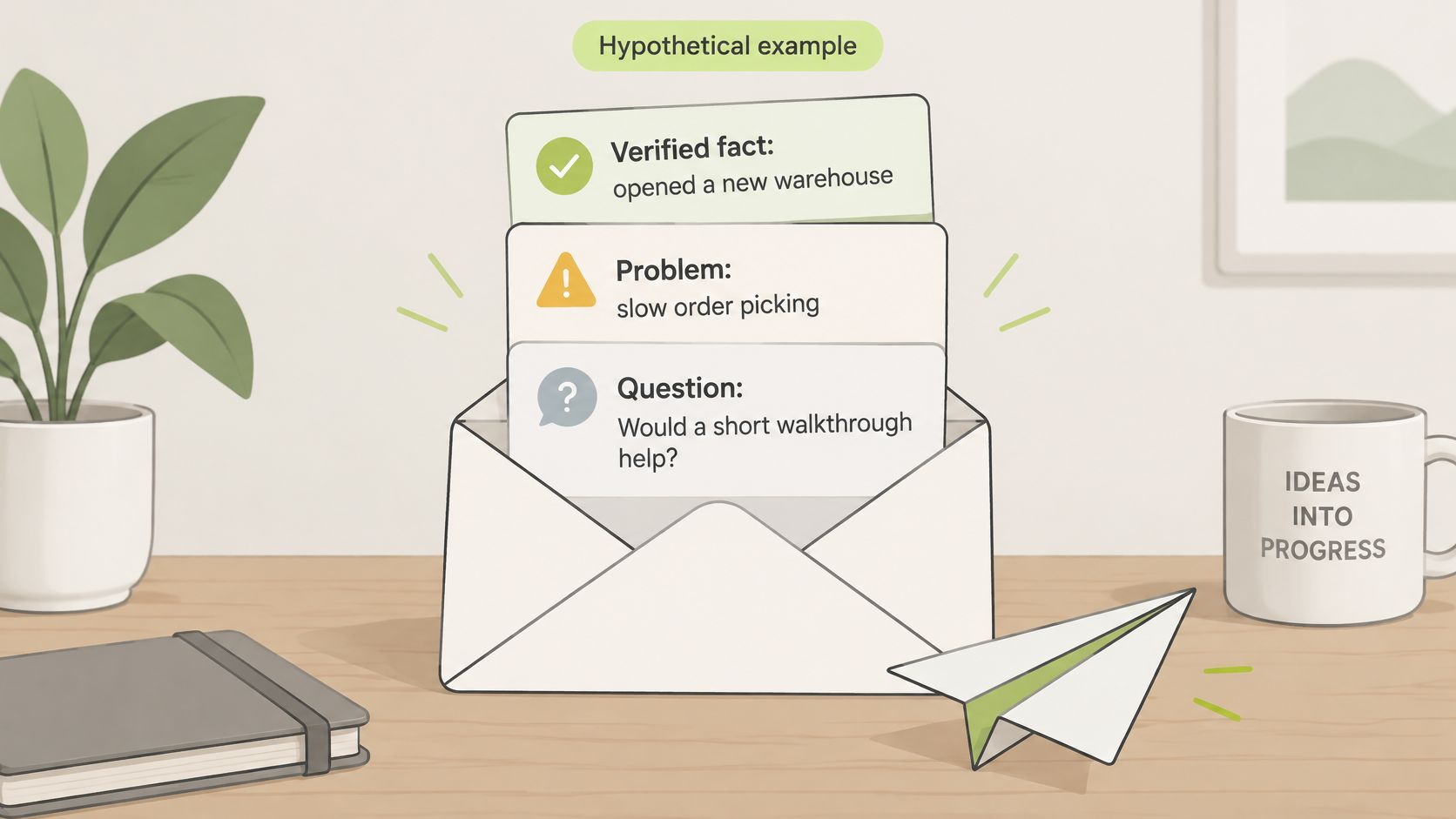
Hypothetical example, not a client email. The evidence field contains a checked, current database-administrator vacancy on the recipient company's careers page.
The database-administrator vacancy on the company careers page mentions on-call cover.
Cover during recruitment can leave an existing team stretched.
How is on-call database support handled while the role remains open?
If this isn't relevant, reply to opt out of further emails.
The vacancy reference is factual within the example. The possible staffing pressure is framed as a question, not a claim about the company. That distinction keeps AI-assisted copy from turning a verified signal into an invented diagnosis.
Copy checks before release
- Match the source: Every personalised claim must agree with its evidence field and source.
- Remove unsupported sentences: Fluent AI copy still fails if the supporting evidence doesn't.
- Keep uncertainty visible: State a possible problem conditionally or ask about it.
- Honour suppression: An opt-out must block future sends, not just add a review note.
Sending readiness is a separate gate
Google defines bulk senders as those sending more than 5,000 messages per day to Gmail accounts. Its guidance covers authentication, avoiding unwanted or unsolicited messages, and easy unsubscribing. It addresses SPF, DKIM, domain alignment and DMARC in its bulk-sender guidance.
Before raising volume, verify authentication and alignment, confirm unsubscribe handling, and test suppression behaviour. Treat these as release conditions. Ramp new domains gradually; separate sending domains by segment can make issues easier to diagnose, but cannot bypass provider policies or repair a poorly controlled programme.
Keep segment and sending-domain identifiers in each exported record. If complaints, bounces or negative replies worsen, use those fields to trace the problem and pause the affected segment instead of sending more. Apply staged credit controls too: enrich a small batch, check evidence and delivery outcomes, then release more records only when the rules pass.
The email deliverability best-practice guide supports this operational work. A verified address does not establish inbox placement, permission or relevance.
Measuring the Funnel and Meeting UK Consent Rules
Measure Clay lead generation by accepted prospects and sales outcomes, not enriched row counts. The cited outbound benchmark coverage reports an average reply rate of 1.9–3.4% and a meeting-booked rate per outreach of 0.5–1.2%. It also reports approximately 83.5% global inbox placement. These are reported averages, not campaign forecasts. Reply rates include replies generally, not only positive responses.
| Metric | Reported average | Illustrative outcome for 1,000 |
|---|---|---|
| Reply rate | 1.9–3.4% | 19–34 replies |
| Meeting-booked rate per outreach | 0.5–1.2% | 5–12 meetings |
| Global inbox placement | About 83.5% | About 835 placements |
Industry-reported outbound benchmark coverage is the source for each average in the table. The outcomes are arithmetic illustrations of those rates. Contacts, messages and delivered emails are different denominators, so state which one each campaign rate uses.
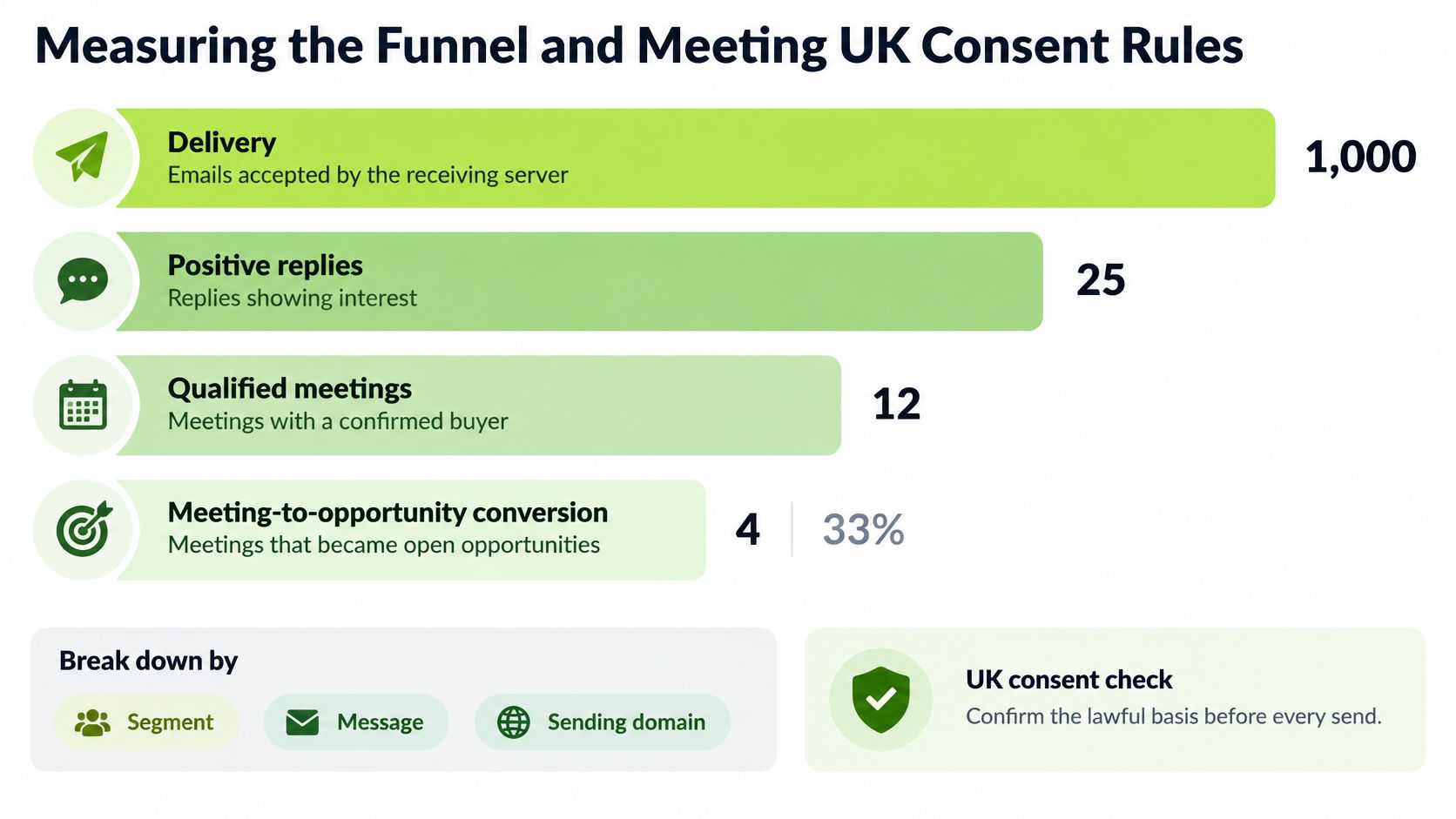
The funnel image explains the stages, not campaign results. Its example counts are not performance expectations.
Separate activity from qualification
A booked meeting can fail qualification or never become an opportunity. Report delivery, positive replies, qualified meetings and meeting-to-opportunity conversion separately. Break results down by segment, message and sending domain, and record enrichment spend beside them. This shows whether a low-cost list is producing useful conversations or merely more activity.
- ICP fit: Does the account meet the acceptance criteria?
- Problem severity: Is there a material issue, rather than general curiosity?
- Authority: Can the contact influence or progress a decision?
- Timing: Is there a credible reason to act?
Sales should return these classifications to RevOps. Use patterns in accepted and rejected conversations to adjust scoring and copy, rather than optimizing for reply volume alone.
Capture UK subscriber status
The ICO distinguishes corporate subscribers from individual subscribers under PECR, the Privacy and Electronic Communications Regulations. Its direct-marketing guidance says the electronic-mail rule does not apply to corporate subscribers, but does apply to individual subscribers, including sole traders and some partnerships.
For individual subscribers, consent is generally required unless a valid soft opt-in applies. Data-protection law may also apply when personal information is used. A company-domain address alone does not establish corporate-subscriber status.
Store account type, business structure, lawful basis, contact-data source and suppression status as separate fields. If subscriber status or the basis for contact is ambiguous, stop the record from entering an outreach sequence until someone resolves it.
Compliance checkpoint: Evidence of commercial relevance is not evidence of consent.
Have legal counsel determine the programme's rules and exceptions. These operational checks do not replace legal advice or an auditable opt-out process.
Deciding Whether to Build In-House or Outsource
The build decision starts with commercial readiness and ownership, not tool preference. An internal pilot is realistic when the offer is proven, someone owns the table each week and sales can handle the replies it creates.
Match the route to the constraint
- Offer proven: There's a clear problem, buyer and reason to engage.
- Owner available: A named operator can maintain rules, resolve exceptions and review costs.
- Sales capacity available: Interested replies will receive prompt attention and useful follow-through.
If all apply, build the workflow above, launch a single segment and schedule a review after a suggested four-week pilot. Judge the pilot through accepted records and qualified conversations, with enough operational detail to explain failures.
When the offer is proven but internal time is missing, managed execution may be more practical. When execution capacity exists but data handling is unreliable, a system build or training engagement may address the narrower problem.
Choose support around the operating gap
Fully Managed Outbound covers market research, list building, verification, sending infrastructure, copywriting, reply handling and meeting booking. Launch timing depends on data, domain and inbox readiness.
Custom GTM System Builds address a bottleneck or connect several stages, with documented inputs, decision rules, fallback paths, training and an operating runbook.
Private GTM Workshops develop team capability around Clay workflows, enrichment costs and quality control, with practical exercises and a bespoke handbook.
The current pricing and engagement terms provide the commercial details. The right choice depends on whether the missing resource is execution time, a reliable system or the ability to operate it internally.
H2 offers fully managed outbound, custom GTM systems and private workshops for teams that need dependable prospect research, qualification and handover. Visit H2 to arrange a 15-minute introductory call about the business, target audience and current outbound challenge.
