Stronger verbs and added urgency won't rescue a cold email that asks a stranger for too much. Good call to action writing starts with the commitment being requested, not the cleverness of the closing line. The practical aim is to make one relevant next step easy to understand, easy to answer and worth taking.
Which CTA Type Fits Each Commitment Level
A cold email should ask for the smallest next step that fits the prospect's familiarity and interest, not default to a full sales meeting. A reply confirming a problem can be more useful than an ignored booking link.
Cold email CTA types by commitment level
| CTA type | Example wording | Commitment | Best used when |
|---|---|---|---|
| Interest question | Is reducing manual prospect research a priority this quarter? | Very low | First email to an unfamiliar prospect |
| Permission to share | Would it help if I sent a two-line summary of how we would approach this? | Low | The prospect's role fits but there is no reply yet |
| Resource offer | I can send the account list we built for your market. Want it? | Low to medium | The prospect has a specific problem that an available asset addresses |
| Specific time request | Are you free for 15 minutes on Thursday? | Medium | The prospect has replied with interest or named a pain |
| Named-slot booking | Does Thursday at 10 am UK time work for a 15-minute call? | High | A warm lead on a later touch, after a clear signal |
These are illustrative examples, not universal rankings of performance. The distinction between the final rows is slot specificity: one asks whether a day works, while the other proposes a confirmed available time.
Say an outbound team contacts a founder whose sales staff manually research accounts. Instead of closing with Book a demo, the sender asks the interest question in the table. The founder can confirm whether the problem matters without first evaluating an unfamiliar supplier or committing calendar time.
Match the ask to the decision
An unfamiliar prospect can't yet judge whether a meeting will be worthwhile. A relevant yes-or-no question asks for a smaller decision, although it still needs credible context in the email body.
A foundational Nielsen Norman Group study of 293 B2B websites supports making the next step and its likely value explicit within a buying journey involving research, comparison and multiple stakeholders. This is website usability evidence, not proof that an interest question beats a meeting request in cold email.
Practical rule: Choose the lowest-commitment CTA that can move the conversation forward, then make it the email's only commercial ask.
A resource offer also creates a delivery obligation. Only offer an account list, assessment or summary that the team can provide.
How to Write a CTA in Five Steps
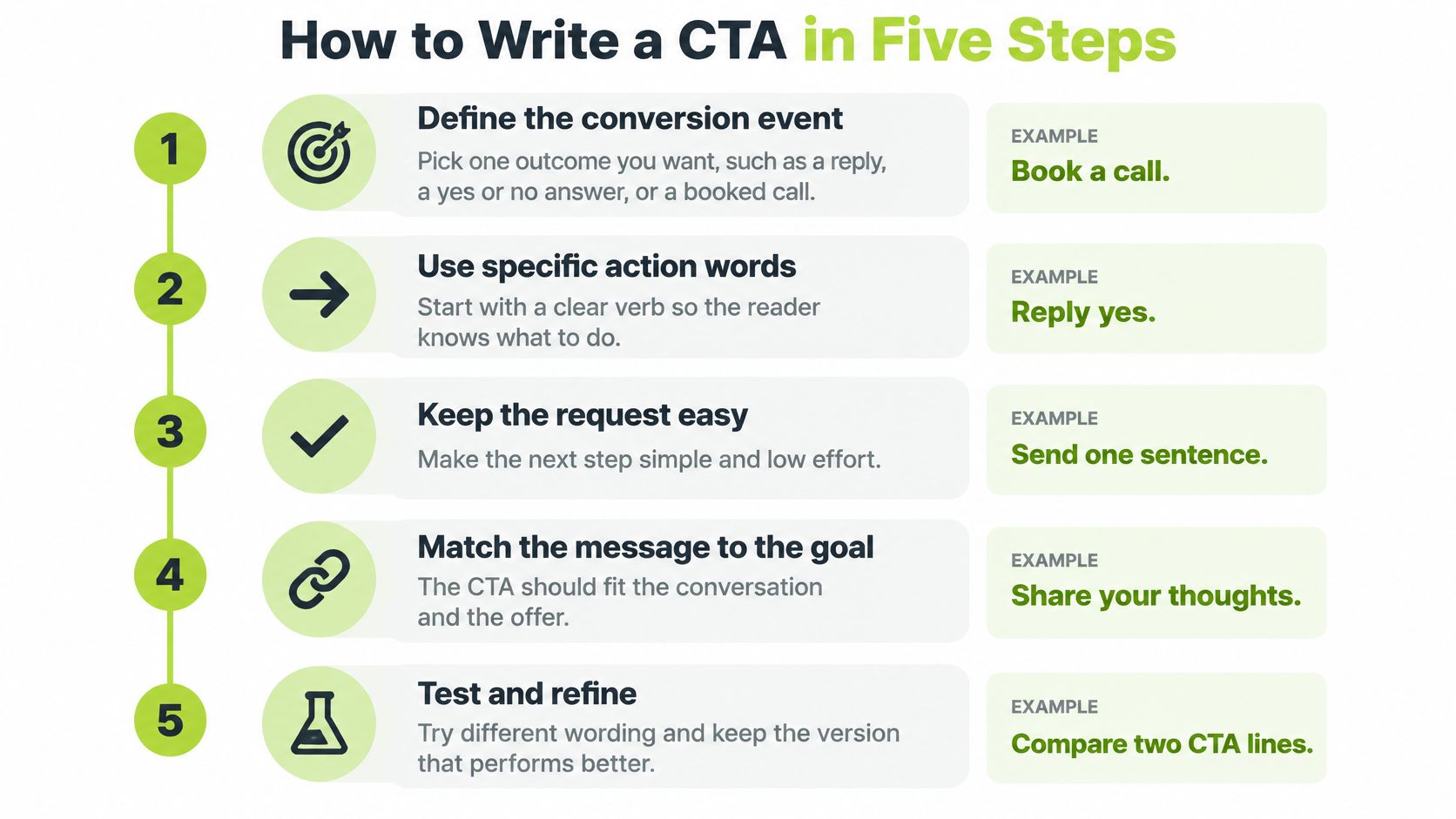
A useful drafting formula is verb + object + outcome or time. It identifies the action, what it concerns and why the prospect should take it.
Nielsen Norman Group's usability guidance recommends action verbs, clear expectations and communicated value. Applied to email, that means replacing generic wording with a specific action, such as Book a 15-minute diagnosis, when a diagnostic conversation matches the offer.
Build the request around an outcome
-
Define the conversion event. Choose the immediate outcome: confirmation of a priority, permission to send an asset, or a booked conversation. For a first-contact research offer, the event might be permission to send an account shortlist.
-
Start with a specific action verb. Use Reply, Book, Send or Compare where natural, rather than an ambiguous instruction such as Submit. A conversational question can still be explicit, so there's no need to force every email into an imperative.
-
State the expected outcome. Explain what the prospect receives, such as a shortlist showing which accounts deserve investigation. Name the deliverable rather than describing it as useful information.
-
Reduce uncertainty about commitment. Explain the effort involved and what happens next. For a warm prospect, 15 minutes, no slides sets expectations, provided the actual meeting follows that format.
-
Check the fit. Confirm that the request suits the prospect's stage and that another link, question or attachment doesn't compete with it. If the prospect hasn't acknowledged the problem, simplify the decision rather than adding persuasion.
Work through a hypothetical rewrite
Before: Let me know if interested.
For an unfamiliar prospect, first define the desired response as permission to share. Then name the asset, specify its purpose and make clear that receiving it doesn't require a meeting.
After: Reply yes to receive a short account list showing where the team could start its prospect research. No call needed.
That line is appropriate only if the list exists and the email has established why those accounts matter. H2's guide to email copywriting helps connect the closing request with the rest of the message; for broader format choices, explore different CTA types in Otter A/B's guide.
Read the line aloud. If the action and the benefit can't be explained in one breath, shorten or clarify it.
The formula is a drafting aid, not a requirement to pack every detail into the final sentence. Supporting context can sit immediately above the ask.
Opt-Out Wording and Required Sender Details
Every commercial email carries two obligations alongside its CTA: a working route to decline future messages, and enough sender detail for the recipient to know who is behind it. Under the FTC's CAN-SPAM guidance, the opt-out must be recognisable and understandable, offer a way to stop all marketing emails, and remain operational for at least 30 days after sending.
Three surrounding details support that requirement:
- Honest identification: Don't disguise the message's commercial nature; the sender name and subject line should reflect what the email is.
- Opt-out notice: Make the opportunity to decline future commercial email conspicuous.
- Sender address: Include a valid physical postal address.
These commercial-email disclosures are set out in the FTC's CAN-SPAM regulatory document. On scope: CAN-SPAM's explicit advertisement-labelling rule applies mainly to sexually oriented commercial email, so honest identification carries more weight than a literal label. CAN-SPAM is US law; a UK-based sender should also check UK PECR and UK GDPR for the intended recipients rather than assuming US compliance settles everything.
Keep refusal easy
Hypothetical closing line: If this isn't relevant, reply no and no further marketing emails will be sent.
That instruction must be operationally honoured, meaning the address comes off the list before the next scheduled send. It doesn't replace the required opt-out notice or postal address.
H2's guide to prospecting by email provides broader outreach context, while email advertising insights from NZ Apps offer a complementary marketing perspective, not a substitute for jurisdiction-specific legal guidance.
Keep the positive ask in the body and the required details in a readable footer. Use one obvious opt-out, since a refusal route hidden in dense text fails the recipient and the sender alike.
Sequencing CTAs Across a Cold Email Series
A sequence should respond to the prospect, not become more demanding with each scheduled send. The following is a hypothetical planning example, with illustrative gaps rather than prescribed sending intervals.
Example CTA sequence for a four-email cold series
| Timing | CTA | Commitment | |
|---|---|---|---|
| 1 Opening | Day 1 | Is this a priority for your team this quarter? | Very low |
| 2 Relevance | Day 4 | Would a short list of target accounts in your region help? | Low |
| 3 Proof | Day 8 | Worth a 15-minute call to compare notes on your current approach? | Medium |
| 4 Close | Day 12 | Should I close this thread, or send the list anyway? | Very low |
The proof email's meeting request is a conditional escalation, not permission to demand a call from every silent recipient. Without a meaningful signal, retain a lighter offer rather than moving automatically up the commitment ladder.
Branch on the response
A positive reply can justify asking about a day for a conversation. A not-now reply calls for agreement on when to return, while a negative reply ends the sequence and should trigger the appropriate suppression process.
A relevant click may justify reviewing the next message, but it isn't equivalent to expressed buying interest. An open alone shouldn't trigger a stronger ask.
For example, suppose a prospect appears to open the relevance email but doesn't reply. Instead of sending the scheduled meeting request, the proof email could ask: Would an example account, with the reason it fits, make this easier to assess?
A scheduled follow-up isn't evidence that the prospect is ready for a bigger commitment.
Plan what happens after the reply
Space messages according to response patterns and the team's ability to fulfil offers and handle conversations. When comparing tools, cold outreach software pricing from TopToolAdvisor is useful commercial context, but reply handling and sequence controls should matter alongside cost.
At H2, messaging is concise, relevant and reviewed with the client before launch. The commercial team should confirm that offered assets exist, meeting owners are available and refusal requests reach the right workflow.
Before activation, map each email to one CTA, one next step and one exit. A graceful final message should close the thread, not conceal another escalating pitch.
Wording Mistakes That Lower Reply Rates
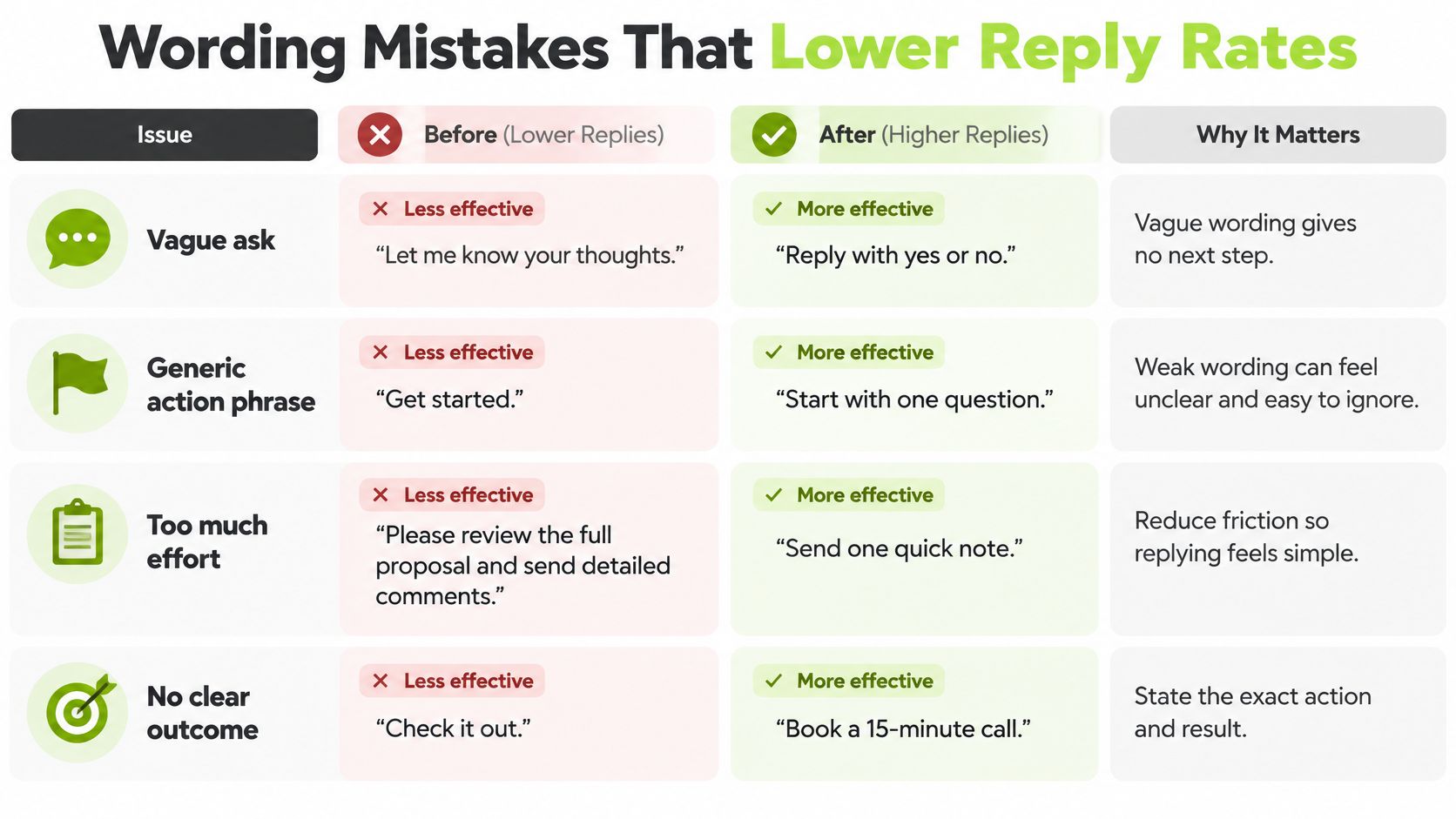
The most common mistake is treating a vague closing line as a polite CTA. Politeness doesn't help if the prospect has to invent the next step.
These hypothetical rewrites address different sources of friction. None guarantees a higher reply rate.
Replace ambiguity and unnecessary effort
| Habit | Before | After | Why change it |
|---|---|---|---|
| Vague ask | Let me know your thoughts. | Is account research a priority this quarter? | Gives the prospect a defined question. |
| Unexplained action | Get started. | Reply yes to receive the research checklist. | Explains what follows. |
| Stacked requests | Review the deck, share feedback and book a call. | Would the account-selection summary help? | Removes competing tasks. |
| False urgency | Only two spots left this week. | Would a conversation be useful this month? | Removes unsupported pressure. |
| Premature demo | Book a demo. | Is replacing manual qualification on the agenda? | Checks relevance before requesting calendar time. |
| First-person filler | I hope this finds you well. I wanted to ask whether… | Is the team still qualifying accounts manually? | Reaches the relevant question sooner. |
| Buried CTA | A request beneath a long company history. | A standalone question after the relevant problem and offer. | Makes the ask easier to locate. |
Shorter isn't automatically better. Removing the problem, context and value can leave a crisp sentence that still gives the prospect no reason to respond.
Specific verbs aren't universal winners either. In a NextAfter Facebook donation experiment, changing Learn More to Download reduced donations by 56.1%, with reported confidence of 98.5%. That donation result isn't a cold-email benchmark, but it challenges the assumption that a more forceful verb must perform better.
Audit meaning, not just visibility
A prospect can notice a CTA and still reject it because the requested action or benefit remains unclear. Moving an unclear sentence higher in the email doesn't solve that problem.
Audit the previous month's emails with a short set of labels:
- Vague: The recipient must work out what response is wanted.
- Stacked: The message asks for several different actions.
- Urgent without cause: The deadline or scarcity isn't genuine.
- Buried: The request follows unnecessary explanation.
Finally, separate courtesy from commercial progress. A pleasant reply or a clicked asset isn't necessarily a qualified conversation or booked call.
Testing CTA Wording Without Fooling Yourself
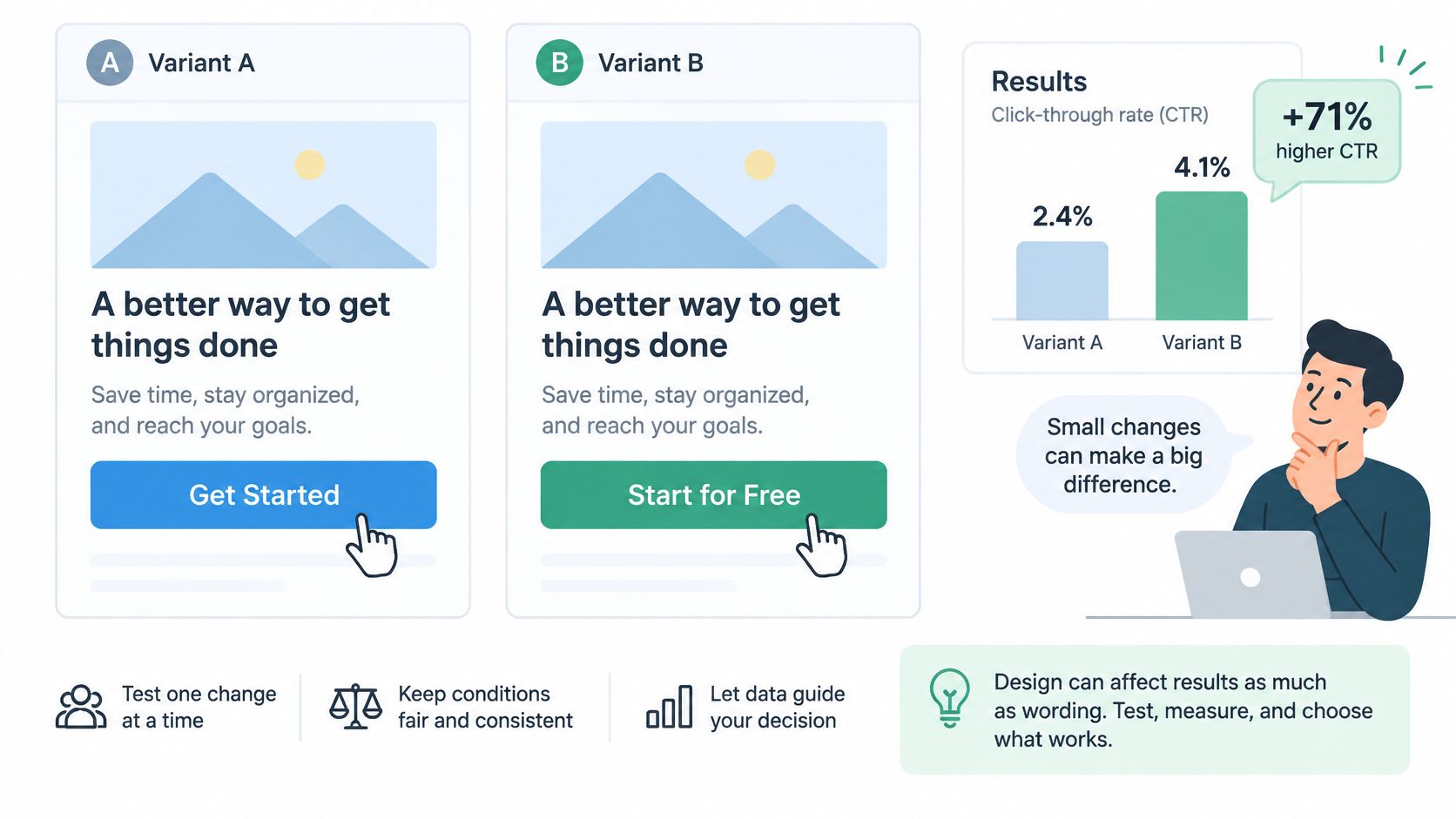
In a MECLABS experiment reported by MarketingSherpa, one treatment increased click-through by 277% and final conversion by 82%, both at 99% confidence; changing “Sign In And Order A Sample” to “Request A Free Copy” increased click-through by 132%, also at 99% confidence. However, the final-conversion improvement between the stronger treatment and its comparison was 14% at only 80% confidence.
Those are historical experiment results, not expected cold-email lifts. The wording also changed the perceived value and effort of the next step, so the lesson isn't just to replace a particular verb.
Decide the test before sending
- Write a hypothesis. For example, permission to receive an account shortlist may generate more qualified positive replies than an immediate meeting request among unfamiliar accounts.
- Isolate the change. Change only the CTA while keeping audience criteria, offer, sending-time distribution and surrounding copy comparable. Randomly allocate recipients, avoiding inconsistent messages to people at the same account.
- Choose the primary metric. Select positive reply rate or booked meetings per 100 sends before launch. Define whether the denominator means attempted sends or delivered messages, then use it consistently.
- Set the sample and stopping rule. Plan the minimum sample around the baseline rate and the smallest improvement worth acting on. Don't stop early because one variant appears ahead.
H2's explanation of split testing provides supporting context for controlled comparisons. Changing the audience, subject line and offer alongside the CTA prevents a clean conclusion about wording.
Classify replies before declaring a winner
Record positive, negative and out-of-office replies separately. Also distinguish interest in an asset from willingness to discuss a commercial problem, so automated replies and polite refusals don't inflate apparent success.
H2 measures success by qualified conversations, booked meetings and the opportunities those meetings create. Opens and raw send volume serve as diagnostic signals rather than the outcome.
Small B2B lists may require several rounds over several weeks. Preserve comparable conditions where possible, and treat an inconclusive result as inconclusive.
Report the absolute change, meaning the difference between rates, and the relative change, meaning that difference compared with the original rate. Include sample size, event counts and confidence so colleagues can judge the evidence rather than just the headline.
Choose the CTA to Send This Week
The best decision this week is to send the lowest-commitment CTA that matches the prospect's stage. For a cold account with no expressed interest, that usually means checking relevance or offering a concrete resource, not presenting a calendar link.
Choose a fixed sample before launch, then compare positive replies and booked calls per 100 sends with the previous sequence. Keep sample size and confidence beside the result; a historical comparison can guide the next test, but changes in audience or timing limit what it proves.
Check whether wording is the constraint
- Capacity: If replies wait unanswered or nobody can take meetings, fix ownership and availability.
- List quality: If recipients lack the relevant problem or authority, tighten account and role selection.
- Offer: If the promised next step has little practical value, improve the deliverable rather than polishing its description.
For teams facing those wider constraints, a short introductory call about the business, audience and current challenge can establish the right next step. H2's fully managed outbound service starts with the prospect explaining where growth is stuck, after which H2 sets out the audience, infrastructure and campaign it would build. Current commercial details are available on the pricing page.
Adaptable example, not a promise of results: Would a 15-minute call on reducing manual prospect research be useful this month?
H2 offers fully managed outbound and custom GTM systems that connect audience selection, CTA wording, reply handling and sales follow-through. Visit H2 to book an introductory conversation about where growth is stuck and what the next campaign needs to achieve.
