A Gartner survey of 771 B2B buyers in the United States, Canada, the United Kingdom and Australia found that 68% of purchases were completed through self-service digital commerce or rep-assisted digital commerce, and that 75% of buyers preferred a rep-free sales experience (Gartner). The second number is often read as buyers wanting to be left alone. That's the wrong conclusion. Buyers want to reach a shortlist on their own terms, then talk to someone who can settle the questions their research couldn't answer.
That puts the pressure in an awkward place. If buyers do most of the work before a conversation happens, a lead generation programme that only buys more contacts and sends more emails is adding supply to a crowded inbox. What creates qualified pipeline is narrower: accounts with a reason to act, data clean enough to trust, evidence a buyer can verify, and a fast human response when interest appears.
The uncomfortable lever: most pipeline problems are list problems. Adding volume hides them. Cutting the list exposes them.
Lead Generation Channels Compared Side by Side
Six channels account for most B2B SaaS pipeline. They differ less in prestige than in the constraints they impose, which is why the same channel works for one team and stalls for another running an identical playbook.
| Channel | Best when | Typical time to first meetings | Main cost | Main risk |
|---|---|---|---|---|
| Cold email outbound | Proven offer, clear target accounts, capacity to take conversations | Weeks, once sending setup is ready | Data, sending infrastructure and copywriting time | Deliverability damage if volume scales too fast |
| LinkedIn outreach | Named decision makers in a smaller target list | Weeks | Time or tool seats | Low reach with unverified profiles and account restrictions |
| Content and SEO | Known search topics with steady long-term demand | Months | Writing, expertise and editing | Slow, with little control over timing |
| Paid search and social ads | Existing demand and clear high-intent keywords | Days after launch | Ongoing media spend | Costly clicks and low buyer intent |
| Partners and referrals | Partners already serve the same buyers | Weeks to months, set by partner activity | Partner margin or relationship time | Hard to scale and tied to individual relationships |
| Events and webinars | Launch moments and category education | Weeks to months | Event, promotion and follow-up costs | Attendance does not equal fit |
Those timings are working ranges, not benchmarks. They move with the market, the seniority of the buyer and how much internal approval an offer needs. A message to an operations lead who can approve a small subscription behaves nothing like one aimed at a platform engineering group that will run a security review before anyone signs.
Why research happens before the reply
Gartner's 2017 Digital B2B Buyer Survey, based on 750 B2B buyers, found buyers spent only 17% of the purchase journey meeting potential suppliers, and when comparing several suppliers the time with any individual sales rep fell to about 5-6%. Independent online research took 27% of buying time (Gartner via Internet Archive). An outbound email is therefore rarely the start of an evaluation. It competes with a documentation page, a review site and whatever a peer said in a community thread.
That's why splitting budget between inbound and outbound channels for SaaS usually produces two half-systems. The message earns the click, the content library earns the trust, and the sales conversation confirms the decision. Break any one of the three and reply rates flatten no matter how good the copy is.
Say a three-person sales team has a proven offer, forty accounts it keeps winning, and no content library. Cold email is the right first channel. It's the fastest route to a first meeting and the only one that tests the offer directly against named accounts. Case studies can be written while the first campaigns run, and by month six the same pages that support outbound begin to earn search traffic.
The rule for a first channel is simple. Choose the one that fits the offer, the size of the buying group and the team's capacity to handle replies, run it properly for a full quarter, and leave the second channel alone until the first is stable.
Choosing Accounts Worth Pursuing Before Outreach
A target list is a hypothesis about who has the problem, the budget, and the reason to act this quarter. Most outbound failures begin with a list that encodes none of those and matches an industry code to a headcount band.
Build the profile from deals, not from imagination
An ideal customer profile is only useful when it comes from evidence the company already owns. Won deals show the shape of the market that buys: industry, company size, the technology already in place, the region, and the specific problem the product solved. Lost deals matter just as much, because they separate accounts that looked right from accounts that could act.
Support conversations and sales calls add the part a firmographic filter can't see. Teams rarely buy because a category exists. They buy because a contract is ending, a new leader has arrived, a month-end report broke, or a board asked a question nobody could answer.
Keeping the ideal customer profile and the buyer persona in separate boxes prevents a common muddle, where account-level fit gets confused with the job title of the person who happens to answer an email.
Weighing signals without over-reading them
| Buying signal | What it can indicate | How much weight to give it |
|---|---|---|
| Hiring for a role tied to your product | A budget or a capability gap | Medium, a vacancy alone is not intent |
| Technology in use that your product replaces or integrates with | Fit and switching effort | Medium |
| Recent funding or fast headcount growth | Capacity to buy | Medium |
| Public statement about a problem you solve | Priority of the problem | Medium to high when specific |
| Public dissatisfaction with an alternative | Openness to switch | High when specific and recent |
| Recent visits to relevant content or pages | Current research | High, but check it against fit before acting |
No single row in that table is a purchase signal. A vacancy can be a backfill. A funding round can be earmarked for hiring rather than software. A conference talk can be a marketing obligation rather than a confession. Signals become useful when two or three point at the same problem from different directions.
A SaaS company hiring a data engineer, running a legacy reporting tool and complaining publicly about slow month-end reporting is a stronger bet than one that has only posted the vacancy. The first account has three signals converging. The second has one, and it may be replacing someone who left.
What the team should hold before the first email
- A fit score per account, built from the same criteria every time so the numbers are comparable across lists and quarters.
- A reason to act, written in one sentence, that names the trigger rather than the industry.
- A named contact with a verified role, not the most senior person the data provider happened to return.
- A reject list, which is the document that stops sales receiving three thousand accounts and pretending they're opportunities.
The reject list does more for pipeline than the target list. It's the difference between a team that knows why it isn't contacting an account and a team that contacts everything and learns nothing.
Reaching Buyers Who Already Shortlisted With AI
Most outbound advice still assumes a discovery path of search, content download, then email. That path is now one of several, and often not the first.
The change is easiest to see in how a shortlist gets built.
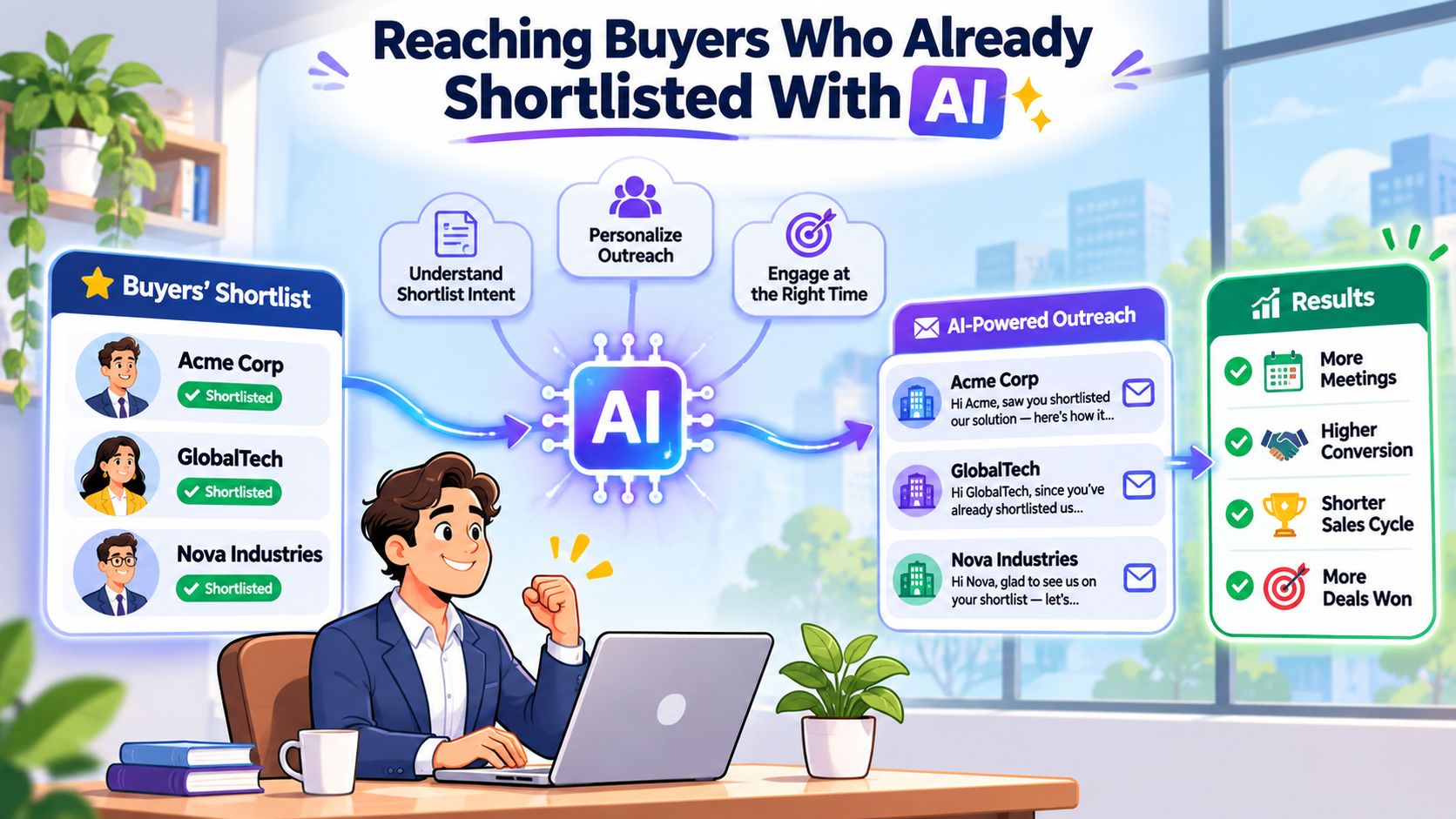
Recent buyer research puts numbers on it: 45% of B2B buyers used generative AI during a recent purchase, and 67% prefer a rep-free buying experience (Outreach Engine research). A separate survey reports that AI platforms are now the primary research starting point for 41% of respondents, though that figure rests on 102 respondents and deserves caution before anyone builds a strategy on it.
The practical consequence is straightforward. A prospect can arrive with a shortlist already shaped by ChatGPT, Gemini or a similar tool, having never visited the vendor's site and with no reason to reply to a generic email.
Why more volume makes this worse
Doubling send volume doesn't reach a buyer who never opened the inbox. It reaches more of the wrong people and damages the domain doing the sending. The response that fits the evidence is to publish the material a buyer needs to validate or challenge an AI-produced recommendation: who the product is for, who it isn't for, how pricing is structured, which integrations exist, how migration works, and what happens when the tool fails.
Account-specific research beats broad personalisation. A first name and a company logo are not research. A named initiative, a hiring pattern, an announced migration, or a published complaint about the incumbent is research, and it's the kind of detail an AI summary won't have surfaced.
Watch for the evaluation window
Evaluation has tells. A contract renewal approaching, a new leader taking the role, a formal vendor review being announced, or an internal project that failed last quarter all create a window where a conversation lands differently.
Where sales earns its place: after the shortlist exists, the useful job is testing it. A short call that asks what the AI comparison missed and whether the criteria match what the buying group actually agreed is worth more than another demo.
Intent signals help here, and it pays to understand what B2B intent data can and cannot tell you before treating a spike in page views as a buying decision.
A four-point check before outreach
- Publish answers to buying questions. Pricing structure, fit and non-fit, integrations and migration effort belong in public view, not behind a form.
- Research each account properly. One specific, verifiable detail beats ten personalisation tokens.
- Time outreach to triggers. Renewal dates, leadership changes and vendor reviews are better timing signals than a new quarter.
- Validate the shortlist in conversation. Ask what the buyer's research got wrong, then answer it with evidence.
Qualifying Leads Before They Reach Sales
Qualification fails in two directions. A lead that reaches sales without a real problem wastes an afternoon. A lead with a real problem that never reaches a human because a score landed at 64 instead of 70 loses a deal, and nobody logs it.
Fit is not intent
These are separate tests and they should be scored separately. Fit asks whether the account and the person match the profile: company size inside the range, a role that holds or influences budget, a stack the product works with, a region the team can support. Intent asks whether something is happening now: a trigger, a public statement, an active evaluation, or a reply that names a problem.
Five criteria do most of the work:
- Company size inside the range, measured on employees or revenue, whichever predicts a closed deal better for the offer.
- A role that holds or influences budget, named precisely rather than inferred from seniority.
- Evidence of the problem, taken from research, a reply or a public statement.
- A timing trigger, with a date attached if one exists.
- Complete, verified data, including the right company and a validated work email.
As an example of a workable model, weight fit at 60 points, intent at 30 and data quality at 10, with 70 as the routing threshold. An account that fits perfectly but shows no signal lands at 60 and stays in nurture. One that fits adequately and shows a specific trigger crosses the line, which is the behaviour wanted from a scoring model.
The data underneath the score
A 2025 sales-data health check estimates that 91% of CRM records are missing key fields, about 18% are duplicated, and roughly 70% of data becomes outdated each year without maintenance (sales data health check). Those figures come from a vendor-produced report, so check them against your own records before quoting them internally. The pattern is what matters: automation can look healthy while routing stale contacts and poor-fit accounts to reps.
Verify the fields that decide routing before scoring anything. That means the correct company domain and legal entity, a validated work email, a current role, a country the team can sell into, and suppression status.
A practical rule: weak signals should trigger research, not outreach. A single page view is a reason to look at an account, not a reason to email it.
Measure false positives and false negatives against downstream outcomes: accepted meetings, opportunities and pipeline. Where marketing owns the definition, it helps to be precise about how qualified leads marketing works as a shared standard rather than a handover ritual.
Someone must own the definitions, the exception handling, the audits of AI classifications, and the loop that feeds sales feedback back into scoring. Without a named owner, the rules drift within a quarter.
What to verify before trusting a score
- The domain resolves to the right entity, with subsidiaries and rebrands checked.
- The contact still holds the role, since job changes invalidate the best firmographic fit.
- The email passes verification, ideally at the point of send rather than at the point of purchase.
- The account isn't already in the CRM as an open opportunity or a recent rejection.
- The suppression record is clear for the person and the company.
Choosing Tools and Data for Lead Generation
Tool decisions are usually framed as feature comparisons. They're better judged on what happens to a record between the moment it's bought and the moment a rep dials the number.
You need seven categories covered: contact and company data, verification and enrichment, deduplication, CRM sync, sending infrastructure, sequencing, and suppression. Judge each supplier on coverage of the target market, verification method and refresh frequency, export and contract terms, CRM integration, logging of consent and suppression status, and cost per usable record.
Where one platform wins and a stack loses
A single platform reduces handoffs and sync errors, and it also creates lock-in and limits control over each step. Separate tools give flexibility and add failure points the team has to monitor, usually the gap where a record exists in one system and not the next.
The number that matters is cost per usable record, not cost per record bought. Take a list of 10,000 records. Suppose 6,500 pass verification and 700 of those duplicate records already in the CRM. That leaves 5,800 usable records, so the unit cost is the invoice divided by 5,800.
Mapping the categories before signing anything prevents paying twice for the same function, and a written GTM tech stack plan is cheaper than an annual contract signed in haste.
Clay is one workflow tool teams assess against the same criteria. It's effective for stitching data sources and holding an enrichment process in one place, and it's a poor fit for teams that want a fixed process nobody has to inspect. Judge it on coverage, refresh, export terms and the cost of getting a record to the point where a rep can use it.
Run a 500-record pilot before committing. Measure bounce rate, match rate against the CRM and accepted meetings from that batch, then keep only the tools that survive all three.
Deliverability and Compliance Checks Before You Scale
If messages don't reach the inbox, nothing else in this guide matters. Deliverability comes first for a diagnostic reason: a collapsed reply rate can mean the targeting is wrong, or it can mean the messages never arrived. Rewriting copy to fix a placement problem wastes a month and teaches the team the wrong lesson.
Validity's benchmark puts global inbox placement at an average of 87.2% in 2025, with hosting-platform placement down 1.3 percentage points, which points to a tightening environment for senders (Validity benchmark report). Domain reputation, authentication and sending behaviour decide how much of a prospect list is exposed to the message.
The gates to check
| Gate | Requirement | Why it matters |
|---|---|---|
| Authentication | SPF and DKIM pass, with a DMARC policy published at p=none or stricter | Receiving providers verify the sender and detect spoofing |
| Volume threshold | Senders delivering 5,000 or more messages a day to Gmail accounts must meet Google's sender requirements | Above this level the rules apply in full |
| Spam rate | Keep the spam rate below 0.3% | A higher rate is where delivery support or mitigations become unavailable |
| Unsubscribe | One-click unsubscribe for promotional messages, honoured within 48 hours | Required by the sender rules and expected by recipients |
| Consent basis | Confirm whether each recipient is a corporate subscriber or an individual before sending | Sets whether PECR consent rules apply |
| Suppression | A persistent do-not-contact record applied before export, enrichment, sequencing and reply handling | Stops objections being re-added through another list |
Use separate sending domains or subdomains so a damaged reputation doesn't take the primary domain with it. Set SPF, DKIM and DMARC, warm volume up gradually, validate addresses, suppress invalid contacts, and watch bounces, complaints and placement continuously. DMARC matters more than the other two records because it gives receiving providers a policy and a reporting mechanism for authentication failures.
The UK rules that change what you can send
Under PECR, the electronic-mail rule doesn't require consent for direct marketing to corporate bodies, but consent can still be required when contacting individuals, including sole traders and some partnerships. A generic role address is still covered by PECR even when the sender doesn't know the recipient's name (ICO guidance on electronic mail marketing).
Where a named work email is used, UK GDPR applies as well, so each record needs a lawful basis, an explanation of how the data will be used, and a way to object. Bought-in lists don't solve this, because the personal data on them still has to comply.
Suppression deserves its own process. The ICO notes that businesses and business contacts can object to direct marketing, and its B2B marketing guidance treats withdrawals and objections as things an organisation must act on. An objection is a data-governance event, not just a negative reply, and it has to survive list refreshes, re-enrichment and new campaigns.
Take a team sending about 300 messages a day to Gmail addresses that sees replies fall. It should check authentication, placement and complaint rates before touching the copy. That volume sits below Google's 5,000-a-day threshold, so the bulk-sender rules don't apply to it, yet checking authentication and complaint rates is still the right first move.
How to Hand Leads to Sales Within an Hour
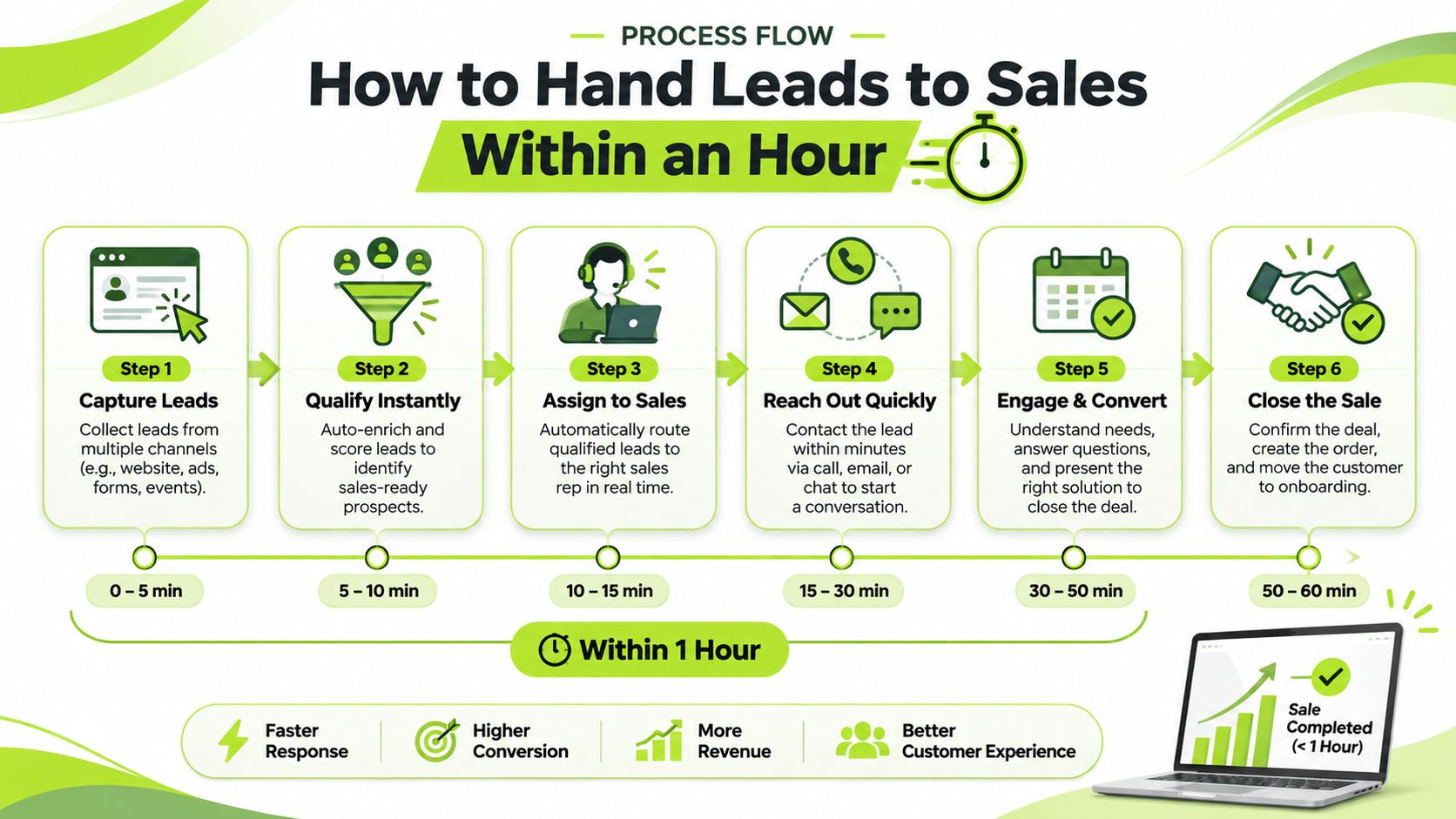
Speed is a system variable, not a personality trait. A Harvard Business Review study covering 1.25 million leads across 42 firms found that organisations contacting a lead within one hour were nearly seven times more likely to qualify it than organisations that waited longer (lead response time study). Interest decays: a prospect who has just requested information is reachable while the problem is still the most interesting thing on their screen.
The routine
- Define what counts as high intent. A form submission, a positive reply from a qualified account, or a product-interest signal with a named user. Reason: routing rules inherit whatever definition you give them, so a vague definition floods the queue. Common slip: counting every reply, including unsubscribes.
- Route each event to a named owner with an SLA timer under one hour. Reason: unassigned leads wait until someone notices. Common slip: a lead arriving on Friday evening and sitting untouched until Monday.
- Send an automated acknowledgement, but log it as a receipt. Reason: the objective is human contact, and a confirmation email doesn't achieve it. Common slip: the CRM showing "contacted" when nobody spoke to anyone.
- Set a fallback owner. Reason: enrichment fails and reps take leave. Common slip: the record sits in a queue nobody owns when the assigned rep is away.
- Escalate on breach. Reason: an SLA with no consequence is a wish. Common slip: dashboards showing breaches that nobody is asked to explain.
- Record the reply, meeting outcome and next step in the CRM. Reason: campaign feedback has to reach targeting and messaging. Common slip: useful objections living in a rep's inbox and never reaching the people writing copy.
- Measure time to first human contact and qualification rate by response-time band. Reason: an average hides the tail, and the tail is where the deals were lost. Common slip: reporting only overall conversion, which makes a slow process look acceptable.
What separates the good versions: the escalation path is boring and automatic. Nobody has to remember it, and nobody gets praised for rescuing a lead the system should have caught.
Measuring Pipeline Instead of Lead Volume
Lead count is the least useful number in the report, because it counts inputs that may never have fitted in the first place.
| Metric | What it counts | What it cannot tell you |
|---|---|---|
| Leads | Records created or added to a campaign | Whether the accounts fit or will take a call |
| Replies | Any response, positive or negative | Whether the reply is a real buying signal |
| Qualified conversations | Replies that sales accepts as relevant | Whether the conversation moves forward |
| Meetings booked | Calls scheduled in the calendar | Whether the buyer attends or has budget |
| Opportunities created | Deals entered in the CRM with a stage | Whether the deal will close |
| Pipeline value | Estimated value of open opportunities | Whether that value will convert to revenue |
Read the sequence rather than any single row. Suppose a quarter produces 120 leads, 30 replies, 8 qualified conversations, 3 meetings and 1 opportunity. Thirty replies from 120 leads is a 25% response rate, high enough that the first check is whether those replies were human, and whether automated out-of-office messages and unsubscribes are inflating the count.
Eight qualified conversations from 30 replies points at the qualification rules or the message itself. Three meetings from eight conversations suggests the call isn't reaching the person who owns the problem. One opportunity from three meetings points at the handoff or the discovery call, where budget and authority get tested.
Pipeline value stays an estimate until deals close, so define CRM stages the same way across marketing, sales and RevOps. A stage that means something different to two teams turns the pipeline report into an argument.
Give every stage a named owner and a review cadence. Weekly for the handoff and response times, monthly for qualification rates, quarterly for stage definitions and conversion between them.
Deciding Whether to Run Outbound In-House or Outsource It
Four criteria decide this reasonably well, and all four should hold before outsourcing makes sense:
- The offer is proven. Buyers already respond to it when it reaches them.
- The company can absorb more conversations. A booked meeting with nobody free to run it is a cost, not a result.
- The team lacks the time or appetite to build the function. Research, list building, sending infrastructure and reply handling are a job, not a side task.
- Pipeline is a current priority. If the next two quarters depend on something else, outbound will be the first thing dropped.
Three routes and when each fits
When all four apply, a fully managed programme is the shortest path. H2 runs research, sending infrastructure, deliverability, copywriting, testing, reply handling and meeting booking, leaving the client's team to run the conversations themselves. That model suits teams with a proven offer and a need for more pipeline without the appetite to build an outbound function internally. The scope sits on the fully managed outbound service page.
When capacity exists but one step is the bottleneck, such as routing, enrichment or lead scoring, a custom build is usually cheaper than outsourcing everything. Define the system by its outcome, inputs, decision rules and fallback paths before anything is constructed. That's the shape of H2's custom GTM system builds.
If the gap is skill rather than capacity, particularly in workflow tools such as Clay or AI-assisted prospecting, training closes it faster than a retainer. H2's private GTM workshops are built around a team's own market, tools and live commercial questions.
A team with a weak offer should fix positioning first. Outbound makes a vague proposition expensive at speed, and no amount of list quality rescues a message nobody recognises as relevant.
Current scope and prices sit on the H2 pricing page. The next step is a short conversation about the business, the audience and where growth is currently stuck.
H2 builds and runs outbound programmes that start with account selection and data quality rather than send volume, covering market research, list building, enrichment, sending infrastructure, copywriting and reply handling through to booked meetings. That approach suits B2B SaaS and technology companies with a proven offer and a need for more qualified conversations than their current pipeline produces. Book a 15-minute introductory call at H2 to talk through your market, your buyer group and where growth is stuck.
