Two thirds of B2B buyers would rather complete a purchase without a salesperson in the room. A 2026 B2B buyer behaviour report published by Consensus puts the share preferring a rep-free buying experience at 67%. Read that as a rejection of cold email and you'll stop reading here, which would be a mistake. Read it as a specification, and the work becomes clear: the buyer researches alone, decides alone for most of the journey, and only then accepts contact from someone who has already understood the problem.
Outbound still fills pipelines. What's changed is the standard a message has to clear. Every claim in it must be verifiable without a call, every follow-up must add something the last one didn't, and the campaign must be judged on qualified conversations and opportunities rather than sends. That's the system this guide sets out, in the order a team builds it.
How B2B Outbound Lead Generation Works Step by Step
Outbound lead generation is the work of finding accounts that fit your offer, reaching the right people with a credible reason to talk, and turning replies into qualified conversations. It isn't a synonym for cold email. A Gartner survey of 632 B2B buyers conducted in August and September 2024 found that 73% actively avoid suppliers that send irrelevant outreach, while 61% preferred an overall buying experience without a sales representative. Relevance, not contact volume, decides whether a message survives its first three seconds.
The same research makes a finer point that teams miss. Buyers still wanted seller involvement for tasks that need contextual intelligence, such as judging whether an offering fits their organisation. Contact isn't unwelcome. Uncontextualised contact is.
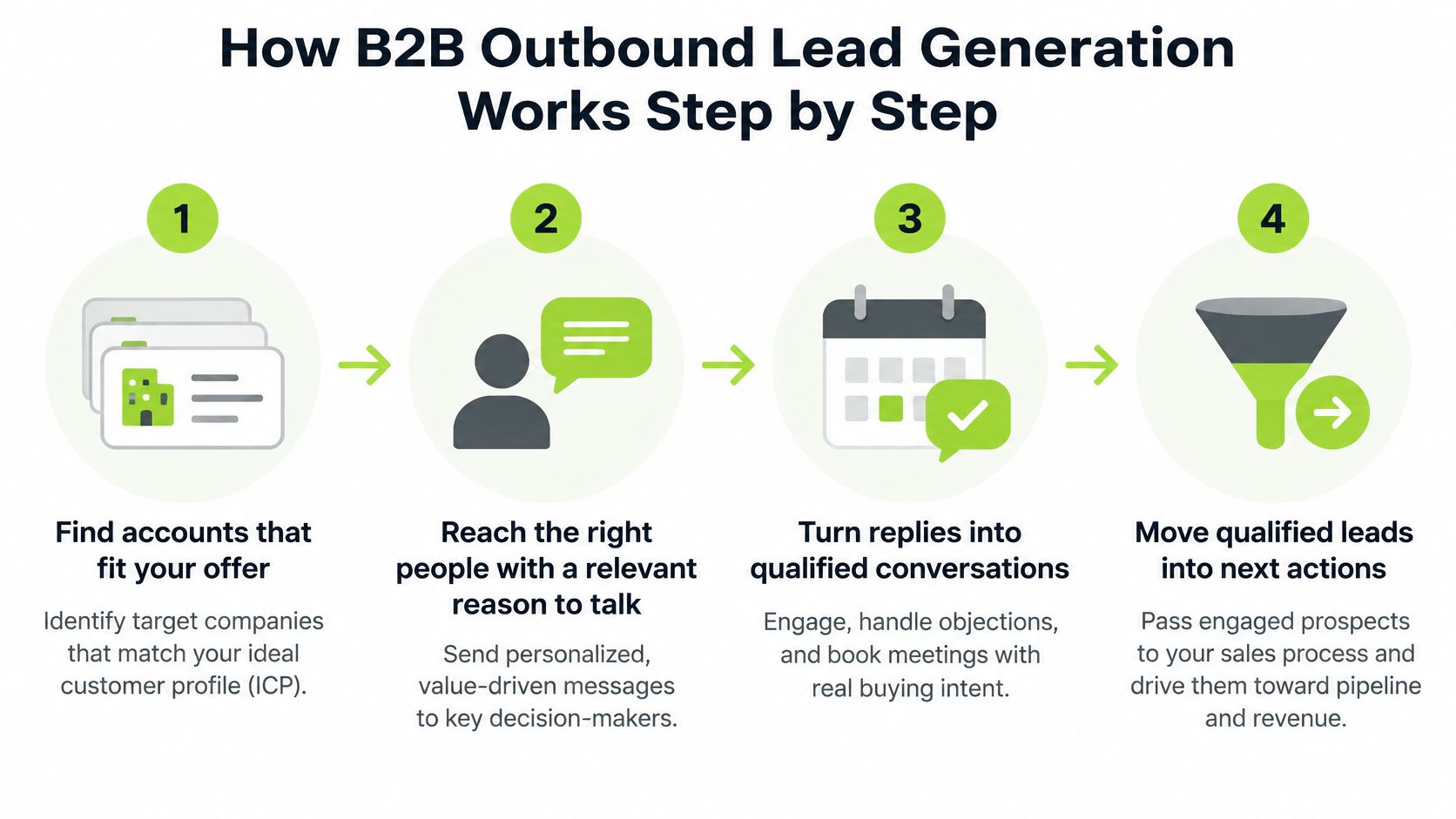
Six stages, in order, each with the artefact a team should hold before moving on:
- Define the ideal customer and the exclusions. Output: one written page naming firmographic fit, the problem you solve and the role that feels it, plus the accounts you will never contact.
- Identify accounts and buying signals. Output: a ranked account list, each row carrying a fit score and the signal that raised it.
- Find and verify contacts. Output: a verified contact list with role, seniority, a valid business address and no duplicates against the CRM.
- Write and launch a multi-step sequence. Output: approved copy plus sending infrastructure that passes authentication before the first send.
- Handle replies and book meetings. Output: a sorted reply queue with a response rule per category, and meetings booked with the context attached.
- Record outcomes in the CRM and measure qualified conversations. Output: tagged CRM records showing source, reply type and meeting outcome, ready for a monthly review.
Skipping stages one and two is what pushes teams towards volume, which makes the relevance problem worse. For teams adding phone to the mix, Voicedial's guide to building an outbound calling strategy covers call structure and timing without the usual scripted openings.
The rule that ties the six stages together: every message names a credible business trigger, explains why that account may be affected, and offers a next step that costs the reader almost nothing to take.
Define Your Ideal Customer and Who to Exclude
A profile that can't reject an account isn't a profile, it's a wish list. Build it in three layers, each narrower than the last.
Firmographic fit covers the sector, headcount band, revenue range, geography and technology stack where your offer lands without translation work. The operational problem is the specific thing that's broken or expensive for them right now, described in the language their team uses internally rather than your product's. The buyer role is the person who feels that problem weekly and can start a budget conversation.
Say a 30-person cybersecurity consultancy sells compliance audits. The broad version of its ICP is "companies that care about security," which is everyone and therefore no one. The usable version is companies with 200 to 1,000 staff that handle regulated data, where the buyer is the head of operations rather than every director on the org chart. Operations owns the audit evidence, feels the deadline and has the budget line. The CISO cares, but is a second conversation.
The exclusion list matters just as much, and it's the part teams keep informal:
- Outside your service region, including the time zones your team can't cover properly.
- Below your minimum contract value, where the sales cost eats the margin.
- Existing customers and direct competitors, removed before any sequence loads.
- Companies in a recent restructuring, where the buyer's attention is elsewhere for a quarter.
- Records without a clear legal entity type, which brings us to the part that can halt a campaign outright.
The legal check that separates a company from a sole trader
UK rules depend on who is on the other end of the email. Under the Privacy and Electronic Communications Regulations (PECR), the consent requirement for direct marketing by electronic mail doesn't apply to corporate subscribers such as limited companies, limited liability partnerships and government bodies, as the ICO's guidance on business-to-business marketing sets out. Sole traders and some partnerships are treated as individuals and generally need specific consent or a valid soft opt-in.
The same guidance is clear that UK GDPR still applies wherever personal data is processed, and that senders must identify themselves and provide a valid address or a simple way to opt out. Classify every record by legal entity before launch, record the data source and lawful basis, and suppress previous opt-outs. A list mixing companies, sole traders and personal addresses can't be governed by one blanket rule.
The scoring sheet that lets sales challenge the rules
Give every account a fit score and a one-line reason, then keep the rejection reason for the ones you drop. "Too small, 40 staff, no compliance function" is a rule sales can argue with. A silent exclusion is a rule nobody can review. Reviewing those reasons monthly is how the ICP improves instead of calcifying. If the distinction between a firmographic profile and a role-level persona still feels blurry, this explanation of ICP versus persona separates the two cleanly.
Find Accounts and Verify Buying Signals
Public company information, the company's own website, job postings, technology usage and relevant social activity all help identify accounts worth investigating. None of them prove intent. A signal ranks an account for research. It doesn't tell you the buyer has a problem, a budget or a reason to act this quarter.
The distinction matters more now that AI tools make signal collection cheap. Gartner's research on AI in sales notes that sellers need to understand market trends, business priorities and each buyer's needs when positioning AI-enabled selling, and its published figures report that 45% of B2B buyers used generative AI during a purchase while 69% prefer to check AI-generated insights with sales representatives. Buyers are using the same tooling you are, and they're checking its output. A confident-sounding inference that turns out to be wrong costs you the account.
Five signals, what each suggests and what it doesn't prove
| Signal | What it may suggest | What it does not prove | How to verify |
|---|---|---|---|
| Relevant job posting | A capacity or skills gap your offer could fill | An open role does not mean budget is approved | Read the job specification and check team size |
| Technology usage | Fit with a tool or integration your offer needs | Current tools do not show dissatisfaction | Confirm the stack on the company's site or product documentation |
| Recent funding round | New budget or a growth target | Funding does not guarantee spending on outbound | Check the date and any stated priorities |
| Recent website change | A launch, repositioning or new market | A redesign does not show a need for your service | Read the announcement and check whether the change affects your buyer |
| Social engagement | Interest in a topic your offer addresses | A like or comment is not purchase intent | Treat as a reason to research, then confirm the problem directly |
Firmographic fit is the gate. One or two strong signals then raise priority within that gated set. Accounts with a plausible signal but no clear operational problem belong in a research queue, not a sequence. The workflow behind that queue is worth studying in other contexts too, including this example of a search and filter prospecting workflow for paid media agencies, which shows how filters and exclusions stack before anyone gets contacted.
Verify the contact before you verify the timing
Contact verification is unglamorous and it protects everything downstream. Check email validity, remove addresses that fail, deduplicate against the CRM, confirm role and seniority, and refresh the record before each campaign rather than once a year. A correctly named person in the wrong job is a bounce waiting to happen.
For AI-detected characteristics, record a confidence level, the source date and the name of the reviewer. Pause any account where the automated score conflicts with what a researcher sees on the company's site. When choosing tools, judge them by job rather than by feature list: contact data, signal capture and enrichment, sending, and CRM logging. Score each on data source transparency, cost per usable record, deduplication, CRM integration, opt-out suppression and whether the audit trail can be exported. The output for every ranked account is short: company, signals found, fit score, next action. If you want a fuller treatment of which signals predict a conversation, this piece on sales buying signals goes deeper.
Write Sequences That Earn Replies
The first email gets less credit than it deserves and less blame than it gets. A 2025 survey of more than 1,200 sales professionals, published by Smarte, found that 62% of cold-email replies came from follow-up steps rather than the first message. The sequence is the unit of work, not the email.
Structure the opening message in three parts. A specific trigger the reader recognises. One sentence on why that account may be affected. A single low-friction ask, such as a yes or no question or an offer to send a short example.
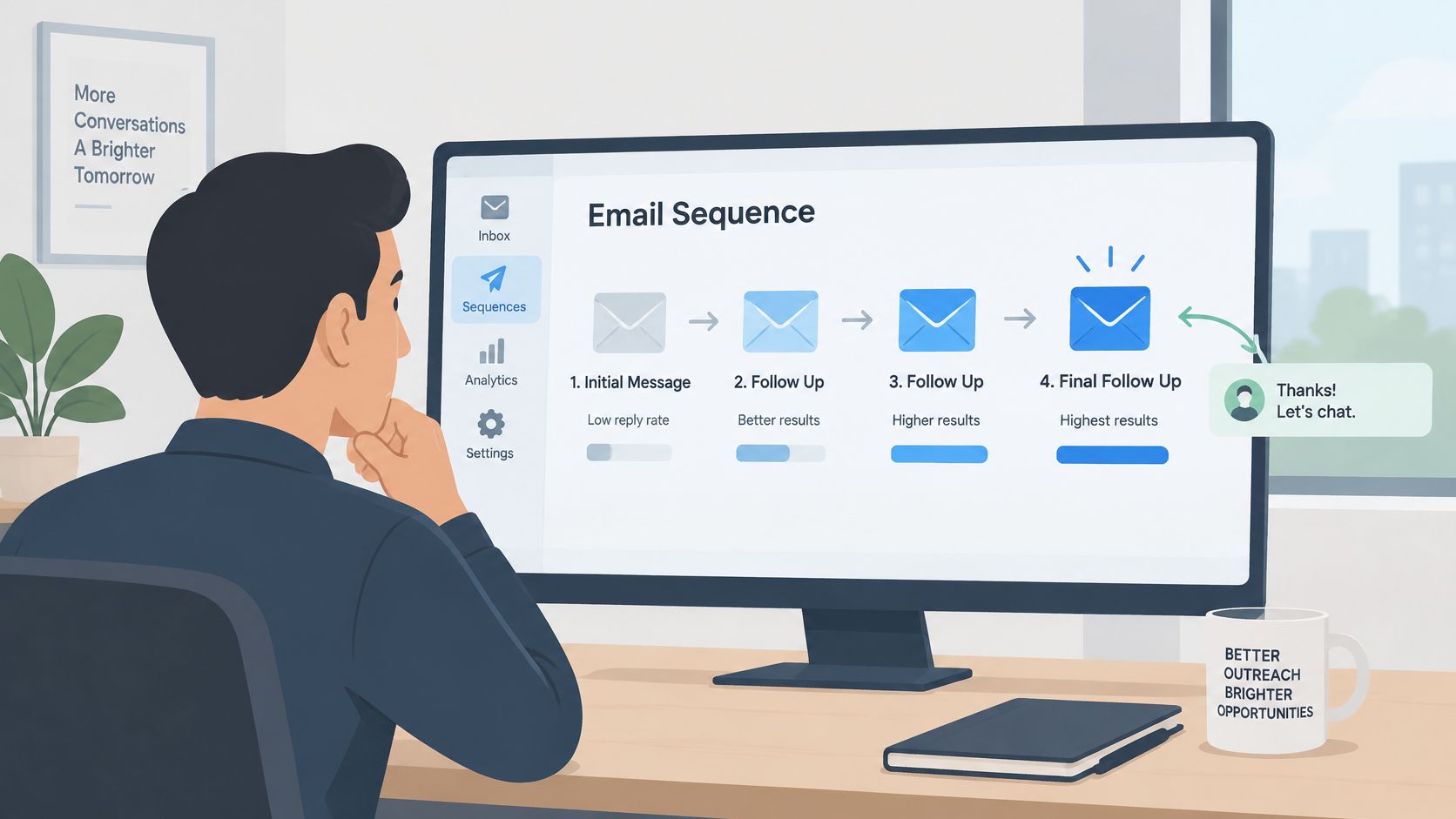
A hypothetical first email, under 90 words: "You've advertised two platform engineering roles since March. Teams hiring at that rate usually hit a wall on environment setup before the second hire starts. We build internal developer platforms for companies at exactly that point. Would a two-page example from a similar team be useful, or is this already handled?"
No "hope you're well," no paragraph about your company. The reader can check the job ad themselves, which is the point.
What each follow-up has to add
Four or five steps is enough. Each one earns its place by adding something new:
- Step two carries proof. A short result from a comparable company, one or two sentences, with enough detail that the reader can ask a follow-up question about it.
- Step three changes angle. Same problem, different entry point, perhaps the cost of the status quo rather than the fix.
- Step four gives without asking. A benchmark, a checklist or a teardown with no meeting request attached. Some prospects reply only to this one.
- Step five closes politely. Say this is the last message, what happens to the account afterwards, and leave a route back in six months.
LinkedIn touches and calls can run alongside, but they follow the same relevance rules. A LinkedIn message that repeats email copy is a wasted touch.
Sort replies before you write another email
Reply handling is where programmes lose momentum. Sort incoming replies into interested, wants more information, objection, not now and unsubscribe. Give each a written response rule and an owner, and suppress unsubscribes immediately rather than at the end of the week. The objection category is the most valuable one you'll get, because it tells you what the market believes about your offer.
Measure reply rate by step, not just per sequence. When one step underperforms, rewrite that step. Many teams rewrite the whole sequence and lose the comparison.
Set Up Deliverability Before You Send Volume
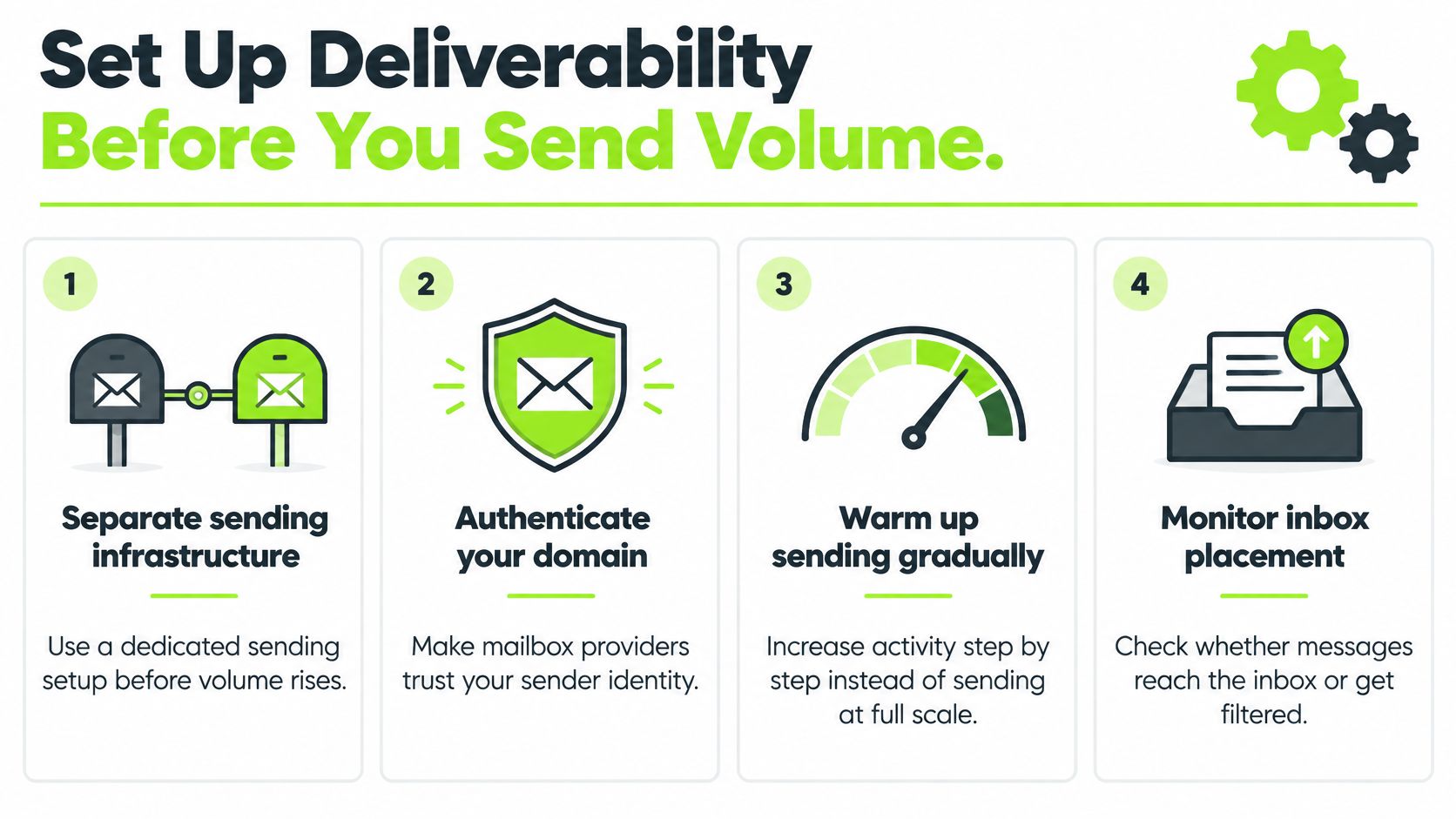
Deliverability is an engineering constraint. Mailbox providers judge sender trust before a human sees the subject line, so excellent targeting can be entirely invisible if authentication is weak. A campaign that would have worked at 300 sends can fail at 3,000 from the same list.
The setup order is fixed. Send from a separate domain or subdomain rather than your primary corporate domain, configure SPF, DKIM and DMARC, validate the records before launch, then warm mailboxes gradually instead of opening at full volume.
The thresholds worth planning around
Google publishes concrete numbers rather than vague best practice. Its sender guidelines for Gmail state that senders should keep user-reported spam rates below 0.1% and prevent them from reaching 0.3% or higher. Senders delivering 5,000 or more messages per day to Gmail accounts have had additional requirements since February 2024, covering authentication, avoiding unwanted messages and easy unsubscribing. Senders must also align the domain in the From header with either the SPF or DKIM domain so DMARC alignment passes.
Spam rates are calculated daily. A bulk sender above 0.3% can lose mitigation eligibility, and regaining it means staying below 0.3% for seven consecutive days. That's a costly place to end up because of a careless list.
Caution on the volume figure: the 5,000 messages per day threshold applies to messages sent to personal Gmail accounts. It's a sensible baseline for any programme, not a universal definition of high volume.
Release criteria for every campaign
Treat these as gates, not post-launch fixes. No campaign ships until all five are true:
- Authentication passes on the sending domain, checked rather than assumed.
- Contacts are verified, with invalid addresses removed at import.
- Suppression lists are live, covering previous opt-outs and current customers.
- Unsubscribe works, is visible and takes one click.
- Bounce and complaint monitoring is on, with a named person watching it daily during launch.
Volume rises only when complaint rates have held within limits at the current level, ideally for a week or two. If a step change in volume pushes complaints up, come back down and find out why. An email deliverability audit is a faster way to find the weak point than guessing at copy changes. For teams that want the underlying mechanics explained plainly, MakeAutomation's notes on deliverability fundamentals for B2B sales teams cover the setup in more detail.
Measure Pipeline Instead of Send Volume
The most common reporting error in outbound isn't a missing metric. It's mixing six metrics that answer six different questions into one dashboard, then arguing about the number at the top. Sends show activity. Positive replies show relevance. Qualified conversations show whether the audience fits. Each needs its own line and its own owner.
| Measure | What it tells you | Common misreading | Read it with |
|---|---|---|---|
| Emails sent | The scale of activity | Treated as success on its own | Positive reply rate |
| Positive reply rate | Whether the message is relevant | Counting out-of-office and auto replies | Reply rate split by sequence step |
| Qualified conversations | Whether the audience fits the offer | Counting every reply as qualified | Qualification rules agreed with sales |
| Meetings booked | Calendar output | Counting meetings that did not take place | Meetings held rate |
| Opportunities created | Progression into the sales process | Confusing an opportunity with a meeting | Source tag recorded in the CRM |
| Pipeline value | Potential revenue from open opportunities | Treating pipeline as closed revenue | Closed revenue, reported separately |
Qualification rules need agreeing with sales before launch, in writing. "They replied and seemed interested" isn't a rule. Something like "they described a current operational problem our offer addresses, confirmed a budget owner and accepted a date" is.
Review with sales, not only with marketing
Once a month, sit with the people taking the meetings. Look at positive reply rate against qualified conversations, and at meetings booked against meetings held. A gap between booked and held usually means the qualification bar was too low or the meeting was pitched to the wrong role. A gap between positive replies and qualified conversations usually means the messaging attracted curiosity your offer can't satisfy.
Ask sales to tag every reply and every meeting outcome in the CRM: qualified, objected, wrong person, not now, unsuitable. Those tags are the raw material for the next round of targeting and copy changes. Without them, the programme keeps running on the same assumptions until the numbers force a rethink.
A smaller programme with a high qualified-conversation rate beats a larger one that fills a calendar with meetings that never should have been booked. The test isn't whether October beat September on sends. It's whether qualified conversations and opportunities rose across successive cycles.
Judging the system this way also protects the team. Nobody has to defend a volume target that the market has already rejected. They defend the pipeline instead.
Decide Whether to Run Outbound In-House or Outsource It
The build-or-buy decision usually gets made on budget when it should be made on three questions. Does the offer convert in a live sales conversation, repeatedly, with people who weren't already looking for you? Does the sales team have room for more conversations each week? And does anyone internally have the time to own research, data, copy, deliverability and testing as a single system?
If the answer to the first two is yes and the third is no, outbound will stall in-house for reasons that have nothing to do with ability. The roles required are rarely one person. Research, RevOps, copywriting and deliverability are distinct skills, and a single SDR covering all four usually does the first two well and the last two badly. Hiring that team takes months before the first qualified meeting, and the programme often dies in the gap.
The managed path trades control for speed. H2 runs fully managed outbound for B2B teams with a proven offer, capacity to take more sales conversations and a need for more pipeline, without the time or appetite to build a function internally. H2 researches the market, builds the infrastructure, writes the campaigns, launches the experiments and improves the system, so the client briefs once and concentrates on the resulting conversations. Scope and pricing change, so check the fully managed outbound page and the current pricing before budgeting.
Two narrower options exist. A custom system build suits a single manual bottleneck, such as enrichment, scoring or CRM routing. A private GTM workshop suits a team that wants to run outbound itself and needs the skills first.
Five questions before you choose
- Proven offer: have similar buyers paid for this after a sales conversation in the last two quarters?
- Free capacity: can the team take five to ten more qualified conversations a month without dropping quality?
- No internal owner: is there nobody who can own outbound for the next six months?
- Clear ideal customer: can you name ten companies that fit and ten that don't, with reasons?
- Agreed qualification rules: do sales and marketing describe a qualified conversation the same way?
Mostly yes points towards managed outbound or a hybrid, where an external team runs the top of the funnel and your closers keep the bottom. Mostly no means fix the offer or the qualification rules first, then start with research or a workshop rather than paying for campaigns that can't convert.
H2 builds and runs fully managed outbound for B2B teams that have a proven offer and the capacity to take more sales conversations, covering market research, audience definition, list building, sending infrastructure, campaign copy, reply handling and meeting booking. The client briefs H2 once and then concentrates on the conversations landing in the calendar. If your pipeline still depends on referrals and irregular inbound, visit H2 to talk through your market and which accounts are worth approaching first.
