83% of B2B buyers surveyed in 2023 said they initiated first contact with vendors, according to MediaPost's coverage of 6sense's survey of more than 900 buyers who had made purchases worth over $10,000 annually. Sellers can't assume that a prospect receiving outreach is ready to speak.
Effective appointment setting for B2B creates a worthwhile reason for a conversation, then checks whether that conversation belongs on a salesperson's calendar. The useful outcome isn't a full diary. It's access to suitable buyers with a business question worth exploring.
What B2B Appointment Setting Means
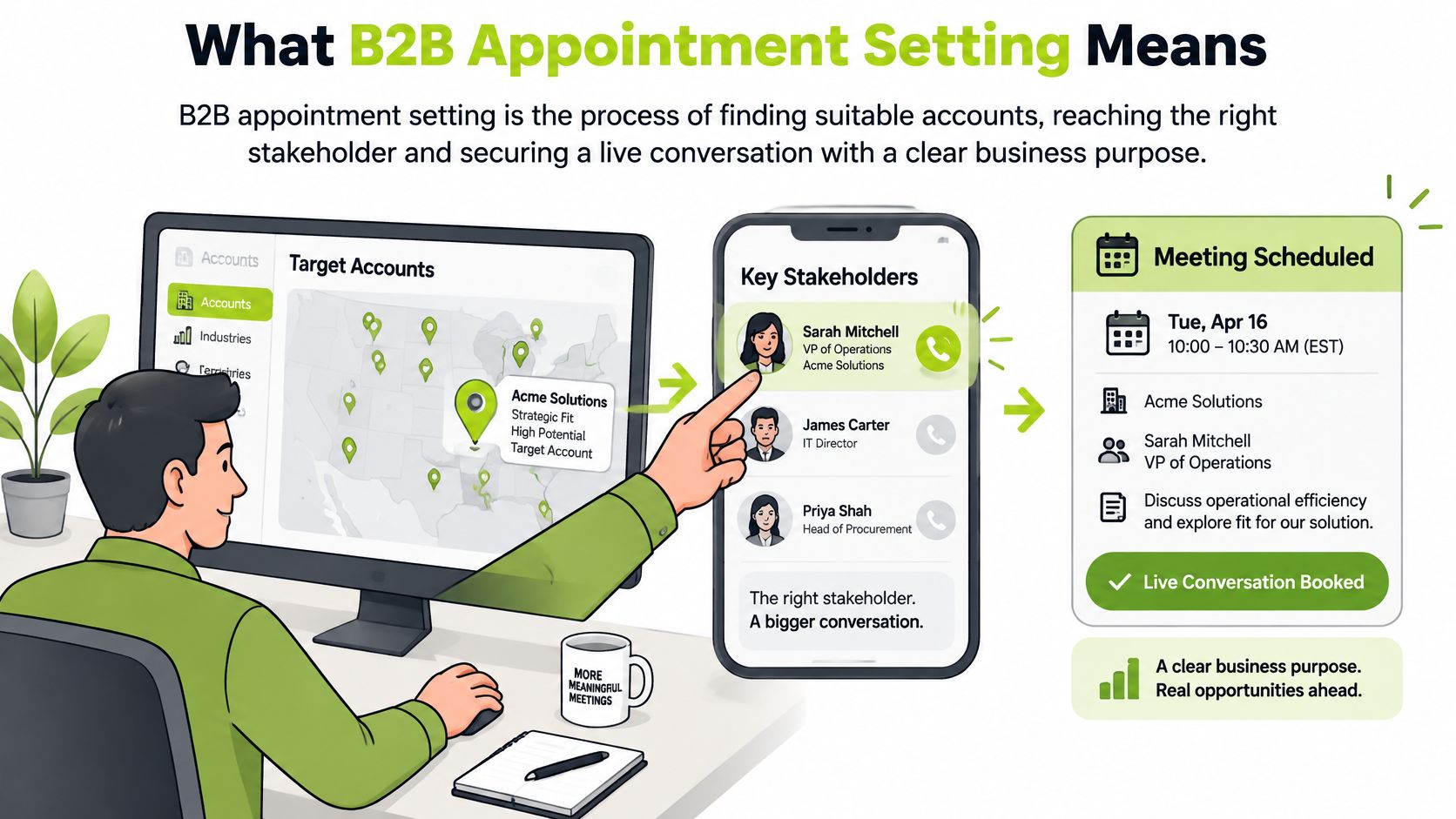
B2B appointment setting is the process of finding suitable accounts, reaching the right stakeholder and arranging a live conversation with a clear business purpose. It brings research, outreach, qualification and scheduling together.
A calendar is like a shop window: it shows activity, while the filter behind it determines who gets in. A meeting adds value when the prospect fits and has a reason to take part. Irrelevant outreach can also make it harder to earn that buyer's attention later.
The terms that matter
- Ideal customer profile: A description of organisations with a credible need for the offer and a commercial fit for the business.
- Buying signal: An observed change or behaviour that suggests an account deserves investigation, but does not prove purchase intent.
- Stakeholder access: A contact's ability to influence the problem or involve colleagues who can.
- Qualified meeting: A conversation that meets agreed tests for account fit, relevant need, stakeholder access and readiness.
Appointment setters may work with outbound prospects or respond to inbound interest. Their job is to establish whether a useful sales conversation is possible, then pass its context to the person running it. A polite reply or an email address alone is not enough.
Why the buyer's time changes the job
Gartner findings summarised in LeadRiver's appointment-setting guide indicate that buyers spend about 17% of their total purchase process meeting potential suppliers, while 67% prefer a rep-free experience for at least part of their journey.
That leaves little room for a meeting that describes the seller's company. The prospect should be able to see how a conversation could help answer a question that written information cannot resolve.
Appointment setting connects account research, relevant information and human contact to the buyer's circumstances. The aim is building a pipeline of qualified appointments, not filling the diary with conversations that lack a clear purpose.
Booking test: Does the account fit, is there a relevant need, can the contact influence it, and is there a credible reason to talk now?
In-House, Outsourced and Managed Models Compared
Appointment setting models compared
| Model | Who runs the work | Control over targeting | Cost basis | Best fit |
|---|---|---|---|---|
| In-house SDR or BDR team | The company's own sales development staff | Full control and direct feedback | Salaries, tools and management time; total calculated from staffing and operating costs | Teams with capacity to manage outbound every week |
| Outsourced appointment-setting agency | An external agency books meetings to an agreed brief | Moderate; governed by the brief, scripts and approval process | Per meeting or retainer; confirm qualification, replacement and cancellation terms | Teams with proven targeting that need additional delivery capacity |
| Managed service, such as Fully Managed Outbound | A provider runs the agreed research, data, sending, copy, replies and booking | Shared; the client supplies commercial context and feedback | Programme fee under the provider's current agreement | Proven offers, available sales capacity and limited internal operating time |
SDR means sales development representative; BDR means business development representative. Employers use the titles differently, so responsibilities matter more than the label.
The distinction between outsourced and managed services also needs checking. Some agencies use both descriptions for the same arrangement. The contract should name the work, approval rights and definition of an accepted meeting.
Control, speed and workload
In-house teams offer close access to customer knowledge and rapid changes to targeting. A sales leader can hear objections directly and adjust the offer without an external handoff. The trade-off is management: recruiting, coaching, data purchasing and campaign troubleshooting remain internal responsibilities.
An outsourced agency can add delivery capacity without building a permanent team. However, a provider working from an incomplete brief can reproduce weak targeting faster rather than improve it. Per-meeting pricing needs particular scrutiny because a calendar invitation and a commercially useful meeting aren't equivalent deliverables.
A managed programme brings more of the operating work together. The client still owns product truth, commercial constraints and sales follow-through. Launching responsibly takes preparation when contact data, sending domains or inboxes aren't ready.
Earlybird AI's discussion of replacing SDRs through outsourced sales development provides context for the staffing decision. The practical question is which responsibilities can transfer, not whether a provider can remove every internal obligation.
A hybrid route
Some companies need an internal operator supported by external training or a custom workflow, rather than a replacement sales development function.
- Retain commercial judgement: Founders and sales leaders approve audience rules and claims.
- Build operating skills: Private workshops can develop list construction, qualification and workflow design.
- Choose tools around the task: Clay is one option for research and enrichment, alongside CRM-native automation and specialist data providers.
A hybrid model preserves direct market learning, but someone internally must still own execution. Training won't compensate for an unassigned role.
KPIs That Show Real Meeting Quality
A full calendar can still mean little sales progress. The useful question is whether meetings involve suitable buyers who have a relevant problem and are ready to discuss it.
Gong's analysis of more than 300 million cold calls, summarised by MarketSplash, found that representatives needed approximately 402 cold calls to book a meeting on average. The same compilation cites a separate benchmark of about two meetings from 800 dials for average representatives, compared with 18 for top-quartile representatives.
These are cold-call figures, not email conversion benchmarks. They illustrate how the same activity volume can produce different results, rather than setting a target for any particular campaign.
Appointment setting KPIs and what they diagnose
| Metric | Formula | What it diagnoses | First action if weak |
|---|---|---|---|
| Reply rate | Replies divided by messages delivered | Message relevance and offer clarity | Review targeting and the opening line |
| Booked-meeting rate | Meetings booked divided by contacts reached | Calendar output only | Compare against qualified-meeting rate |
| Qualified-meeting rate | Qualified meetings divided by meetings booked | Targeting and qualification quality | Tighten fit and trigger rules |
| Show rate | Meetings attended divided by meetings booked | Timing, confirmation and reason to meet | Review confirmation and booking copy |
| Next-step rate | Meetings with agreed follow-up divided by meetings held | Whether a buying question advanced | Refine the call's purpose |
| Opportunity creation rate | Opportunities created divided by qualified meetings | Handoff and sales-fit quality | Review CRM fields and decline reasons |
| Pipeline created | Value of opportunities attributed to the programme | Commercial impact | Report separately from leads and meetings |
| Bounce and complaint rate | Calculate bounces and complaints separately, each divided by messages sent | Data quality and sender reputation | Verify contacts and check unsubscribe handling |
Multiply a rate by a hundred to express it as a percentage. Keep the denominator consistent: accounts, contacts, messages and meetings measure different stages, like separate checkpoints on a route to revenue.
Reply reporting needs the same care. Separate positive responses, objections, referrals and opt-outs; a campaign can have a high reply rate because it provokes complaints.
A hypothetical funnel
An illustrative campaign reaches 1,000 contacts, receives 30 replies, books 18 qualified meetings, holds 12, and creates 4 opportunities. These are teaching figures, not reported performance.
The gap between 18 bookings and 12 held meetings calls for an attendance review. Then examine why the 12 conversations produced four opportunities. If the meetings were irrelevant or buyers were not ready, adding more outreach would increase calendar volume without fixing the cause.
A qualified booking and a qualified conversation are different checkpoints. Report both.
Universal targets rarely help without consistent comparisons. Group results by segment, trigger and message variant, then allow time for meetings and opportunities to develop before judging a campaign.
Targeting and Messaging That Earn a Reply
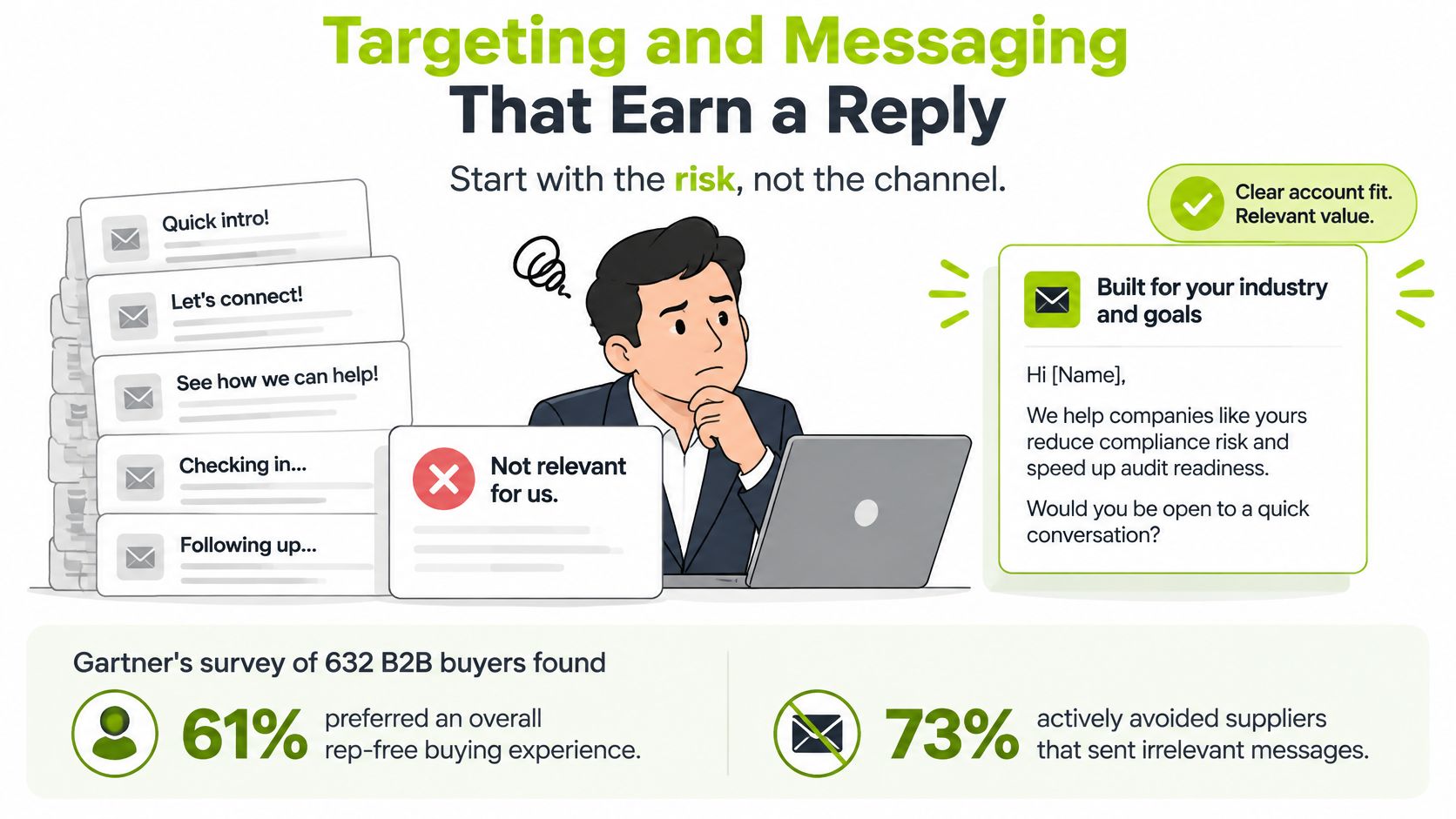
Irrelevant outreach risks more than a deleted email. In Gartner's 2025 survey of 632 B2B buyers, 73% actively avoided suppliers that sent irrelevant outreach, while 61% preferred an overall rep-free buying experience.
The channel isn't the first decision. The first decision is whether the seller has enough evidence to justify contacting the account.
Select accounts before writing messages
The selection rule is firmographic fit plus a problem-specific trigger. Firmographic fit covers company characteristics such as sector, size, geography and operating model; a trigger adds a plausible reason for investigating the account now.
The distinction between an organisation and the person inside it matters. The guide to ICP versus persona helps separate account selection from stakeholder selection.
- Keep an evidence trail: Store the source page and the observation supporting outreach.
- Treat intent conservatively: A vacancy may indicate a capacity gap, but it doesn't establish an active purchase.
- Check AI output: An AI-generated pain point without supporting evidence shouldn't enter campaign copy.
- Suppress unsuitable accounts: Exclude poor fits, existing customers where appropriate, active opportunities and contacts who have opted out.
Offer context rather than assuming demand
A hypothetical message might mention a publicly advertised revenue operations role, suggest that reporting ownership could be under review, and offer a comparison of approaches. It should also make correction easy: the role may support expansion rather than address a reporting problem.
The opening should connect the observation to a possible business question. A product description or immediate demo request asks the buyer to do that connecting work.
A hypothetical 14-day cadence for a carefully selected segment could use:
- Days 1, 4 and 9: Email with a relevant observation, useful follow-up and closing note.
- Days 2 and 7: Calls addressing the same business question.
- Day 5: A LinkedIn connection request only where the profile matches the trigger.
Any reply, unsubscribe or wrong-contact signal stops the automated sequence. A human then decides whether to respond, redirect or suppress the record.
Protect delivery and respect opt-outs
Google's sender requirements, introduced from February 2024, require bulk senders to use SPF, DKIM and DMARC authentication, meet domain-alignment requirements and support easy unsubscribing. Authentication confirms sending identity; it doesn't make unwanted outreach acceptable.
The FTC's CAN-SPAM compliance guide requires accurate headers, non-deceptive subject lines, a valid physical postal address and a clear opt-out mechanism with prompt handling. These US commercial-email obligations aren't a substitute for checking other laws applicable to the campaign.
Qualification Rules and CRM Handoffs That Hold Up
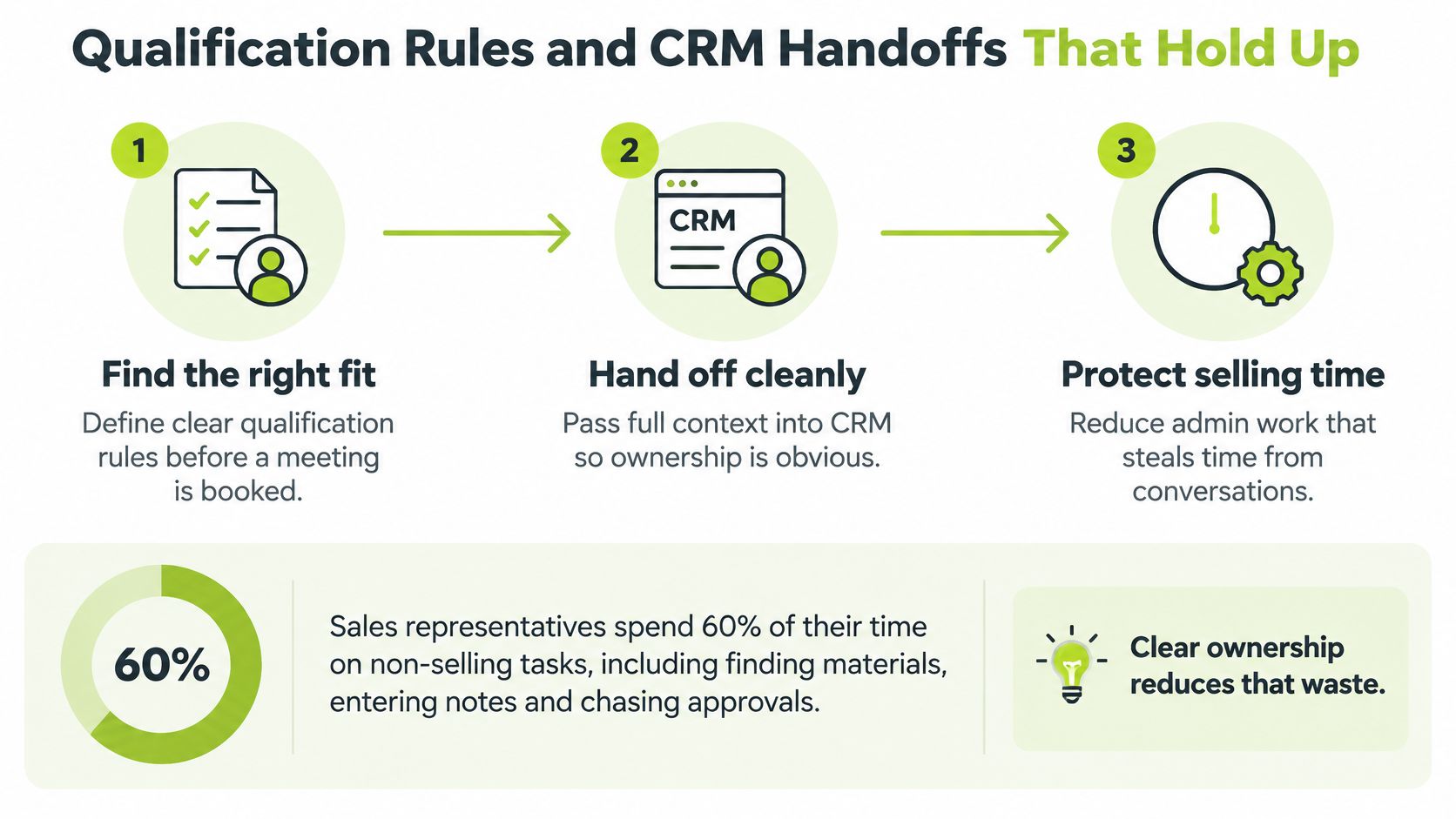
Salesforce reports that sales representatives spend 60% of their time on non-selling tasks, including finding materials, entering CRM notes and chasing approvals. The cited page's summary doesn't establish the underlying survey year or sample, so the figure is context rather than a forecast of recoverable time.
Clear ownership reduces avoidable administration. Automation helps only when the team has agreed what each record means and who acts next.
Decisions before automation
-
Assign owners. Name who handles research, enrichment, qualification, CRM updates, booking and follow-up. Shared access isn't shared accountability.
-
Write qualification criteria as yes-or-no tests covering fit, problem, stakeholder access, timing and the purpose of a live conversation. The guide to qualifying a lead provides a basis for turning broad judgement into explicit checks.
-
Separate readiness from engagement. Account fit describes suitability, message engagement describes behaviour, and readiness describes whether a conversation can advance a current question. A positive reply shouldn't automatically raise all of them.
-
Redirect premature meetings to suitable self-serve evidence and record why booking was deferred. A prospect comparing general options may benefit more from a relevant explanation than a discovery call.
-
Complete required CRM fields before changing stage. Block incomplete records instead of forwarding them with a request for sales to repair them.
-
Route confirmed meetings with the named owner, conversation context and an agreed response window. Include what the prospect expects, not just the campaign name.
-
Record outcomes and review them monthly. Reasons such as no fit, no timing and wrong contact should lead to changes in targeting or qualification, rather than remain unused notes.
Define fields so operators agree
| CRM field | Written definition needed |
|---|---|
| Account fit | States which commercial inclusion and exclusion rules the company meets |
| Problem evidence | Separates a public observation from a need the prospect has confirmed |
| Stakeholder access | Records influence over the problem or a credible route to relevant colleagues |
| Timing | Captures a stated event or constraint, not the setter's guess |
| Meeting purpose | Names the buying question the conversation should advance |
| Next owner | Identifies the person responsible for the next action |
VoxNote's explanation of preventing overwritten data during CRM updates is relevant when several systems write to the same record. Enrichment shouldn't replace buyer-confirmed information with an inferred value.
Clay workflows can enrich and route records, but the rules must come first. Custom GTM system builds are an option where CRM routing, suppression logic and exception handling need a connected implementation.
Worked Examples for SaaS and Service Businesses
The following examples are hypothetical calculations, not reported results. Pipeline, closed revenue, leads, booked meetings and qualified meetings are separate measures and mustn't be added together.
Both examples use an account-based denominator. That choice matters because contacting several people at an organisation changes contact-level reporting without increasing the number of accounts reached.
SaaS example with a hiring trigger
A SaaS campaign targets 400 accounts advertising for a revenue operations lead. The vacancy suggests a possible reporting or process requirement, but the campaign doesn't claim that the employer has a confirmed reporting problem.
Assuming one delivered message per account, the campaign produces 25 replies and 6 qualified meetings.
| Measure | Hypothetical calculation | Result |
|---|---|---|
| Reply rate | 25 replies divided by 400 delivered messages | 6.25% |
| Accounts reaching a qualified meeting | 6 accounts divided by 400 accounts contacted | 1.5% |
The operator classifies replies before booking. A recruitment enquiry, a courteous rejection and a request for a general guide all count as replies, but none automatically qualifies as a meeting.
A useful conversation could explore how reporting responsibilities will change when the new role starts. If the prospect confirms that the advertised position is unrelated to the offer, the operator records the mismatch rather than forcing a sales handoff.
Service-business example with a migration trigger
A service provider approaches 250 regional accounting firms with evidence of a recent software migration. The campaign generates 12 replies and 4 qualified meetings, giving an account-to-qualified-meeting rate of 1.6%, calculated as four divided by 250.
The message offers help comparing post-migration processes. It doesn't assert that the migration failed or that staff are struggling.
Some firms may already have an implementation partner. Others may be willing to discuss a specific unresolved workflow, but only after confirming the contact's responsibility and the business purpose should a meeting reach sales.
Measurement distinction: These examples calculate qualified meetings against accounts contacted. The KPI dashboard's qualified-meeting rate uses meetings booked as its denominator.
The campaign operator should compare like-for-like measures against the company's own baseline by segment, trigger and message variant. If unsuitable conversations reach sales, the rejection reason should identify whether the error came from account selection, an unsupported assumption or incomplete qualification.
Neither example establishes commercial success by itself. Sales still needs to report attended conversations, opportunities and eventual revenue separately.
Deciding Whether to Outsource and What to Do First
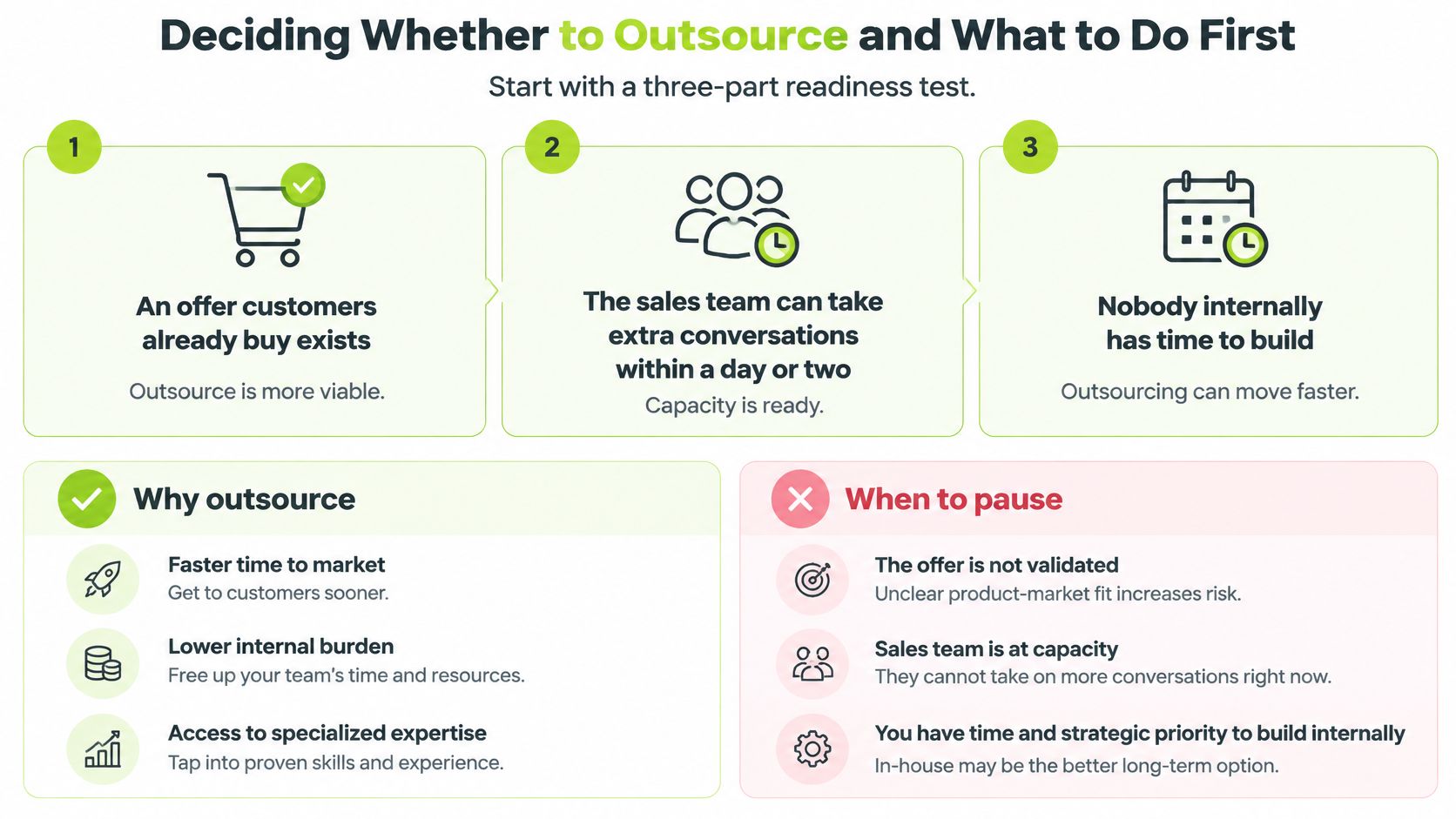
Start with a three-part readiness test. Outsourcing is more viable when an offer customers already buy exists, the sales team can accept additional conversations within a day or two, and nobody internally has time to build and run outbound.
These conditions address different risks. A proven offer reduces commercial uncertainty, available sales capacity prevents neglected prospects, and a genuine operating gap gives the provider useful work to take over.
When outsourcing helps and when it doesn't
| Outsourcing can help when | Pause when |
|---|---|
| Sales can describe a repeatable customer problem | The offer changes with every sales conversation |
| Suitable accounts can be recognised from evidence | The ideal customer profile remains speculative |
| Someone can approve messages and provide feedback | Nobody owns campaign decisions |
| Sales has room for additional qualified conversations | Existing enquiries already wait for follow-up |
| Internal time is the main constraint | The main constraint is weak product or market fit |
A provider can supply specialist tooling, campaign discipline and a steady operating cadence. The trade-off is less direct exposure to early market conversations and reliance on an external process.
That makes feedback access important. Sales leaders should be able to inspect replies, understand rejection reasons and see which accounts were excluded. A meeting total without supporting context makes it difficult to distinguish a targeting problem from a sales problem.
For software teams weighing the operating model, the guide to outbound lead generation services for B2B SaaS connects the outsourcing decision to the wider pipeline process.
Capacity can be the real constraint
Consider a hypothetical 12-person software company with two account executives who can handle about 10 new conversations a week. An outbound programme producing 40 meetings a week would create a queue rather than useful extra capacity.
The appropriate response isn't to buy the largest activity package. The company needs an intake limit, clear qualification decisions and protected follow-up time before increasing bookings.
Capacity includes preparation and subsequent work, not just empty calendar slots. Account executives need time to investigate requirements, involve technical colleagues and progress agreed actions.
A practical starting sequence
-
Confirm the offer and ideal customer profile. Use sales calls, support conversations and won deals to identify recurring problems, buyer language and clear exclusions.
-
Choose an operating model based on management capacity and the work that needs transferring. Contract labels matter less than ownership.
-
Establish a baseline. Track qualified-meeting rate and pipeline by segment before scaling, with attribution rules that avoid counting the same opportunity repeatedly.
-
Write qualification and handoff rules, including acceptable reasons for deferring a meeting. Agree how sales will return outcome feedback.
-
Check operational readiness. Confirm authentication, unsubscribe handling, suppression ownership and approval responsibilities before increasing sending volume.
For teams considering external delivery, Fully Managed Outbound provides the relevant service destination, while current pricing and billing terms should guide the commercial discussion. Scope and contract terms need confirmation before commitment.
Where the internal team needs skills rather than outsourced execution, Private GTM Workshops offer a separate route. The sensible choice is the smallest intervention that resolves the actual constraint.
H2 offers fully managed outbound, custom GTM systems and private workshops for B2B teams. For appointment setting, the starting point is an offer, a suitable audience and clear rules for which conversations deserve sales time. Teams can visit H2 to discuss those requirements and the operating model that fits.
