An account research fee can range from $0.25–$3.00 per verified contact record to $300–$2,500 per independent desk-research brief, $5,000–$30,000 per boutique consultancy project, or $50,000–$250,000 or more per custom study. There's no single standard rate, so choosing the cheapest hourly rate or largest list isn't a reliable buying method.
For B2B teams, the useful comparison is cost per usable, sales-ready account. A usable account meets agreed qualification rules, carries supporting evidence and reaches the sales team without another round of repairs. That's different from a spreadsheet row containing a company name and an email address.
Account Research Fee Ranges by Pricing Model
A contact-data purchase, a scoped research brief and a continuously maintained account database are three different products. Comparing them by price alone is like comparing a brick delivery with an architect's survey: both belong on a building site, and only one tells you what to build.
The figures below mix contact data, desk research and wider market research. Read each row for the deliverable as well as the number. They are budget guides, not account-research quotes.
Typical account research fee ranges by pricing model, USD
| Pricing model | What you pay for | Typical range | Best suited to |
|---|---|---|---|
| Per verified contact record | Data access and verification for one contact | $0.25–$3.00 per record, Leadspace cost guide | Teams with a clear list and fit criteria |
| Independent desk-research brief | Desk research on a defined set of accounts | $300–$2,500 per brief, VerifiedDesk estimates | Quick checks on a market or account set |
| Boutique consultancy project | Scoped research with analysis and recommendations | $5,000–$30,000 per project, VerifiedDesk estimates | Segment or account-set strategy |
| Custom multi-method study | Desk research, interviews and analysis combined | $50,000–$250,000 or more per study, Counsileum's market research cost guide | Market entries and multi-market programmes |
| Ongoing research retainer | Recurring research and record refresh | Quoted per scope: output volume, refresh frequency and review work | Teams needing continuously updated accounts |
Reading the models correctly
A per-record charge buys contact information and verification, not an explanation of why the company fits. A provider can supply a perfectly accurate email address for a business that will never buy. That is why the number worth calculating is cost per usable, sales-ready account: the fee divided by the records that pass your qualification rules and reach a seller without another round of repairs.
A desk-research brief answers a bounded question from existing information. A software company might commission a review of target accounts' products, operating markets and publicly visible technology choices.
A consultancy project adds interpretation and recommendations. A custom multi-method study goes further, combining desk work with interviews and modelling. That wider scope is why its price is a poor benchmark for a straightforward prospect list.
Buying rule: Match the pricing model to the decision, not to the number of rows promised.
An ongoing retainer needs a defined output and a maintenance obligation. Without those boundaries, the buyer cannot tell whether the recurring payment covers fresh research, rechecking existing accounts or continued platform access.
Where legal-entity checks form part of qualification, SOSfinder's guide to budgeting for business verification APIs gives useful context for a separate data-access budget. That budget is not the full analyst and workflow cost.
The phrase also appears in investment-fund pricing, a separate subject covered by the SEC's mutual fund fee guidance. This guide concerns B2B commercial account research.
What an Account Research Fee Actually Covers
A useful scope separates data acquisition, analytical qualification and operational integration. These layers answer different questions: what information is available, what it means commercially and how the team will use it.
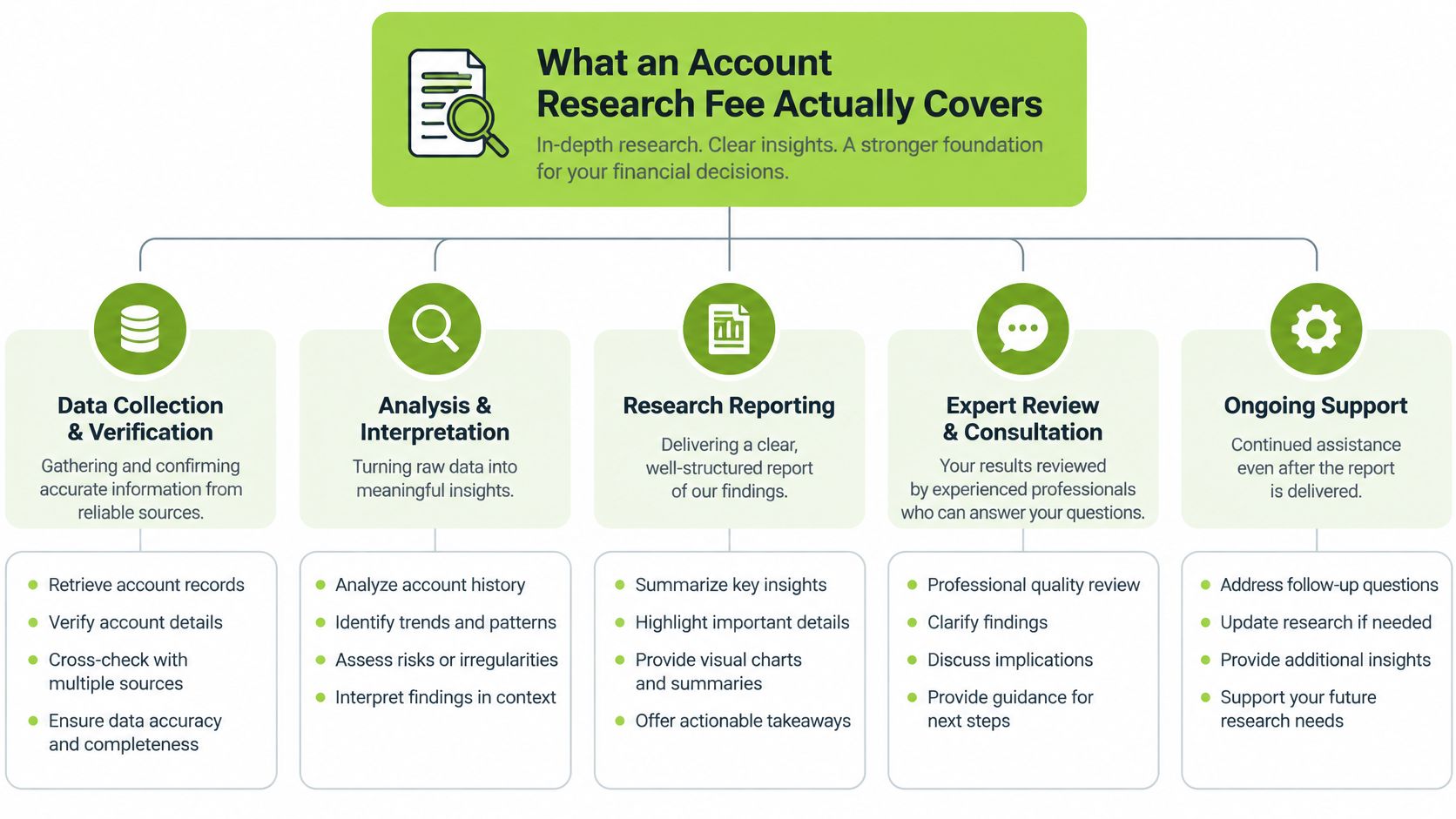
Data access isn't the finished research
Data acquisition covers sourcing and checking information. Leadspace's 2026 contact-data cost guide puts a verified contact record at approximately $0.25–$3.00, while identifying subscriptions, filters, CRM synchronisation, integrations and credit overages as additional cost considerations.
For example, obtaining a finance director's details doesn't establish whether the employer has the operating problem the seller solves. It supplies an input, not a qualification decision.
Analytical qualification checks the account against an ideal customer profile, or ICP. Analysts examine firmographics, such as company size and sector, and technographics, meaning the technology a business uses. They can also map the buying committee, the people who influence, approve or use a purchase.
A market-mapping exercise helps define the account universe before individual records are researched. Without that boundary, analysts can spend time documenting companies that should never enter the target list.
The handover is part of the deliverable
Operational integration makes the findings usable. That might mean mapping fields into Salesforce or HubSpot, applying qualification rules, assigning an account owner and documenting what happens when evidence is missing.
The written scope should identify:
- Fit criteria: Inclusion rules, exclusions and the evidence required to qualify.
- Account evidence: Relevant company facts, source references and buying signals.
- Contact quality: Validated contacts and their buying-committee roles.
- Decision confidence: Confidence scores and reasons for uncertain classifications.
- Usable outputs: CRM-ready records, documented logic and workflow ownership.
A vacancy, technology choice or social interaction is a relevance signal, not proof of purchase intent. The useful test is whether the scope describes what each layer delivers and which work remains with the buyer.
What Changes the Fee Up or Down
Scope factors and their effect on an account research fee
| Factor | Effect on fee | Why it matters |
|---|---|---|
| Number of market segments | Rises with each segment | Each segment needs its own criteria and evidence rules |
| Depth of qualification | Rises with buying-committee mapping and trigger tracking | Deeper evidence takes more analyst time |
| Number of data sources | Rises with each source to reconcile | Conflicting records need human checks |
| Buyer interviews | Rises sharply for senior, hard-to-reach contacts | Recruiting decision-makers costs more than desk research |
| CRM integration | Rises with routing rules and field mapping | Build and testing time comes before handover |
| Refresh frequency | Rises with weekly or monthly refresh | Rechecking records repeats labour each cycle |
| Share of records needing human review | Rises with ambiguous records | Judgement takes time but limits false positives |
These effects are directional, not fixed price increments. Quotes differ because the work differs, even when both proposals describe the output as qualified accounts.
Interviews change the nature of the work
Finding a named executive online isn't equivalent to recruiting that executive for an interview. Scheduling, screening, consent and participation all require separate work.
Wavefield Research's B2B market research guide, whose publication date isn't established here, describes specialist audiences reaching incentive territory of $100 or more per expert hour. That figure concerns specialist participation, not a universal researcher's hourly rate.
The distinction matters when a proposal promises buyer validation. The scope should say whether that means checking public evidence or speaking directly with potential buyers.
Refresh is recurring production work
A refresh isn't reopening the original spreadsheet. Analysts may need to check role changes, company status, evidence dates and whether an account still meets the agreed rules.
The data enrichment services guide helps distinguish adding missing information from maintaining an account's qualification. A completed field doesn't guarantee that its contents remain relevant.
A narrow programme covering a clearly defined segment and a single CRM generally requires less work than a broad programme with different qualification rules and destinations.
Outside-the-fee charges should be itemised separately. Otherwise, an apparently lower research quote can conceal a larger operating bill.
The Real Cost of Manual Account Research
The proper alternative to a research fee is the cost of producing equivalent work internally. Comparing a finished, qualified account with the price of raw contact data leaves out most of the labour.
Salesmotion's manual account research cost guide, for which an exact publication date isn't established, gives an illustrative enterprise-sales benchmark: six hours of research per week, 312 hours annually, and a loaded labour cost of $50–$70 per hour, producing approximately $15,600–$21,800 per rep per year.
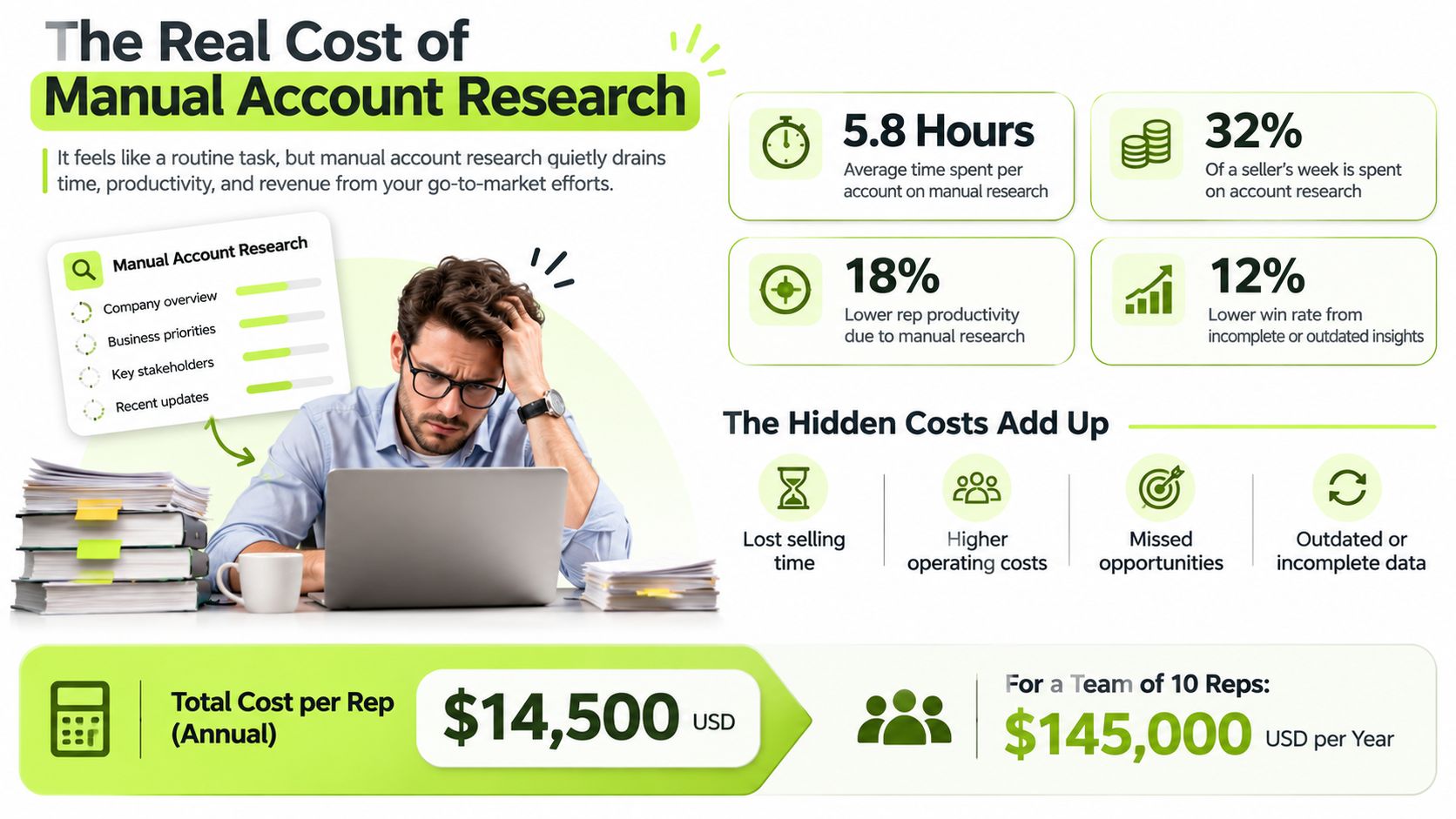
Illustrative arithmetic
Using that benchmark, the calculation is straightforward:
- Annual time: Six hours of weekly research becomes 312 hours across a full working-year calculation.
- Lower labour estimate: 312 hours multiplied by $50 gives $15,600 annually.
- Upper labour estimate: 312 hours multiplied by $70 gives $21,840, rounded to approximately $21,800.
- Team total: For ten representatives, the benchmark gives roughly $156,000–$218,000 annually.
Those are illustrative labour costs, not a claim about every sales team. They exclude the commercial effects of displaced selling time, context switching, uneven research quality and stale records.
Loaded labour cost means more than salary alone. The internal calculation should reflect employment costs and allocated overhead, using the organisation's own finance assumptions.
A practical pricing test
- Measure baseline research hours by account segment, separating discovery, checking, qualification and CRM administration.
- Apply the loaded hourly cost for the people doing that work.
- Assess displaced selling capacity, keeping potential commercial value separate from direct payroll cost to avoid double-counting.
- Compare equivalent scope, including the internal review time that would remain after outsourcing.
Track the team for a month rather than assuming the benchmark applies. Research effort changes with territory, deal size, source availability and the complexity of the target market.
Reclaimed capacity also needs a defined use. If the team plans to spend it improving outreach, Stimulead's guide to A/B testing AI outreach prompts provides a relevant testing approach; research quality and message quality should remain separate variables.
Decision test: A fee is worth considering when it improves the economics of producing usable accounts, not merely when it looks cheaper than an employee's time.
How to Compare Fee Quotes Fairly
The cheapest quote can become the most expensive when sales development representatives, or SDRs, must repair records before outreach. A higher price isn't automatically better either: the VerifiedDesk market research pricing guide gives 2026 estimates of $300–$2,500 per independent brief and $5,000–$30,000 for boutique consultancy work, but price alone doesn't establish whether the output answers the commercial question.
The useful denominator is accepted, usable accounts, not delivered rows. The following figures are a hypothetical calculation, not market quotes or reported results.
Hypothetical quote comparison, labelled example, not a market quote
| Quote | Records delivered | Usable records | Cost per usable account, USD |
|---|---|---|---|
| Quote A, $4,000 fee | 300 | 40 | $100 |
| Quote B, $9,000 fee | 200 | 150 | $60 |
Divide by accepted output
For Quote A, $4,000 ÷ 40 usable accounts = $100 per usable account. For Quote B, $9,000 ÷ 150 usable accounts = $60 per usable account.
Quote B has the higher headline fee but the lower unit cost. It also supplies more usable accounts despite delivering fewer records.
The comparison still excludes internal repair time. If SDRs must investigate rejected records, resolve duplicates or rebuild missing evidence, that labour belongs in the numerator:
All-in cost per usable account = research fee plus attributable tools and internal review cost, divided by accepted accounts.
Define acceptance before delivery
The agreement should specify:
- Evidence completeness: Required fields and acceptable supporting sources.
- Record hygiene: Permitted duplicate and stale-data rates.
- Qualification confidence: Thresholds and documented scoring logic.
- Maintenance: Refresh frequency and evidence dates.
- CRM accuracy: Correct field mapping, ownership and routing.
A practical pilot could cover 20–30 accounts, an illustrative buying recommendation rather than an industry standard. The buyer and researcher should score the same sample against the written criteria before a larger commitment.
The revealing final question is how many accounts the researcher expects to reject, and why. A credible qualification process needs exclusion decisions, not just a promise to fill a list.
Where AI Lowers Cost and Where People Stay Essential
AI can reduce the work involved in collecting public signals, summarising websites and classifying accounts. It can't reliably establish purchase intent from those activities alone.
Resourcera's market research cost guide discusses AI-assisted cost reductions for selected research tasks. Those task-level claims shouldn't be treated as a discount on an entire account-research programme.
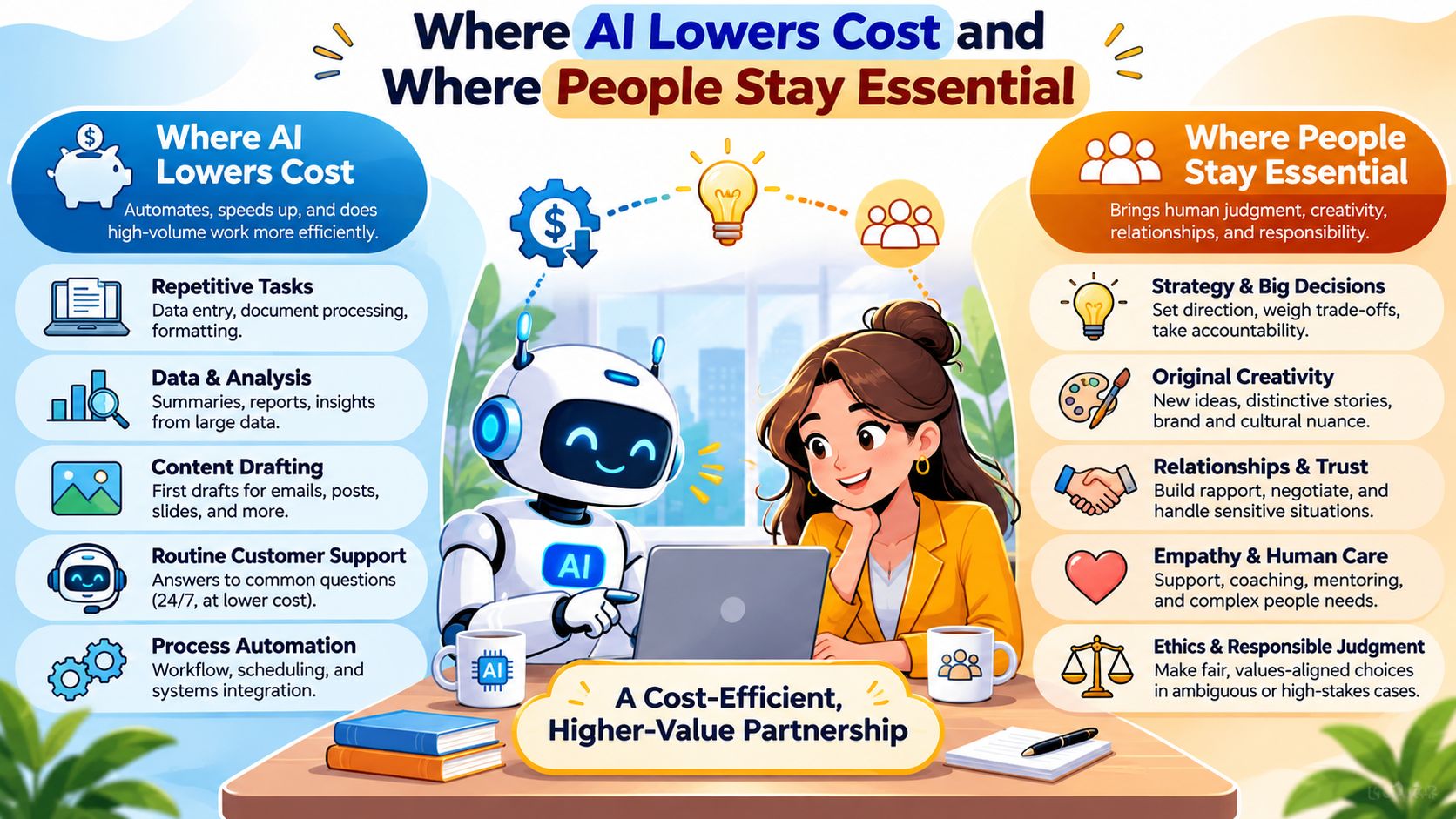
Price the controls as well as the automation
A governed workflow needs:
- Source rules: Approved evidence types and traceable references.
- Confidence thresholds: Clear conditions for accepting or withholding a classification.
- Human review: An exception queue for ambiguous accounts.
- Duplicate handling: Consistent account identity and merge rules.
- Escalation paths: A named decision-maker for unresolved cases.
- Acceptance testing: Measurable sales-ready output.
RevOps should own the acceptance rules and audit missed accounts. The research operator should own corrections to false positives, with sales feedback informing both.
The AI sales prospecting guide provides practical context for deciding where automation belongs. Bad classifications can waste SDR time, prompt inappropriate outreach, damage sender reputation and contaminate the CRM.
Cheaper generation isn't the same as cheaper usable output. Human-led and AI-assisted routes should face the same acceptance test.
Confirm the Scope Before You Commit to a Fee
- Charging unit: Is the fee per account, contact record, report or recurring retainer?
- Coverage: Which markets and outreach channels fall within the scope?
- Sources and inclusion: Which sources are permitted, and what evidence qualifies or excludes an account?
- Acceptance: What standards apply to evidence, duplicate records and stale information?
- Additional charges: Are data-provider credits, contact verification, software, enrichment and campaign operations included, billed separately or passed through at cost?
- Handover: Does delivery include documentation, training and an operating runbook?
- Maintenance: How often are records refreshed, and who pays for rechecks and corrections?
A one-off list may need only a per-record purchase or defined brief; a repeatable research system needs a scoped proposal covering decisions, integrations and ownership.
Agree the operating boundary
H2 sets the fee around the markets and channels, research and data requirements, systems to connect, and how much the client's team wants to run itself. H2 agrees delivery scope and final fees in the client's proposal.
Compare those requirements with the H2 system builds page and check the current pricing page before requesting a proposal. The useful starting point is a clear account-acceptance standard, not an arbitrary list-size target.
H2 offers fully managed outbound and custom GTM systems for teams that need dependable account research, qualification and CRM workflows. Visit H2 to book an introductory call and start with a free GTM strategy, using the current research bottleneck and required sales-ready output as the discussion points.
