Approximately 361.6 billion emails were sent and received each day worldwide in 2024, according to Radicati's Email Statistics Report. In that crowded environment, a cold email process needs more than readable copy: it needs evidence that the audience, contact data and sending setup deserve to be trusted.
The Cold Email Process From Research to Refinement
A cold email process is the repeatable sequence a B2B team runs before, during and after sending unsolicited commercial outreach. Its seven stages are market research, list building and verification, sending infrastructure, messaging and sequencing, controlled sending, reply handling, and review.
Each stage should produce something inspectable. A campaign isn't ready because someone has bought a contact list, connected a mailbox and approved an email. It's ready when the team can show that each part has passed its gate.
The seven stages and their gates
| Stage | What it produces | Gate before moving on |
|---|---|---|
| 1. Market and ICP research | Ideal customer profile criteria, disqualifiers and a shortlist of accounts | Criteria a researcher can verify on a public source |
| 2. List building and verification | Verified contacts with source, date and contact type recorded | Every record passes a verification and suppression check |
| 3. Sending infrastructure | Authenticated domains, gradually warmed mailboxes and planned daily volume | SPF and DKIM checks pass, with DMARC alignment confirmed |
| 4. Messaging and sequence | A first email, follow-ups and variants to test | Copy uses the buyer's language and carries one clear ask |
| 5. Controlled sending | Daily volume spread across the sending set | Complaints remain below provider limits and bounce behaviour is understood |
| 6. Reply handling | Conversations routed to a named owner with context | Every substantive reply receives a response within the team's agreed service window |
| 7. Review and refinement | Decisions on audience, message, volume and offer | Each change is tied to a metric agreed in advance |
The gates aren't equal in effort or importance. Data and infrastructure determine whether the team can judge message quality at all. If addresses are stale or messages fail authentication, a poor response doesn't establish that the offer is wrong.
A sensible operator also distinguishes activity from learning. Sending more messages is activity. Discovering that a specific role recognises the problem, asks a relevant question and progresses to a qualified conversation is learning.
Treat the process as a loop
Replies should change the next research cycle. A repeated wrong-contact response suggests a role-selection problem; a repeated objection can expose a mismatch between the promise and the buyer's circumstances.
Meeting quality matters too. A prospect may agree to speak without having the problem, authority or commercial fit needed for a useful opportunity. Sales feedback therefore belongs in campaign review, not in a separate report that the campaign operator never sees.
Practical rule: A failed gate should stop progression, not trigger a compensating increase in sending volume.
For an existing programme, the repair order is authentication, list hygiene, then messaging. This order removes technical and data-quality explanations before the team spends time rewriting copy.
Turn a Market into a List You Can Defend
An ideal customer profile, or ICP, should describe observable characteristics rather than an attractive-sounding market. Useful criteria include sector, company size, technology in use, hiring patterns and structural changes that make a problem worth investigating.
Disqualifiers deserve equal attention. A consultancy selling implementation support might exclude agencies offering the same service, businesses without the relevant platform and companies outside its delivery territory.
Research the problem before collecting addresses
Sales calls, support tickets, lost deals and past campaigns reveal how buyers describe their circumstances. At onboarding, H2 investigates client-provided calls, support conversations, customer stories, campaigns and failed attempts to uncover audiences, pains, language and buying triggers.
Public signals then help locate accounts worth examining. A job posting, technology choice or social interaction doesn't establish purchase intent by itself.
Revenue Nomad's pipeline building guide for founders provides useful context for separating prospecting activity from the broader work of generating pipeline. That distinction helps teams avoid treating a database export as a finished commercial strategy.
The list-building workflow should preserve the evidence behind each record:
- Source: Record the company page, directory or provider used.
- Enrichment: Add role and company details without overwriting stronger evidence.
- Verification: Check address status and quarantine uncertain results.
- De-duplication: Match against active campaigns, customers and existing opportunities.
- Governance: Store collection date, contact type, lawful-basis reasoning and suppression status.
A structured prospecting list template makes those checks easier to repeat and audit.
Classify the recipient before sending
Under the ICO's guidance on choosing a lawful basis for direct marketing, corporate subscribers don't generally require prior consent under PECR, but sole traders and some partnerships are individual subscribers and generally require specific consent or a valid soft opt-in. Using an employee's personal data also brings data-protection obligations into the process.
| Contact type | Consent position | What the record must hold |
|---|---|---|
| Generic company address at a limited company | No prior consent needed under PECR for corporate subscribers | Company name, source, collection date and confirmation that the address contains no personal data |
| Named employee at a limited company | UK GDPR applies to the personal data alongside the PECR position | Name, role, business email, source, date, lawful basis and objection status |
| Sole trader or partnership treated as an individual subscriber | Specific prior consent generally required unless a valid soft opt-in applies | Consent evidence or soft opt-in reasoning, plus the opt-out record |
| Any contact who has objected or unsubscribed | No further marketing of any kind within the recorded objection or opt-out | Suppression record retained after the active prospect record is deleted |
| US recipient covered by CAN-SPAM | A working opt-out must be provided and honoured | Sender identity, physical postal address, opt-out availability and request-processing evidence |
For US commercial outreach, the FTC's CAN-SPAM compliance guide requires accurate sender information, a truthful subject line, identification as advertising or solicitation, a physical postal address and an opt-out mechanism available for at least 30 days, with valid requests honoured within 10 business days. Companies remain responsible for messages sent on their behalf, including agency-run campaigns.
The ready-list test is straightforward: every active record has a defensible fit, usable address, recorded classification and completed suppression check. Deleting an unsubscribed prospect must not delete the evidence that prevents another tool from adding that person again.
Set Up Sending Infrastructure Before You Write a Word
A mailbox that can send a message isn't necessarily ready for a campaign. Mailbox providers assess technical legitimacy before a recipient decides whether the message deserves attention.
Google's sender guidelines require senders to personal Gmail accounts to configure SPF or DKIM, while bulk senders must configure SPF, DKIM and DMARC. Google also recommends monitoring sender compliance through Postmaster Tools.
Understand authentication and alignment
SPF identifies the systems authorised to send for a domain. DKIM adds a digital signature that the receiving provider can verify.
DMARC checks whether an authenticated domain aligns with the visible From domain. It doesn't authenticate a message independently: a message passes DMARC when SPF or DKIM succeeds with the required alignment.
That distinction explains a confusing failure. A sending platform can produce a valid authentication result for its own domain while the message still fails alignment with the business domain shown to the recipient.
The technical owner should authenticate the sending domain, inspect actual message headers and confirm the results. DMARC monitoring should precede stronger enforcement so legitimate sending systems can be identified before policy changes affect them.
H2's email deliverability best practices provide supporting guidance for operating the sending environment rather than treating setup as a completed administrative task.
Give the sending set an owner
Separate sending domains can help organise campaigns and reduce operational exposure, but they aren't permission to conceal identity or bypass complaints. Each domain should clearly represent the sender.
The operator should document mailbox allocation, daily caps, spacing between messages and the conditions for increasing volume. Gradual warm-up means introducing real, legitimate sending cautiously, not assuming that automated warm-up activity guarantees inbox placement.
H2 controls sending volume, verifies contact data and monitors performance continuously to protect the client's brand and deliverability. The same ownership principle applies to an internal programme: someone must be accountable for the whole sending set.
Before launch, the owner should confirm:
- Authentication: SPF and DKIM results are checked, with DMARC alignment working.
- Visibility: Authentication reporting and complaint monitoring are available.
- Unsubscribing: The opt-out route works, including one-click unsubscribe where bulk-sender rules apply.
- Data feedback: Bounces are classified and linked to their source.
- Volume controls: Mailbox caps, send spacing and pause permissions are documented.
A successful test send proves that a message travelled. It doesn't prove that the campaign belongs in the inbox.
Poor technical reputation can prevent a fair assessment of targeting and copy. Infrastructure therefore remains a live gate throughout the programme, not merely a launch checklist.
Write Messages and Follow-Ups That Earn Replies
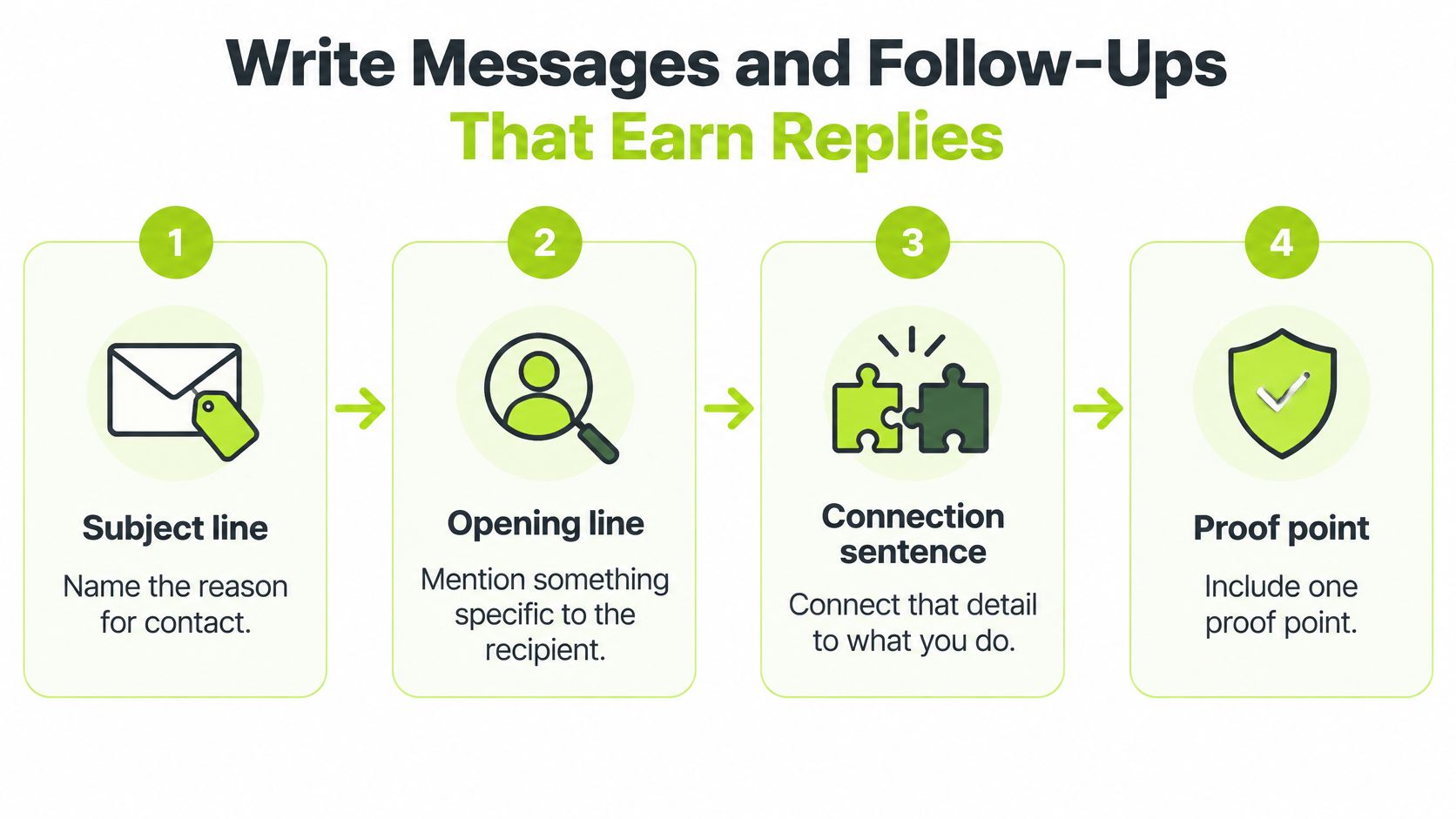
A first email should make the reason for contact easy to understand. Its basic anatomy is a relevant subject line, a specific observation, a connection to the service, credible evidence and a small next step.
The structure is simple enough to inspect before any copy test begins.
A hypothetical first email
The following example assumes that a database consultancy has found a relevant vacancy and has a genuine, shareable handover checklist. It illustrates message structure, not a claim about a real company.
Subject: Database cover during recruitment
Hello Alex,
The database administrator vacancy mentions responsibility for overnight incidents.
The consultancy provides temporary database support while engineering teams recruit permanent cover.
A sample incident-handover checklist is available for review.
Would that be useful for the hiring team?
Each line has a distinct job:
- Subject: Names the business reason for contact without manufacturing urgency.
- Observation: Uses a verifiable detail rather than a generic compliment.
- Connection: Explains why the sender's service might be relevant without asserting an unproven problem.
- Evidence: Offers something inspectable instead of an invented result.
- Ask: Requests a small decision rather than an immediate sales meeting.
The operational version also needs the appropriate sender identity, address and opt-out information. Plain text, restrained formatting and few links keep the commercial point easy to inspect.
Add information with each follow-up
A hypothetical follow-up could introduce another consequence of the same situation:
Hello Alex,
Temporary cover can include documenting escalation ownership before a permanent hire starts.
Is incident cover part of the current recruitment plan, or already handled internally?
The opening adds an angle rather than complaining about silence. The closing question allows a useful negative answer, which can improve qualification.
Outreach's 2025 survey of 500 sales professionals found that sales teams required an average of 4.81 touches to receive a response, as reported in this cold email statistics summary. That's a sales-touch finding, not a prescription for a particular number of cold emails.
As a hypothetical starting plan, a team could draft three to five touches across two to four weeks, then adjust based on relevance, recipient signals and sender health. Stop automated follow-ups when a human reply arrives.
NotionSender's guidance on how to follow up with clients effectively offers useful follow-up principles, although existing-client relationships shouldn't be treated as equivalent to cold outreach.
Testing needs a written hypothesis. For example: role-specific language may produce more qualified replies than a broad efficiency claim. Hold the audience constant and change the relevant copy element, rather than changing the subject, offer and targeting together.
Before launch, someone who speaks to customers should check the vocabulary and credibility. H2 keeps messaging concise, relevant and reviewed with the client before launch.
Launch on a Controlled Ramp, Not a Single Switch
The transition from prepared mailboxes to campaign sending should be observable and reversible. A launch plan needs a hold decision as clearly defined as an increase decision.
Start with a narrow pilot: a coherent segment and a message variant with a clear hypothesis. A mixed batch makes diagnosis difficult because the operator can't separate audience differences from message performance.
Increase only when the evidence supports it
The ramp should follow a controlled sequence:
- Pilot: Send to a small, verified group whose fit has been checked manually.
- Inspect: Review delivery responses, available placement evidence, complaints and unsubscribes.
- Hold or increase: Add volume only when the signals remain stable.
- Separate: Keep audiences identifiable by sending domain or mailbox group.
- Record: Save mailbox counts, daily caps, send spacing and the responsible owner.
Audience separation helps an operator locate problems. It shouldn't become a method for moving a rejected list to a fresh domain.
A bounce increase calls for investigation, not a larger replacement batch. Recheck address verification, identify the affected source and distinguish invalid addresses from temporary delivery failures.
Complaint signals require the same restraint. Hold volume while the owner examines relevance, frequency and recipient expectations.
An illustrative planning timetable
A hypothetical timetable might allow two to three weeks for infrastructure preparation and gradual warm-up, followed by a pilot in week four. The team might reserve its first substantial reply assessment until after four to six weeks of steady sending.
Those periods are planning assumptions, not performance benchmarks or promised launch dates. An established domain with clean records presents a different situation from unfamiliar infrastructure and uncertain list provenance.
Ramp rule: The calendar can schedule a review. Only sender health and usable evidence should authorise an increase.
The useful output is a repeatable sending configuration with a documented rationale. A campaign that pauses for a clear reason is better governed than one that continues because a launch date has passed.
Handle Replies, Then Measure What They Tell You
Reply handling is part of campaign execution, not an administrative task left until the end of the day. It determines whether interest becomes a conversation and whether negative feedback changes the next send.
Set an internal service target, such as a response within one business day, and assign a named owner. That target is an operating choice, not an industry benchmark.
Route the inbox by meaning
Interested replies should reach the salesperson with the segment, original message, relevant research and the prospect's actual words. The handover shouldn't force the salesperson to reconstruct the conversation.
Not-now replies need a reason and, where appropriate, an agreed return date. A specific procurement delay differs from a polite rejection.
Wrong-contact replies can justify a brief request for direction, but they also reveal a targeting issue. Repeated referrals away from the selected role should change the research criteria.
Objections should be retained word for word before being grouped. A repeated concern about implementation effort may indicate that the message makes the proposed next step sound too disruptive.
Opt-outs go directly into suppression controls across connected sending tools. Moving the prospect to a closed CRM stage isn't sufficient if another workflow can enrol the same address again.
For interested prospects, offer a calendar link or a choice of specific times, then confirm the arrangement promptly. After a missed meeting, send a brief rescheduling message rather than restarting an automated sales sequence.
For CIDT, qualified meeting invitations arrived throughout the week, with lead details and context added to the CRM. That combination matters: the invitation and the information needed to conduct the conversation should travel together.
Measure the commercial ladder
A useful dashboard separates the following measures:
- Messages sent: The activity produced by the sending system.
- Delivered: Messages accepted by the receiving server, not proof of inbox placement.
- Inbox placement: Evidence about destination, interpreted with the limits of the measurement method.
- Replies: Human responses, excluding automated replies.
- Positive replies: Responses showing relevant interest.
- Qualified conversations: Exchanges that satisfy agreed fit criteria.
- Meetings held: Conversations that took place.
- Pipeline created: Opportunities accepted under the sales team's qualification rules.
For personal Gmail and Yahoo traffic, spam complaints must remain below 0.30%, according to this Gmail and Yahoo bulk-sender requirements guide. Treat that as a ceiling, not a performance target.
| Signal | What it usually means | What to change |
|---|---|---|
| Complaint rate approaching the provider ceiling | Audience, promise or volume may be unsuitable | Pause the segment, check authentication, tighten targeting and restart at lower volume |
| Hard bounce spike | Stale or poorly verified list data | Re-verify addresses, remove the offending source and inspect enrichment |
| Healthy delivery but very few replies | The message or offer may not be relevant, or inbox placement needs checking | Check placement evidence, then test the opening, ask or segment before adding volume |
| Replies arrive but few are qualified | Targeting is too broad or the signal is weak | Tighten ICP criteria, add a qualifying signal and disqualify earlier |
| Meetings booked but many decline | The proposed next step may exceed the prospect's interest | Offer a smaller step, such as answering a relevant question |
| Volume held flat with no learning | Tests lack a written hypothesis or useful comparison | Agree a variable to test and record the result |
These are diagnostic starting points, not automatic verdicts. For example, cancelled meetings can also reflect poor scheduling or a weak handover, so the owner should inspect actual conversations.
Turn the review into decisions
When sender health deteriorates, pause the affected segment. Inspect authentication and DNS with the technical owner, re-verify addresses, remove risky contacts and resume cautiously only after identifying a plausible cause.
Hold the review on a consistent weekly cadence. Split results by segment, message and volume, and compare qualified outcomes rather than combining every campaign into an account-wide reply rate.
Agree a change and the measure that would support it. Avoid declaring a winner from a handful of responses; if evidence is limited, record uncertainty rather than inventing confidence.
H2's learning-led process follows four steps: define the first ICP, launch informed copy, read replies and objections, then refine and repeat. The commercial value lies in making that cycle explicit enough for sales, marketing and RevOps to act on the same evidence.
Decide Whether to Run It In-House or Hand It Over
Every gate covered so far needs a named owner. Someone checks that the list is verified before anything sends, that authentication records are in place before the ramp starts, that volume steps up only on evidence, and that replies get read and acted on within the week. Running the process internally is reasonable when the business has a proven offer, capacity for sales conversations and a person accountable for those calls. Without that owner, another sending tool will not resolve the constraint.
Match the route to the bottleneck
- Keep it in-house: a named operator can manage data, infrastructure, messaging and replies, with sales contributing useful feedback.
- Delegate execution: the offer works, but the team lacks the time or specialist capacity to run each gate consistently.
- Fix a specific system: qualification, enrichment or CRM routing is the main source of delay, so one targeted build may beat a full handover.
- Build team capability: the team wants to retain execution but needs practical methods and supervised learning to run the gates well.
For delegated execution, H2's fully managed outbound service covers research, audience definition, lists, enrichment, verification, infrastructure, copy, testing, reply handling and meeting booking across email and LinkedIn. Custom GTM system builds address operational bottlenecks, and private GTM workshops support internal capability.
The cold email lead generation agency guide can help frame the outsourcing decision. If telephone prospecting is a separate staffing requirement, LatHire's discussion of the best place to hire cold callers addresses that adjacent hiring question, which sits apart from the email programme's technical needs.
Decision test: Hand over the programme when the gap is ownership or capability. If the open question is whether any buyer values the offer, that question needs evidence first.
Before committing, fix the weakest stage for a fortnight and watch whether the gate behind it passes. Launch readiness still follows domain and data conditions rather than a fixed calendar, whichever route you choose.
H2 offers fully managed outbound and custom GTM systems for teams that need a dependable route from prospect research to qualified conversations. Visit H2 to book an introductory call about the audience, infrastructure and campaign needed to address the current bottleneck.
