Search for advice on AI lead qualification and the same claim appears everywhere: buy the smarter model, feed it more signals, and the pipeline sorts itself out. That gets the order backwards.
The constraint isn't model sophistication. It's the evidence behind each score. A model that reads a job advert and concludes an account is ready to buy hasn't qualified anything. It has automated a guess, and it will repeat that guess at scale with complete confidence.
The useful questions are narrower. What evidence justifies calling a lead qualified? Which signals only suggest interest? Where must a person own the decision? And how do you test a workflow before it touches the whole pipeline?
What AI Lead Qualification Means for Your Pipeline
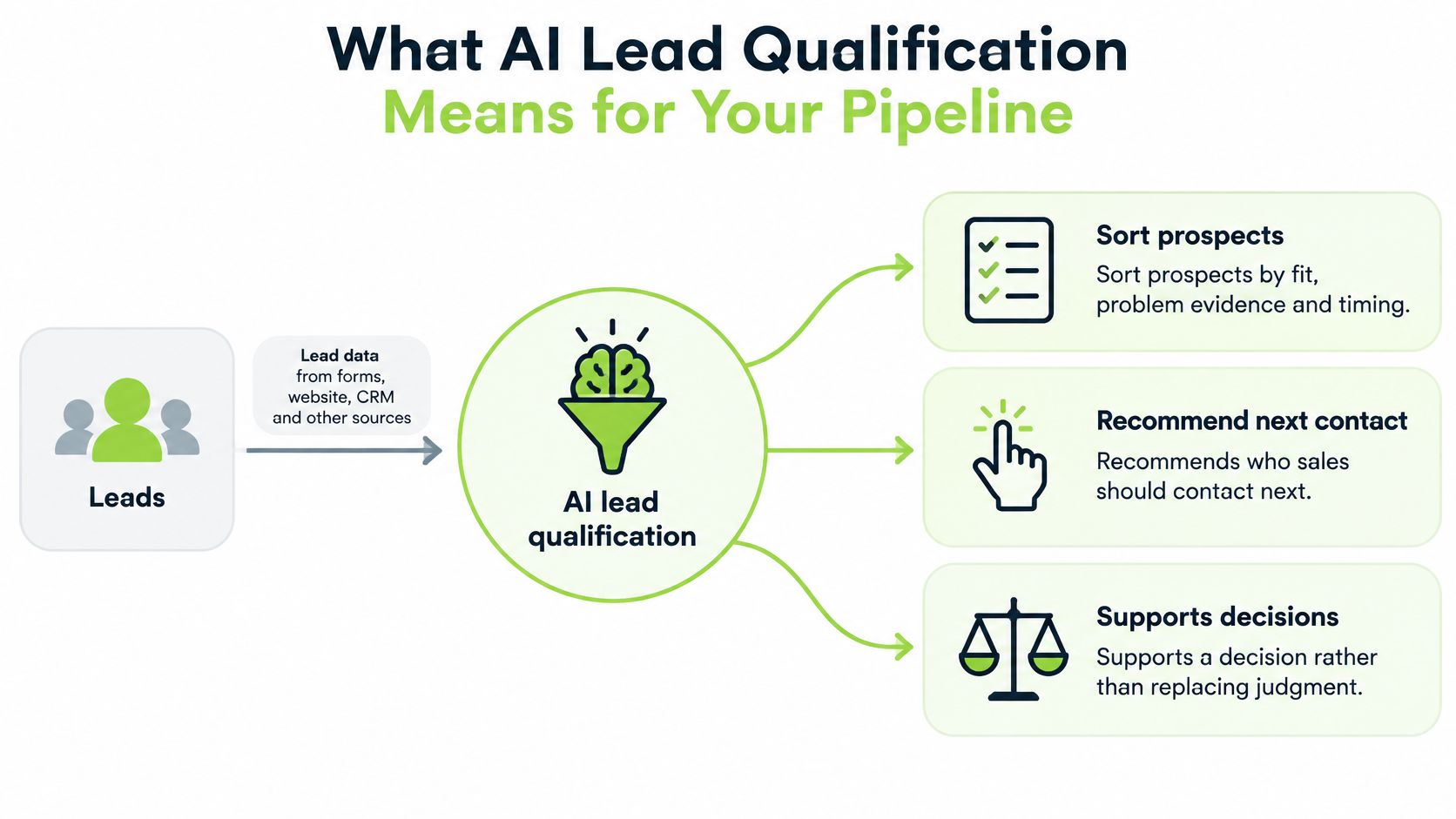
AI lead qualification is a decision-support process. A model reads what's known about a prospect, estimates how well that prospect fits your offer and how strong the timing evidence is, then recommends what sales should do next. It supports a decision. It doesn't replace sales judgement.
In practice the model does three jobs:
- Extracts the firmographics. Company size, sector, region, ownership and stage, pulled from a CRM field, an enrichment provider or the company's own website.
- Interprets buying signals. A new operations hire, a funding round, a technology switch, the language a business uses about its own product.
- Scores and routes. Turns that evidence into a rank, a segment and a CRM owner, so each record lands in the right queue.
The closest everyday comparison is a hospital triage desk. A nurse sorts arrivals by urgency so doctors see the right patients first. Triage isn't a diagnosis, and nobody expects it to be. A lead score works the same way: it orders the queue using the evidence available at the door, and the doctor still examines the patient.
A qualification workflow has four stages, and each needs a named owner:
- Define the qualifying outcome. A booked meeting with someone who can buy, not a form fill.
- Gather evidence. Firmographics, hiring activity, technology, public statements, past engagement.
- Score or classify. Rules, a trained model, a language model reading public evidence against a rubric, or a mixture.
- Route to an action. Outreach, more research, nurture, or exclusion with a logged reason.
The governance question is where automation stops. The NIST AI Risk Management Framework 1.0, published in January 2023 and organised around four functions (Govern, Map, Measure and Manage), calls for human-oversight processes to be defined, assessed and documented. It's voluntary, sector-neutral and written for organisations that build or use AI systems. It is not a sales benchmark, and it makes no claim about conversion rates.
What it does establish is the operating principle. A model may extract data, read signals, assign a score or recommend CRM routing. The business defines the rules, the acceptable evidence and the escalation path.
The same four stages translate to other screening problems. Franchisors applying the logic to applicants can see it worked through in screening franchise candidates faster with AI, where fit and timing evidence are separated the same way.
The decision worth making isn't whether to use AI. It's which parts of qualification go to a model and which stay with people.
Which Signals Prove Fit and Which Only Suggest Interest
A workable system is a multi-signal prioritisation system. It combines several kinds of evidence, gives each one a reason code and a confidence level, then ranks accounts on the balance of that evidence rather than on a single trigger.
| Signal | What it can show | What it does not prove | How to use it |
|---|---|---|---|
| Firmographic fit | Size, sector, region and company stage | Need, budget or authority | Hard filter or fit score |
| Technology in use | Current or complementary tools | Dissatisfaction or intent to switch | Context for messaging |
| Hiring activity | Team gaps and new roles | Budget or purchase timing | Priority for research |
| Strategic change | Funding, new product or new leader | That they want your offer | Timing signal, checked by a person |
| Website language | Positioning and product focus | Pain or buying role | Supporting evidence only |
| Engagement or intent data | Recent research activity | An active buying committee | Verify before any outreach |
Read the third column before buying another data source. Most signals fall into one of two categories: proof of fit, or a reason to look.
Hard exclusions belong in deterministic rules, not in a model. Geography, company size and an incompatible technology stack are pass or fail. There's no judgement to make and no reason to let a model guess.
Job adverts are the most over-trusted signal in B2B. A posting for a database administrator shows a team gap and, sometimes, a support problem worth a conversation. It doesn't show budget, and it doesn't show that anyone has decided to buy. It moves an account up the research list.
The rule that matters most: a signal can justify research. It cannot prove purchase intent on its own.
Intent data tests that rule hardest. One review of AI qualification tools reports that third-party intent feeds showed false-positive rates of 31% to 47% across four vendors (GVM Technologies). That's a research prompt, not a green light to email.
Used properly, the combination is powerful. McKinsey describes generative AI as capable of prioritising opportunities and recommending actions such as immediate campaign treatment, a webinar invitation or later nurturing. That's routing, and routing is exactly the right scope.
Whatever the model concludes, store the evidence in the CRM: the source, the date, the signal, the reason code. A salesperson who can see why an account was flagged will act on it. Get the inputs right first, and data enrichment is where most of that evidence enters the system.
Practical Use Cases and a Worked Example
Qualification works like triage in A&E: it decides who gets seen first. Three jobs cover most of what B2B teams ask a system like this to do.
| Use case | Trigger evidence | Question answered | Owner |
|---|---|---|---|
| Inbound demo requests | Form fields and domain match | Does the company fit the hard rules, and does the requester hold a buying role? | Automated routing, sampled weekly |
| Outbound account prioritisation | Hiring activity and strategic change | Which accounts show a timing reason to research now? | Sales development, human review before outreach |
| Expansion and renewal review | Usage change and new executive sponsor | Which existing customers justify a conversation? | Account manager |
Inbound demo requests are the simplest case to automate because the person has already raised a hand. The system checks the email domain against the CRM, applies size and geography rules, then reads the job title and message text for role and problem context. Records that clear the rules reach the sales queue in minutes. A thin submission still lands in review, because a score can only reflect the evidence in front of it.
Outbound prioritisation runs in the opposite direction. Nobody has raised a hand, so every account starts at a lower confidence level and the output is a research order for a person to work through. The top band earns a human look before a single email goes out.
On the customer side, a usage drop or a new executive sponsor acts as an account management trigger. Push that record into an automated sales sequence and a renewal conversation becomes a complaint, so the destination of the routing matters as much as the score itself.
A worked example of routing
Take a team screening a fictional list of 500 accounts. Hard rules reject 150 on geography or incompatible size, with the reason logged for each. Of the remaining 350, about 100 show strong fit plus recent timing evidence and enter the accept lane. The other 250 carry partial evidence, an unfamiliar segment or conflicting data, so they go to human review.
Two things fall out of that split. Only a fifth of the original list is treated as ready, which is an honest read of the evidence. And the review queue doubles as a training set, because every reviewer decision becomes a labelled outcome the rules can be tested against later. A pilot that produces a review queue worth arguing about is doing its job; one that waves everything through is a faster way to be wrong.
The same evidence problem appears wherever inbound volume is high and public signals are thin. Teams pulling early interest out of community discussions run into it constantly, and roundups of Reddit lead generation tools cover the tools built for that end of the funnel.
Model Approaches and How to Choose Between Them
Model sophistication is the least important variable in this choice. What separates the four approaches is how much labelled outcome history sits behind them, because a score is only ever as strong as the evidence it was built from.
| Approach | Data it needs | Main strength | Main risk | Best when |
|---|---|---|---|---|
| Rules-based scoring | Clean firmographic fields | Transparent and easy to audit | Misses nuance and goes stale | Outcome history is small or unlabelled |
| Predictive model on CRM history | Large set of won and lost deals with labels | Finds patterns humans miss | Learns errors in old data | Thousands of consistent outcome records exist |
| LLM account classification | Public evidence and a clear rubric | Explains reasoning for each account | Confident-sounding errors without review | Qualification depends on reading unstructured evidence |
| Hybrid | Both rules inputs and a labelled outcome history | Hard rules stay controllable while ranking adapts | More maintenance | B2B teams with mixed data quality and partial history |
Published accuracy figures for AI lead scoring differ widely, so treat any headline number as context rather than proof. The pattern that holds is simpler and more useful than any percentage: predictive qualification improves as the system receives more consistent, outcome-labelled records, and it degrades when the underlying labels are weak.
The status quo explains why so many teams stall. In a 2024 study of 385 B2B companies in Switzerland and Germany, 56% said they still evaluated leads manually during lead scoring, according to ZHAW. Manual scoring is the default, which makes it the baseline any model has to beat rather than a relic to dismiss.
Cost shapes the choice as much as accuracy does. Enrichment credits and language model calls are priced per record, so run the cheap deterministic filters first and spend on the records that survive. Sending an entire account list through a language model when a firmographic rule could have rejected most of it is a straightforward way to waste budget.
Rule of thumb: if your outcome data is small, duplicated or unlabelled, start with rules or a hybrid, then add a trained model once the labels are reliable.
Teams that want to see the ranking half of this working end to end can read how to use AI for sales prospecting alongside their own pitch data.
Where Humans Must Review Qualification Decisions
Human oversight isn't a quality-control afterthought. It's a design choice, and there are three established patterns for it. The NIST guidance on human-AI interaction sets out human-in-the-loop, human-on-the-loop and active learning as distinct configurations, and recommends choosing between them with a risk-based approach.
Human-in-the-loop means a person approves a borderline account before it becomes sales-ready. Human-on-the-loop means the system runs automatically while a named operator watches performance and intervenes when something drifts. Active learning means reviewer corrections feed back into the prompts and rules, so the system improves from the decisions people make.
Most B2B teams need all three at once, applied to different record types. That's easier to run as three lanes.
| Lane | Criteria | Action | Owner |
|---|---|---|---|
| Accept | Meets hard rules, strong fit and recent timing evidence | Add to outreach queue | Automated, sampled weekly |
| Reject | Fails a hard exclusion such as geography or incompatible size | Exclude and log the reason | Automated, reviewed monthly |
| Review | Partial evidence, new segment, high account value or conflicting data | Human decision and labelled outcome | RevOps or sales reviewer |
The accept lane earns its trust through sampling, not assumption. Pull a random set of accepted records each week and check whether the evidence holds up.
The reject lane deserves the same attention. A wrongly rejected account is invisible. Nobody chases it, nobody complains, and the pipeline loses a good buyer. Review a sample monthly for that reason alone.
The review lane is where judgement lives, and it needs a reason code rather than a free-text note. The useful labels are qualified, disqualified, wrong persona, stale signal, duplicate and insufficient evidence. Each one points to a different fix.
Missing evidence sends a record to review, never to rejection. Absence of data is not proof of poor fit.
Then measure the lanes, not the model. Track precision among accepted leads, the share of accepted accounts that become qualified conversations, the disagreement rate between model and reviewer, the override rate, data freshness and the duplicate rate. A model that agrees with itself proves nothing.
Overfitting, Bias and Data Risks to Check
A score can look excellent in a demo and fail on the next market. Four risks explain most of that gap, and each has a test.
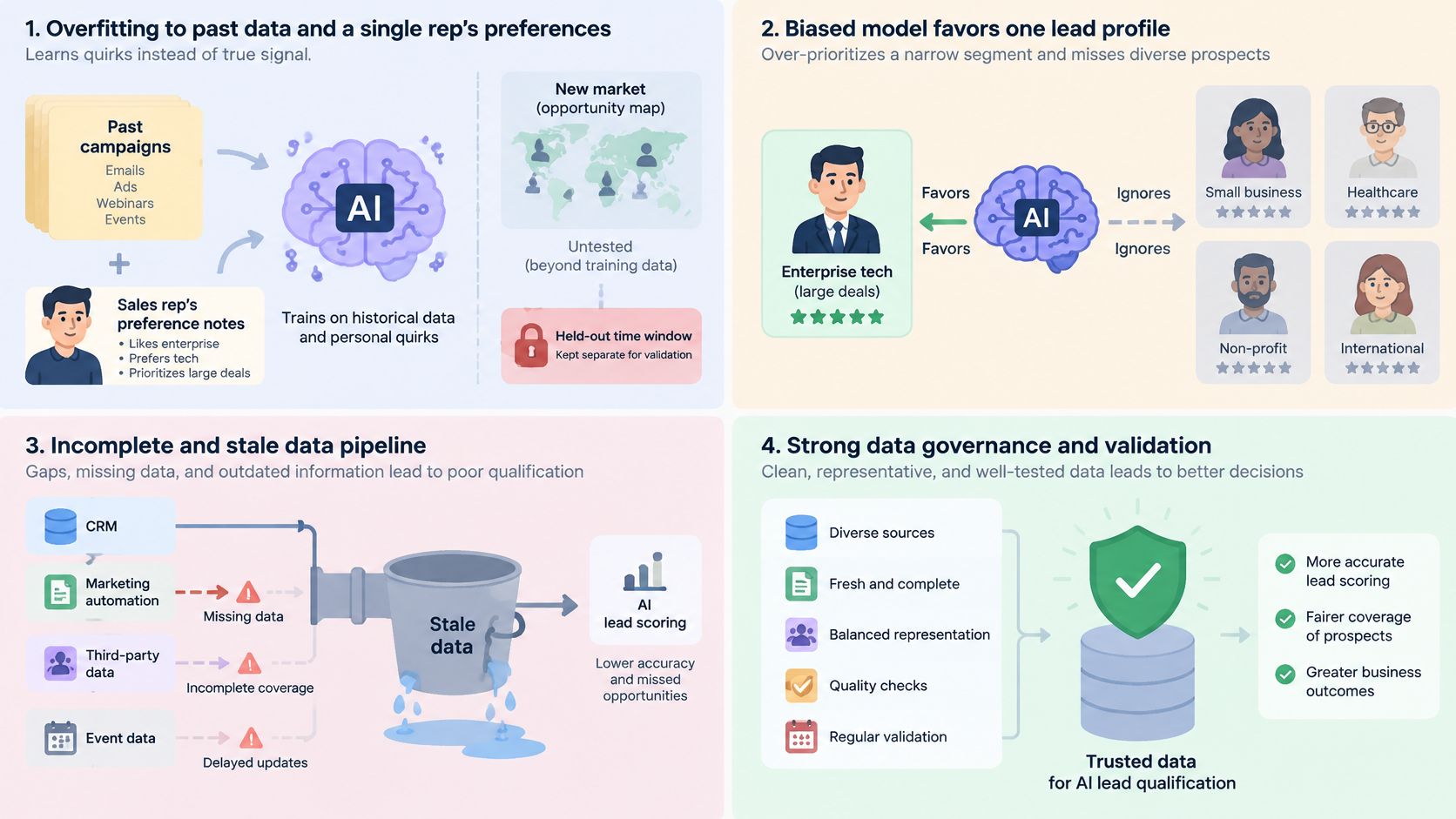
Overfitting. A model trained on last year's pipeline learns last year's campaigns, one rep's preferences and one region's quirks. It scores beautifully on history and poorly on a new segment. Test on a held-out time period and on a segment the model has never seen before trusting either.
Bias and skew. Scores can drift high for certain regions, company sizes or founder profiles because those groups dominated the training data. Break accuracy down by segment, source and geography. An overall accuracy figure can hide a segment being systematically over-scored or under-scored.
Data risk. Duplicate accounts, stale job titles and three different definitions of "qualified" teach the model the wrong thing. A model trained on messy records automates poor decisions at scale, which is worse than a slow human making them one at a time.
Privacy and automated decisions. Under Article 22 of the UK GDPR, an individual has the right not to be subject to a decision based solely on automated processing, including profiling, when that decision produces legal effects or similarly significant effects, as set out in the text of Article 22. Exceptions apply where the decision is necessary for entering into a contract, authorised by law with safeguards, or based on explicit consent, and safeguards must include the right to obtain human intervention, express a point of view and contest the decision.
For B2B work the practical reading is modest. Scoring and prioritising is fine. A rejection or exclusion that matters to an identifiable person should have a route to human review, and the route should be written down before anyone needs it.
Every score also needs an owner. Record the source, the reasoning, the confidence, the date the evidence expires and the person accountable for exceptions. When someone asks why an account was excluded in March, that record is the answer.
Set Up and Pilot an AI Qualification Workflow
Eight steps take a qualification workflow from idea to something a sales team trusts. Each one exists to prevent a specific failure.
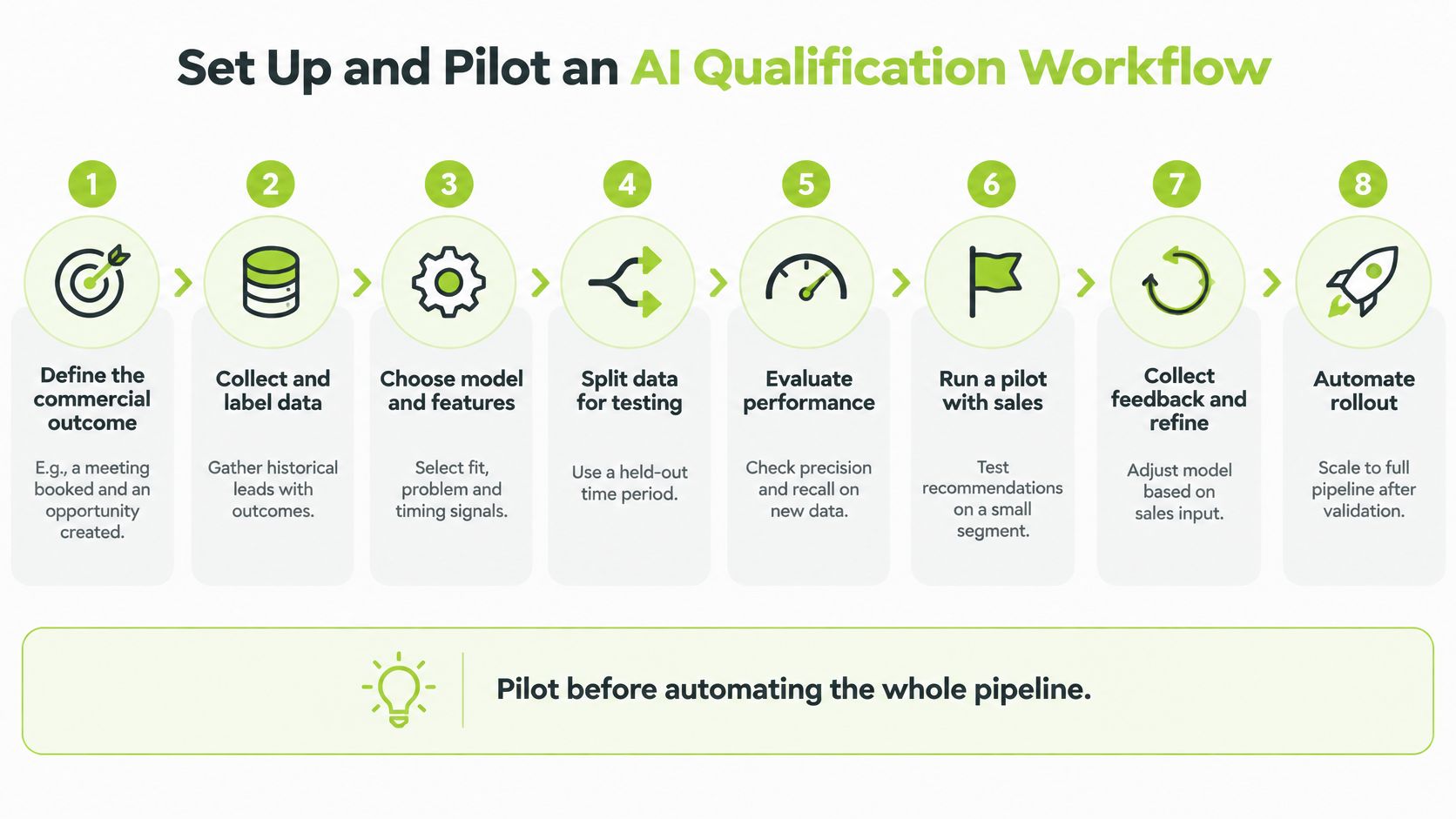
The eight setup steps
- Define the commercial outcome. A meeting booked with a named buyer and an opportunity created. Anchor every score to something sales already counts, or the score becomes a debate.
- List the inputs and their sources. Clay enrichment, a data provider, your CRM fields, public job postings. Write down which field comes from where, so stale data has an address.
- Write the decision rules in order. Hard exclusions first, then scoring points, then the three routing lanes. Order matters: exclusions are cheap and should run before anything that costs a credit.
- Add reason code and confidence fields to every record. The evidence belongs in the CRM, not inside a prompt only one person can see.
- Map the integrations and deduplicate by domain. Duplicate accounts are the most common reason a score disagrees with reality, and they break reporting before they break outreach.
- Set fallbacks. Missing data goes to review, not rejection. Empty fields are common and shouldn't be read as a verdict.
- Name an owner for each field, each review queue and each rule change. Unowned rules rot. Unowned review queues fill up and get ignored.
- Run a four-week pilot on one segment with a named reviewer and a manual comparison group, so you can see what the workflow adds rather than what it agrees with.
The pilot measures and the stop rule
Track three numbers during the pilot: precision among accepted leads, the share of accepted accounts that become qualified conversations, and the override rate. Write the stop rule before the pilot starts, so the decision isn't made in the middle of a good week.
Take a hypothetical check. Review 100 accounts, accept 30, and 21 of those become qualified conversations. That's 70% precision, a figure to track and improve rather than assume. The 20% overturn threshold is an example stop rule to calibrate: if reviewers overturn more than a fifth of the model's calls, pause and fix the evidence rules.
For teams that would rather fix the workflow than rebuild it, CRM workflow automation is usually the layer where routing, deduplication and fallbacks run. Where the rules outgrow a spreadsheet and a few fields, H2 defines the commercial outcome, required inputs, decision rules, integrations, edge cases and ownership before anything expands, then connects sources, enrichment, qualification and integrations around the customer's actual logic. The scope of a custom GTM system build sets out what that covers, and current figures sit on the H2 pricing page.
Teams handling a wider pipeline often pair that routing with CRM automation and pipeline configuration, particularly where lead status, owner assignment and handoff rules need to match the qualification lanes exactly.
Pilot before automating the whole pipeline. A workflow that's wrong in one segment is a nuisance. The same workflow applied everywhere, with no comparison group and no stop rule, is a quarter of wasted outbound.
If your team is still sorting leads by hand and calling it qualification, or running a score nobody can explain to a colleague, H2 builds the layer that fixes it: the outcome, the evidence rules, the routing lanes and the review queue, all designed around your own commercial logic. Prospects can start by booking an intro at H2 and describing where growth is stuck, and H2 will show the audience, the infrastructure and the workflow it would build to move it.
