If a prospect researches your company, discusses the problem with colleagues and compares alternatives before speaking to sales, why would a contact list or a booked meeting count as successful lead generation?
B2B lead generation is the system for creating qualified buying conversations, not the mechanical production of names. It combines account selection, research, useful information, targeted outreach, qualification, conversion paths and timely sales follow-up. The strongest programmes help buyers investigate independently while giving sales enough context to make a relevant approach when the timing is right.
That distinction matters because modern buyers don't wait for a salesperson to explain every option. They search, consult internal colleagues, evaluate peer opinions and form an early view of the problem before a commercial conversation begins. A good lead-generation system earns attention before that conversation, then turns evidence of fit and need into a disciplined handoff.
Understanding B2B Lead Generation
The phrase sounds simple, but teams often use it to describe several different activities. A database vendor may call a verified contact a lead. An SDR team may call a scheduled meeting a lead. Marketing may use the term for someone who downloaded a guide. Those records can be useful, but none automatically represents a qualified opportunity.
Consider a software company selling a technical platform to businesses with complex infrastructure. A technology director at a suitable company may still be a poor lead if there's no relevant problem, no internal initiative and no reason to engage now. Another contact, perhaps an engineering leader who has publicly described a capability gap, may be more valuable even if they haven't filled in a form or requested a demo.
Practical definition: A B2B lead is an account with plausible fit, relevant evidence, an identifiable stakeholder and a credible reason to start a conversation.
The work therefore progresses in stages:
- Find the right accounts: Define the organisations that can benefit from the offer, including their operating context and exclusions.
- Identify the right people: Map likely users, influencers, budget owners and technical evaluators instead of relying on one job title.
- Establish relevance: Connect the offer to a problem, initiative, trigger or business change that can justify contact.
- Create a low-friction next step: Give the buyer a useful resource, a clear reply option or a relevant conversation path.
- Learn from outcomes: Feed replies, objections, meetings and opportunities back into targeting and messaging.
This is why content, search visibility and outbound research work together. A prospect might first discover an educational article, later see a thoughtful social post and eventually receive a concise email that reflects the company's circumstances. For lean teams, practical production support such as editing built for lean marketing teams can help turn specialist knowledge into usable video and educational assets without making senior operators manage every production task.
The aim isn't to force an early sales interaction. It's to become credible during independent research, recognise when the account is worth prioritising and make the eventual human exchange more specific.
How B2B Buying Behaviour Shapes Lead Generation
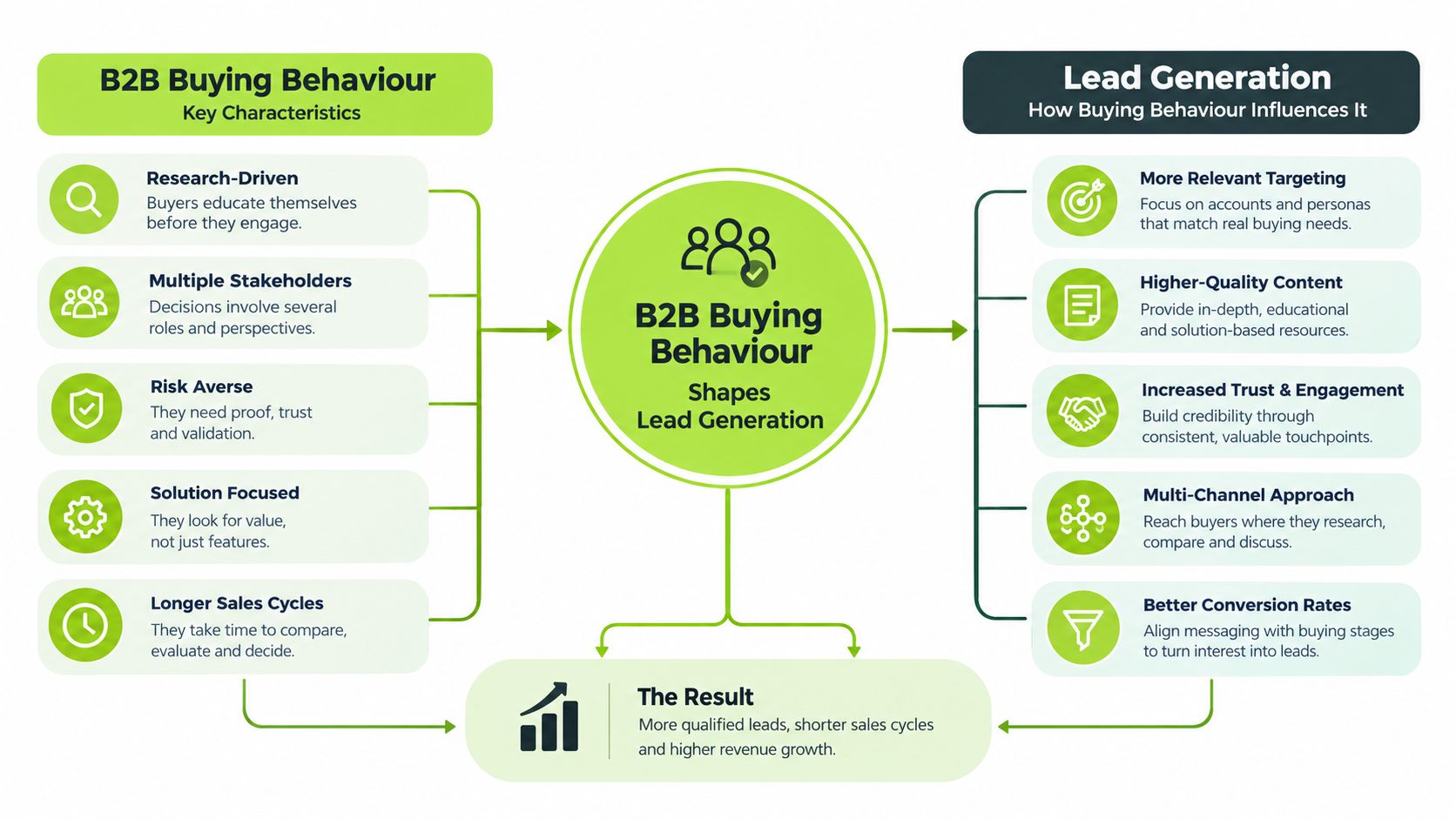
A B2B lead-generation process fails when it treats the buyer as a title in a spreadsheet. The buyer is part of an organisation, a problem, a decision process and a group of people who must eventually agree that change is worthwhile.
Research on buyer enablement reports that buyers spend only about 17% of purchasing time interacting with vendors. The remaining time goes to internal discussion, independent research and peer evaluation, which means your outreach competes with a large amount of activity you can't directly observe. (Buyer Enablement's B2B buyer statistics)
A contact's role matters, but it isn't sufficient. A finance leader, technical evaluator and operational owner may each interpret the same purchase differently. Your research needs to identify the business situation that gives each stakeholder a reason to care.
Build qualification from evidence
A useful qualification record combines several dimensions:
- Firmographic fit: Does the organisation match the industries, markets, operating model and commercial profile your offer serves?
- Problem evidence: Is there a visible operational issue, strategic initiative or capability gap that your product or service could address?
- Stakeholder relevance: Can the contact influence the problem, evaluate a solution or introduce the person who can?
- Timing: Is there a reason the issue may matter now, rather than at an undefined point in the future?
- Trigger context: Has a vacancy, technology change, expansion, leadership shift or business initiative created a reason to investigate?
A trigger is evidence for prioritisation, not proof of intent. A company hiring for a particular role may be building capability internally, replacing someone or just testing the market. A technology change may be routine maintenance rather than a buying signal. Treating every trigger as intent produces overconfident lists and awkward messages.
Protect sales capacity with explicit rules
Write inclusion and exclusion rules before researchers begin. Include the company characteristics, relevant roles, acceptable evidence and minimum confidence required for outreach. Exclude industries, business models, regions, company stages or situations where the offer can't create a credible outcome.
Record the source and confidence of each signal. That makes review possible when a salesperson challenges a record, and it helps the team distinguish a researched hypothesis from a confirmed buying conversation. The best systems don't pretend to know more than the evidence supports.
The multi-channel nature of buying reinforces this discipline. Buyer Enablement's research reports an average of 10.2 interaction channels during the buying journey. A lead-generation programme should coordinate content, search, social activity, email, human follow-up and CRM feedback rather than assuming one message will carry the entire decision.
B2B Versus B2C Lead Generation Approaches
B2B and B2C lead generation share a basic objective, create enough relevant interest to support commercial growth. The operating conditions are different, so copying consumer tactics into a business market often creates activity without meaningful progression.
| Dimension | B2B lead generation | B2C lead generation |
|---|---|---|
| Decision-making | A buying group may include users, managers, finance and technical reviewers | An individual or household may make the decision |
| Research | Buyers often investigate the problem, vendors and business case independently | Buyers may compare options quickly around price, convenience or preference |
| Qualification | Fit, authority, problem evidence and timing all matter | Identity, need and immediate purchase readiness may be sufficient |
| Messaging | Requires business context, risk reduction and stakeholder relevance | Can focus more directly on product benefits, emotion and ease |
| Follow-up | Sales and marketing may need coordinated nurturing across a longer process | Conversion paths can often move directly from attention to purchase |
A consumer campaign can optimise for an immediate click or transaction because the person seeing the message may also be the person paying. In B2B, the person who downloads a guide may be an evaluator, not the budget owner. A useful response from one stakeholder can still require internal consensus before any purchase takes place.
The difference changes what “personalisation” means. In B2C, personalisation might use browsing behaviour or product preference. In B2B, credible personalisation reflects the company's operating reality, such as the systems it uses, the market it serves or the change it appears to be managing. Mentioning an irrelevant detail is worse than using no personalisation because it signals automated research.
Why volume tactics often disappoint
B2C acquisition can sometimes tolerate broad targeting because a large audience contains many individual buyers. A specialist B2B market has fewer plausible accounts and a higher reputational cost when outreach is careless. Sending the same sequence to every company in an industry may generate replies, but those replies can be from people who lack the problem, authority or timing to progress.
B2B teams should therefore optimise for qualified progression, not the largest possible audience. A smaller, well-researched account set can produce better sales conversations than a broad list that forces sellers to perform qualification from scratch.
Common B2B Lead Generation Tactics
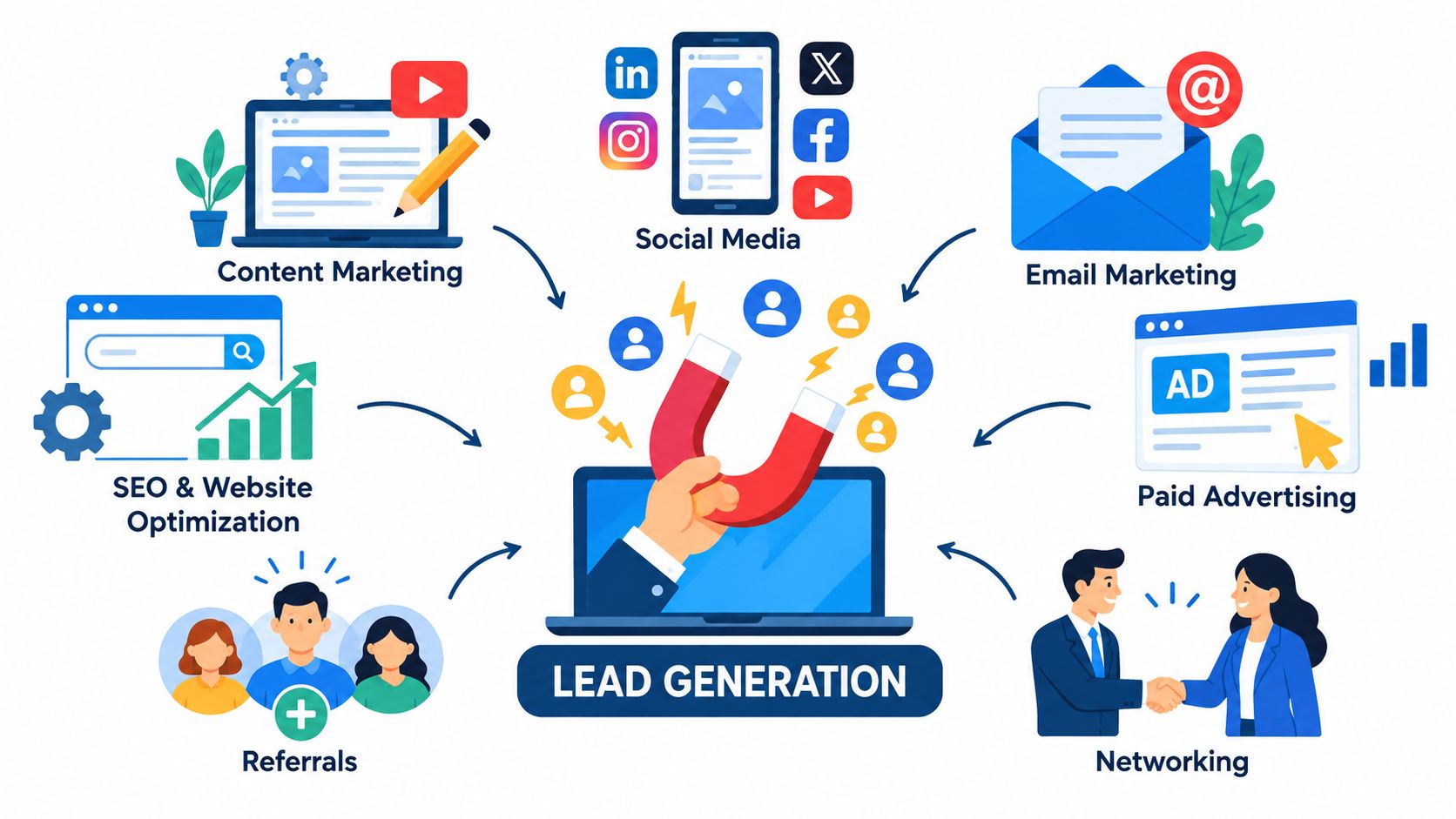
No single channel reliably creates a complete B2B pipeline. Search helps buyers discover answers, content builds understanding, outbound research creates proactive coverage, social engagement develops familiarity and conversion paths make response easy. The programme works when these activities share an audience definition and a set of commercial hypotheses.
Create demand before asking for a meeting
Search visibility and educational content help buyers answer questions before they're ready to speak with a vendor. Publish material that explains the problem, trade-offs, implementation considerations and evaluation criteria. Generic thought leadership is less useful than content that helps a technical or commercial stakeholder make a decision internally.
Targeted outbound email adds proactive coverage, but it should begin with account research rather than a template. State why the account was selected, connect the message to a plausible issue and make the response easy. A short question that allows a simple correction or referral is often more respectful than a long product pitch.
Account-based research is particularly useful in small, technical markets. Map the account, its likely stakeholders, relevant systems, public initiatives and reasons to exclude it. Use automation for collection and enrichment, but keep human judgement over the interpretation of evidence.
Coordinate channels around the buyer
Social engagement should contribute something useful, not become a sequence of public sales pitches. Comment on relevant problems, share informed observations and use interaction as a reason to improve research. Social activity can create familiarity, but it doesn't prove that an account is ready to buy.
Digital conversion paths should match the buyer's stage. An early researcher may want an explanation or diagnostic resource. A later-stage evaluator may need implementation information, technical documentation, commercial justification or a direct conversation. Don't force every visitor into the same form.
A good handoff preserves context. The salesperson should know what prompted the record, why the account fits, what evidence exists and what remains uncertain.
Teams that need a more structured overview of outbound execution can use a practical guide to master outbound lead gen. For the mechanics of outbound specifically, this explanation of outbound lead generation is a useful reference when deciding which research, messaging and follow-up tasks belong in the operating process.
The trade-off is clear. Automation increases coverage and consistency, while human review protects relevance and reputation. Remove automation and research becomes slow. Remove judgement and the system produces polished noise.
Measuring Lead Generation Success
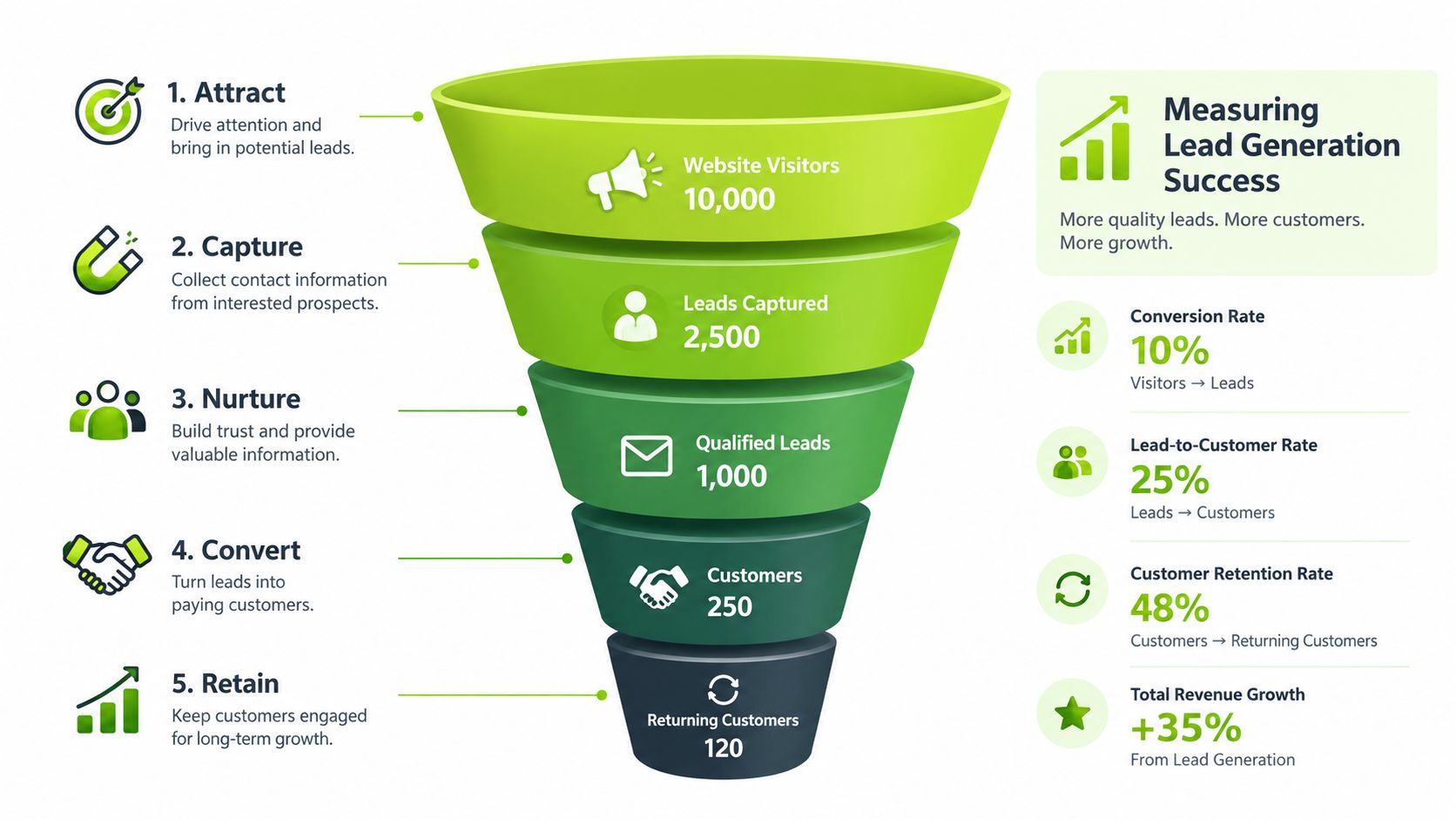
A lead-generation dashboard that celebrates contact volume can hide a weak commercial process. The useful question isn't how many records entered the system. It's how many suitable accounts became verified contacts, positive replies, qualified conversations, meetings, opportunities and pipeline.
Analysis of 1.25 million leads across 2,241 companies found that organisations responding within one hour were nearly seven times more likely to qualify a lead than those waiting an additional hour. The same analysis reported an average response time of 42 hours. (Leadscraper's B2B sales funnel analysis)
Measure each stage separately
Track the funnel as a chain of decisions rather than one conversion rate:
- Valid accounts: The organisation passes the inclusion rules and isn't a duplicate.
- Verified contacts: The person and contact details are sufficiently reliable for the intended channel.
- Positive replies: The contact responds with interest, a relevant question, a referral or useful context.
- Qualified conversations: The account and problem justify a sales discussion.
- Meetings: A conversation is scheduled with the right level of relevance and ownership.
- Opportunities and pipeline: Sales accepts a commercial opportunity and records its progression.
This structure separates data quality from message performance. A campaign can produce positive replies from poor-fit accounts, or strong meeting numbers that fail to create opportunities. Those outcomes require different fixes.
Build an event-driven handoff
When an enquiry or positive reply arrives, the system should deduplicate the record, enrich missing context, apply qualification rules, assign ownership and trigger a human response. Store timestamps for receipt, assignment and first response so managers can identify delays instead of arguing from memory.
Lead scoring should also distinguish engagement from fit. An email open is weak evidence. A specific reply that describes a relevant operational problem is stronger evidence, but it still needs account and stakeholder validation. Teams that want a more detailed treatment of prioritisation can consult this guide to B2B lead scoring.
Close the loop with sales
Sales feedback should change the system. Review which accounts progressed, which objections repeated, which triggers proved misleading and which messages earned a useful response. Update the audience rules, research prompts, qualification thresholds and message hypotheses accordingly.
The best lead-generation metric is not activity. It's the quality of progression from researched account to commercially useful conversation.
Open rates and sending volume can help diagnose deliverability or message problems, but they shouldn't become the goal. Pipeline reviews should always connect channel activity to data quality, response latency and opportunity outcomes.
Building Your Lead Generation Strategy
Start with the commercial constraint, not the channel. A company that relies on referrals may need broader account coverage. A sales team with plenty of meetings but few opportunities may need stricter qualification. A RevOps team drowning in spreadsheets may need better routing and data controls before it needs another prospecting tool.
A practical strategy has four decisions:
- Define the market: Describe the account characteristics, problems, stakeholders and exclusions that shape your ideal customer profile.
- Choose the operating motion: Decide how search, content, outbound, partnerships, social activity and follow-up will support the buyer journey.
- Set the handoff rules: Specify what evidence qualifies a record, who owns it and how quickly the owner must act.
- Create the feedback rhythm: Review replies, objections, meetings and opportunities often enough to change targeting before waste accumulates.
Build internally when control matters
Internal ownership makes sense when the team has commercial knowledge, time to research accounts, someone responsible for campaign operations and enough sales capacity to handle resulting conversations. It also gives the company direct access to learning, provided the team documents decisions rather than keeping them in individual inboxes.
The downside is opportunity cost. Founders and sales leaders often understand the market best, but they may not have the capacity to build lists, verify contacts, manage campaigns, review replies and maintain CRM hygiene every week. A half-built system can consume attention without creating reliable learning.
Outsource the bottleneck, not accountability
Outsourcing can cover audience discovery, enrichment, contact verification, campaign execution, reply handling or reporting. The buyer should still own the offer, commercial priorities, acceptance criteria and feedback from sales calls. A supplier that sends activity without explaining account selection or evidence creates dependency rather than capability.
A custom system is appropriate when manual research, duplicate records, inconsistent qualification or disconnected tools constrain growth. A managed service may suit a company with a proven offer and sales capacity but limited time to operate outbound. For practical guidance on the broader distinction between demand creation and direct prospecting, see this resource on B2B demand generation.
Evaluate providers by asking to see their qualification logic, data-quality checks, handoff process, reporting definitions and approach to negative feedback. The right arrangement makes the work more repeatable without pretending that software can replace commercial judgement.
Frequently Asked Questions About B2B Lead Generation
How long does it take to see results?
Timing depends on the market, evidence available, channel and sales capacity. Outbound can create conversations sooner than search-led content, while content and reputation typically compound over a longer period. Judge early activity by research quality, relevant replies and learning, not by pipeline alone.
What's the difference between an MQL and an SQL?
A marketing-qualified lead has shown enough fit or engagement to justify continued marketing attention. A sales-qualified lead has passed an agreed threshold for direct sales action, usually because the account, problem, stakeholder and timing support a conversation. Define both terms internally, or the handoff will remain subjective.
Does cold email still work?
It can, but generic volume outreach performs poorly in reputation-sensitive markets. Cold email works best when the account is well selected, the reason for contact is credible, the message respects independent research and the recipient can respond without committing to a meeting.
How should a small technology company approach lead generation?
Start narrowly. Select a market where the company understands the problem, identify a manageable set of account characteristics and investigate the signals that distinguish a plausible fit from a weak one. Use founder and delivery knowledge to sharpen messages, then build repeatable research and CRM processes once the pattern is clear.
What should a team do first?
Audit recent opportunities, lost deals, successful referrals, support conversations and failed campaigns. Extract the buyer language, account traits, triggers and objections that recur, then turn those observations into inclusion rules and a first research workflow.
H2 helps B2B technology and service companies research suitable accounts, build outbound systems, improve qualification and generate more relevant sales conversations. Visit H2 to discuss your market and current pipeline challenge, or book an introductory call to decide whether managed outbound, a custom GTM system or a private workshop fits your next step.
