A prospect replies to your email, accepts a meeting, and your team marks the opportunity as moving. Then the first call produces a long list of questions, new stakeholders appear, and the promised next step slips into an undefined future. The reply was real, but it wasn't the buying progress your CRM implied.
That pattern is common in complex B2B sales. A long sales cycle rarely reflects one problem, such as weak interest or insufficient follow-up. More often, the buyer is coordinating people, evidence, approvals and risk across an organisation. The commercial task isn't just to create more activity. It's to identify the missing commitment, help the right person secure it internally, and stop investing in deals that have no credible path to consensus.
The Hidden Buying Journey Before the First Meeting
A prospect responds to an outbound email about a software platform. The salesperson sees the reply as a breakthrough, books a discovery call and prepares a product demonstration. On the call, the buyer asks about implementation, security, integrations, pricing approval and alternatives. Nothing seems to move quickly.
That isn't necessarily hesitation. The buyer may have spent weeks researching the problem, comparing approaches and discussing the need internally before replying. Research conducted by Google and the Corporate Executive Board surveyed 1,500 business leaders across 22 large B2B organisations and found that suppliers were contacted only after 57% of the purchase process had been completed (SearchLab's summary of the sales-cycle research). The first meeting is therefore often the start of the seller's process, not the buyer's.
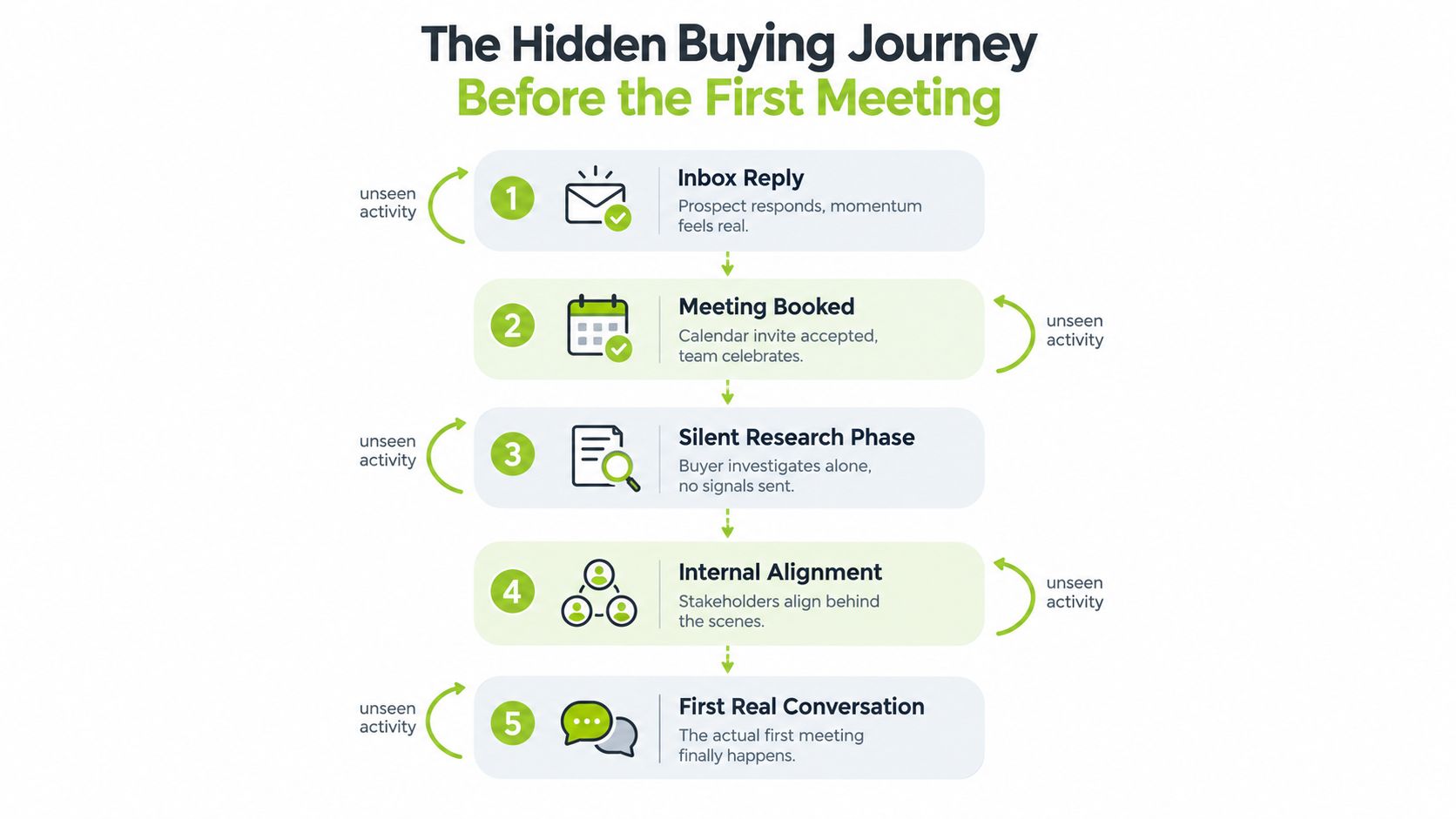
What the reply actually means
An inbox reply proves that your message earned attention. It doesn't prove that the organisation has agreed on the problem, assigned an owner, secured funding or accepted a buying timeline. The prospect may be testing whether your company belongs in an evaluation already shaped by private research.
That distinction changes the job of outbound. Early messaging needs to create recognition before engagement, using a specific problem, relevant operating context and evidence that helps a buyer explain the issue to colleagues. Once the conversation starts, follow-up should answer evaluation questions and make internal circulation easier. Repeating “just checking in” adds activity without adding decision support.
Practical rule: Treat the first reply as access to the buying journey, not evidence that the journey has just begun.
A long-cycle opportunity needs content that can travel without the salesperson present. That might include a concise explanation of the operational problem, implementation assumptions, technical requirements, commercial rationale and the risks of delaying. The buyer's private research won't appear in your CRM, so your process must leave room for unseen work rather than interpreting every quiet period as lost interest.
What Determines Sales Cycle Length Across Deal Sizes
A standardised purchase and an enterprise transformation don't belong in the same forecast category. Their sales cycles differ because the buyer faces different levels of financial exposure, operational disruption and approval risk.
A compiled set of B2B benchmarks reports a median software sales cycle of 84 days, while smaller deals commonly close in roughly 14 to 30 days. Mid-market opportunities often take 30 to 90 days, and enterprise deals valued above $100,000 frequently require 90 to 180 days or longer (RevenueFlow's B2B sales-cycle benchmarks). The same source reports an overall cross-industry average of approximately 118 days, with enterprise opportunities above $500,000 in annual contract value averaging 270 days.
These figures aren't targets for every team. They're a warning against using one blended average to describe very different buying processes.
| Deal profile | Typical duration |
|---|---|
| Smaller software deals | 14 to 30 days |
| Mid-market opportunities | 30 to 90 days |
| Enterprise opportunities above $100,000 | 90 to 180 days or longer |
| Enterprise opportunities above $500,000 ACV | 270 days on average |
Why complexity adds elapsed time
A larger purchase usually introduces more than a higher price. The buyer may need technical validation, security review, procurement sequencing, legal approval, implementation planning and budget confirmation. Those activities often depend on one another. Procurement can't finalise terms until security has answered its questions, and finance may not approve the purchase until the business owner can explain implementation and expected value.
That means a deal can remain commercially healthy while appearing inactive to a seller. A meeting-based forecast may show strong activity, but revenue still depends on the time between qualified conversation and approved purchase. Pipeline planning should therefore segment opportunities by deal size, buying complexity and approval path, not only by source or representative.
A sales leader should ask:
- What is the commercial tier? Apply different duration expectations to smaller, mid-market and enterprise opportunities.
- What approvals are required? Record technical, security, legal, procurement and budget dependencies.
- What evidence is missing? Match the proof package to the level of risk the buyer must defend internally.
- What capacity is realistic? Don't plan near-term revenue from enterprise opportunities as if they behave like standardised purchases.
More meetings won't correct a forecast that uses the wrong cycle assumption. Better segmentation will.
Why Long Cycles Are Coordination Problems Not Interest Problems
A deal can have a committed champion and still fail to progress because the champion can't secure agreement from the rest of the buying group. The problem isn't always that people don't care. It's that each participant is assessing a different form of risk.
Gartner-related research describes buying groups of roughly 5 to 16 people spanning as many as four business functions, while other compiled benchmark data places complex enterprise committees around 6 to 11 stakeholders (Callbox's overview of B2B buying committees). The economic buyer cares about value and budget ownership. A technical evaluator focuses on fit and integration. Security examines exposure, legal reviews obligations, procurement manages process and an operational user wants the change to work in practice.
A single contact can report positive engagement while the account remains blocked elsewhere. If your CRM models the opportunity as one lead, you'll miss the approval dependency that matters most.
Build a decision network
Map the account by role, not just by contact count:
- Economic buyer: Owns the financial decision and the expected commercial outcome.
- Operational champion: Feels the problem directly and carries the internal case.
- Technical evaluator: Tests architecture, integrations, security and implementation fit.
- Procurement contact: Controls the purchasing process, documentation and sequencing.
- Potential blocker: Can delay or reject the purchase because of risk, policy or competing priorities.
For each person, record their success criteria, objections and dependency. Then provide role-specific evidence. A technical evaluator doesn't need another benefits presentation. They need architecture detail, implementation assumptions and clear answers to security questions. A finance stakeholder needs a defensible commercial case. A champion needs material they can use when you're absent.
More outreach touches won't resolve a missing approval. Find the person who owns the next decision and give them a reason to act.
This is also why commercial and marketing teams need shared account information. Teams working on how to scale growth with aligned teams can use a common view of stakeholders, evidence and ownership instead of treating engagement in one channel as proof of account-wide progress. Alignment doesn't mean sending identical messages. It means agreeing on the buying problem, the account status and the action required next.
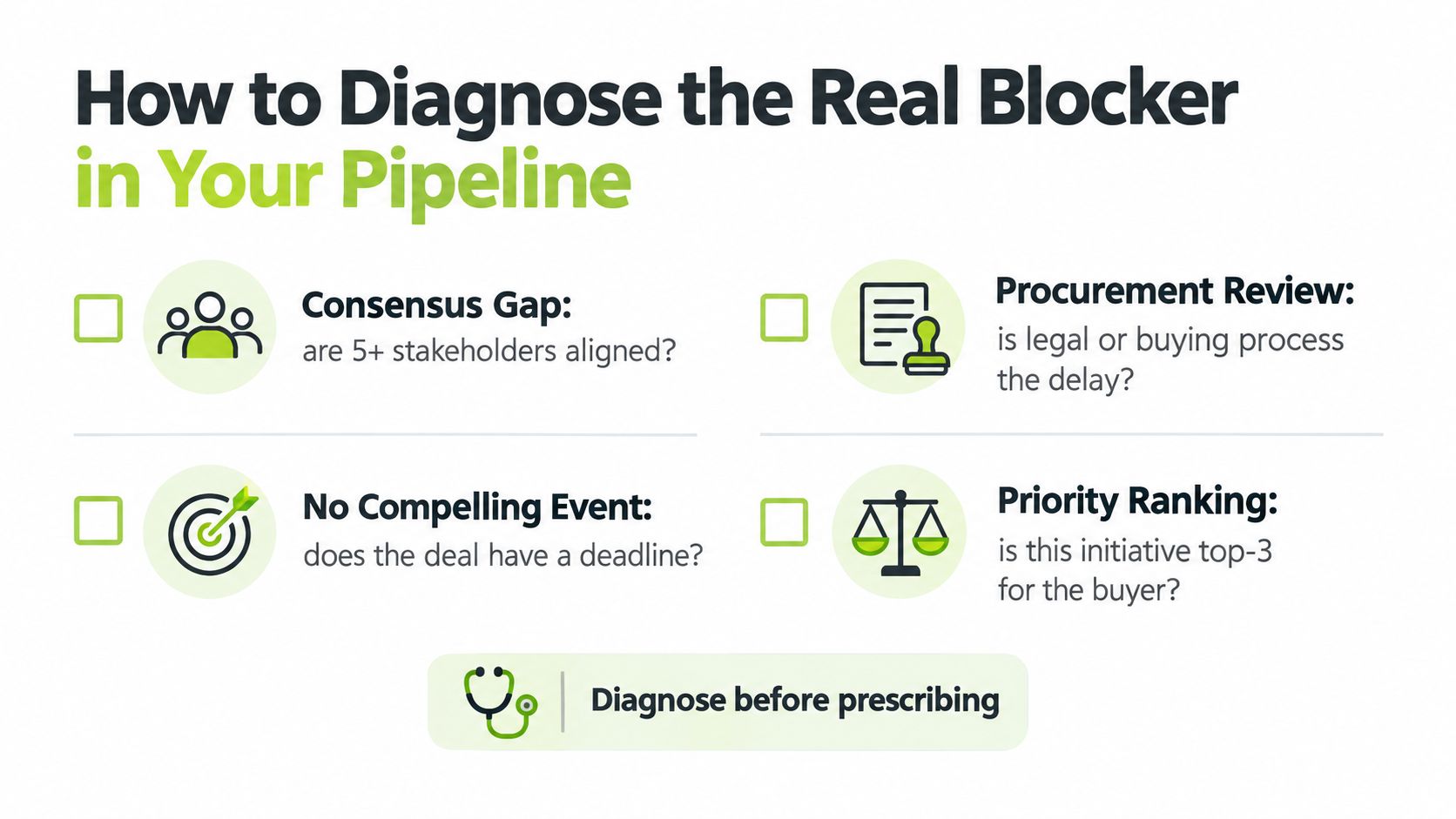
How to Diagnose the Real Blocker in Your Pipeline
Most stalled opportunities receive the same response: send another follow-up, offer another meeting and wait. That approach treats every delay as a communication problem. A useful diagnosis starts by naming the blocker.
The five categories below separate a healthy evaluation from a structurally weak opportunity.
Match the symptom to the intervention
No urgency means the buyer recognises a problem but hasn't attached a consequence or decision date to it. Look for vague timing, postponed internal discussions and language about revisiting the issue later. The intervention is a compelling event, such as a defined operational deadline, planned implementation window or documented cost of inaction. If no credible event exists, downgrade the opportunity rather than manufacturing pressure.
No consensus appears when the champion is engaged but can't bring the required stakeholders into the process. Ask who must approve the purchase, whose work will change and what objections those people are likely to raise. Supply an internal business case, role-specific evidence and a mutual action plan, then make stakeholder access a stage requirement.
No budget isn't the same as price resistance. It means ownership or funding hasn't been established. Ask where the budget would come from, who controls it and what approval would release it. If the buyer can't name a commercial owner, don't treat a favourable reaction as forecastable progress.
No technical clearance shows up in unanswered integration, security, data or implementation questions. Assign a technical owner on both sides, list the open requirements and agree on how each will be verified.
No commercial owner means people like the solution but nobody is accountable for turning the evaluation into an approved purchase. Ask who will present the case internally, who signs and what the approval sequence looks like.
Assign every delay an owner
Put the blocker, required evidence, responsible person and next internal commitment in the CRM. “Waiting for the customer” isn't an actionable status. “Security evaluator to confirm data requirements before the next review” is.
A mutual action plan should contain buyer-owned actions as well as seller-owned actions. That prevents the seller from carrying the entire process while the buying group remains passive. If the buyer won't identify a stakeholder, date or approval step, the absence of commitment is itself qualification evidence.
The Case for Evidence-Led Qualification Over Persistent Outreach
The instinct to nurture every responsive prospect can waste more capacity than it creates. Reported 2025 data indicates that 86% of purchases stall during the process, while more than four in five technology purchases involve at least four stakeholders (Sopro's B2B buyer statistics). Persistent outreach can't repair an opportunity that lacks authority, urgency or internal alignment.
A better approach scores observable readiness signals before assigning more sales effort. This isn't a rigid formula. It's a disciplined conversation about whether the account can move.
Score readiness, not friendliness
Look for evidence of:
- A funded project or active hiring need: The organisation has connected the problem to an initiative, team or resource decision.
- A defined operational problem: The buyer can describe what fails today, who experiences it and why the current approach is insufficient.
- A named owner: One person accepts responsibility for moving the internal decision forward.
- Stakeholder access: The champion can introduce technical, commercial and operational participants.
- A credible implementation window: The timing reflects a real business requirement rather than a hoped-for close date.
- A consequence of inaction: The buyer can explain what remains costly, risky or impossible if nothing changes.
A prospect with several of these signals may justify a customized evidence package and active multi-threading. A prospect with polite replies but no owner, budget path or business consequence belongs in a lower-intensity nurture track. Disqualification is not failure. It protects time for accounts with a realistic route to consensus.
Choose the right level of investment
Continue investing when the buyer provides access, accepts shared actions and closes evidence gaps. Redesign the approach when the problem is real but the message or proof doesn't help the champion make the internal case. Step back when the account won't establish ownership, timing or approval requirements.
For teams refining their method, this practical sales qualification guide offers useful framing for separating fit, authority, need and timing. You can also compare your internal criteria with this lead qualification framework, then adapt the fields to the buying roles and dependencies that matter in your market.
The purpose of qualification is not to force every deal into a short cycle. It's to distinguish a long, healthy process from extended polite interest.
Segmenting Cycles by Complexity and Expected Duration
B2B SaaS teams often describe their market as having one sales cycle, then wonder why forecasts behave unpredictably. A mid-market purchase with a familiar implementation path and an enterprise deployment requiring security, legal and procurement shouldn't share the same stage rules.
Benchmark evidence places common B2B SaaS cycles at roughly two to six months, with larger enterprise opportunities extending to approximately seven to nine months. One cited CRM benchmark reports a 6.2-month mid-market average (Boomerang's B2B sales glossary). These bands provide planning context, not promises.
Compare the operating models
| Operating model | What the team optimises for | Typical risk |
|---|---|---|
| One blended cycle | Simple reporting and uniform targets | Enterprise deals distort near-term forecasts |
| Segment-based cycle | Different stage rules and duration expectations | Requires cleaner CRM data |
| Coordination-led cycle | Stakeholder access, evidence and approvals | Takes more discipline during qualification |
The blended model is easy to administer but creates pressure to accelerate the wrong activities. A representative may chase another meeting when the actual dependency is security review or budget ownership. The segment-based model is more demanding, but it gives leaders a better view of expected conversion timing and resource requirements.
The coordination-led model adds the most useful operational detail. It asks whether the buyer's decision network is progressing, not just whether the opportunity is ageing.
Build forecasts around dependencies
For each tier, define the evidence required before proposal, technical review and commercial approval. Track stage ageing against the relevant segment rather than against one company-wide average. A longer cycle can be acceptable when stakeholder coverage expands, requirements are being cleared and buyer-owned actions are completed.
Supplier-controlled meetings represent only a fraction of the buyer's total research and alignment work. Your go-to-market system should therefore create assets that work between meetings, including implementation notes, security responses, internal business-case material and clear decision milestones.
Measuring Real Buying Progress Instead of Activity Volume
Opens, replies and booked meetings are useful diagnostic signals, but they don't prove that a buying committee has moved. A contact can respond to every email while withholding the introduction, approval information or internal commitment that would make the opportunity real.
Track engagement separately from structural progression. That lets sales leaders see whether activity is creating access and decisions or merely producing pleasant conversations.
Use stage exits that require buyer evidence
A qualified stage shouldn't close because a meeting happened. Require observable outcomes such as:
- Confirmed business problem: The buyer agrees on the operational issue and its impact.
- Agreed internal owner: A named person accepts responsibility for progressing the decision.
- Identified approval process: The account explains who approves, who signs and what sequence applies.
- Technical or security requirements: The relevant evaluator has listed requirements and a path to validation.
- Scheduled next action: The next meeting includes the stakeholder needed for the following decision.
These criteria expose false momentum early. If a proposal has been sent but no approval process exists, the proposal isn't a sign of late-stage progress. It's an artefact waiting for an owner.
Create a progress dashboard
Track time to first qualified conversation, stage ageing, stakeholder coverage, next-step completion and opportunity creation independently from engagement metrics. A useful dashboard might show an opportunity's current stage, required stakeholder, unresolved blocker, buyer-owned action and date of the next decision.
Teams can use a dedicated sales buying signals framework to organise observable triggers, but signals should support judgement rather than replace it. A hiring event, technology choice or social interaction may justify research. It doesn't establish authority, budget or consensus by itself.
Forecasting principle: A meeting is an event. A completed buyer action is evidence of progress.
Review old opportunities by asking what changed in the decision network, not how many touches the salesperson completed. If no stakeholder, requirement, approval step or business consequence has changed, the account probably hasn't advanced, regardless of email engagement.
Practical Steps to Accelerate or Manage Long Cycles
Acceleration starts with a decision about the opportunity's actual condition. Some deals need faster coordination. Others need better evidence. A few should leave the active pipeline.
Begin with an account-level review and create a short record for each open opportunity:
- Map the roles. Name the champion, economic buyer, technical evaluator, procurement contact and likely blocker.
- Record the missing evidence. Link each stakeholder to the proof they need, such as implementation assumptions, security answers or a commercial case.
- Name the blocker. Use no urgency, no consensus, no budget, no technical clearance or no commercial owner.
- Assign ownership. Give one person responsibility for removing the blocker, whether that's the seller, champion, technical lead or procurement contact.
- Set the next commitment. Make the action buyer-owned where possible, with a participant and a date.
- Reclassify the opportunity. Keep it active, redesign the approach, move it to nurture or disqualify it based on evidence.
Change the system, not just the follow-up
Update CRM fields so the team can record committee progression and approval dependencies. Train sellers to distinguish contact engagement from buying progress. A reply should update communication status. It shouldn't automatically update deal stage.
A custom GTM system can connect account research, buying signals, lead qualification, scoring and CRM routing when manual handoffs create blind spots. Teams considering automation can also review this practical perspective on AI-driven cycle time reduction, while a structured lead follow-up system can keep timely actions from depending on individual memory.
H2 can support this type of work through Fully Managed Outbound, Custom GTM System Builds and Private GTM Workshops, depending on whether the constraint is campaign capacity, workflow design or team capability. The right intervention is the one that removes the actual bottleneck, not the one that creates the most activity.
Use this final test before putting more effort into a stalled deal:
- Is there a named business problem?
- Is there an internal owner?
- Can the team access the required stakeholders?
- Is the approval process understood?
- Does the buyer have a credible implementation window?
- Has the buyer completed a meaningful next action?
If the answers are mostly yes, coordinate the deal more deliberately. If they are mostly no, preserve capacity by redesigning or disqualifying the opportunity.
H2 helps B2B technology and service companies build qualified pipeline through managed outbound, custom go-to-market systems and private workshops. Visit H2 to discuss your audience, buying-cycle bottlenecks and the practical support your team needs.
