LinkedIn cold outreach is sometimes planned around roughly 1 booked meeting per 667 connection requests, using benchmarks from 180,155 matured requests, but that estimate doesn't match the stated meeting-rate denominator. The practical answer is to prioritise relevant accounts, earn substantive replies and measure qualified meetings rather than connection growth.
That distinction matters before anyone writes a message. A campaign can generate accepted connections without creating useful sales conversations, and an impressive reply rate can include polite declines. Founders, sales leaders and RevOps teams need a funnel that separates those outcomes.
What the LinkedIn Cold Outreach Funnel Actually Looks Like
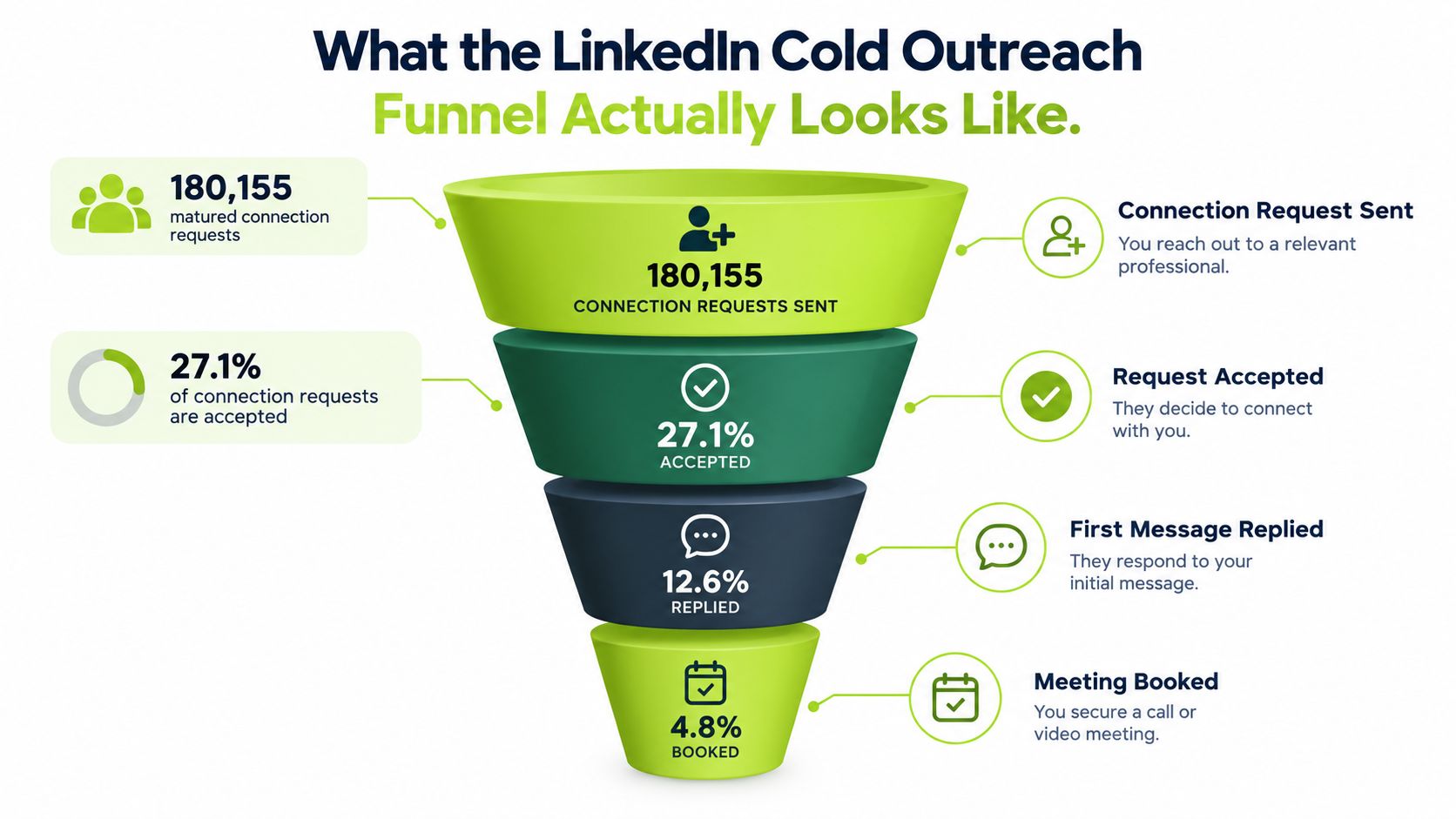
The published funnel supports roughly 54 booked meetings per 10,000 connection requests, not the opening estimate. In a 2025–2026 dataset of 180,155 requests, each matured for at least 30 days, 27.1% were accepted, 27.6% of accepted connections replied and 2.0% of accepted connections booked a meeting, according to Reachium's connection-to-meeting research.
Those figures describe different transitions. The meeting percentage uses accepted connections as its denominator, so it shouldn't be multiplied by the reply percentage again. Doing that introduces an extra conversion stage that the stated benchmark doesn't support.
The funnel below provides the operating frame.
Keep the denominator visible
A reporting dashboard should name the population behind every rate. “Meeting conversion” isn't a useful label unless the reader knows whether it means meetings per request, accepted connection or reply.
| Funnel measure | What it helps diagnose |
|---|---|
| Requests accepted ÷ requests sent | Audience fit and sender credibility |
| Replies ÷ accepted connections | Message relevance and conversation opening |
| Qualified replies ÷ total replies | Commercial fit rather than general engagement |
| Meetings booked ÷ requests sent | Overall campaign productivity |
| Opportunities created from meetings | Sales value beyond the booking |
A reply isn't automatically qualified. A qualified conversation should establish a relevant problem, a suitable account and a plausible route to a commercial discussion. Booked meetings should also remain separate from attended meetings and opportunities.
Plan for selective outreach
These are directional benchmarks, not a forecast for every technology business. Audience, profile credibility, relevance and follow-up quality can change the outcome, and observed campaign data doesn't prove which input caused a difference.
LinkedIn's invitation controls and prohibition on unauthorised automation also constrain the operating model. The sensible commercial response is to allocate research and attention to accounts worth reaching, rather than treating the platform as an unlimited sending channel.
Planning rule: A bigger network is an intermediate outcome. A qualified conversation is evidence that the outreach has commercial relevance.
Getting the Sender Profile Ready for Outreach
A prospect should be able to reconcile the sender's message with the sender's profile. Outreach about database operations looks less credible when the headline, experience and featured content describe an unrelated business.
Profile preparation is therefore a consistency exercise, not a promise of a conversion lift. Fix anything that makes the reason for contact difficult to understand before spending time on cosmetic improvements.
Make the market served obvious
Consider this hypothetical headline rewrite:
Before: Head of Growth at Acme
After: Head of Growth at Acme | Outbound systems for B2B software teams
The second version retains the actual role while making the commercial context clearer. It doesn't invent expertise, claim a result or promise to solve every revenue problem.
The About section should explain the work in similarly concrete language. Name the market served, the problem addressed and how the business approaches it. Avoid a dense catalogue of capabilities or an opening paragraph about being passionate and results-driven.
Visible experience should support those statements. If the sender represents a consultancy, the employment record and company information should make that relationship clear rather than creating the impression of an independent peer conversation.
Put relevant evidence within reach
The featured section should help a suitable buyer assess the sender's thinking. Choose material that supports the topic of the outreach, not just the latest company announcement.
- Relevant explanation: Feature a useful post or guide about the operational problem being discussed.
- Credible evidence: Include an approved case study only when its claims can be substantiated and shared.
- Consistent activity: Review recent posts and comments for relevance, accuracy and alignment with the proposed message.
- Clear identity: Keep the photograph, role and company details recognisable and current.
Treat recent activity as material a prospect may inspect, not as a guaranteed acceptance lever. There isn't a justified posting quota or profile-change performance promise in the benchmarks used here.
Marketing can supply useful content and approved proof. Sales should check whether those assets answer the questions buyers raise. Banner design and visual polish come later, once the profile explains who the sender is and why the conversation makes sense.
Building a Tight Account List and Invitation Cadence
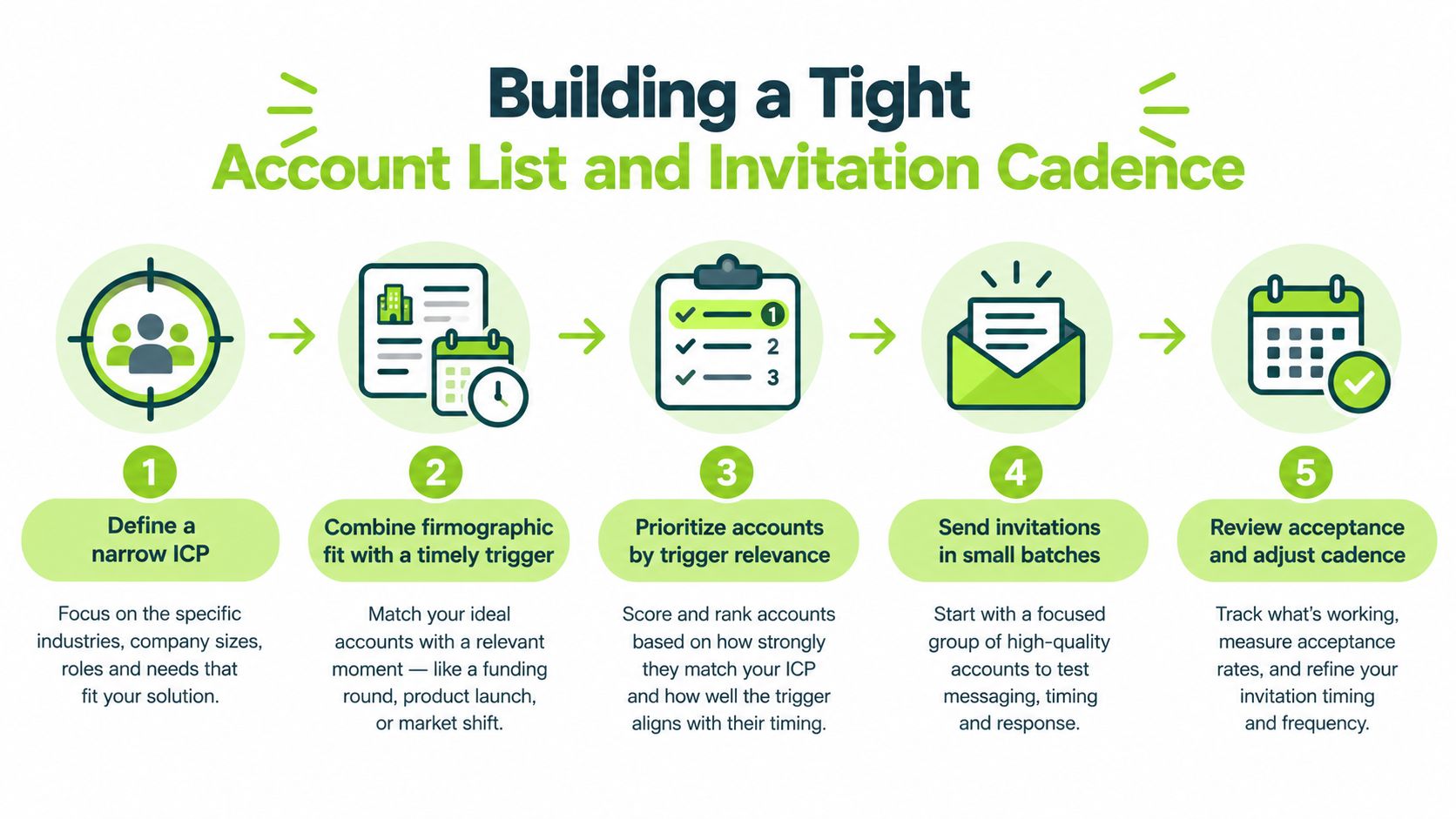
Start with the account, then select the person. An ideal customer profile, or ICP, describes the organisations that could benefit commercially; a buyer persona describes the relevant individual within them. The ICP versus persona guide helps separate those decisions before prospecting begins.
For a hypothetical software consultancy, an account criterion might be a business maintaining a substantial customer-facing application. The relevant contact could be an engineering leader responsible for delivery capacity, rather than every employee with a technology title.
A vacancy, technology change or public post can justify further investigation. It doesn't establish a budget, an urgent problem or purchase intent.
Rank by fit and evidence
Record the evidence behind each targeting decision. A researcher should distinguish a company announcement from an inference about what that announcement might mean.
| Account tier | Evidence required | Recommended treatment |
|---|---|---|
| Strong fit with relevant trigger | Clear commercial fit and a verified circumstance | Deeper research and a contextual invitation where useful |
| Strong fit without timely trigger | Suitable account, but no clear reason to act now | Consider a blank request or defer outreach |
| Uncertain fit | Missing information or weak commercial relevance | Research further before sending |
For teams extending the same account strategy into email, Starward Navigators' email marketing lead generation guide offers a separate resource for planning the email lead-generation work. Keep channel selection distinct from account qualification.
Use cadence as a constraint, not a target
Across the matured-request dataset, acceptance peaked at 32.0% for accounts averaging 10–19 invitations daily, then fell to 26.7% at 20–29, with the latter band representing 89.6% of measured requests, according to Reachium's invitation-volume analysis. That association doesn't prove higher volume caused lower acceptance or establish a safe sending allowance.
LinkedIn applies invitation limits to Basic and Premium members; reaching a limit can produce a restriction typically lasting one week, and withdrawing pending requests doesn't remove it, according to LinkedIn's invitation-limit documentation.
Use small, manually reviewed batches and monitor pending requests. Free members can add personalised notes to only five connection requests per month, according to LinkedIn's personalised-invitation guidance, so reserve that allowance for accounts with a genuine reason for contact.
Writing Connection Notes That Earn Acceptance
A personalised note isn't automatically better than a blank request. In a 2025–2026 analysis of 180,155 requests, the 160,639 requests without a note achieved 27.66% acceptance, with 25.54% of accepted connections replying, equivalent to replies from 7.06% of requests sent, according to Reachium's connection-note analysis.
Those results support testing note-free requests. They don't prove that blank invitations outperform every well-researched note, because the audience and campaign conditions also matter.
The decision should be whether a note adds credible context. If the only available wording is a generic compliment or a compressed sales pitch, leaving it blank is a reasonable test.
Connection note patterns at a glance
| Pattern | Best used when | Risk to manage |
|---|---|---|
| Trigger-led | A verified post, role change or company development connects to the topic | Treating the event as proof of pain or intent |
| Mutual-context | A genuine shared market, professional connection or discussion provides context | Implying an introduction or endorsement that didn't happen |
| Blank | The profile communicates relevance but a note adds little | Mistaking acceptance for commercial interest |
LinkedIn's Help documentation specifies a 200-character personalised-message limit and says Premium members can send unlimited personalised invitations, while ordinary request limits still apply, in its connection-request personalisation documentation. The note must therefore act as an opener, not a miniature proposal.
Draft around an observable detail
Hypothetical connection note
Saw Acme's platform engineering vacancy mentioning database reliability. That overlaps with the operational topics covered here. Open to connecting?
This wording names the evidence and the overlap without declaring that Acme has a support gap. Before sending, verify that the vacancy exists and that the sender's profile supports the topic.
Hypothetical first follow-up after acceptance
Thanks for connecting. Acme's vacancy mentions database reliability alongside platform delivery. Is the role mainly about building new capability or supporting the existing estate?
The question offers a useful distinction without demanding a meeting. Omit the service catalogue, calendar link, unsupported customer proof and exaggerated praise.
For a separate copy-editing reference, Ploot's sales outreach message tips can support the drafting process. Keep any recommended wording subordinate to the actual evidence about the account.
Personalisation means a defensible reason for contact, not a name inserted into an otherwise unchanged pitch.
Test notes against a no-note control within comparable audiences. Judge the result through downstream conversation quality, not acceptance alone.
Designing the First Follow-up After Acceptance
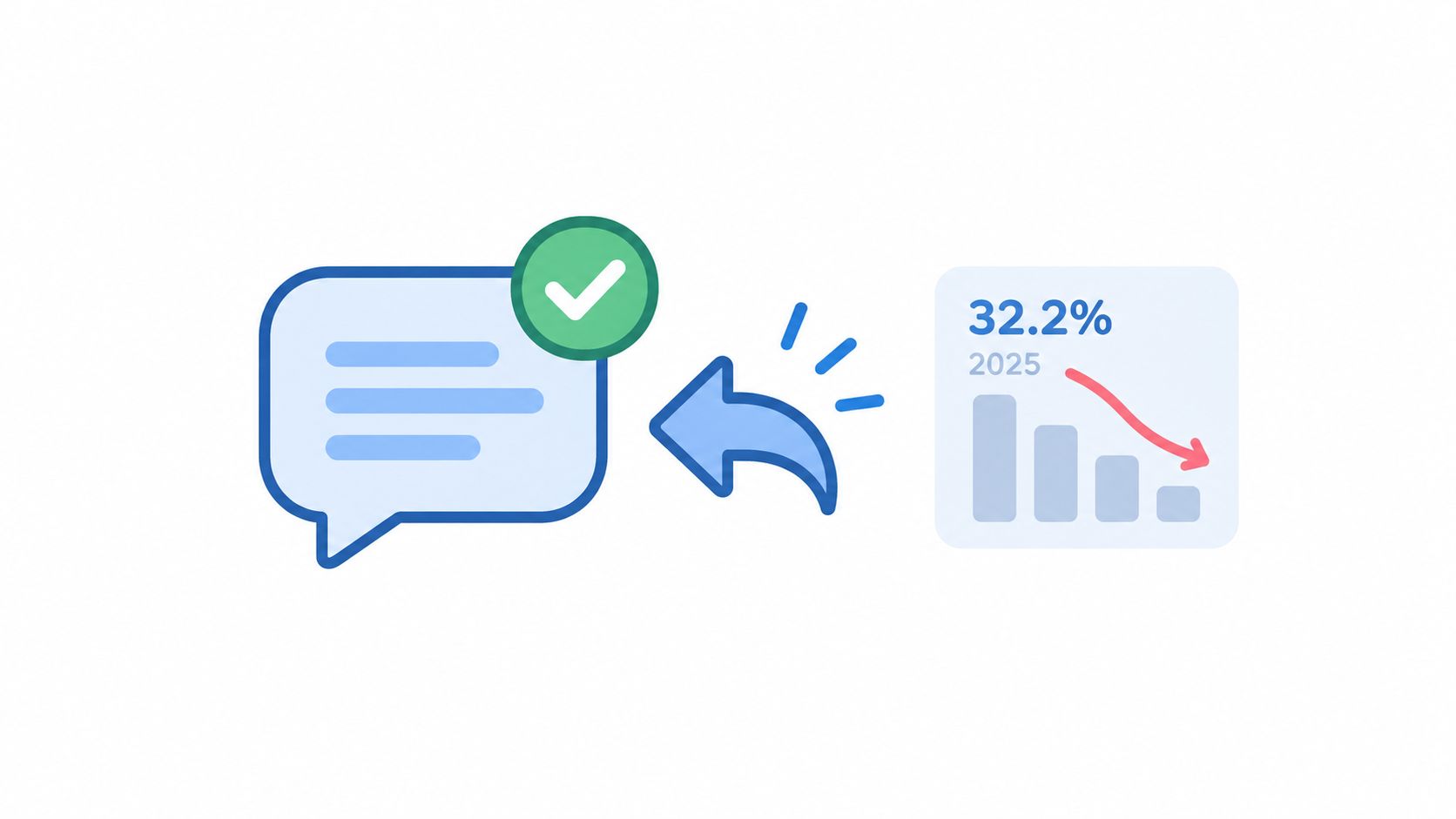
Acceptance became easier while replies became harder in the published longitudinal comparison. Across 101,191 requests in 2025 and 78,964 in 2026, acceptance rose from 26.3% to 28.1%, but replies among accepted connections fell from 32.2% to 22.0%, according to Reachium's reply-rate comparison.
That is a reason to examine the first message separately from the invitation. It isn't evidence that every audience has become less responsive or that a particular template will reverse the trend.
Ask for context before time
Use an observable circumstance, explain the relevant topic and ask an easy-to-answer question. The database-vacancy example works as a starting structure because it lets the recipient correct the hypothesis.
A weaker opening would announce that the company needs external database support and immediately request a call. That asks the prospect to accept both an unverified diagnosis and a meeting commitment.
Hold the meeting request until a reply establishes a relevant problem, timing or responsibility. A later exchange can introduce it naturally, although a clear commercial enquiry doesn't need an artificial delay.
The email copywriting guide provides supporting guidance for developing buyer-focused language. Keep the LinkedIn version conversational rather than importing a full email introduction and sign-off.
Branch according to the answer
The sequence should respond to the person, not continue regardless of what they say.
- Interested: Clarify the problem and the recipient's involvement, then offer a discussion with a specific purpose.
- Not now: Ask whether a future follow-up would be welcome and record any agreed timing.
- Not relevant: Accept the answer, correct the targeting record and stop the sales sequence.
- Out of office: Pause outreach rather than treating an absence notification as engagement.
- Silence: Leave space, add useful context in a later nudge, then close the thread politely.
A short proposed flow can contain a connection request, a relevant opener, a value-based nudge, a graceful close and a human handoff when appropriate. Branches should replace scheduled touches rather than add more messages on top.
Email can enter after a recipient expresses a preference for it, or when a separately justified account approach makes sense. A profile view or post reaction is only a soft signal. It doesn't authorise scraping contact details or establish consent for an email sequence.
Running a Multi-Step Sequence With Email and CRM
Consider a hypothetical campaign targeting platform leaders at software businesses. The requests receive reasonable acceptance, but the follow-up conversations stall because the opener describes an engineering vacancy and then jumps straight to outsourced support.
The targeting evidence may be real while the commercial interpretation is wrong. Before adding another channel, the operator should inspect whether replies distinguish hiring for expansion from hiring to address an operational shortfall.
The CRM should preserve that distinction rather than storing every response under a generic “engaged” status.
Build the handoff around the conversation
The sales cadence guide supports planning the timing and ownership of connected outreach activities. Spacing should leave the prospect room to respond and give the sender a reason for the next touch, rather than following an unsupported universal schedule.
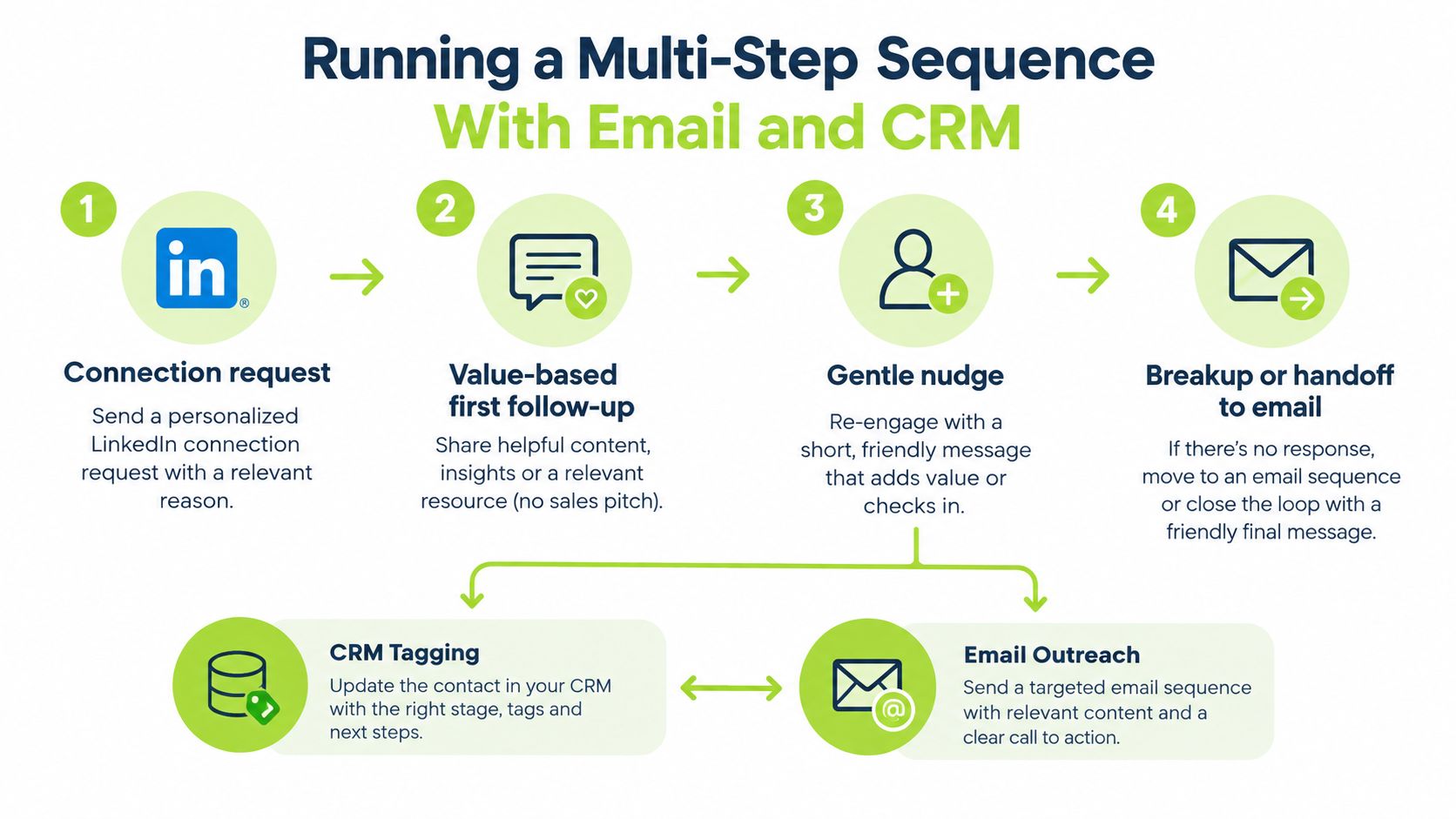
In the hypothetical campaign, the revised LinkedIn flow would proceed as follows:
- Request: Open the relationship without assuming the vacancy represents a buying project.
- First message: Ask what the role is intended to change.
- Useful nudge: Offer relevant material or a concrete observation, but only if there is something worth adding.
- Close or continue: End silent threads politely; move substantive replies into a human-led conversation.
- Handoff: Record the problem, evidence, agreed action and owner before introducing email or booking a call.
Thoughtful comments and profile research can sit between messages when relevant. They shouldn't become a checklist of manufactured interactions.
Automate administration, not unauthorised LinkedIn activity
LinkedIn prohibits third-party software, browser extensions, bots, crawlers and scripts that scrape member data or automate platform activity, including adding contacts and sending or redirecting messages, according to LinkedIn's prohibited-software policy. Staying below an assumed volume threshold doesn't remove that method-based risk.
Keep LinkedIn actions manual or within authorised functionality. A CRM can manage ownership, reminders, suppression records and reporting without an external tool operating the sender's account.
For the email branch, CleanMyList's sales outreach guide for 2026 offers a separate planning reference. Establish the contact-data provenance and applicable requirements before launching email activity.
Route positive replies to a responsible person with the original message context. Suppress explicit declines across the relevant workflows, pause restricted accounts and carry objections back into account research. Otherwise, the team merely repeats the same targeting error through another channel.
Diagnosing and Improving Sequence Performance
Healthy acceptance with stalled replies doesn't automatically mean the invitation needs rewriting. It suggests that the operator should inspect what happens after acceptance, while checking whether the people accepting are commercially suitable.
Use cohort reporting, which groups prospects by when and how they entered a campaign. Compare groups with comparable maturation periods, and segment them by persona, market, seniority, trigger, sender profile and message version.
Match the intervention to the stalled stage
| Observed pattern | First investigation |
|---|---|
| Weak acceptance | Account fit, contact selection and profile credibility |
| Acceptance without substantive replies | Trigger relevance, opening question and premature meeting request |
| Replies dominated by polite declines | Whether the problem applies to the selected persona |
| Qualified replies without bookings | Meeting purpose, ownership and handoff execution |
| Meetings without opportunities | Qualification criteria and alignment with the actual offer |
These are diagnostic hypotheses, not automatic verdicts. Read the actual replies before deciding which explanation fits.
In the hypothetical platform-engineering campaign, the first test should challenge the assumption connecting recruitment to external support. Changing the sender's banner or increasing invitations wouldn't address that mismatch.
Test a specific hypothesis
Prioritise changes in this order:
- Trigger: Replace weak evidence with a circumstance more closely connected to the offer.
- Persona: Check whether the contact owns or influences the problem.
- Opening line: State the observable detail without overstating its meaning.
- Call to action: Ask for relevant context before requesting time.
Keep a fixed comparison segment and change a variable deliberately. Log the hypothesis, message version and outcome so an audience change isn't mistaken for a copy improvement.
Operating discipline: Improve the stage that is failing, while protecting the relevance and compliance of the whole process.
Teams capable of running the programme internally can use this approach as an operating checklist. Those with fragmented research, routing and reporting may need a custom GTM system build; those lacking campaign capacity may need fully managed outbound.
H2 offers fully managed outbound and custom GTM systems covering audience research, prospect qualification, messaging, reply handling and sales handoffs. Visit H2 to discuss the current bottleneck, whether that's selecting better LinkedIn accounts, coordinating email and CRM workflows or generating more qualified sales conversations.
