Go to market engineering designs how a company finds, qualifies, contacts, and hands over buyers as a documented, repeatable system. B2B buyers used an average of seven information sources in a recent purchase, and 45% used generative AI, according to a 2026 Gartner survey. A useful sales conversation may begin after that research is already done.
Two reps contact the same logistics firm. One relies on a job advert from March; the other copies a CRM note from last year. Neither can explain why the account merits contact this week, and the founder learns about the overlap only after both receive a confused reply.
The CRM stores names, but the decision to contact them still sits in one person's head. That gap is a data-governance problem as much as a sales problem: teams need clear rules for which information is reliable and how it guides action. A sensible first build is often a narrow routing or data-quality system, not an autonomous prospecting agent. This guide moves from the definition to roles, timing, and a system you can test.
What Go to Market Engineering Means and Why It Matters
A sales team without go to market engineering resembles a kitchen where every cook works from memory. The method changes with the shift. GTM engineering writes the recipes down, measures what comes out, and changes the method when quality drops.
The lineage is ordinary commercial software, not a new job title. CRM systems moved customer details out of personal spreadsheets into shared records. GTM engineering extends that record. It connects external company data, buying signals, qualification rules, messaging and sales feedback so a handover can be checked by someone who wasn't in the original conversation.
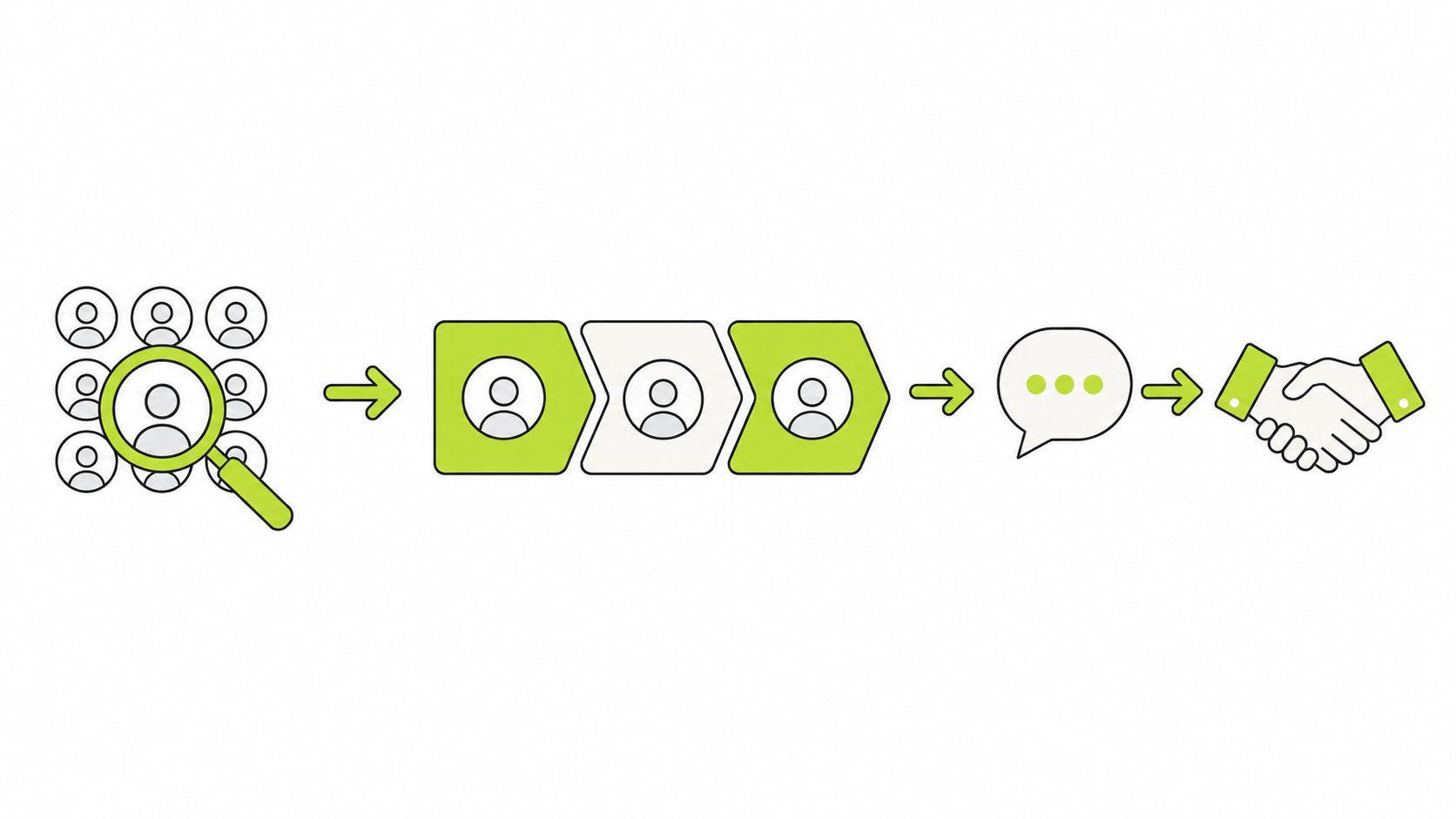
Why the buyer's own research changes the job
A 2026 Gartner survey reported that B2B buyers used an average of seven information sources during a recent purchase, while 45% used generative AI, primarily to research vendors and products. The same findings indicate that 69% of buyers turned to sales representatives to validate AI-generated insights. Those figures describe buyers' reported recent purchase, not every market.
Automation doesn't remove the sales role. It moves the valuable moment. Reps are asked to confirm, correct or deepen something the buyer has already read. A team that only increases send volume misses that moment. A team that can explain why an account was chosen, and what the buyer is likely to have seen, can use it.
Practical rule: If qualification depends on one person's memory, the process needs engineering.
What it is not
GTM engineering isn't one tool, and it isn't a licence to send more email. Clay, a CRM, or an AI writer can sit inside the system. None of them is the system. The test is simple. Can another person follow the written rule, see the evidence, and get the same include-or-exclude decision? If the answer is no, you have habits, not an engineered motion.
Who Does GTM Engineering and How It Differs From RevOps
Three functions get mixed up because they all touch the CRM. They answer different questions.
| Function | Core question | Typical owner | Typical output |
|---|---|---|---|
| Sales operations | Are reps working efficiently with the tools they have? | Sales operations manager | CRM administration, pipeline reports, process documentation |
| RevOps | Do marketing, sales and customer data agree across the revenue process? | RevOps lead | Shared definitions, attribution, forecasting, data governance |
| GTM engineering | Can prospect selection, qualification and routing run as tested, repeatable systems? | GTM engineer, often with RevOps and sales | Data models, enrichment and qualification workflows, automation, runbooks |
Who holds each job
Sales operations keeps reps moving inside the tools they already have. The owner is usually a sales operations manager. The work is administration, reporting and written process, not a new way of choosing accounts.
RevOps asks whether marketing, sales and customer data tell the same story. A RevOps lead owns shared definitions, attribution, forecasting and data governance. Without that agreement, a "qualified account" means one thing in a campaign and another thing in the forecast.
GTM engineering asks whether selection, qualification and routing can run as tested systems. The owner is often titled a GTM engineer and works with RevOps and sales leaders. In a smaller firm one person may cover all three jobs. In a larger firm the engineer builds workflows beside the people who govern definitions and manage rep time.
A 2024 Openprise State of RevOps Survey, run with MarketingOps.com and the RevOps Co-op, found that 35% of organisations had a formal revenue operations department, while 32.5% still operated with siloed teams and no dedicated RevOps function. GTM engineering often starts as gap-filling in that second group, then becomes a distinct build role once definitions exist.
Skills that actually matter
Commercial judgement comes first. The person must say who is in the market and why a signal is weak or strong. Data modelling follows, so an account and a contact have stable keys. Basic workflow and API integration matter more than a long tool list. The same person should evaluate AI output, spot when a message doesn't follow the evidence, and run a disciplined test. Copywriting skill here means checking logic, not producing a brand voice.
When a Business Needs GTM Engineering
Company size is a poor trigger. A 12-person team with a weekly routing mess needs a system sooner than a larger team whose pipeline already runs on written rules. Watch for these signs.
- One memory holds qualification. If that person leaves, new pipeline stops, because nobody else can repeat the include-or-exclude decision.
- Two reps contact the same account. Owner assignment is decided by hand, in Slack or in a spreadsheet beside the CRM.
- Lead volume rises and meetings don't. More names are entering, but opportunities stay flat, which usually means the qualification rule is weak.
- Sales and marketing can't share a definition. They argue about which leads to count because "qualified" was never written down.
- AI tools arrive without a decision boundary. Writing or enrichment software is added, and nobody has said what the tool may decide and what a person must decide.
If the team can write the rule down and the problem repeats each week, a system is likely to pay back. If the offer itself is unproven, fix positioning first. Automation only speeds up a weak message.
A business with none of these signs, and a steady pipeline that already converts, may not need a build yet. Name the question the team can't answer today. Match it to sales operations, RevOps or GTM engineering, and staff that gap before buying another sequencer.
Core Components of a GTM System and What Breaks Without Each
Five components carry a GTM system. Miss one and the others produce confident, wrong work.
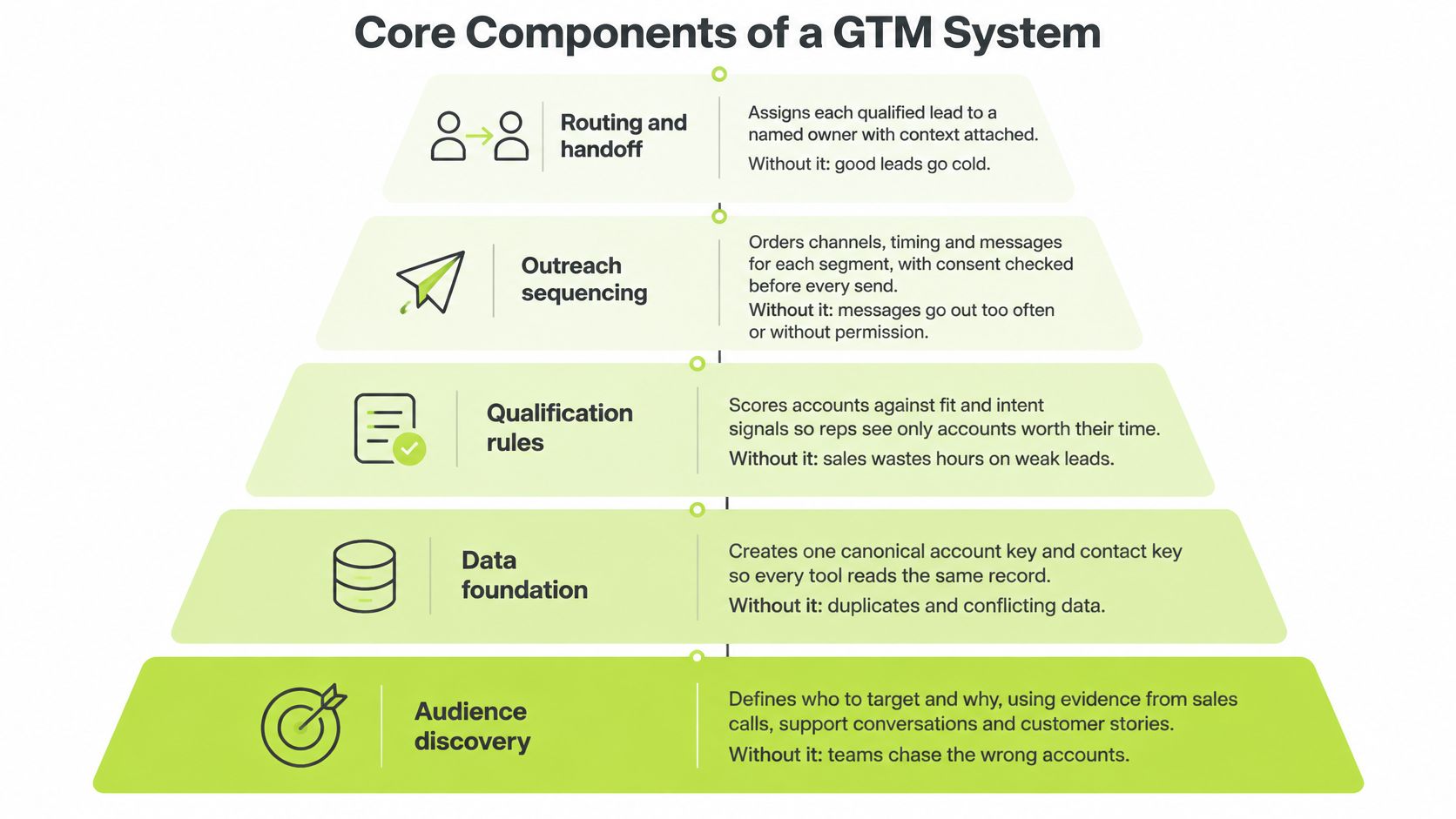
Audience discovery defines who to target and why. Evidence comes from sales calls, support conversations, customer stories and past campaigns. Without it, lists get broad and reps chase logos that never had a reason to buy.
Data pipelines bring in company and contact data, enrich only the fields a decision needs, validate them and refresh them on a schedule. HubSpot's data governance guidance states that approximately 30% of CRM data decays each year as people change jobs, contacts move between organisations and companies reorganise. The same guidance recommends deduplication rules that identify duplicate records at the point of entry.
Keys, conflicts and handoffs
A canonical account key, such as a normalised company domain, and a contact key based on verified email, stop the same firm being created twice. New records are checked against those keys before creation. A job change, a new company association or a failed email check should trigger review, not a silent overwrite.
Say who wins when sources disagree. The CRM owner, a verified data vendor or a manually approved field can't all be right. Write the precedence down. When finance and CRM must describe the same customer, finance controls for ERP–CRM integration are a useful model for ownership at a system boundary. The same idea belongs in CRM workflow automation: a routed record should carry source, timestamp and the reason it moved.
Lead scoring and qualification apply explicit rules and store a reason code for every include, hold or exclude. Without reason codes, a score is a number nobody can challenge.
Automation handles triggers, routing, CRM updates and sequences. Without it, people copy rows between tools and fail states vanish.
Clay and similar AI workflows combine data sources and enrichment steps. Clay is one tool among several. The same logic can run in other stacks. Use AI for bounded interpretation, such as classifying website language or judging whether a job posting is relevant. Don't let a model set the market, the exclusion list or the lawful basis.
The wider connection of these parts is set out in the GTM operating system guide. This article stays with the decisions, not that architecture diagram.
Without refresh logic you get stale records. Without audience rules you get broad lists. Without explainable scores you get arguments. Without automation you get copying. Without a check on AI output you get text nobody can defend.
Worked Example From Account Research to Feedback
This is a hypothetical example, not a client result. A UK software company sells a compliance tool to mid-sized logistics firms. The point is the path from research to feedback, and where each stage can mislead.
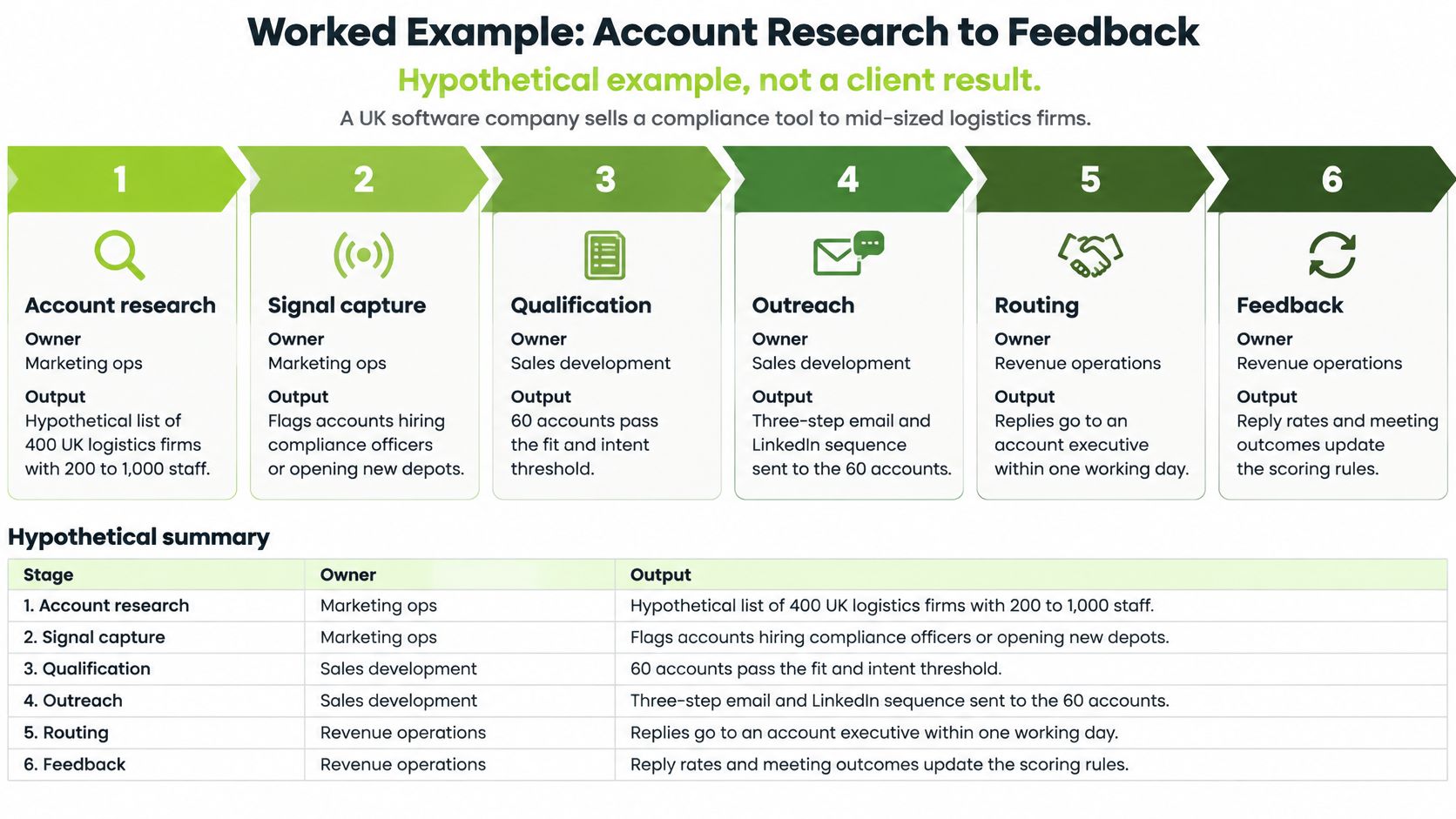
Marketing operations starts from a firmographic list and public pages, which is the same discipline as market mapping. An account enters only with a verified reason. Qualification then demands two independent signals inside a recent window, for example a platform-engineering vacancy and a change away from a competing tool. One signal sends the account to research, not to a sequence.
A person checks legal-entity type and the global suppression list before any send. The message names the verified signal. An AI draft doesn't leave until a person has read it. Routing matches on domain, assigns an owner and stores source, timestamp and reason code. Replies, objections, meetings and disqualification reasons come back and adjust the rules.
Why a person still reads the draft
McKinsey's 2024 B2B research found that 19% of surveyed sales organisations were already implementing generative-AI use cases and a further 23% were experimenting or developing them. Among companies reporting at least 10% market-share growth, adoption reached 57%. That 57% is a survey correlation, not evidence that AI causes growth. It justifies review, not unsupervised sending.
| Stage | Inputs | Decision | Output | Limit |
|---|---|---|---|---|
| Account research | Firmographic list, company website, public job postings | Include only if the account fits the audience rules and has a verified reason | Account record with evidence and source | Public data can be outdated or incomplete |
| Qualification | Two or more signals with dates and sources | Outreach, research only, or suppress | Score with reason code | Two signals do not prove budget or intent |
| Contact and legal check | Contact details, legal-entity type, suppression list | Send, hold or remove | Cleared contact or exclusion reason | Entity type data may be missing for some records |
| Outreach | Verified signal and approved message variant | Human reviews AI draft before sending | Personalised message logged to the record | Message quality still needs human judgement |
| CRM routing | Matched account and contact keys, owner rules | Create or update record, assign owner | Routed record with source and timestamp | Duplicate matches need human review |
| Feedback | Replies, objections, meetings, disqualification reasons | Adjust rules, signal weights or messages | Updated scoring rules and reports | Small samples can mislead; allow time before changing rules |
Where the example stops being evidence
A vacancy shows a capability gap. It doesn't show budget or willingness to buy. A technology change shows relevance, not dissatisfaction with the incumbent. A handful of meetings can't prove a rule. Leave the weights alone until reply quality, accepted meetings and disqualification reasons have had time to accumulate. The first build here is a scored evidence model with a human-review threshold, not an agent that contacts every firm that posted a job.
Design Checklist for Data, Consent and Routing
Use this list before any build. Each line names the business risk it prevents.
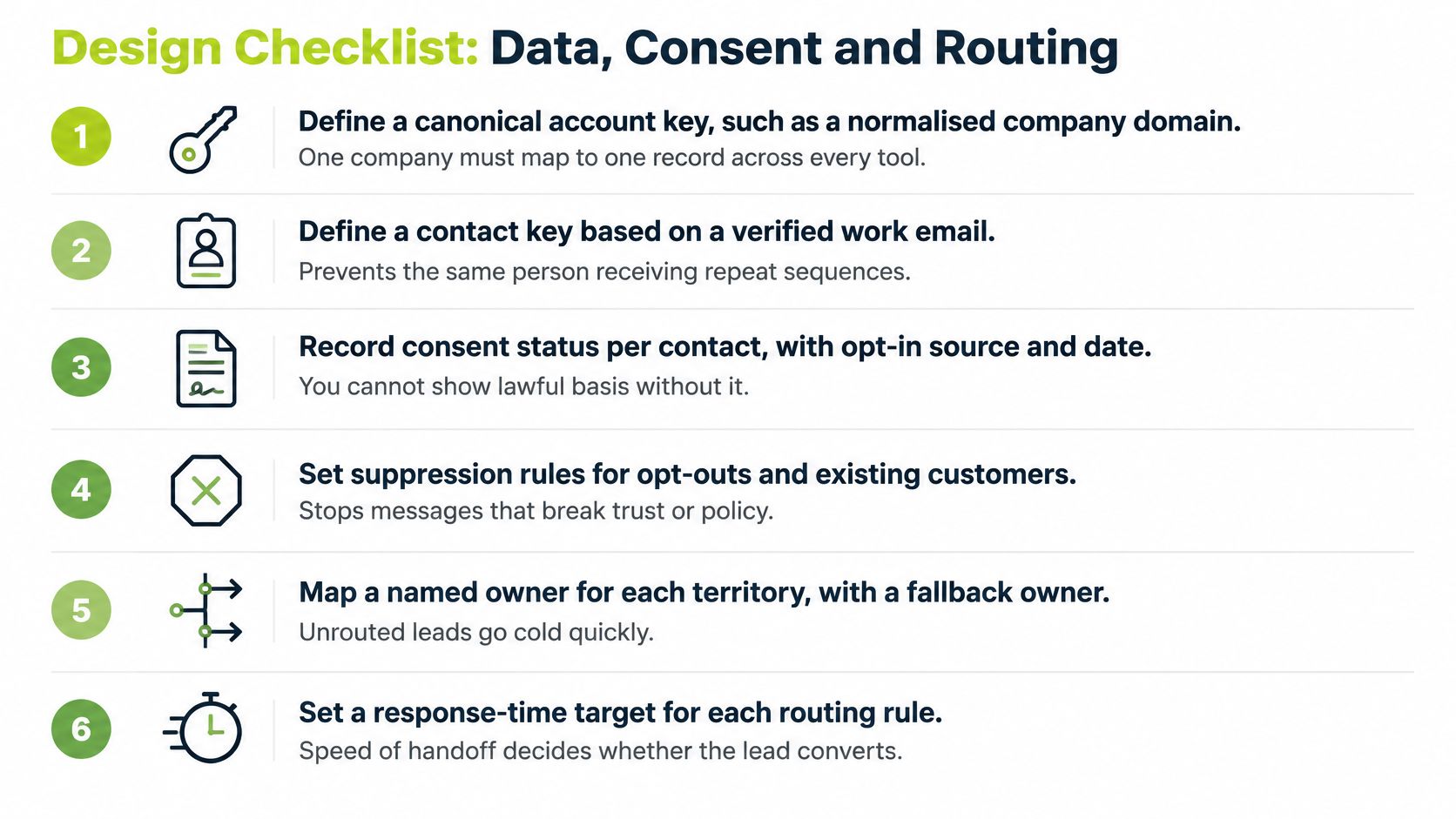
- Define a canonical account key and a contact key. Use a normalised company domain, and verified email or another stable identifier. Records can't be deduplicated without them.
- State which source wins when sources disagree. Otherwise routing changes without warning on the next enrichment run. B2B data enrichment only helps if precedence is written down.
- Write a plain definition for every scoring field. Include source, refresh schedule and confidence level. Scores nobody can explain can't be challenged.
- Add an exception queue and name the owner of each handoff. Failed records otherwise disappear between tools.
- Confirm legal-entity type before contact. Under the ICO's direct marketing guidance on PECR, unsolicited electronic-mail marketing can be sent to corporate subscribers without consent or a soft opt-in, but the sender must not conceal its identity and must provide a valid address for opting out. Sole traders and some partnerships are individual subscribers, so email marketing generally needs specific consent or a valid soft opt-in. A company record alone may not show which case you have.
- Keep the sender identity visible and a valid opt-out address in every message. Concealing identity breaches PECR. For individuals, a soft opt-in also needs a prior purchase or negotiation for a similar product, a clear opt-out when details were collected, and an opt-out in every later message.
- Apply suppression across all campaigns and make unsubscribe handling automatic. The ICO recommends a do-not-email list and screening new lists against it. A suppression flag that lives in one sequencer will miss the next tool. Teams publishing how they handle contact data can start from privacy policy templates for developers so the lawful basis isn't only inside a workflow.
- Set the AI boundary. Deterministic rules decide market definition, exclusions, compliance and CRM routing. AI only interprets unstructured text, such as website copy. A model shouldn't decide eligibility.
- Record a reason code for every inclusion and exclusion. Later feedback has nothing to attach to if the reason was never stored.
- Start with a narrow data-quality or routing system. It proves the rules before a larger autonomous agent is added. Errors in a small system are cheaper to find.
A workflow that tags a limited company correctly and a sole trader incorrectly is a compliance failure, not a data quirk.
How to Test a GTM System Before and After Launch
A clean sample file will pass tests that real CRM exports fail. Test the awkward records on purpose.
- Run real records, including awkward cases. Include duplicates, former employees and missing domains. A perfect sample hides the failures you will meet in week one.
- Check each handoff against its validation rules. Confirm that failed records land in the exception queue with an owner, not in a forgotten folder.
- Run shadow mode beside the manual process. Compare who would have been contacted, who was held, and which owner would have received the record.
- Check sending infrastructure before volume rises. Google's email sender guidelines say that from February 2024 a sender delivering around 5,000 or more messages to personal Gmail accounts within 24 hours is treated as a bulk sender. Bulk senders must authenticate with SPF, DKIM and DMARC, and the domain in the From address must align with the SPF or DKIM domain. Marketing and subscribed messages must support one-click unsubscribe and a clearly visible unsubscribe link. DMARC need not be stronger than "none", but the domain must publish a DMARC record and the message must pass SPF or DKIM. That 5,000-message threshold applies to personal Gmail accounts, not to every provider.
- Launch a controlled batch and watch the metrics below. Set the team's own thresholds before the batch, then read the table against them.
- Hand over a runbook. Include access, named owners, a short training session and a review schedule for refreshes. A system without an owner returns to individual habit within a month.
Record sending-domain ownership, authentication status, complaint signals and opt-out events. Automated suppression should stop any future send to someone who has unsubscribed.
| Metric | What it shows | When to check |
|---|---|---|
| Processing time per qualified account | Speed of research and qualification | Shadow run and each release |
| Valid-record rate | Share of records passing validation | Every batch |
| Duplicate rate | Whether matching keys work | Every batch and weekly |
| Manual intervention rate | How much human rework the system still needs | Weekly |
| Routing latency | Time from qualification to CRM ownership | Launch and after changes |
| Meeting and opportunity conversion | Whether qualified accounts become commercial outcomes | Monthly, after enough volume |
Check the table before launch and again after each change. A rising duplicate rate means the keys are wrong. A high manual intervention rate means the rules aren't finished. Conversion is the commercial test, and it needs enough volume before anyone rewrites the model.
Choose Between a Managed Service, a Custom Build or a Workshop
Choose the starting point by identifying what is breaking or what the team can realistically own. If the rules for handling data and routing are unclear, define them before commissioning a build. A narrow, well-defined system is usually easier to test than an ambitious automated prospecting workflow.
| Situation | Best starting point | Why it fits |
|---|---|---|
| Proven offer, capacity for sales conversations, no time to run outbound | Fully Managed Outbound | Covers research, lists, sending, replies and meeting booking |
| Routing, data or CRM handoffs break repeatedly | Custom GTM System Build | Fixes a specific bottleneck with documented rules |
| Team must run Clay or AI workflows itself | Private GTM Workshop | Trains the team on its own market, tools and data |
| Rules cannot yet be written down | Run the design checklist above first | Defines data, consent and routing rules before any build is scoped |
Fully Managed Outbound suits a B2B team with a proven offer, capacity to take sales conversations and little time or appetite to manage outbound internally. The service covers research, audience definition, list building, enrichment, verification, sending infrastructure, campaign work, reply handling and meeting booking. The client provides commercial context and feedback, then focuses on progressing conversations.
A Custom GTM System Build fits a repeated problem in routing, data quality or CRM handoffs. Start by defining the outcome, inputs, decision rules, integrations and owner. The problem should recur, and its rules should be clear enough to test. If they are not, use the design checklist first to clarify what data the system may use, how records should be routed and who owns exceptions.
A Private GTM Workshop fits a team that wants to run Clay or AI workflows itself. The session uses the team's market, tools and data, so participants can practise on relevant commercial questions rather than a generic example.
For another perspective on choosing between an agency and software, including for French-language buyers, see Trefle sur les choix de prospection. Compare the service that matches your needs with its current scope and the pricing page before committing.
The practical choice is about ownership as much as tools. Choose managed outbound when you need qualified conversations and want support running campaigns. Choose a custom build for a repeatable operational bottleneck, or a workshop when your team will operate the workflows. Start with the narrowest problem you can define, then test whether the system improves it.
