The most popular appointment-setting advice often treats a full calendar as proof of progress. It isn't. A meeting only has commercial value when the account fits, the prospect has a relevant problem, the timing makes sense and sales receives enough context to act.
A dependable appointment setting process connects targeting, outreach, qualification, scheduling and CRM ownership. It measures booked meetings as an intermediate outcome, not the finish line.
Design the Appointment Setting Process
A workable process connects six jobs: define fit, identify the account and contact, run relevant outreach, handle the response, qualify and book, then confirm and hand over. Each job needs an owner, written rules and a record of what happened. When marketing defines the audience, a setter contacts it and sales rejects the meetings, the setter is rarely the root cause. The teams usually never agreed what qualified in the first place.
That alignment matters because buying decisions rarely sit with one person. Demandbase's 2025 B2B Buyer Report found that 72% of purchases involve complex buying groups, while 77% of buyers prioritise integration capability over standalone features (Demandbase's 2025 B2B Buyer Report). A meeting with one enthusiastic contact can still lack the technical, operational or budgetary context sales needs to act on it.
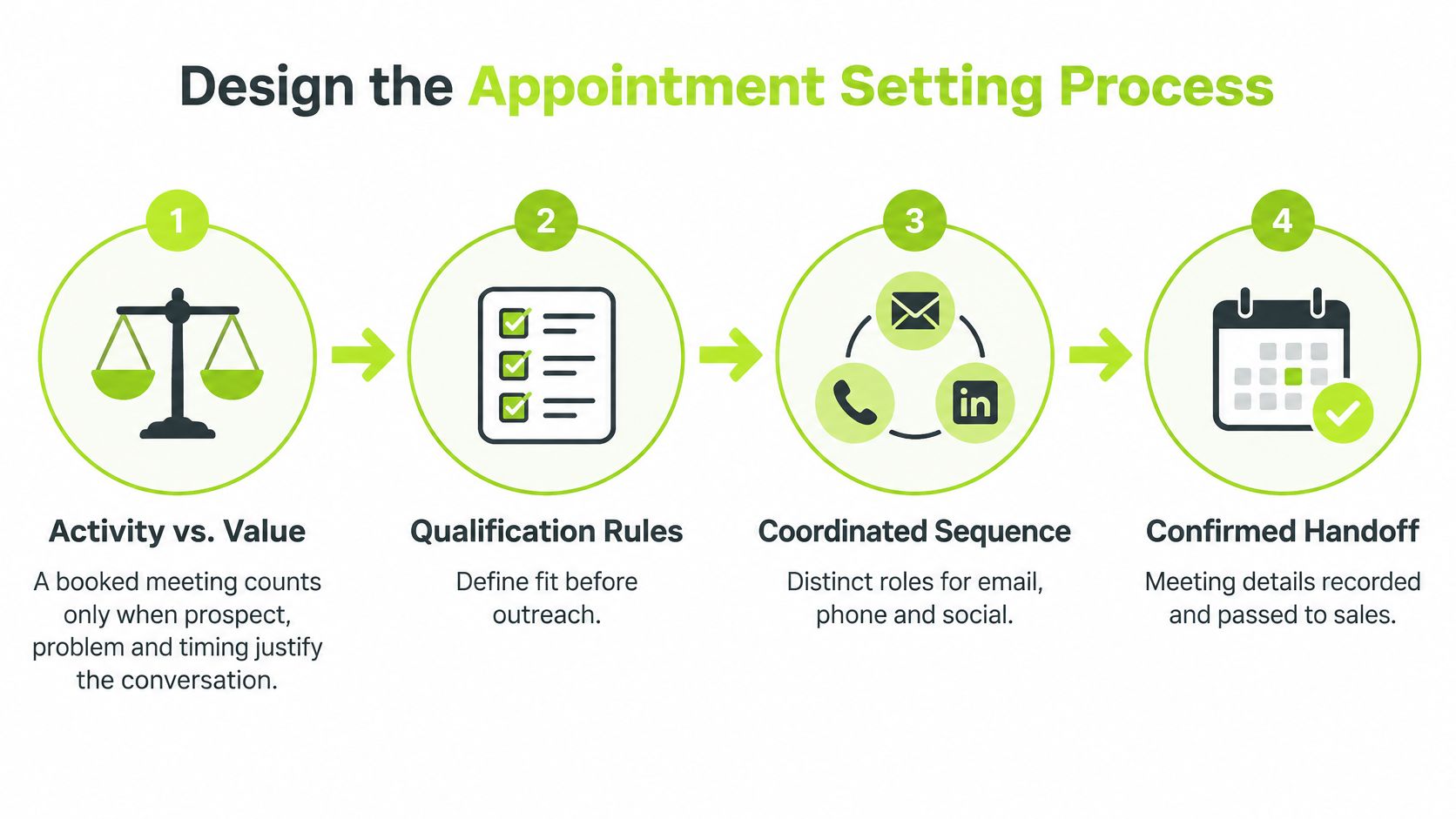
Decide what the process must produce
Before choosing software, sales, marketing and RevOps should agree on:
- Who qualifies: The account characteristics and buyer roles that make outreach relevant.
- What counts as evidence: The problem, trigger or business context that justifies contacting the prospect.
- What a qualified meeting requires: The minimum information sales needs before accepting a booking.
- Who owns each handoff: The person or team responsible for the next action, including when a reply arrives or a meeting is rescheduled.
- Which outcomes stay distinct: Contact, positive reply, booked meeting, held meeting, qualified conversation and opportunity.
Keep these outcomes separate in reporting. Otherwise, a high booking count can conceal poor attendance or weak sales acceptance. The team might then increase outreach volume when the actual issue is an unclear qualification rule or a handoff that loses context.
The response job deserves the same rigour. For inbound enquiries, decide who responds and how quickly before the campaign or form goes live, because slow first responses measurably reduce qualification rates. Calendar access and routing rules should already exist when a prospect replies, not be assembled afterwards.
Teams coordinating scheduled follow-up across agents can look at schedule agents with ContextFlow as one option when assessing how that work should be organised.
Set Qualification Rules Before Outreach
Weak qualification rarely shows up as a missing meeting. It shows up as a held meeting that sales refuses to accept, and by then the outreach budget is spent. Booked meetings are an intermediate outcome in this process. The rules below are what stop them becoming empty ones.
Build the ideal customer profile from evidence: sales calls, support conversations, customer stories, past campaigns and failed attempts. A loose list of industries and job titles is not an ICP. Ask what the successful buyers had in common, which problem brought them to the conversation and which conditions made the offer unsuitable elsewhere.
Write the rules down before researchers or setters build a list. Separate mandatory conditions from useful context. A mandatory condition is a reason to stop if it is missing. Useful context shapes the message or sets priority; it proves nothing about readiness to buy.
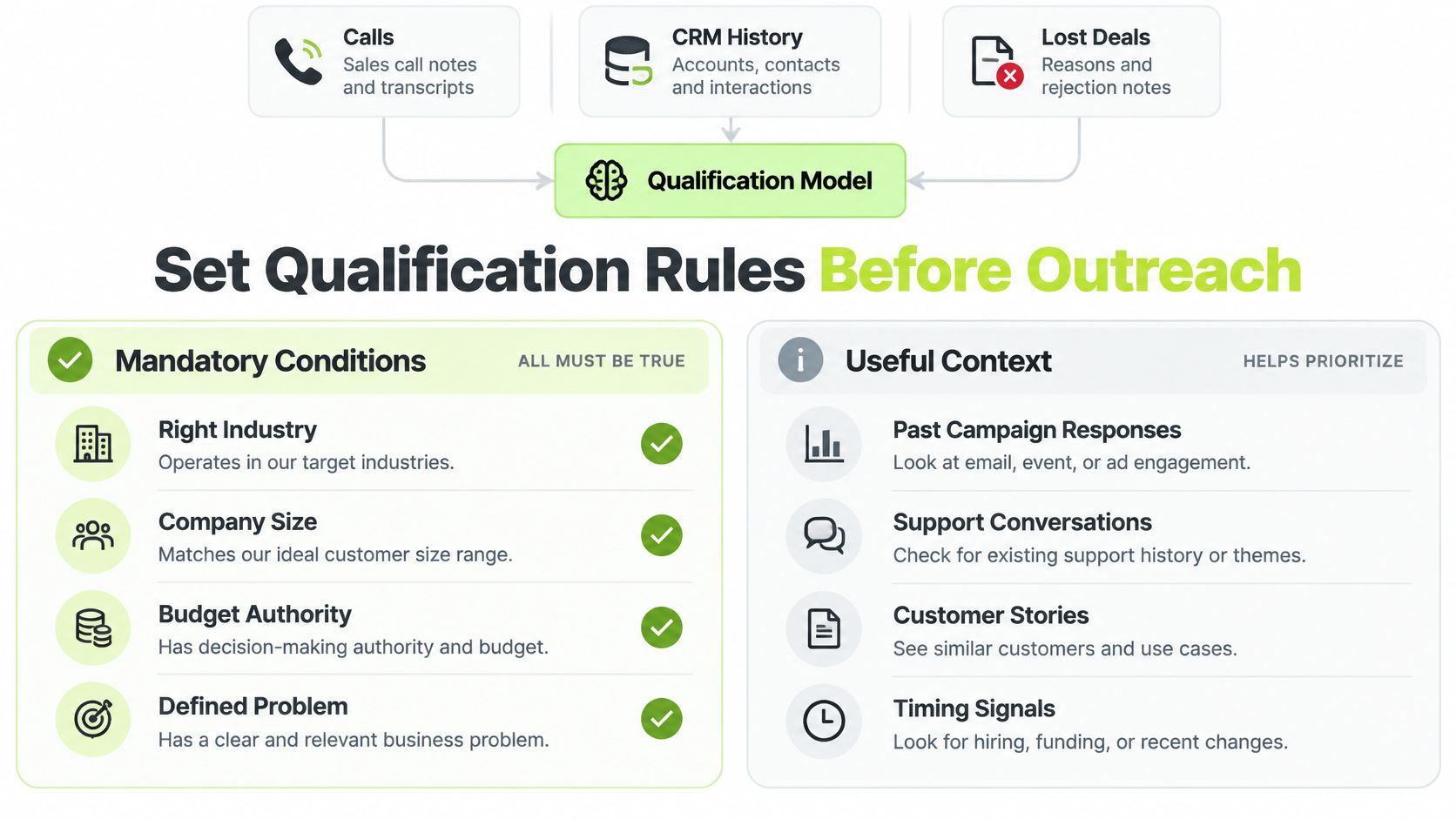
Every account should then answer four questions. Treat them as a chain, because a strong answer to one never excuses a blank answer to another:
| Question | What it checks |
|---|---|
| Account fit | Relevant market, geography, scale and operating needs compatible with the offer |
| Contact influence | Relevant expertise or access to the buying process; the route to a decision must be credible |
| Problem evidence | A specific issue the offer can address, backed by more than a generic assumption |
| Reason to act | A timing cue or business trigger that makes a conversation relevant now |
Technology choices and job vacancies can direct research without proving intent. A database services company might spot that a prospect is hiring database engineers or runs a relevant platform. Those clues justify a closer look at the operating context. They do not establish a support gap, a live project or any reason to change supplier.
Practical rule: Treat a signal as a prompt to investigate, not as permission to claim a buyer has a problem.
Give researchers, setters and salespeople one shared acceptance checklist recording account fit, contact role, the evidence behind the business hypothesis, reason for outreach, known stakeholders and disqualifying information. If an item is unknown, the record says so. Guessing turns the checklist into decoration.
The same checklist applies to inbound replies, including interest that arrives outside campaign hours. A warm response still gets checked for fit and role before anyone books a slot, because enthusiasm is not evidence. For a fuller treatment of the qualification stage, H2's guide to how to qualify a lead covers the evidence checks in detail.
Sequence Relevant B2B Outreach
A UK software consultancy wants meetings with operations leaders at firms that may need help modernising an internal platform. Before anything is sent, the team confirms the account is in scope, verifies the contact's role and records one specific business reason to talk. The sequence earns its budget only after that groundwork exists.
Each channel then gets a different job. Email carries the commercial hypothesis and asks whether a named operational problem sits on the prospect's agenda. A call tests whether that hypothesis lands and gives the person a quick route to say yes, no or later. Social activity supports account research and helps establish a credible professional connection, though it should never become an excuse for repeated, generic connection requests. Any touch that adds no information and asks no sharper question gets cut.
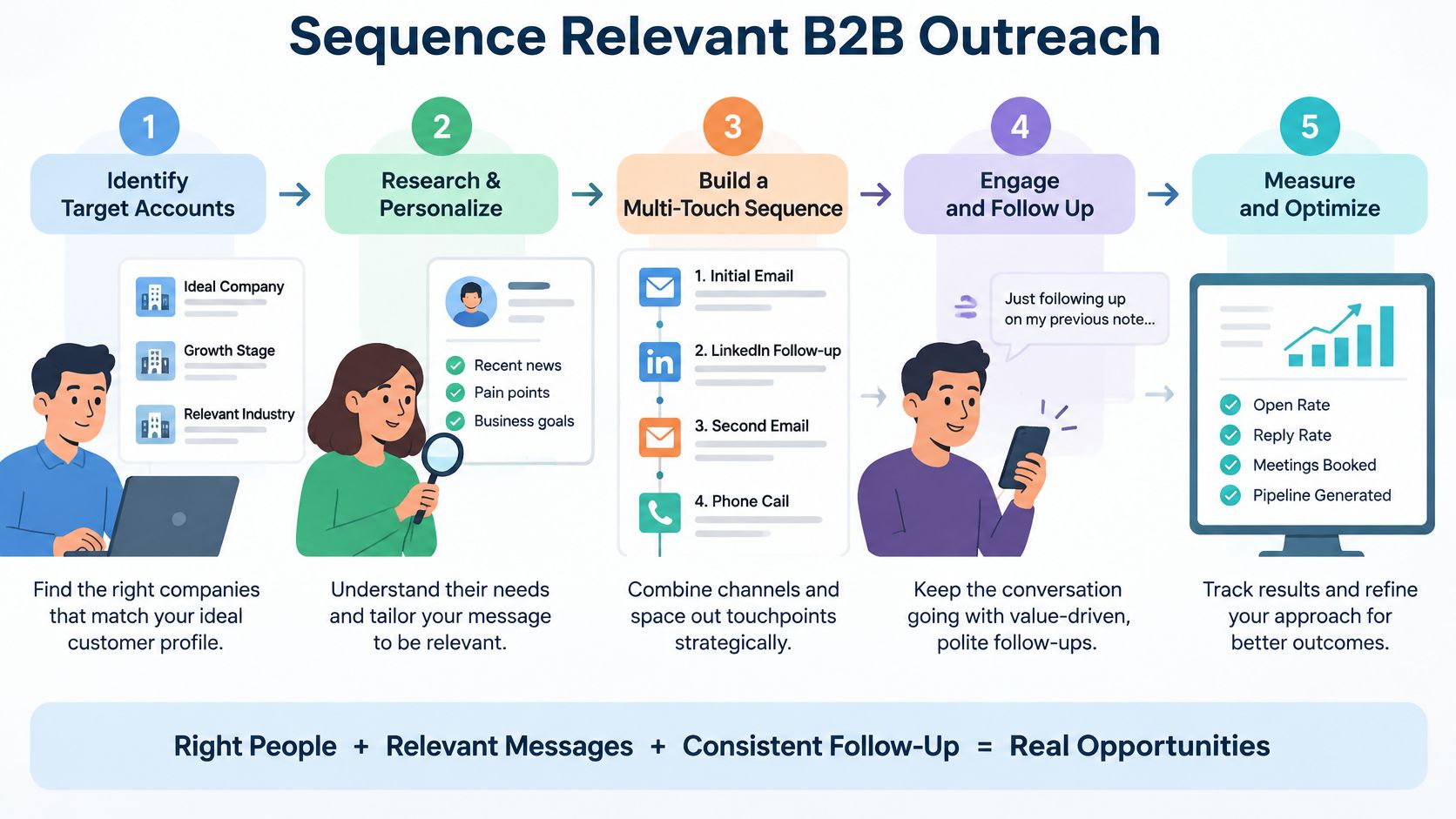
Plan backwards from the meeting, and plan the exit too
For this consultancy, a sensible order is an opening email that states the context and asks one question; a follow-up that contributes a new observation or clarifies the likely outcome; a permission-based call that references the email's subject and accepts a request to continue in writing or stop; and a final message that pauses contact unless the prospect wants to talk, with a clear opt-out. A follow-up that resends the first pitch with “just following up” added is a wasted touch.
The sequence stops the moment someone refuses, opts out or asks not to be contacted, and any reply pauses automated follow-ups until a person has classified it. In the UK, cold-email workflows need controls for recipient type, lawful basis, sender identity, contact details and opt-outs. Guidance summarising the Information Commissioner's Office position indicates legitimate interest may support some business-to-business direct marketing, but teams must assess the lawful basis, make opting out straightforward and stop marketing when someone objects. Rules differ for corporate subscribers and for individuals, including sole traders, so check the recipient's status before sending (UK cold-email compliance guidance).
Volume targets are the wrong way to steer this.
Plan activity backwards from the meeting objective and measure replies, qualified conversations and meetings handed to sales at each step. A booked slot is an intermediate outcome that only counts if it survives qualification and reaches the right owner in the CRM. For calibration, one reference estimates about one meeting per 40 cold-call dials, while another cited result puts appointments at approximately 1.5% of cold calls; the denominators and qualification standards differ, so neither figure is a guarantee (cold-call appointment-setting reference).
Teams weighing scheduled automation can compare their approach against the overview of an outbound sales agent on a schedule. To define how touches progress across channels and when they stop, use a guide to building a sales cadence.
Handle Replies and Book Qualified Meetings
Say a software company is contacting operations teams about a workflow product. A prospect replies: "That could be relevant. What would the call cover?" The easy move is to send a calendar link. The better move is to qualify first: explain what the call would achieve, check whether the prospect owns or influences the workflow, and ask who else should be in the room. If the need is credible, frame the meeting as a working discussion about their current process, with an agreed outcome.
Replies sort into a small set of types, and each earns a different action.
Interested replies get a short exchange that confirms the business issue and that a meeting is a sensible next step. Referral requests get a thank-you plus a question about who owns the relevant area, because the named colleague has agreed to nothing yet. Supplier questions get an accurate answer or a handoff to a subject expert. Guessing to keep momentum alive creates problems the salesperson inherits later. Timing objections get one question about whether a later follow-up would help, then the requested date goes in the CRM and the active sequence stops.
Relevance objections deserve one concise question about business context. If there is no fit, close politely. A clear refusal gets an acknowledgement and an end to contact. Do not route refusals into another automated sequence.
Two scripts cover most situations. For a positive reply: "Thanks for the reply. The proposed conversation would focus on how your team handles [specific workflow] and whether there is a practical case for reviewing it. Would you be the right person to discuss that, or should someone else join?" For a timing objection: "Understood. Would a follow-up at a later point be useful, or would you prefer no further contact? Either is fine."
When a prospect raises a complex technical, commercial or contractual issue, hand the thread to a salesperson or specialist. Setters qualify and book. Improvising on pricing or contract terms creates promises the sales team then has to unwind.
Appointment-setting benchmarks place cold-outreach conversion at approximately 1–3% and meeting show rates at about 65–80% (HubSpot's appointment-setting guidance). Those ranges show why a booked slot proves little on its own: plenty of meetings never happen, and plenty that do were never qualified. Count a reply as progress only when it produces a qualified conversation with the right participants and an agreed purpose. Teams exploring AI-enabled lead workflows should hold automated reply handling to the same standard. Automation can support the process, but an unclear or negative response should never become an unwanted booking.
Choose the Right Level of Automation
More automation doesn't automatically mean better appointments. Manual work gives a team close control, but can create bottlenecks and inconsistent records. Automation can handle repetitive administration, but poor data or weak rules can spread mistakes quickly. A hybrid model is often the practical choice: automate repeatable work, while keeping commercial judgement with people.
Microsoft's 2025 survey of 45 businesses found that 33 respondents were comfortable with AI agents conducting outreach and five were neutral. The research also emphasised trust, transparency, consent, privacy assurances and data security (Microsoft's research on AI-powered outreach). The survey is a useful signal about stated comfort, not a reason to remove human review from sensitive decisions.
| Operating model | Best suited to | Human control | Main trade-off |
|---|---|---|---|
| Manual | Small, high-value programmes where records need close review | High across research, messaging and replies | More staff time spent on repetitive work and record updates |
| Automated | Stable workflows with reliable data and explicit rules | Lower for routine execution, dependent on review safeguards | Errors in data or rules can repeat at scale |
| Hybrid | Teams that want administrative efficiency without handing over judgement | People set rules, review sensitive decisions and handle exceptions | Needs clear boundaries, quality checks and ownership |
Keep judgement where it matters
Teams should retain human review for defining the ICP, deciding whether a signal is meaningful, checking claims in drafted messages, interpreting buying intent, handling objections and stopping contact. Tools, including AI and platforms such as Clay, may assist with routine research or administration where they fit the workflow. The team still needs to verify the records and explain why an account or contact was selected.
Choose the model against the operating conditions. If contact data is unreliable, improve verification before adding automation. If setters spend too much time copying approved information between systems, automating that task may be sensible. If a decision changes who should be contacted or what claim is made to a prospect, preserve an explicit review path.
A hybrid system should also have a fallback. When the data is incomplete, a response is ambiguous or a rule returns conflicting results, the process should send the record to a person rather than force a decision. That makes the system easier to audit and gives RevOps evidence to improve the rules.
Confirm Meetings and Complete the CRM Handoff
A calendar invite preserves the time, not the business context. After booking, send a concise confirmation that names the agreed issue, participants, agenda and any preparation. Keep the summary faithful to the conversation. A prospect who agreed to discuss an operational constraint hasn't necessarily agreed to a product demonstration.
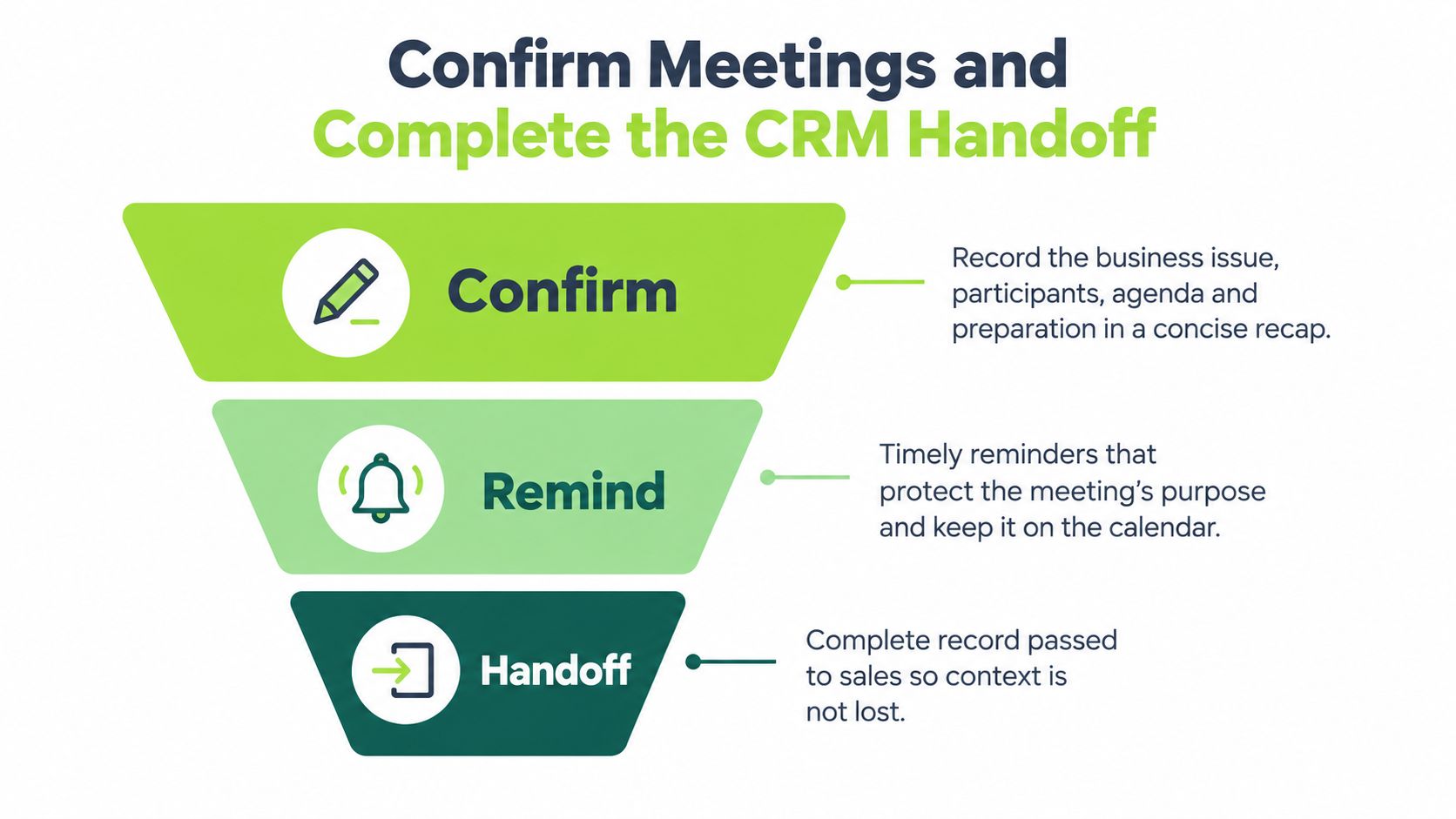
Protect the meeting's purpose
Send a reminder that repeats the meeting's purpose and makes it easy to reschedule. A reminder shouldn't introduce a new pitch or demand unnecessary preparation. If the prospect can't attend, offer a straightforward way to choose another time or decline.
The CRM handoff should give sales enough information to prepare without making the record cumbersome. Capture:
- Pain: The problem the prospect described, in their terms where possible.
- Current approach: How the team handles the issue now, if known.
- Urgency: The reason for discussing it at this point.
- Stakeholders: Who is involved, who influences the process and who may need to attend.
- Qualification evidence: Which agreed criteria the prospect meets, and what remains unknown.
- Next step: The meeting's purpose, participants and any action already agreed.
Set ownership and status definitions so marketing, sales and RevOps read the record the same way. For example, a booking can remain “booked” until it takes place. Sales can then record whether it was held, qualified and accepted as an opportunity. Each stage needs a named owner and a defined action if the meeting is cancelled, missed or rejected.
RAIN Group's benchmark surveyed 488 buyers and 489 sellers across 25 industries. It reported that top-performing prospectors generated 52 meetings, conversations or demos per 100 buyers targeted, compared with 19 for other sellers (RAIN Group's sales prospecting research). Treat the finding as a cross-market benchmark, not a guaranteed target for an individual campaign.
Measure contact rate, positive-reply rate, booked-meeting rate, show rate, qualified-meeting rate and opportunity conversion separately. If meetings book but don't happen, examine confirmation, perceived value and timing. If held meetings don't qualify, revisit targeting and the qualification gate. Teams improving CRM workflow automation should preserve these distinctions in the record and the reporting.
Improve the Process With Evidence and Ownership
Start with the decision rules, not the campaign. Document the ICP, qualification gate, contact conditions and handoff fields. Test those rules on real records, assign an owner to each process stage, then launch a controlled sequence. Review outcomes by segment, trigger, persona, message and touch count so that a change responds to evidence rather than one disappointing result.
A short troubleshooting check can reveal where to act:
- Few positive replies: Recheck account fit, contact selection and whether the message describes a relevant business problem.
- Weak qualification: Tighten the acceptance rules and ask whether outreach relies on assumptions rather than evidence.
- Missed meetings: Review the booking's stated purpose, confirmation and rescheduling route.
- Incomplete CRM records: Clarify the required fields, owner and point at which each field must be completed.
Use objections and sales feedback to adjust the audience, message or timing. Don't respond to weak conversion by increasing volume until the team knows which stage is failing. A smaller number of well-qualified conversations can protect sales capacity and give the pipeline more useful opportunities.
For teams that need implementation support, fully managed outbound covers research, campaign execution, reply handling and meeting booking. A custom GTM system build can address specific research, qualification, routing or CRM bottlenecks, while private GTM workshops provide practical guidance for teams developing their own process.
H2 provides fully managed outbound, custom GTM system builds and private GTM workshops for B2B teams improving how they find, qualify and engage suitable buyers. Visit H2 to discuss an appointment-setting process that gives sales clearer context and more useful conversations.
